Human-Agent Teams: Building Culture When AI Works Alongside People
Turn this article into takeaways for your work.


Each assistant summarizes the article only for you and suggests best practices for your work.
Updated August 2026
A human-agent team is a working unit of people and AI agents that share real tasks, where the agent doesn't just answer questions or draft suggestions but actually plans and executes a piece of the work, then hands back a result a person evaluates rather than produces from scratch. That single shift, from tool you operate to teammate whose output you supervise, is what makes the culture questions in this article genuinely new.
Most companies already know how to write policy for software. Fewer know how to write culture for a teammate that never sleeps and has no track record to build trust on the way a new hire does. This article covers what actually makes a team "human-agent" instead of merely AI-assisted, the cultural questions that follow, the shift from doing the work to orchestrating it, the norms that make the mix work, and the honest limits of how far any of this has actually gotten.
What Makes a Team "Human-Agent," Not Just "AI-Assisted"
Plenty of teams use AI without being a human-agent team in any meaningful sense. Someone asking a chatbot to rephrase an email, summarize a document, or brainstorm three headline options is using a tool, the same category a spreadsheet or a search engine sits in. The person still does the work; the software just makes one step faster.
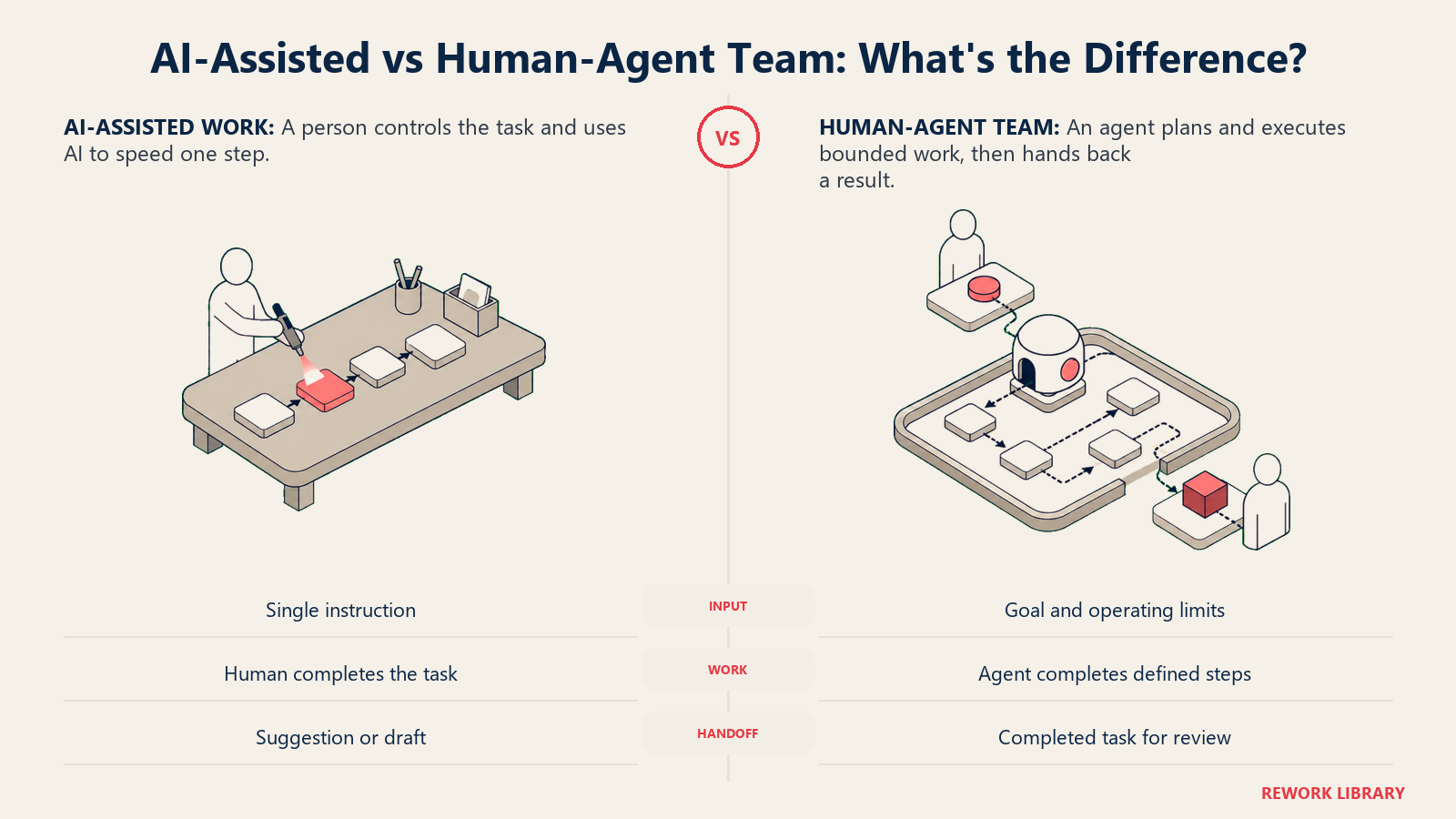
A human-agent team crosses a different line. An AI agent is given a goal, not a single instruction, and it plans a sequence of steps, pulls data from real systems, makes bounded decisions along the way, and only escalates when something falls outside what it's allowed to decide alone. That's the definition of agentic AI: software that perceives a situation, reasons about it, and acts, rather than waiting for the next prompt. Once an agent is doing that inside a workflow that also involves people (a person setting the goal, checking the output, or picking up where the agent stopped) you have a human-agent team, whether or not anyone on the org chart has called it that yet.
The practical test is simple: if you removed the AI from the workflow tomorrow, would a person pick up a completed task, or an empty one? Tool-assisted work leaves an empty task, the person was always going to do it. Human-agent team work leaves a completed task with nobody, which is the situation a growing share of managers are quietly walking into without a plan for it.
How This Differs From Using AI as a Tool: Agents Act, Tools Wait
The distinction matters because it changes what culture has to govern. A tool waits for input and does exactly what it's told; nobody has ever needed a trust policy for a calculator. An agent acts inside boundaries a person set earlier and then isn't in the room for, which means the boundaries have to be right before the work starts, not corrected in the moment the way you'd catch a colleague making a mistake mid-conversation.
That gap between "set the boundary" and "the work happens" is where most of the new cultural weight sits. Tool use inside an AI system, an agent calling a CRM API or updating a record, is what lets it act on real business systems instead of just describing what should happen next. Microsoft's 2026 Work Trend Index found active agents running inside Microsoft 365 grew 15x year over year, and 18x inside large enterprises, a fast enough curve that "we'll figure out the culture later" stops being a viable plan. The mix of who does what, person or agent, is already the current org chart for a meaningful number of teams, whether leadership has named it or not.
Key Facts
- Active AI agents running inside Microsoft 365 grew 15x year over year, and 18x inside large enterprises, evidence that human-agent teams have moved from pilot to production scale fast. Source: Microsoft Work Trend Index 2026
- 86% of workers say they treat AI output as a starting point, not a final answer, and that they stay responsible for the thinking behind it, the closest thing to a working "trust but verify" norm the data shows today. Source: Microsoft Work Trend Index 2026
- 50% of workers rank quality control of AI output as the human skill that matters most as agents take on more execution, ahead of raw production speed. Source: Microsoft Work Trend Index 2026
- Nearly a third of managers across the US, Canada, and the EU already frame AI as a teammate or employee, and more than 20% list AI agents directly on their org charts, according to Boston Consulting Group research led by Matthew Kropp. Source: Fortune, reporting on BCG research
- In that same BCG research, framing AI as an "employee" rather than a tool was tied to 7 points higher concern that AI would replace people's roles and 10 points lower trust in how AI would actually be deployed, evidence that the label a company uses for its agents shapes how people feel about working alongside them. Source: Fortune, reporting on BCG research
- 43% of workers say they trust a coworker's output less once they know AI was involved in producing it, versus just 20% who trust it more, based on a 2026 survey of more than 2,000 employed Americans. Source: Founder Reports, AI in the Workplace Statistics 2026
- Deloitte's 2026 Global Human Capital Trends found 60% of executives already use AI in decision-making, yet only 5% say they manage that well, the gap that shows up as cultural debt inside human-agent teams specifically. Source: Deloitte 2026 Global Human Capital Trends
- Gartner predicts more than 40% of agentic AI projects will be canceled by the end of 2027, citing escalating costs, unclear business value, and inadequate risk controls, a reminder that not every "human-agent team" claim survives contact with production. Source: Gartner
The New Cultural Questions Human-Agent Teams Raise
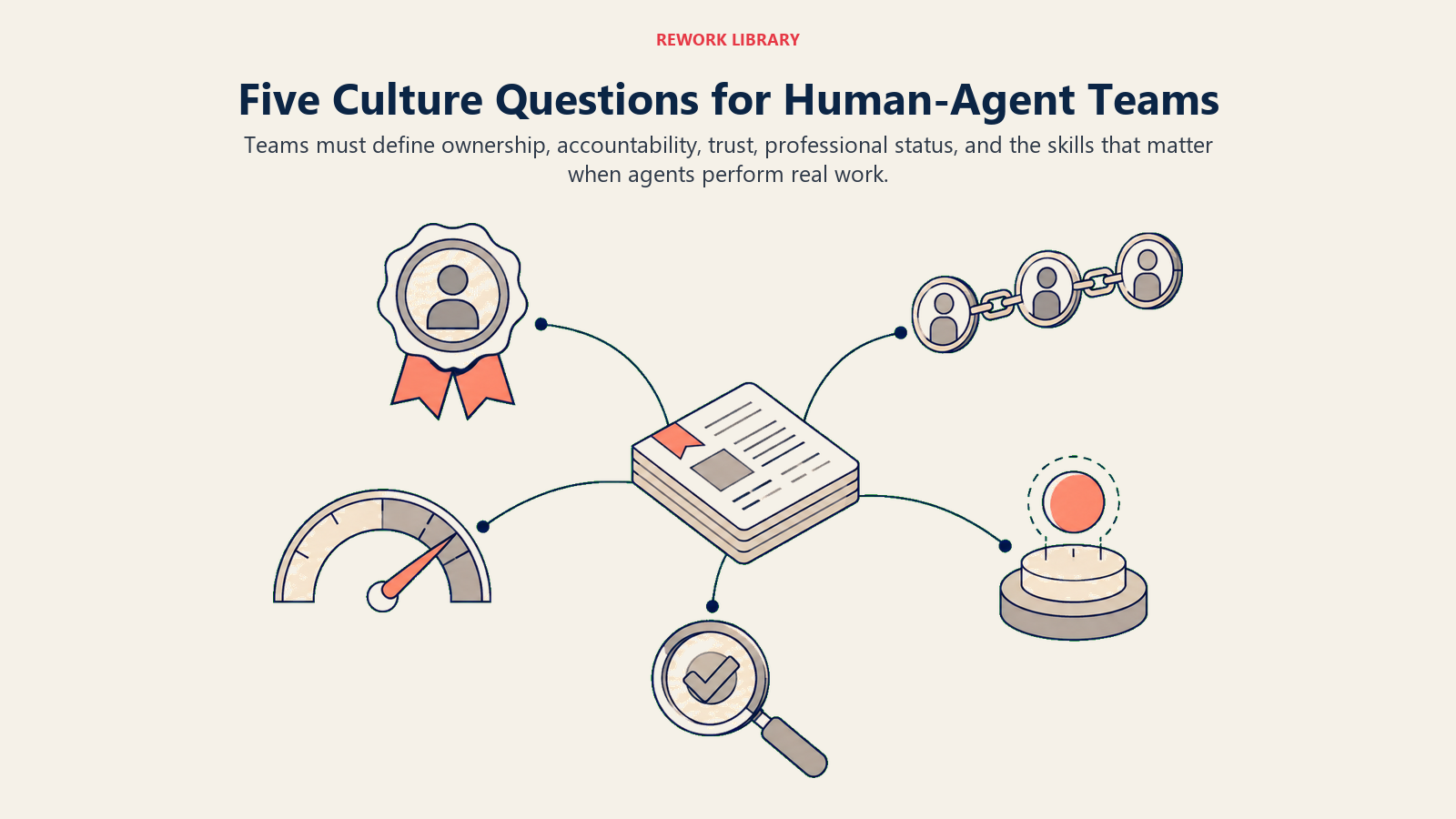
Once an agent is acting inside a workflow instead of just assisting with one, five questions come up that most teams have never had to answer before, and most policies don't cover.
Who Owns the Output?
Ownership used to have an obvious answer: whoever wrote the document, built the model, or drafted the proposal owned it. When an agent produces the first 80% of a proposal and a person edits the final 20%, "who owns this" gets genuinely ambiguous, and most recognition systems still assume one human did all of it. Teams that pretend otherwise, crediting the person as if the agent contributed nothing, or treating agent-assisted work as somehow less legitimate, both end up with resentment on one side or the other.
Who's Accountable When the Agent Gets It Wrong?
If an agent sends a client the wrong figure, or a multi-step task quietly drifts off track, accountability has no settled default yet. Is it the person who wrote the brief, the one who approved the output, or whoever configured the workflow? Companies without an explicit answer get one of two bad patterns: finger-pointing after the fact, or nobody checking closely because everyone assumes someone else already did. This is the gap human-in-the-loop design is supposed to close, by naming in advance which steps require a person's sign-off before the agent's output becomes the team's output.
When Do You Trust the Output, and When Do You Check It?
Trust with a colleague builds slowly, through watching them handle pressure and own their mistakes over months. An agent doesn't have that kind of history; it has a track record measured in completed tasks and a confidence score most people never actually see. Teams without a calibrated answer swing to one of two failure modes: over-trusting, where an unreviewed agent output goes out under someone's name and turns out wrong, or under-trusting, where a manager quietly redoes every agent task by hand and erases the productivity gain the agent was supposed to deliver. The 86% of workers who say they treat AI output as a starting point rather than a final answer are, in effect, already practicing the middle path: use the output, but keep the judgment in human hands.
What Happens to Status and Professional Identity?
Someone whose reputation was built on being the fastest drafter, the fastest analyst, or the fastest coder on the team can watch that edge disappear almost overnight once an agent can match the speed. What's left, judgment, taste, and the ability to catch what an agent missed, is genuinely valuable, but it doesn't feel like the same kind of value, and people notice the difference even when nobody says it out loud. Leaders who don't name that shift directly leave employees to conclude they've been quietly replaced rather than repositioned.
What Skills Actually Matter Now?
Half of workers in Microsoft's 2026 research now rank quality control of AI output as the skill that matters most, ahead of raw production speed, which is a real change most performance systems haven't caught up to. Reviewing critically, spotting a plausible-sounding error, and knowing when a task needs a human judgment call instead of an agent's best guess are becoming the differentiators, and very few companies have updated hiring, training, or promotion criteria to reflect it.
From Doer to Orchestrator: The Shift Nobody Trained For
The clearest way to describe what's changing is a shift in role, not just tooling: from doer, someone who personally produces the work, to orchestrator, someone who designs a system, sets its boundaries, and reviews what comes out the other end. Microsoft's research names this as one end of a spectrum of human-agent collaboration patterns, running from Author (doing the work yourself, with AI helping on pieces) through Editor and Director to Orchestrator, someone running several agents in parallel and stepping in mainly on exceptions. We cover the full pattern set and how it reshapes management roles in the Frontier Firm and the rise of the agent boss.
What matters for culture specifically is that orchestration is a genuinely different kind of accountability than doing, closer to a manager owning a team's output than an individual checking their own work, and almost nobody was trained for it on purpose. A senior analyst who spent a decade getting better at building models is now, in some workflows, being asked to get better at reviewing models an agent built, a distinct skill that doesn't automatically come with seniority. Companies that treat this as a title change rather than a skill to develop are the ones most likely to end up with either careless rubber-stamping or the same over-checking that cancels out the agent's speed advantage.
The Norms That Make Human-Agent Teams Work
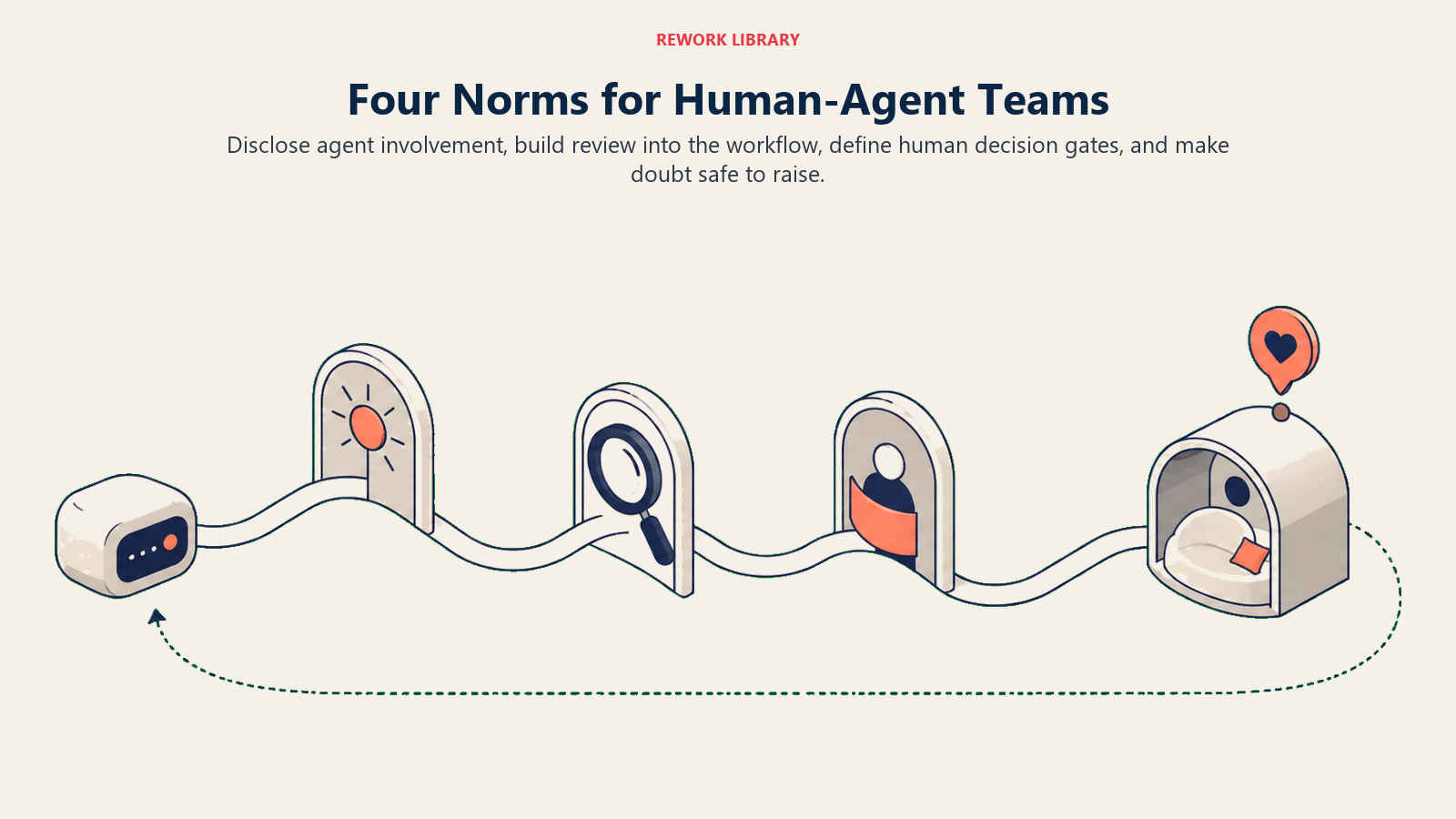
The teams handling this well share a small set of explicit norms rather than a vague commitment to "using AI responsibly." Four show up consistently.
Disclosure: Say When an Agent Was Involved
Trust drops when people learn after the fact that AI was involved and nobody said so upfront. The Founder Reports survey found 43% of workers trust a colleague's output less once they learn AI was involved, against only 20% who trust it more, and that gap gets worse, not better, when disclosure feels like something that had to be extracted rather than volunteered. A simple, consistent norm, say when an agent contributed and how much, does more for trust than trying to make the agent's involvement invisible.
Review: Build the Check Into the Workflow, Not Around It
"Someone should double-check that" is not a review process; it's a hope. Teams that actually catch agent errors before they ship build the check into the workflow itself, a required approval step, a second pass on anything above a certain stakes threshold, rather than trusting it will happen informally because everyone knows they're supposed to be careful. The BCG research on AI "employee" framing found people caught fewer errors, not more, once an agent's output came pre-labeled as coming from a trusted teammate rather than a tool, which argues for keeping review structural rather than relying on how much scrutiny the label happens to invite.
Human-in-the-Loop by Design, Not by Accident
Human-in-the-loop design means deciding in advance which decisions an agent can make on its own and which ones always route to a person, before the workflow goes live, not after something goes wrong. Vague guidance like "use good judgment about when to check" puts the entire burden on an individual in the moment, which is exactly when judgment is hardest to apply consistently. Naming the specific triggers, dollar thresholds, customer-facing communication, anything touching a legal or compliance line, turns a personality trait into a system property that survives staff turnover.
Psychological Safety for a New Kind of Doubt
Psychological safety at work was already the clearest predictor of high-performing teams before agents joined them. Adding agents raises the stakes rather than lowering them, because people now need to feel safe saying things they've never had to say before: "I don't trust what the agent produced here," or "I approved this without fully understanding how it was generated." Teams without that safety don't stop having these moments, they just stop reporting them, which quietly converts an honest doubt into a hidden risk.
Honest Skepticism: Agent Washing and the Reliability Gap
Not everything marketed as a "human-agent team" is one. Agent washing, rebranding a chatbot or a scripted automation as an "AI agent" without the underlying autonomy, means a meaningful share of the tools generating disappointing results were never actually planning and acting the way a real agent does. A team frustrated by an unreliable "agent" that's really just a relabeled script risks learning the wrong lesson, that human-agent collaboration doesn't work, when the real issue is that the tool never qualified as one.
Even where the technology is genuinely agentic, the reliability gap is worth naming honestly. Gartner's prediction that more than 40% of agentic AI projects will be canceled by the end of 2027 points to escalating costs, unclear business value, and inadequate risk controls, not model quality alone. And the BCG finding that framing AI as an "employee" measurably lowered trust and raised replacement anxiety is a caution against overselling the "teammate" language before the review discipline and accountability norms exist to back it up. Calling something a teammate doesn't make the culture questions easier; if anything, it raises the bar for how carefully a company needs to answer them.
Where to Go Next
This article sits inside our broader look at how AI is changing organizational culture. From here:
- What is AI-native culture?, for the foundational concept human-agent teams sit inside
- The Frontier Firm and the rise of the agent boss, for the full set of human-agent collaboration patterns and the manager role they create
- AI cultural debt, for what happens when a company's norms don't keep pace with how fast it adopts agents
- Psychological safety at work, for the deeper mechanics of the safety human-agent teams now depend on
Most teams will discover their human-agent norms the hard way, in the meeting after an agent's mistake reaches a customer. It goes better when the harder questions are settled first: who owns the output, who answers for it when it's wrong, and how much trust the agent has actually earned. Those are old leadership questions in new clothes, and they don't get easier by waiting for the incident to ask them on your behalf.

Co-Founder, Rework.com
On this page
- What Makes a Team "Human-Agent," Not Just "AI-Assisted"
- How This Differs From Using AI as a Tool: Agents Act, Tools Wait
- Key Facts
- The New Cultural Questions Human-Agent Teams Raise
- Who Owns the Output?
- Who's Accountable When the Agent Gets It Wrong?
- When Do You Trust the Output, and When Do You Check It?
- What Happens to Status and Professional Identity?
- What Skills Actually Matter Now?
- From Doer to Orchestrator: The Shift Nobody Trained For
- The Norms That Make Human-Agent Teams Work
- Disclosure: Say When an Agent Was Involved
- Review: Build the Check Into the Workflow, Not Around It
- Human-in-the-Loop by Design, Not by Accident
- Psychological Safety for a New Kind of Doubt
- Honest Skepticism: Agent Washing and the Reliability Gap
- Where to Go Next