How Company Culture Drives Employee Retention
Turn this article into takeaways for your work.


Each assistant summarizes the article only for you and suggests best practices for your work.
Company culture drives employee retention because it directly shapes whether people trust their manager, feel like they belong, see a real path to grow, and believe they're treated fairly. When those things break down, people leave, often long before they update a resume, and research consistently shows culture predicts who quits better than compensation does.
That surprises a lot of leaders, because the instinct when good people start leaving is to fix the offer letter. Sometimes pay really is the problem. But research from MIT Sloan's analysis of over a million employee reviews to Gallup's engagement data points at something else as the bigger lever: the daily experience of working somewhere, not the paycheck from it. This article covers the evidence, the mechanisms behind it, what turnover actually costs, and how to build a culture people don't want to leave, including the early-warning signals and stay-interview questions that catch a problem before the resignation.
Does Culture Affect Retention? What the Evidence Shows
Yes, and the gap is bigger than most leaders assume. MIT Sloan Management Review researchers Donald Sull, Charles Sull, and Ben Zweig analyzed more than 1.3 million Glassdoor reviews from large U.S. employers during the first six months of the Great Resignation and modeled which factors best predicted attrition. Toxic culture, defined by the five traits covered in signs of a toxic culture, turned out to be 10.4 times more powerful a predictor of quitting than how employees rated their pay.
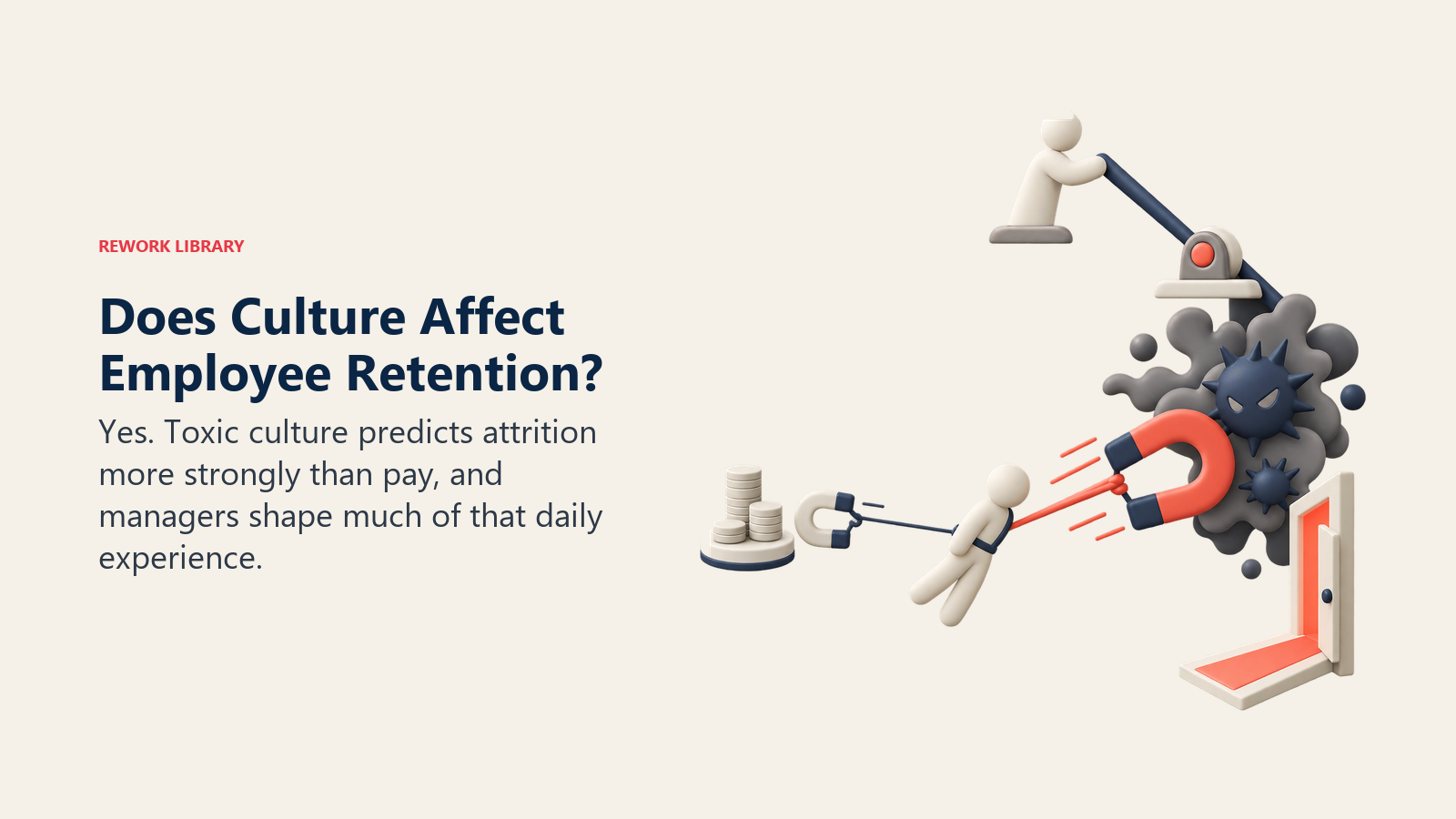
That is not a small effect. Two companies paying the same salary for the same role can post wildly different attrition simply because one tolerates disrespect, favoritism, or public humiliation and the other does not. Compensation still matters, and being genuinely underpaid will push people out regardless of culture. But once pay is roughly competitive, culture does most of the work in whether someone stays or starts quietly looking.
Why People Quit Managers and Culture, Not Just Pay
The old line "people don't quit jobs, they quit managers" oversimplifies a real pattern, but Gallup's data backs the core of it: managers account for at least 70% of the variance in team engagement, meaning whether someone feels engaged or half-interviewing elsewhere usually comes down to who runs their team more than what the company as a whole is doing. A brilliant company-wide culture deck does nothing for someone whose direct manager plays favorites, takes credit for their work, or punishes honest mistakes.
This is why retention efforts built only on company-wide perks and all-hands messaging underperform. The lived culture that determines whether someone stays is assembled team by team, one manager's daily behavior at a time. Fixing retention at scale means fixing how managers are selected, trained, and held accountable, not refreshing the values statement everyone reads once at onboarding.
Key Facts
- Toxic culture is 10.4 times more powerful a predictor of employee attrition than how workers rate their pay. Source: MIT Sloan Management Review
- Workers who rate their culture as good or excellent are almost four times more likely to stay with their employer, and 83% say it motivates them to do high-quality work, versus 45% in poor cultures. Source: SHRM
- Managers account for at least 70% of the variance in team engagement scores, which is a large part of why retention outcomes vary so much between teams inside the same company. Source: Gallup
- Voluntary employee turnover costs U.S. businesses roughly $1 trillion a year, and replacing a single employee typically costs one-half to two times that person's annual salary. Source: Gallup
- Only 20% of U.S. employees strongly agree they feel connected to their organization's culture, even though most workers say culture shapes whether they stay. Source: Gallup
- 77% of adults say they would consider a company's culture before applying for a job, and 56% say culture matters more than salary for job satisfaction. Source: Glassdoor
The Mechanisms: How Culture Actually Keeps People
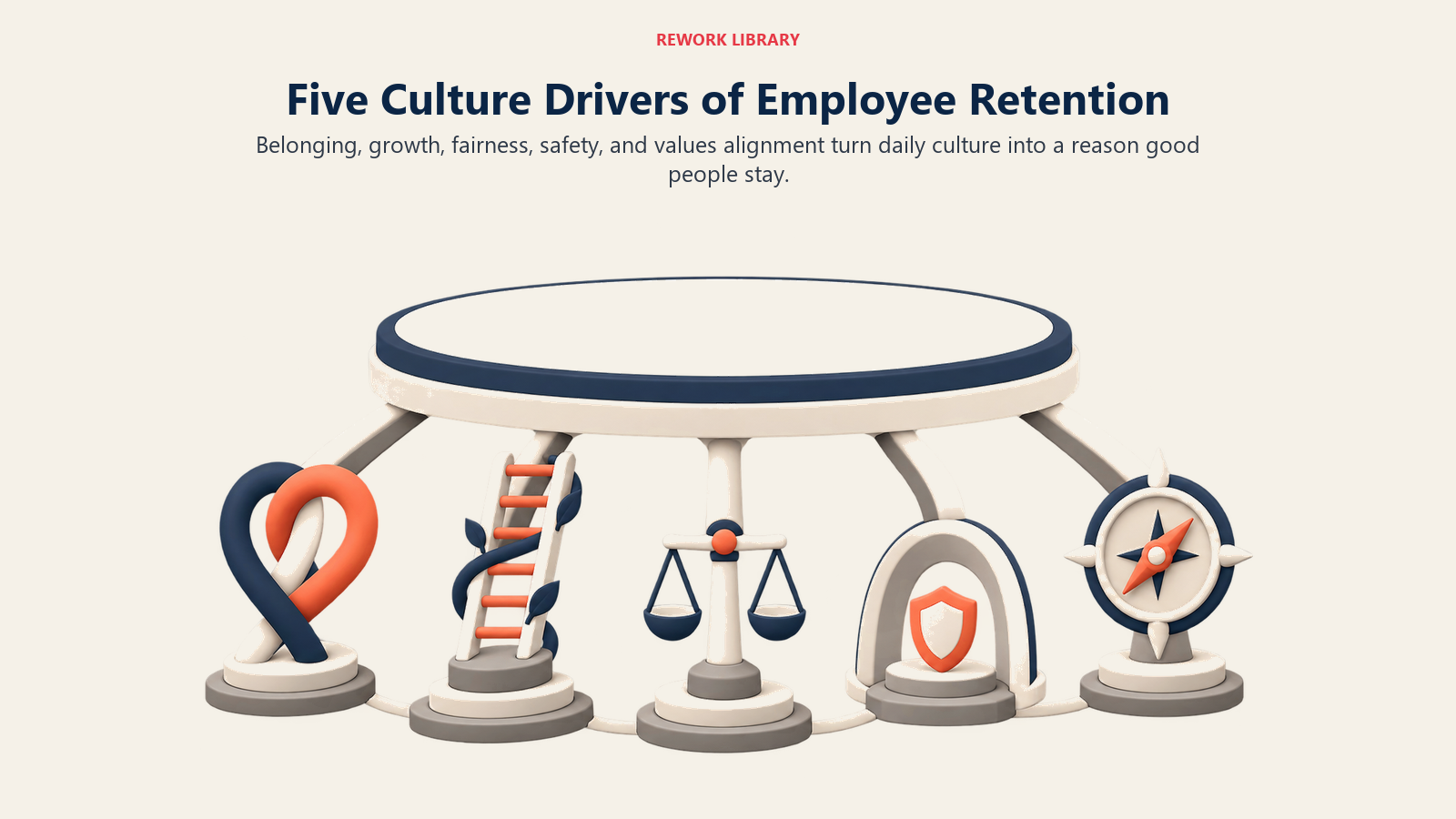
Knowing that culture predicts retention only helps once you understand what it's actually doing. Five mechanisms carry most of the effect, and each is something a leader can diagnose and act on, not just a feeling to chase.
Belonging
People stay where they feel like they matter to the people around them, not just useful to the org chart. Belonging is built in small, repeated moments: getting credited for an idea in a meeting, being included in the conversation before a decision instead of informed after it, having a manager who notices when something is off. Gallup's finding that only one in five employees strongly feels connected to their organization's culture is really a belonging gap, and it is one of the quietest reasons good people leave, because nothing dramatic has to go wrong first. Building trust in the workplace and onboarding for culture both cover how that sense of belonging gets built, or fails to, starting in someone's first weeks.
Growth
A job that stops teaching someone anything has a shelf life, even if the pay and the people are fine. People tolerate a rough quarter if they can see a next step: a new skill, a stretch project, a promotion path that's real rather than theoretical. What kills retention here isn't the absence of a formal career ladder so much as the absence of visible movement. Someone who watches peers get passed over for unclear reasons, or can't name what it would take to get promoted, starts treating the job as a placeholder rather than a place to build a career.
Fairness
Favoritism is one of the fastest ways to burn through retention, because everyone notices it even when leadership insists they don't. Signs of a toxic culture covers this pattern directly: a high performer who misses deadlines gets a pass a struggling employee never would, and once people conclude outcomes depend on relationships rather than merit, their effort quietly declines before their job search even starts. Fairness doesn't mean identical treatment for everyone. It means outcomes track transparent, consistently applied criteria, and people can see that they do.
Psychological Safety
Teams where people can't safely raise a concern don't usually explode. They go quiet, and quiet is the leading indicator that precedes a resignation, not the alternative to one. Psychological safety at work is the belief that speaking up, admitting a mistake, or challenging a decision won't get you punished, and its absence pushes people toward one of two exits: they stop engaging and become a name on the attrition report months later, or they leave outright the moment a better offer appears. Why teams stay silent in meetings walks through how that silence forms, and it's almost always visible well before someone hands in notice.
Values Alignment
Retention breaks down when someone's personal sense of how work should be done clashes with how the company actually operates, regardless of pay. This differs from disliking a specific policy. It's a deeper mismatch between what a person believes and what the underlying assumptions of the organization actually reward, and it's hard to fix with a raise, because the person isn't unhappy about money. They're unhappy about who they have to become to succeed there. The link between culture and performance covers how this same mismatch shows up as declining discretionary effort long before it shows up as a resignation.
The Cost of Turnover
Turnover gets treated as a soft, unavoidable cost of doing business, which is a mistake once you look at the number. Gallup estimates voluntary turnover costs U.S. businesses roughly $1 trillion a year, and replacing a single employee typically runs one-half to two times their annual salary once recruiting, onboarding, lost productivity, and manager time are all counted. That range climbs further for specialized or senior roles, where the search takes longer and the ramp period runs months, not weeks.
The number that rarely makes the budget conversation is the compounding cost: institutional knowledge walking out the door, client relationships rebuilt from scratch, and the drag on the rest of the team covering the gap while a replacement gets hired and trained. Losing a strong performer costs far more than losing an average one, which is why the metric worth tracking closely is retention of specifically high performers, not overall attrition. A company that loses 10% of its workforce a year but loses the wrong 10% has a much bigger problem than the headline number suggests.
How to Build a Retention-Strong Culture
Building a culture that keeps people means treating retention as a systems problem, the same way how leaders shape culture treats culture generally: something produced by hiring, promotion, and daily management decisions, not fixed with a survey or a values refresh.
Fix the Systems, Not Just the Exit Interview
By the time someone sits down for an exit interview, the decision is already made. The more useful data lives upstream: engagement and culture surveys, eNPS, and manager-level breakdowns showing where problems concentrate rather than one company-wide score. How to measure company culture covers the full toolkit for surfacing this before it becomes a resignation.
Make Belonging and Fairness Operational
Belonging and fairness cannot run on good intentions alone. That means transparent promotion criteria everyone can see, calibrated performance reviews so the same behavior gets judged consistently across managers, and recognition tied to actual contribution rather than visibility or tenure. It also means training managers specifically on the behaviors that build trust, since manager quality, not company policy, is where most of this happens or doesn't.
Design the First 90 Days on Purpose
Retention problems that show up at month eighteen often trace back to what someone learned, or failed to learn, in their first two weeks. Onboarding for culture covers how the earliest days on a job transmit whether stated values match lived ones, and a new hire who forms an accurate, positive read of the culture early is far more likely to still be there in year two.
Stay Interviews: Catching the Problem Before the Resignation
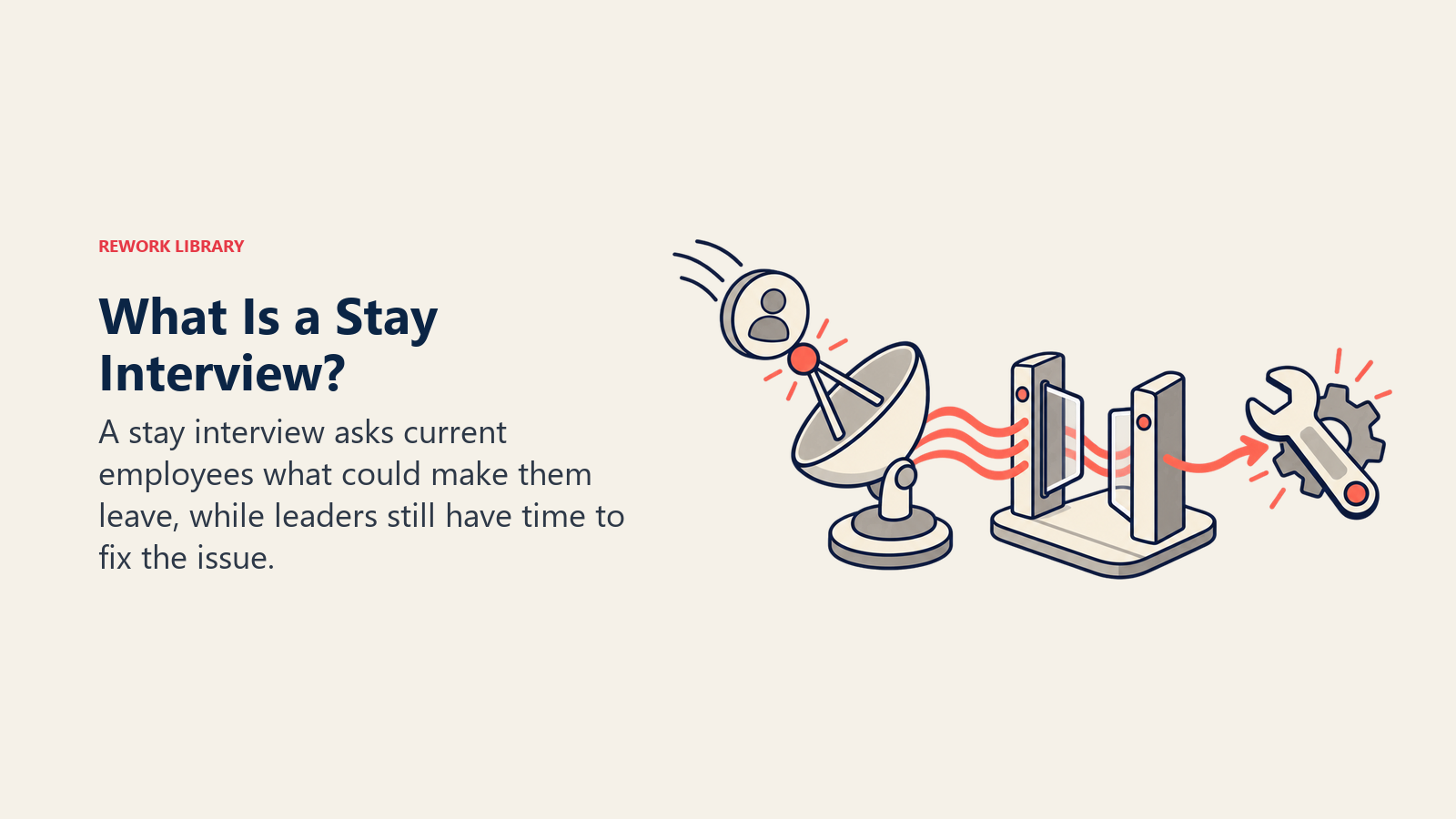
An exit interview tells you why someone already decided to leave. A stay interview asks the same honest questions of people who are still there, while there is still time to act on the answer.
What a Stay Interview Actually Asks
A useful stay interview is short, regular, and specific rather than a vague "how are things going" check-in. Worth asking directly: What would make you consider leaving? What's one thing about your role you'd change if you could? Do you feel your work is recognized in a way that matters to you? Is there a manager or colleague you find hard to work with, and why? The goal isn't to extract a promise to stay. It's to surface the same fairness, belonging, and growth gaps described above while there's still room to fix them.
Early-Warning Signals a Retention Problem Is Forming
Most resignations are preceded by weeks or months of visible signal that gets missed because nobody is looking for it systematically.
| Early-warning signal | What it usually means |
|---|---|
| Someone stops speaking up in meetings they used to be vocal in | A psychological safety break, covered in why teams stay silent in meetings |
| A strong performer's discretionary effort visibly drops | Values misalignment or a fairness breach, often tied to a promotion or recognition decision |
| Someone starts declining optional meetings, projects, or social events | Early disengagement, frequently the first behavioral sign before a job search starts |
| Repeated complaints about the same manager surface across different people | A systemic management problem, not an isolated personality clash |
| Sudden interest in updating LinkedIn, certifications, or external networking | A late-stage signal; by this point the decision may already be close to made |
Catching the first two or three signals in that list gives a manager real room to act. Catching only the last one usually means the conversation is already too late.
Culture, Retention, and the AI Era
AI is adding a new layer to the retention question that didn't exist a few years ago. Job security anxiety tied to automation, uncertainty about which tasks stay human, and the disorienting experience of working alongside an AI agent all put pressure on the same trust and belonging mechanisms covered above, just from a new direction. A team that handles this openly, honest about what's changing and why instead of leaving people to guess, protects retention. A team that goes quiet on it invites the same silent disengagement any psychological safety failure causes.
What is AI-native culture covers how organizations are adapting their norms as AI agents take on more day-to-day work, and AI cultural debt covers the risk of moving fast on AI adoption without updating the trust and ownership norms underneath it. Neither is a retention problem in the traditional sense yet, but both are early versions of the same dynamic: people leave environments where they feel replaced, unheard, or uncertain about where they stand, and careless AI adoption can create that feeling even in an otherwise healthy culture.
Where to Go Next
- Signs of a toxic culture, for the specific patterns behind the MIT Sloan attrition research cited above
- The link between culture and performance, for how the same mechanisms that drive retention also drive execution quality
- Psychological safety at work, for the trust mechanism underneath most of the retention drivers in this article
- How to measure company culture, for the survey and signal toolkit that catches retention risk before an exit interview
Frequently Asked Questions about Culture and Employee Retention
Does company culture actually affect employee retention?
Yes, and more than pay does in most cases. MIT Sloan Management Review's analysis of over a million employee reviews found toxic culture was 10.4 times more predictive of attrition than how employees rated their compensation. SHRM's research separately finds employees who rate their culture as good or excellent are almost four times more likely to stay.
Do people really quit managers, not companies?
It's an oversimplification of a real pattern. Gallup finds managers account for at least 70% of the variance in team engagement, meaning whether someone feels engaged or checked out usually comes down to their direct manager more than company-wide policy. That is not the same as saying pay or company-level culture never matter, but manager quality carries an outsized share of the retention outcome.
How much does employee turnover actually cost a company?
Gallup estimates voluntary turnover costs U.S. businesses roughly $1 trillion annually, and replacing a single employee typically costs one-half to two times that person's annual salary once recruiting, onboarding, lost productivity, and manager time are counted. The cost rises further for senior or specialized roles that take longer to fill and longer to ramp.
What is a stay interview, and how is it different from an exit interview?
A stay interview asks current employees the honest questions an exit interview only asks after someone has already decided to leave: what would make them consider quitting, what they would change about their role, and whether they feel recognized. The point is to surface fixable problems while there is still time to act, rather than learning about them as a departure explanation.
What are the earliest warning signs that someone is about to quit?
Behavioral signals usually appear well before a resignation: someone who used to speak up in meetings goes quiet, a strong performer's discretionary effort visibly drops, they decline optional projects or social events, or repeated complaints about the same manager surface across different people. Sudden LinkedIn or networking activity tends to be a late-stage signal rather than an early one.
If pay isn't the main driver, does compensation matter for retention at all?
Yes, at the extremes. Being genuinely underpaid relative to the market will push people out regardless of how good the culture feels, and pay is often the presenting reason someone gives even when culture was the deeper cause. Once compensation is roughly competitive, though, research consistently shows culture becomes the bigger factor in whether someone stays.
Does AI change how culture affects retention?
It adds a new pressure point rather than replacing the old ones. Uncertainty about job security, unclear expectations around AI-assisted work, and the experience of working alongside AI agents all put stress on the same trust and belonging mechanisms that already drive retention. Organizations that communicate openly about these changes protect retention; organizations that leave people to guess invite the same silent disengagement that any psychological safety failure causes.
Culture drives retention the same way it drives performance: quietly, through daily decisions about who gets heard, who gets credit, and who gets a pass. Pay can buy a little time, but it cannot fix a manager who plays favorites or a team where speaking up carries a cost. The organizations that keep their best people did not get there with a bigger counteroffer. They got there by treating belonging, fairness, growth, and psychological safety as things worth managing on purpose, long before the resignation letter shows up.

Co-Founder, Rework.com
On this page
- Does Culture Affect Retention? What the Evidence Shows
- Why People Quit Managers and Culture, Not Just Pay
- Key Facts
- The Mechanisms: How Culture Actually Keeps People
- Belonging
- Growth
- Fairness
- Psychological Safety
- Values Alignment
- The Cost of Turnover
- How to Build a Retention-Strong Culture
- Fix the Systems, Not Just the Exit Interview
- Make Belonging and Fairness Operational
- Design the First 90 Days on Purpose
- Stay Interviews: Catching the Problem Before the Resignation
- What a Stay Interview Actually Asks
- Early-Warning Signals a Retention Problem Is Forming
- Culture, Retention, and the AI Era
- Where to Go Next