How to Build Culture in Remote and Hybrid Teams
Turn this article into takeaways for your work.


Each assistant summarizes the article only for you and suggests best practices for your work.
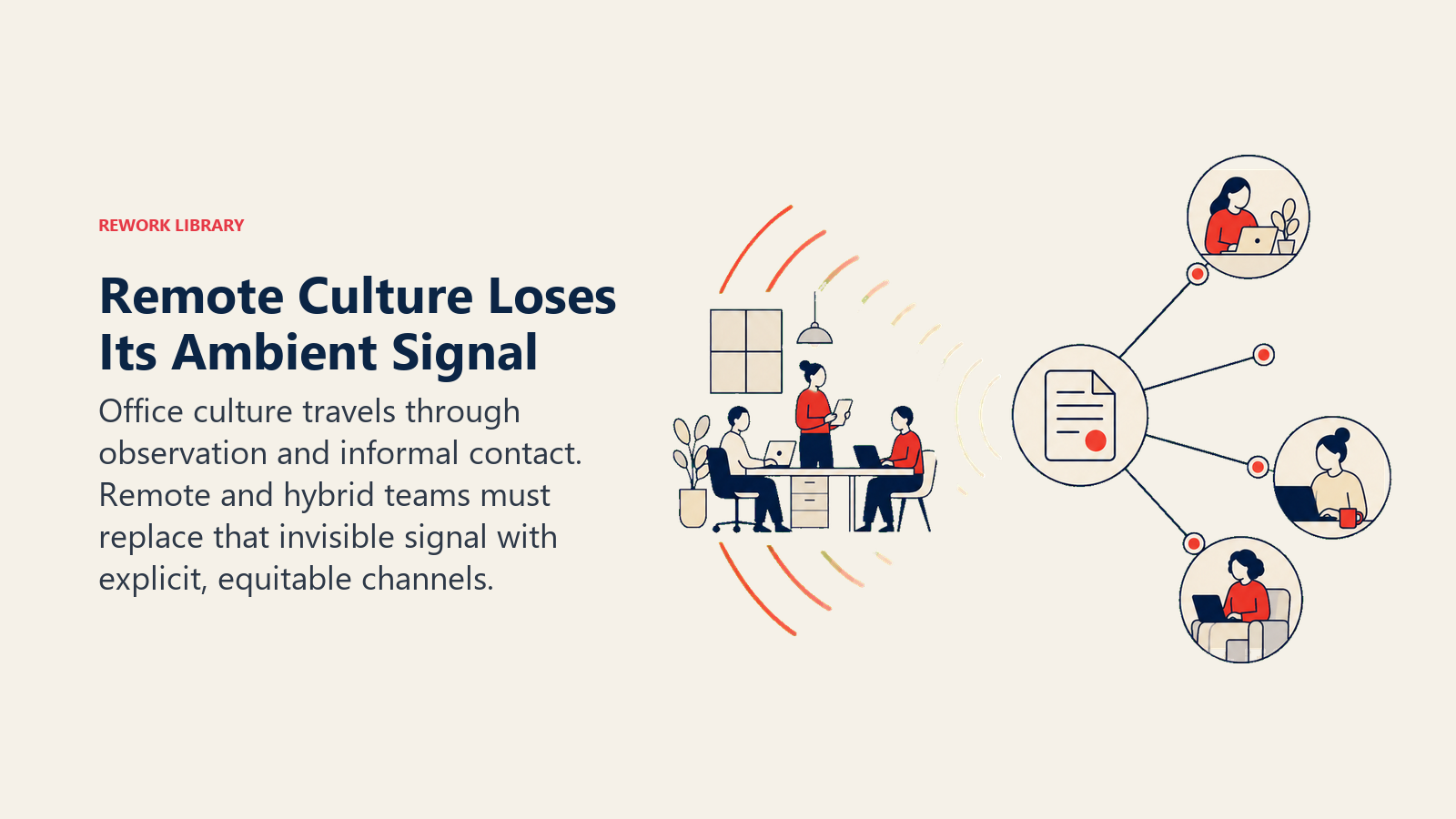
Remote and hybrid team culture is the set of shared values, trust, and unwritten norms a distributed team builds on purpose, because the office is no longer doing that work by accident. In a co-located team, culture spreads through hallway conversations, overheard meetings, and body language nobody has to schedule. Remote work removes that ambient layer, so every part of culture that used to form itself now has to be designed.
That distinction matters because most leaders still manage remote culture as if it were office culture minus a commute. It isn't. The fixes that work in a shared office, an open floor plan, a hallway chat, a manager who reads the room, simply don't transfer. This article covers why culture is structurally harder to build once a team goes remote, what breaks first, the practices that rebuild it deliberately, the extra tension hybrid setups create, and how to know if any of it is working.
Why Culture Is Harder to Build in Remote and Hybrid Teams
Culture was never really "built" in most co-located companies. It accumulated. A new hire watched how their manager handled a missed deadline, noticed who got interrupted in meetings and who didn't, picked up on the fact that the loudest voice in the room usually won the argument, and absorbed all of it without a single slide deck. That absorption process has a name in organizational research: socialization through observation. It is fast, it is free, and it disappears almost entirely the moment a team stops sharing a physical room.
Fewer Ambient Signals
An office produces a constant, low-grade stream of information nobody consciously tracks: who's stressed today, who two colleagues are quietly annoyed with, whether the VP walking past just got good news or bad news. None of that shows up on a video call. A remote employee only receives what someone deliberately decides to send them, in a message, an email, or a scheduled meeting. Everything ambient becomes something somebody has to choose to communicate, and busy people under-communicate by default, not out of malice but because writing down a signal takes more effort than letting someone absorb it by being in the room.
Less Osmosis, More Explanation
The same problem hits new hires hardest. In an office, a new employee learns the unwritten rules, how decisions actually get made versus how the org chart says they get made, what "urgent" really means, by watching for a few weeks. Remote, none of that is visible by default. Culture stops being something a new hire absorbs and becomes something a manager has to explicitly teach, conversation by conversation, and most managers were never trained to do that.
Microsoft's own research on this is unusually direct. A 2021 study of more than 61,000 Microsoft employees, published in Nature Human Behaviour, found that company-wide remote work made the internal collaboration network measurably more static and siloed: the share of time employees spent collaborating across different groups fell by roughly 25% from pre-pandemic levels, while connections inside existing groups got denser. People didn't stop talking to their own team. They stopped bumping into everyone else's.
Key Facts
- A 2021 Microsoft study of over 61,000 employees, published in Nature Human Behaviour, found firm-wide remote work made the collaboration network more static and siloed, with cross-group collaboration time falling by roughly 25% from pre-pandemic levels. Source: Nature Human Behaviour
- In Microsoft's 2022 Work Trend Index, 87% of employees said they were productive at work, while 85% of leaders said the shift to hybrid work had made it hard to trust that employees were actually being productive, a gap Microsoft calls productivity paranoia. Source: Microsoft Work Trend Index
- Hybrid teams that document a formal collaboration plan (when to be available, when meetings happen, how to signal focus time) are 66% more likely to be engaged and 29% less likely to be burned out than teams without one, yet only 21% of hybrid workers have received any training on how to work that way. Source: Gallup
- 75% of remote workers report feeling connected to their colleagues, but among those who don't, the top reasons are no opportunity to connect socially (56%), not interacting with colleagues enough (53%), and not knowing colleagues personally (51%). Source: Buffer State of Remote Work 2023
- A randomized study of 1,612 employees at a large Nasdaq-listed firm (NBER Working Paper 30292, Bloom, Han, and Liang) found structured hybrid work, two fixed remote days a week, had no measurable effect on performance reviews or promotion rates compared to working in the office five days a week, while cutting attrition by 33%. Source: NBER
What Breaks First When Teams Go Remote
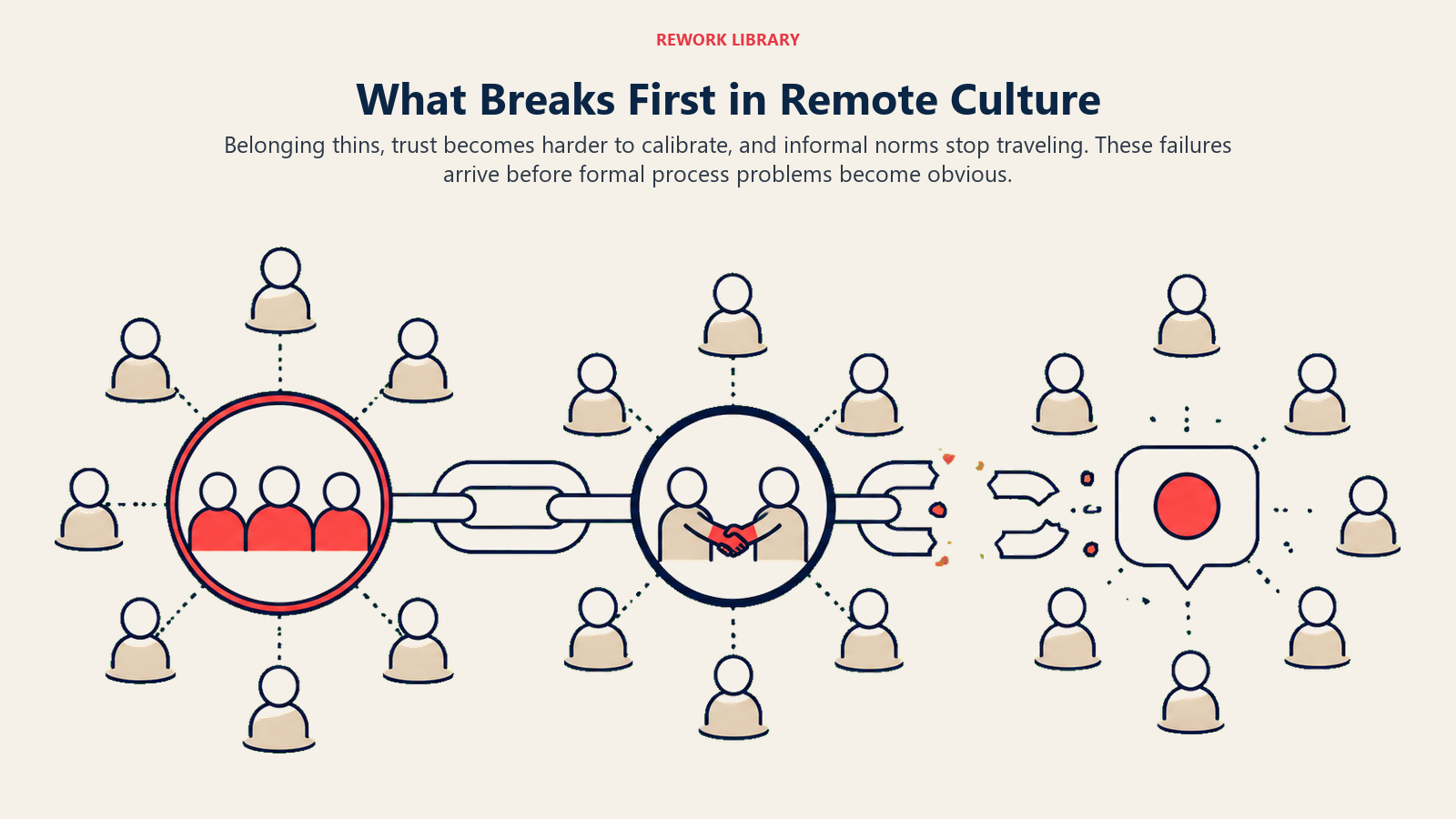
Culture doesn't collapse all at once when a team goes remote. It erodes in a fairly predictable order, and knowing that order helps a leader spot the early warning signs before they show up as resignations.
Belonging
Belonging is usually the first casualty, and it goes quietly. A remote employee can hit every deadline, show up to every meeting, and still feel like they're watching the company from outside a window. Nobody invites them to lunch because there is no lunch to be invited to, and they miss the two-minute pre-meeting chatter where relationships actually get built, because most video calls start and end on the dot. Buffer's research on this is telling: employees who feel disconnected almost never cite the actual work as the reason. They cite the absence of an opportunity to connect socially, which is a structural gap, not a personal one.
Trust
Trust erodes next, and it moves in both directions. Managers who can't see someone working start filling the gap with anxiety instead of evidence, which is exactly the dynamic behind Microsoft's productivity paranoia finding: employees overwhelmingly believe they're productive, leaders overwhelmingly doubt it. Meanwhile employees lose trust in leadership's intentions when communication goes quiet, when a reorg gets announced with no context, or when a manager who used to be visible in the office becomes a name in a calendar invite. Trust that used to get reinforced by small daily interactions now has almost no ambient reinforcement at all, which is one reason psychological safety at work takes deliberate design once a team stops sharing a room.
Informal Norms
The unwritten rules go last, but they go the hardest to notice, because nobody realizes a norm existed until it stops working. In an office, "we don't schedule meetings after 4pm on Fridays" or "if you disagree with a decision, say so before it ships, not in the retro" get transmitted by watching people enforce them in real time. Remote, those norms either get written down or they quietly stop applying to anyone who joined after the office closed. A remote team's culture is, in a very literal sense, only as strong as what its founders and early employees bothered to document. Everything else evaporates.
How to Build Remote Work Culture on Purpose
None of the above is an argument against remote or hybrid work. It's an argument for treating culture as something that has to be engineered instead of something that happens on its own, because on its own is exactly what stops working once the office does.
Make Rituals Intentional, Not Accidental
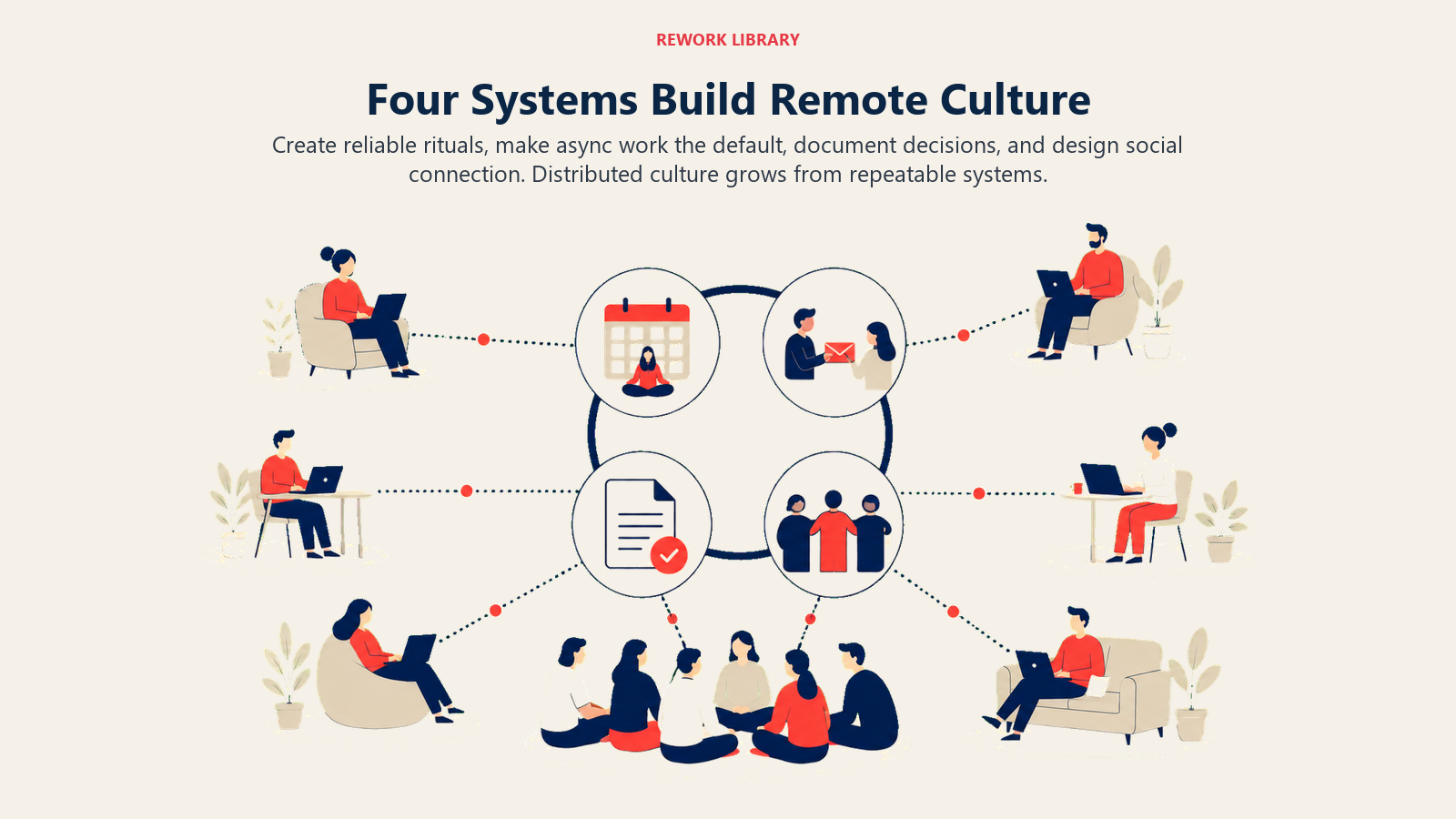
Every office ritual that "just happened" (the Monday coffee chat, the end-of-sprint demo everyone shows up for, the running joke that started in a hallway) has to be recreated on purpose remotely, or it simply won't exist. That doesn't mean a mandatory virtual happy hour, the fastest way to make connection feel like homework. It means picking two or three rituals that carry real weight, a weekly all-hands where leadership actually answers hard questions, a Friday thread where anyone can post a win, a rotating "ask me anything" with a different team each month, and running them consistently enough that they become the thing people expect, the way the hallway used to be.
Set Async-First Norms
Remote teams that try to replicate an office's meeting culture over video calls burn out fast, because a call demands the same synchronous attention as a meeting without the ambient value of actually sharing a room. Async-first doesn't mean no meetings. It means defaulting to written updates, recorded walkthroughs, and documented decisions for anything that doesn't require real-time debate, and reserving live time for what genuinely needs it: disagreement, ambiguity, and relationship-building. Done well, a written update carries more of the "what's really going on" context than a rushed status meeting ever did.
Treat Documentation as a Culture Artifact
Most companies treat documentation as a knowledge-management problem: where do the specs live, where's the onboarding checklist. In a remote team, documentation is also a culture artifact, the closest thing left to the osmosis a new hire used to get by sitting near a veteran employee. A decision log that explains not just what was decided but why, and what was argued against, teaches a new hire more about how the company actually thinks than any values deck. Writing it down once, properly, replaces months of ambient absorption a remote employee will otherwise never get.
Engineer Deliberate Connection
The social layer that used to happen for free now needs a budget and an owner. That can be an annual or twice-yearly in-person gathering that exists specifically to build the trust reserves a team spends down over months of video calls. It can be smaller: rotating pairs for a 20-minute non-work call, a channel where people post what they're actually working on in plain language, an onboarding buddy whose only job for the first month is answering questions a new hire is too embarrassed to ask in the group channel. The mechanism matters less than treating connection as a line item, not an assumption. Building a feedback culture runs on the same logic: the low-stakes exchanges that make people comfortable giving hard feedback in an office have to be manufactured remotely, or feedback stays formal, rare, and late.
Hybrid-Specific Tensions
Hybrid teams get an extra set of problems that fully remote teams don't have, because hybrid doesn't remove the office, it splits the team across two different cultural environments and then asks everyone to pretend they're having the same experience.
Proximity Bias
Proximity bias is the tendency to rate the people you can see as more productive, committed, and promotable than the people you can't, regardless of actual output. It isn't a character flaw; it's a well-documented cognitive shortcut, and it's exactly what shows up in Microsoft's productivity paranoia data, where leaders doubt remote output far more than employees report slacking off. The fix isn't asking managers to try harder. It's removing the shortcut's inputs: evaluate on documented outcomes rather than visible hours, rotate who gets "hallway time" with leadership instead of defaulting to whoever's in the building, and audit promotion and stretch-assignment data by work location on a regular cadence, because bias that isn't measured tends to persist quietly for years.
The Two-Tier Culture Problem
Left unmanaged, hybrid arrangements tend to produce two cultures wearing one company name: an office culture where relationships form fast and opportunities surface first, and a remote culture that gets the meeting recording, the summarized decision, and the promotion cycle a step behind. The NBER research on structured hybrid work is the clearest evidence that this split is a design choice, not an inevitability. When hybrid meant two fixed remote days a week, applied consistently to everyone, promotion rates and performance reviews showed no measurable gap at all. The two-tier problem shows up when hybrid is ad hoc, when some people quietly work from home whenever and others are always in, because that's when the office naturally becomes the real headquarters and remote becomes the annex. Structure, applied evenly, is what prevents the split from forming.
How to Measure Remote and Hybrid Culture
You can't manage what you don't check, and remote culture is easy to assume is fine right up until an engagement survey or a resignation wave says otherwise. The full mechanics of a culture audit, engagement surveys, eNPS, and turning data into action, are covered in how to measure company culture, but three signals matter specifically for distributed teams. Track engagement and burnout by location and by whether a collaboration plan exists, since Gallup's data shows that single variable moving engagement by double digits. Track meeting participation for silence, because a remote employee who stops speaking up on a call is showing the same warning sign as why teams stay silent in meetings, just harder to see through a grid of muted tiles. And track outcomes by work arrangement, promotion rates, performance ratings, stretch-assignment access, on a recurring basis, because proximity bias only stays invisible when nobody's looking at the numbers.
Culture in the Age of AI: Agents on Distributed Teams
The newest wrinkle in remote and hybrid culture isn't a location problem at all. A growing share of a distributed team's "teammates" aren't people logging in from somewhere else, they're AI agents that draft, research, and execute work asynchronously, at any hour, from nowhere in particular. That extends the async-first norms above in a real way: a remote team already had to get comfortable trusting work it didn't watch get made, and an agent's output is the most extreme version of that, no video call, no tone of voice, no chance to read the room before deciding whether to trust the result.
The upside is that agents already fit a distributed team's rhythm, since they don't care about time zones or who happens to be in the office, which removes a layer of proximity bias rather than adding to it. The risk runs the other way: a team that already struggles with belonging can drift further if async human-AI handoffs replace scarce human interaction instead of freeing people up for more of it. Getting this right looks less like a tool rollout and more like an explicit culture decision: what gets delegated to an agent, what stays with a human because the relationship matters, and who's accountable when an agent's output turns out to be wrong. The Frontier Firm and the rise of the agent boss covers how that accountability structure is forming, and AI cultural debt covers what happens to a distributed team's trust reserves when the decision gets skipped.
Where to Go Next
Remote and hybrid culture is a subset of a bigger question: how a leader shapes the deeper layers of business culture on purpose instead of letting them form by accident. From here:
- National vs. company vs. team culture, for how distributed teams add a national-culture layer that co-located teams rarely have to think about
- Managing a multicultural team, for the playbook once your distributed team also spans different national and communication norms
- Psychological safety at work, for the specific behaviors that make it safe to speak up when nobody shares a room
- What is AI-native culture, for the fuller picture of how AI teammates reshape trust and ownership across any team, distributed or not
Culture in a remote or hybrid team was never going to build itself the way it did in a shared office, and pretending otherwise is how a distributed team ends up with a values deck that describes a culture nobody actually experiences. The teams that get this right didn't find a clever hack for replacing the hallway. They accepted that every signal the hallway used to send now has to be sent on purpose, and they built the rituals, the norms, and the documentation to send it consistently.

Co-Founder, Rework.com
On this page
- Why Culture Is Harder to Build in Remote and Hybrid Teams
- Fewer Ambient Signals
- Less Osmosis, More Explanation
- Key Facts
- What Breaks First When Teams Go Remote
- Belonging
- Trust
- Informal Norms
- How to Build Remote Work Culture on Purpose
- Make Rituals Intentional, Not Accidental
- Set Async-First Norms
- Treat Documentation as a Culture Artifact
- Engineer Deliberate Connection
- Hybrid-Specific Tensions
- Proximity Bias
- The Two-Tier Culture Problem
- How to Measure Remote and Hybrid Culture
- Culture in the Age of AI: Agents on Distributed Teams
- Where to Go Next