The Link Between Company Culture and Performance
Turn this article into takeaways for your work.


Each assistant summarizes the article only for you and suggests best practices for your work.
Yes, company culture affects performance, but not by magic and not on its own. Culture shapes performance through a specific, measurable chain: it drives how engaged people are, engagement drives discretionary effort and retention, and those two things show up directly in productivity, quality, and profit. The link is real. It just runs through people's daily behavior, not through a values poster in the lobby.
That distinction matters because "culture drives performance" has become a phrase repeated so often it stopped getting questioned. It turned into a slogan: culture eats strategy for breakfast, so just fix the culture and the numbers follow. The actual research is more specific and a little less flattering to that slogan. This article covers what the evidence shows, the mechanisms that carry culture into results, and the part most culture content skips: when a strong culture becomes a performance drag instead of an engine.
What "Culture Drives Performance" Actually Means
Culture does not touch the P&L directly. Nobody's balance sheet has a line item for "shared values." What culture touches is behavior, and behavior is what shows up in revenue, retention, and cost.
The chain looks like this in practice: a culture of trust and clear expectations produces higher engagement, engaged people give more discretionary effort and stay longer, and both compound into better execution, lower replacement cost, and stronger customer outcomes. Break any link in that chain and "we have a great culture" stops predicting "we perform well." A company can have a culture people love working in and still underperform if that never translates into focused execution. The reverse is also true: a company can post strong short-term numbers on a culture that is quietly burning people out, right up until the retention bill comes due.
Key Facts
- Business units in the top quartile of employee engagement show 23% higher profitability and 18% higher productivity than those in the bottom quartile. Source: Gallup, State of the Global Workplace
- Companies in the top quartile of McKinsey's Organizational Health Index deliver total shareholder returns roughly three times higher than bottom-quartile companies. Source: McKinsey
- Workers who rate their culture as good or excellent are almost four times more likely to stay with their employer, and 83% say it motivates them to do high-quality work, versus 45% in poor cultures. Source: SHRM
- Employees at organizations with a strong sense of purpose are far more confident about growth: 82% versus 48% at organizations without one. Source: Deloitte Core Beliefs and Culture Survey
- Managers account for at least 70% of the variance in team engagement scores, meaning the culture-performance link is often decided at the team level, not the company level. Source: Gallup
- Google's two-year Project Aristotle study of more than 180 teams found psychological safety was the single biggest factor separating its highest-performing teams from the rest. Source: Google re:Work
The Evidence: What the Research Actually Shows
Engagement and Productivity
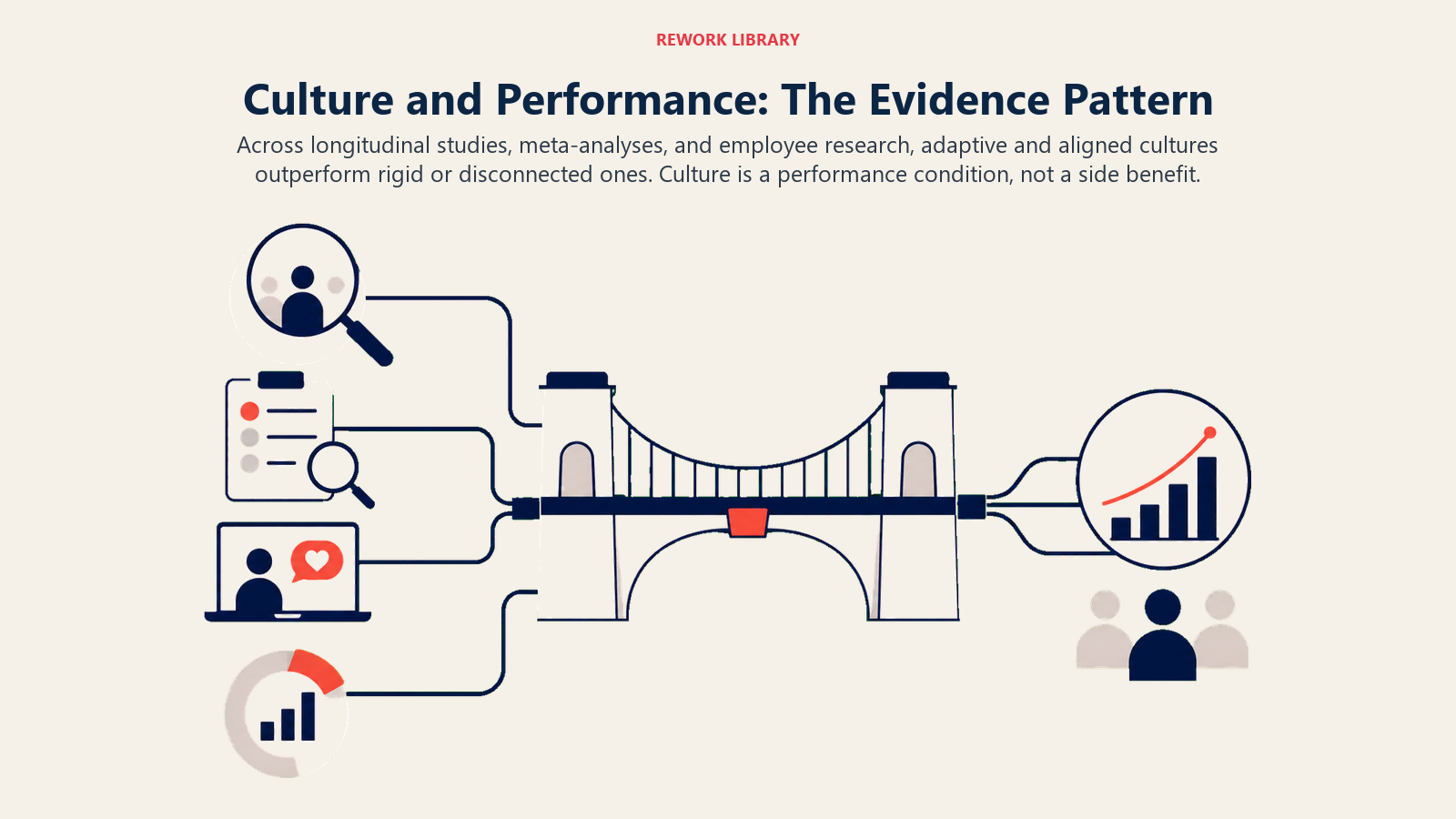
The clearest, most replicated piece of the culture-performance link is the engagement-to-productivity connection. Culture produces engagement in the first place: people who trust their leaders, understand what is expected of them, and believe their work matters show up differently than people who are just clocking hours. That difference compounds across a team and shows up in output, error rates, and customer experience.
Retention and the Cost of Getting It Wrong
Retention is where the link becomes a hard dollar figure instead of a soft feeling. Losing a good employee costs far more than the recruiting fee: lost institutional knowledge, a hiring and ramp cycle that takes months, and a temporary hit to output while the gap gets covered. SHRM's finding that strong culture predicts nearly four times better retention is really a statement about avoided cost. Why teams stay silent in meetings covers the earliest, cheapest-to-fix warning sign before someone quietly starts job hunting.
Financial Performance at the Company Level
The company-level evidence is where things get more contested. McKinsey's Organizational Health Index research, built on assessments of hundreds of organizations, consistently finds a large gap in shareholder returns between the healthiest organizations and the least healthy ones. Denison Consulting's decades of survey data on culture traits (mission, consistency, involvement, adaptability) similarly correlate with return on assets, sales growth, and quality across industries. That word, correlate, deserves its own honest section.
Correlation vs. Causation: Examining "Culture Eats Strategy" Honestly
The line "culture eats strategy for breakfast" gets attributed to Peter Drucker, though there is no verified source where he actually wrote it, which is itself a small lesson in how culture claims spread without evidence behind them. The idea is not wrong, but treating it as a law rather than a heuristic causes real mistakes.
The most rigorous look at this question is still Kotter and Heskett's long-running study of corporate culture and performance, which tracked over 200 companies across multiple industries for more than a decade. Their finding was more precise than "strong culture wins": companies with a strong culture that was also adaptive to a changing environment massively outperformed peers, while companies with a strong but rigid, inward-looking culture underperformed even companies with weaker cultures. Strength alone was not the variable that mattered. Fit between culture and environment was.
That is the honest version of "culture eats strategy": culture does not replace strategy, it determines whether an organization can execute whatever strategy it picks and adapt that strategy when conditions change. A brilliant strategy inside a culture that punishes bad news will quietly fail, one ignored warning sign at a time. But a strong culture pointed at the wrong market will not save a company either. There is also a reverse-causation problem here: profitable, growing companies can afford better pay and more patient management, both of which improve measured culture scores. Some of the correlation between "great culture" and "great performance" almost certainly runs in that direction too. The honest conclusion: culture is a necessary condition for sustained performance, not a sufficient one, and the studies below are strong correlational evidence, not proof of a single causal arrow.
The Mechanisms: How Culture Actually Turns Into Performance
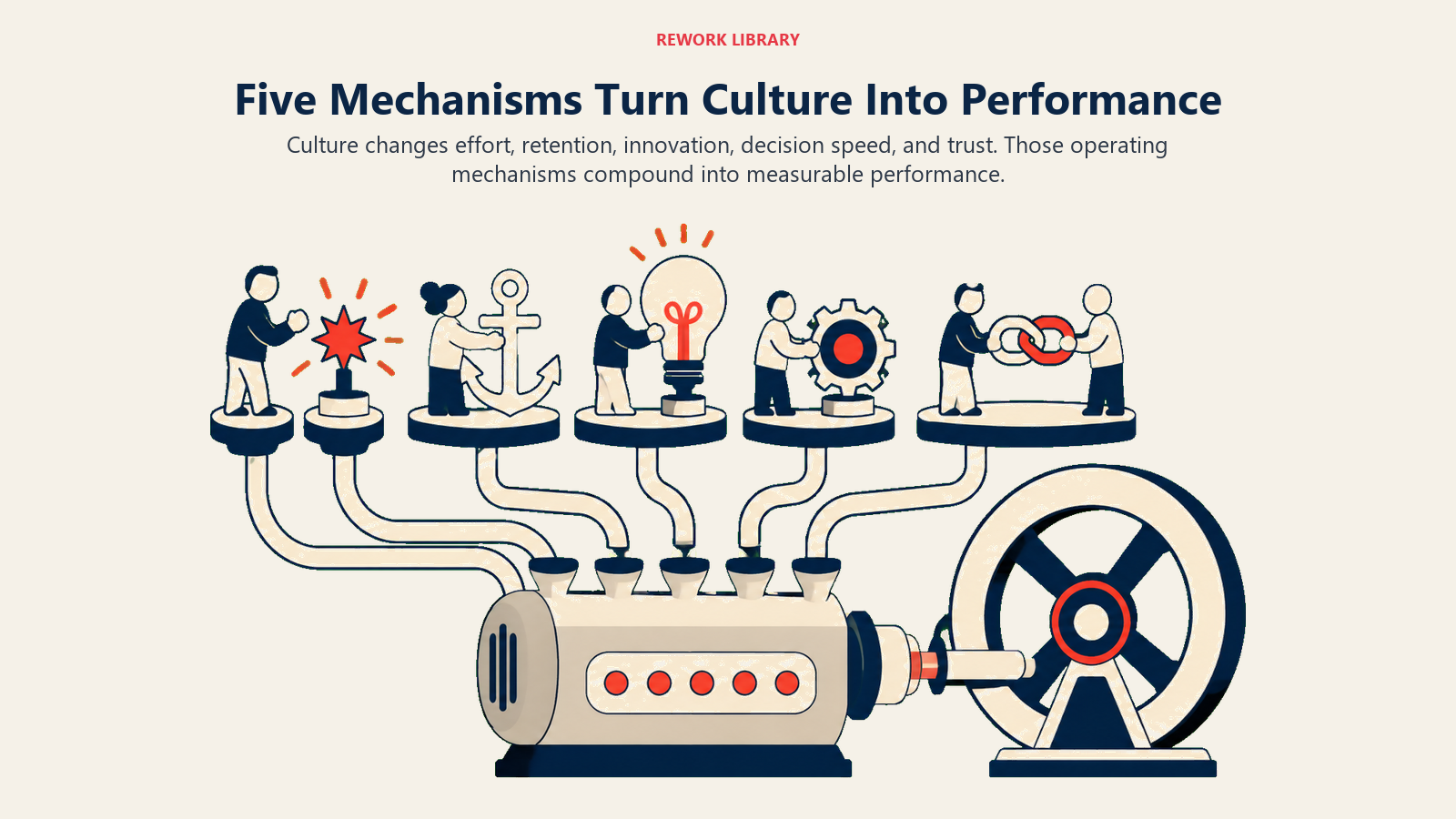
Knowing that culture correlates with performance is only useful if you understand the pipes it flows through. Five mechanisms carry most of the effect.
Discretionary Effort
Every job has a floor: the minimum someone can do without getting in trouble. Culture determines how far above that floor people choose to operate, and that gap, the extra care, the second look at a client email, the willingness to flag a problem early, is discretionary effort. Nobody can be forced to give it through a policy. It shows up when people trust that the effort will be noticed and that raising a problem will not be punished, which is exactly what a healthy culture supplies and a fear-based one destroys.
Retention
Retention is a mechanism, not just an outcome. Every person who stays instead of leaving preserves institutional knowledge, client relationships, and the quiet competence that only comes from doing a job for two years instead of two months. A culture that keeps good people keeps the team's collective skill compounding instead of resetting every time someone new has to be trained from scratch.
Innovation
Innovation requires people to propose ideas that might not work, which means it requires a culture where being wrong in public carries no lasting cost. Amy Edmondson's research on psychological safety, echoed in Google's Project Aristotle findings above, shows this is not a soft nice-to-have: teams that feel safe experimenting and disagreeing outperform teams that play it safe, because playing it safe means never testing the idea that would have been the breakthrough.
Speed of Decision-Making
Low-trust cultures are slow cultures, even when nobody intends them to be. When people do not trust that a decision will stick, or that a colleague's numbers are accurate, or that raising a concern will not be held against them, every decision picks up friction: extra approvals, defensive documentation, meetings scheduled just to cover a base that should not need covering. Trust removes that friction, which is why fast-moving teams so often describe their culture as simply "we trust each other to do the job."
Trust as the Multiplier
Trust sits underneath the four mechanisms above rather than beside them. It is what makes discretionary effort feel worth giving, what makes people stay instead of quietly interviewing elsewhere, what makes it safe to propose an unfinished idea, and what makes a decision stick without three rounds of double-checking. Building trust deliberately, as an operating system for how a team makes decisions and handles setbacks, is the closest thing to a single lever for moving all five mechanisms at once. Psychological safety and talent density are the two leadership levers most directly tied to how much trust a team actually has.
Culture and Performance Studies at a Glance
| Study or source | What it measured | What it found |
|---|---|---|
| Gallup, State of the Global Workplace | Business unit engagement vs. profitability and productivity | Top-quartile engaged units: 23% higher profitability, 18% higher productivity |
| McKinsey Organizational Health Index | Organizational health vs. shareholder returns | Top-quartile healthy organizations: roughly 3x the total shareholder returns of bottom-quartile peers |
| Kotter and Heskett, Corporate Culture and Performance | 200+ companies over 11 years, adaptive vs. rigid strong cultures | Adaptive strong cultures massively outperformed peers; rigid strong cultures underperformed even weak-culture peers |
| SHRM, Workplace Culture and Retention | Self-rated culture quality vs. retention and motivation | Good/excellent culture: ~4x more likely to stay, 83% report high motivation vs. 45% in poor cultures |
| Google, Project Aristotle | 180+ teams, factors behind team effectiveness | Psychological safety was the top differentiator of high-performing teams |
| Denison Organizational Culture Model | Culture traits (mission, consistency, involvement, adaptability) vs. business outcomes | Consistent correlation with return on assets, sales growth, and quality across industries |
When Culture Becomes a Performance Liability
Most culture content stops at "invest in culture and performance follows." That advice is incomplete, because a strong culture can just as easily become the thing holding performance back. The failure modes are specific and worth naming.
Cohesion Without Challenge
A tight-knit, high-trust team can slide into groupthink, where the same cohesion that makes people comfortable with each other also makes them reluctant to disagree. Consensus starts feeling more important than being right, and dissenting views get smoothed over before they reach the people who need to hear them. This is the dark side of the trust mechanism described above: strong social bonds without a deliberate habit of inviting challenge produce comfortable, confident, wrong decisions.
Rigidity Disguised as Strength
This is the failure mode Kotter and Heskett documented directly. A culture built for a market that no longer exists does not know it is obsolete. It keeps rewarding behaviors that worked five years ago and reads early warning signs as noise rather than signal. Kodak and Blockbuster are the textbook cases: strong, confident, deeply held cultures that were exceptionally good at executing a strategy the market had already started to abandon.
Culture as an Excuse for Bad Management
"That's just our culture" is one of the most expensive sentences a leader can say, because it usually excuses a specific management failure rather than describes a genuine trait. A toxic team lead protected because they hit their numbers, a burnout-driving pace defended as "how we move fast here": these are management choices wearing a culture costume. Left unaddressed, they erode the same trust and discretionary effort a healthy culture builds.
Strength That Outpaces Structure
Fast-growing companies sometimes discover that the informal, high-trust culture that worked at 40 people cannot scale to 400 without deliberate systems underneath it. What felt like culture was partly just proximity: everyone knew everyone, so trust formed naturally. Once that proximity disappears, culture has to be built on purpose or it quietly degrades into subcultures and the exact silence described in why teams stay silent in meetings.
How to Invest in Culture as a Performance Lever
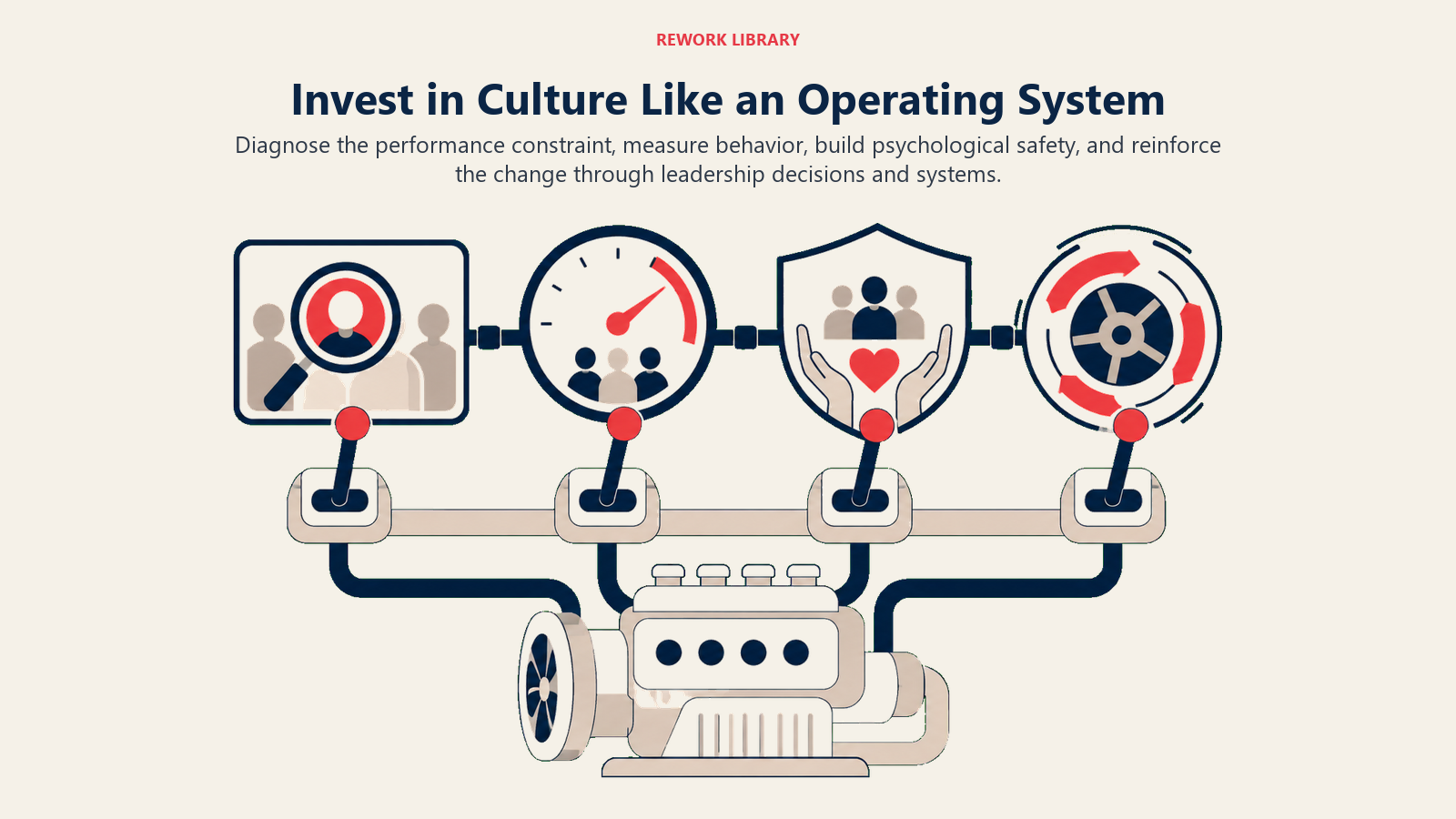
Given both the evidence and its limits, treating culture as a genuine performance lever means being deliberate about the investment, not just enthusiastic about the idea.
Diagnose Before You Invest
Skip the values refresh until you know what is actually happening. Look at exit interview themes, engagement survey trends by manager rather than company-wide, and where good ideas or bad news tend to die on their way up the chain. How business culture differs across the world is useful here too: a global team's engagement numbers can look inconsistent for reasons that trace back to how different national cultures, mapped through Hofstede's cultural dimensions and Erin Meyer's Culture Map, express disagreement differently, not to management quality.
Tie Culture Systems to the Metrics That Matter
The mechanisms above point directly at what to measure: retention of high performers specifically, not just overall attrition; how fast decisions get made and unmade; and whether problems get raised early or surface late as expensive surprises. Those are performance metrics with a culture cause, which makes the business case for investing in culture far more concrete than a satisfaction score alone.
Protect Psychological Safety on Purpose
Given how much of the mechanism runs through trust, protecting it deliberately, in how meetings are run, how mistakes are handled publicly, and how disagreement with a senior person is received, is one of the highest-leverage places to invest. A genuine culture architecture redesign, changing what gets measured, promoted, and rewarded, does more here than any single training session.
Make It a Leadership Discipline, Not an HR Initiative
Culture investment fails when it lives entirely inside HR as a program with a budget line and a survey cadence. It works when leaders treat the mechanisms above (effort, retention, trust, speed) as operating metrics they personally own, the same way they own revenue and cost. What leadership actually means is a useful gut check: culture is one of the clearest tests of whether leadership is exercising real influence or just formal authority.
Tooling plays a smaller but genuine role here. Culture is decided by decisions and systems, not software, but consistent onboarding, visible recognition, and clean handoffs between HR and the rest of the business are easier to sustain when they are not scattered across five disconnected tools. That kind of operational consistency is what Rework's People app (HRIS, time and attendance, and timesheets in one platform) supports underneath the harder leadership work above, not a substitute for it.
Culture and Performance in the Age of AI
As AI takes over more of the routine, well-specified parts of a job, the performance differential left for humans shifts toward the parts culture actually governs: judgment calls, trust, initiative, and the willingness to flag something an automated process missed. When two teams have access to the same AI tools, the gap between them increasingly comes down to whether their culture encourages people to catch what the model got wrong, or quietly defers to it because raising a concern feels risky.
This is the same underlying dynamic Microsoft's Work Trend Index research on human-agent teams and Deloitte's Human Capital Trends work on AI-era culture point to from different angles: the technology layer is becoming commoditized faster than the trust layer around it. A team with strong psychological safety will treat an AI's confident, wrong output as something worth double-checking out loud. A team without it will let the mistake through rather than be the one who questioned the machine. What is AI-native culture and AI cultural debt go deeper on how this plays out as AI agents become regular participants in daily work, not just tools people occasionally open.
Where to Go Next
- What is business culture?, for the foundational definition, models, and levers this article builds on
- Why teams stay silent in meetings, for the earliest, cheapest-to-fix warning sign that the performance link is breaking down
- What is AI-native culture?, for how the mechanisms in this article carry into human-AI teams
- Psychological safety, for the leadership behaviors that build the trust mechanism described above
Culture does not eat strategy, and it does not automatically produce performance either. It sets the conditions, trust, effort, retention, and speed, that determine whether a good strategy actually gets executed and whether a team catches its own mistakes before they get expensive. The organizations that treat that link as real, measurable, and reversible tend to keep it. The ones that treat it as a slogan usually find out the hard way which mechanism broke first.

Co-Founder, Rework.com
On this page
- What "Culture Drives Performance" Actually Means
- Key Facts
- The Evidence: What the Research Actually Shows
- Engagement and Productivity
- Retention and the Cost of Getting It Wrong
- Financial Performance at the Company Level
- Correlation vs. Causation: Examining "Culture Eats Strategy" Honestly
- The Mechanisms: How Culture Actually Turns Into Performance
- Discretionary Effort
- Retention
- Innovation
- Speed of Decision-Making
- Trust as the Multiplier
- Culture and Performance Studies at a Glance
- When Culture Becomes a Performance Liability
- Cohesion Without Challenge
- Rigidity Disguised as Strength
- Culture as an Excuse for Bad Management
- Strength That Outpaces Structure
- How to Invest in Culture as a Performance Lever
- Diagnose Before You Invest
- Tie Culture Systems to the Metrics That Matter
- Protect Psychological Safety on Purpose
- Make It a Leadership Discipline, Not an HR Initiative
- Culture and Performance in the Age of AI
- Where to Go Next