Trust When Your Teammate Is an AI
Turn this article into takeaways for your work.


Each assistant summarizes the article only for you and suggests best practices for your work.
Trusting an AI teammate means calibrating how much you rely on its output to evidence of how reliable it actually is on a given task, not to how confident it sounds. That's a different skill than trusting a colleague, because an AI has no intent to deceive and no career at stake if it's wrong, which removes the two signals people normally use to decide who to believe.
Most advice on "trusting AI" skips straight to policy: write a usage guideline, add a disclosure rule, done. That's necessary but it isn't the hard part. Trust with a human teammate and trust with an AI teammate run on almost entirely different mechanics, and teams that miss the difference end up stuck in one of two costly failure modes: quietly redoing everything the AI touches, or rubber-stamping output that turns out to be confidently wrong. This article covers why the mechanics differ, both failure modes with the research behind them, what calibrated trust looks like in practice, what actually builds it, and the team norms that make it durable.
Why Trusting an AI Is a Different Problem Than Trusting a Person
Human trust is built on a simple, well-studied foundation: you watch someone's ability, their integrity, and whether they seem to care about your interests (benevolence), across enough situations that a pattern emerges. We cover that model in depth in how to build trust in the workplace. The mechanism works because a person has intent: they can choose to deceive you, and the possibility of getting caught, of a reputation cost, is part of what keeps most people honest.
An AI system has neither part of that mechanism. It doesn't intend to mislead you when it's wrong, and it has no reputation to protect, no career on the line. That's not a moral failing, it's just a different kind of system, but it means the shortcuts people normally use to decide who to trust (does this person mean well, do they have something to lose if they don't deliver) simply don't apply. You're left evaluating something closer to a measuring instrument than a colleague: how accurate is it, under what conditions, and how do you know when it's drifted.
Confident and Wrong Looks Identical to Confident and Right
The sharper problem is presentation. A person who is unsure of an answer usually signals it through hedging, tone, or body language. A large language model produces a fabricated citation, a wrong number, or an invented quote in exactly the same fluent, assured register as a correct one. This is the core mechanic behind AI hallucination: the system isn't lying, it's generating plausible text, and plausible and true are not the same property. Nothing about how confident the output sounds tells you which one you're looking at.
That single fact is why trust in AI can't just extend trust in people. You need external signals, evidence from testing, a track record on a specific task, sourcing you can check, because the internal signal humans instinctively read for confidence has been decoupled from actual reliability.
The Two Failure Modes: Under-Trust and Over-Trust
Teams without a deliberate approach don't land in the middle. They swing to one of two extremes, and both are expensive in different ways.
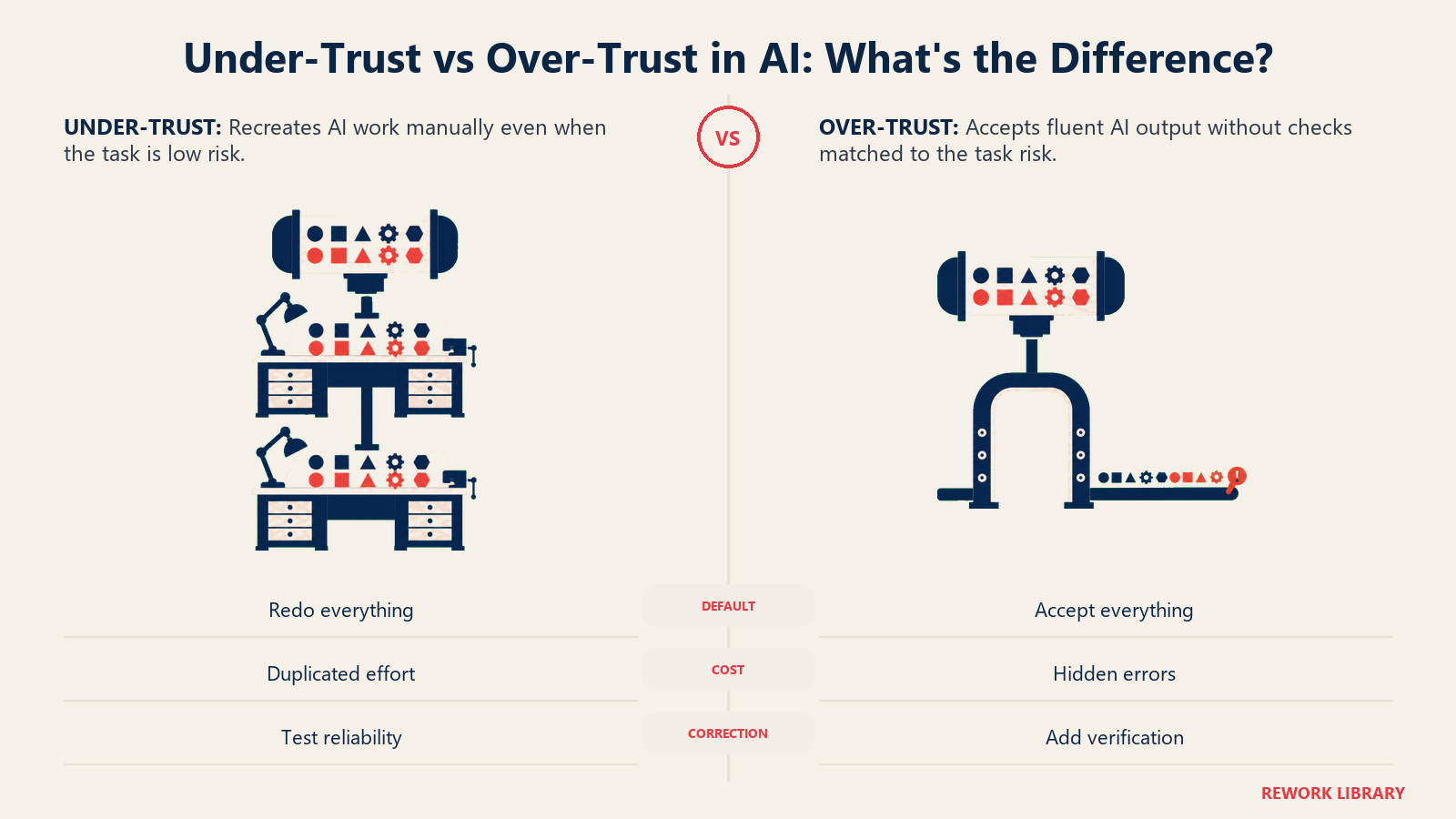
Under-Trust: Redoing the Agent's Work by Hand
Under-trust looks responsible on the surface. A manager reviews every line an agent produces with the same scrutiny they'd apply if they didn't trust the system at all, effectively doing the work twice. That erases the productivity gain the AI was supposed to deliver. If checking a draft takes as long as writing it from scratch, the organization has added a tool without changing its output, and whoever is doing the double-checking eventually burns out or quietly stops, which just delays the over-trust problem instead of solving it.
Under-trust shows up hardest in teams that had one bad early experience with an AI tool and never revisited it. A single embarrassing hallucinated fact in a client deck can freeze a team's willingness to rely on AI output for a year, even after the tool improves.
Over-Trust: Automation Bias and the Cost of Skipping the Check
Over-trust, or automation bias, is the tendency to give an automated system's output more weight than the evidence supports, and to stop verifying once a system has been right a few times. It's one of the best-documented failure modes in human-automation research, going back decades of aviation and safety studies, and it gets worse, not better, as AI systems improve, because a system that's right 95% of the time is confident enough to make people stop checking the other 5%.
A 2023 study in the journal Radiology put a number on how severe this can get. Researchers had 27 radiologists read 50 mammograms, some paired with an AI system's BI-RADS classification suggestion. When the AI's suggestion was wrong, accuracy for less-experienced radiologists collapsed from roughly 80% down to under 20%. Radiologists with more than 15 years of experience weren't immune either: their accuracy dropped from 82% to 45.5%. Experience reduced the damage. It didn't come close to eliminating it.
That's a clinical setting, but the mechanism shows up in ordinary knowledge work too, under a lower-stakes name: workslop. A September 2025 survey of 1,150 US full-time workers by BetterUp Labs and Stanford's Social Media Lab found 40% had received "workslop," AI-generated content that looks polished but lacks the substance to move a task forward, in the preceding month. Each incident took an average of two hours to sort out, at an estimated cost of $186 per employee per month, or roughly $9 million a year for a 10,000-person company. Workslop is over-trust in practice: someone accepted an agent's draft at face value, passed it along, and left the actual verification for whoever received it next.
Key Facts
- Radiologist accuracy on mammogram readings dropped from about 80% to under 20% for less-experienced readers, and from 82% to 45.5% for readers with 15+ years of experience, when an AI system's suggestion was incorrect, in a study of 27 radiologists reading 50 mammograms. Source: Automation Bias in Mammography, Radiology (RSNA), via EurekAlert
- 40% of 1,150 surveyed US full-time workers received AI-generated "workslop" in the preceding month, each incident costing an average of two hours to fix, an estimated $186 per employee per month, or about $9 million a year for a 10,000-person company. Source: BetterUp Labs, "Workslop"
- 60% of executives already use AI in decision-making, but only 5% say they manage it well, a gap Deloitte names as a driver of organizational "cultural debt." Source: Deloitte 2026 Global Human Capital Trends
- 56% of leaders design AI solely for business outcomes; only 40% design for both business and human outcomes, and 42% of workers say their organization isn't evaluating AI's impact on people at all. Source: Deloitte 2026 Global Human Capital Trends
- When managers visibly modeled their own AI use, employees reported a 30-point lift in trust toward agentic AI and were 1.4 times more likely to become high-frequency, safety-net-supported users of it. Source: Microsoft Work Trend Index 2026
Calibrated Trust: Trust But Verify, With Specifics
Researchers who study human-automation interaction use the term calibrated trust (also called appropriate reliance) for the target state between the two failure modes: accepting a system's output when the evidence says it's reliable, and pushing back when the evidence says it isn't, task by task rather than as a blanket policy. The distinction that matters here is between trust and reliance. Trust is what someone says they believe about a system; reliance is what they actually do with its output. Research consistently finds the two drift apart: someone can say they don't fully trust an AI tool and still act on its output without checking it, because verification takes effort and the path of least resistance is to accept.
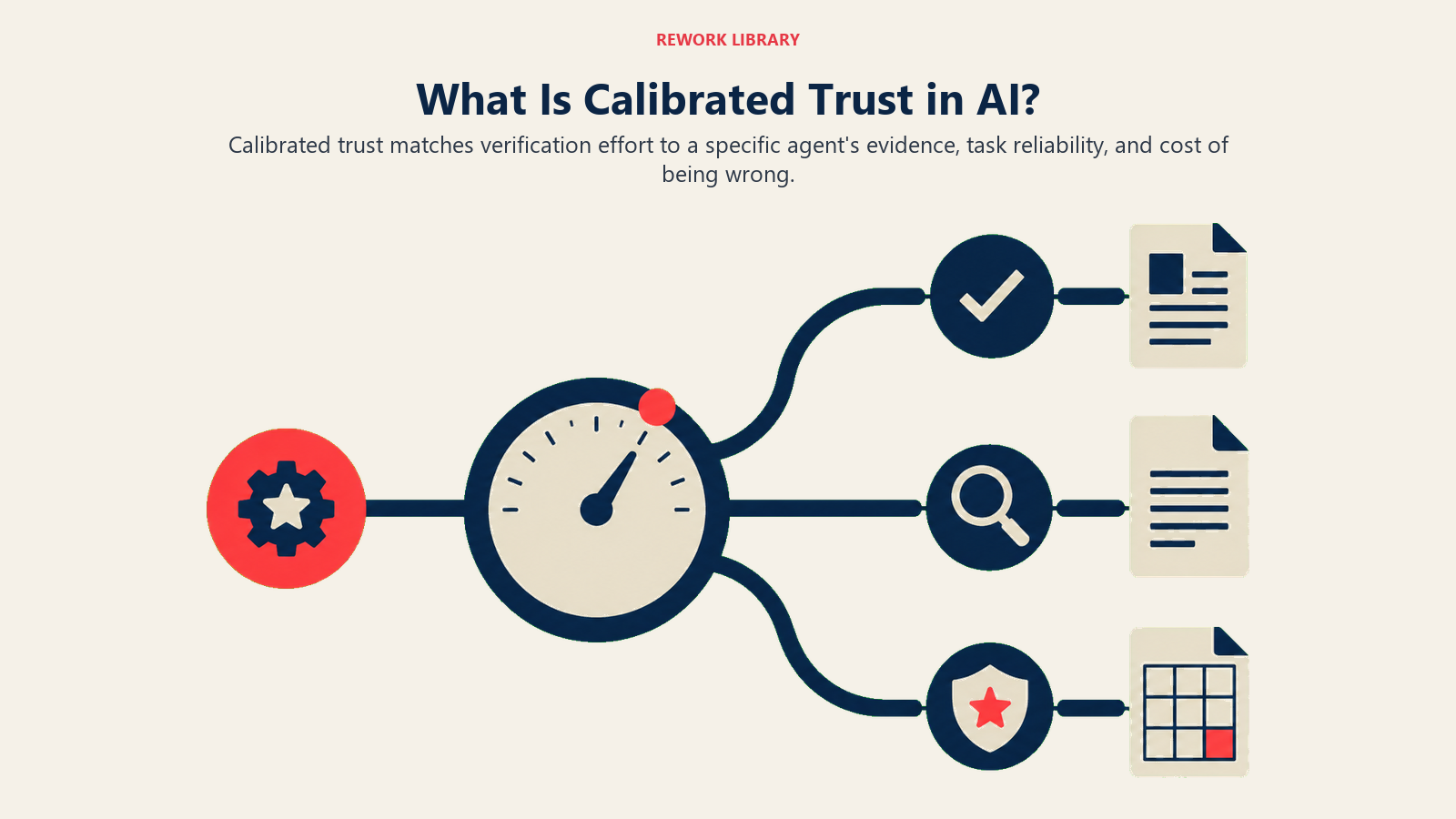
Calibration only works when it's specific to the task, not the tool as a whole. An agent that reliably drafts a first-pass meeting summary is a completely different reliability profile than the same model asked to calculate a financial projection or cite a legal precedent. "Do we trust the AI" is the wrong question. "Do we trust this agent, on this task, based on what we've actually seen it get right and wrong" is the useful one.
Know Where the Agent Is Reliable and Where It Isn't
Building that task-level picture takes deliberate tracking, not intuition. A team that has quietly noticed an agent nails first drafts of routine emails but regularly fabricates statistics in research summaries has done real calibration work, even if nobody wrote it down. The gap most teams have isn't the noticing, it's making that knowledge explicit and shared instead of living in one person's head, so a new hire doesn't repeat the over-trust mistake the rest of the team already learned to avoid.
What Verification Actually Looks Like Day to Day
Concretely, this means spot-checking sourced claims before a document goes external, sanity-checking any number an agent produces against a known baseline, and treating a first draft as a draft to edit, not something to forward as-is. None of that requires redoing the work from scratch, which is what separates calibrated trust from under-trust: targeted checking where the agent is known to be weak, and confident acceptance where it's known to be strong.
What Builds Appropriate AI Trust
Four things reliably move a team from guessing to calibrated, and none of them is a one-time training session.
Transparency. An agent that shows its sources, flags its confidence, or explains the steps it took gives a person something real to evaluate, instead of a polished final answer to accept or reject on faith. Teams working with tools that surface visible reasoning or citations tend to calibrate faster than teams stuck with a black box that only returns a clean-looking result.
Track record. Trust in a new hire builds by watching them handle real situations over weeks. Trust in an agent should build the same way, by keeping an honest account of what it got right and wrong on specific task types, not by assuming week one performance predicts week twelve.
Guardrails. Trust is easier to extend when the cost of a mistake is bounded. An agent scoped to draft, not send; to recommend, not execute a payment; to flag, not auto-close a ticket, gives people room to verify before anything irreversible happens. We go deeper on scoping that authority in AI agent guardrails.
Human-in-the-loop by design, not by default. There's a real difference between a workflow with a checkpoint deliberately placed where errors matter most, and one where a human just happens to glance at the output because that's how it's always been done. Human-in-the-loop done well places the checkpoint at the highest-leverage point, not everywhere, which is what causes the under-trust failure mode in the first place.
The Team and Culture Angle: Shared Norms for When to Check
None of the above works if it lives in one careful person's head. The actual failure point on most teams isn't that nobody knows to verify agent output, it's that there's no shared, explicit answer to "who checks what, and when," so everyone defaults to their own instinct, and instincts vary wildly. One person spot-checks everything; another forwards agent drafts without a second look; neither is following a written norm, because there isn't one.
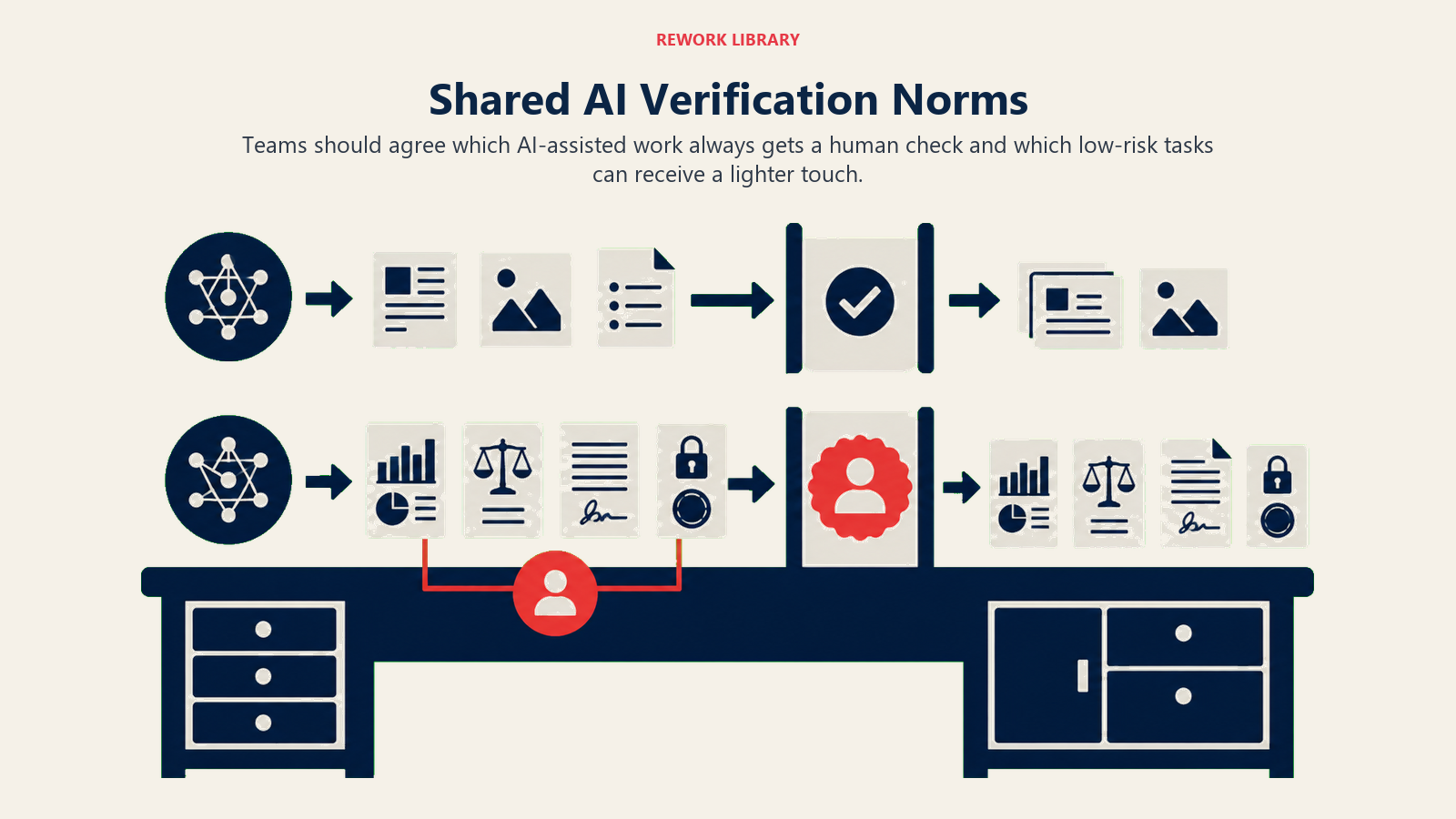
This is squarely a culture problem, not a tooling one. AI etiquette and workplace norms covers the broader set of unwritten rules teams are negotiating around disclosure and appropriate use; the trust-specific version means agreeing, out loud, on which categories of work always get a human check before anything external happens (client-facing numbers, legal language, anything irreversible) and which categories are low-stakes enough for a light touch. Getting that split wrong in either direction reproduces one of the two failure modes above at a team level instead of an individual one.
The same norms matter more, not less, as agents stop being tools one person operates and start acting as part of the team's actual output, the shift covered in human-agent teams. A team without shared trust norms doesn't fail loudly. It accumulates the kind of gap Deloitte calls AI cultural debt: quiet over-reliance in some corners, quiet redundant double-checking in others, nobody with a clear picture of which is happening where until a visible mistake forces the conversation. Getting this right is one piece of the larger shift covered in what AI-native culture actually looks like, where trust, ownership, and accountability all have to be rebuilt on purpose.
None of this is unique to companies with dedicated AI teams. A five-person shop using an agent to draft outreach emails needs the same explicit answer to "who checks this before it goes out" that a thousand-person enterprise does. The stakes scale with company size; the calibration problem doesn't.
Where to Go Next
- How to build trust in the workplace, the human-to-human trust models this article contrasts against
- Human-agent teams, what changes when an agent becomes part of the actual output, not just a tool
- AI cultural debt, what happens when trust norms never get built and the gap compounds
- AI etiquette and workplace norms, the broader set of unwritten rules teams are negotiating around AI use
- What is AI-native culture?, the full picture of how trust and accountability shift once agents are teammates
- What is agentic AI?, how these systems plan and act, part of why their errors look different from a simple tool's
- AI hallucination, the specific mechanism behind confident, fluent, wrong output
- Human-in-the-loop, how to design the checkpoint instead of leaving it to habit
Trust in an AI teammate shouldn't be a private feeling carried by whoever happens to watch it most closely. Make it a measurement instead: track where the agent is reliable, where it isn't, and share that read across the team so trust is calibrated rather than assumed. Teams that do this stop swinging between blind faith and blanket suspicion, and start using the agent for exactly what it has earned, no more and no less.

Co-Founder, Rework.com
On this page
- Why Trusting an AI Is a Different Problem Than Trusting a Person
- Confident and Wrong Looks Identical to Confident and Right
- The Two Failure Modes: Under-Trust and Over-Trust
- Under-Trust: Redoing the Agent's Work by Hand
- Over-Trust: Automation Bias and the Cost of Skipping the Check
- Key Facts
- Calibrated Trust: Trust But Verify, With Specifics
- Know Where the Agent Is Reliable and Where It Isn't
- What Verification Actually Looks Like Day to Day
- What Builds Appropriate AI Trust
- The Team and Culture Angle: Shared Norms for When to Check
- Where to Go Next