AI Etiquette: The New Workplace Norms for Using AI at Work
Turn this article into takeaways for your work.


Each assistant summarizes the article only for you and suggests best practices for your work.
AI etiquette is the emerging set of norms for using AI respectfully and transparently at work: when to say you used it, who gets credit for AI-assisted output, which moments call for a human instead, and how much to lean on it before help turns into a shortcut nobody signed off on.
None of this is written down anywhere official, which is exactly the problem. "Email etiquette" felt just as new once, when to reply-all, how fast a reply was expected. Teams worked that out informally, unevenly, and often the hard way. AI etiquette is following the same path, except the stakes are higher: get email etiquette wrong and you annoy a colleague, get AI etiquette wrong and you can quietly erode trust, misattribute someone's work, or leak a client's data into a tool nobody approved.
What "AI Etiquette" Actually Means
AI etiquette sits one layer below AI policy. Policy says which tools are approved and what data can touch them. Etiquette is everything policy doesn't cover, the judgment calls people make dozens of times a day that no document anticipated. Do you mention you used AI to draft this email? Should a note-taking bot be sitting in on this particular meeting?
Most companies have an AI usage policy by now, often a page about approved tools and data handling. Far fewer have said anything about the social norms, and that gap is where most of the friction actually lives. A policy document doesn't tell a manager whether it's acceptable to use AI to draft feedback for a direct report's review. A norm does, once a team has actually talked about it.
Key Facts
- 57% of employees globally admit to presenting AI-generated content as their own without disclosing it (53% in the US), based on a KPMG study of more than 48,000 people across 47 countries. Source: KPMG, Trust, attitudes and use of artificial intelligence
- 40% of US desk workers received "workslop," AI-generated content that looks polished but lacks substance, in the past month, costing roughly $186 per employee per month to clean up. Source: BetterUp Labs and Stanford Social Media Lab, Workslop
- 39.7% of all data employees move into AI tools involves sensitive information, entered roughly once every three days per employee. Source: Cyberhaven, 2026 AI Adoption & Risk Report
- 33.4% of employed Americans say an AI notetaker has sat in on a work meeting, but only 34.7% of that group were always asked for permission first; 25.1% were never asked. Source: Kolmogorov Law / Pollfish survey, July 2026
- 60% of executives already use AI in decision-making, but only 5% say they manage that well, a gap Deloitte's 2026 research names "cultural debt." Source: Deloitte, 2026 Global Human Capital Trends
- When managers visibly modeled their own AI use, employees reported a 30-point lift in trust toward agentic AI, evidence norms spread through leadership behavior more than policy documents. Source: Microsoft Work Trend Index 2026
- 44% of US workers say their employer has no clear AI policy, or aren't sure one exists, even though most already use AI for work; at companies under 10 employees, that figure rises to 59%. Source: Founder Reports, AI in the Workplace Report
The Disclosure Question: Do You Say You Used AI?
Disclosure is the norm teams argue about most, usually without realizing they're arguing about it, because the disagreement shows up as vague discomfort rather than an open debate. The KPMG figures above put a number on something a lot of leaders suspected: more than half of employees who use AI at work don't say so, and a meaningful share actively present the output as fully their own.
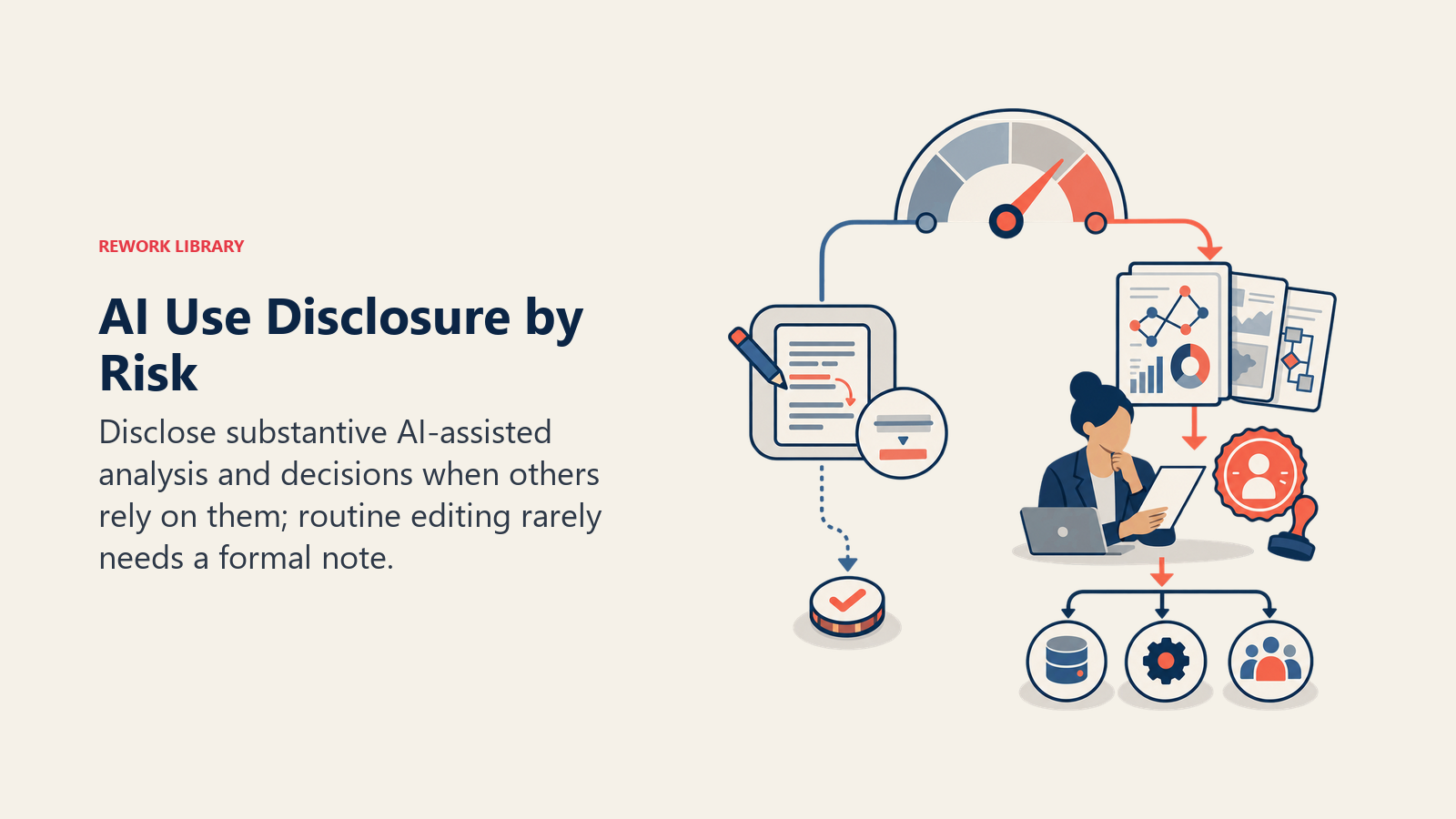
The honest complication is that "always disclose" isn't obviously right either. Nobody expects a footnote every time spellcheck catches a typo. The norm that actually holds up in practice scales disclosure to stakes: light editing doesn't need a mention, but substantive content, an analysis, a recommendation, a decision memo, probably does, especially once someone downstream is going to rely on it. That's a judgment call a policy document can't make for a team; it has to be discussed and agreed on, ideally before the first awkward moment forces the conversation. The deeper shift behind this tension, from "I operate the tool" to "I supervise the output," is covered in what AI-native culture actually is.
Attribution and Credit: Whose Work Is This?
Adjacent to disclosure, and just as unresolved, is who gets credit when a person and an AI agent both contributed. When an agent drafts most of a proposal and a person edits the final fifth, most recognition systems still assume one human produced 100% of the output, because that's the only model they were ever built to score.
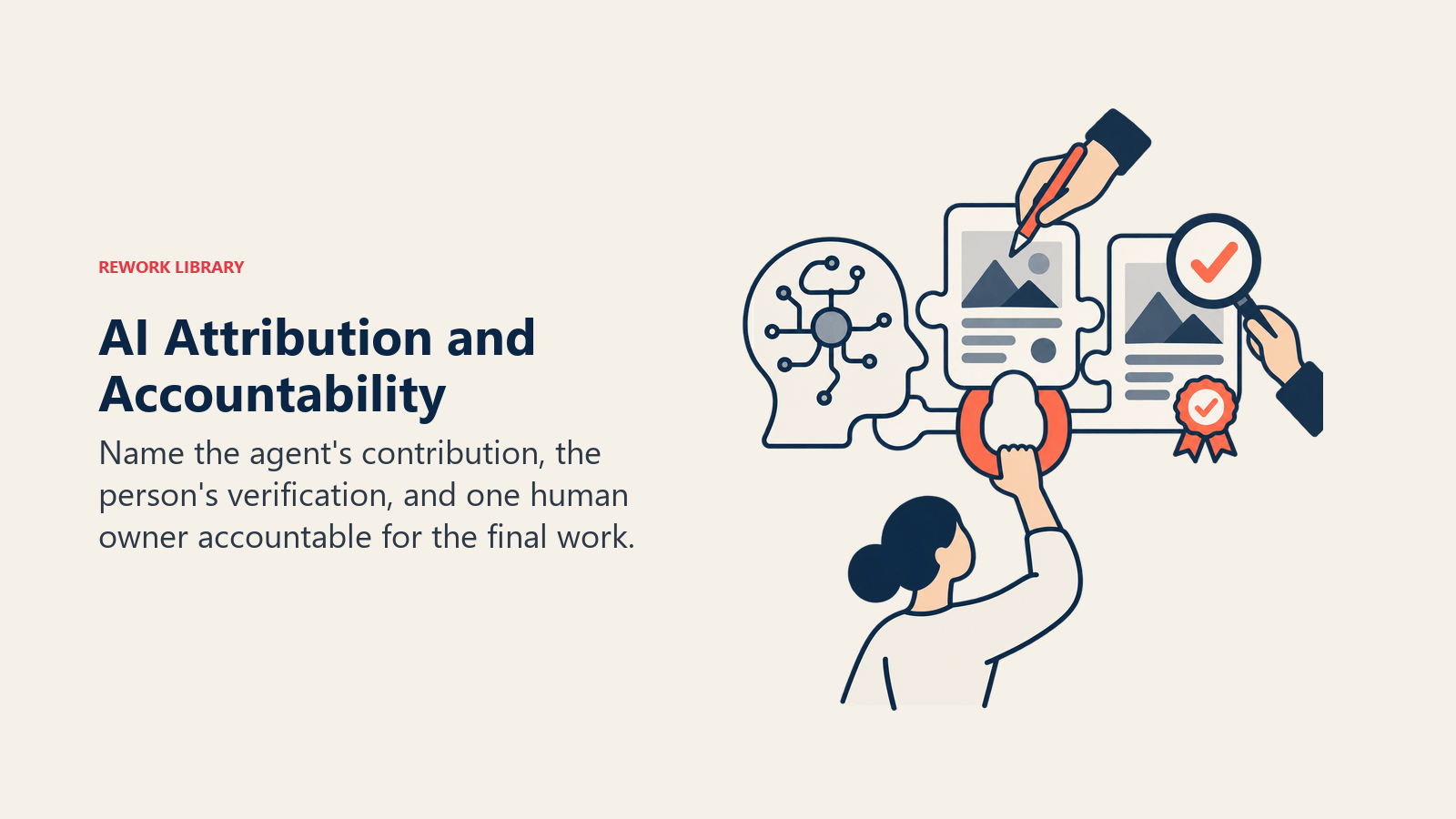
Teams that skip this conversation tend to land in one of two bad spots. Some quietly inflate credit, letting AI-assisted work read as if a person did it all unassisted, which breeds resentment once colleagues figure out the ratio. Others discount AI-assisted output as somehow less legitimate, which punishes people for using a tool that was often the efficient, honest choice. Neither extreme is fair, and both erode the trust that human-agent teams depend on. A workable norm names the split honestly: what the agent produced, what the person changed or verified, and who's accountable if it's wrong. That last part matters more than the first two combined, because credit without accountability is just marketing.
When Not to Use AI: The Moments That Call for a Human
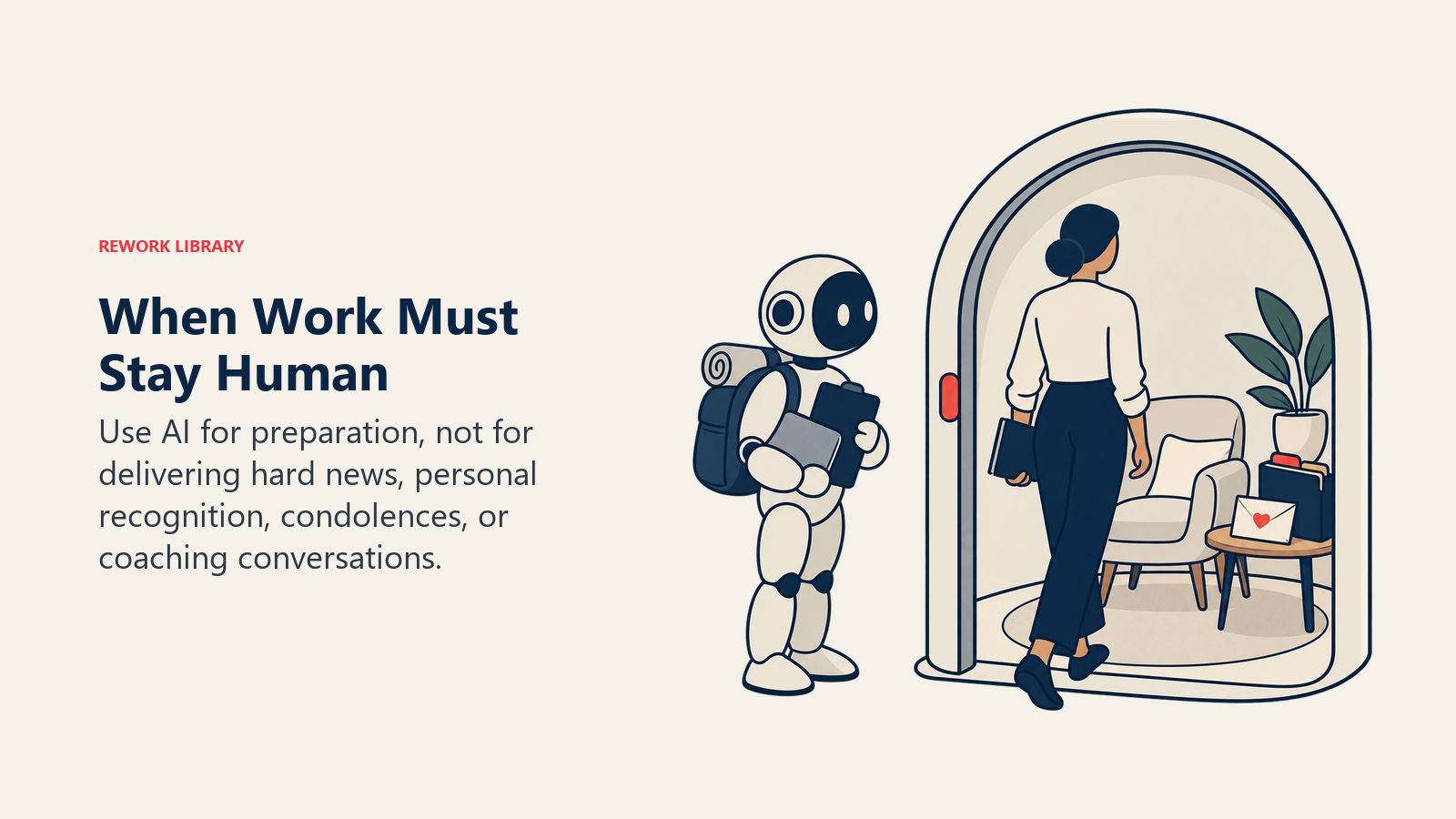
Most AI etiquette conversations focus on how to use AI well. The harder half is agreeing on when not to use it at all, because some moments carry weight a fluent output can't substitute for.
Layoffs, performance reviews, and other hard news
Employees can tell when a difficult message was AI-drafted, and the tell isn't bad grammar, it's an unnatural formality that reads like it was optimized to avoid liability rather than written by someone who weighed the decision. SHRM has specifically warned employers not to use AI alone to deliver layoff news: the message can technically say the right things and still feel hollow, because the recipient senses nobody sat with the decision long enough to write it themselves.
Condolences, congratulations, and other personal moments
The same logic applies at a smaller, more personal scale. A note to someone who lost a family member, or a message congratulating a genuine milestone, carries meaning specifically because a person chose to spend a few minutes composing it. Running it through AI first doesn't just risk a slightly off tone, it changes what the gesture is. The moment stops being "someone thought of me" and becomes "someone delegated thinking of me," even if the recipient never learns how it was written.
One-on-ones and coaching conversations
The most consequential version shows up in ongoing people management. A manager can use AI to structure notes or prep talking points, but the coaching conversation itself, the follow-up questions, the read on how someone's really doing, is the kind of interpersonal work that psychological safety and workplace trust are built on. Outsourcing that substance to an AI-drafted script, rather than using AI as prep, is a fast way to make a direct report feel like a ticket instead of a person.
Over-Reliance and Workslop: When AI Help Becomes Extra Work
The workslop research from BetterUp Labs and Stanford's Social Media Lab names a failure mode common enough to need a word: AI-generated content that looks finished but isn't, a slide deck, report, or piece of code that creates the appearance of progress while quietly pushing the real thinking onto whoever receives it. A 40% monthly incidence rate means this isn't an edge case, it's a routine tax most desk workers are already paying without a name for it.
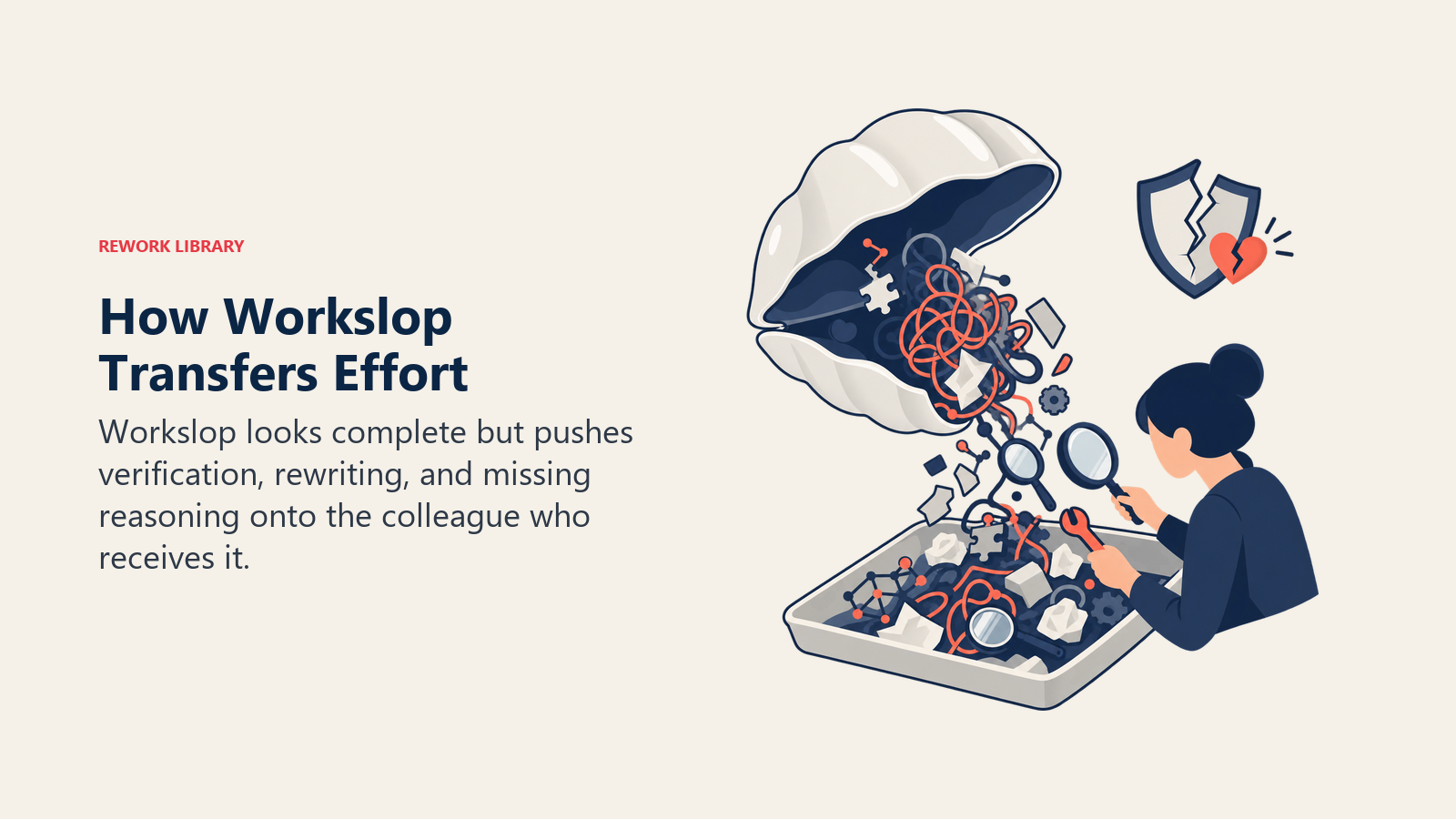
The etiquette failure underneath workslop is subtle: it's not that someone used AI, it's that they treated a first draft as a finished one and passed the gap on to a colleague to close. The same research found receiving workslop measurably damages how people view the sender, more than half report feeling annoyed, and a large share start viewing that colleague as less trustworthy or capable, regardless of their other work. That reputational cost compounds the same way AI slop damages external content: quality standards eroding because volume got easier than depth.
Shadow AI and Sensitive Data: The Norms Nobody Wrote Down
A large share of AI etiquette problems trace back to a simpler root cause: people using AI tools their employer never approved, sometimes called shadow AI. It happens because personal AI accounts are one tab away, and asking permission first often feels slower than just getting the work done.
The risk isn't hypothetical. Cyberhaven's research found nearly 40% of all data employees move into AI tools qualifies as sensitive, source code, client information, financial figures, and that the average employee does this roughly every three days. Most of that isn't malicious, it's someone pasting a client email into a chatbot to draft a reply faster, without thinking through where that information just went. The etiquette norm worth setting explicitly: before pasting anything into an AI tool, ask whether you'd be comfortable if the person it's about could see exactly where it went. AI governance covers the structural side; etiquette is the daily habit that keeps the gap from reopening between policy reviews.
AI in Meetings: Notetakers, Transcripts, and Consent
AI notetakers have quietly become one of the most common AI tools at work, and one of the least governed by any actual norm. A third of employed Americans have now had one sit in on a meeting, and the consent data is the real story: fewer than 35% say they were consistently asked first, and a quarter say they were never asked at all.
The etiquette gap here is almost entirely about the moment before the meeting starts, not the tool itself. Announcing that a bot will be recording, and giving people a real chance to object, costs about ten seconds. Skipping that step doesn't just risk a legal issue in consent-to-record jurisdictions, it quietly signals that speaking freely might get transcribed and forwarded somewhere unexpected. That has a direct line to whether people stay quiet in meetings or say what they actually think.
Why Explicit Norms Beat Leaving It Implicit
Every gap above shares a root cause: teams are adopting AI faster than they're agreeing on how to use it around each other. The Founder Reports data captures the scale plainly, most workers already use AI, and nearly half say their employer never told them where the lines are, worse at smaller companies where nobody owns writing that policy.
Leaving these norms implicit doesn't make the underlying tension go away, it just defers the cost, the same mechanism Deloitte's research calls cultural debt. A team without an explicit disclosure norm doesn't avoid the disclosure question, it just answers it inconsistently, person by person, until someone gets burned by an assumption nobody agreed to. Explicit norms are cheaper, not because they're perfect, but because they turn a hundred individual judgment calls into one conversation the team only has to have once, and can revisit as the tools change.
A Practical Starter Set of Team AI Norms
Teams that get this right write down something short and specific rather than exhaustive:
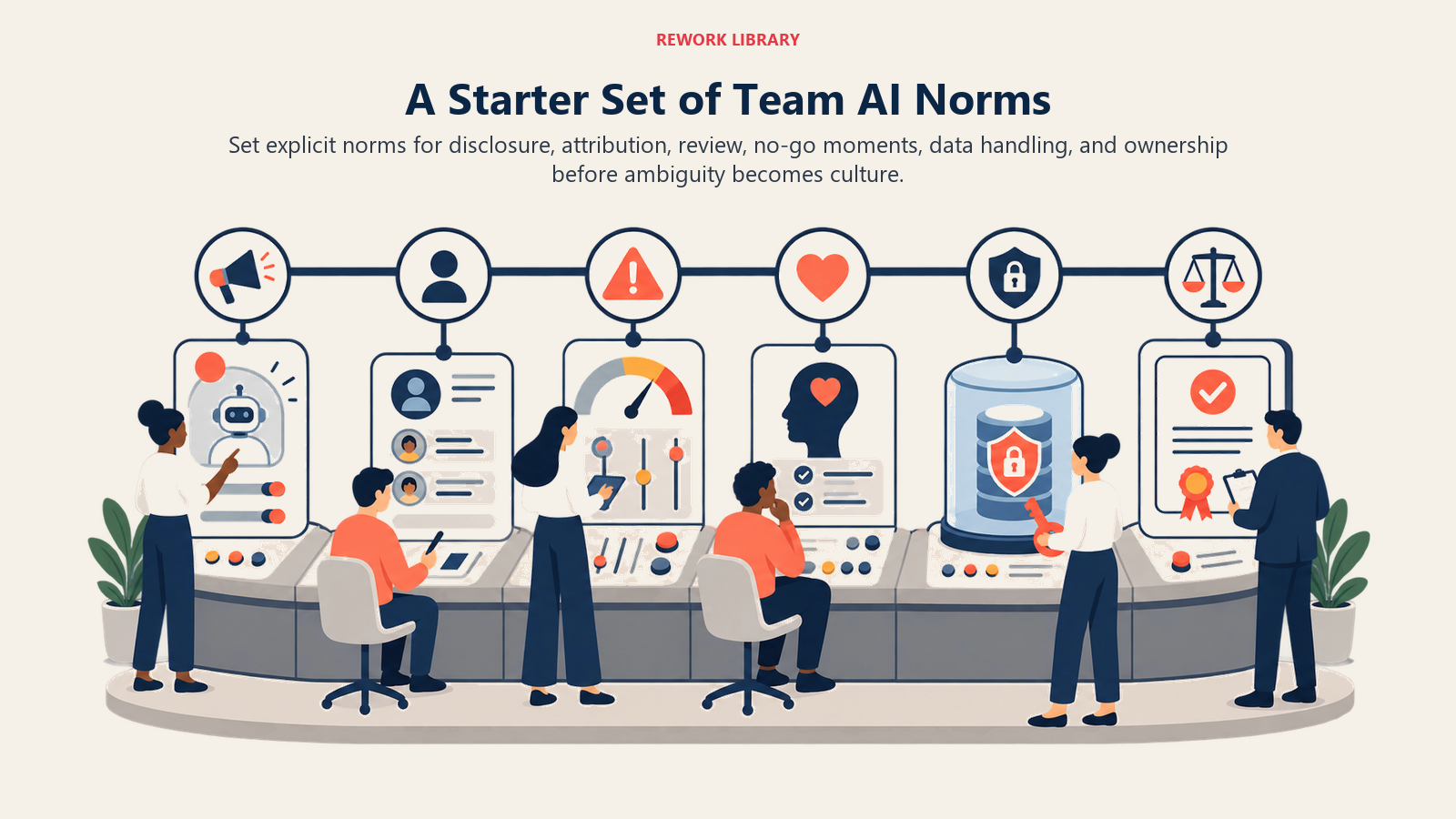
| Situation | Starter norm |
|---|---|
| Drafting routine emails, formatting, light editing | No disclosure needed |
| Substantive analysis, recommendations, decision memos | Disclose AI involvement and who reviewed it |
| Layoffs, terminations, disciplinary action | Human-drafted and human-delivered, no exceptions |
| Condolences, congratulations, personal recognition | Human-written, every time |
| One-on-ones and coaching conversations | AI may help with prep notes, never the conversation itself |
| Pasting client or employee data into an AI tool | Only approved tools; when in doubt, ask first |
| Recording or transcribing a meeting with AI | Announce it and get a real chance to object before it starts |
| Reviewing a colleague's AI-assisted work | Review the substance, not the tool used to produce it |
This isn't a template to copy without discussion. Writing it down as a team, rather than adopting someone else's list, is what builds the shared understanding. A norm nobody discussed rarely survives the first ambiguous case.
How Leaders Set AI Norms, Not Just Announce Them
Norms don't spread because a policy got emailed out. Microsoft's research on manager behavior found that when a manager visibly modeled their own AI use, disclosing it, admitting where it went wrong, employee trust in agentic AI rose by 30 points. That's a leadership finding, not a technology one: people calibrate what's acceptable by watching what their manager does, not by reading what the company says.
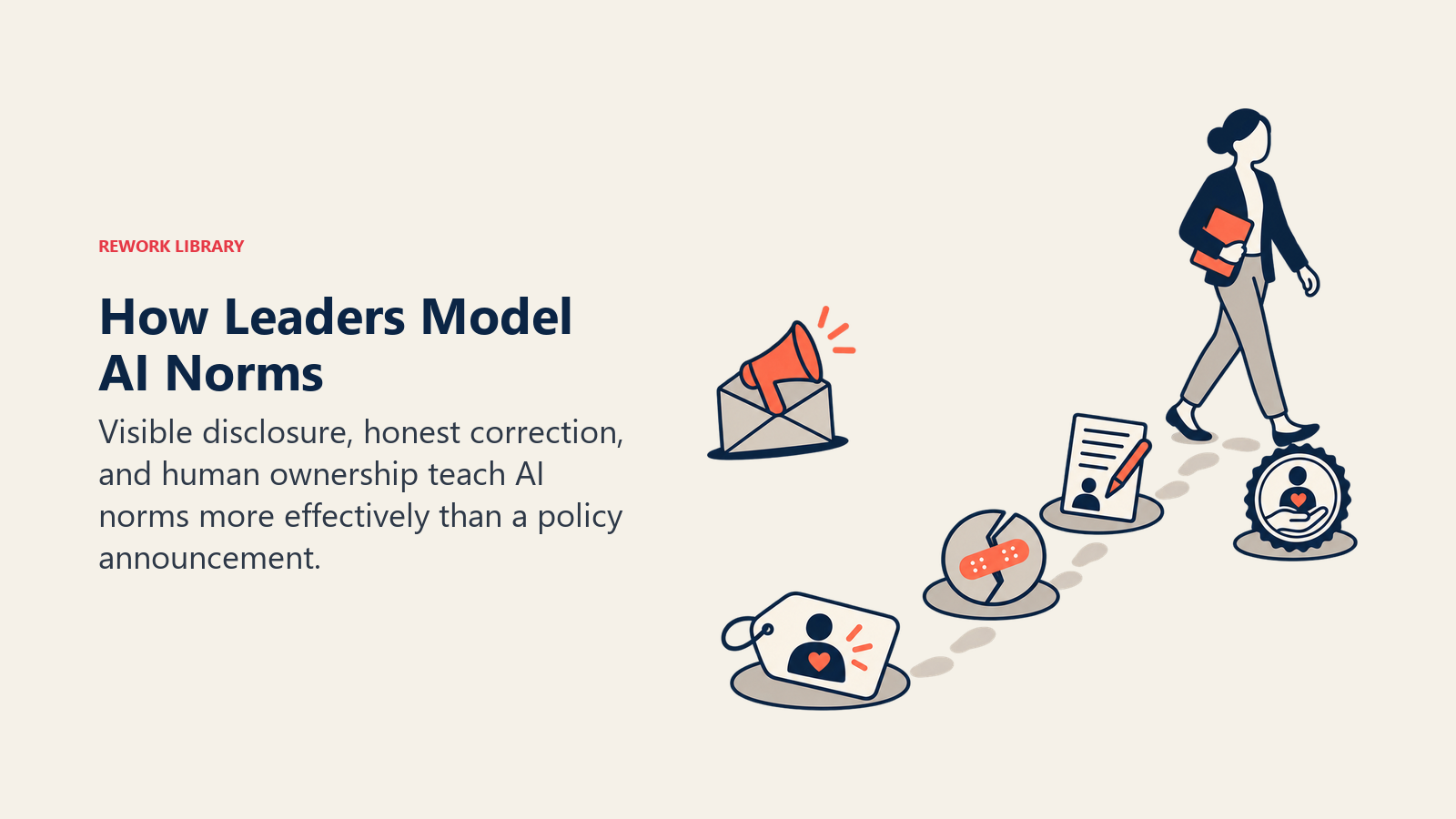
A leader who says "I used AI to draft this, then rewrote the parts that mattered" does more to set a disclosure norm than a slide in an onboarding deck ever will. The same applies to harder calls: a manager who visibly writes their own difficult feedback, rather than letting AI draft it, teaches the team where the line sits. This is the same dynamic behind the Frontier Firm and the rise of the agent boss, where the manager's job increasingly includes modeling judgment about AI. It rests on the same foundation as what business culture actually is: norms are what a group does under pressure, not what's on a values slide.
Where to Go Next
AI etiquette sits inside the larger shift covered in what AI-native culture actually is:
- Human-agent teams, for the deeper mechanics of working alongside an agent that acts, not just answers
- AI cultural debt, for what happens when norms like these never get made explicit
- Psychological safety at work, for why people need to feel safe raising doubts about AI-assisted work in the first place
Nobody is going to hand your team a finished AI etiquette manual, because the tools keep changing faster than any document could track. What doesn't change is the underlying test: would you be comfortable if the person on the other end knew exactly how this was made? Teams that keep answering that honestly, together, end up with norms that hold. Teams that leave it to individual judgment end up with the KPMG numbers: half the team quietly doing its own thing.

Co-Founder, Rework.com
On this page
- What "AI Etiquette" Actually Means
- Key Facts
- The Disclosure Question: Do You Say You Used AI?
- Attribution and Credit: Whose Work Is This?
- When Not to Use AI: The Moments That Call for a Human
- Layoffs, performance reviews, and other hard news
- Condolences, congratulations, and other personal moments
- One-on-ones and coaching conversations
- Over-Reliance and Workslop: When AI Help Becomes Extra Work
- Shadow AI and Sensitive Data: The Norms Nobody Wrote Down
- AI in Meetings: Notetakers, Transcripts, and Consent
- Why Explicit Norms Beat Leaving It Implicit
- A Practical Starter Set of Team AI Norms
- How Leaders Set AI Norms, Not Just Announce Them
- Where to Go Next