10 Signs of a Toxic Work Culture (and How to Fix Them)
Turn this article into takeaways for your work.


Each assistant summarizes the article only for you and suggests best practices for your work.
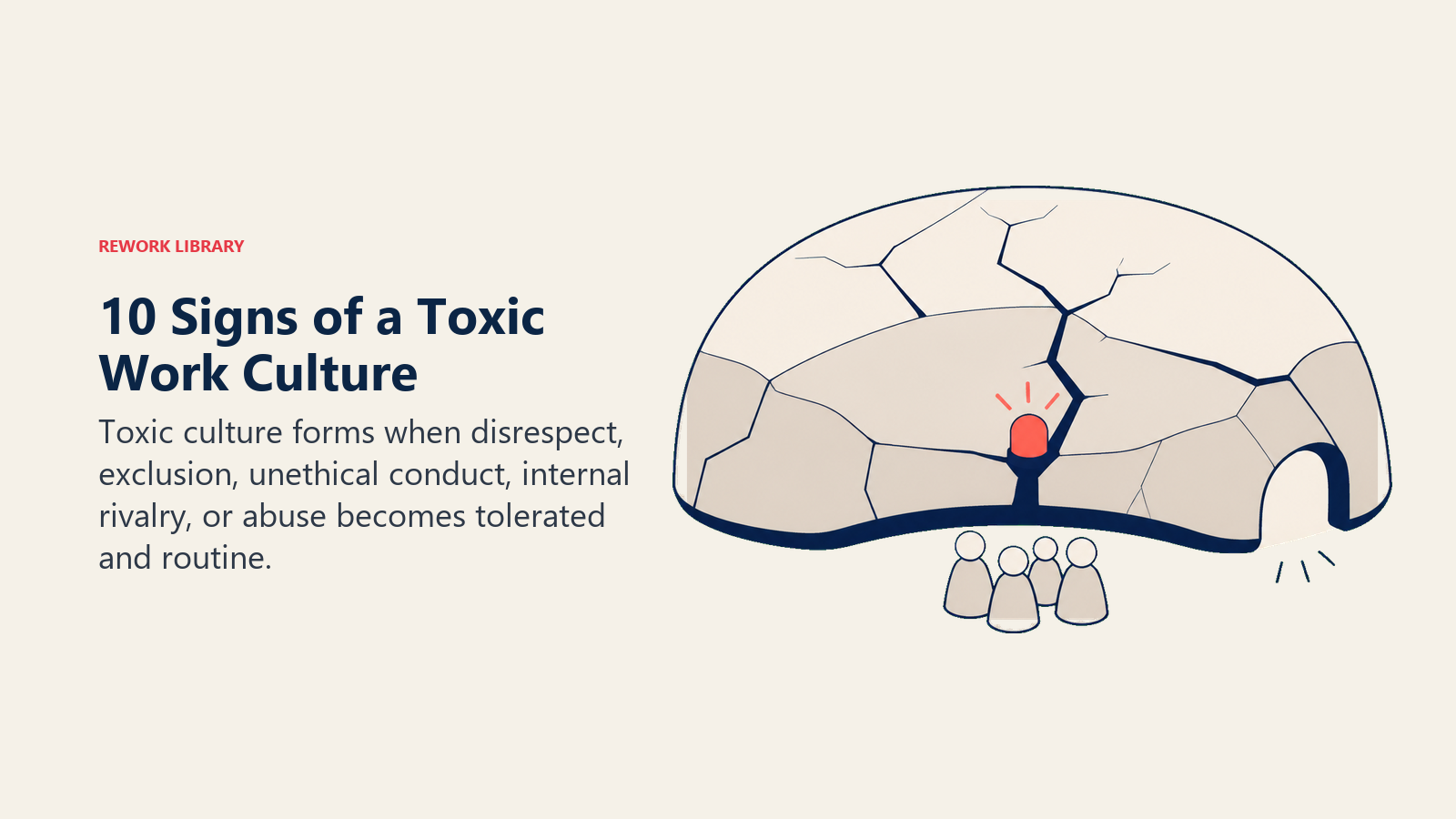
A toxic work culture is a workplace where disrespect, exclusion, unethical behavior, cutthroat competition, or abusive management are tolerated often enough that they become normal. It is not the same as a stressful week or a difficult boss. It is a pattern, reinforced by what leadership rewards and lets slide, and MIT Sloan research finds it predicts who quits far more reliably than salary does.
Most leaders do not think their own culture is toxic. They call it "intense," or "high-performance," or "just going through a rough patch." That gap between how leadership describes the culture and how employees actually experience it is usually the first sign something is wrong. Below: what actually separates toxic from merely tough, ten concrete warning signs, why research says this is the single biggest driver of unwanted turnover, how it forms, and what it takes to fix.
What Makes a Culture "Toxic," Not Just Difficult
Every workplace has bad days, blunt feedback, and real pressure. That is not automatically toxic. MIT Sloan researchers Donald Sull and Charles Sull analyzed more than a million Glassdoor reviews from large US employers and found toxic cultures cluster around five measurable attributes: the Toxic Five.
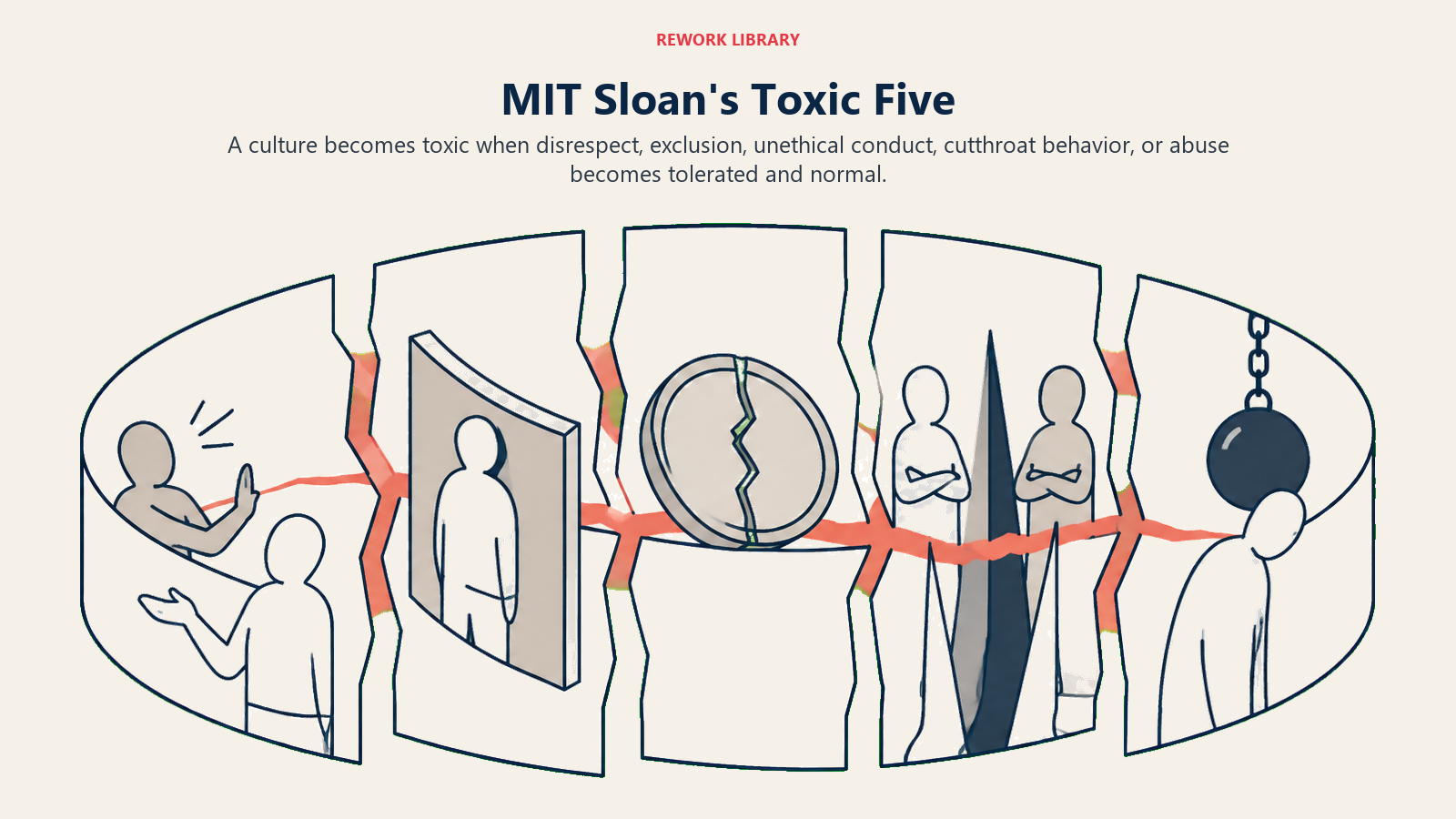
| Toxic Five element | What it looks like day to day |
|---|---|
| Disrespectful | Managers talk over people, dismiss ideas without engaging with them, or treat junior staff as beneath a real response |
| Non-inclusive | Certain groups are consistently excluded from decisions, credit, or advancement, regardless of stated diversity commitments |
| Unethical | Corners get cut on honesty with customers, compliance, or internal reporting, and it is quietly accepted as "how we operate" |
| Cutthroat | Colleagues are treated as competitors to be undermined rather than teammates, and internal politics outweighs collaboration |
| Abusive | Managers use intimidation, public humiliation, or threats as a management style, and it goes unaddressed by leadership above them |
A culture does not need all five to qualify as toxic. Even one, tolerated consistently, is enough to start driving people out the door. This is also why toxic cultures are so easy to miss from the top: the espoused values on the careers page can look fine while the underlying, unspoken assumptions Edgar Schein describes in the three levels of culture are already rotten underneath them.
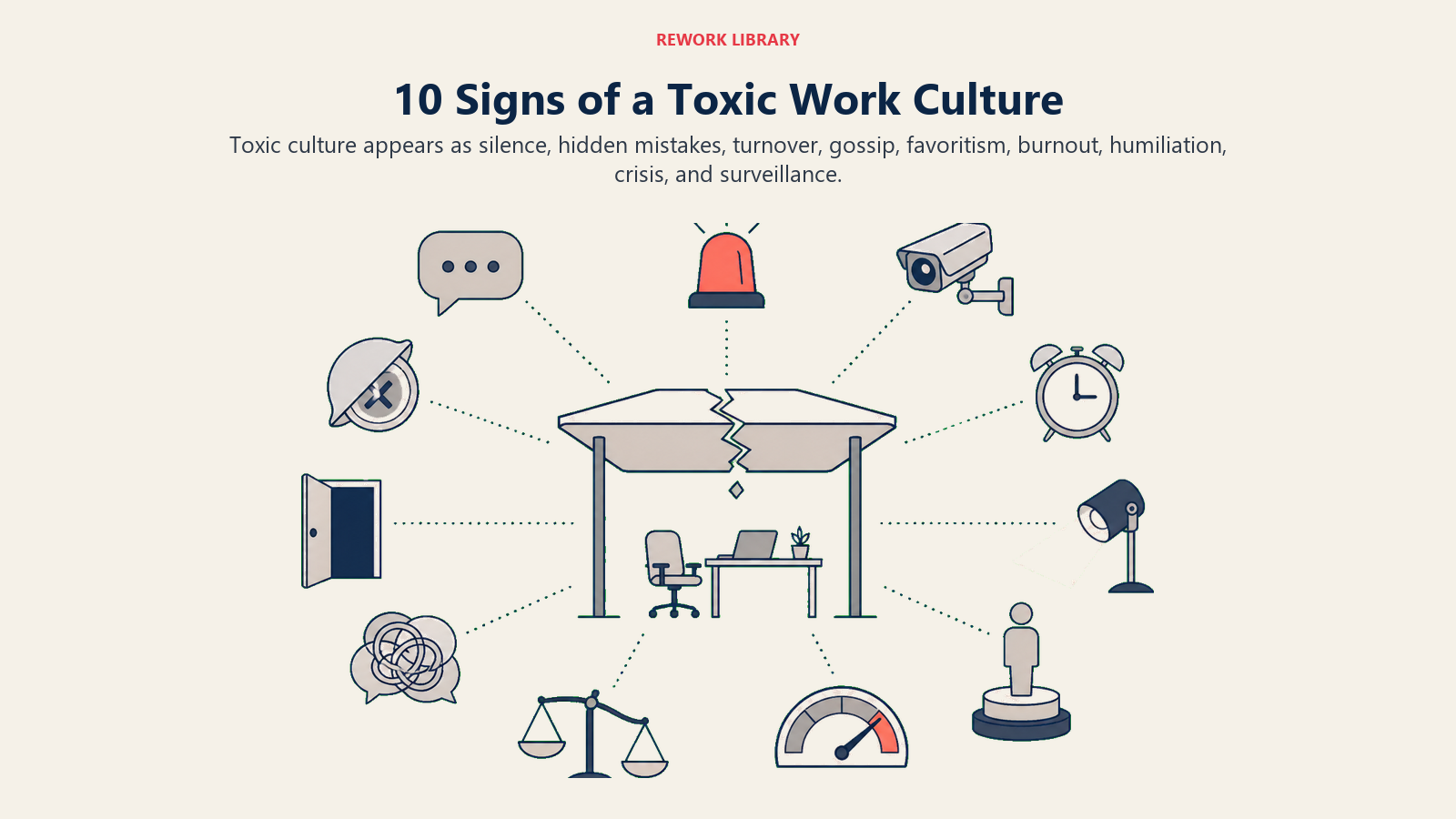
10 Signs of a Toxic Work Culture
These signs rarely show up all at once. They tend to accumulate quietly, which is exactly why so many leadership teams miss them until an exit interview, an anonymous survey, or a resignation spike forces the issue.
1. People Stop Speaking Up in Meetings
The clearest early signal is silence. Questions go unasked, concerns go unraised, and disagreement disappears from meetings that used to have real debate. This is not because the team suddenly agrees on everything. It is because someone learned, usually the hard way, that speaking up costs more than it is worth. We cover the specific mechanics of how this pattern forms, and how to reverse it, in why teams stay silent in meetings.
2. Mistakes Get Hidden, Not Fixed
In a healthy culture, someone who catches a problem raises it, because speaking up costs less than staying quiet. In a toxic one, the incentives flip: admitting a mistake gets you blamed, so people hide problems until they are too big to hide. Watch for small errors that surface late and big ones nobody saw coming, even though someone clearly did.
3. Turnover Keeps Climbing, and Exit Interviews Say Why
Some turnover is healthy. A steady, unexplained rise in departures, especially among strong performers, is not. If exit interviews keep circling back to the same manager or the same vague answer like "it just wasn't the right fit," that repetition is data, not noise. Most companies discount it because no single departure looks alarming on its own.
4. Cliques and Gossip Replace Trust
When people cannot get information through official channels, they build informal ones instead. Gossip becomes the fastest way to learn what is really going on, and cliques form around whoever seems to hold real influence. This is a symptom of a trust deficit, not a personality problem with a few chatty employees.
5. The Rules Bend for Certain People
Favoritism is one of the fastest ways to poison a culture, because everyone notices it even when leadership insists they do not. A high performer who misses deadlines gets a pass a struggling employee never would. Once people conclude outcomes depend on relationships rather than merit, effort on the actual work quietly declines.
6. Burnout Is Worn Like a Badge of Honor
A culture that treats exhaustion as proof of commitment, "I haven't taken a real vacation in two years" said with pride, is normalizing harm. Gallup finds 76% of employees experience burnout at least sometimes, 28% very often or always, and those who feel treated unfairly are 2.3 times more likely to land in that high-burnout group. When burnout is the expectation, that is a system problem, not an individual resilience problem.
7. How Leaders Treat "Unimportant" People Reveals Everything
Watch how a leader treats people who cannot affect their career: a new hire, a support-desk employee, a vendor. This is one of the most reliable culture signals there is, because it carries the least incentive to fake. A leader who is warm to the board and dismissive to the front desk is showing you the real culture, not the performed one.
8. Feedback Turns Into Public Humiliation
Direct feedback is not the problem. Feedback delivered to embarrass someone in front of colleagues, meant to punish rather than help, is. It is one of the clearest markers of the "abusive" element in the Toxic Five, and it trains everyone watching, not just the recipient, to say less and take fewer risks.
9. Everything Feels Like a Crisis, All the Time
Genuine emergencies happen. A culture where every deadline is existential and calm periods feel suspicious is running on manufactured urgency. Leaders sometimes do this deliberately, believing pressure drives performance. Mostly it drives people toward the exit once they find somewhere calmer.
10. Surveillance Replaces Trust
A newer version of an old problem: leadership responds to declining trust not by rebuilding it, but by monitoring more closely, screen trackers, keystroke logging, AI tools that flag "low activity" windows. Employees read constant surveillance as exactly what it usually is, a signal that leadership assumes the worst about them by default, which corrodes the trust it was meant to protect. It is one of the clearest examples of what AI cultural debt actually looks like in practice.
Why Toxic Culture Is the Number One Predictor of Attrition
During the Great Resignation, MIT Sloan researchers Donald Sull, Charles Sull, and Ben Zweig analyzed attrition data alongside more than a million Glassdoor reviews to find what actually predicted who quit. Compensation mattered, but not as much as most executives assumed: a toxic culture, measured through the Toxic Five, was 10.4 times more powerful than pay at predicting whether someone would leave.
That overturns the default executive instinct: fix attrition with money. Raises can slow a specific departure, but they do not fix a culture where people are disrespected, excluded, or managed through fear. SHRM backs this up from the other direction: about one in five American workers has left a job in the past five years specifically because of culture, at an estimated cost of $223 billion in turnover over five years. The same research found 76% of workers say their manager sets the culture, yet 36% say that manager cannot actually lead a team, which is exactly why the link between culture and performance traces back to management quality more than company-wide policy.
Key Facts
- Toxic culture is 10.4 times more predictive of employee attrition than compensation, and its "Toxic Five" traits (disrespectful, non-inclusive, unethical, cutthroat, abusive) make workers 35% to 55% more likely to face a serious physical illness. Source: MIT Sloan Management Review and MIT Sloan Management Review
- Toxic cultures have cost US businesses an estimated $223 billion over five years; roughly one in five employees has quit specifically because of culture. Source: SHRM
- 76% of employees say their manager sets the culture, but 36% say that manager cannot lead a team, and 58% of people who quit over culture named their manager as the reason. Source: SHRM
- 76% of employees experience burnout at least sometimes, and 28% feel burned out very often or always; those who feel treated unfairly are 2.3 times more likely to reach high burnout. Source: Gallup
- 74% of US employers now use some form of online employee monitoring, and a meaningful share of employees say they would quit if that surveillance increased. Source: ExpressVPN
How a Toxic Culture Forms
Toxic cultures almost never start with someone deciding to build one. They form through a series of individually defensible decisions that add up to something nobody would have designed on purpose.
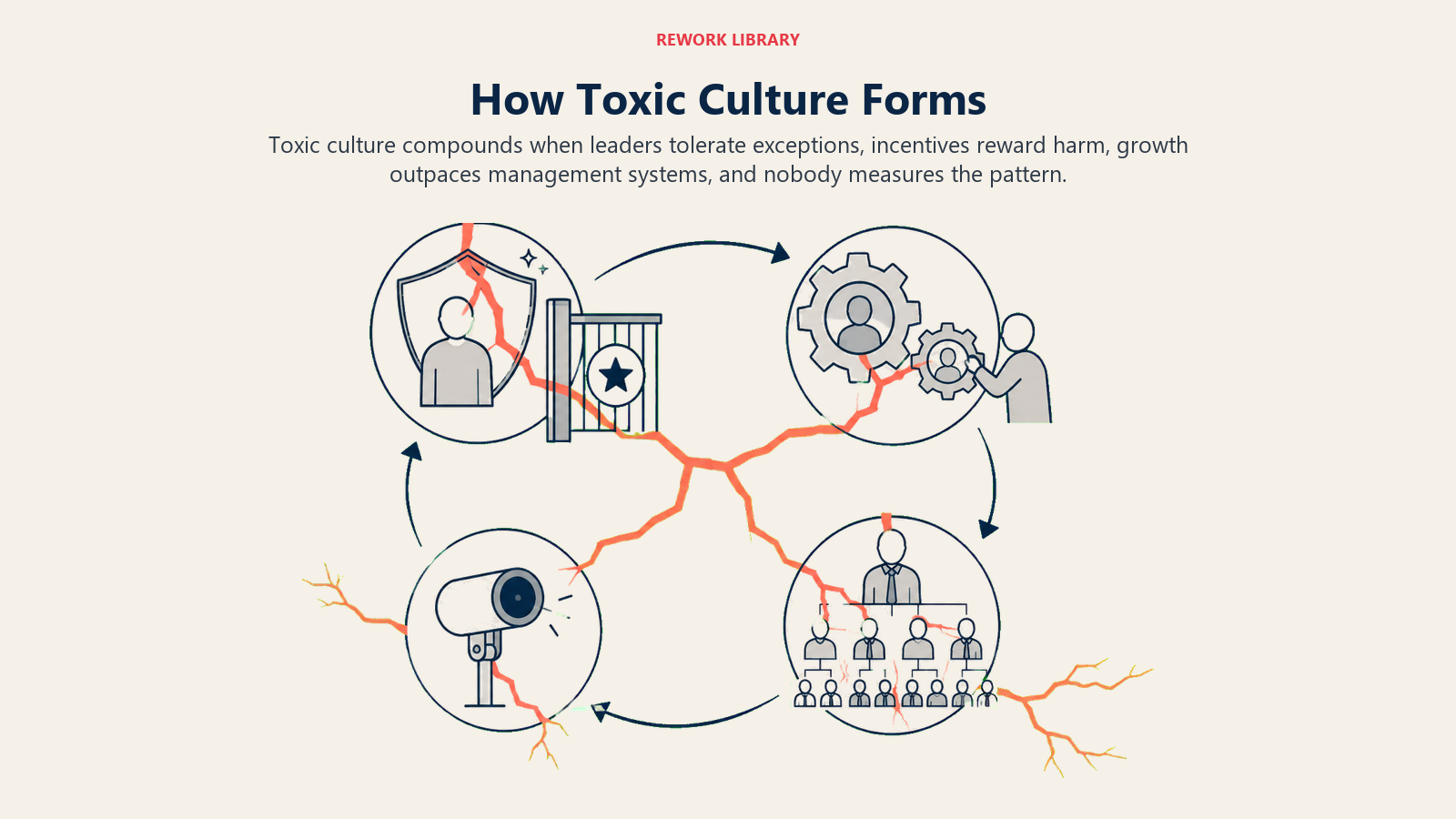
Leadership tolerates one exception. A high performer gets away with treating people poorly because their numbers are good, and everyone watching updates their understanding of what actually gets rewarded. This single moment does more damage than almost anything else a leader can do.
Incentives reward the wrong behavior. If targets are hit through pressure tactics that damage internal trust and the person hitting them keeps getting promoted, the system teaches everyone else to copy that approach.
Growth outpaces process. A 20-person company can run on trust and informal norms; a 200-person company running the same way develops managers who were never trained to lead, exactly the gap SHRM points to when 36% say their own manager cannot lead a team. This is also where team culture tends to concentrate the damage, since one bad manager can run a toxic pocket inside an otherwise healthy company.
Nobody is measuring it. Problems compound quietly, surfacing only as a resignation spike or a bad review. Teams that build honest measurement in, covered in how to measure company culture, catch the early version instead of the expensive one.
How to Fix a Toxic Culture
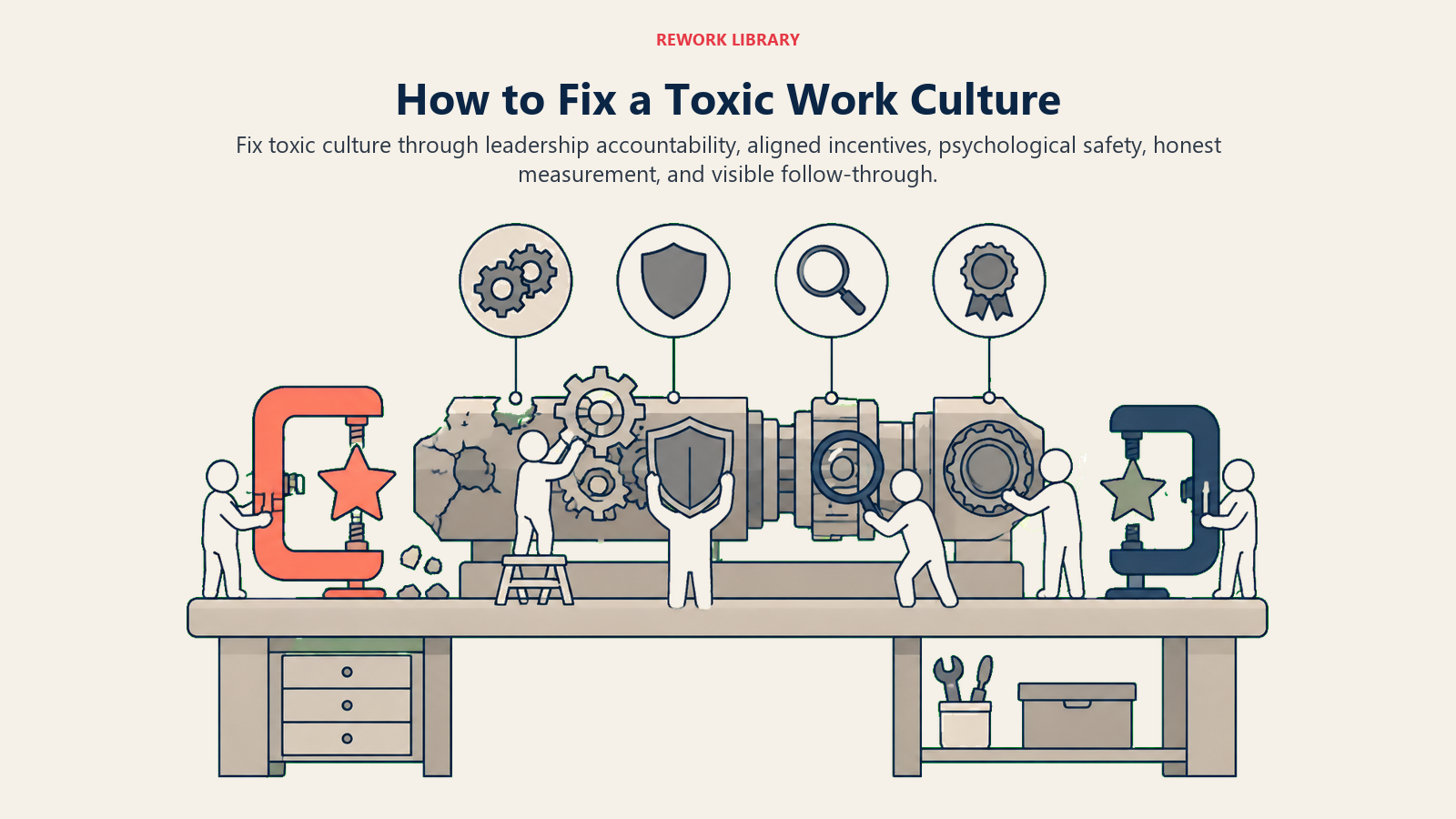
Fixing a toxic culture is a systems problem, not a communication problem. A new values statement or an all-hands about "being kinder to each other" will not move anything if the underlying incentives and unaddressed behavior stay the same.
Start With Leadership Accountability
Nothing else here works if leadership exempts itself. The fastest, most credible signal a leader can send is holding a high performer accountable for exactly the behavior the company claims to prohibit, the first time it happens, in view of everyone. Skipping it once undoes months of stated commitment.
Fix the Systems, Not Just the Messaging
Check whether what gets measured, rewarded, and promoted matches the culture leadership claims to want. If collaboration is the stated value but reviews only score individual output, the system wins every time. That means rewriting promotion criteria so they reinforce the behavior leadership actually wants, and fixing how feedback gets delivered: the difference between building a feedback culture and the humiliation in sign #8.
Build Psychological Safety on Purpose
Teams where people feel safe raising a concern, admitting a mistake, or disagreeing with a decision consistently outperform teams where they do not. This does not happen by accident. It requires leaders to respond visibly well the first several times someone takes that risk, the specific mechanism covered in psychological safety at work.
Measure Honestly, Then Act on What You Find
An anonymous survey filed away without visible action is worse than no survey at all, because it teaches employees that speaking up changes nothing. Pair honest measurement with a public commitment to act on at least one finding every cycle, so the process does not become one more symptom of the problem.
Tooling will not fix a toxic culture on its own; the work above is leadership work, not a feature request. But the operational side, consistent onboarding and visible recognition instead of favoritism behind closed doors, is easier to run honestly when it is not scattered across five disconnected systems. That is the kind of unglamorous consistency Rework's People app (HRIS, time and attendance, and timesheets in one place) supports, not a substitute for the accountability work above it.
Culture in the Age of AI: Surveillance as a New Toxicity Vector
AI has added a genuinely new toxicity vector to an old problem: surveillance dressed up as productivity management. Screen trackers, keystroke logging, and AI tools that score "focus" are now common enough that 74% of US employers report using some form of online monitoring, and a meaningful share of employees say they would quit over further increases in it. The intent is often framed as neutral, "we just want visibility," but employees experience constant monitoring as a default assumption of bad faith, corrosive to trust the same way abusive management is.
Some honest skepticism helps here. Gartner projects more than 40% of agentic AI projects will be canceled by the end of 2027 over unclear value, and MIT's Project NANDA found roughly 95% of enterprise generative AI pilots have failed to deliver measurable ROI so far. A lot of "AI-powered oversight" tooling is bought on hype, not results. Before adding a monitoring layer, ask the same question you would of any management decision: does this build trust, or does it just look like control.
When to Leave a Toxic Culture
Not every toxic culture can be fixed from the inside. A few signals suggest it will not change: leadership has been told directly, more than once, and nothing moved; the people with the power to change incentives and promotions are themselves the source of the behavior, not bystanders to it; or your own health and relationships outside work have started absorbing the cost of staying.
If you lead an organization and recognize several of the ten signs above, that is a harder thing to sit with than reading this as someone else's problem. If you are an employee weighing whether to stay, the research is consistent: strong culture is one of the most reliable predictors of retention, which means staying in a genuinely toxic one rarely pays off the way people hope.
Where to Go Next
- Psychological safety at work, for the specific behaviors that build (or destroy) the trust a healthy culture depends on
- Why teams stay silent in meetings, for the mechanics behind sign #1 above
- The link between culture and performance, for the data connecting culture health to business results
- How to measure company culture, for building the honest measurement this article recommends
- Building a feedback culture, for turning feedback into something other than sign #8
- AI cultural debt, for how AI adoption quietly adds new toxicity risk if culture is not part of the rollout
- What is business culture?, for the foundational model this article builds on
A toxic culture rarely announces itself with a single dramatic incident. It shows up in the meeting where nobody pushed back, the exit interview filed without follow-up, and the burnout everyone quietly agreed was just part of the job. None of that responds to a values refresh. It responds to leaders who name the specific behavior, change the systems that reward it, and hold the line on accountability even when the person benefiting from the old rules is someone valuable.

Co-Founder, Rework.com
On this page
- What Makes a Culture "Toxic," Not Just Difficult
- 10 Signs of a Toxic Work Culture
- 1. People Stop Speaking Up in Meetings
- 2. Mistakes Get Hidden, Not Fixed
- 3. Turnover Keeps Climbing, and Exit Interviews Say Why
- 4. Cliques and Gossip Replace Trust
- 5. The Rules Bend for Certain People
- 6. Burnout Is Worn Like a Badge of Honor
- 7. How Leaders Treat "Unimportant" People Reveals Everything
- 8. Feedback Turns Into Public Humiliation
- 9. Everything Feels Like a Crisis, All the Time
- 10. Surveillance Replaces Trust
- Why Toxic Culture Is the Number One Predictor of Attrition
- Key Facts
- How a Toxic Culture Forms
- How to Fix a Toxic Culture
- Start With Leadership Accountability
- Fix the Systems, Not Just the Messaging
- Build Psychological Safety on Purpose
- Measure Honestly, Then Act on What You Find
- Culture in the Age of AI: Surveillance as a New Toxicity Vector
- When to Leave a Toxic Culture
- Where to Go Next