More in
AI Workforce Transformation
Does AI Make Distributed Teams Easier or Harder to Lead?
Oct 11, 2026
Where AI Productivity Monitoring Turns Into Surveillance
Oct 11, 2026
Why Your Most Experienced People Resist AI Hardest (and Why You Need Them Most)
Oct 11, 2026
Is AI Making Teams Less Collaborative?
Oct 11, 2026
Should CEOs Use AI Themselves? Why Executive Fluency Sets the Adoption Ceiling
Oct 11, 2026
Does AI Favor Generalists or Specialists? What It Means for Who You Hire
Oct 10, 2026
Is Experience Still Worth Paying For When AI Narrows the Skill Gap?
Oct 10, 2026
When Every Candidate Uses AI, What Is a Resume Still Worth?
Oct 10, 2026
Should AI Screen Your Job Candidates? Where Automated Hiring Helps and Where It Backfires
Oct 10, 2026
Should Candidates Be Allowed to Use AI in Interviews?
Oct 10, 2026
The New Performance Review: How AI Changes How You Measure People
Turn this article into takeaways for your work.


Each assistant summarizes the article only for you and suggests best practices for your work.
Imagine two employees on the same sales team. One produces 45 outreach sequences a week. The other produces 15. Under traditional performance logic, the first is your top performer. But when you look closer, you realize the first employee is running everything through an AI assistant with minimal editing, while the second is writing fewer, sharper sequences that close at double the rate.
Who's actually performing?
That question doesn't have a clean answer under most performance frameworks built in the last decade. And that's the problem CHROs and CEOs need to solve before their next review cycle.
AI didn't just change how work gets done. It broke the measurement system underneath performance management. Output volume, task completion rates, and activity metrics (the things most companies still track) are no longer reliable proxies for contribution when every employee has access to tools that dramatically amplify raw throughput. The AI augment vs. replace workforce data shows that augmentation is now the dominant pattern, which means the measurement problem is universal, not confined to tech-forward companies.
The organizations that figure out new measurement frameworks first won't just have better performance data. They'll have a retention edge, a compensation model that rewards the right behaviors, and a culture that actually accelerates AI adoption instead of quietly punishing it.
Why Traditional Metrics Break Down
Performance measurement has always been an approximation. We track what's visible and countable because contribution is hard to quantify. For decades, that worked reasonably well because the gap between a high performer and an average one was mostly a function of effort, skill, and focus, all of which correlate with observable output.
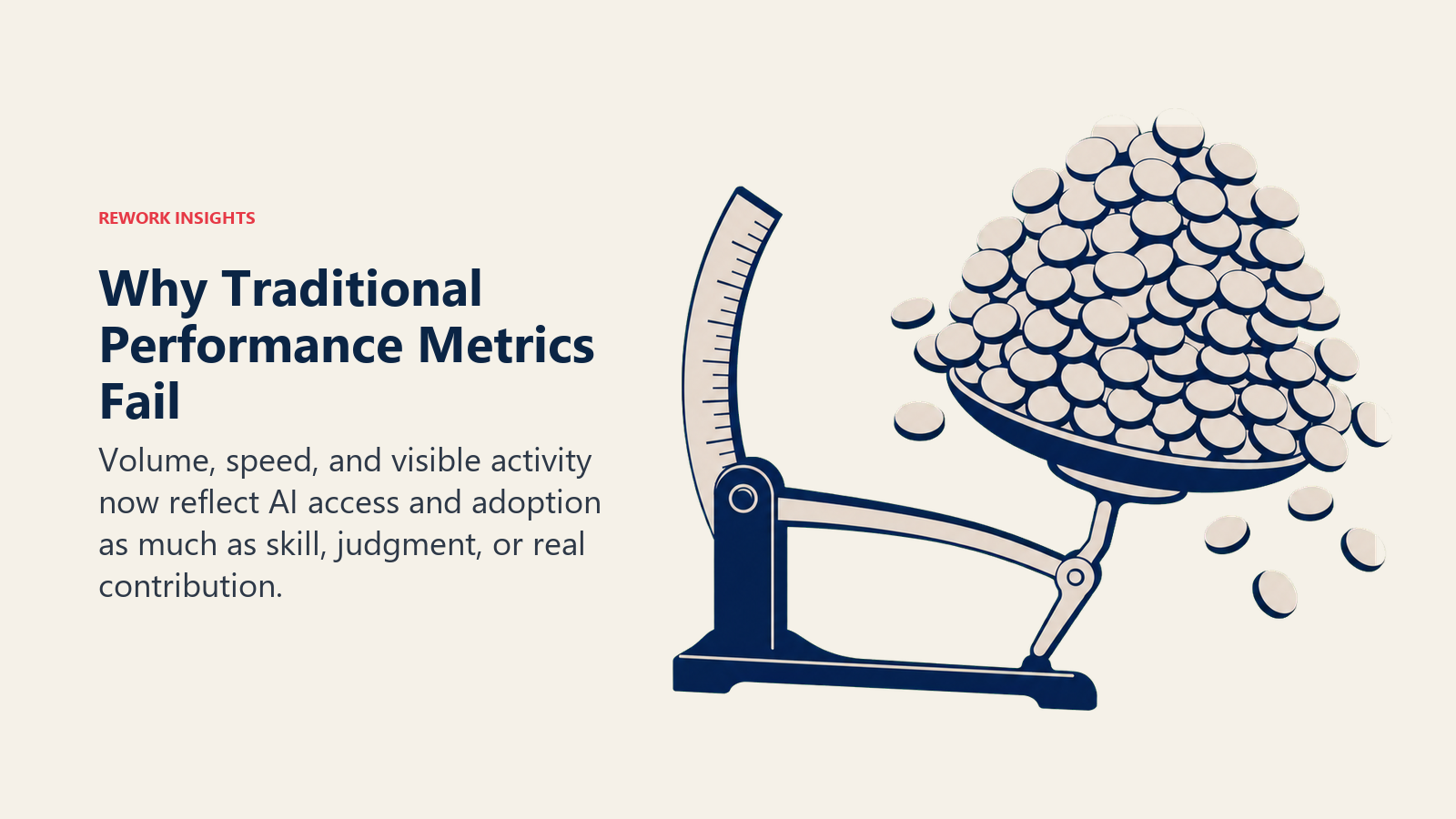
AI breaks that correlation.
When a marketing manager can produce ten times the content she could produce manually, raw volume stops signaling effort or skill. It signals AI access and the willingness to use it. And those two things don't map cleanly to who your best people are.
Three specific failure modes show up in organizations that haven't updated their frameworks:
Output inflation without quality signal. Employees using AI tools generate more: more emails, more reports, more proposals. But if your review criteria reward volume, you're measuring the tool, not the person. An organization that recognizes this problem early can avoid promoting the wrong people based on inflated activity metrics. The executive decision framework for AI workforce strategy addresses how measurement gaps connect to broader workforce strategy decisions.
Speed metrics that reward early adopters, not necessarily strong performers. The first employees to adopt AI will show dramatic productivity gains regardless of their underlying capability. If your Q1 reviews reward that speed, you're giving high ratings to the people who adopted a tool first, not the people who applied best judgment, produced the highest quality work, or made the team around them better.
Manager perception that lags the actual shift. Most managers' intuitions about who "seems productive" were formed in a pre-AI context. Research from McKinsey's 2025 organizational capability study found that manager perception scores diverged from measurable output metrics by as much as 35% in teams where AI adoption was highest. Managers underrated AI-fluent employees who worked quietly and efficiently, and overrated visible activity in employees who appeared busy but produced lower-quality work.
The result is a performance management system that's slowly mismeasuring your workforce. And mismeasurement at scale has serious consequences: wrong people promoted, wrong people lost, and compensation tied to metrics that no longer reflect value.
What Good Performance Looks Like Now
Rather than trying to fix broken metrics incrementally, the cleaner approach is to establish new dimensions of performance that reflect what actually matters in an AI-augmented environment. There are three.
Dimension 1: AI Output Ratio
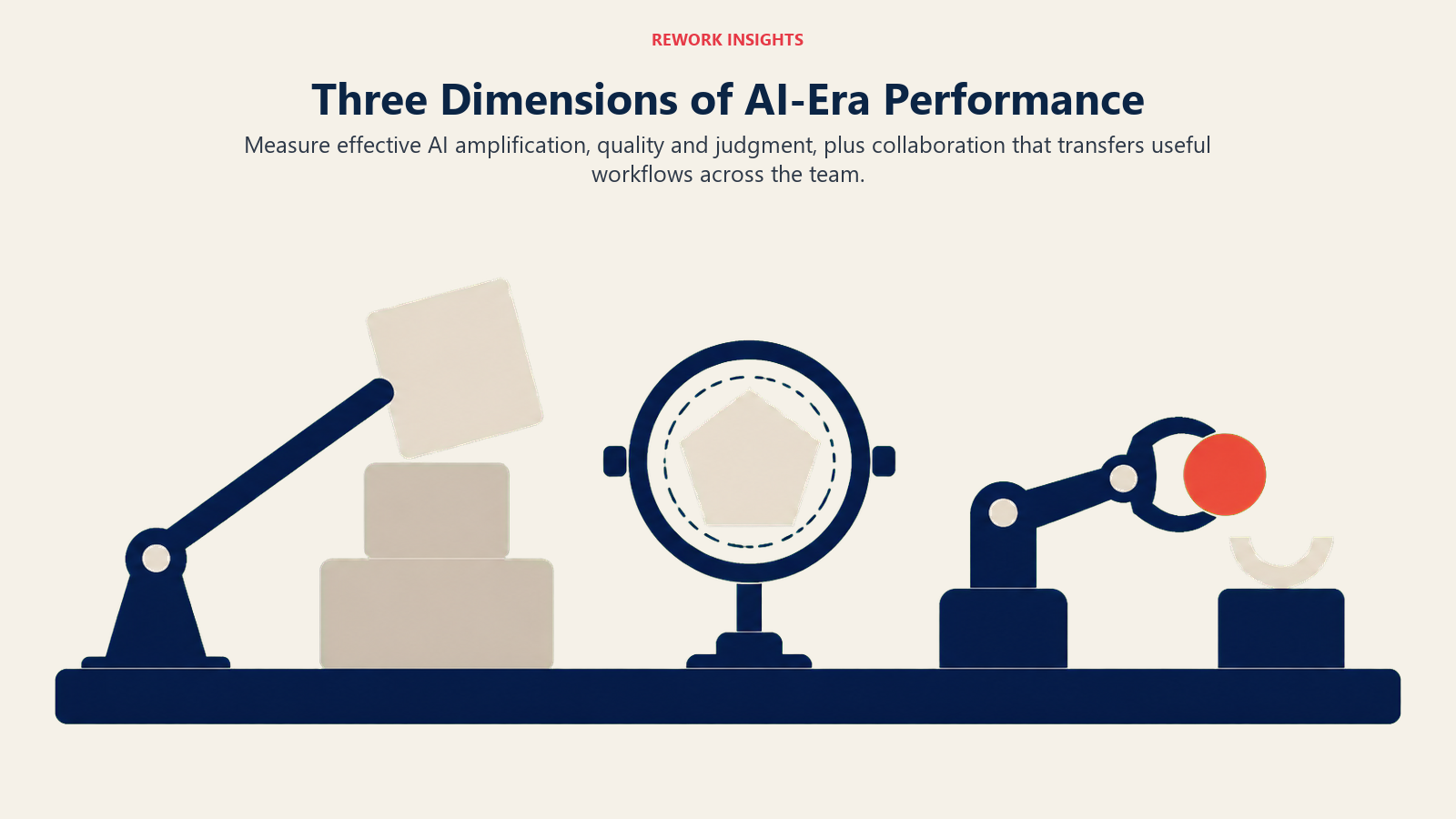
The AI output ratio is a measure of how effectively someone amplifies their output using AI relative to their peers in the same role. It's not about raw volume. It's about the multiplier.
A strong performer doesn't just use AI more. They use it smarter. They know when to trust AI output, when to rewrite, when to reject. They've developed workflows that make AI genuinely useful rather than superficially fast. And they produce work that holds up under scrutiny, where the judgment layer is clearly theirs.
In practice, measuring the AI output ratio means moving away from activity counts and toward output-to-quality ratios. How much of what they produce gets used, approved, or converted downstream? A sales rep with 60 sequences that convert at 4% has a higher ratio than one with 120 sequences converting at 1.5%.
This requires building feedback loops your current systems may not have. But it's trackable, and it's the right signal.
Dimension 2: Quality and Judgment
AI produces first drafts at scale. The human contribution in an AI-augmented workflow is increasingly about judgment: catching errors, adding context, applying domain expertise that the model doesn't have.
This dimension asks: how good is someone at seeing what AI gets wrong? At adding what AI can't?
A financial analyst who can identify the three assumptions buried in an AI-generated model that will cause it to fail under real conditions is performing at a high level. A marketer who knows when a technically correct AI-generated message will land wrong with a specific audience is adding value that doesn't show up in output volume.
Judgment is hard to quantify, but it's not invisible. It shows up in error rates downstream, in how often someone's work requires significant revision by others, and in qualitative feedback from the people who depend on their output. Structured peer review processes that specifically ask about quality of judgment, not just output quantity, give you data here.
Dimension 3: Collaboration and Knowledge Transfer
This is the dimension most performance frameworks ignore entirely, and it may be the most strategically important for AI transformation.
Some employees don't just use AI well. They make their teammates better at using AI. They share workflows, document prompts that work, build shared systems, and lower the adoption barrier for peers who are slower to adapt. This is exactly the behavior a formal AI champions program is designed to surface and reward, turning informal knowledge transfer into a structured, scoreable contribution.
That contribution is enormous. An employee who brings three hesitant colleagues into effective AI usage has multiplied the organization's AI capability. But under traditional performance frameworks, none of that shows up. It looks like time not spent on personal output.
High-performing AI-augmented organizations are starting to treat knowledge transfer and team AI-enablement as scoreable performance behaviors, not soft add-ons, but actual criteria with weight in the review.
Redesigning the Review Cycle
Changing what you measure is only half the work. You also need to change the process and the calibration.
What to Add to Performance Criteria in 2026
The table below shows a before/after view of how performance criteria should shift:
| Dimension | Traditional Criteria | Updated Criteria |
|---|---|---|
| Productivity | Task completion volume, activity counts | AI output ratio, output-to-quality conversion |
| Quality | Error rate on deliverables | Judgment accuracy, downstream revision rate |
| Growth | Skills training completion | AI tool proficiency, new workflow adoption |
| Collaboration | Meeting participation, team projects | AI knowledge transfer, peer enablement |
| Initiative | Going beyond assigned work | Building shared AI systems, documenting best practices |
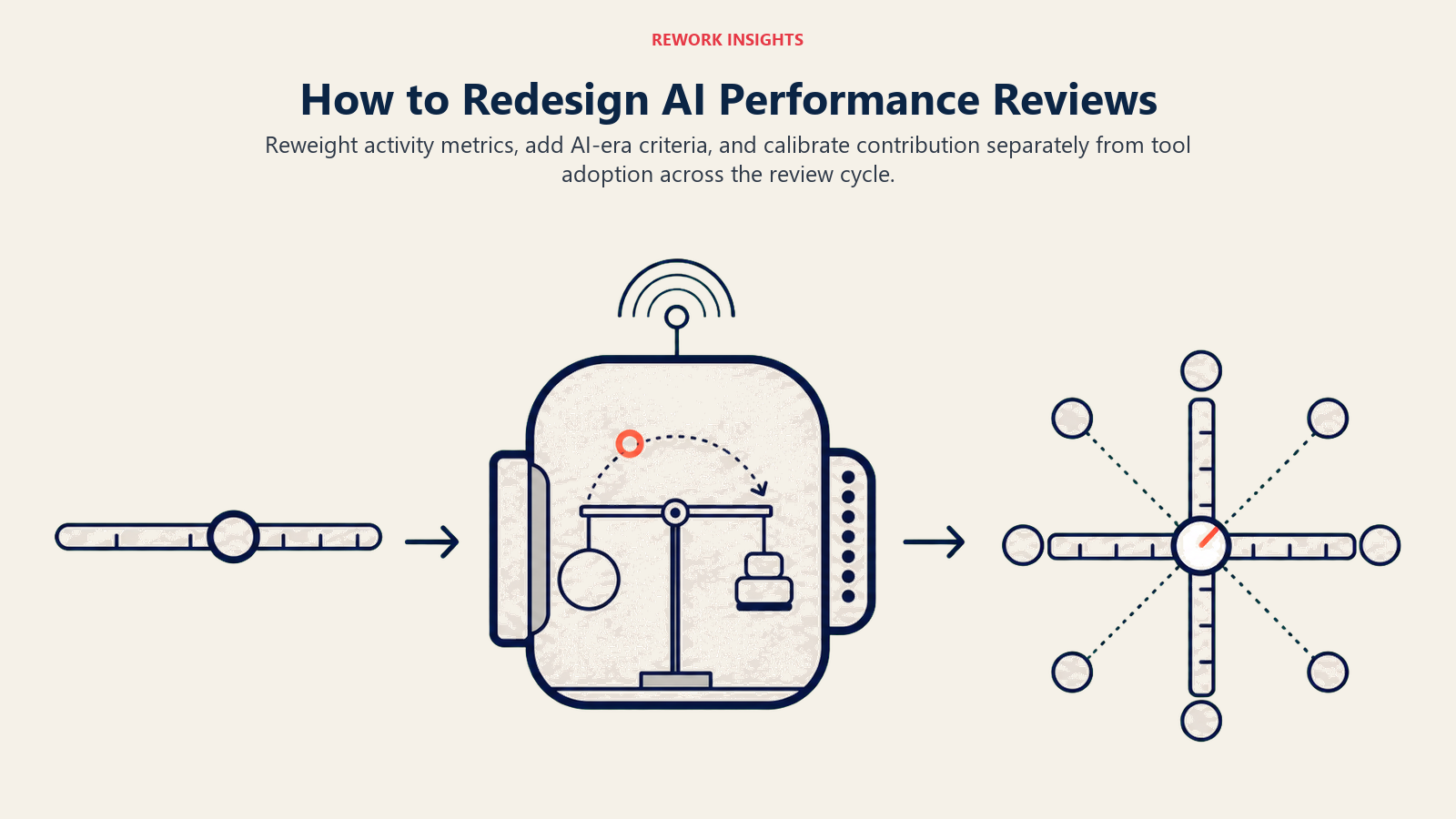
The goal isn't to throw out existing criteria entirely. It's to reweight them and add the dimensions that now matter.
What to Remove or Reweight
Raw output volume and activity metrics should be moved from primary to secondary indicators, context rather than evaluation criteria. If someone produces twice the volume with half the quality, the volume isn't the signal.
Speed metrics should be decoupled from performance ratings. How fast someone adopted AI early in 2025 or 2026 doesn't predict how well they're using it now, and it certainly doesn't predict long-term contribution. Speed of adoption was a leading indicator, not a performance dimension.
How to Calibrate Across AI-Adopter and Non-Adopter Splits
This is where most organizations get tripped up. On any given team, you'll have employees who have meaningfully integrated AI into their workflows and employees who haven't. If you calibrate performance ratings on a single scale without accounting for this, you're essentially rating employees on a mix of their contribution and their tool adoption.
The right approach is to treat AI proficiency as a separate axis during calibration rather than letting it silently distort ratings across the board. During review calibration sessions, managers should explicitly flag where AI adoption is a factor in output differences, and adjust comparisons accordingly.
This doesn't mean non-adopters get a pass. Failure to adopt AI tools that are available and relevant to a role is a performance issue, but it should be treated as one explicitly, not baked invisibly into a rating.
The Compensation Implication
The question of whether to tie AI fluency to compensation is one of the sharper debates in people ops right now. The AI fluency salary premium data for 2026 gives CHROs external market benchmarks for calibrating where to set AI-related compensation adjustments. The answer depends on what behavior you're trying to drive.
If AI fluency is a baseline expectation for a role (meaning the job literally requires it now), it shouldn't generate a premium. It's table stakes. Paying extra for using the standard tools of the role is like paying a bonus for using email. You'll create a culture of performed AI usage rather than genuine adoption.
But if AI fluency is above and beyond, if an employee is doing work that wasn't previously possible, producing outcomes at a level that genuinely changes what the role can deliver, then compensation recognition is appropriate and retention-critical. According to a 2025 Gartner HR survey, 48% of high-performing AI-fluent employees cited a belief that their AI contribution wasn't reflected in compensation as a primary reason for considering a move.
The risk of inaction here is asymmetric. Your most AI-capable people have options. Companies that leave AI fluency unrecognized in compensation will lose them to organizations that don't.
Legal and Fairness Considerations
AI adoption doesn't happen uniformly across a workforce. And the patterns of who adopts and who doesn't tend to correlate with factors that create legal risk.
Older employees, particularly those over 50, adopt AI tools at lower rates on average. OECD research on AI and labor market transitions documents this pattern and notes that differential access to training (not resistance) is often the primary driver of adoption gaps across age cohorts. Employees in certain role types or with longer tenure may have more deeply ingrained workflows that are harder to change. If performance ratings shift significantly based on AI adoption, and AI adoption correlates with age or tenure, you have a potential disparate impact problem under employment discrimination law.
This doesn't mean you can't hold employees accountable for failing to develop relevant capabilities. It means you need to ensure equitable access to training and support before you tie those capabilities to performance outcomes. Organizations that create AI upskilling programs only for certain departments or levels, then evaluate everyone on AI proficiency, are exposing themselves.
The cleaner path: document AI training availability and completion before implementing AI-fluency criteria. Make support accessible across age groups, roles, and tenures. The AI onboarding checklist for 2026 is a useful starting point for ensuring equitable access across your workforce before you tie training completion to review outcomes. And involve legal counsel when you're designing compensation structures tied to AI adoption rates.
The companies getting this right are also building explicit non-retaliation protections for employees who raise concerns about AI tools, both because it's the right policy and because it creates a signal that the organization is thoughtful about adoption pressure.
What This Means at the Board Level
Performance measurement might seem like an HR operational concern, but its strategic implications sit squarely at the board level.
Organizations that get measurement wrong during AI transformation will experience two compounding problems. First, they'll promote people for the wrong reasons, building management layers full of employees who gamed early adoption metrics rather than people who exercise strong judgment in an AI-augmented context. Second, they'll lose their best people to companies that do recognize AI contribution accurately, because top performers know what they're worth.
Both problems are expensive and slow to reverse.
The CHRO who brings a redesigned performance framework to the board isn't just presenting an HR initiative. They're presenting a talent retention strategy, a capability-building mechanism, and a competitive differentiator for attracting the people who will actually drive the organization's AI future.
Performance measurement is the lever. Get it right, and AI workforce transformation accelerates because the right people are rewarded and retained. Get it wrong, and you're running transformation programs while quietly degrading the human judgment layer that makes AI output actually useful.
That's not a tradeoff any executive should be comfortable making.
Learn More

Co-Founder, Rework.com
On this page
- Why Traditional Metrics Break Down
- What Good Performance Looks Like Now
- Dimension 1: AI Output Ratio
- Dimension 2: Quality and Judgment
- Dimension 3: Collaboration and Knowledge Transfer
- Redesigning the Review Cycle
- What to Add to Performance Criteria in 2026
- What to Remove or Reweight
- How to Calibrate Across AI-Adopter and Non-Adopter Splits
- The Compensation Implication
- Legal and Fairness Considerations
- What This Means at the Board Level
- Learn More