More in
AI Workforce Transformation
Does AI Make Distributed Teams Easier or Harder to Lead?
Oct 11, 2026
Where AI Productivity Monitoring Turns Into Surveillance
Oct 11, 2026
Why Your Most Experienced People Resist AI Hardest (and Why You Need Them Most)
Oct 11, 2026
Is AI Making Teams Less Collaborative?
Oct 11, 2026
Should CEOs Use AI Themselves? Why Executive Fluency Sets the Adoption Ceiling
Oct 11, 2026
Does AI Favor Generalists or Specialists? What It Means for Who You Hire
Oct 10, 2026
Is Experience Still Worth Paying For When AI Narrows the Skill Gap?
Oct 10, 2026
When Every Candidate Uses AI, What Is a Resume Still Worth?
Oct 10, 2026
Should AI Screen Your Job Candidates? Where Automated Hiring Helps and Where It Backfires
Oct 10, 2026
Should Candidates Be Allowed to Use AI in Interviews?
Oct 10, 2026
How SaaS Companies Are Restructuring Teams Around AI in 2026
Turn this article into takeaways for your work.


Each assistant summarizes the article only for you and suggests best practices for your work.
The SaaS companies that quietly restructured their teams around AI capabilities in 2024 and 2025 are now operating at a structural advantage. They're not just moving faster. Deloitte's 2026 State of AI in the Enterprise report found that companies have broadened workforce access to AI by 50% in just one year, growing from fewer than 40% to around 60% of workers now equipped with sanctioned AI tools. That expansion is what restructuring is built on top of. They're running customer success teams at 20-30% lower headcount without a drop in NPS. They're closing revenue targets with consolidated go-to-market teams that would have seemed understaffed two years ago. And their finance and ops functions are handling the same transaction volume with fewer people.
This isn't a story about layoffs. It's a story about what happens when the fundamental unit of work in a SaaS company changes, and how the smartest operators are building org structures to match.
Why Headcount-Based Planning No Longer Works
For most of the last decade, SaaS scaling followed a fairly predictable formula: more ARR required more people. Customer success needed bodies to manage accounts. Support needed agents to handle tickets. Sales needed SDRs to fill pipeline. The ratio might shift at different growth stages, but the direction was always the same. Revenue up, headcount up.
That formula is breaking down. Not because AI replaces people wholesale, but because it changes the unit of work that teams are organized around. McKinsey's research on redesigning technology workforces for the agentic AI era documents how AI is already driving a 20-30% net impact on workforce composition, with roles like renewal managers, support engineers, and SDRs being partially replaced while others are being reshaped around AI oversight.
Traditionally, you'd size a CS team based on accounts-per-CSM. A mid-market SaaS company might budget one CSM for every 30-40 accounts, with an expected annual churn rate baked into the staffing model. Today, AI-augmented CS teams at comparable companies are managing 60-80 accounts per person. Not by skimping on service, but because the AI handles the repetitive touchpoints, flags at-risk accounts before the CSM would have noticed, and automates onboarding sequences that used to require manual coordination.
The planning math has changed. You're not asking "how many people do we need for X accounts?" You're asking "what's the AI capacity we're deploying, and how many people do we need to direct and supervise it?"
This shift from headcount-based to capacity-based planning is the foundational change driving every restructuring pattern we're seeing in 2026. And it requires measuring AI adoption ROI differently than traditional productivity metrics capture, because what you're measuring isn't just output per person, it's effective capacity per team.
Three Restructuring Patterns in SaaS Companies 50-500 Employees
Pattern A: AI-First Customer Success and Support
This is the most common pattern, and it's producing the most visible results. Companies restructuring under Pattern A are doing two things simultaneously: collapsing Tier 1 support through AI deflection, and elevating the remaining team into higher-complexity roles.
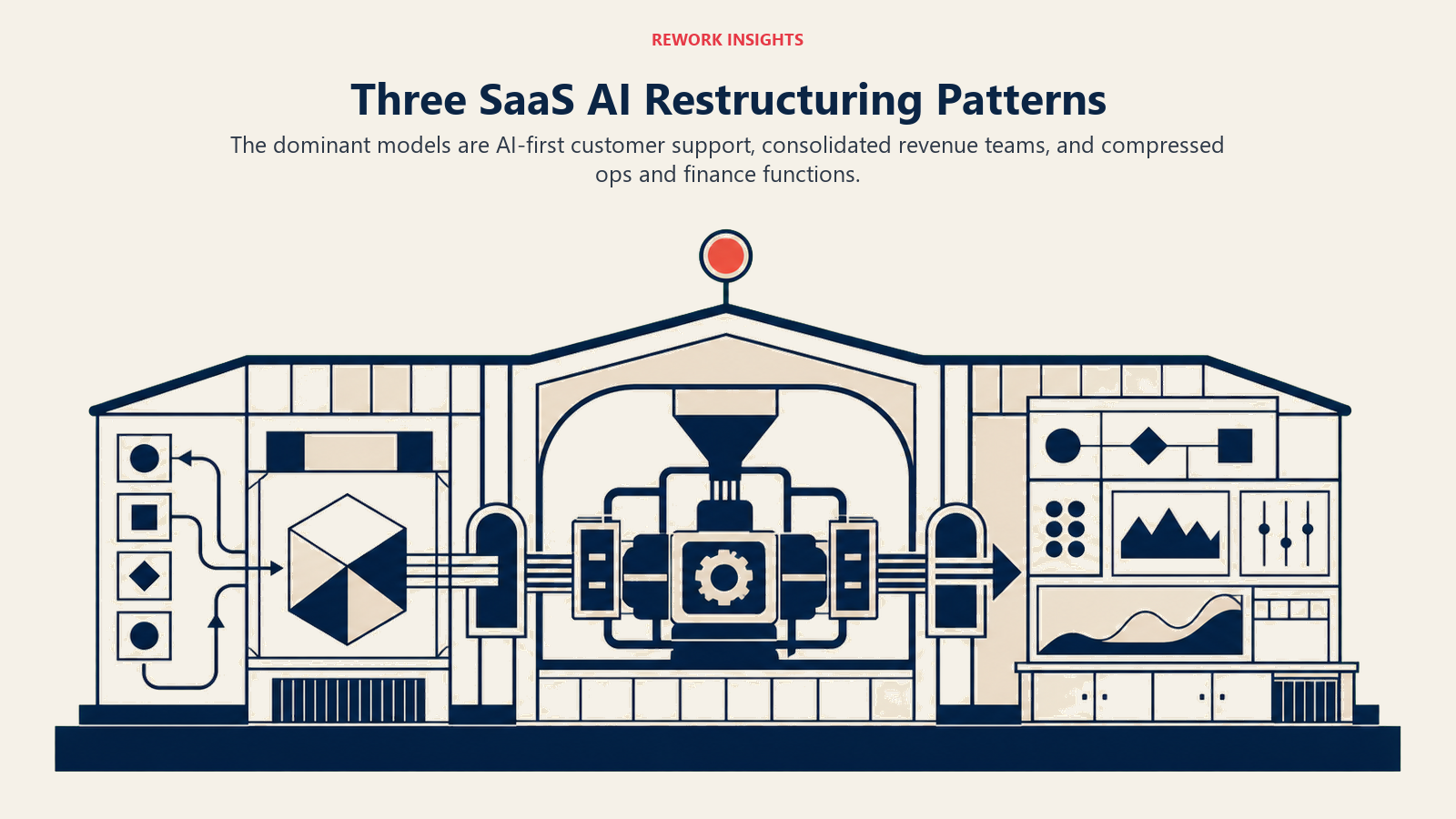
The before-state at a typical 200-person SaaS company looked something like this: a 12-person support team split roughly 70/30 between Tier 1 (password resets, onboarding FAQs, billing questions) and Tier 2 (technical escalations, complex integrations, churn risk). CS sat separately with 8 CSMs handling accounts across segments.
The after-state, for companies that have completed this restructuring, looks different. AI handles 65-75% of Tier 1 ticket volume with comparable satisfaction scores. The Tier 1 headcount drops from 8-9 people to 3-4. But the Tier 2 team grows slightly, because it now handles a higher proportion of the issues that reach a human. The CS team consolidates: fewer CSMs, but each one is backed by AI tools that surface renewal risk, usage patterns, and expansion signals automatically. What used to require a CS Ops analyst running reports is now surfaced in the CSM's workflow each morning.
One anonymized B2B SaaS company in the 150-employee range described it this way: "We went from 11 people in support and CS to 8, but the 8 people we have now are doing work the old 11 couldn't. They're actually having strategic conversations with customers instead of answering the same five questions." The AI augmented sales teams performance data from 2025-2026 corroborates this pattern at scale: teams with elevated AI support roles consistently outperform those simply running deflection-first models.
Pattern B: Revenue Team Consolidation
The SDR/AE ratio has been a flashpoint in SaaS go-to-market design for years. Conventional wisdom said you needed roughly 2 SDRs per AE to keep pipeline full. That math assumed SDRs were spending most of their time on prospecting, sequencing, and qualification tasks that are now heavily automatable.
Companies restructuring under Pattern B are collapsing this ratio, sometimes to 1:1, sometimes further. AI tools handle outbound sequencing, prospect research, intent signal monitoring, and initial qualification filtering. What's left for human SDRs is the higher-value work: relationship-building calls, complex multi-threading into enterprise accounts, and the judgment calls that AI can't make cleanly.
But this isn't just about reducing SDR headcount. The more interesting structural change is the blurring of the SDR/AE boundary itself. Several companies in the 50-200 employee range have moved toward hybrid "full-cycle AE" models, where each AE owns both prospecting and closing for a defined territory, supported by AI tools that handle the volume work. This restructuring was previously considered inefficient at scale, since AEs spending time prospecting meant less time closing. But AI changes the economics: if the prospecting work requires 20% of the time it used to, a full-cycle model becomes viable.
The result is a leaner revenue team that, counterintuitively, often produces higher per-rep productivity than the siloed model it replaced. AI-powered workflows for sales teams are what make the full-cycle model operationally viable rather than just theoretically appealing.
Pattern C: Ops and Finance Team Compression
This is the quietest of the three patterns, but in some ways the most structurally significant. Ops and finance teams in SaaS companies handle a high volume of repeatable, rules-based work: revenue reconciliation, commission calculations, contract review, vendor management, reporting. These functions have historically grown with company size on a near-linear basis.
Companies restructuring under Pattern C are breaking that linearity. AI tools handling revenue reconciliation, automated commission calculation engines, and AI-assisted contract review are reducing the labor input required for each transaction. A finance team that needed 6 people to support a 200-person company is now managing the same transaction volume with 4.
The structural implication goes beyond headcount. Ops and finance roles are shifting from execution-heavy to judgment-heavy. The remaining team members are spending more time on exception handling, strategic analysis, and the work that requires contextual business knowledge. It's a different job profile, and companies that communicate this transition clearly are retaining their best operators through the change.
What's Not Working
Not every AI restructuring effort is going smoothly, and executives planning these changes would benefit from knowing where others have stumbled.
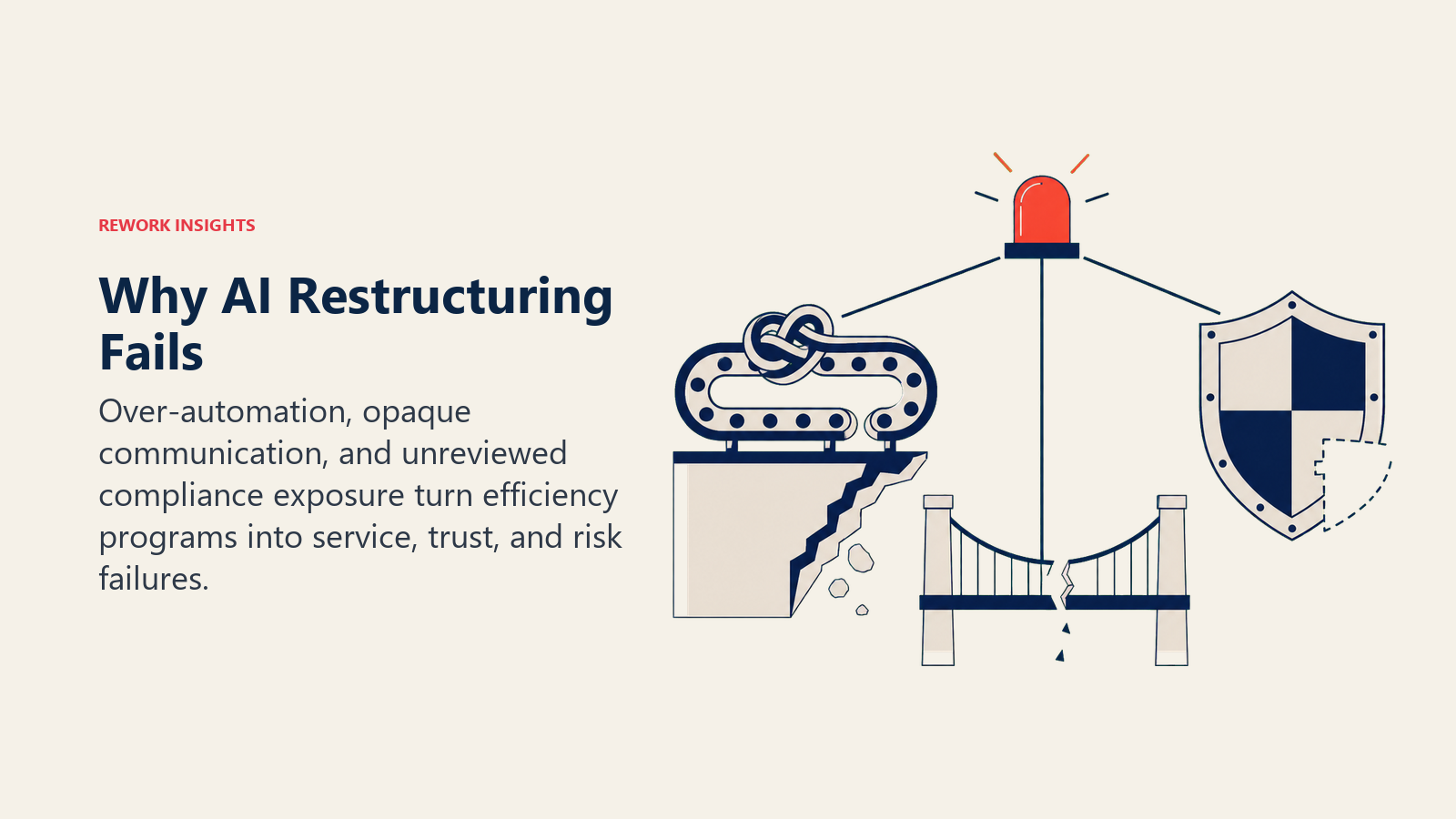
Over-automation failures are more common than reported. Several companies pushed AI deflection rates in support too aggressively, targeting 80%+ deflection, and saw customer satisfaction scores drop as edge cases fell through the gaps. The AI handled the easy tickets well, but complex issues requiring nuance were getting stuck in automated loops before reaching a human. The lesson: deflection rate is a lagging indicator, not a success metric. Customer effort score and escalation resolution time matter more.
Morale damage from poor communication is the most preventable failure mode. Companies that restructured without transparent communication about the reasoning, timeline, and criteria for who would be affected saw disproportionate voluntary attrition among high performers. Gartner's research on CHROs leading AI workforce change is direct on this: just over half of organizations have redesigned or redefined roles because of AI, and without deliberate change management, transformation efforts are undermined at exactly the moment they matter most. The people with options left first. This connects directly to the broader point about how AI is changing retention, not just hiring: restructuring decisions made opaquely accelerate the departure of exactly the employees you're trying to build around. Executives who framed restructuring as "efficiency improvement" without addressing the obvious subtext (that headcount was being reduced) lost trust that proved difficult to rebuild. The companies that handled this well were direct: they named the change, explained why it was happening, described how decisions were being made, and gave affected employees real notice and support.
Compliance risk in regulated SaaS is an underappreciated exposure. Companies operating in fintech, healthtech, or legal SaaS with specific data handling requirements have discovered that AI tools introduced in the restructuring created new compliance surface area. When AI is touching customer data as part of automated support or CS workflows, that has implications for SOC 2, HIPAA, or other frameworks. Restructuring efforts that moved faster than the compliance review process have created cleanup work that is both expensive and embarrassing.
The CRO and COO Playbook: How to Sequence a Restructuring
The sequencing of this restructuring matters as much as the structure itself. Companies that got the sequencing wrong, typically by cutting headcount before the AI tools were actually performing reliably, created service disruptions they're still recovering from.
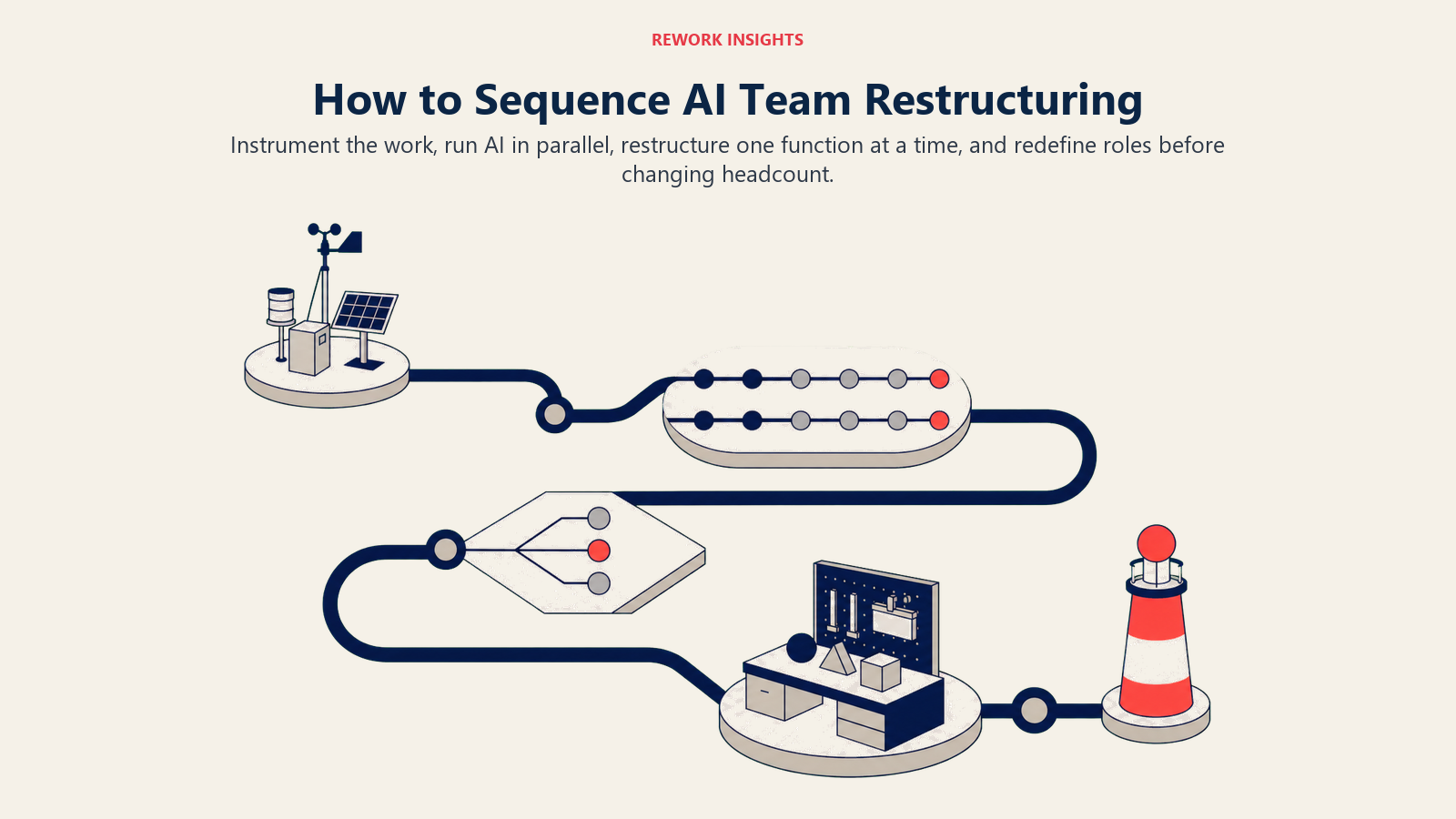
The playbook used by the companies that executed this well follows a consistent pattern:
Phase 1: Instrument before you cut. Before any restructuring decisions, establish clear baselines on the work your current team is doing. Ticket volume, resolution time, account coverage, pipeline metrics. You can't evaluate what AI is replacing if you don't know what you're starting from.
Phase 2: Run the AI tools in parallel, not as replacement. The most important data you'll collect is on where AI performs well and where it fails. Run AI-assisted workflows alongside your existing human workflows for 6-8 weeks. Track where the AI output is good enough and where humans are catching errors. This parallel run data is what you actually use to make restructuring decisions.
Phase 3: Restructure by function, not all at once. The companies that tried to restructure multiple functions simultaneously (CS, support, and sales at the same time) created change management chaos. The companies that phased by function, completing one transition before beginning the next, maintained operational stability and gave leaders time to learn what actually worked before applying it elsewhere.
Phase 4: Redefine roles before you backfill. This is where many companies leave value on the table. When a role is eliminated by AI automation, the instinct is to simply not backfill. But the better question is: what higher-value work can this person's capacity now do? Companies that used restructuring as an opportunity to deliberately redesign remaining roles, expanding scope and adding responsibilities that were previously crowded out, retained talent and got more from their headcount. A hiring vs. upskilling AI framework helps leadership make those role redefinition decisions systematically rather than on a case-by-case basis.
When to restructure versus when to augment is a decision that deserves its own framework. The basic logic: if the AI tool can replace a specific task type at 80%+ the quality of a human, and that task type represents a significant portion of a role's time, restructuring is worth evaluating. If AI augments capability but doesn't replace task volume, augmentation is the right call: you're adding AI to make existing headcount more effective, not reducing it.
| Scenario | Recommended Approach |
|---|---|
| AI replaces >50% of role's core tasks | Evaluate restructuring |
| AI augments quality but not volume | Augment existing team |
| AI performance is inconsistent or unproven | Parallel run first |
| Regulated data environment | Compliance review before any AI deployment |
| High-trust customer relationships at risk | Preserve human touchpoints; automate backend only |
What This Means for 2027 Headcount Planning
The companies setting their 2027 headcount plans today are already making structural decisions that will compound over the next 18 months. The SaaS market is bifurcating: on one side, companies that have done the hard work of instrumenting their operations, running AI tools in parallel, and restructuring deliberately. On the other, companies still planning headcount the same way they did in 2022.
The gap in unit economics between these two groups will be visible in 2027. Not because the restructured companies cut their way to efficiency, but because they built org structures that match how work actually gets done when AI is in the workflow.
The structural patterns are documented now. Pattern A, B, and C aren't hypothetical. They're operational realities at comparable companies in your segment. The question isn't whether to restructure, but how to sequence it without destroying the culture and institutional knowledge that got you here.
That sequencing question is where the real executive judgment is required. And it's worth getting right.
Learn More
- What the First AI Ops Manager Hire Looks Like in a 100-Person Company
- The Org Chart of the Future: What AI-Augmented Departments Actually Look Like
- Upskill or Hire AI-Native? The ROI Case Every Executive Needs to Run
- The Hidden Cost of Delaying AI Upskilling: A CFO-Ready Analysis
- Running AI Pilot Programs That Actually Prove ROI: How to structure the parallel-run phase before any restructuring decision
- AI Governance Policy for Departments: The compliance and accountability framework that prevents restructuring failures

Co-Founder, Rework.com
On this page
- Why Headcount-Based Planning No Longer Works
- Three Restructuring Patterns in SaaS Companies 50-500 Employees
- Pattern A: AI-First Customer Success and Support
- Pattern B: Revenue Team Consolidation
- Pattern C: Ops and Finance Team Compression
- What's Not Working
- The CRO and COO Playbook: How to Sequence a Restructuring
- What This Means for 2027 Headcount Planning