More in
AI Workforce Transformation
Does AI Make Distributed Teams Easier or Harder to Lead?
Oct 11, 2026
Where AI Productivity Monitoring Turns Into Surveillance
Oct 11, 2026
Why Your Most Experienced People Resist AI Hardest (and Why You Need Them Most)
Oct 11, 2026
Is AI Making Teams Less Collaborative?
Oct 11, 2026
Should CEOs Use AI Themselves? Why Executive Fluency Sets the Adoption Ceiling
Oct 11, 2026
Does AI Favor Generalists or Specialists? What It Means for Who You Hire
Oct 10, 2026
Is Experience Still Worth Paying For When AI Narrows the Skill Gap?
Oct 10, 2026
When Every Candidate Uses AI, What Is a Resume Still Worth?
Oct 10, 2026
Should AI Screen Your Job Candidates? Where Automated Hiring Helps and Where It Backfires
Oct 10, 2026
Should Candidates Be Allowed to Use AI in Interviews?
Oct 10, 2026
The AI Skills Gap Executives Are Getting Wrong
Turn this article into takeaways for your work.


Each assistant summarizes the article only for you and suggests best practices for your work.
Your company just ran 200 employees through an AI certification program. Three months later, your sales pipeline process looks exactly the same. Your ops team still manually compiles the same weekly report. Your customer success reps still aren't using AI to prep for renewal calls.
Sound familiar?
You're not alone. And the problem isn't that your employees can't learn. The problem is that you diagnosed the wrong disease and prescribed the wrong cure.
Most executives frame the AI skills gap as a technical deficit: a shortage of people who can write prompts, use APIs, or understand how language models work. So they buy certifications, run lunch-and-learns, and hire a few prompt engineers. And then they wonder why nothing changes.
The real AI skills gap isn't technical. It's behavioral, organizational, and deeply tied to how people make decisions under uncertainty. Until executives get that diagnosis right, they'll keep spending on training that produces certificates but no change.
Why "We Need More Technical AI Skills" Is the Wrong Read
Gartner's research on AI project outcomes is worth sitting with: roughly 73% of AI initiative failures trace back to adoption issues, not technical ones. The model worked. The integration was solid. But people didn't change how they work.
That pattern shows up across industries. The roles struggling most with AI aren't software engineers or data teams. It's sales, operations, and management. These are people whose jobs are fundamentally about judgment: which deal to prioritize, which process to fix, which hire to make. And yet the AI tools flooding their workflows require a different kind of judgment, one most organizations have never had to develop before.
When a CRM now auto-suggests next-best actions, a sales rep has to judge whether to trust it. When an AI summarizes a customer complaint, a customer success manager has to judge whether the summary captured what matters. When a dashboard uses predictive analytics to flag churn risk, a revenue leader has to decide how much weight to give it versus their own read of the account.
None of that requires knowing how a transformer model works. It requires something harder to certify: AI judgment.
Companies that have poured money into AI training and seen flat results typically made the same mistake. They taught people how the tools work. They never taught people how to think differently about their work.
The Real Three-Layer Gap
A more useful model for executives breaks the skills deficit into three distinct layers. Each layer requires a different investment. Conflating them (which is what most L&D programs do) is why those programs underperform.
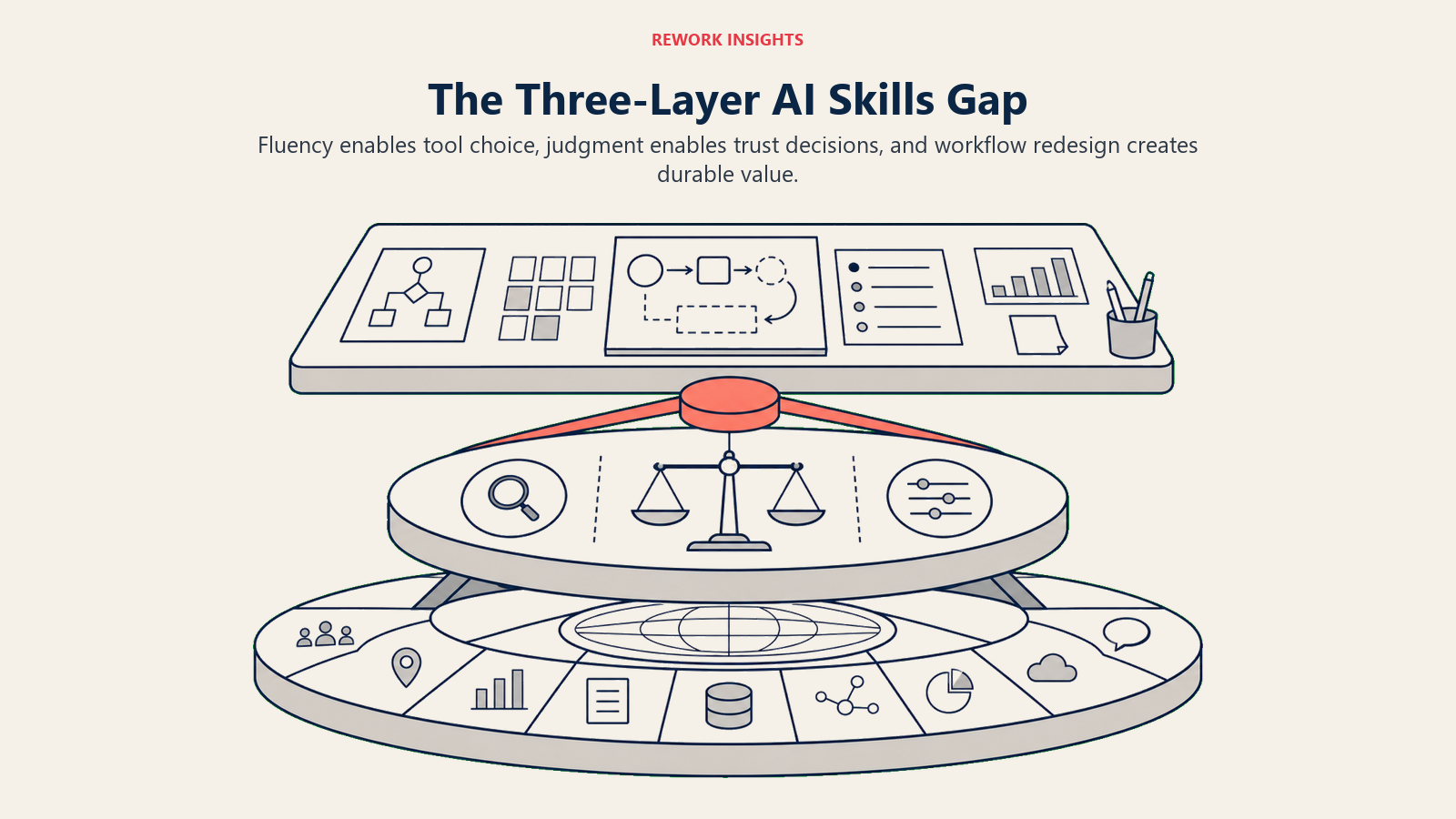
Layer 1: AI fluency. This is the foundation: knowing which tools exist, what they're actually good at, and when they apply to your work. It's not deep technical knowledge. It's practical awareness. A sales rep with AI fluency knows that there's a tool that can research a prospect's recent press releases and board changes in 30 seconds. They don't need to know how the tool was built. They need to know it exists and when to reach for it.
Most organizations have low AI fluency. People are vaguely aware that "AI can help" but don't have a clear mental map of what to use for what. This is solvable, but not with a certification course. It requires regular, role-specific exposure, ideally from peers who've actually built the workflows, not trainers who are demoing them for the first time. A structured 90-day AI fluency plan is one of the more effective approaches for accelerating this layer systematically across a team.
Layer 2: AI judgment. This is where most organizations have a near-total gap and almost no training investment. AI judgment is the ability to evaluate AI outputs: knowing when to trust them, when to override them, and when the stakes are too high to rely on them at all.
Bad AI judgment looks like: a manager who takes an AI-generated performance summary at face value without reading the underlying data. A sales rep who sends an AI-drafted email without noticing it got the prospect's title wrong. A VP who approves a forecast built on AI projections that silently excluded a key account segment.
Good AI judgment looks like: the same people treating AI outputs as a first draft that requires verification, not a finished product. They have calibrated skepticism, not reflexive rejection, but not blind trust either. This is a cognitive skill, not a technical one, and it develops through practice, feedback, and occasionally getting burned.
Layer 3: AI workflow redesign. This is the highest-leverage layer and the rarest skill in most organizations. Workflow redesign is the ability to look at how work currently gets done and restructure it around AI capabilities. Not just bolt AI onto existing processes, but fundamentally rethink the process.
Most AI adoption is additive: we added an AI tool to step 3 of a 10-step process. The organizations that are pulling ahead are doing something harder. They're looking at the 10-step process and asking which steps exist only because of human limitations (speed, memory, availability, consistency) that AI now removes. Then they're rebuilding the process from scratch with those constraints gone.
This skill is rare because it requires systems thinking, comfort with ambiguity, and organizational authority to actually change how work gets done. It's not a skill you can hire for easily or train in a classroom. It develops in small teams, iteratively, with support from leadership that's willing to accept a messier process while the new one gets built.
What This Means for Hiring
If you've been scanning resumes for AI certifications, you've been filtering on the wrong signal.
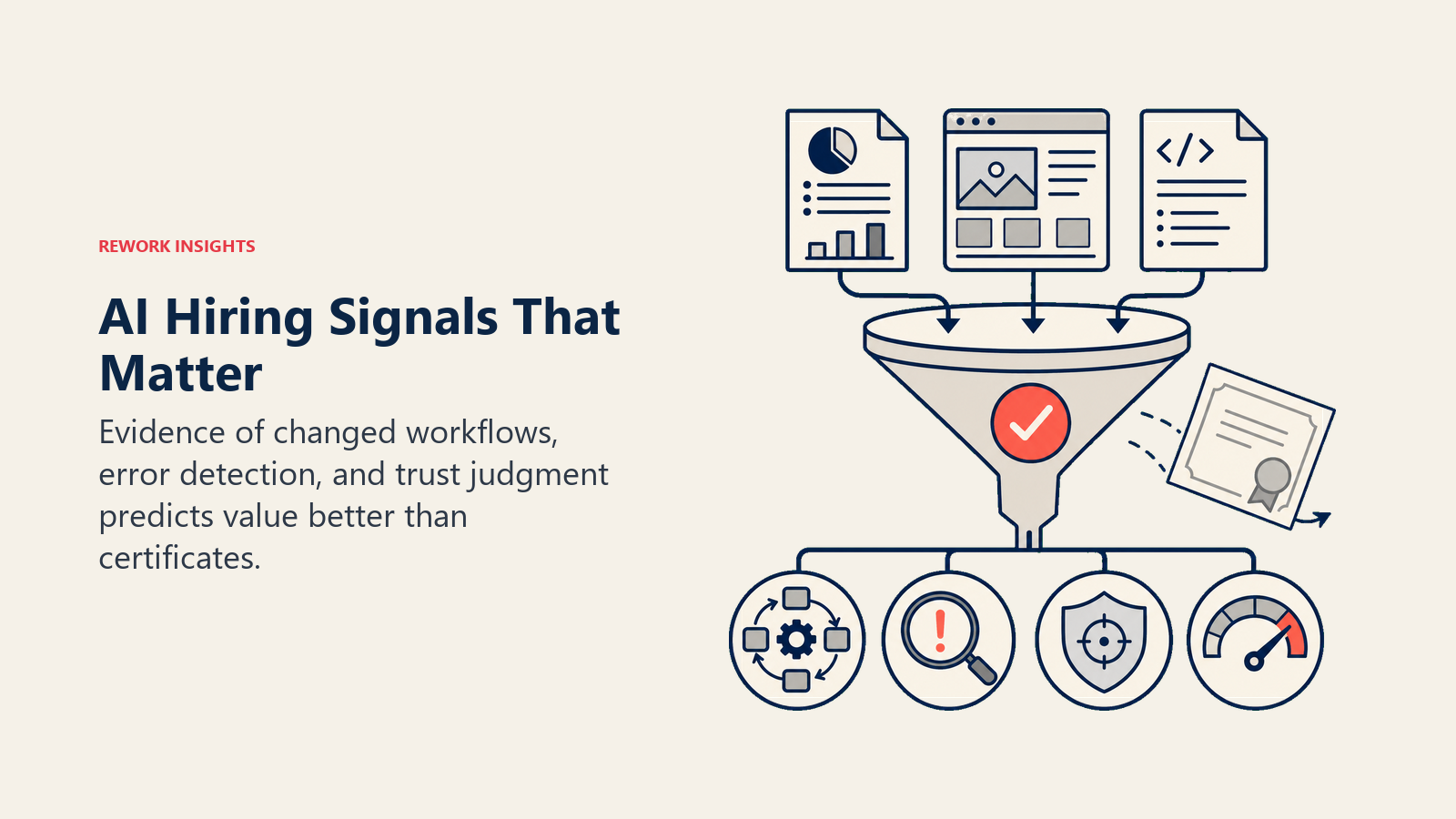
An AI-certified hire has demonstrated that they can pass a test about AI concepts. An AI-fluent hire has demonstrated that they've changed how they work because of AI. Those are very different people.
The behavioral signals that matter in interviews aren't "tell me about a course you took." They're:
- "Walk me through a workflow you changed in the last six months because of an AI tool. What did you stop doing? What do you do differently now?"
- "Tell me about a time an AI output was wrong in a way that wasn't obvious. How did you catch it?"
- "What's a task in your last role that you think could be almost fully automated? What would have to be true for you to trust that automation?"
These questions surface AI judgment, the calibrated skepticism and workflow creativity that actually moves the needle. They're hard to fake with a certification and hard to teach in a half-day workshop.
For roles where AI fluency is now table stakes (sales, marketing, ops, customer success), why every sales and marketing hire in 2026 needs AI fluency is worth reading before your next hiring cycle. The profile of an effective rep has shifted faster than most job descriptions reflect.
What This Means for L&D
The dirty secret of enterprise AI training is that four-hour certification programs change almost nothing. They're designed for compliance and optics, not behavior change. MIT Sloan's research on workforce learning supports this: short-form certification has minimal impact on actual on-the-job behavior, especially for AI-related workflows.
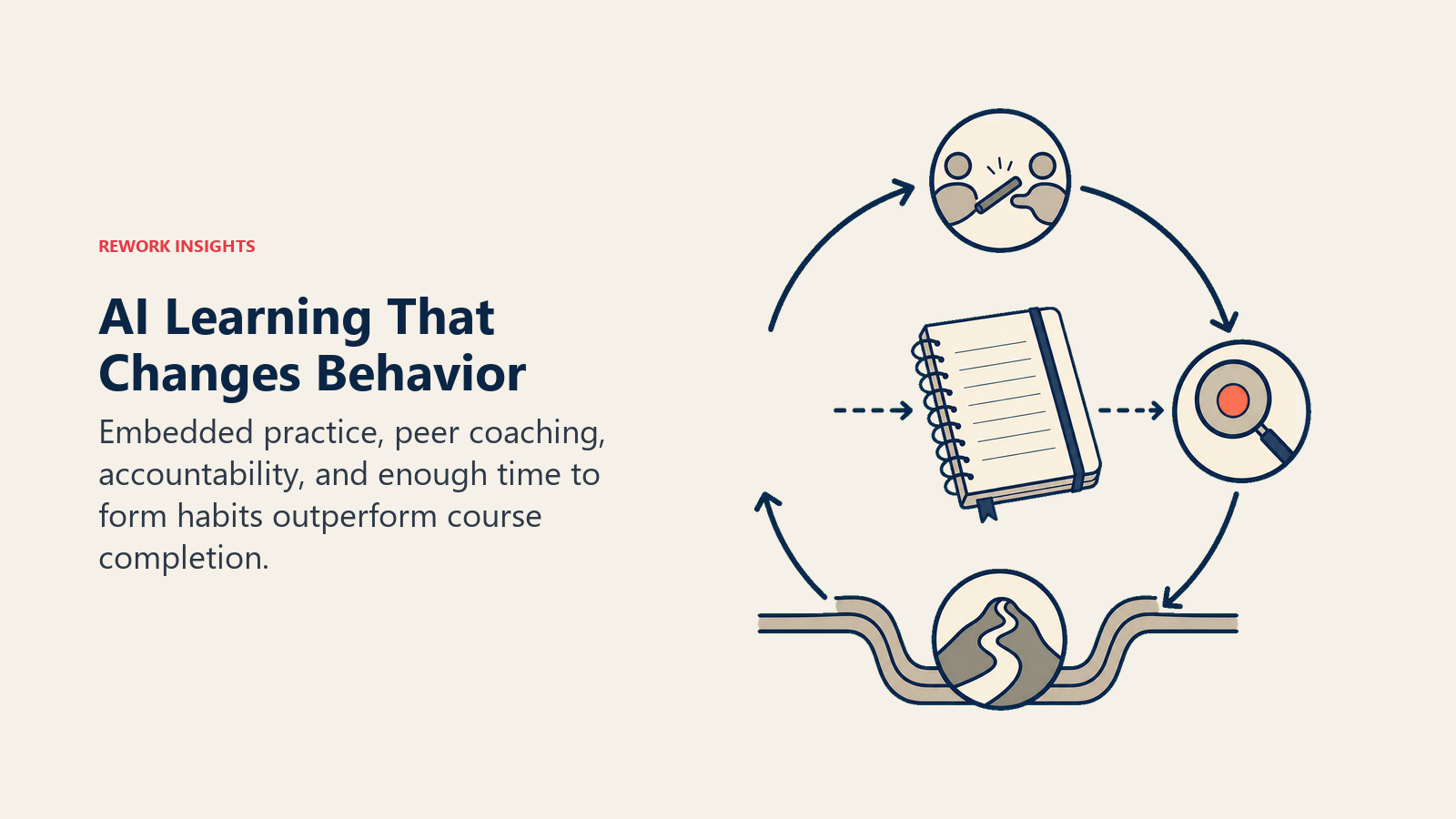
The L&D programs that actually work share a few characteristics. They're embedded in the workflow, not separated from it. Learning happens in the context of real work, not synthetic exercises. They run long enough for habits to form, 60 to 90 days minimum, with checkpoints and accountability. And they measure behavioral change, not course completion.
One example worth studying: a 300-person B2B software company struggling to get its sales team to use AI consistently. Standard approach would have been to buy a training platform license and track completions. Instead, they picked six high-performing reps who were already experimenting with AI and embedded them into the rest of the team as workflow coaches for 10 weeks. Each coach owned a pod of five reps and was accountable for getting those reps to adopt at least three new AI-assisted behaviors by the end of the program. This is exactly the model behind an AI champions program, finding internal advocates and making them the change agents.
Completion rates on the formal training module were about 40%. Adoption of actual AI workflows across coached reps was around 78%. The difference wasn't the content. It was accountability, peer credibility, and time. This is the core reason peer-led AI programs outperform top-down training rollouts.
The implication for your training budget: stop buying certifications. Start funding embedded workflow pilots. Find the people in your organization who are already doing the Layer 2 and Layer 3 work well, and make them the curriculum.
When you're deciding between building that capability internally or hiring it in, the upskill vs. hire AI-native ROI case gives you a framework for running the numbers. The answer isn't universal. It depends on your timeline, your existing talent density, and how much workflow redesign authority you're willing to extend to new hires versus developing it in people who already understand the business.
The Change Management Reframe
The executives closing the AI skills gap fastest aren't the ones who built the most sophisticated AI infrastructure. They're the ones who stopped treating AI adoption as an IT or L&D problem and started treating it as a change management problem.
Change management isn't a soft discipline. McKinsey's research on organizational change puts the failure rate of large-scale change programs at 70%, and AI adoption follows the same pattern. It's the rigorous practice of understanding why people resist changing how they work, removing the barriers that make change harder than the status quo, and building the organizational structures (incentives, accountability, peer networks) that make new behaviors stick.
By that framing, the question isn't "do our people have AI skills?" It's "have we built the conditions under which AI skills can develop and compound?"
That means executives asking harder questions:
- Are our managers modeling AI-fluent behavior, or are they still working the same way they did in 2023?
- Are our incentive structures rewarding people who redesign workflows, or just people who hit their existing metrics?
- Do we have any organizational mechanism for sharing what's working, or is AI adoption happening in isolated pockets that never get scaled?
Most companies can answer these honestly in about 15 minutes. Most don't like what the answers reveal.
The AI skills gap is real. But it's not a gap in Python knowledge or prompt engineering credentials. It's a gap in fluency, judgment, and the organizational infrastructure to support workflow change at scale.
Which roles AI is actually eliminating gives context on where the pressure is highest. And what AI-augmented departments actually look like structurally is useful for thinking about the org design decisions that need to run parallel to your skills investments.
The companies getting this right are the ones treating AI workforce transformation as a sustained organizational development effort, not a training initiative with a start date and a completion certificate. That shift in framing is harder than any technology deployment. But it's also the only one that actually produces the behavior change you're looking for.
Learn More
