More in
AI Workforce Transformation
Does AI Make Distributed Teams Easier or Harder to Lead?
Oct 11, 2026
Where AI Productivity Monitoring Turns Into Surveillance
Oct 11, 2026
Why Your Most Experienced People Resist AI Hardest (and Why You Need Them Most)
Oct 11, 2026
Is AI Making Teams Less Collaborative?
Oct 11, 2026
Should CEOs Use AI Themselves? Why Executive Fluency Sets the Adoption Ceiling
Oct 11, 2026
Does AI Favor Generalists or Specialists? What It Means for Who You Hire
Oct 10, 2026
Is Experience Still Worth Paying For When AI Narrows the Skill Gap?
Oct 10, 2026
When Every Candidate Uses AI, What Is a Resume Still Worth?
Oct 10, 2026
Should AI Screen Your Job Candidates? Where Automated Hiring Helps and Where It Backfires
Oct 10, 2026
Should Candidates Be Allowed to Use AI in Interviews?
Oct 10, 2026
What the First AI Ops Manager Hire Looks Like in a 100-Person Company
Turn this article into takeaways for your work.


Each assistant summarizes the article only for you and suggests best practices for your work.
68% of 100-to-250-person companies that invested in a dedicated AI operations role in 2025 reported measurable productivity gains within six months. That's not a small number, and it raises an obvious question for anyone running a company at that scale: what does this role actually look like, and do we need one? Deloitte's 2026 State of AI in the Enterprise report found that insufficient worker skills are the single biggest barrier to integrating AI into existing workflows, exactly the gap an AI Ops Manager is built to close. For context on what those companies were responding to, the LinkedIn AI skills demand surge data from 2026 shows just how fast the talent market for operational AI roles is moving.
The short answer: probably yes. But the more useful answer involves understanding what the role is, when you're truly ready to hire it, and how to make the case internally before the window to act closes.
This isn't a think-piece about the future of work. It's a playbook for companies that are past the "should we use AI?" question and are now facing the harder one: who owns making it work?
What "AI Ops Manager" Means in a Mid-Market Context
The title sounds technical, but the job is fundamentally operational and cultural, not purely engineering.
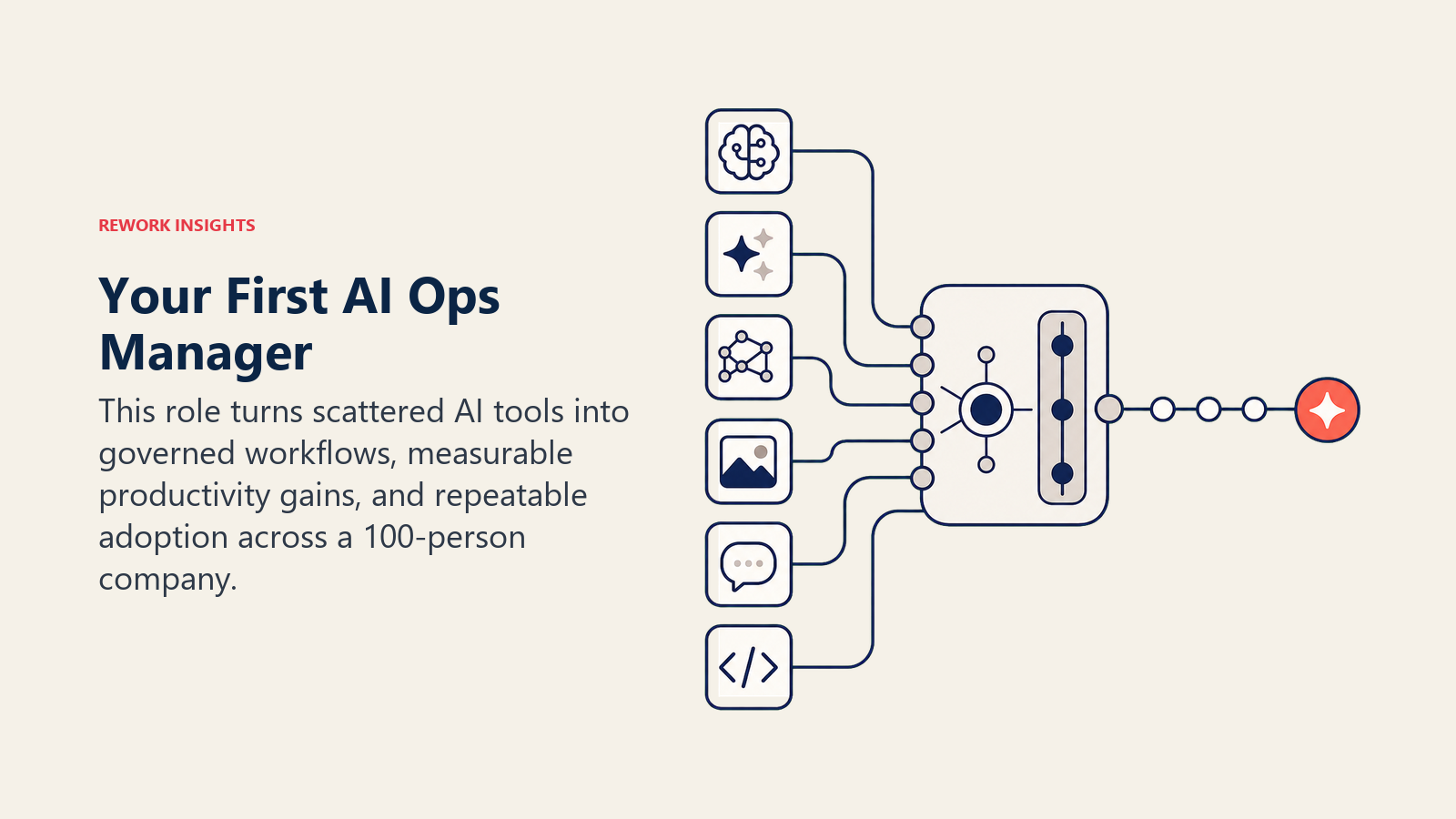
An AI Ops Manager at a 100-person company is the person who bridges the gap between AI tooling and actual business outcomes. They're not writing large language model fine-tuning code. They're not the IT manager who maintains software licenses. And they're not a consultant who hands you a 60-slide transformation deck and disappears.
They're the person who:
- Audits which teams are using which AI tools and how effectively
- Identifies workflow bottlenecks where AI can cut time-to-outcome
- Builds internal playbooks so that AI adoption doesn't depend on individual initiative
- Manages vendor relationships across your AI stack
- Trains managers (not just ICs) on how to integrate AI into team workflows
- Tracks productivity metrics and reports to leadership on ROI
Think of it as the role that makes sure your AI investment doesn't just sit in a line item. It actually changes how work gets done.
How this differs from adjacent roles:
Your CTO or VP of Engineering is focused on building product, not optimizing internal operations. Your IT manager is reactive, keeping systems running rather than redesigning them. A transformation consultant delivers a project, then exits. The AI Ops Manager is permanently embedded, owns outcomes, and builds institutional capability over time.
The Trigger Point: Signs You're Ready vs. Not Ready
Not every 100-person company needs this hire today. But there are clear signals that the gap is costing you money.
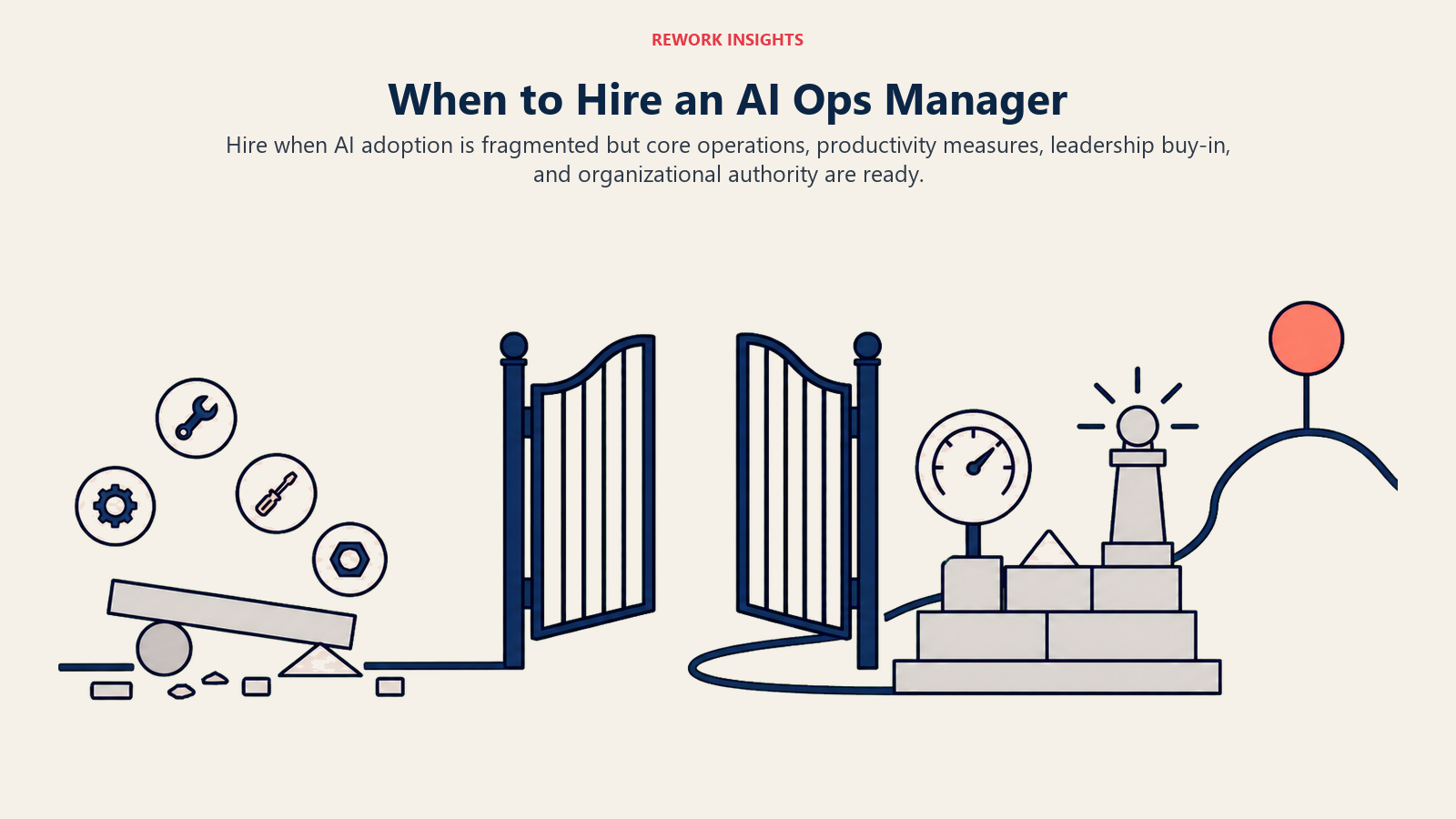
You're ready to hire when:
- You've spent money on AI tools but can't quantify the ROI
- Different teams are using different tools for the same jobs with no central visibility
- Your highest-leverage people are spending time on tasks AI should be handling
- You've had an "AI champion" in one department but it hasn't scaled to others
- Your competitors are visibly moving faster on AI-driven workflows
- You're about to hit a growth inflection point where manual processes will break
You're not ready yet when:
- Your core operations are still unstable (AI can't fix a broken process, it just accelerates it)
- You haven't defined what "productivity" means in your organization
- Leadership doesn't have buy-in for the investment (the AI Ops Manager needs organizational authority to be effective)
- You're pre-product-market fit and every dollar is existential
The trigger point is usually this: when you realize your AI adoption is random rather than systematic. Random adoption creates pockets of value; systematic adoption creates compounding advantage. Gartner research on AI maturity found that in organizations with high AI maturity, 57% of business units trust and are ready to use new AI solutions, compared to only 14% in low-maturity organizations. That gap is what the AI Ops Manager builds over time. A sales team AI readiness audit is often the tool that surfaces exactly this kind of fragmented adoption pattern before it becomes a structural problem.
Role Architecture: Responsibilities, Reporting, and the First 90 Days
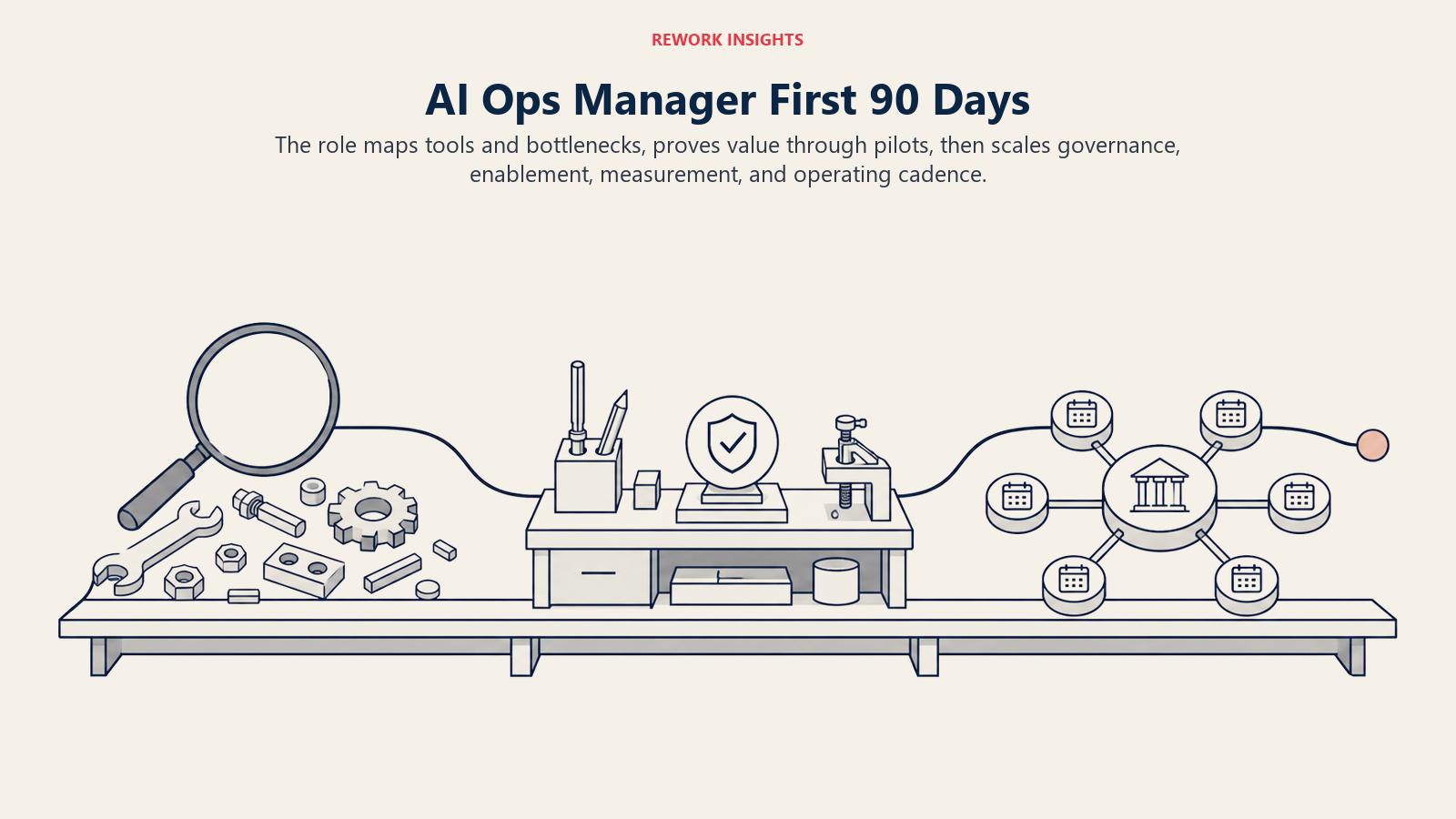
The role needs a clear operating sequence, not just a broad mandate.
Core Responsibilities
A well-scoped AI Ops Manager role at this company size typically covers five areas:
- AI Stack Governance: Owns the inventory of AI tools, manages vendor contracts, and sets standards for how tools get evaluated and adopted
- Workflow Optimization: Maps current workflows, identifies automation opportunities, and pilots new AI-assisted processes with specific teams
- Enablement and Training: Builds training programs for both managers and ICs; ensures AI fluency isn't concentrated in one department
- Measurement and Reporting: Defines KPIs for AI ROI (time saved, error reduction, output velocity) and reports progress to the executive team quarterly
- Change Management: Anticipates resistance, communicates the "why" to skeptical employees, and manages the cultural shift from AI-as-experiment to AI-as-standard. For a structured approach to this dimension, change management frameworks for AI rollouts provide the sequencing that most first-time AI Ops hires need to borrow from rather than reinvent
Reporting Line Options
There are three viable reporting structures, each with tradeoffs:
Reports to CEO: Best when AI transformation is a strategic priority and needs executive visibility. Risk: the role can get pulled into strategic conversations at the expense of operational execution.
Reports to COO: The most common fit for mid-market companies. The COO owns operations, and AI Ops is fundamentally an operations function. This is the default recommendation.
Reports to CTO: Works when AI adoption is heavily product-adjacent, or when the company's operational complexity is low. Risk: the role can become too technical and lose its organizational influence.
For most 100-person companies, reporting to the COO is the right starting structure. Revisit after 12 months.
The First 90-Day Framework
Days 1-30: Listen and Map
- Interview every department head (1:1, 60 minutes each)
- Inventory all AI tools currently in use across the company
- Document the top 3 workflow bottlenecks per team
- Identify 2-3 quick-win automation opportunities
Days 31-60: Pilot and Prove
- Launch 2 pilot projects with willing teams, picking for visibility, not just ease
- Build a simple AI ROI dashboard (baseline metrics established)
- Draft an internal AI usage policy (acceptable use, data privacy, vendor standards)
- Deliver first report to COO/CEO with findings and 90-day recommendations
Days 61-90: Scale and Systematize
- Formalize the AI stack governance process
- Run first company-wide AI enablement session (45-minute, practical, not theoretical)
- Establish a monthly AI ops review cadence with department heads
- Present 6-month roadmap to leadership team
This 90-day arc gives the hire clear deliverables that justify the investment before the first performance review.
Hiring Profile: What to Look For (and What to Avoid)
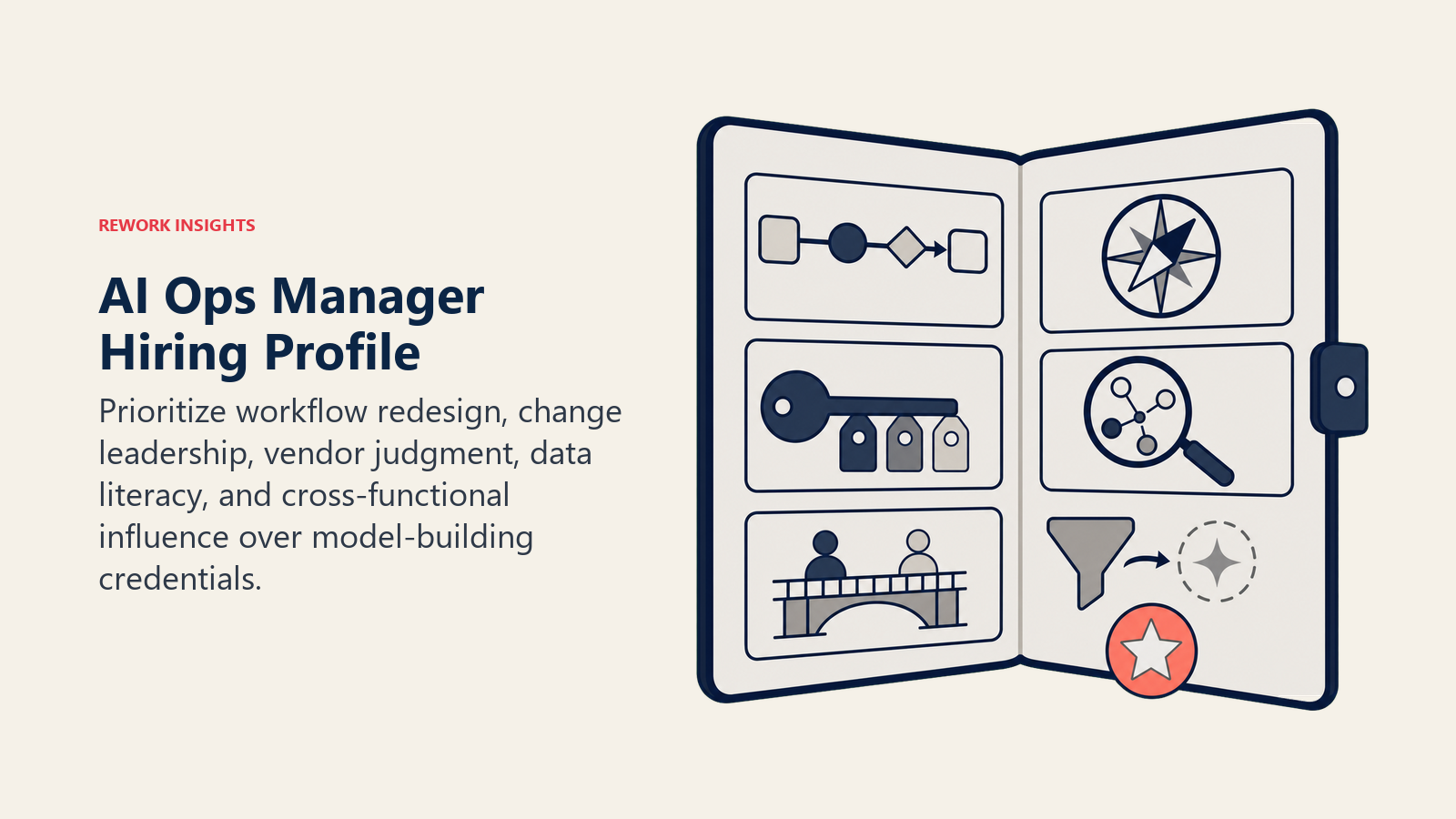
The strongest candidates combine operational judgment with the influence to change how teams work.
The Ideal Background
The best candidates for this role at a 100-person company typically come from one of three paths:
- Operations + AI project experience: A senior ops manager or director who led an AI tooling rollout in a previous company and wants to own the function
- Management consulting + tech exposure: Someone who has advised clients on digital transformation but wants to build rather than advise
- Product or program management in an AI-adjacent company: Someone who understands technical constraints but isn't themselves an engineer
Skills That Matter
- Workflow analysis and process design (not just documentation, but actual redesign)
- Change management and stakeholder communication
- Vendor evaluation and procurement basics
- Data literacy (comfortable reading dashboards, not necessarily building them)
- Strong communication across technical and non-technical audiences
- Experience with project management tools and cross-functional coordination
Red Flags
- Candidates who lead with tool names rather than business outcomes
- People who haven't worked in a company under 300 employees (mid-market ops is different from enterprise)
- Anyone whose pitch is about building AI (you need someone who operationalizes existing AI, not builds new models)
- Candidates who can't give concrete examples of measuring their impact
What the 2026 Market Looks Like
The market for this role is maturing fast. In early 2025, most job listings were vague and internally inconsistent. By late 2025, companies like Notion, Monday.com, and mid-market SaaS vendors began formalizing the role with clearer scope. In 2026, you're competing with companies who've had this function running for 12-18 months, which means the best candidates have options. McKinsey's research on technology workforce design for the agentic AI era documents how AI is already driving a 20-30% net impact on workforce composition. The companies moving now are the ones shaping what these roles look like. The industries hiring AI talent fastest in 2026 shows where competition for this profile is most intense.
Expect a base salary range of $120,000-$165,000 for a strong mid-level hire in most US markets. Senior candidates with demonstrable ROI track records are commanding $170,000-$200,000. Equity is increasingly expected, even at this level.
ROI Framing: How to Sell This Hire Internally
The CFO and board question will always be the same: what do we get back?
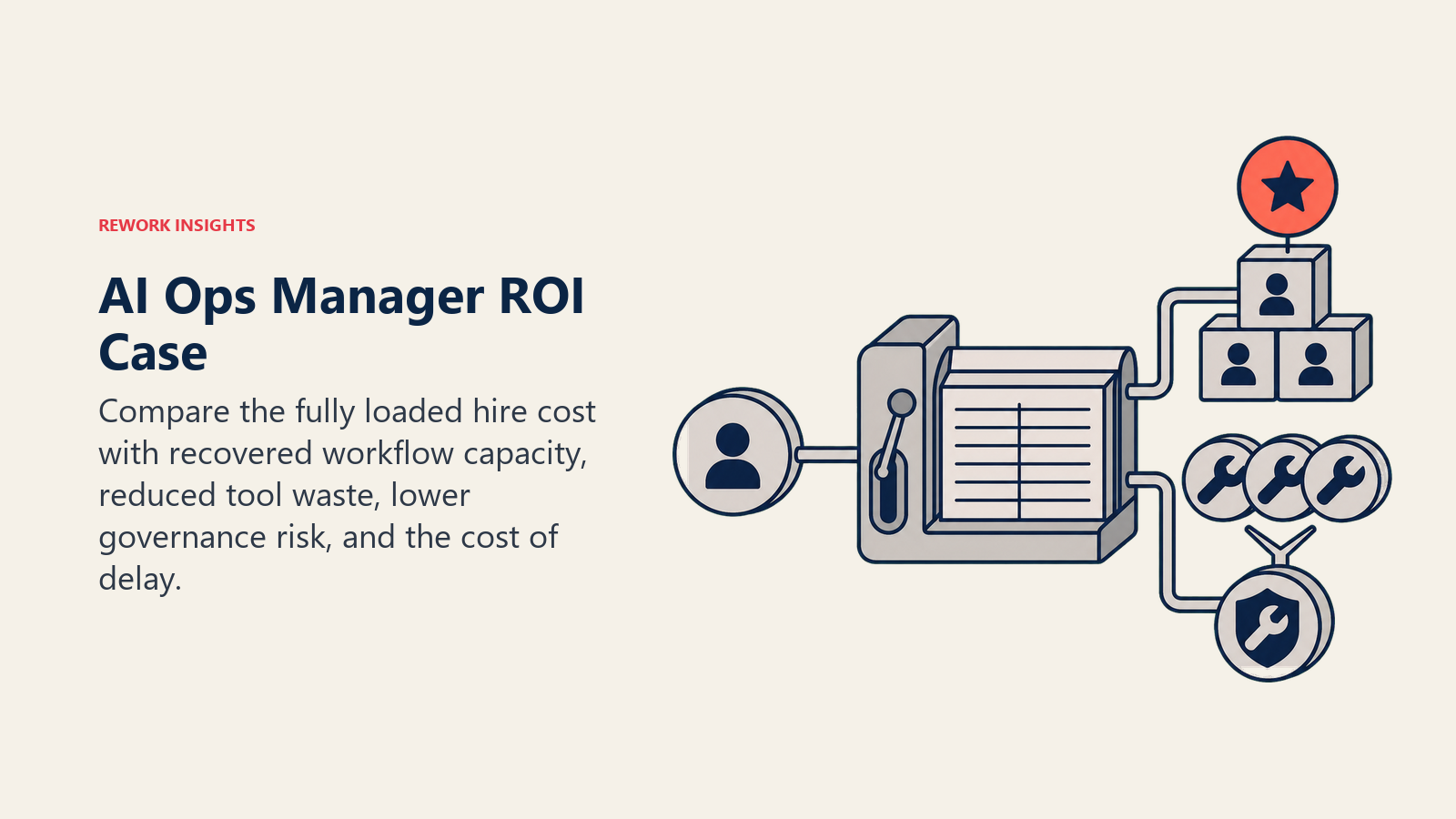
Here's a framework for making the case:
Step 1: Quantify the current cost of AI chaos. How many hours per week are your highest-paid people spending on tasks that AI should handle? Multiply by their fully-loaded cost. At a 100-person company, this is typically $400K-$800K per year in lost leverage.
Step 2: Estimate conservative productivity recovery. Even a 10% productivity improvement across 100 employees generates significant measurable output lift. The key is to attach it to specific workflows, not abstract "productivity."
Step 3: Frame the governance savings. Unmanaged AI tool proliferation means duplicate subscriptions, inconsistent outputs, and compliance exposure. Centralizing this function typically saves $40K-$80K in redundant tooling within the first year.
Step 4: Present the risk of delay. Companies that systematize AI adoption in 2025-2026 are building a compounding advantage. The gap between AI-mature and AI-reactive companies is widening. The cost of waiting isn't $0. It's competitive positioning over the next 3 years. A CFO-ready analysis of the hidden costs of delaying AI upskilling provides the numbers that turn this argument from strategic assertion into boardroom evidence.
A credible first-year ROI case often looks like: $130K-$150K all-in hire cost, $180K-$250K in documented productivity gains and tooling savings, plus strategic positioning that's harder to quantify but directionally correct.
Three Companies That Got Here First
Rippling (early phase): Before Rippling formalized its AI operations function, a senior ops hire was tasked with owning AI tooling across HR and finance workflows. Within the first year, the team reduced manual processing time by 40% in two core HR workflows. The hire was promoted within 14 months.
A Series B fintech (confidential): A 90-person payments company hired its first AI Ops Manager in Q1 2025. By Q3 2025, the role had consolidated 11 point AI tools into a unified stack of 4, saving $62K annually and reducing onboarding time for new tools by 70%.
A professional services firm: A 120-person consulting firm hired a former McKinsey EM with internal AI experience. Her first deliverable was an AI usage audit that revealed 6 departments were using different tools for the same research workflows. Standardizing saved $47K in tool costs and cut research cycle time by 35%.
The pattern across these cases: early movers hired before the function was obvious, and the hires paid back quickly.
The Window Is Closing
There's a version of this conversation that happens in 2028 where every job description for a VP of Ops, a COO, or a Chief of Staff includes AI operations experience as a baseline requirement. At that point, the role won't be a differentiating hire. It'll be table stakes.
You're still early enough to hire someone who will build the function from scratch, own it, and grow with it. But "early" has a shorter shelf life than most executives expect.
The question isn't whether your company will have an AI Ops function. It's whether you build it deliberately, with the right hire, or let it assemble itself through trial and error in 2027 when the cost of delay is much higher.
Learn More
- The CAIO is Not a Fad: Why Mid-Market Companies Are Appointing AI Executives
- How SaaS Companies Are Restructuring Teams Around AI in 2026
- The Executive Decision Framework for AI Workforce Strategy
- From AI as Tool to AI as Teammate: The Mindset Shift That Unlocks Value
- Measuring AI Adoption ROI Across Your Organization: The metrics framework your AI Ops Manager will need from day one

Co-Founder, Rework.com
On this page
- What "AI Ops Manager" Means in a Mid-Market Context
- The Trigger Point: Signs You're Ready vs. Not Ready
- Role Architecture: Responsibilities, Reporting, and the First 90 Days
- Core Responsibilities
- Reporting Line Options
- The First 90-Day Framework
- Hiring Profile: What to Look For (and What to Avoid)
- The Ideal Background
- Skills That Matter
- Red Flags
- What the 2026 Market Looks Like
- ROI Framing: How to Sell This Hire Internally
- Three Companies That Got Here First
- The Window Is Closing
- Learn More