More in
AI Jobs & Skills News
Finance Keeps Shedding Jobs as the Economy Hires: The White-Collar Warning
Jun 6, 2026
AI Skills Just Became the Hardest Hire in the World. You Won't Recruit Your Way Out
Jun 6, 2026
Is AI Actually Killing Jobs? May's Hiring Numbers Say Not So Fast
Jun 5, 2026
You Put Your AI Agents on the Org Chart. Accountability Quietly Dropped
Jun 5, 2026
Everyone Blames AI for the Gen Z Job Crisis. The Fed Points at Remote Work
Jun 5, 2026
AI's Net Job Drag Fell to 11,000 a Month. Construction Is Hiding the Truth
Jun 4, 2026
AI Blamed for a Record 40% of May's US Layoffs, the Third Month Running
Jun 4, 2026
Four Futures for Jobs by 2030: The Mid-2026 Checkpoint for CEOs
Jun 3, 2026
Can Federal AI Apprenticeships Fix Your Skills Gap Cheaper Than Hiring?
Jun 3, 2026
AI Engineer Pay Split Into Two Markets. Only the Top Is a Bubble
Jun 3, 2026
Workers with AI Fluency Are Commanding a 27% Salary Premium: What That Means for Your Comp Strategy
Turn this article into takeaways for your work.


Each assistant summarizes the article only for you and suggests best practices for your work.
The number is 27%. And it doesn't apply to AI engineers or data scientists. It applies to your operations manager, your sales analyst, your finance associate, and your marketing coordinator.
That's the average salary premium commanded by workers who can demonstrate meaningful AI tool proficiency across their role, compared to peers in the same job family without those skills. That broad premium sits well below the frontier-lab pay packages for top AI engineers, which run in a separate market entirely. The data comes from cross-referenced compensation surveys including Radford's 2025 AI Skills Impact Report, Mercer's Global Talent Trends analysis, and LinkedIn Salary Insights covering over 2.3 million job postings from 2024 through early 2026.
"AI fluency" here has a specific definition. It doesn't mean knowing how to prompt ChatGPT. It means demonstrable proficiency in applying AI tools to workflow outputs, consistently producing faster, higher-quality work using AI-assisted methods in a way that hiring managers and employers can verify through portfolio, work samples, or structured skill assessments.
That distinction matters for ops leaders making compensation decisions, because it means you can't close the gap with a company-wide "introduction to AI" training session. Fluency is a depth-of-skill bar, not a familiarity bar.
What Happened: A Comp Divergence That Built Quietly, Then Wasn't
The salary divergence between AI-fluent and non-fluent workers didn't happen overnight. It started as a premium visible only in data-heavy or tech-adjacent roles in 2023. By mid-2024, it had spread into sales operations, finance, and marketing analytics. By 2025, Radford's data was tracking the premium across all major role families, including functions that most companies wouldn't have associated with AI skills at all.
The mechanism is straightforward: employers are finding that workers with genuine AI proficiency produce measurably more output per hour, including better first drafts, faster analysis, higher-quality research, and more consistent process execution. When output quality is higher, market-clearing wages rise. And when competing employers start paying more for that output quality, the rest of the market either follows or loses those workers.
The 2025 Mercer data showed that within a single year, 34% of companies had updated at least one pay band specifically to account for AI skill differentials. That figure is expected to exceed 60% by end of 2026.
The Numbers, Broken Down by Function
The 27% average masks meaningful variation by function. Here's what the data shows at the role-family level:
Sales: Workers in sales roles with demonstrated AI tool proficiency (pipeline analysis, AI-assisted outreach, forecasting model use) command a 31% premium over peers without those skills. This is the highest premium of any major function, driven partly by the direct revenue attribution that makes output quality easy to measure.
Operations: 24% premium for operations professionals with AI workflow integration skills. This covers roles from supply chain analysts to HR operations coordinators. The premium reflects efficiency gains that are directly trackable in throughput and cycle time metrics.
Finance: 22% premium across finance and accounting functions where AI-assisted analysis, reporting, and anomaly detection have become differentiating skills. FP&A roles are seeing the sharpest divergence.
Marketing: 29% premium for marketing roles where AI content generation, campaign optimization, and analytics proficiency are demonstrable. The high premium reflects both the speed advantage and the creative output quality differential.
Customer success and support: 18% premium, lower than other functions but still material, driven primarily by AI-assisted case resolution speed and quality.
The Turnover Data Is the Real Risk Signal
The salary premium is a cost and a hiring benchmark. But the turnover data is what makes this urgent for retention-focused ops leaders.
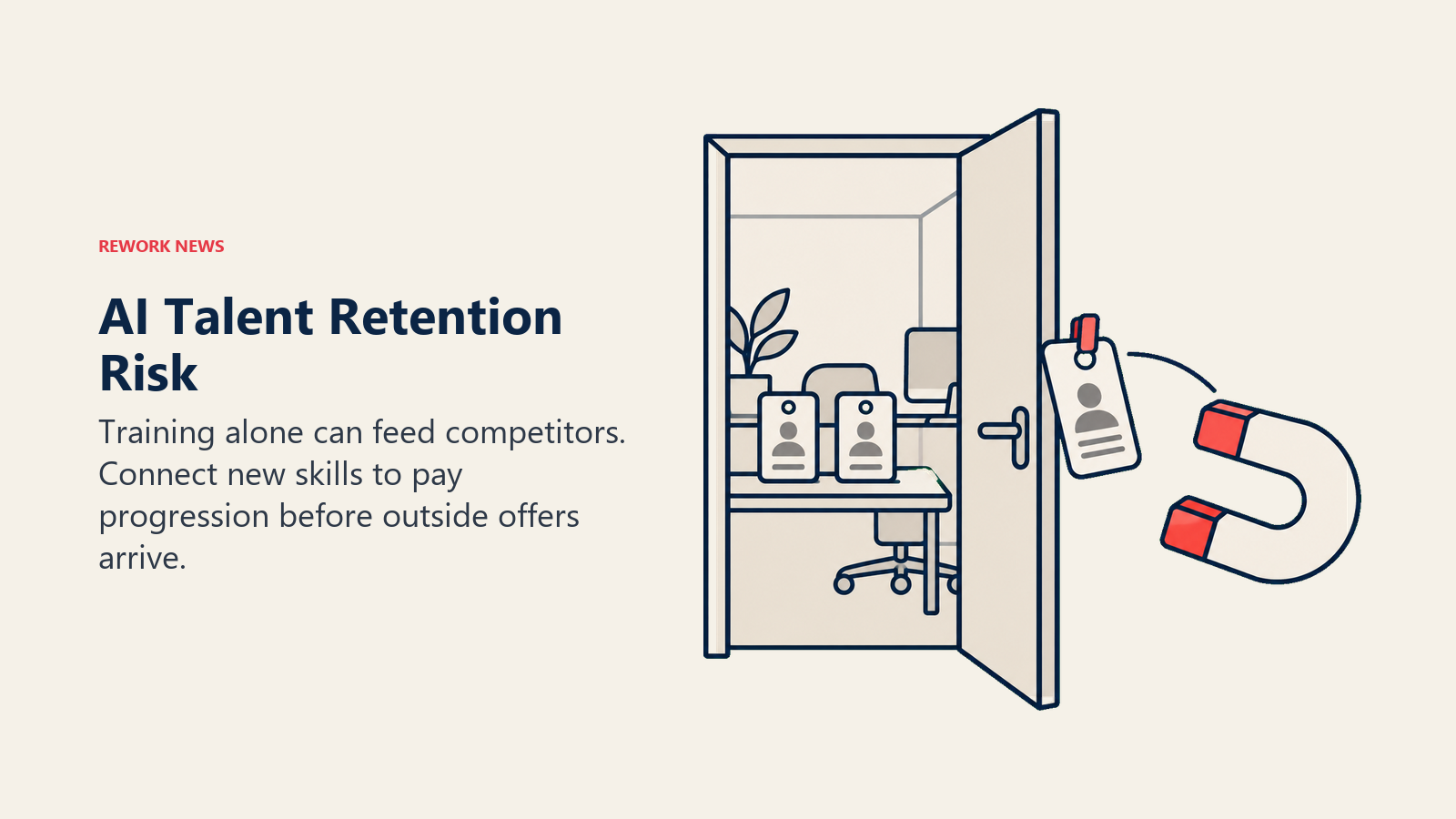
AI-fluent employees leave at 2.1x the rate of non-AI-fluent employees in comparable roles. This isn't because they're more volatile. It's because their phones ring more. LinkedIn InMail response rates for AI-fluent workers are 3.4x higher than for peers in the same role without those skills. Recruiters know who has the skills, and they're working those people hard. Understanding how AI is changing retention, not just hiring is the first step toward building a proactive response before the exit interviews start.
The average cost to replace an AI-fluent employee, accounting for recruitment, onboarding, and productivity ramp, runs approximately $85,000-$140,000 depending on seniority and function. That figure is based on Society for Human Resource Management cost-per-hire data adjusted for current AI talent market conditions.
The cost to reskill an existing employee to genuine AI fluency, through a structured bootcamp or intensive learning program, runs $3,000-$8,000 per person depending on program quality. The ROI calculation isn't close. You can reskill 10-20 existing employees for the cost of replacing one AI-fluent employee who left. A 90-day AI fluency plan gives you the structure to move fast without disrupting existing team output.
But there's a catch: reskilling has to be tied to comp progression to close the retention gap. If an employee completes AI fluency training and their compensation doesn't reflect the new skill, the market will simply offer them the 27% premium elsewhere. The reskilling investment becomes a subsidy for your competitors' hiring efforts.
What Smart Leaders Are Doing
The companies managing this well are doing three things in combination.
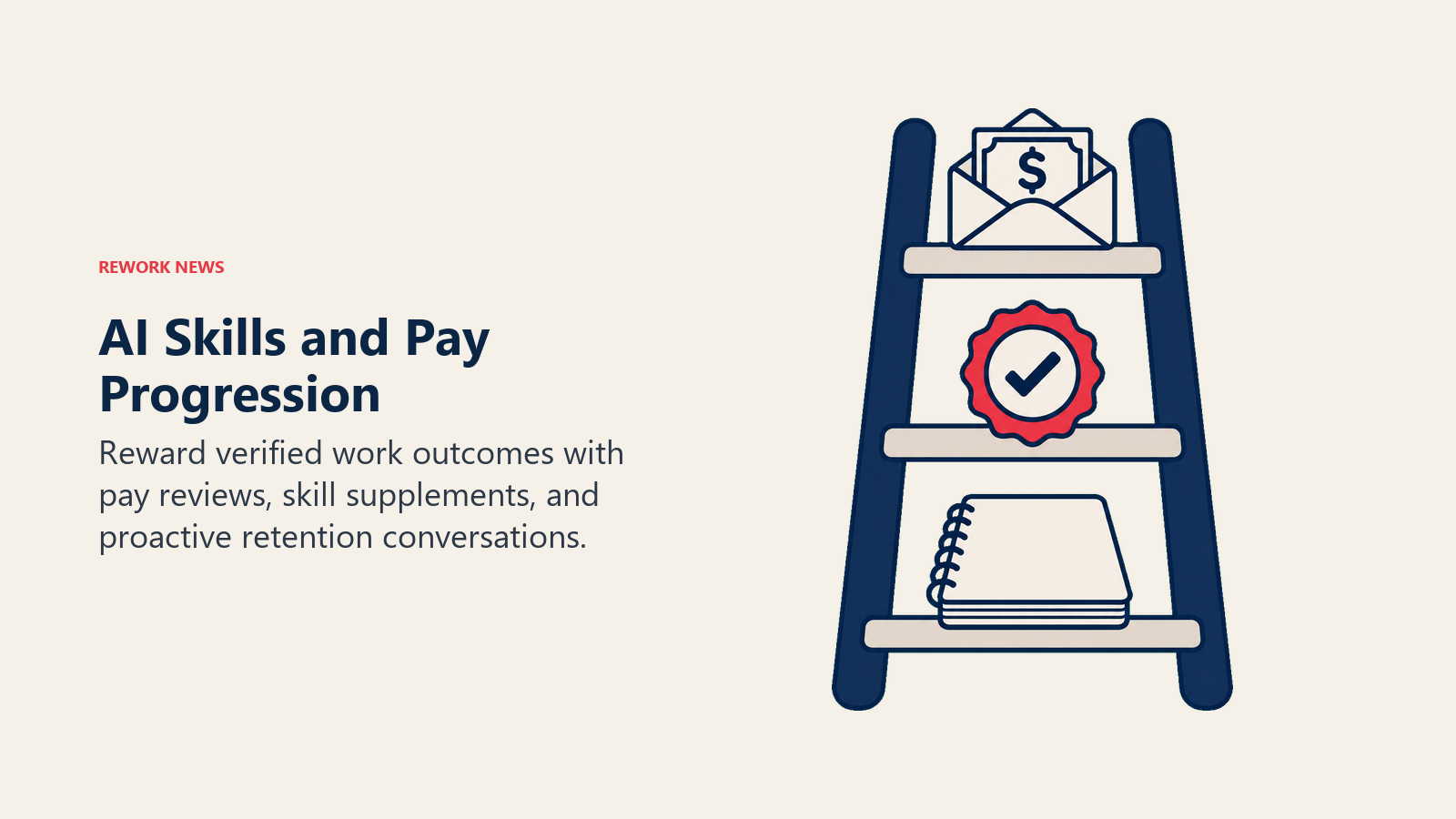
Proactive comp band updates. Rather than waiting for AI-fluent employees to bring competing offers, companies like Salesforce and several large regional banks have implemented AI skill supplements, additional compensation added to base when an employee demonstrates verified AI proficiency. The amounts range from $5,000-$15,000 annually depending on role level. This isn't a bonus. It's a base compensation adjustment tied to a skill certification or demonstrated output standard.
AI skill stipends tied to pay progression. A growing number of mid-market companies are building AI learning into their formal compensation ladders. Employees who complete approved AI training and pass an internal skill assessment unlock the next pay band eligibility review. This creates a clear, transparent connection between skill investment and compensation outcome, and it makes the L&D spend retention-protective rather than just developmental.
Retention risk scoring for current staff. Some HR leaders are doing something uncomfortable but useful: identifying which current employees are most likely to be targeted by external recruiters based on AI fluency signals visible on LinkedIn or resume updates. Those employees get proactive retention conversations and comp reviews rather than exit interviews. The goal is to close the external gap before a competing offer forces the issue.
What to Watch Next
The 27% premium will not hold forever at that magnitude. As AI fluency becomes more widespread, as more workers complete training and more employers invest in reskilling, the premium will compress. The question is how fast.
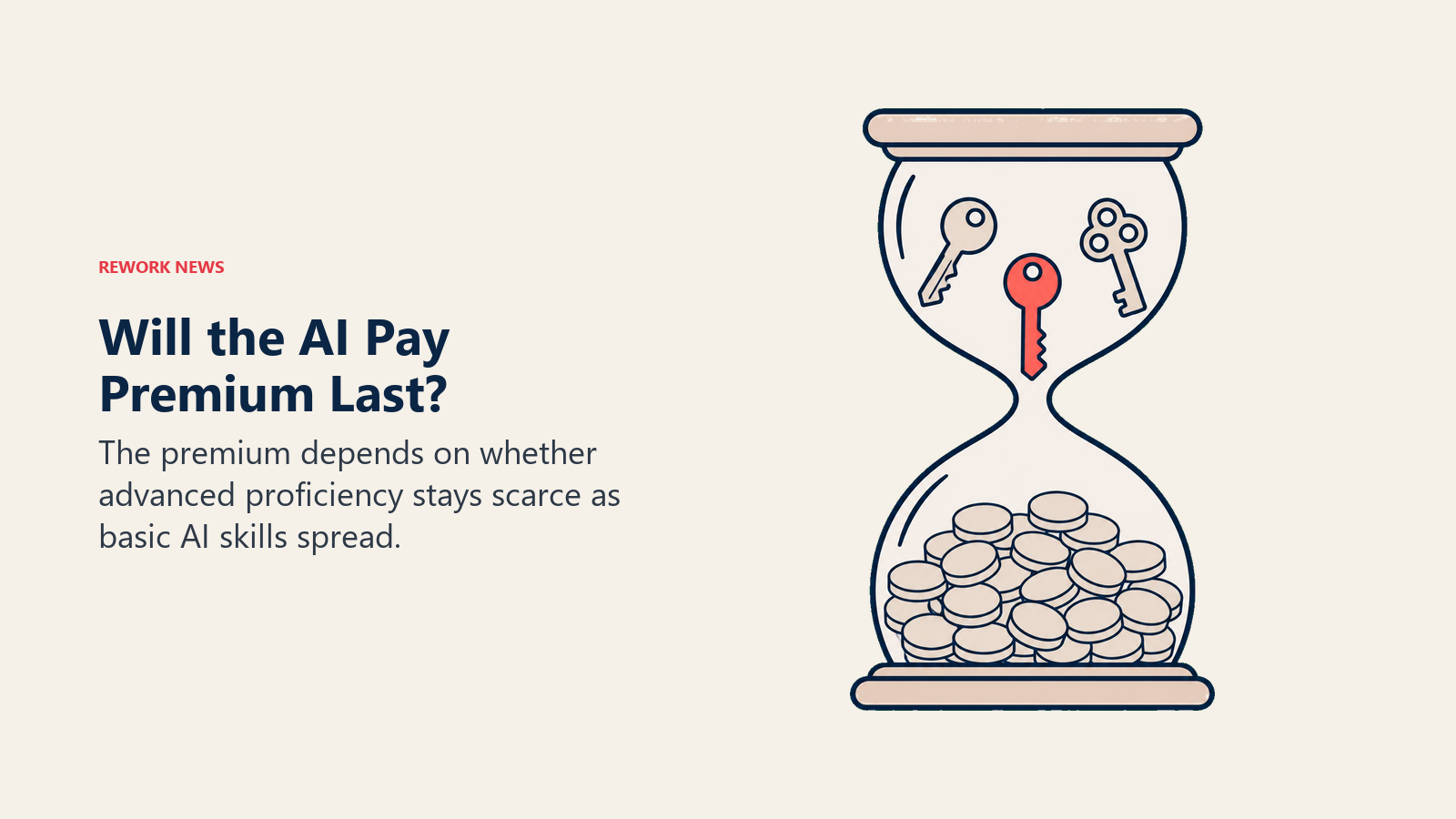
There are two plausible scenarios. In the first, AI tools continue advancing fast enough that the definition of "fluency" keeps moving. Depth of skill stays scarce even as basic proficiency becomes common, and the premium stays elevated for workers at the frontier. In the second, AI tools become simple enough that genuine proficiency requires less expertise, fluency becomes commoditized, and the premium compresses toward zero over 3-5 years.
Most compensation analysts believe the first scenario is more likely for the next 2-3 years, and the second scenario becomes relevant as AI tool interfaces simplify further. That means the window to use comp strategy as a retention tool against the AI fluency premium is probably 2-4 years.
For ops leaders, the practical implication is simple: the cost of waiting is compounding. Every quarter you delay proactive comp band adjustments or structured reskilling programs is a quarter in which AI-fluent employees are more likely to leave, replacement costs stay high, and the gap between your workforce's skills and market expectations widens.
The 27% premium is a retention problem disguised as a hiring statistic. Treating it as only an external market signal misses the most actionable and most expensive part of the issue.
Learn More
- The AI Certification Market Hit $4B, But Only a Handful of Credentials Signal Job Readiness
- Companies Are Spending an Average of $1,800 Per Employee on AI Reskilling
- AI Skill Requirements Are Now Showing Up in Non-Tech Job Postings
- The Hidden Cost of Delaying AI Upskilling, CFO Analysis
- Measuring AI Adoption ROI Across Your Teams
