More in
AI Workforce Transformation
Does AI Make Distributed Teams Easier or Harder to Lead?
Oct 11, 2026
Where AI Productivity Monitoring Turns Into Surveillance
Oct 11, 2026
Why Your Most Experienced People Resist AI Hardest (and Why You Need Them Most)
Oct 11, 2026
Is AI Making Teams Less Collaborative?
Oct 11, 2026
Should CEOs Use AI Themselves? Why Executive Fluency Sets the Adoption Ceiling
Oct 11, 2026
Does AI Favor Generalists or Specialists? What It Means for Who You Hire
Oct 10, 2026
Is Experience Still Worth Paying For When AI Narrows the Skill Gap?
Oct 10, 2026
When Every Candidate Uses AI, What Is a Resume Still Worth?
Oct 10, 2026
Should AI Screen Your Job Candidates? Where Automated Hiring Helps and Where It Backfires
Oct 10, 2026
Should Candidates Be Allowed to Use AI in Interviews?
Oct 10, 2026
The Executive Decision Framework for AI Workforce Strategy

Turn this article into takeaways for your work.


Each assistant summarizes the article only for you and suggests best practices for your work.
Most AI workforce transformations fail before they start. Not because the technology doesn't work. It does. But because the executive team treated an AI workforce decision like a software procurement decision.
They bought tools. They didn't build strategy.
The result? You've got a company full of AI licenses that nobody uses, a skills gap that's actually wider than before you started, and a middle management layer that's quietly killing adoption at every level. Gartner found that 56% of enterprise AI initiatives underperform expectations. Workforce misalignment is the leading cause.
This framework gives you a structured way to make AI workforce decisions. Not theory. A tool you can bring to your next board meeting or leadership offsite and use immediately.
Why AI Workforce Decisions Keep Failing
Before the framework, let's name the real problem.
Most executives approach AI workforce strategy as a series of one-off decisions: Should we buy Copilot? Should we hire a prompt engineer? Should we train the sales team on AI tools?
Those are tactical questions. And answering tactical questions without a strategic framework is how you end up spending $2 million on AI software with a 14% adoption rate.
The companies getting this right are asking different questions: Which functions depend most on the work AI is now automating? Where is our competitive position most at risk if we don't move? And where are we moving too fast without the internal capability to absorb the change?
If you haven't read about the AI skills gap executives are getting wrong, start there. The gap isn't where most leaders think it is, and that misdiagnosis is costing companies serious money.
The framework below gives you a way to answer the right questions, in the right order.
The Four-Quadrant AI Workforce Decision Model
Start with a two-by-two. It's simple for a reason: executive teams need something that survives a 60-minute leadership meeting.
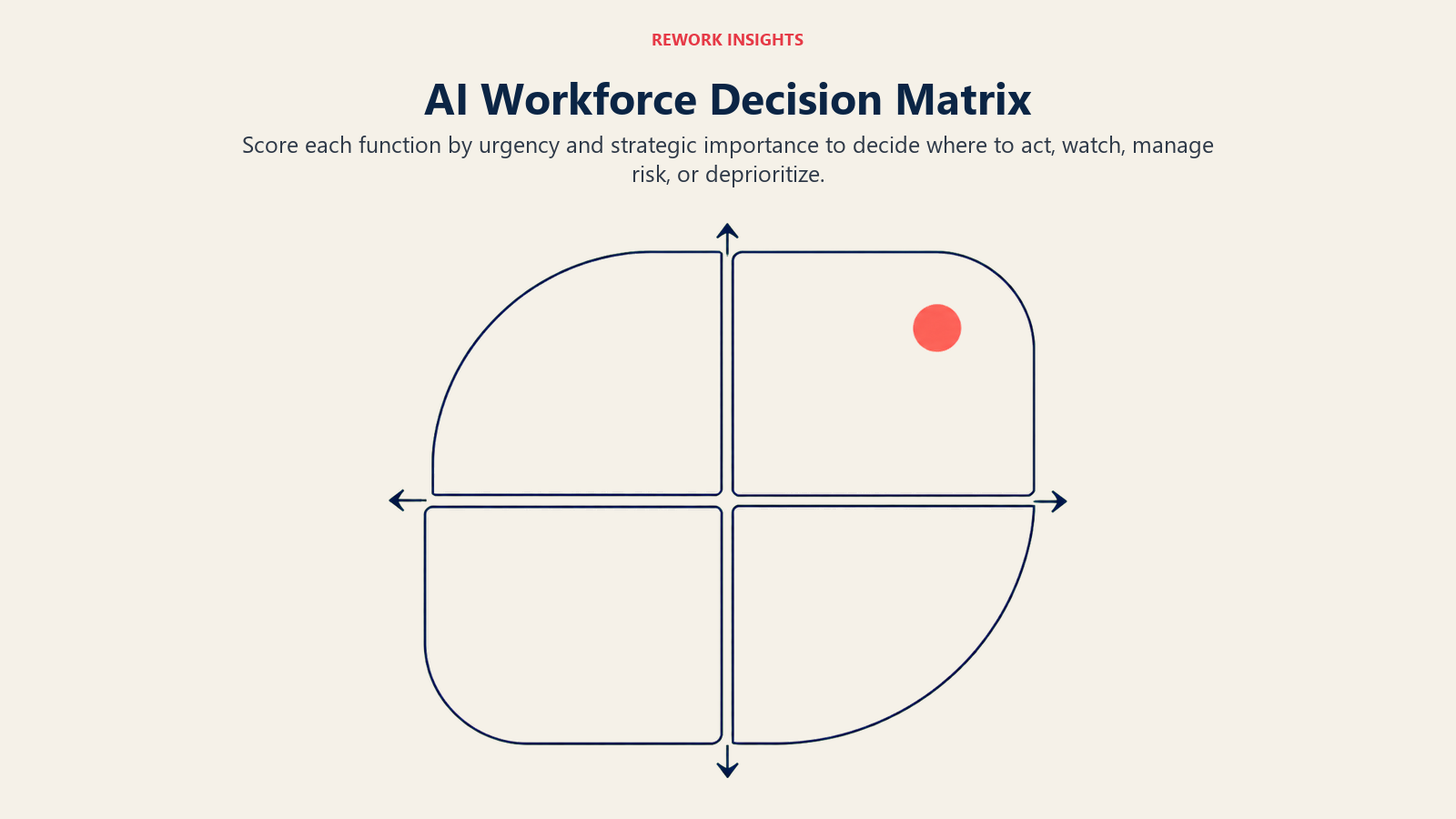
Axis 1: Urgency (Low → High) How quickly will your competitive position erode if you don't act in this function?
Axis 2: Strategic Importance (Low → High) How central is this function to your core value creation and differentiation?
This gives you four quadrants:
                    HIGH STRATEGIC IMPORTANCE
                    |
  [Q2] Watch        |  [Q1] Act Now
  Upskill selectively|  Full investment: upskill
  Monitor closely   |  + hire AI-native + augment
                    |
  ──────────────────+──────────────────  HIGH URGENCY →
                    |
  [Q3] Deprioritize |  [Q4] Manage Risk
  Low ROI on AI     |  Move fast before
  investment now    |  window closes
                    |
                    LOW STRATEGIC IMPORTANCE
Q1: Act Now (High Urgency + High Strategic Importance) This is where your AI workforce investment should concentrate first. Examples: sales, customer success, product, revenue operations. These functions are both strategically central and already being disrupted by AI adoption at competitors. Every quarter you delay here is a quarter your competitors build compounding advantage.
Q2: Watch (Low Urgency + High Strategic Importance) These functions matter a lot but have more runway before AI disruption becomes competitive pressure. Finance is a good example in many mid-market companies. AI is changing it, but the urgency is lower than sales. Invest in upskilling selectively. Don't rush.
Q3: Deprioritize (Low Urgency + Low Strategic Importance) Focus your limited AI budget elsewhere. Don't let a vendor convince you to prioritize AI transformation in a function that's neither urgent nor strategically differentiating.
Q4: Manage Risk (High Urgency + Low Strategic Importance) These functions are getting disrupted fast but aren't your competitive differentiators. Move quickly to protect efficiency, but don't over-invest in capability building. Often these are candidates for outsourcing or AI-led automation with minimal human augmentation.
Decision Gate 1: Assess Your Workforce Against AI Exposure Risk
Before you decide what to do, you need an honest map of where you are.
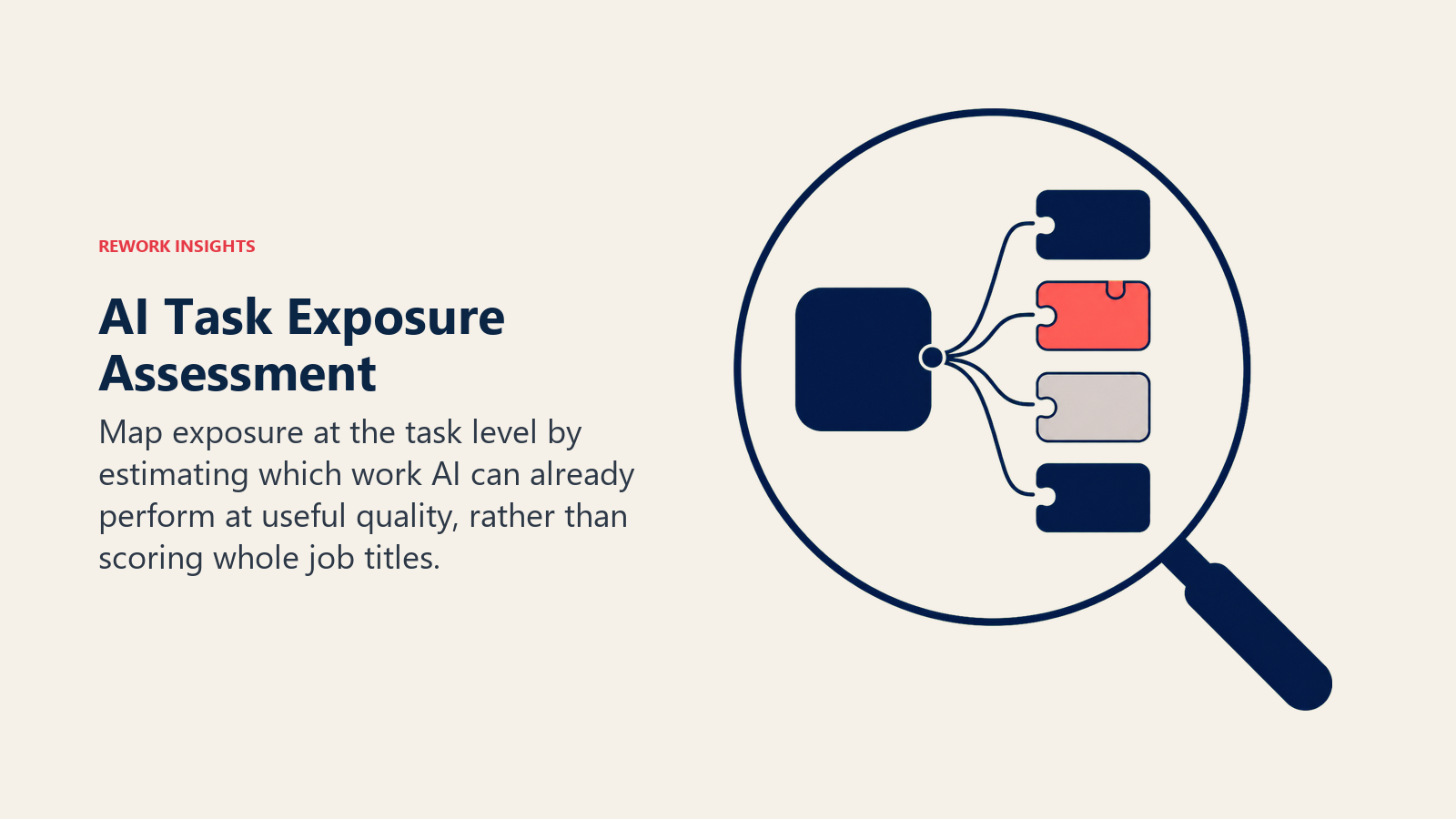
The assessment question for each major function: "What percentage of the hours worked in this team go toward tasks that AI can now do at 70% quality or better?"
That 70% threshold matters. It's the point where AI assistance meaningfully changes the economics of the role, even if it doesn't replace the role entirely.
For most mid-market companies in 2026, the honest answer for sales, marketing, customer success, and operations is somewhere between 30% and 60% of task hours. That's not a replacement scenario. It's an augmentation scenario. But it means those functions can either get dramatically more productive, or get dramatically more expensive relative to AI-augmented competitors.
Do this assessment by function, not by job title. The mistake most HR teams make is mapping AI exposure by role when the real exposure is at the task level. MIT Sloan research on AI task automation confirms that within any given role, AI exposure varies dramatically across individual tasks rather than mapping uniformly to job titles. A sales manager's job has tasks with very different AI exposure profiles: pipeline analysis (high), relationship management (low), forecasting (high), coaching (medium). A structured AI skills matrix helps map this exposure at the task level across departments.
This task-level mapping is the foundation of your workforce decision. Without it, you're guessing.
Decision Gate 2: Prioritize Where AI Augmentation Delivers the Highest ROI First
Once you've done the mapping, you need to prioritize where to invest. Not every function can go first, and not every AI workforce initiative delivers equal return.
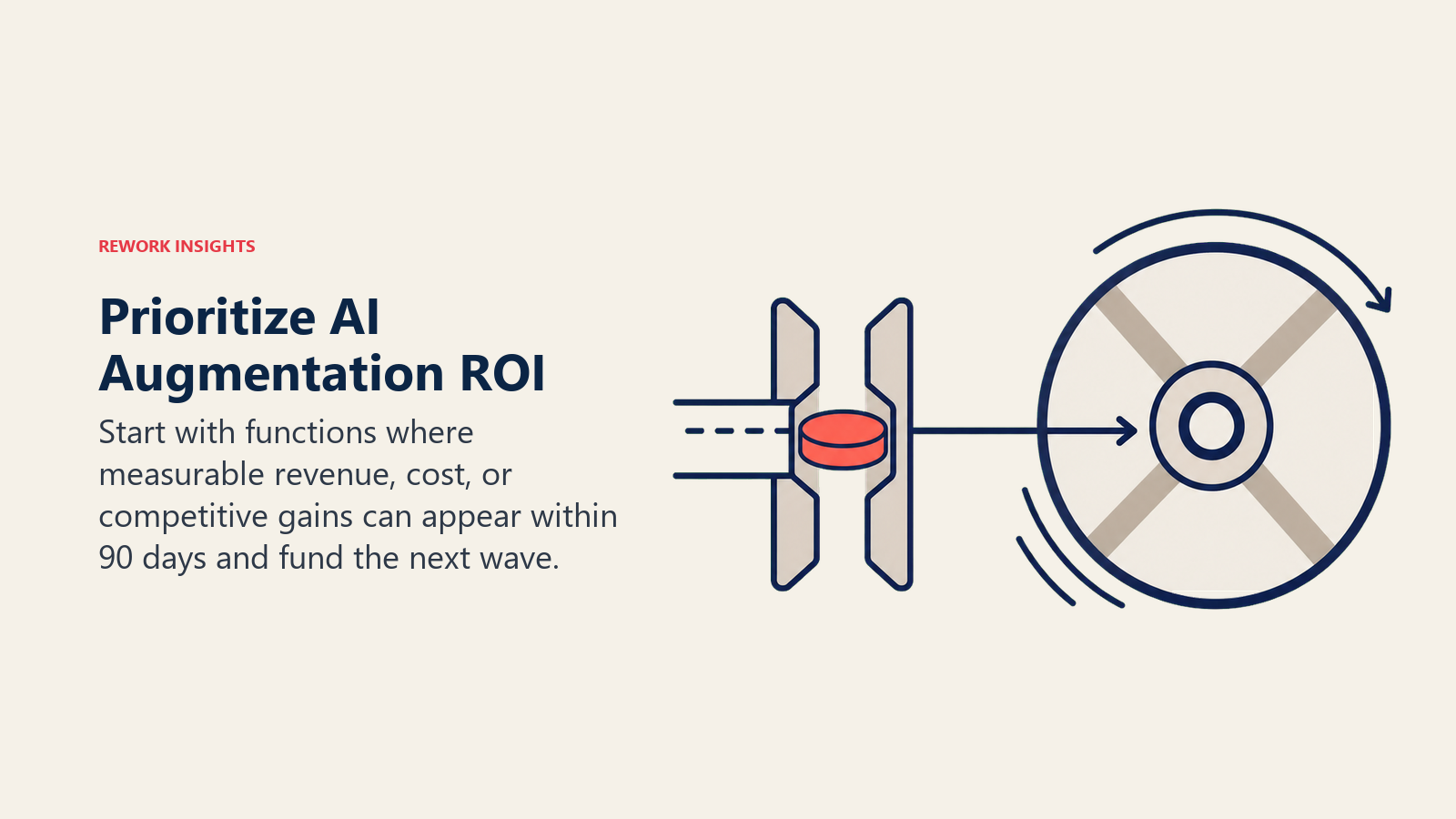
McKinsey's 2025 analysis found that companies focusing initial AI augmentation on revenue-generating functions (sales, marketing, customer success) achieved 2.3x higher ROI on AI investment compared to companies starting with back-office functions. The reason is simple: revenue function improvements compound. Better pipeline analysis leads to better close rates leads to better revenue leads to more resources for the next wave of improvement.
The prioritization question is: "Which functions, if AI-augmented in the next 90 days, would have the most measurable impact on revenue, cost, or competitive position?"
For most B2B SaaS companies in the 100-500 employee range, the answer is usually: sales operations and revenue operations first, then customer success, then marketing operations. Before AI can deliver in revenue operations, though, the underlying RevOps data has to be aligned, or the AI amplifies noise instead of surfacing signal.
This isn't a universal rule. A professional services firm has a different prioritization than a SaaS company. But the principle holds: start where the ROI is clearest and the measurement is easiest. It lets you build the internal case for continued investment.
The upskill vs. hire AI-native decision is part of this prioritization gate. In high-priority functions, you often need both: existing team members upskilled quickly AND new AI-native hires who can accelerate the learning curve for everyone else.
Decision Gate 3: Act. Build, Hire, or Acquire?
You've mapped your exposure. You've prioritized your functions. Now you need to decide how to close the capability gap.
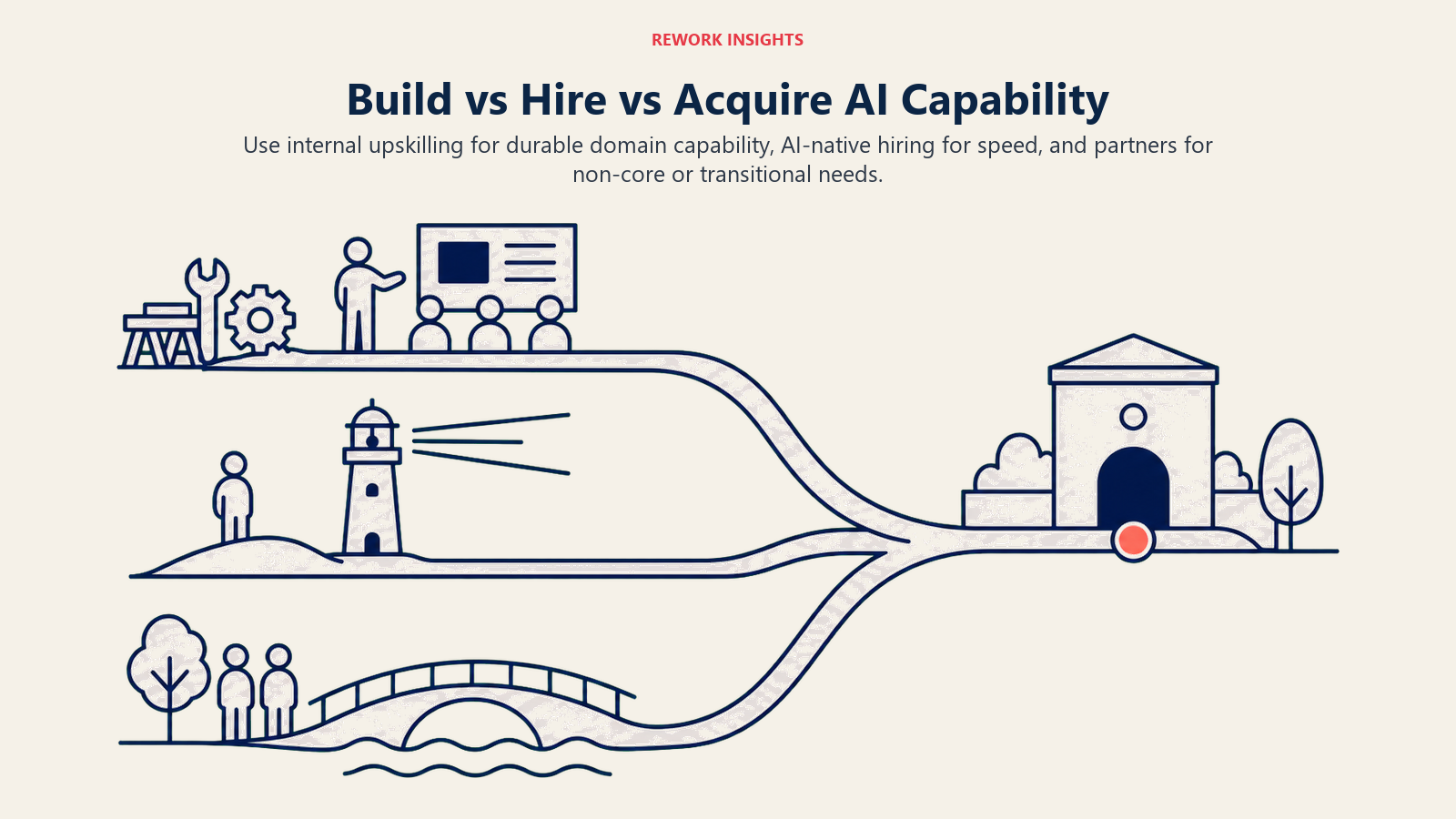
You have three options, and the right mix depends on your timeline and the capability gap size.
Option A: Build Internal Capability (Upskill) Best when: You have a 6-12 month runway, your existing team has strong domain expertise, and the AI skills needed are learnable by motivated employees.
The risk: Most upskilling programs take 4-6 months to show results, and only 40-50% of employees make the transition effectively without significant management support. If you need results in 90 days, pure upskilling won't get you there. A 90-day AI fluency plan can compress that timeline with the right structure.
Option B: Hire AI-Native Talent Best when: You need to move fast, the capability gap is too large to close through training, or you need an internal champion who can accelerate broader adoption.
The risk: AI-native talent is expensive and scarce. And without the right integration plan, new AI hires can create friction with existing teams rather than pulling them forward. The hidden cost of delaying AI upskilling is real, but so is the cost of a bad AI hire who destabilizes a high-performing team.
Option C: Acquire Through Partners or Outsourcing Best when: The function is non-core, you need speed, and the cost of building internal capability outweighs the long-term benefit.
This isn't just about outsourcing entire functions. It includes: AI-specialized agencies for marketing execution, RevOps consultants who can stand up AI-augmented workflows in 60 days, or managed service providers who bring AI capabilities without the hiring overhead.
Most mid-market companies should be running all three in parallel, but with different weightings by function. High-priority, strategic functions get Options A + B. Lower-priority, non-core functions get Option C.
Common Executive Mistakes (And How to Avoid Them)
Mistake 1: Buying Tools Without Workforce Plans This is the most common and most expensive mistake. AI tools don't create value. AI-capable people using the right tools create value. Every AI tool purchase needs a corresponding workforce adoption plan. Who will use it? How will they be trained? What does success look like at 30, 60, and 90 days?
Mistake 2: Moving Too Slowly in Q1 Functions Executives often underestimate how fast their competitive window is closing in high-urgency, high-importance functions. A competitor who moved on AI sales augmentation six months ago is now compounding that advantage every quarter. The cost of waiting isn't linear. It accelerates.
Mistake 3: Underestimating Middle Management Friction This is where the most well-designed AI workforce strategies go to die. Middle managers feel most threatened by AI adoption. It changes their role, their status, and their sense of value. And they have enormous power to slow adoption without ever explicitly resisting it.
Why middle management is AI's biggest obstacle is a real dynamic, not a side issue. Your AI workforce strategy needs a specific middle management engagement plan, not just a change management slide deck. Managers need to understand how AI changes their role in ways that make them more valuable, not less.
Mistake 4: No Single Owner AI workforce transformation without a clear executive owner doesn't get done. It gets diffused across HR, IT, and individual business unit leaders who have conflicting priorities and no mandate to move fast. Assign one executive (CHRO, COO, or a new CAIO) to own the roadmap and the accountability.
Your 90-Day Decision Sprint
Here's how to translate this framework into immediate action:
Days 1-30: Assess
- Complete task-level AI exposure mapping for your top 5 functions
- Score each function on the urgency/strategic importance matrix
- Identify your Q1 functions (Act Now)
- Audit current AI tool licenses, adoption rates, and unused capability
Days 31-60: Prioritize and Plan
- Run the ROI prioritization exercise for Q1 functions
- For each Q1 function: determine the build/hire/acquire mix
- Create a middle management engagement plan with function heads
- Define 90-day success metrics (not vanity metrics): revenue, efficiency, or adoption rate
Days 61-90: Act
- Launch upskilling cohorts for Q1 functions (small batches, fast feedback loops)
- Begin AI-native hiring process for priority roles
- Stand up measurement infrastructure
- Schedule 90-day review with leadership team to adjust based on what's working
The 12-month AI workforce roadmap goes deeper on what comes after this sprint, but the 90-day frame is where you prove the model and build internal momentum.
The Real Competitive Advantage
The companies that win the AI workforce transition aren't the ones who bought the most tools or hired the most AI engineers. They're the ones whose executive teams made deliberate, structured decisions, and made them fast.
Speed matters. But undirected speed is how you spend $3 million on AI investments that don't compound.
Use this framework to bring structure to decisions that most of your competitors are still making reactively. The urgency/importance matrix tells you where to focus. The three decision gates tell you how to close the gap. And the 90-day sprint gives you a timeline that's short enough to maintain momentum and long enough to see real results.
Your competitors are making these decisions right now. The question is whether they're making them well.
Learn More

Co-Founder, Rework.com
On this page
- Why AI Workforce Decisions Keep Failing
- The Four-Quadrant AI Workforce Decision Model
- Decision Gate 1: Assess Your Workforce Against AI Exposure Risk
- Decision Gate 2: Prioritize Where AI Augmentation Delivers the Highest ROI First
- Decision Gate 3: Act. Build, Hire, or Acquire?
- Common Executive Mistakes (And How to Avoid Them)
- Your 90-Day Decision Sprint
- The Real Competitive Advantage
- Learn More