More in
AI Workforce Transformation
Does AI Make Distributed Teams Easier or Harder to Lead?
Oct 11, 2026
Where AI Productivity Monitoring Turns Into Surveillance
Oct 11, 2026
Why Your Most Experienced People Resist AI Hardest (and Why You Need Them Most)
Oct 11, 2026
Is AI Making Teams Less Collaborative?
Oct 11, 2026
Should CEOs Use AI Themselves? Why Executive Fluency Sets the Adoption Ceiling
Oct 11, 2026
Does AI Favor Generalists or Specialists? What It Means for Who You Hire
Oct 10, 2026
Is Experience Still Worth Paying For When AI Narrows the Skill Gap?
Oct 10, 2026
When Every Candidate Uses AI, What Is a Resume Still Worth?
Oct 10, 2026
Should AI Screen Your Job Candidates? Where Automated Hiring Helps and Where It Backfires
Oct 10, 2026
Should Candidates Be Allowed to Use AI in Interviews?
Oct 10, 2026
From AI as Tool to AI as Teammate: The Mindset Shift That Unlocks Value
Turn this article into takeaways for your work.


Each assistant summarizes the article only for you and suggests best practices for your work.
Your company spent months selecting an AI platform. Your IT team integrated it. You sent the all-hands announcement. And now, three quarters later, roughly 40% of employees use it regularly. The same 40% who would have adopted any new software tool.
That number isn't a training problem. It's a framing problem.
McKinsey's 2025 State of AI survey found that companies reporting the highest AI value gains weren't necessarily using more advanced tools. They were using familiar tools differently, with a fundamentally different assumption about what AI is in the organization. The distinction they draw is simple but consequential: tool versus teammate.
And getting that distinction right is the executive job, not the L&D team's.
The Tool vs. Teammate Distinction
Most enterprise software works the same way: you make a request, it executes, you get an output, interaction ends. That's true whether you're running a report in your CRM, generating a slide in PowerPoint, or pulling a dashboard in your BI tool. The software doesn't remember last week. It doesn't adapt to how you work. It doesn't improve based on your feedback over time.
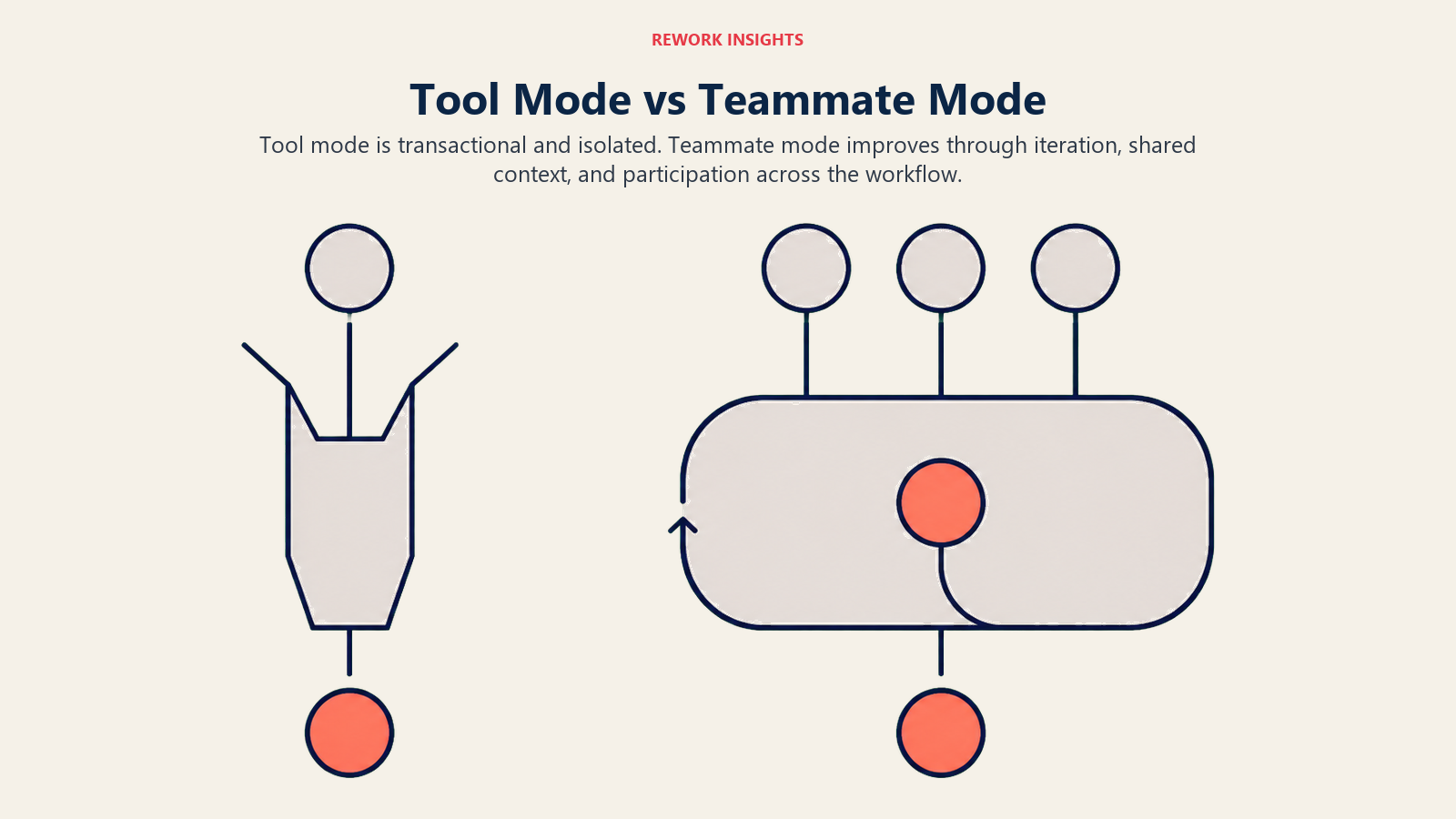
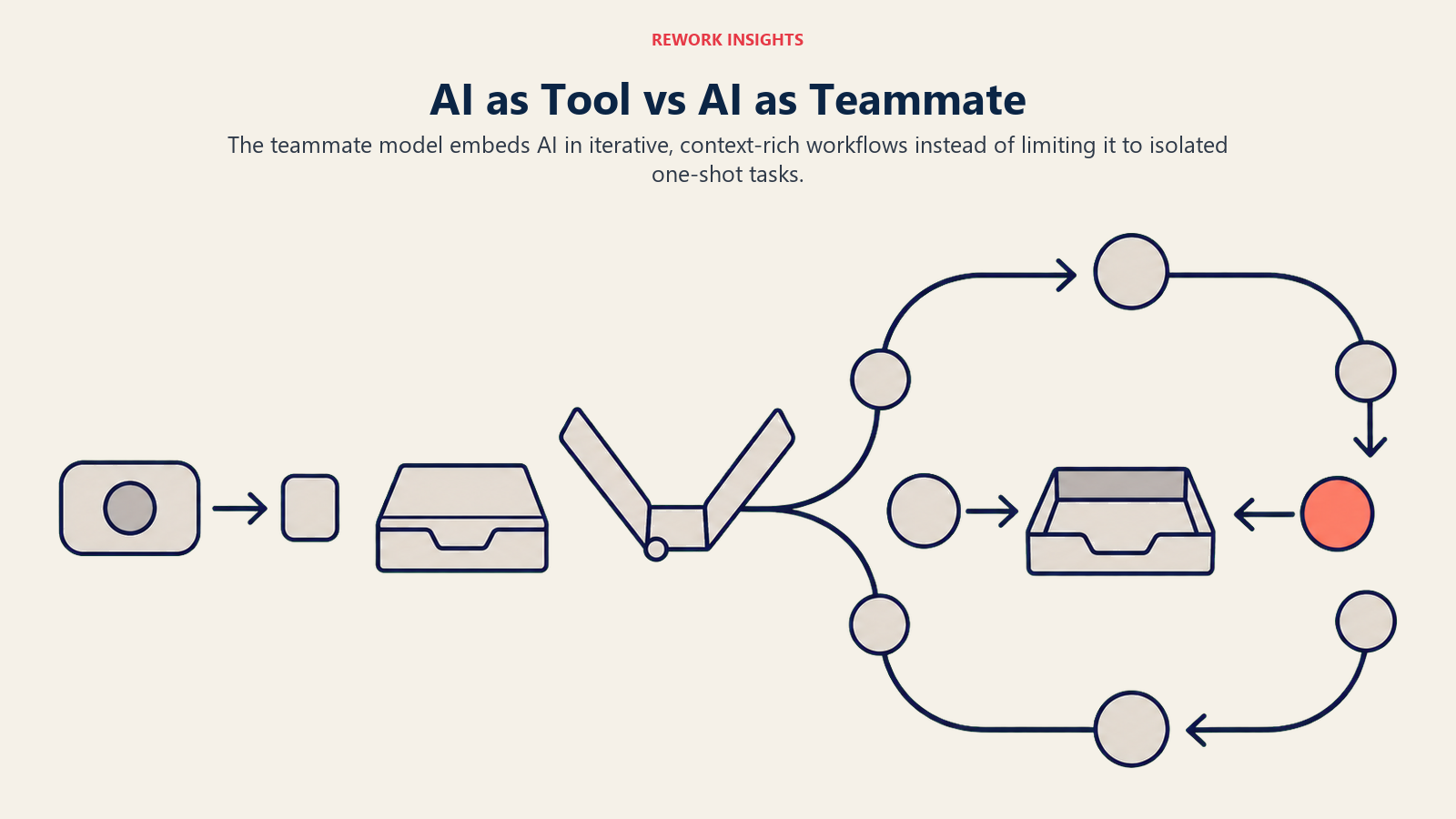
Early AI adoption at most companies follows the same pattern. Employees use AI to complete discrete tasks: summarize this document, draft this email, generate this code snippet. The output is the endpoint. The AI is a faster, smarter execution layer, but it's still just a tool.
The teammate model works differently across three dimensions:
Iteration over transaction. A teammate relationship is built on feedback loops. You brief, review, refine, redirect. The AI retains context across a session (and increasingly across sessions), and its output improves as it understands your priorities, language, and judgment. Teams that use AI this way report substantially better output quality than those running one-shot prompts. The corporate AI reskilling budget benchmarks for 2026 confirm that companies investing in iterative training methods are getting measurably higher adoption rates than those relying on one-time tool rollouts.
Context-awareness over task execution. A tool doesn't know that your Q3 pipeline review is happening Friday, that your biggest account is in a sensitive renewal, or that your CFO wants numbers presented in a specific format. Teammates carry context. AI systems configured and used as collaborators, with shared project context, organizational memory, and role-specific framing, produce work that fits instead of work that merely answers.
Contribution to the workflow, not just the output. Tools get called when you need them. Teammates are part of how work happens. The distinction matters organizationally: when AI is a teammate, workflow design changes. Meeting preparation, account research, financial modeling, content review: these don't just get faster, they get restructured around what humans and AI each do best.
The reason this framing matters for executives isn't philosophical. It determines how you design roles, distribute workload, and evaluate performance across your organization.
What This Looks Like in Practice
Abstract distinctions rarely move executive teams. Here's what the tool-to-teammate shift produces in three functional areas.
Sales. At a 300-person SaaS company, the account executive team was using AI to draft follow-up emails after demos. Adoption was fine. Impact was marginal, maybe 20 minutes saved per rep per day. When leadership reframed the AI as a deal collaborator rather than a drafting tool, the workflow changed. Reps began sharing CRM notes, call transcripts, and competitive intel with their AI context before every major interaction. The AI started surfacing objection patterns, recommending next-best actions based on deal history, and flagging pipeline risk signals the rep hadn't connected. Time-to-close dropped by 11% in two quarters. The AI wasn't doing new things. It was doing the same things inside the workflow instead of alongside it.
Operations. A regional logistics firm used AI for exception reporting: flag anomalies in shipment data, generate a daily digest, send to operations managers. Useful. But still tool behavior: AI as a reporting layer on top of existing processes. When the operations director restructured the team's workflow so that the AI was a participant in morning stand-ups (briefing, flagging, suggesting trade-offs in real time), the dynamic shifted. Managers stopped waiting for the daily digest and started thinking alongside the AI during the meeting. Decisions that previously waited for end-of-day data reviews moved to morning. Incident response time dropped by roughly a third.
Finance. A CFO at a professional services firm described the before state clearly: "We were using AI like a calculator with better syntax." Her FP&A team would pull data, build models, then ask the AI to explain variance or reformat output. The AI touched work at the end, not the middle. After restructuring planning cycles so that the AI was briefed on business context (growth targets, headcount assumptions, board presentation priorities), it began contributing to model architecture, not just output formatting. Analysts spent less time on structure and more time on interpretation. The CFO's comment after one quarter: "The work that used to take a week to prepare I now trust to take two days."
These aren't edge cases. They're the natural result of changing the assumption from "AI executes tasks" to "AI participates in work."
The Management Implication
When AI moves from tool to teammate, the manager's job changes in ways most organizations haven't fully reckoned with. Gartner's research on change management in the AI era identifies that organizations continuously adapting change plans based on employee responses are four times more likely to achieve transformation success, which means the management layer has to be actively engaged in the shift, not just informed of it.
Accountability gets more complex. If an AI collaborator contributes substantially to a deliverable (research, analysis, draft structure), who owns the output quality? The answer matters for performance management, client relationships, and risk. Companies that have navigated this well treat AI contribution like they treat contractor contribution: the employee is accountable for the output, including what the AI produced under their direction. That accountability model has to be explicit, or teams default to ambiguity.
Workload distribution has a new variable. Managers currently allocate work based on headcount, skill, and capacity. When AI is a legitimate contributor, the allocation math changes. High-complexity work that previously required a senior person might be scoped differently if AI handles the first 60% of the analytical lift. This isn't about cutting headcount. It's about understanding what the team is actually capable of at current AI capability levels. Managers who don't do this thinking will under-utilize both their people and their AI systems.
Performance reviews need a new dimension. How well does a person direct, brief, and iterate with AI collaborators? That's now a meaningful skill distinction. Two analysts with identical technical backgrounds can produce substantially different output quality based on how effectively they work with AI. This doesn't fit neatly into most existing performance frameworks, which is partly why middle management often becomes AI's biggest obstacle rather than its accelerant. Building an internal AI champions program is one structural way to bridge that gap by creating peer leaders who model the teammate behavior rather than leaving it entirely to formal management, which is also why peer-led AI programs tend to outperform top-down training rollouts. The executives who get ahead of this are building "AI collaboration effectiveness" into role expectations before annual review cycles force the conversation.
How to Drive the Shift: Executive Levers
The mindset shift from tool to teammate doesn't happen through training programs. It happens through decisions executives make about language, norms, tooling, and role design.
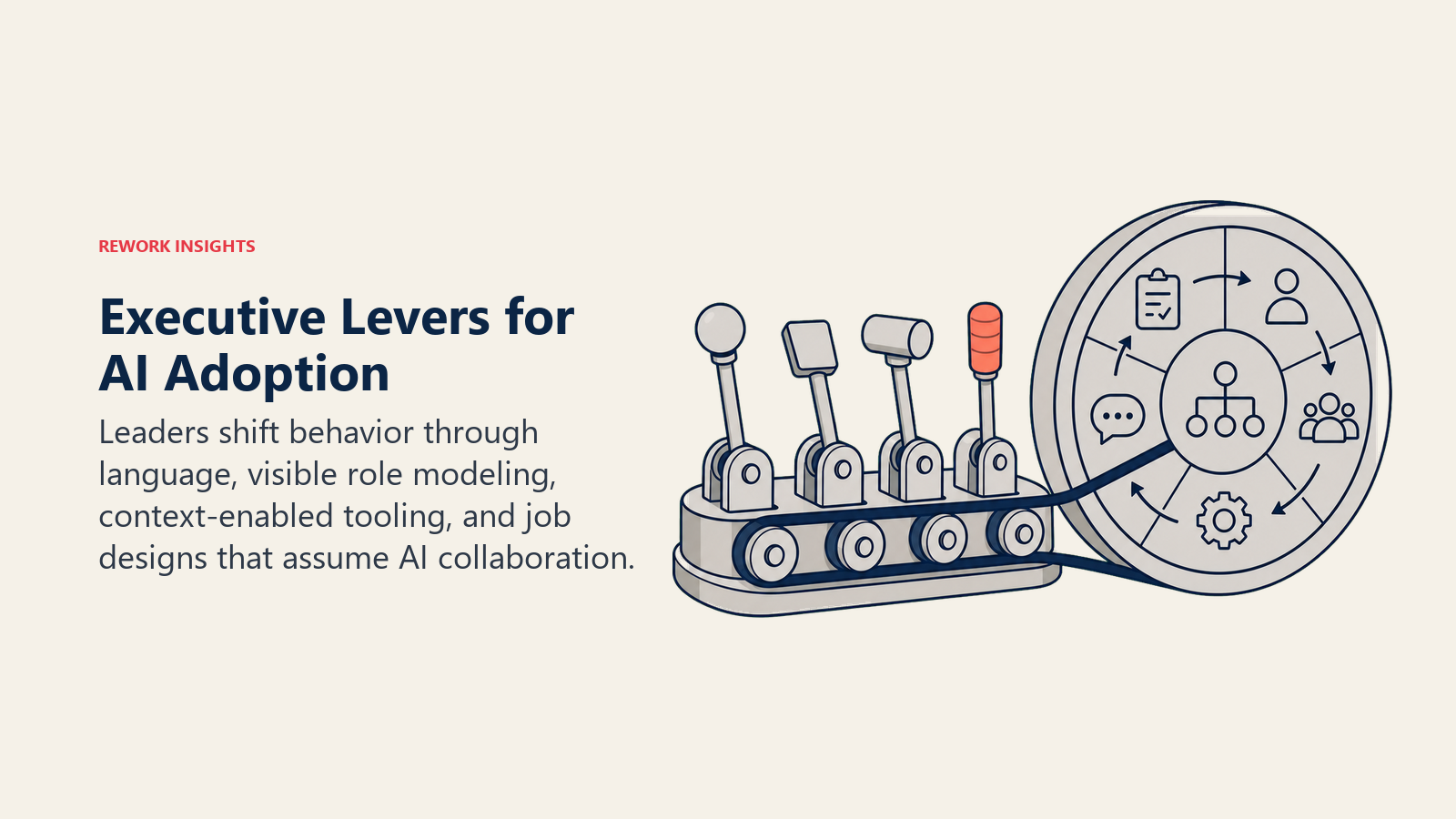
Language first. The words leaders use to describe AI shape how teams relate to it. If your all-hands messaging consistently frames AI as "efficiency software" or "an automation tool," your teams will use it accordingly. If you talk about AI as a collaborator that your best people direct well, the behavioral expectation changes. This sounds soft. It isn't. Language is how executives set norms at scale without being in every meeting.
Norm-setting through visible behavior. When a CEO shares how they briefed their AI assistant before a board prep session, or when a CRO talks about iterating on a territory model with AI input, it signals that the teammate model is real and endorsed at the top. McKinsey's superagency research found that 48% of US employees would use AI tools more often with formal training, and 45% would use them more if AI were integrated into their daily workflows, both signals that top-down norm-setting directly accelerates adoption. People watch what leaders do. If leadership uses AI as a search engine, the organization will too.
Tooling choices that enable context. Not all AI platforms support the teammate model equally well. Tools that allow shared project context, persistent memory, and role-specific configuration make the shift operationally feasible. Tools that operate as isolated chat interfaces make it difficult regardless of how well-intentioned the framing is. This is a procurement and configuration decision with real workflow consequences. And it connects directly to how AI ops functions are being staffed and structured, because the people building those workflows need a clear mandate. A well-designed AI-powered workflow for operations can make the context-sharing infrastructure concrete rather than aspirational.
Role design that assumes collaboration. The most durable signal you can send is redesigning roles so that effective AI collaboration is part of the job description, not an add-on. When a new sales role explicitly includes "manages AI-assisted pipeline analysis as part of weekly cadence," the framing is baked in before the person starts. This also has direct implications for who you're retaining and what makes the job compelling, because people who want to work alongside AI expect to be set up for it structurally. The AI augmented sales teams performance data from 2025-2026 shows that role design is what separates teams with 15% productivity gains from those stuck at 3%.
The Tool-to-Teammate Diagnostic
Before building a transformation initiative, it's worth knowing where your organization actually sits. A simple four-question diagnostic:
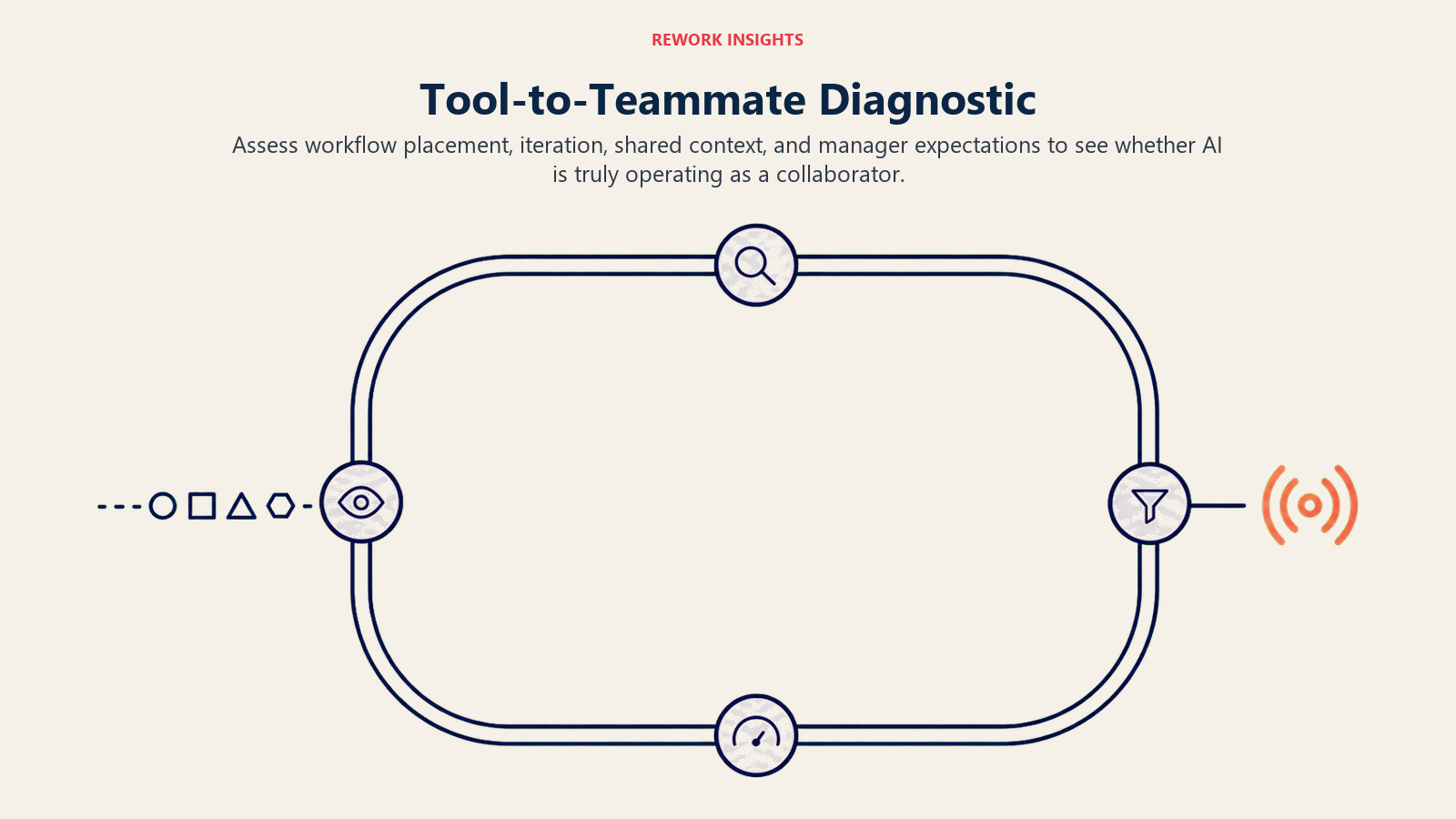
Do your teams use AI within existing workflows, or alongside them? Within means AI is a participant in how work gets done. Alongside means it's a supplementary step after work is already structured.
Does your AI usage involve iteration, or is it mostly one-shot prompting? Iteration indicates people are treating AI as a collaborator they refine with. One-shot usage indicates tool behavior.
Is AI context shared across your team, or siloed to individual users? Shared context (project briefs, CRM notes, meeting prep) enables the teammate model. Siloed usage limits it.
Do managers factor AI collaboration effectiveness into performance expectations? If not, there's no organizational signal that it matters.
Teams that answer "alongside," "one-shot," "siloed," and "no" are using AI as a tool regardless of what the vendor pitch said at deployment. The shift starts with acknowledging the gap.
The 12-18 Month Window
Here's the strategic reality: the companies that make this shift aren't waiting for better AI. They're extracting more value from the AI they already have by changing the operating model around it.
Gartner's research on AI organizational readiness found that business units redesigning how work gets done, rather than just deploying AI tools, are twice as likely to exceed revenue goals. There's a consistent lead time between companies that shifted to collaborative AI operating models and those still running tool-mode deployments. The gap compounds. Teams that build strong AI collaboration habits now are developing organizational muscle that takes time to replicate. Not because the AI is hard to access, but because the workflows, norms, and management practices take time to build.
The future org chart doesn't just have AI embedded in department workflows. It has people who are genuinely skilled at directing AI collaborators, managers who know how to allocate work across human-AI teams, and executives who set the norms that make all of it work. The AI replace vs. augment workforce data makes clear that augmentation, not replacement, is the dominant pattern at companies successfully making this shift.
That starts with the framing decision. Tool or teammate. The answer determines everything downstream.
Executive Action Checklist
- Audit current AI usage across functions: is it tool behavior or teammate behavior?
- Update leadership communication to use collaborative language around AI
- Review tooling configuration for context-sharing and persistent memory capability
- Redesign at least two role definitions to include AI collaboration as an explicit expectation
- Brief management layer on the workload distribution and accountability implications
- Add AI collaboration effectiveness as a dimension in the next performance cycle
Learn More
- How AI Is Changing Your Retention Problem, Not Just Your Hiring Problem
- The Org Chart of the Future: What AI-Augmented Departments Actually Look Like
- Why Middle Management Is AI's Biggest Obstacle (and Biggest Opportunity)
- What the First AI Ops Manager Hire Looks Like in a 100-Person Company
- AI Replace vs. Augment Workforce Data: What the research actually says about job displacement vs. job transformation
- Building an AI Champions Program Inside Your Company: A structured approach to spreading teammate-model AI adoption
