More in
AI Workforce Transformation
Does AI Make Distributed Teams Easier or Harder to Lead?
Oct 11, 2026
Where AI Productivity Monitoring Turns Into Surveillance
Oct 11, 2026
Why Your Most Experienced People Resist AI Hardest (and Why You Need Them Most)
Oct 11, 2026
Is AI Making Teams Less Collaborative?
Oct 11, 2026
Should CEOs Use AI Themselves? Why Executive Fluency Sets the Adoption Ceiling
Oct 11, 2026
Does AI Favor Generalists or Specialists? What It Means for Who You Hire
Oct 10, 2026
Is Experience Still Worth Paying For When AI Narrows the Skill Gap?
Oct 10, 2026
When Every Candidate Uses AI, What Is a Resume Still Worth?
Oct 10, 2026
Should AI Screen Your Job Candidates? Where Automated Hiring Helps and Where It Backfires
Oct 10, 2026
Should Candidates Be Allowed to Use AI in Interviews?
Oct 10, 2026
Why Middle Management Is AI's Biggest Obstacle (and Biggest Opportunity)
Turn this article into takeaways for your work.


Each assistant summarizes the article only for you and suggests best practices for your work.
The pilot works brilliantly. Your team demos the AI tool to the executive committee, and the numbers look clean: 40% faster turnaround, 30% fewer errors, positive user feedback from the test cohort. Leadership is excited. The budget gets approved. And then... six months later, adoption is sitting at 12%.
Nobody wants to say it out loud, but the people who killed the rollout didn't intend to. They're your regional managers, your senior team leads, your department heads: the 200 or so people in your organization who sit directly between strategic decisions and daily work. Middle management didn't sabotage your AI initiative. But they did stop it cold.
This pattern plays out in company after company, across industries and geographies. And if you want to understand why AI transformation actually fails, and how to fix it, you have to start here.
Why Middle Managers Resist AI (It's Not What You Think)
The easy explanation is that middle managers are afraid of being replaced. And while that's partly true, it misses the real psychological dynamic.
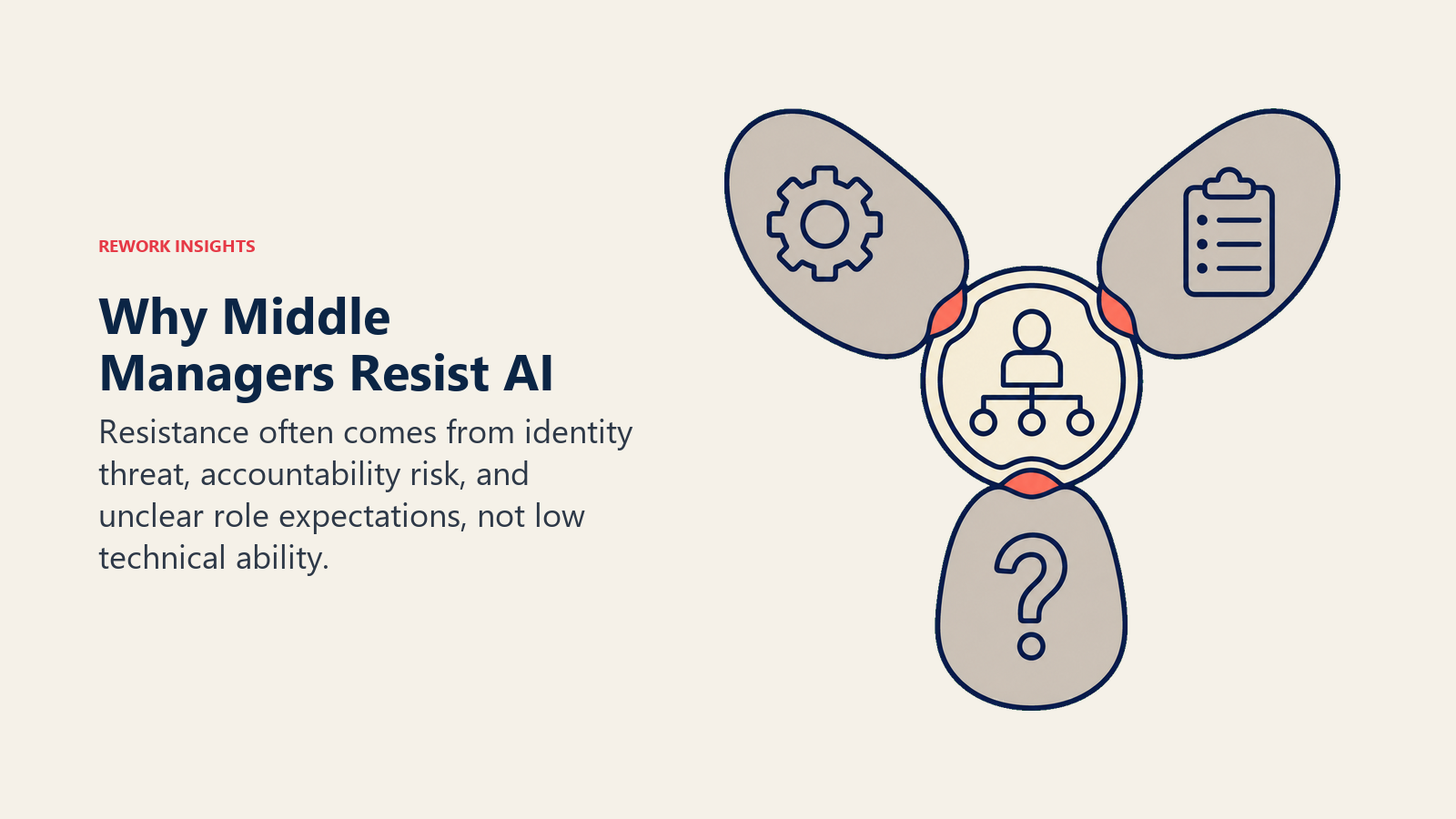
Middle managers' professional identity is built on two things: coordinating people and controlling information flow. They know who's behind on what. They translate executive strategy into team-level tasks. They're the ones who've earned trust on both sides: trusted by leadership to execute, trusted by their teams to advocate. That positioning took years to build.
AI automates both of those functions directly. Workflow tools surface status without asking the manager. Reporting dashboards give executives direct visibility into team performance. Synthesized briefings replace the manager's role as information translator. When that happens, what exactly is the manager for?
This isn't a fear of technology. It's an identity threat. And identity threats don't respond to training programs or mandates.
Accountability fear compounds the problem. When an AI system makes a mistake, it happens on the manager's watch. The vendor doesn't get the call from the VP asking what went wrong. The manager does. So the rational move, from a career-protection standpoint, is to keep AI at arm's length: use it informally, never put it in the critical path, and maintain enough distance to say "we were still validating the approach" if something goes sideways.
Skill anxiety makes both of those worse. A 2025 survey by Deloitte found that 61% of managers said they lacked confidence in their ability to use AI tools effectively in their day-to-day role. That's not a technology literacy problem. Most of these managers are technically capable. It's a role clarity problem. Nobody's told them what "using AI well" looks like for someone in their specific position. A structured AI champions program directly addresses this by giving early-adopter managers a defined role and peer network. So they default to watching and waiting.
The Opportunity Side: What Changes When Managers Become Champions
Here's what the resistance narrative misses: the same structural position that makes middle managers so effective at blocking AI adoption makes them equally powerful at accelerating it.
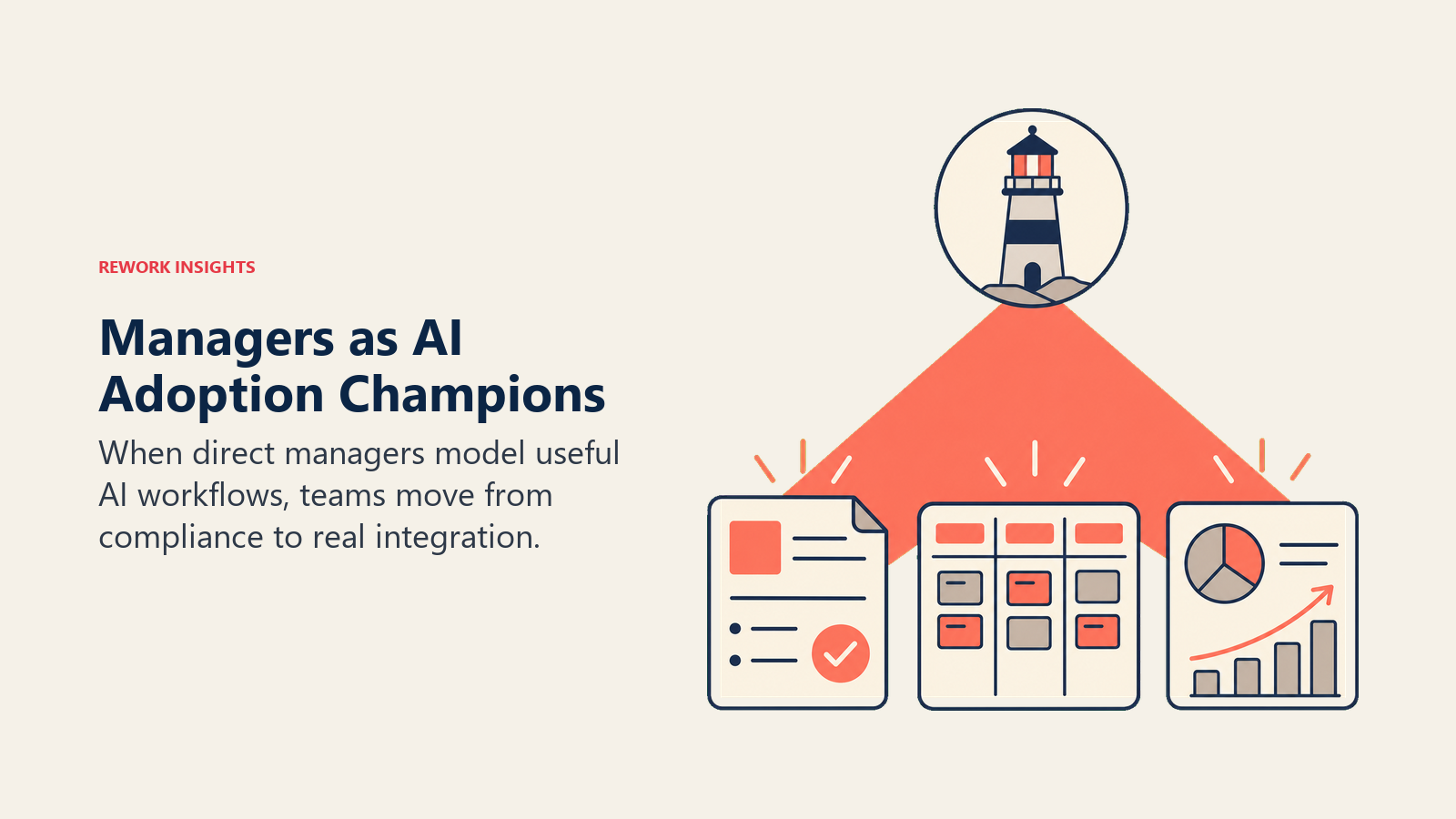
Research from MIT Sloan's 2025 AI workplace study found that team-level AI adoption rates are three times higher when the direct manager is proficient and visibly using AI tools. Not when the CEO talks about AI in the all-hands. Not when there's a learning portal. When the person who assigns work, runs 1:1s, and gives performance feedback is actively using AI, the team follows.
And the quality of adoption is different too. Top-down mandates produce compliance: people use the tools because they have to, in ways that check the box. Manager-driven adoption produces integration: people use the tools because they've seen their manager model what good looks like, and they understand the why.
There's also a practical advantage to manager-generated use cases. A VP of Engineering can tell teams to use AI for code review. But the senior engineering manager is the one who knows that the specific bottleneck on his team is PR review latency, that three engineers are doing redundant security checks, and that the QA pipeline for one product line is consuming 40% more time than the others. The use cases he builds around AI are specific, credible, and immediately relevant. The top-down mandate produces generic adoption. The manager-driven use case produces actual ROI.
Three Profiles of Middle Managers in AI Transitions
Not all resistance looks the same. And not all opportunity looks the same either. Before you can build the right program, you need to know which profile you're dealing with.
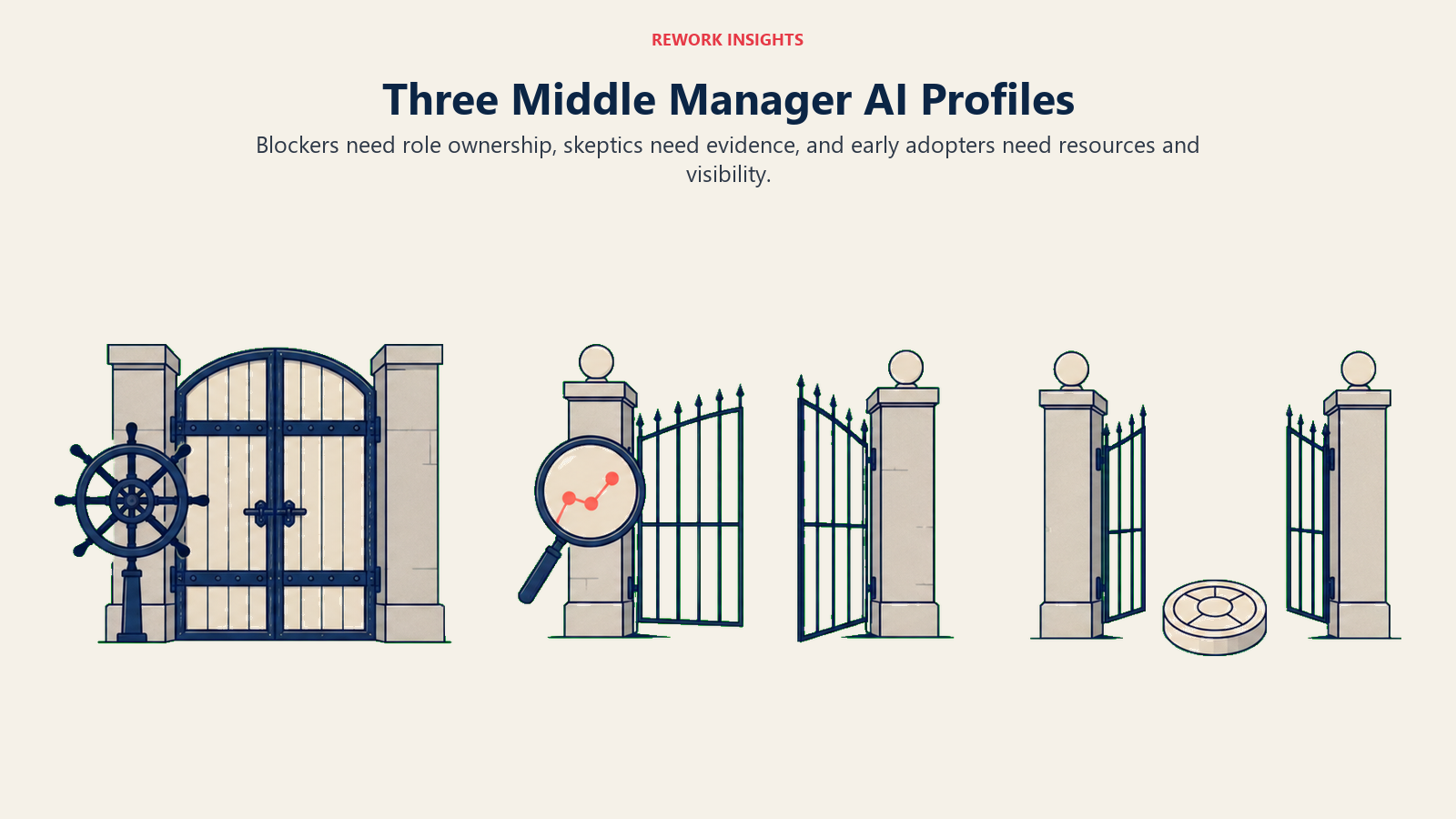
| Profile | Behavior Signals | What's Really Going On | How to Address It |
|---|---|---|---|
| The Blocker | Repeatedly surfaces risks, slows approvals, escalates edge cases, keeps team on legacy workflows | Identity threat is acute; they've built their value around the thing AI is replacing | Redefine their role explicitly: they become AI quality leads, governance owners, change architects |
| The Skeptic | Participates in pilots but doesn't advocate, waits for proof, hedges in communications | Accountability fear is dominant; they won't go first, but they'll follow with evidence | Give them a safe sandbox, a defined use case, and a peer reference who looks like them |
| The Early Adopter | Already experimenting informally, building workarounds, asking for more access | Skill anxiety is low; they see the opportunity but lack organizational support | Give them resources, visibility, and a formal role as an internal champion or AI ambassador |
Most organizations focus almost entirely on convincing Skeptics. But the highest-impact move is usually amplifying Early Adopters. They're already doing the work. They just need permission, resources, and an audience.
And Blockers aren't lost causes. Many of the most effective AI governance leads in mid-market companies are former Blockers who were given a meaningful role in shaping how AI gets deployed. The identity threat dissolved when they realized they weren't being replaced; they were being promoted to a different kind of authority.
What CEOs Get Wrong
The most common mistake at the executive level is treating middle manager AI resistance as a compliance problem. The solution, from that framing, is clearer mandates, better monitoring, and consequences for non-adoption.
That approach will produce exactly the outcome you've seen: surface-level compliance and no real integration.
The deeper mistake is issuing mandates without addressing the identity threat first. When you announce an AI transformation and tell managers to get on board, you haven't answered the question that's actually running in the background of every manager conversation: "What's my job after this?" Until you answer that question concretely and specifically, resistance is the rational response.
A related failure is designing AI training programs entirely around the technology. The training covers how the tool works, what features are available, where to find help. What it doesn't cover is what the manager's actual role looks like after the tool is deployed. What decisions are now theirs to own that AI doesn't handle? What judgment calls become more important? What does "managing well" mean in an AI-augmented environment?
For more on how this connects to evaluating your workforce strategy overall, see The Executive Decision Framework for AI Workforce Strategy and The AI Skills Gap Executives Are Getting Wrong.
A 60-Day Middle Manager AI Enablement Program
This isn't a training curriculum. It's a role redesign process that happens to include training. The distinction matters.
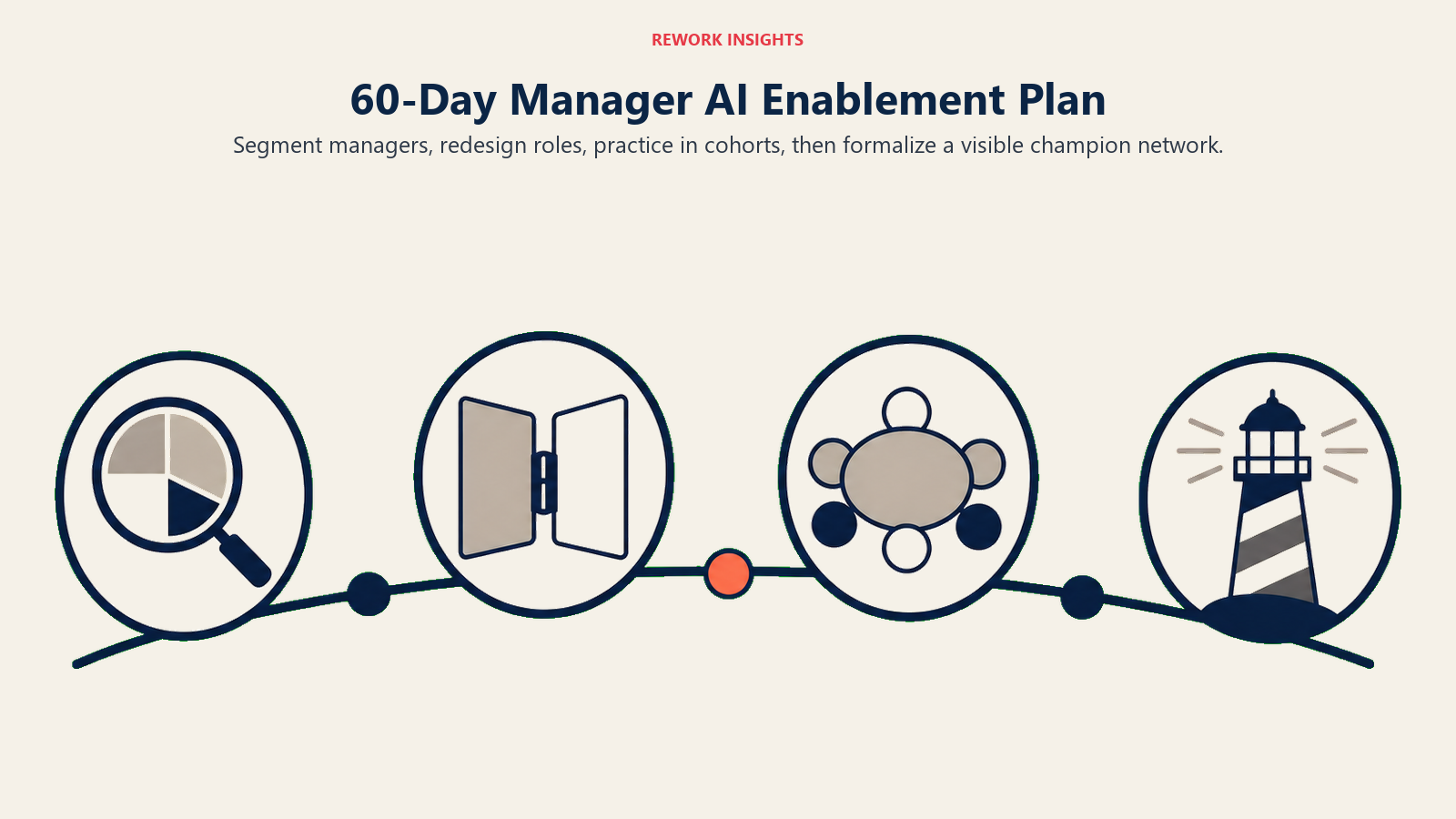
Days 1-14: Map and Segment
Before you run a single workshop, you need to know which managers you're working with and what profile they fit. Pull adoption data from existing tools. Talk to HR. Talk to skip-level managers. Identify your Early Adopters, your Skeptics, and your Blockers. Don't guess. Segment with data.
Also use this phase to map the identity stakes. For each manager group, write down specifically what their current value proposition is to the organization. Then write down what AI automates within that value proposition. That document will tell you where the identity threat is sharpest and where you need to focus your redesign work.
Days 15-30: Redesign Roles Before Deploying Tools
This is the step most companies skip, and it's why their programs fail. Before you train any manager on the AI tools, have explicit conversations about what their role looks like after deployment. Be specific. "You'll be doing more strategic work" is not specific. "Your team's AI output will need human review for contextual accuracy, and that judgment call is yours. Here's what that looks like in practice" is specific. Use a change management AI rollout framework to structure these conversations at scale across your management layer.
For Blockers in particular, define a formal governance or quality role before asking them to engage with the tool. Give them something to own that AI doesn't replace.
Days 31-45: Cohort-Based Learning with Peer Modeling
The most effective AI training for managers isn't a course. It's a cohort of 8-12 managers working through real use cases together, with Early Adopters included in the cohort as peer models. The same dynamic is why peer-led AI programs consistently outperform top-down training rollouts.
Focus each session on a specific workflow the managers already own. Don't teach generic AI skills. Teach AI-augmented versions of the decisions they're already making. A professional services firm that did this with their engagement managers saw adoption jump from 15% to 67% over 90 days, because every session was grounded in a workflow they recognized as theirs. Harvard Business Review's analysis of AI change management consistently identifies role-specific training as a key differentiator in enterprise AI rollouts.
Days 46-60: Amplify and Formalize
By week seven or eight, you should have enough Early Adopters and converted Skeptics to create an internal champion network. Make that network visible. Feature them in all-hands, give them a formal title, have them share what they've built with peer managers in other departments.
The goal by day 60 isn't full adoption. It's momentum. You want a visible cohort of managers who are using AI well, whose teams are producing better results, and who are willing to say so publicly. That cohort becomes the gravitational pull for the rest.
The Connection to How You Measure People
One thing that often gets overlooked: middle managers will adopt AI at the rate that their performance reviews reward AI adoption. If you're still measuring managers on throughput metrics that don't account for AI output, you've created a structural disincentive.
This is a broader issue worth addressing at the executive level. The way performance management needs to evolve in an AI-augmented environment is covered in depth in New Performance Review: How AI Changes How You Measure People.
The short version: if a manager's team produces better work in half the time because of AI, and your current metrics don't differentiate that outcome from a manager whose team is just working harder, you've signaled that AI contribution doesn't matter. And you'll get exactly what you measure.
What This Looks Like in Practice: A Professional Services Example
A 400-person management consulting firm rolled out an AI research and synthesis tool to all client-facing teams in Q3 2025. Initial adoption was strong in the analyst cohort: young, technically comfortable, lower identity stakes. Adoption in the senior manager and principal layers was under 20% after 90 days.
The firm ran the segmentation exercise and found that most senior managers fell into the Skeptic profile. The primary fear wasn't job replacement. It was that if AI was producing the research summaries and synthesis documents, the managers couldn't differentiate their judgment in the work product. The documents would look the same whether they applied deep expertise or just approved AI output.
The intervention was a role redesign: senior managers were repositioned as "synthesis architects" who defined the judgment frameworks that AI used to structure research, then validated the output against client-specific context that the tool couldn't access. Their fingerprint on the work became the framework, not the execution.
Six months after the redesign, adoption in the senior manager cohort was at 78%. More importantly, client satisfaction scores improved because the frameworks being applied were more consistent and the senior manager's domain judgment was being applied earlier in the process, not just at the final review. Measuring AI adoption ROI outlines how to track these gains at the manager cohort level with metrics boards can actually evaluate.
The Executive's Real Job Here
Your job isn't to mandate AI adoption. That part is easy. Anyone can write a policy. Your job is to make it safe for middle managers to embrace AI without losing their sense of professional identity and organizational value in the process.
That means naming the identity threat explicitly, not pretending it doesn't exist. It means designing roles around what AI doesn't do, not just training people on what it does. It means measuring outcomes that AI actually produces, not just the inputs that existed before AI existed.
The middle management layer is the highest-impact point in any AI transformation. Get it right, and adoption accelerates through the organization faster than any mandate could produce. Get it wrong, and you'll be explaining to your board why the third AI initiative in two years has stalled at 15% penetration.
For building out the broader workforce strategy around this, From AI as Tool to AI as Teammate addresses the cultural shift that has to happen at every level. And if you're thinking about the multi-year arc, The 12-Month AI Workforce Roadmap gives you the sequencing for a 200-person company where middle management enablement is built into the plan from the start.
The companies that figure out the middle manager layer first will outpace the ones still issuing mandates. The question is whether yours will be one of them.
Learn More

Co-Founder, Rework.com
On this page
- Why Middle Managers Resist AI (It's Not What You Think)
- The Opportunity Side: What Changes When Managers Become Champions
- Three Profiles of Middle Managers in AI Transitions
- What CEOs Get Wrong
- A 60-Day Middle Manager AI Enablement Program
- The Connection to How You Measure People
- What This Looks Like in Practice: A Professional Services Example
- The Executive's Real Job Here
- Learn More