More in
AI Workforce Transformation
Does AI Make Distributed Teams Easier or Harder to Lead?
Oct 11, 2026
Where AI Productivity Monitoring Turns Into Surveillance
Oct 11, 2026
Why Your Most Experienced People Resist AI Hardest (and Why You Need Them Most)
Oct 11, 2026
Is AI Making Teams Less Collaborative?
Oct 11, 2026
Should CEOs Use AI Themselves? Why Executive Fluency Sets the Adoption Ceiling
Oct 11, 2026
Does AI Favor Generalists or Specialists? What It Means for Who You Hire
Oct 10, 2026
Is Experience Still Worth Paying For When AI Narrows the Skill Gap?
Oct 10, 2026
When Every Candidate Uses AI, What Is a Resume Still Worth?
Oct 10, 2026
Should AI Screen Your Job Candidates? Where Automated Hiring Helps and Where It Backfires
Oct 10, 2026
Should Candidates Be Allowed to Use AI in Interviews?
Oct 10, 2026
The Org Chart of the Future: What AI-Augmented Departments Actually Look Like
Turn this article into takeaways for your work.


Each assistant summarizes the article only for you and suggests best practices for your work.
The org chart you're running today was probably designed (or inherited from a design) built in an era before email. Harvard Business Review's research on organizational design notes that the hierarchy of VP, Director, Manager, IC hasn't fundamentally changed since the 1950s. What's changed is the volume of work flowing through it, and the assumption that each layer needs to be filled by a human doing coordination work.
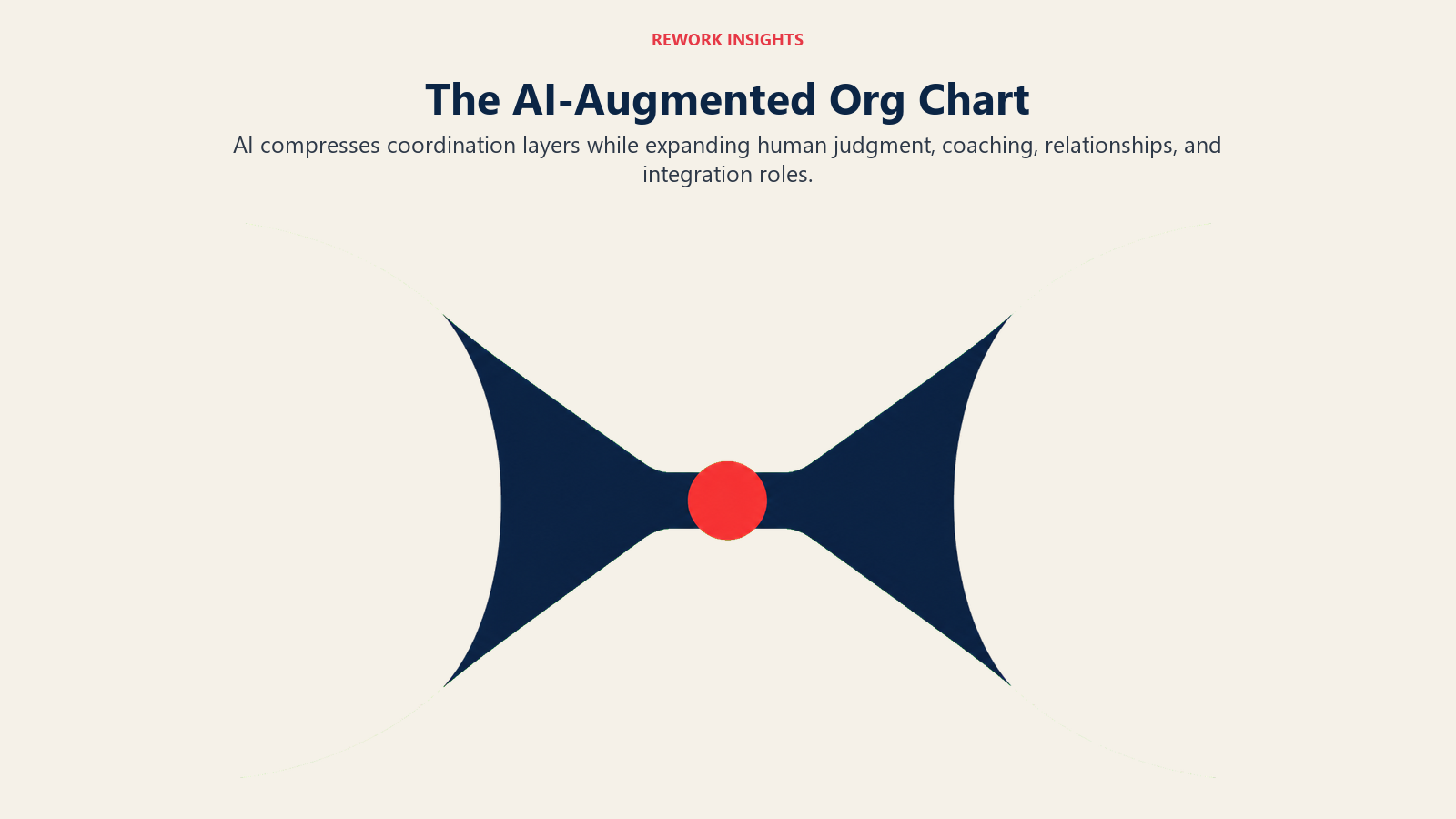
AI is about to collapse that assumption. Not by replacing the chart entirely, but by compressing the layers inside it. The coordination work (status tracking, first-pass reviews, data pulls, routine client communications) is shifting from people to software. What's left for humans is judgment, relationship management, and decisions that require context you can't encode in a prompt.
Here's what that compression actually looks like across departments. Not in theory. In the structures that mid-market companies are already testing.
How AI Changes Span of Control
The traditional span of control sits around 1:6 or 1:8, meaning one manager for every six to eight direct reports. That ratio exists because managers spend a significant portion of their time on work that's essentially administrative: tracking project status, generating progress reports, reviewing first drafts, answering "where are we on this?" questions.
Strip that work out, hand it to AI, and the math changes.
In tech-forward companies that have deployed AI-assisted project tracking and automated reporting, manager spans of 1:12 to 1:15 are emerging. A recent survey of SaaS companies with 200-500 employees found that teams using AI coordination tools (like AI-powered CRM layers and automated workflow status dashboards) saw managers report spending 40% less time on status work. That time recaptures roughly two to three direct reports worth of cognitive overhead per manager. The 12-month AI workforce roadmap for 200-person companies shows how to sequence these changes without collapsing team effectiveness mid-transition.
The implication is direct: if your 200-person company currently has 25 managers at a 1:8 ratio, an AI-augmented structure might need 15 to 18 managers at a 1:12 ratio. That's not a layoff. It's a restructuring. Those freed-up manager slots can become senior IC roles, team leads with different responsibilities, or simply headcount you don't backfill when people leave.
For middle management specifically, the question isn't whether the role survives. It's whether the people in those roles can shift from coordination to coaching. The managers who thrive in AI-augmented orgs are the ones whose value was always judgment and development, not project tracking. The ones whose value was primarily status aggregation are in a genuinely difficult spot.
Department-by-Department: What's Actually Changing
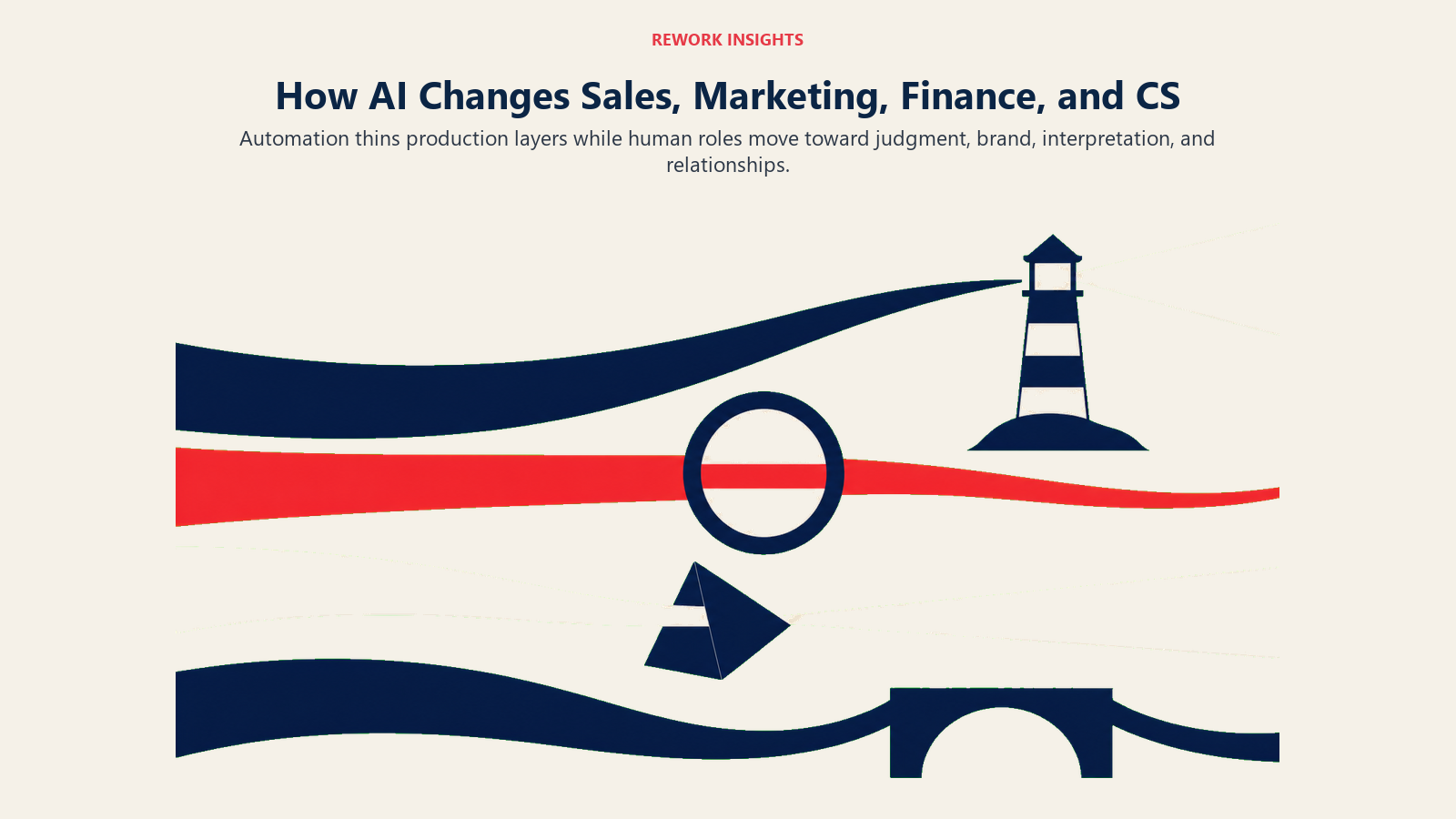
Across departments, AI removes different production bottlenecks while raising the value of a distinct human advantage.
Sales: Fewer SDRs, a Smarter AE Layer
The traditional sales funnel required a lot of human bodies at the top. SDRs doing cold outreach at volume, sequencing emails, handling initial qualification calls. AI handles that work now, better and at a fraction of the cost.
What's emerging at companies like Gong, Outreach, and fast-growing B2B SaaS mid-market players is a structure where the SDR layer is dramatically thinner and the AE layer is more senior and more expensive. AI runs the outreach sequences, scores leads, handles first-touch qualification through conversational AI, and surfaces deal risk signals from CRM activity patterns.
The new structural element is an AI Ops layer between the CRM and the reps. This isn't the CRM admin. It's a function that manages the models, maintains the data quality that AI scoring depends on, and interprets the AI's recommendations for the sales leadership team. In a 40-person sales organization, this might be one person. But it's a critical hire. See what the first AI Ops Manager hire looks like for a detailed breakdown of the role at this scale, including what to look for and how to set them up for success.
For headcount planning: if you're running 8 SDRs and 12 AEs today, a 2026 structure might look like 3 SDRs (handling AI-generated warm leads that still need human touch), 14 AEs (elevated to handle more of the pipeline), and 1 AI Ops specialist. Net headcount flat or slightly down, but the cost structure shifts toward higher-skill, higher-cost roles.
Marketing: Smaller Creative Teams, Human Brand Oversight
The first-generation response to AI in marketing was "we can produce more content." That's true. But the smarter structural response is "we need fewer content producers and more brand stewards."
AI handles content generation, A/B copy variants, SEO drafts, and campaign reporting. What it doesn't handle well is brand coherence at scale: knowing when something is technically correct but feels off, making calls on creative direction that require accumulated institutional knowledge of what the brand actually stands for.
The marketing org in a 2026 mid-market company looks less like a creative production shop and more like an editorial team running an AI-powered publishing operation. Fewer writers, more editors. Fewer coordinators, more strategists who know how to prompt, review, and redirect AI output efficiently.
A 15-person marketing team might restructure to 10, with AI handling what two to three content roles were doing, one AI content operations specialist added, and senior brand and demand gen roles protected or upgraded.
Operations and Finance: Analysts Compressed, Interpreters Expanded
This is where the structural change is most dramatic and most underestimated.
Traditional finance and ops teams are built around data extraction and report building. Analysts spend 60-70% of their time pulling numbers, building decks, and answering questions that require querying systems. AI collapses that work almost entirely. A well-configured AI layer on top of your ERP and financial systems can generate most recurring reports automatically, answer ad hoc questions through natural language queries, and flag anomalies before anyone asks.
What remains, and what grows in importance, is interpretation. Explaining what the numbers mean in the context of strategy. Making the call when the AI flags an anomaly about whether it's a data error or a real signal. Communicating financial reality to non-financial stakeholders.
Deloitte's research on AI in finance suggests that finance teams deploying AI-assisted reporting spend 40-50% less time on data assembly. The organizational response from forward-thinking CFOs isn't to cut the finance team. It's to redeploy the capacity toward FP&A, business partnering, and strategic modeling that the team never had time for before.
Customer Success: AI Owns Tier-1; Humans Own Relationships
Customer success may be the function where the structural change is most visible because the before and after is so stark.
Before: CSMs spend a significant chunk of their week fielding questions that have known answers, pulling usage data for QBR prep, monitoring health scores manually, and sending renewal reminders. Much of that work requires a human account only in the loosest sense.
After: AI handles tier-1 support routing and resolution, monitors product usage signals and surfaces at-risk accounts automatically, and drafts renewal communications based on account health data. CSMs own the QBR conversation, the escalation call, the relationship with the economic buyer, and the strategic expansion discussion.
The ratio of accounts per CSM changes. A CSM managing 40 accounts with a lot of manual work might manage 60-70 accounts in an AI-augmented structure, with AI handling the monitoring and first-touch work that previously consumed the hours.
New Structural Elements That Didn't Exist in 2023
Three roles and functions are appearing in org charts that weren't there two years ago:
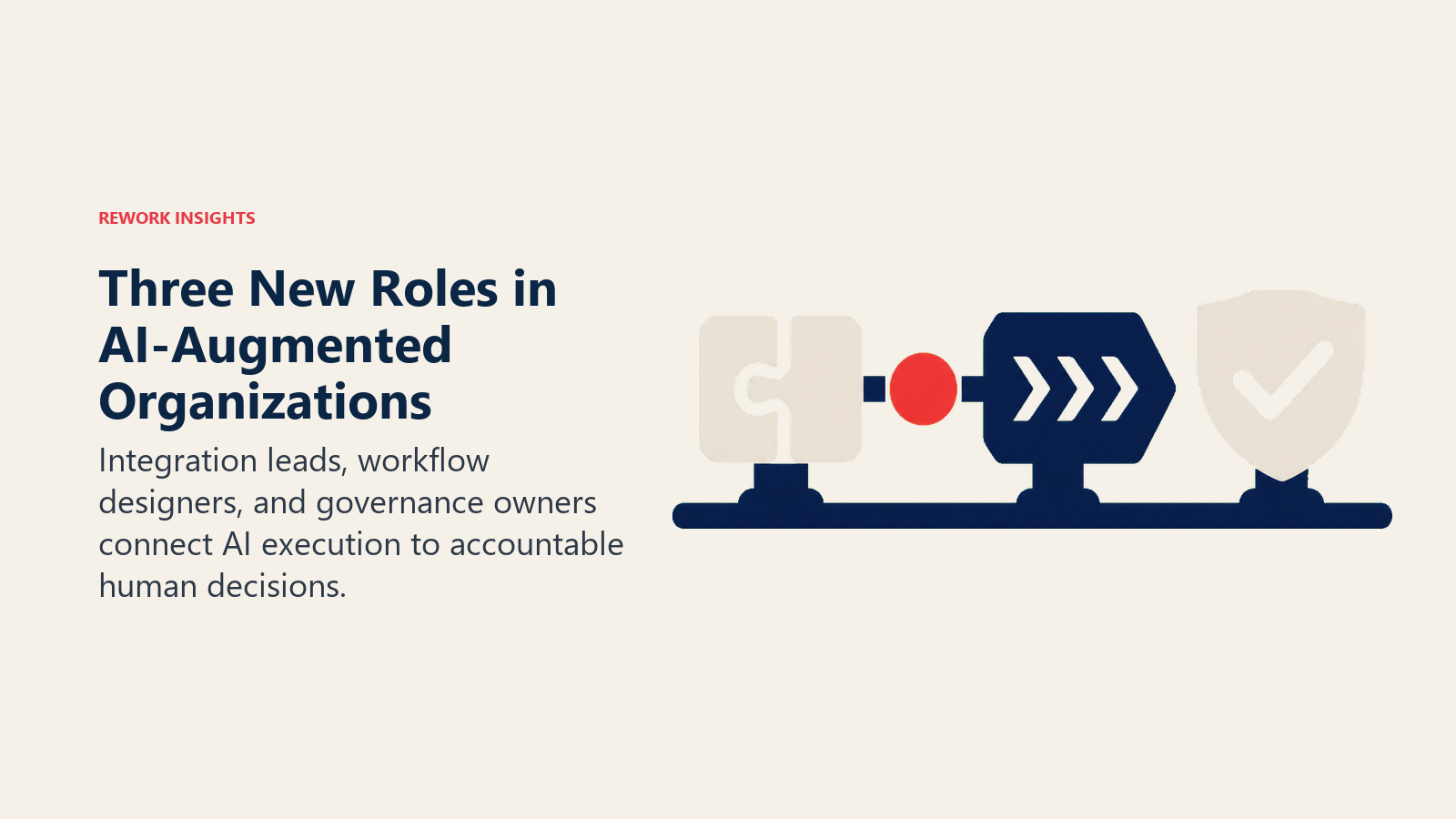
AI Integration Lead (embedded per department, not in IT). This is distinct from the IT team's AI implementation work. The AI Integration Lead sits inside a business function (Sales, Marketing, CS) and owns the ongoing relationship between the team's workflows and the AI layer. They manage prompt libraries, evaluate AI tool performance against business outcomes, and serve as the internal expert for AI-assisted work. In a 50-person department, this is a single senior IC role. It's often the highest-leverage hire a department head can make in 2026.
Human-AI Workflow Designer. As organizations build more complex workflows that mix human judgment with AI execution, someone needs to design those workflows intentionally. This role lives at the intersection of process design and AI capability: understanding what AI can do well, where human checkpoints are necessary, and how to build handoff points that don't create bottlenecks or errors. It's emerging most clearly in ops, finance, and customer success.
AI Governance function (risk, audit, ethics). For companies past roughly 200 employees, an informal governance approach to AI is becoming untenable. The question isn't whether you need AI governance: it's whether you build it as a standalone function or embed it in legal/compliance/risk. Either way, someone needs to own model auditing, bias review, vendor evaluation, and the policies that govern how AI output is used in customer-facing and employee-facing contexts. The CAIO role that's emerging at mid-market companies often serves as the executive sponsor for this function.
What This Means for Headcount Planning
Let's make this concrete. A 200-person company transitioning to an AI-augmented structure over 18 months.
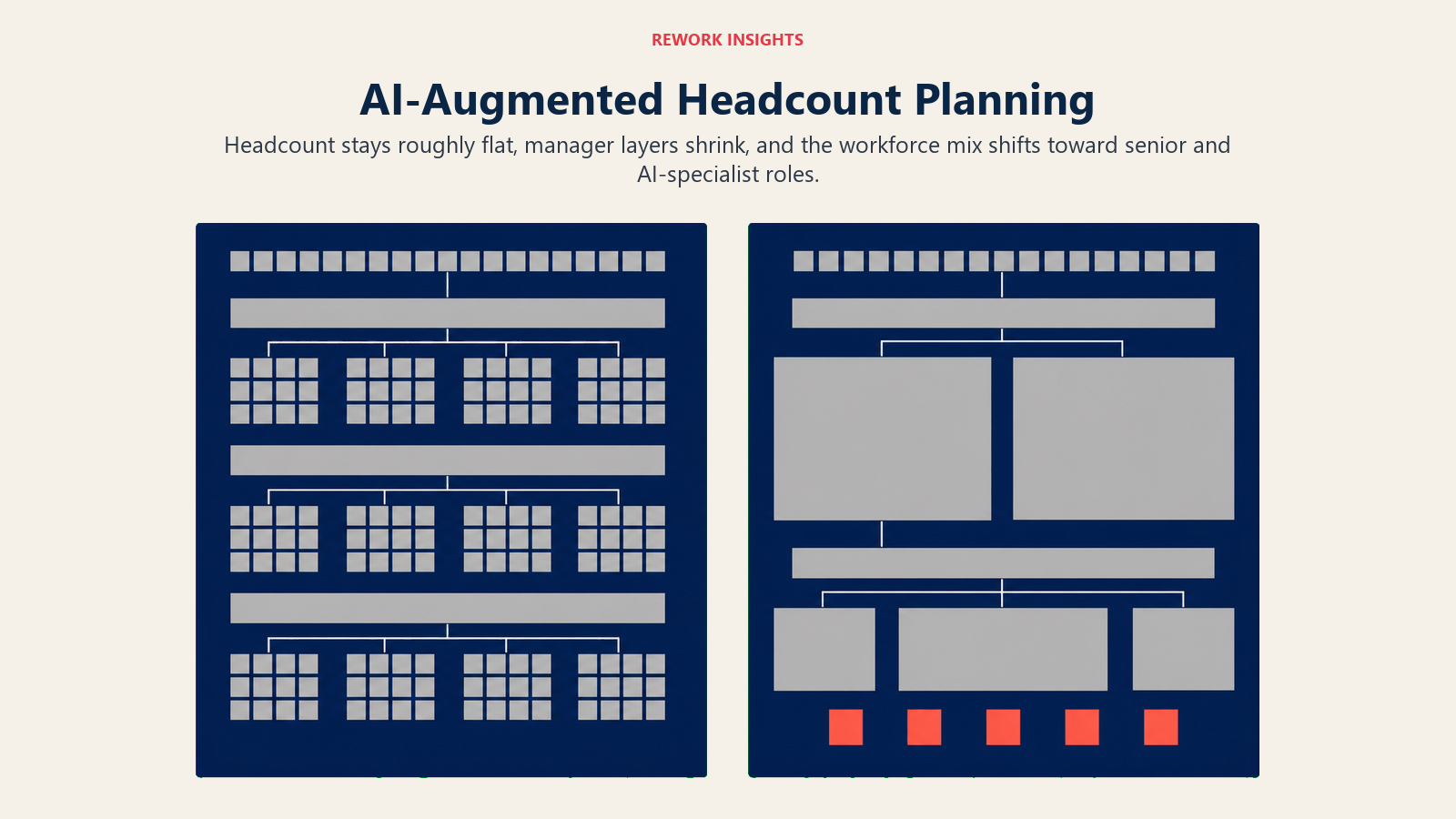
Today's structure (approximate):
- 30 managers and team leads
- 140 individual contributors across functions
- 30 senior leadership, operations, admin
AI-augmented target state:
- 20-22 managers and team leads (expanded spans, coaching-focused)
- 130-135 ICs, but the mix shifts toward senior, hybrid-judgment roles; 15-20 roles that were pure execution (data pulling, content production, outreach volume) are replaced by AI + 5-7 new AI-specialist ICs
- 30-33 senior leadership, ops, admin (slightly expanded to include AI governance and integration roles)
Net headcount: roughly flat to slightly down (190-195). But the cost per head goes up because the mix shifts toward higher-skill roles. And the output per head goes up more.
The mistake most leadership teams make is treating this as a cost reduction exercise. The companies getting the most out of AI workforce transformation are treating it as a capability upgrade: keeping headcount roughly stable while dramatically increasing what that headcount can accomplish. The ROI case is different from what most executives expect, and it's worth running the model before you commit to a headcount reduction framing.
Drawing the New Org Chart Before You're Forced To
The companies drawing this org chart now (before a hiring freeze, a budget cut, or an attrition spike forces their hand) are restructuring with intention. They're deciding which roles to upgrade, which to let attrite, and which to redesign from scratch. They're identifying the AI Integration Leads and Workflow Designers they need before those roles are obvious, while there's still time to develop them internally.
The companies that wait are restructuring in reaction. And reactive restructuring almost always costs more, damages morale more, and produces worse outcomes than intentional redesign.
The roles being created and eliminated are already visible in the hiring data from tech-forward sectors. And the AI fluency bar for new hires is rising fast, which means your current hiring model may already be building a team optimized for a structure that won't exist in 24 months.
The org chart hasn't fundamentally changed since the 1950s. But the work flowing through it has. The executives who recognize that aren't waiting for the next planning cycle to start redesigning. They're doing it now, with the advantage of choice.
Learn More
- Which Roles AI Is Actually Eliminating: what's disappearing and what's being created in mid-market companies right now
- The CAIO Is Not a Fad: why AI executive leadership is becoming a structural necessity, not a trend
- Upskill or Hire AI-Native? The ROI Case: the financial model executives need to run before making workforce investment decisions
- Why Every Sales and Marketing Hire Needs AI Fluency: how the hiring bar is changing and what it means for your current team
- SaaS Companies Restructuring Teams with AI in 2026
- Change Management for AI Rollouts
- Cross-Functional AI Collaboration

Co-Founder, Rework.com
On this page
- How AI Changes Span of Control
- Department-by-Department: What's Actually Changing
- Sales: Fewer SDRs, a Smarter AE Layer
- Marketing: Smaller Creative Teams, Human Brand Oversight
- Operations and Finance: Analysts Compressed, Interpreters Expanded
- Customer Success: AI Owns Tier-1; Humans Own Relationships
- New Structural Elements That Didn't Exist in 2023
- What This Means for Headcount Planning
- Drawing the New Org Chart Before You're Forced To
- Learn More