More in
AI Workforce Transformation
Does AI Make Distributed Teams Easier or Harder to Lead?
Oct 11, 2026
Where AI Productivity Monitoring Turns Into Surveillance
Oct 11, 2026
Why Your Most Experienced People Resist AI Hardest (and Why You Need Them Most)
Oct 11, 2026
Is AI Making Teams Less Collaborative?
Oct 11, 2026
Should CEOs Use AI Themselves? Why Executive Fluency Sets the Adoption Ceiling
Oct 11, 2026
Does AI Favor Generalists or Specialists? What It Means for Who You Hire
Oct 10, 2026
Is Experience Still Worth Paying For When AI Narrows the Skill Gap?
Oct 10, 2026
When Every Candidate Uses AI, What Is a Resume Still Worth?
Oct 10, 2026
Should AI Screen Your Job Candidates? Where Automated Hiring Helps and Where It Backfires
Oct 10, 2026
Should Candidates Be Allowed to Use AI in Interviews?
Oct 10, 2026
How AI Is Changing Your Retention Problem, Not Just Your Hiring Problem
Turn this article into takeaways for your work.


Each assistant summarizes the article only for you and suggests best practices for your work.
Your top engineer just handed in her notice. Her exit interview is polite but vague. She mentions "growth" and "opportunity." What she doesn't say (but you can read between the lines) is that your competitor gave her access to tools that make her work ten times more interesting and ten times more impactful. You didn't.
That scenario is playing out across mid-market companies right now. Boards are approving headcount for AI-literate hires. Recruiting teams are rewriting job descriptions to filter for "prompt engineering experience." But the harder, quieter problem is going unaddressed: AI adoption is creating a retention crisis, and most executive teams aren't framing it that way yet.
The talent market has sorted companies into two buckets. AI-forward companies are attracting and keeping high performers. Everyone else is watching them leave.
Why AI Changes What Talented Employees Expect
High performers don't just want to do more work faster. They want to do better work. They want to solve harder problems. They want to build things that matter. And increasingly, AI tools are what unlock that ambition.
When a company withholds AI access (whether through slow procurement, blanket IT restrictions, or leadership inertia), it sends a signal to the employees who pay closest attention. It says: we're not investing in your capability. We're not confident in where this is going. We're waiting to see how others figure it out first.
That signal lands hardest on exactly the people you can't afford to lose.
Senior engineers notice when their counterparts at other companies are shipping three times faster with AI-assisted code review and test generation. RevOps analysts notice when peers at competing firms have AI-native forecasting tools that make their Excel-based models look like archaeology. Top marketers notice when AI-enabled teams are running personalization experiments that their own team can't even prototype without a six-week sprint.
The gap isn't just about tools. It's about what those tools signal about a company's trajectory. Talented employees are not just optimizing for current compensation. They're making a bet on where they want to be in two years. And the companies that lag on AI adoption look, to those employees, like a losing bet.
What Exit Interviews Are Actually Saying in 2025-2026
The language in exit interviews rarely maps directly to "you didn't give me AI tools." But the patterns are there for leaders who know what to look for.
Exit interview data from mid-market companies across SaaS, professional services, and operations-heavy industries in 2025 shows three recurring themes among voluntary departures of high performers:
"I wasn't growing fast enough." In context, this often means the work wasn't evolving. When peers at other companies are working with AI models that surface insights automatically, being stuck on manual processes doesn't feel like stability. It feels like stagnation.
"My team wasn't set up to do great work." This surfaces most frequently in engineering and analytics roles. When the team is under-equipped relative to market standard, high performers absorb the productivity gap as personal frustration. They compensate by working harder. Eventually, they look for a team where the tools match the ambition.
"I saw a better opportunity." This is the catch-all. But when you probe the specific opportunity, a pattern emerges: the new role offers AI tools, AI-literate teammates, or a company that explicitly positions AI fluency as a career accelerant rather than a nice-to-have.
A 2025 Gartner survey on employee AI excitement found that 65% of employees are excited to use AI at work, which means the employees who aren't getting that access are noticing the gap. And "modern productivity tools" in 2026 means AI-augmented workflows, not just faster laptops.
The departure data isn't just about who leaves. It's about who starts looking. High performers who aren't actively job searching still recalibrate their engagement when they feel their company is falling behind. They stay, but they stop raising their hand for hard problems. They stop mentoring junior colleagues. They start doing enough. That quiet disengagement is often harder to measure than turnover, and more expensive.
What a Retention-Focused AI Strategy Actually Looks Like
Most AI strategies are framed around productivity: cost savings, output per headcount, automation of repetitive work. That framing isn't wrong. But it misses a critical stakeholder: the employees who see themselves as the engine of the company's future.
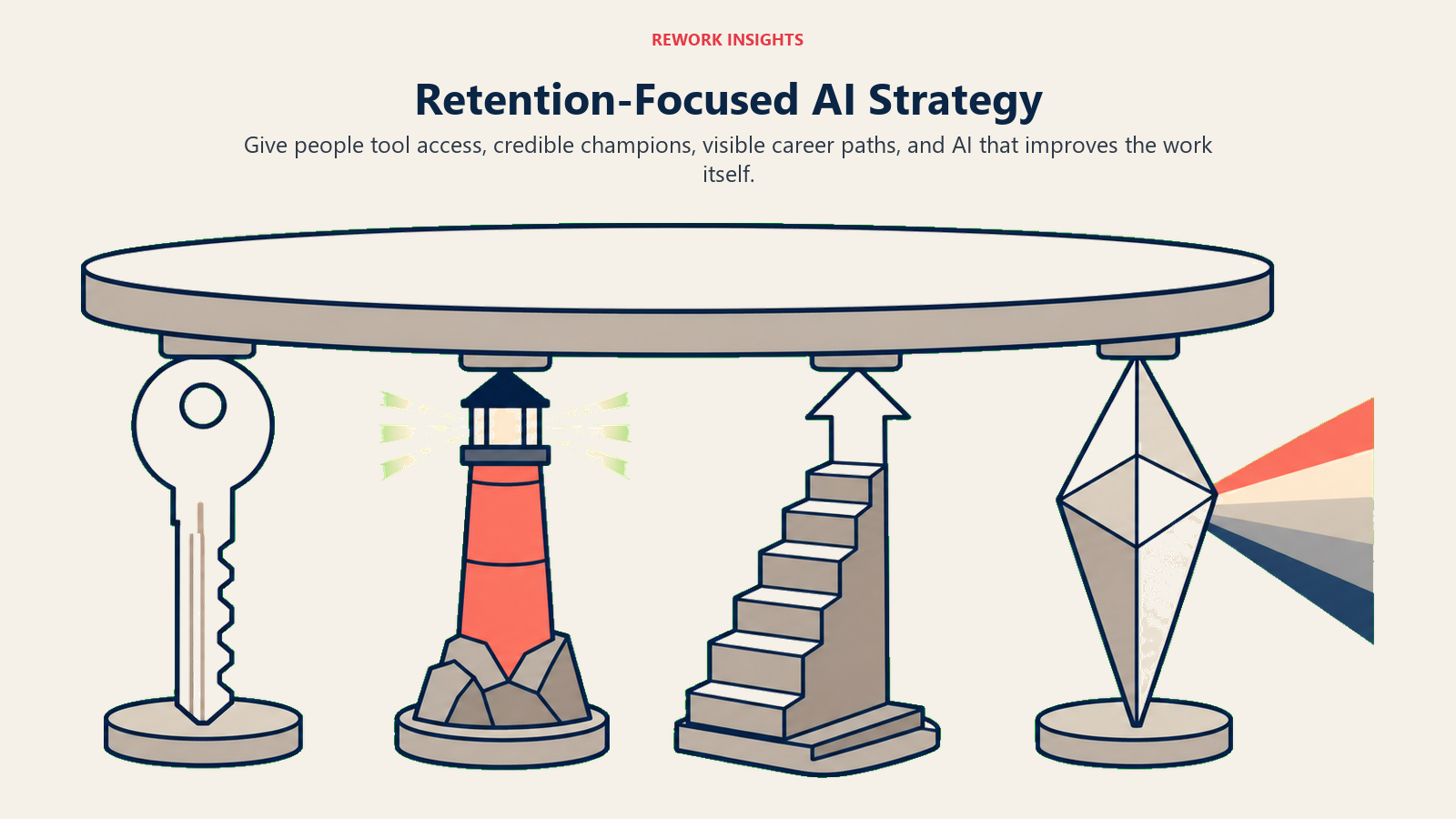
A retention-focused AI strategy looks different. Here's what it involves.
Democratize tool access before you perfect governance. The instinct to lock down AI access until security policies are airtight is understandable. But it has a cost. Every month your senior engineers spend waiting for IT approval is a month your competitors are pulling ahead, and a month your best people are updating their LinkedIn profiles. Define a fast track for AI tool access for high-impact roles. Get governance right over time, not before anyone can start.
Create internal AI champions with real authority. Designating someone as an "AI champion" without budget, headcount, or decision-making power is theater. Real champions need the ability to run experiments, bring in vendors, and redesign workflows. They also need visibility: regular all-hands time, access to leadership, and a clear mandate to pull others forward. The champion program at a 180-person SaaS company in Austin drove a 23% improvement in 90-day retention among their engineering team in 2025, primarily because engineers reported feeling equipped rather than left behind.
Tie career path clarity to AI skill development. One of the strongest retention signals an executive team can send is: "Here is what your career looks like here, and here is how AI accelerates it." That means building explicit AI competency ladders, offering internal AI training with real recognition attached, and creating senior roles that require AI fluency. A structured AI skills matrix gives employees a visible framework to develop against, which turns career path clarity from a promise into a plan. When employees can see a future for themselves in the company that's tied to skills they're genuinely excited to develop, the calculus around departure shifts.
Use AI tools to improve the employee experience, not just the product. Companies that deploy AI primarily to squeeze more from existing headcount, without investing in improving how their people work, create resentment, not retention. The most effective AI-forward cultures deploy tools that make employees' work more meaningful: automating the tedious, surfacing the interesting, and freeing up time for the problems that actually require human judgment.
As discussed in The AI Skills Gap Executives Are Getting Wrong, the companies that misframe AI as a cost lever rather than a capability lever consistently get worse talent outcomes. The same logic applies to retention. And when high performers can see the gap between your AI investment and a competitor's, the AI fluency salary premium data from 2026 makes that gap feel very concrete.
The AI Retention Audit: A Practical Checklist for Executives
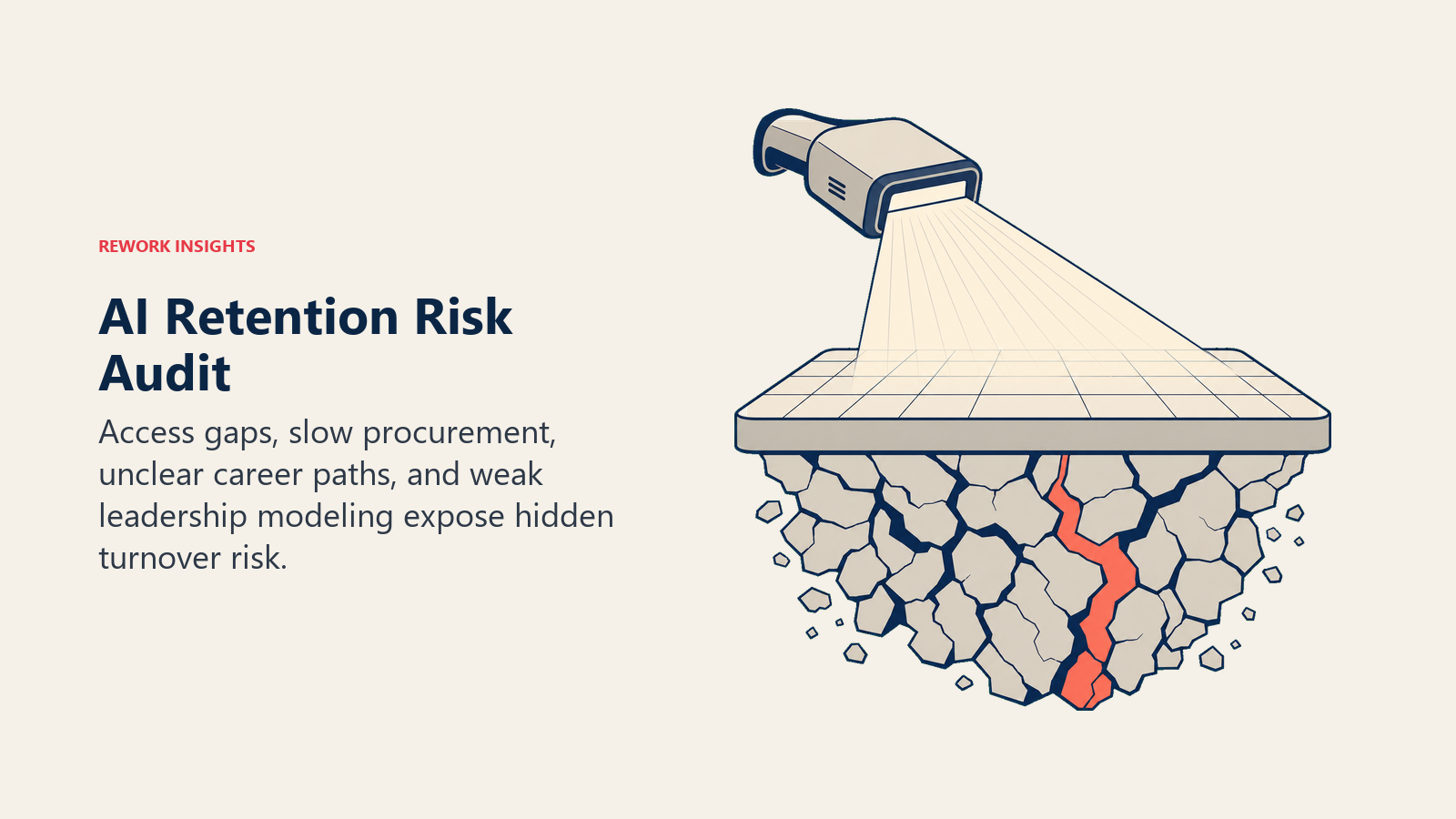
Before your next leadership offsite, run through these questions honestly:
- What AI tools do your top 20% of performers have access to today? How does that compare to what they could access at a direct competitor?
- When was the last time you asked your highest performers what tools they wish they had? What happened with that feedback?
- Do your senior engineers, analysts, and operators know what the company's AI roadmap looks like? Does that roadmap include them?
- Are there active IT or procurement bottlenecks preventing teams from accessing AI tools they've already requested? How long has that backlog existed?
- Is AI fluency factored into promotion decisions? Can an employee point to an explicit career ladder that rewards AI skill development?
- Have you reviewed exit interview data in the last two quarters specifically looking for signals about tools, growth, and technology access?
- Do you have internal AI champions with real authority, or nominal ones with no budget?
- Has your leadership team modeled AI tool adoption personally, or is AI adoption a message you send downward without demonstrating upward?
If more than half of those questions surface uncomfortable answers, retention risk is higher than your turnover numbers currently show.
The Executive Decision: Reframe AI Investment as Retention Spend
CFOs and boards are used to evaluating AI investment through a productivity lens. That's the right lens for some decisions. But there's a second P&L line that rarely gets calculated: the cost of losing a high performer to a more AI-equipped competitor.
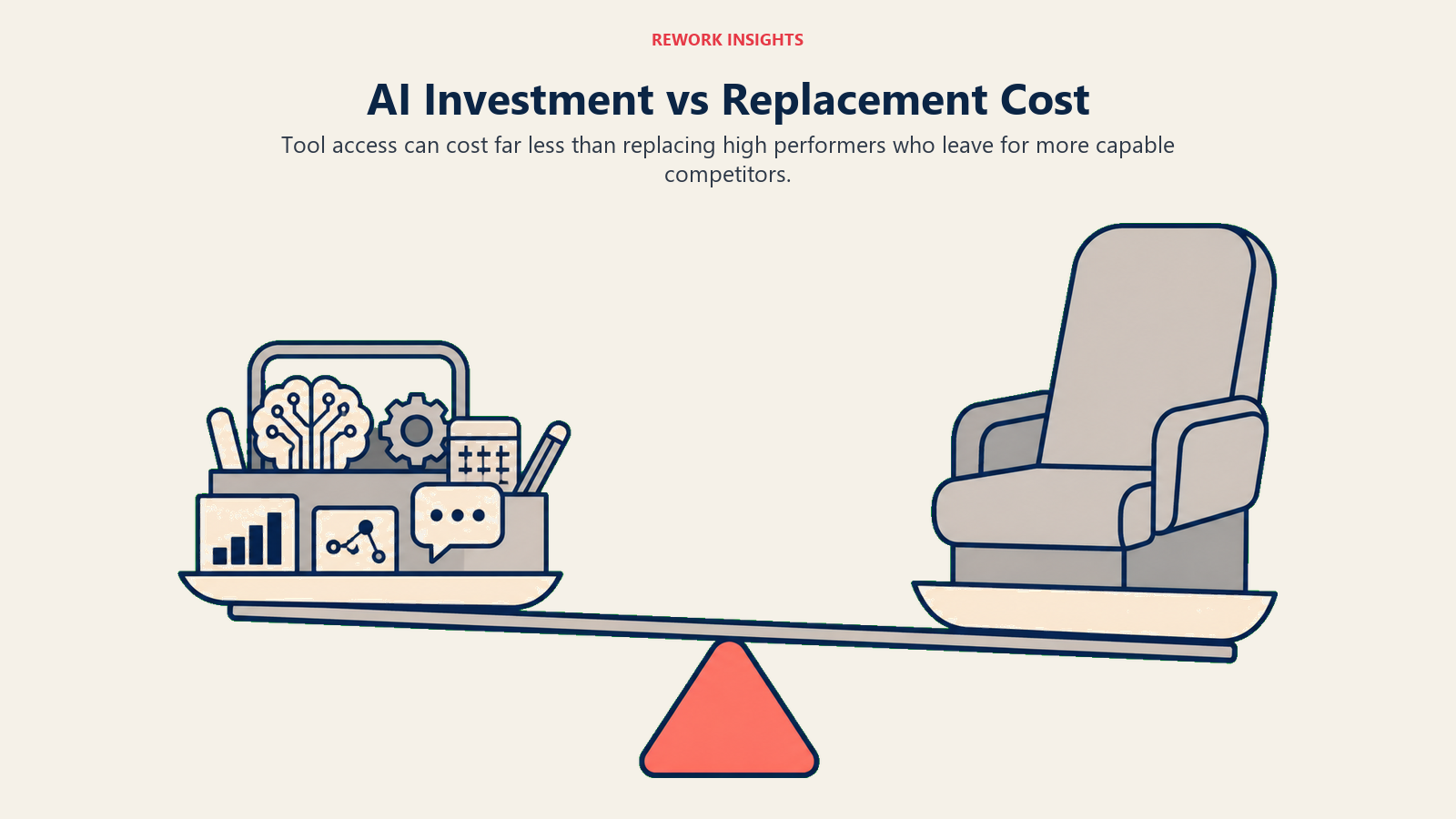
Replacing a senior engineer costs, by most estimates, 1.5 to 2x their annual salary when you factor in recruiting fees, ramp time, and the institutional knowledge that walks out the door. HBR's research on talent management in the AI era confirms that scenario-based skills planning is now the most effective way to model where AI will disrupt your talent pipeline, and where retention investment pays off fastest. Replacing a top-performing sales director in a company running a complex B2B motion can cost even more, particularly when deals in flight get disrupted. A 200-person company that loses six high performers in a year to AI-forward competitors (well within the range of what's happening in mid-market SaaS right now) is absorbing a $1.5 to $3 million replacement cost on the conservative end.
Against that number, the cost of AI tool access looks different. A well-scoped AI tools budget for a 200-person knowledge-work company runs $200,000 to $500,000 annually. If that spend meaningfully improves retention among your top 20%, the ROI math is straightforward.
The harder conversation is cultural. McKinsey's 2025 workplace report found that the biggest barrier to AI scaling isn't employees (who are largely ready) but leaders who aren't steering fast enough. That gap lands hardest on retention. Why Every Sales and Marketing Hire in 2026 Needs AI Fluency makes the case that AI fluency is now a baseline hiring requirement in revenue-facing roles. The same logic applies on the retention side: employees who have built AI fluency will not stay at companies that treat those skills as irrelevant. They will go where their skills are valued and where they can keep developing them.
Upskill or Hire AI-Native? The ROI Case Every Executive Needs to Run lays out the financial framework in detail. But the retention angle adds a variable that's often missing from the pure ROI calculation: the cost of losing existing high performers who would have stayed if you'd invested in them.
And From AI as Tool to AI as Teammate: The Mindset Shift That Unlocks Value captures the cultural shift underneath all of this. Companies where AI becomes a genuine teammate, not just a tool deployed by IT, create an environment that talented people want to work in. That environment is itself a retention asset.
Retention Is the ROI Metric That Changes the Board Conversation
Productivity metrics are clean. Output per headcount, cost per task, cycle time improvements. They fit neatly into board decks and quarterly reviews. Retention is messier, slower to measure, and easy to dismiss until the departures start accelerating.
But in 2026, retention is an AI strategy problem. The companies holding their best people are the ones that have made AI fluency a core part of their employee value proposition, not just a line item in the IT budget.
The question for every executive team right now isn't just "how do we hire AI-literate people?" It's "why would an AI-literate person stay here, and are we confident we have a good answer?"
If you're not sure, the exit interview data from the next two quarters will tell you. But by then, some of your best people will already be gone.
Learn More
- The AI Skills Gap Executives Are Getting Wrong: Why the gap is more about strategy than technical knowledge
- Why Every Sales and Marketing Hire in 2026 Needs AI Fluency: The new baseline for revenue-facing roles
- Upskill or Hire AI-Native? The ROI Case Every Executive Needs to Run: The financial framework for the build-vs-buy talent decision
- From AI as Tool to AI as Teammate: The Mindset Shift That Unlocks Value: What cultural adoption actually looks like
- AI Fluency Salary Premium Data for 2026: The compensation gap between AI-fluent and non-fluent employees
- How to Build a 90-Day AI Fluency Plan for Your Team: A structured onboarding path for AI skills development

Co-Founder, Rework.com
On this page
- Why AI Changes What Talented Employees Expect
- What Exit Interviews Are Actually Saying in 2025-2026
- What a Retention-Focused AI Strategy Actually Looks Like
- The AI Retention Audit: A Practical Checklist for Executives
- The Executive Decision: Reframe AI Investment as Retention Spend
- Retention Is the ROI Metric That Changes the Board Conversation
- Learn More