More in
AI Workforce Transformation
Does AI Make Distributed Teams Easier or Harder to Lead?
Oct 11, 2026
Where AI Productivity Monitoring Turns Into Surveillance
Oct 11, 2026
Why Your Most Experienced People Resist AI Hardest (and Why You Need Them Most)
Oct 11, 2026
Is AI Making Teams Less Collaborative?
Oct 11, 2026
Should CEOs Use AI Themselves? Why Executive Fluency Sets the Adoption Ceiling
Oct 11, 2026
Does AI Favor Generalists or Specialists? What It Means for Who You Hire
Oct 10, 2026
Is Experience Still Worth Paying For When AI Narrows the Skill Gap?
Oct 10, 2026
When Every Candidate Uses AI, What Is a Resume Still Worth?
Oct 10, 2026
Should AI Screen Your Job Candidates? Where Automated Hiring Helps and Where It Backfires
Oct 10, 2026
Should Candidates Be Allowed to Use AI in Interviews?
Oct 10, 2026
The CAIO Is Not a Fad: Why Mid-Market Companies Are Appointing AI Executives
Turn this article into takeaways for your work.


Each assistant summarizes the article only for you and suggests best practices for your work.
Forty percent of Fortune 500 companies now have a Chief AI Officer or equivalent executive, and that number grew by 18 percentage points in a single year. Harvard Business Review's analysis of AI leadership tracks how fast this function is institutionalizing across industries. Most mid-market CEOs have noticed this trend, studied it from a safe distance, and concluded: that's an enterprise problem.
It's not. But the way you solve it at a 200-person B2B SaaS company looks nothing like what Microsoft or JPMorgan built.
Here's the real question you should be asking: not "do we need a CAIO?" but "who in our organization owns AI strategy right now?" If the honest answer is nobody, or maybe the CTO when they have time, you already have your answer.
What a CAIO Actually Does (And What They Don't)
Let's clear something up first. The CAIO role gets badly mischaracterized. It's not a senior data scientist with a better title. It's not someone who manages your Azure OpenAI subscriptions. And it's definitely not a role you create to signal to your board that you're "taking AI seriously."
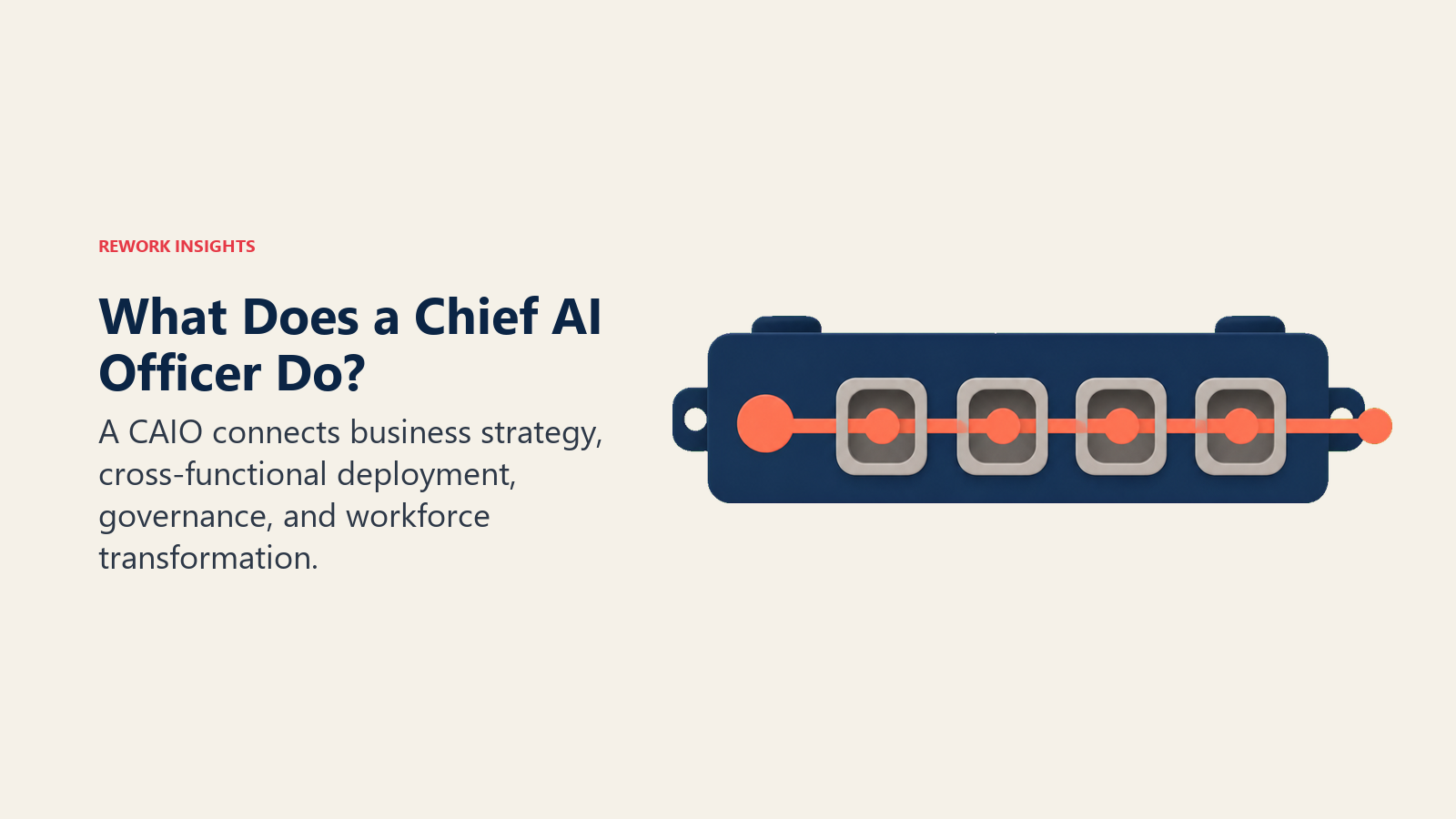
The CAIO's job is to sit at the intersection of three things that almost never overlap cleanly in most companies: strategy, operations, and workforce transformation.
On the strategy side, a CAIO translates AI capability into business model change. They're asking: which parts of our go-to-market, our service delivery, our product roadmap can be fundamentally restructured because of what AI can now do? This isn't a technology question. It's a business question that requires someone who understands both sides deeply enough to make the call.
On the operations side, the CAIO owns AI deployment priorities across functions. Which teams get AI tooling first? Where do you build vs. buy? How do you measure ROI before committing to enterprise contracts? Most companies get stuck in pilot purgatory. They run dozens of small AI experiments that never scale because nobody has the authority to consolidate, prioritize, and push through.
On the workforce side, the CAIO manages the organizational risk of AI adoption. That means ethics, compliance, and the harder cultural problem: what happens to people when their jobs change. We go deeper on this in Which Roles AI Is Actually Eliminating, but the short version is that the workforce dimension of AI is where most companies are completely exposed.
Critically, the CAIO reports to the CEO, not the CTO. That reporting line matters more than the title. When AI strategy reports through technology, it gets filtered through a technology lens. Budget allocation, headcount decisions, partnership choices: they all get shaped by IT priorities rather than business priorities. That's a structural error that compounds over time.
Why Mid-Market Is Different From Enterprise
Enterprise AI leadership has a different set of problems. They're fighting legacy IT infrastructure, navigating procurement bureaucracy, and trying to move a 50,000-person organization through change management. The CAIO at a Fortune 500 company spends enormous political capital just getting people in the room.
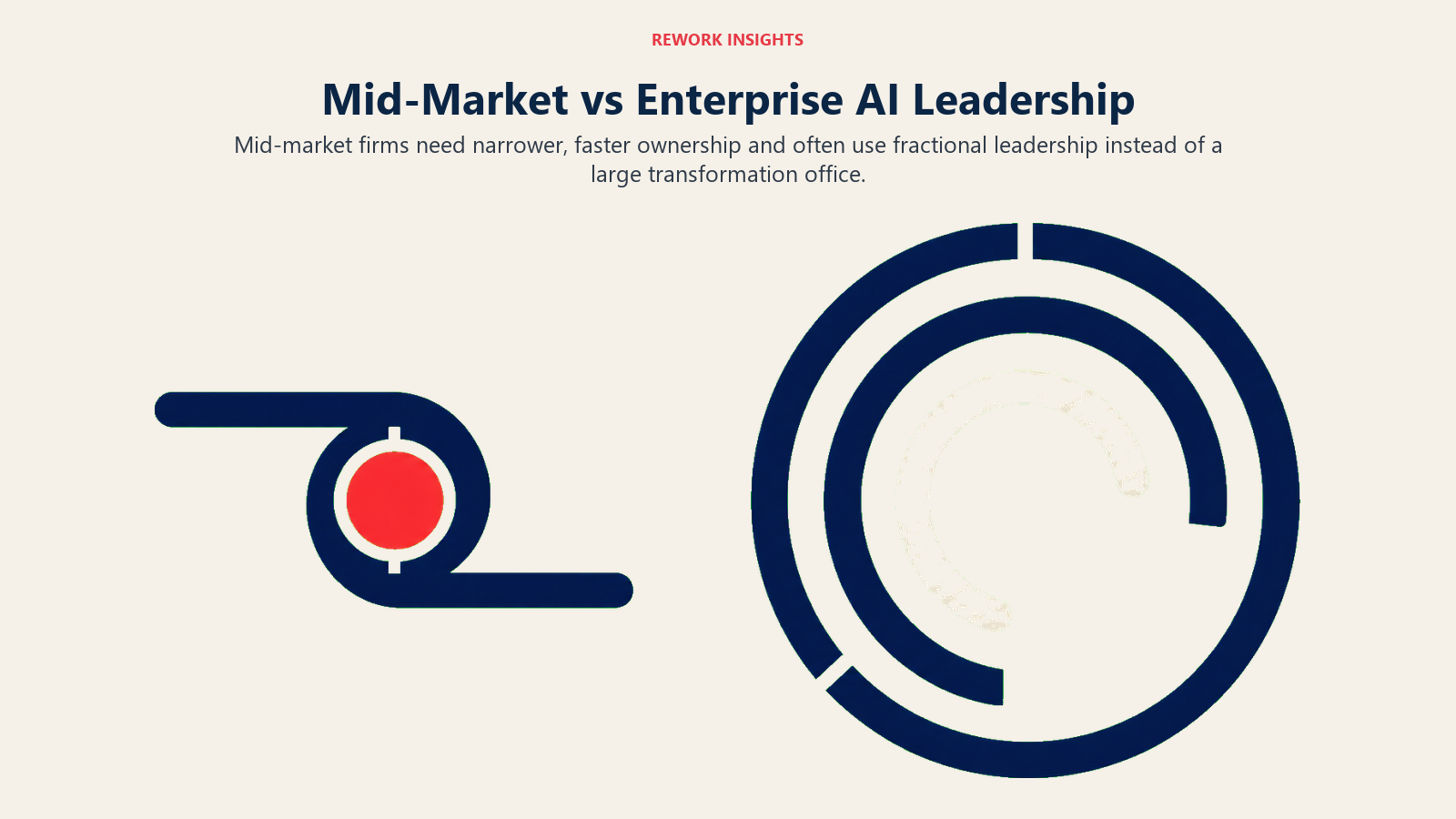
Mid-market companies don't have those problems. But they have their own.
The most common one: no dedicated AI budget. Most 100–500 person companies are treating AI as a line item under technology or operations, which means it competes with infrastructure refreshes and software renewals. Without a budget owner at the executive level, AI investment stays small and scattered.
The second problem is candidate scarcity. The pool of people who have both genuine AI expertise and the executive presence to run cross-functional strategy at a senior level is thin. Most of them are at Tier 1 tech companies or consulting firms with compensation packages that mid-market can't match.
This is where the fractional CAIO model becomes genuinely interesting.
A fractional CAIO works part-time (typically 2-3 days a week) across one or a small number of companies. They're not a consultant delivering a report. They're operating inside the company, in executive team meetings, shaping the AI roadmap and making decisions. Several talent platforms and boutique firms now specialize specifically in placing fractional AI executives, and the model has gained significant traction in the 100–500 person range.
The economics work better than most CEOs expect. A full-time CAIO at a growth-stage company runs $280,000-$420,000 in total comp. A fractional engagement typically runs $15,000-$25,000 per month. That's expensive, but fundable from an operating budget without requiring a board-approved headcount expansion. The Chief AI Officer adoption data from Fortune 500 companies gives context for how fast this function is institutionalizing across company sizes.
The harder question is when you need a fractional model versus when your existing team can absorb the function. Here's a simple framework:
Your COO or CTO can absorb AI strategy if: AI is currently a productivity enhancement play (you're deploying copilots and automation tools), your AI roadmap is primarily internal-facing, and your competitive differentiation doesn't depend on AI capability in the next 18 months.
You need dedicated AI leadership if: AI is core to your product or service delivery, you're making build-vs-buy decisions that require deep technical judgment at the executive level, you're in a regulated industry where AI risk and compliance needs its own owner, or your competitors are moving faster and you can feel it.
The Business Case in Hard Numbers
The data on this is clear enough that it should move the conversation from "should we?" to "when and how?"
BCG research found that companies with dedicated AI leadership are more than twice as likely to report measurable ROI from their AI investments compared to companies where AI is owned by a general technology or operations executive. Gartner's 2025 survey data shows that organizations with a formal AI governance structure (which typically means a CAIO or equivalent) deploy AI initiatives 40% faster and experience significantly fewer compliance or ethics incidents.
The mechanism isn't mysterious. Dedicated AI leadership means faster decisions, clearer ownership, and someone whose entire job is to make AI investments pay off. Without that, AI initiatives compete for attention with every other priority the CTO or COO is managing.
There's also a talent signal effect. Companies that have appointed AI executives attract stronger AI-native candidates across the organization. If you're trying to recruit a Head of AI Product or a senior ML engineer, the presence of a CAIO signals that the company has genuine executive commitment to the domain, not just a budget line and a vague directive.
What to Look for in the Role at Your Scale
Forget the PhD requirement. The profile that works at a 200-person B2B SaaS company looks nothing like the academic-turned-executive model that dominated AI leadership hiring in 2022 and 2023.
The CAIO you want at mid-market has probably spent time as an operator (a VP of Product, a COO, or a general manager) who developed genuine AI depth either through building AI-adjacent products or through deep engagement with the technology over the past three to five years. They know how to run a P&L, manage cross-functional teams, and make resource allocation decisions. The AI expertise is real but it's paired with business judgment.
Specifically, you're looking for someone who can do four things well:
First, translate between technical and business language fluently in both directions. They can explain model selection tradeoffs to the board and explain business constraints to an engineering team without oversimplifying either conversation.
Second, build vendor accountability. Most mid-market AI investment flows through software vendors, not internal builds. The CAIO needs to know how to evaluate vendor claims, structure contracts with performance milestones, and kill relationships that aren't delivering.
Third, manage the ethics and compliance surface. This is only getting more complex. The EU AI Act, emerging state-level regulations in the US, and sector-specific requirements (especially in financial services, healthcare, and HR) mean that someone needs to own the AI risk register. That person can't be your general counsel who's already overloaded. A solid starting point for this work is an AI governance policy for your department.
Fourth, be a change agent without being disruptive for its own sake. The AI skills gap that most executives are getting wrong isn't a training problem. It's a change management problem. Your CAIO needs to bring the organization along, not just mandate adoption.
A Side-by-Side: CAIO vs. CTO Scope
The overlap between the CAIO and CTO functions is real, and it creates friction if you don't define the boundary clearly before you hire.
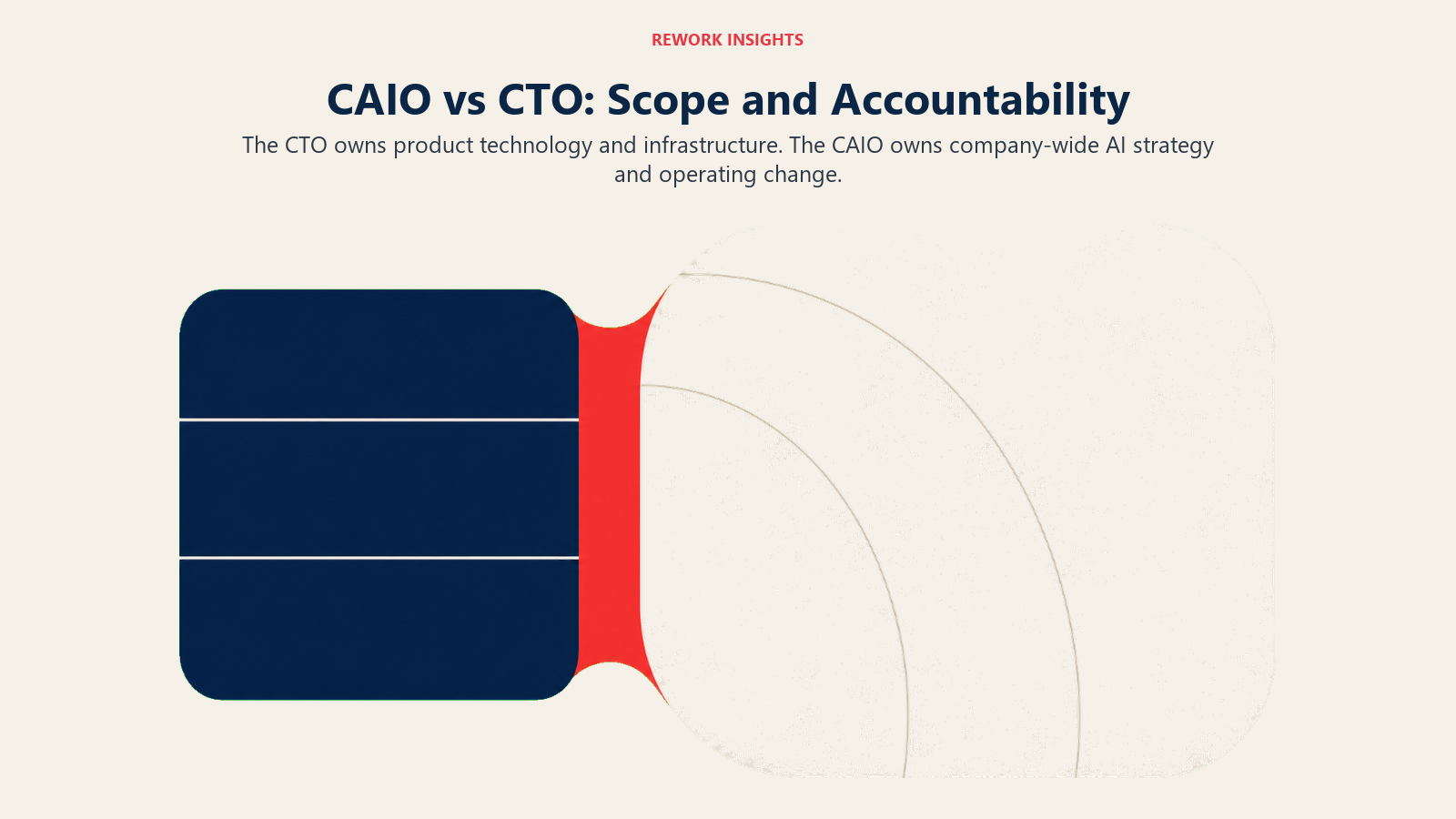
The CTO owns: infrastructure, engineering teams, system architecture, build vs. buy decisions for core product technology, security, and technical debt management.
The CAIO owns: AI strategy across all business functions (not just product), AI vendor relationships and evaluations, workforce AI capability building, AI ethics and governance, and the AI investment roadmap across the company.
The clean dividing line is product vs. organization. The CTO is accountable for what you ship. The CAIO is accountable for how the entire company operates with AI. In a well-structured mid-market executive team, these roles should be collaborators, not competitors. But that requires clear scope from day one.
One real example worth noting: HubSpot appointed a Chief AI Officer in 2024 who reports directly to the CEO and sits outside the CTO's organization entirely. For a company at HubSpot's scale, this reflected a deliberate strategic choice that AI transformation wasn't a product function. It was a company-wide operating model question. The same logic applies at a company with $30M ARR, just with a smaller budget and a narrower scope.
The Org Design Question You Can't Defer
The org chart of the future isn't just about which roles get added or eliminated. It's about where accountability sits for the most consequential capability shift of the decade.
Right now, most mid-market companies have AI capability scattered across their org chart with no single owner. Marketing is running Jasper pilots. Sales is using AI-generated outreach. Product is experimenting with LLM-powered features. Finance is exploring automated reporting. Each team has their own vendor relationships, their own success metrics, and their own risk exposure. The AI readiness assessment templates can surface just how fragmented things actually are before you appoint someone to unify them.
This works until it doesn't. The consolidation moment comes when you have a compliance incident, a vendor who overcharged you on usage you didn't track, a failed rollout that damaged team trust, or a competitor who moved faster because they had coordinated AI strategy and you didn't.
The question isn't whether to appoint AI leadership. For companies above 100 employees in sectors where AI is reshaping the competitive landscape, the question is what the right structure looks like at your specific scale. Fractional or full-time? CAIO title or a restructured COO role with formal AI accountability? External hire or an internal operator who's earned the credibility to lead the transformation?
Those are decisions worth spending real time on. The decision to defer entirely is the one that ages badly. The ROI case for AI-native leadership only gets stronger as the capability gap between companies with and without dedicated AI leadership widens.
The Fortune 500 got here first. But they're not the only ones who need to solve it.
Learn More
