More in
AI Workforce Transformation
Does AI Make Distributed Teams Easier or Harder to Lead?
Oct 11, 2026
Where AI Productivity Monitoring Turns Into Surveillance
Oct 11, 2026
Why Your Most Experienced People Resist AI Hardest (and Why You Need Them Most)
Oct 11, 2026
Is AI Making Teams Less Collaborative?
Oct 11, 2026
Should CEOs Use AI Themselves? Why Executive Fluency Sets the Adoption Ceiling
Oct 11, 2026
Does AI Favor Generalists or Specialists? What It Means for Who You Hire
Oct 10, 2026
Is Experience Still Worth Paying For When AI Narrows the Skill Gap?
Oct 10, 2026
When Every Candidate Uses AI, What Is a Resume Still Worth?
Oct 10, 2026
Should AI Screen Your Job Candidates? Where Automated Hiring Helps and Where It Backfires
Oct 10, 2026
Should Candidates Be Allowed to Use AI in Interviews?
Oct 10, 2026
Why Every Sales and Marketing Hire in 2026 Needs AI Fluency
Turn this article into takeaways for your work.


Each assistant summarizes the article only for you and suggests best practices for your work.
A sales rep who can't use AI to research accounts, personalize outreach, and compress admin time is now structurally disadvantaged against one who can. Not "slightly behind." Not "less efficient." Structurally disadvantaged, the way a rep without a CRM was disadvantaged in 2005.
This isn't a technology argument. It's a talent strategy and competitive positioning argument. The companies that make AI fluency a hiring requirement in their GTM org this year will have a measurable performance gap over those that don't by 2027. And it's not a gap you can close by retrofitting fluency onto people who were hired without it.
Here's the business case CROs and VP Sales need, with definitions, screening frameworks, and compensation guidance.
Why GTM Is the Highest AI Leverage Point in the Business
Before you can build the argument internally, you need the number. And the numbers are now solid.
According to McKinsey research on sales and AI, high-performing sales teams are significantly more likely to be using AI than underperformers. More specifically, reps who use AI for account research, outreach personalization, and pipeline management are closing 20-30% more deals than peers working the same territory without it. LinkedIn's 2025 Future of Work in Sales survey found that 74% of top-quota reps now use AI tools weekly, compared to 31% among reps who missed quota. The AI fluency salary premium data for 2026 adds another dimension: fluent reps aren't just more productive, they command 12-18% higher comp, which means the best candidates are actively filtering for AI-forward employers.
On the marketing side, the delta is even more pronounced. Teams using AI for content production, audience segmentation, and campaign testing are generating substantially more output on equivalent headcount. Forrester's research on AI in marketing tracks these productivity gains across the B2B SaaS cohort consistently.
The productivity delta shows up within 90 days. That's fast enough that you'll see the difference before the first performance review cycle.
But here's what makes this a hiring issue rather than a training issue: the gap between AI-fluent and AI-naive reps compounds. An AI-fluent AE builds better account models over time, generates better pipeline data, and creates feedback loops that improve their own performance. A rep who's using AI superficially (copy-pasting outputs, running generic prompts) doesn't get those compounding benefits. And a rep who isn't using it at all falls further behind each quarter.
You can't close that gap with a one-day AI training session. You hire it.
What AI Fluency Actually Means in GTM Roles
The mistake most hiring managers make is treating AI fluency as tool familiarity. "Do you use Gong? Have you worked with Outreach's AI features?" That's the wrong question. Tool familiarity is table stakes and it transfers across platforms in weeks.
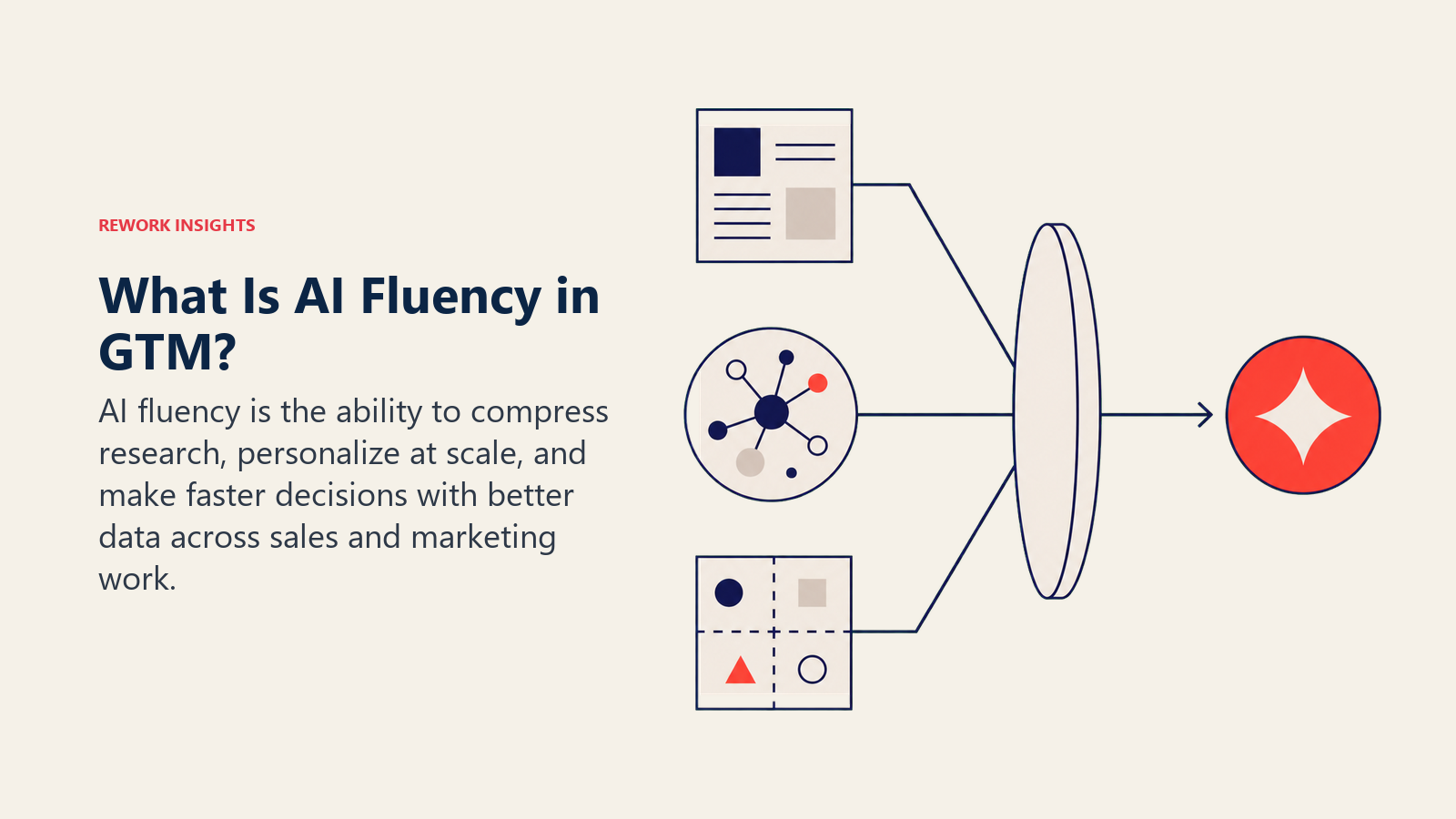
Real AI fluency in GTM is about outcomes: the ability to use AI to compress research cycles, personalize at scale, and make faster decisions with better data. Here's what it looks like broken down by role.
Account Executive
| Capability | What AI Fluency Looks Like |
|---|---|
| Account Research | Uses AI to synthesize 10K filings, LinkedIn signals, and news into a 3-minute ICP brief before every call |
| Outreach Personalization | Generates first drafts of tailored sequences based on account context, doesn't rely on generic templates |
| Deal Coaching | Uses AI-assisted call analysis (Gong, Chorus) to self-coach between manager cycles |
| Admin Compression | CRM updates, follow-up drafts, and opportunity notes completed in under 15 minutes per deal |
| Forecasting Input | Understands how to use AI probability tools and can explain their own pipeline accurately |
SDR / BDR
An AI-fluent SDR isn't writing more emails. They're writing better ones, faster. The benchmark is 3-4x the personalized touchpoints on equivalent time investment. They use AI to build prospect research briefs, generate messaging variants for A/B testing, and flag intent signals from tools like Clay, Apollo, or Cognism. An SDR who can't do this is operating at 2022 productivity levels. The AI-powered workflows for sales teams guide breaks down exactly which SDR tasks can be automated and which still need human judgment.
Marketing Manager
AI fluency in marketing means the ability to run content experiments faster than a team twice the size could have done two years ago. That includes: using AI to generate content briefs and first drafts, running multivariate copy tests at scale, building audience segments from CRM + intent data without a data analyst in the loop, and using AI-generated insights to adjust campaign spend in real time. The marketing manager who needs a two-week sprint to produce a content calendar is a structural mismatch for 2026.
How to Screen for It: Interview Questions That Work
The biggest failure mode in AI fluency hiring is the resume screen. Everyone now lists "proficient in AI tools" somewhere. It's meaningless. You need live signals.
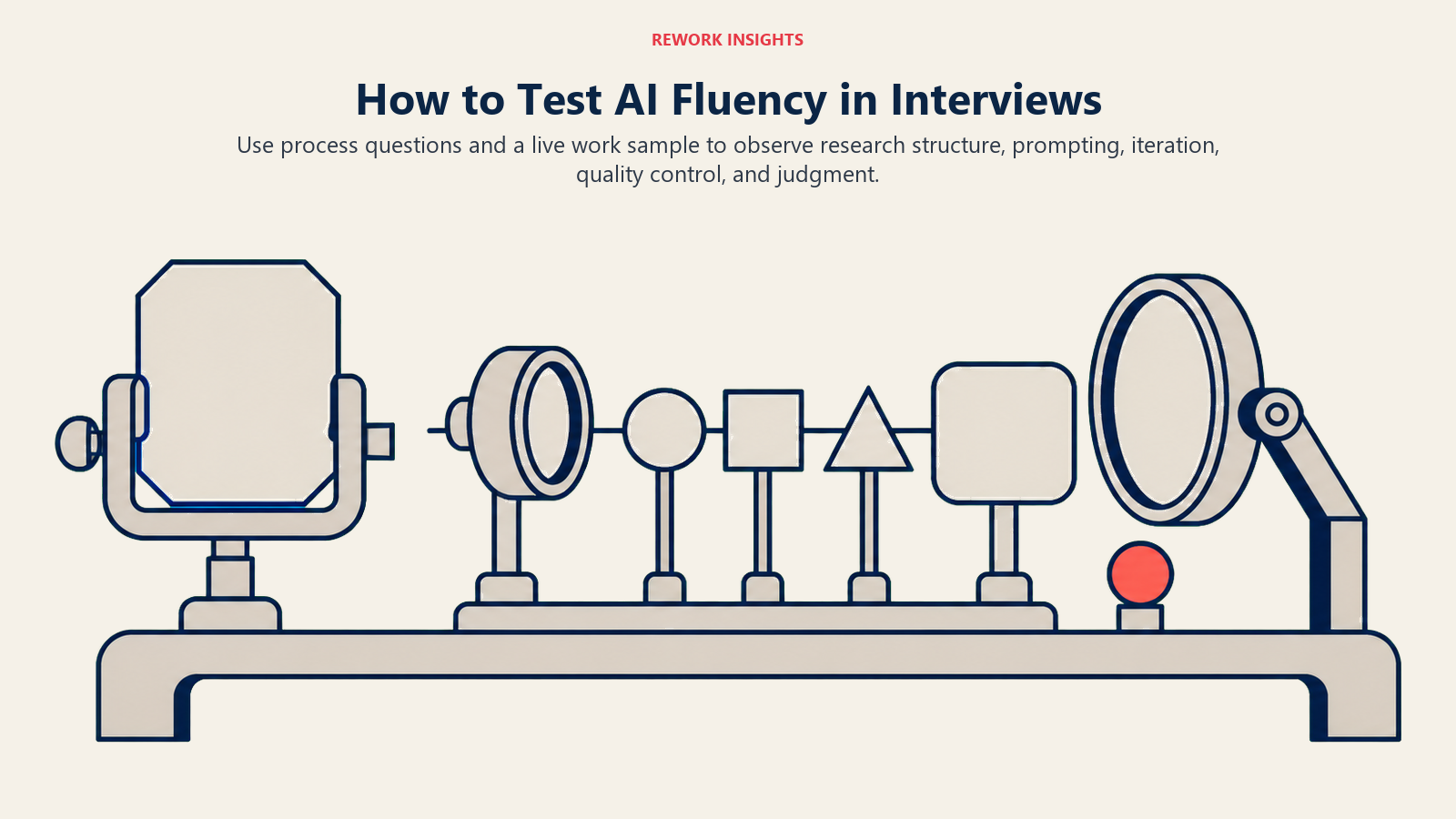
For Account Executives and SDRs:
Start with a process question, not a tool question: "Walk me through how you researched your last five accounts before your first call. What sources did you use, and how long did it take?"
An AI-fluent rep will describe a synthesis process: pulling from multiple signals, using AI to compress research into a structured brief, validating with live triggers (news, funding, hiring). A rep who isn't fluent will describe a linear process: LinkedIn, Google, maybe company website. The difference is obvious.
Follow up with: "If I gave you an ICP and a list of 50 target accounts right now, how would you prioritize them and build the first-touch sequence?" Give them 20 minutes and access to whatever tools they use. Watch what they do. An AI-fluent rep will immediately start structuring a research workflow. A rep who's padding their resume will open Google.
For Marketing Managers:
Ask: "Tell me about a campaign where you used AI to accelerate time from brief to launch. What changed in the process?" The answer tells you whether they're using AI to compress execution or just using it for spell-check.
Then ask: "How do you QA AI-generated content before it goes out?" This separates fluent from over-reliant. You want someone who can prompt, edit, and judgment-check, not someone who assumes the output is ready to publish.
The live prompt exercise:
For senior GTM hires, add a 30-minute working session to the final round. Give them a real (or anonymized) customer persona, a competitor to displace, and access to tools. Ask them to produce: an account research brief, a 3-email sequence, and a one-paragraph deal strategy. The quality of their prompting, iteration, and judgment about the output tells you more than any interview question. For how to run that session when candidates use AI openly, see should candidates be allowed to use AI in interviews. A sales team AI readiness audit can also benchmark where your current team sits before you start comparing them against AI-fluent candidates from the market.
Compensation and Offer Design
Should AI fluency command a premium? In 2026, yes. The data supports it.
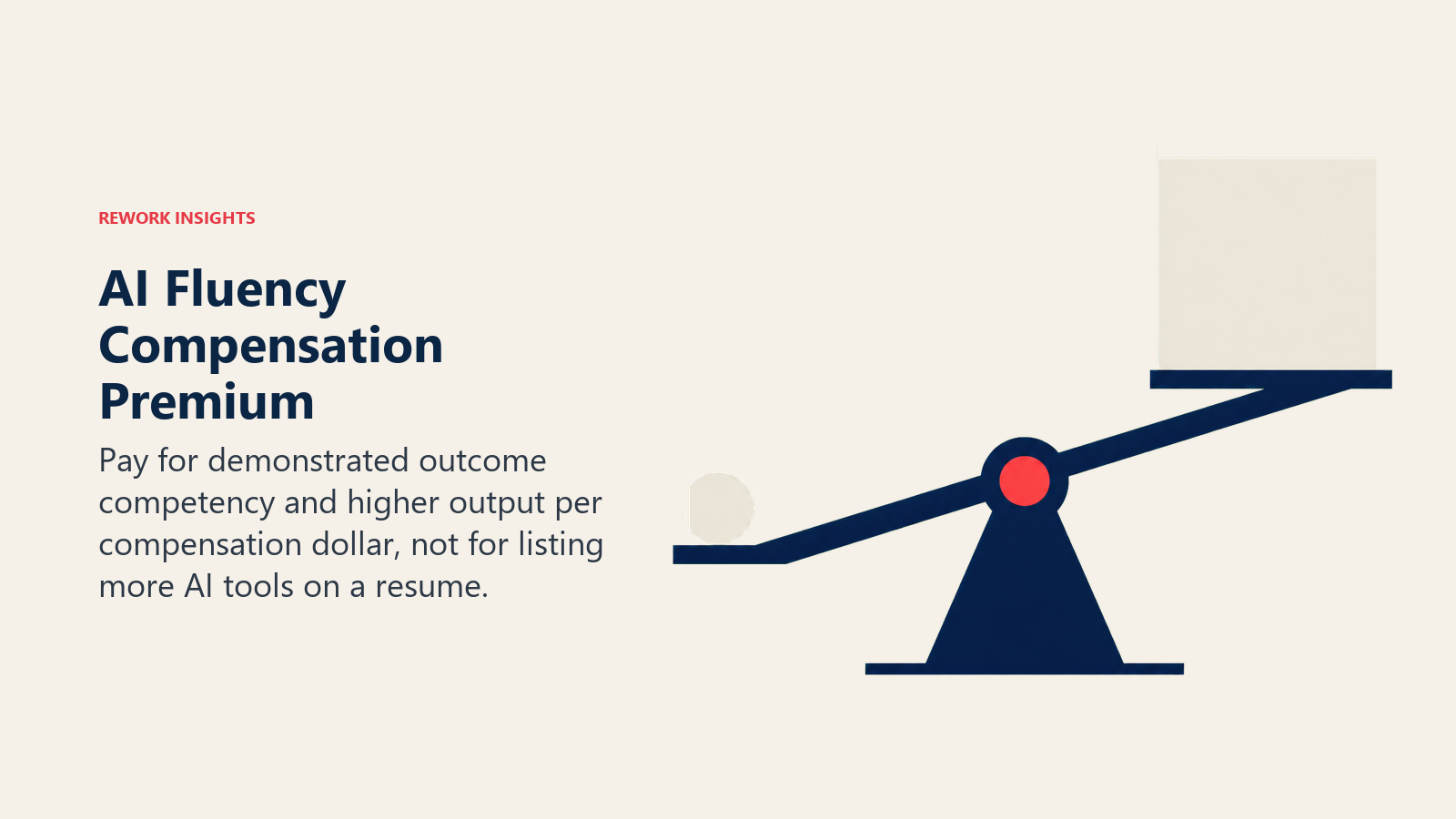
LinkedIn's Workforce Insights show that AEs with documented AI fluency (demonstrated in hiring process, not self-reported) are commanding 12–18% higher base salaries in B2B SaaS markets than peers with equivalent quota history but no AI competency. For senior marketing managers, the premium runs 10–15%.
But there's a more useful framing than "pay more." Think of it this way: an AI-fluent AE operating at 125% quota is worth more than an AI-naive AE at 100% quota, even if the fluent rep costs 15% more. The ROI calculation isn't about salary. It's about output per dollar of total compensation.
The practical implications for offer design:
Don't bury it in the comp structure. If AI fluency is a hard requirement, treat it as a skill premium the same way you'd treat fluency in a specific vertical or enterprise deal experience. Name it in the offer letter context.
Build it into the performance framework. The rep who's not using AI effectively within 90 days is underperforming, even if their pipeline looks fine. Make AI adoption a metric in the first-year performance framework so there's accountability on both sides.
Don't overpay for tool names. "I've used 12 AI sales tools" is not fluency. Pay for outcome competency, not tool familiarity. The tools change every 18 months. The underlying capability to learn and apply them compounds.
The Competitive Timing Argument
There's a window here that's closing.
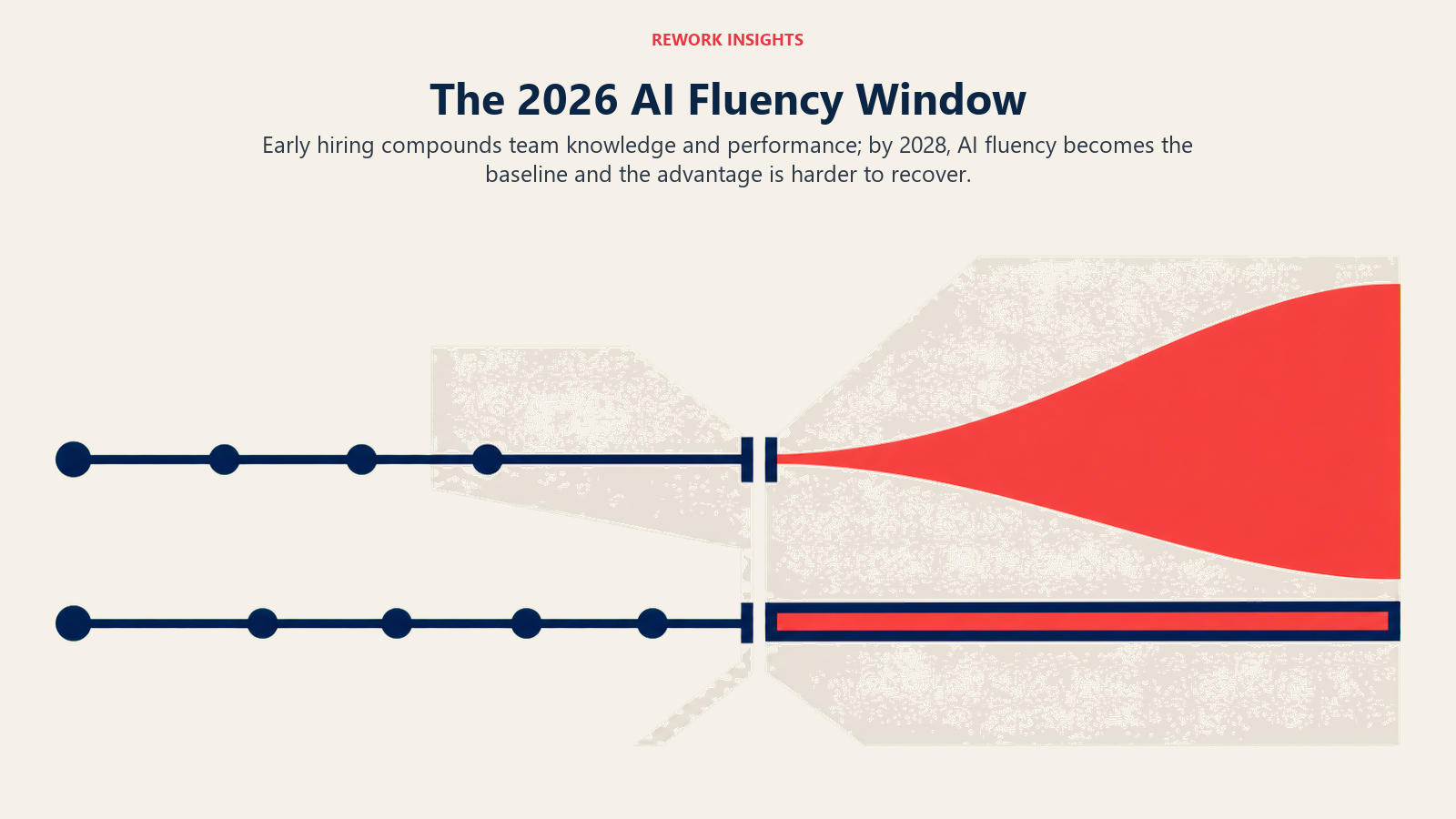
Right now, AI-fluent GTM talent is still identifiable as a differentiator. Companies that build AI-fluent sales and marketing teams in 2026 will have a structural performance advantage going into 2027: measurably lower cost per acquisition, higher rep productivity, and faster content cycles.
By 2028, AI fluency in GTM will be the floor, not the ceiling. The companies hiring without it now will spend the next two years closing the gap their competitors built. That's a gap measured in pipeline and market share, not just headcount efficiency.
This is the same pattern that played out with CRM adoption in the early 2010s and data-driven marketing in the late 2010s. The companies that made those capabilities a hiring requirement early didn't just work faster. They built organizational knowledge that compounded.
The CROs making this shift now aren't doing it because they're technology enthusiasts. They're doing it because the AI skills gap executives are getting wrong is a talent strategy gap, and they've seen what happens when you're 18 months late on one of those.
Building the Internal Case
If you need to take this argument to a CEO or board, the structure is straightforward.
Start with the productivity delta: AI-fluent GTM teams produce 20-30% more output on equivalent headcount. That's not a pilot number. It's showing up consistently across mid-market B2B SaaS cohorts.
Then frame the hiring risk: every non-fluent hire you make now is a gap you'll be managing in 12 months. The question isn't whether to require AI fluency. It's whether you want to make the switch during a hiring cycle or during a performance management cycle.
Close with the competitive timeline: the window to build a structural advantage is 2026. After that, it's table stakes.
The decision to upskill existing teams versus hire AI-native talent is a separate calculation, and one worth running. But for new GTM headcount, the math is clear.
What This Doesn't Mean
AI fluency as a hiring requirement doesn't mean hiring people who love AI tools. It means hiring people who use AI fluency to produce better outcomes faster.
The rep who's evangelizing the latest GPT wrapper in every Slack channel but missing quota isn't what you're hiring for. You're hiring for the quiet closer who researches accounts in 10 minutes instead of 40, personalizes 50 emails before most reps finish their first call setup, and updates CRM in the time it takes to walk back from a meeting.
That's the profile. The tools are just how they got there.
Understanding which roles AI is actually eliminating helps clarify where GTM hiring pressure is really coming from. It's not about eliminating reps. It's about the productivity bar rising faster than non-fluent reps can keep up with.
Learn More
- The AI Skills Gap Executives Are Getting Wrong: Why most executive AI strategies are solving the wrong problem
- Upskill or Hire AI-Native? The ROI Case: How to run the build-vs-buy calculation for AI talent
- Which Roles AI Is Actually Eliminating: The honest mid-market picture on GTM role changes
- The Org Chart of the Future: What AI-augmented departments actually look like in practice
- AI Augmented Sales Teams Performance Data
- AI-Powered Workflows for Marketing Teams

Co-Founder, Rework.com
On this page
- Why GTM Is the Highest AI Leverage Point in the Business
- What AI Fluency Actually Means in GTM Roles
- Account Executive
- SDR / BDR
- Marketing Manager
- How to Screen for It: Interview Questions That Work
- Compensation and Offer Design
- The Competitive Timing Argument
- Building the Internal Case
- What This Doesn't Mean
- Learn More