Liderazgo Adaptativo: Marco y Prácticas
Turn this article into takeaways for your work.


Each assistant summarizes the article only for you and suggests best practices for your work.
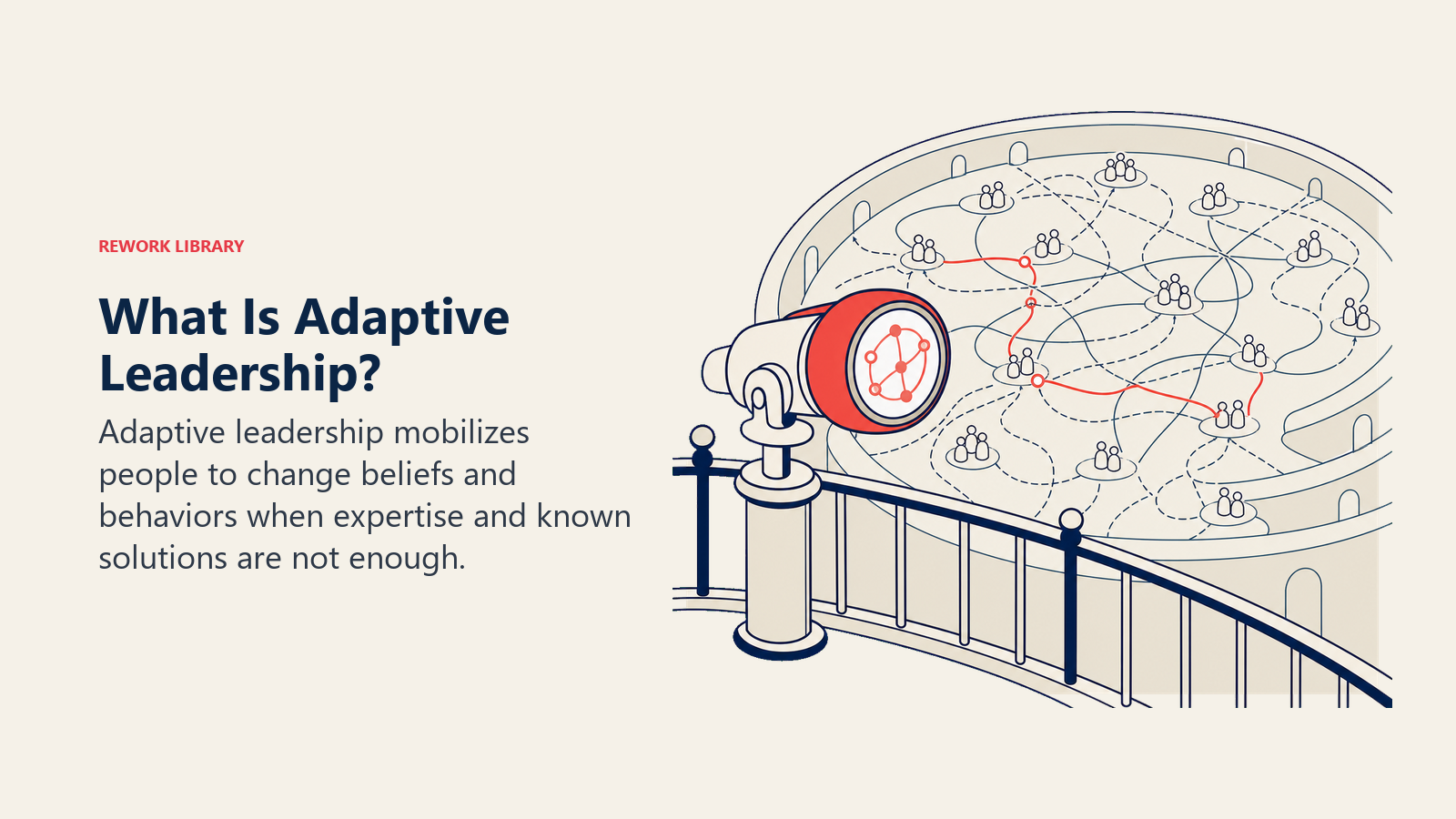
El liderazgo adaptativo es la práctica de movilizar a las personas para enfrentar problemas difíciles que no tienen una solución técnica clara. Es el marco al que recurren las organizaciones cuando la experiencia por sí sola no resuelve lo que tienen frente a ellas.
¿Qué es el liderazgo adaptativo?
El liderazgo adaptativo es un marco de liderazgo desarrollado por Ronald Heifetz y Marty Linsky en Harvard Kennedy School, presentado por primera vez en el libro de Heifetz de 1994 Leadership Without Easy Answers y ampliado en su colaboración de 2002 Leadership on the Line. El marco sostiene que la mayoría de los grandes desafíos de liderazgo no son problemas técnicos con soluciones conocidas, sino desafíos adaptativos que requieren que las personas involucradas cambien sus creencias, comportamientos o valores.
La distinción importa porque los líderes que aplican herramientas técnicas a problemas adaptativos fracasan sistemáticamente. No porque les falte competencia, sino porque están aplicando la intervención equivocada. Un desafío adaptativo no puede delegarse a la persona más inteligente de la sala. Requiere que las personas dueñas del problema realicen el trabajo difícil de transformarse a sí mismas.
Heifetz y Linsky no describieron el liderazgo adaptativo como un tipo de personalidad ni como un conjunto de virtudes de carácter. Es una práctica: un conjunto de comportamientos que pueden aprenderse, aplicarse y mejorarse con el tiempo.
Datos clave
La encuesta global de McKinsey de 2023 sobre cambio organizacional encontró que el 70% de los grandes programas de transformación no alcanzan sus objetivos, siendo la razón más común la atención insuficiente al cambio conductual y cultural en lugar de fallas en la ejecución técnica. (McKinsey, "Successful transformations," 2023)
El informe de Deloitte Global Human Capital Trends de 2022 encontró que el 90% de los ejecutivos citó "liderar en la ambigüedad" como su capacidad de liderazgo más crítica para los próximos cinco años, mientras que menos de la mitad dijo que sus organizaciones estaban desarrollando esa capacidad en los líderes.
Una investigación publicada en el Journal of Applied Behavioral Science encontró que los líderes que distinguen explícitamente entre problemas técnicos y desafíos adaptativos tienen significativamente más probabilidades de sostener el cambio durante 12 meses en comparación con los líderes que tratan todos los problemas como técnicos.
Problemas técnicos versus desafíos adaptativos
La base del marco de Heifetz y Linsky es esta distinción fundamental. Cada situación de liderazgo implica uno u otro, y confundirlos es la fuente más común de estancamiento organizacional.
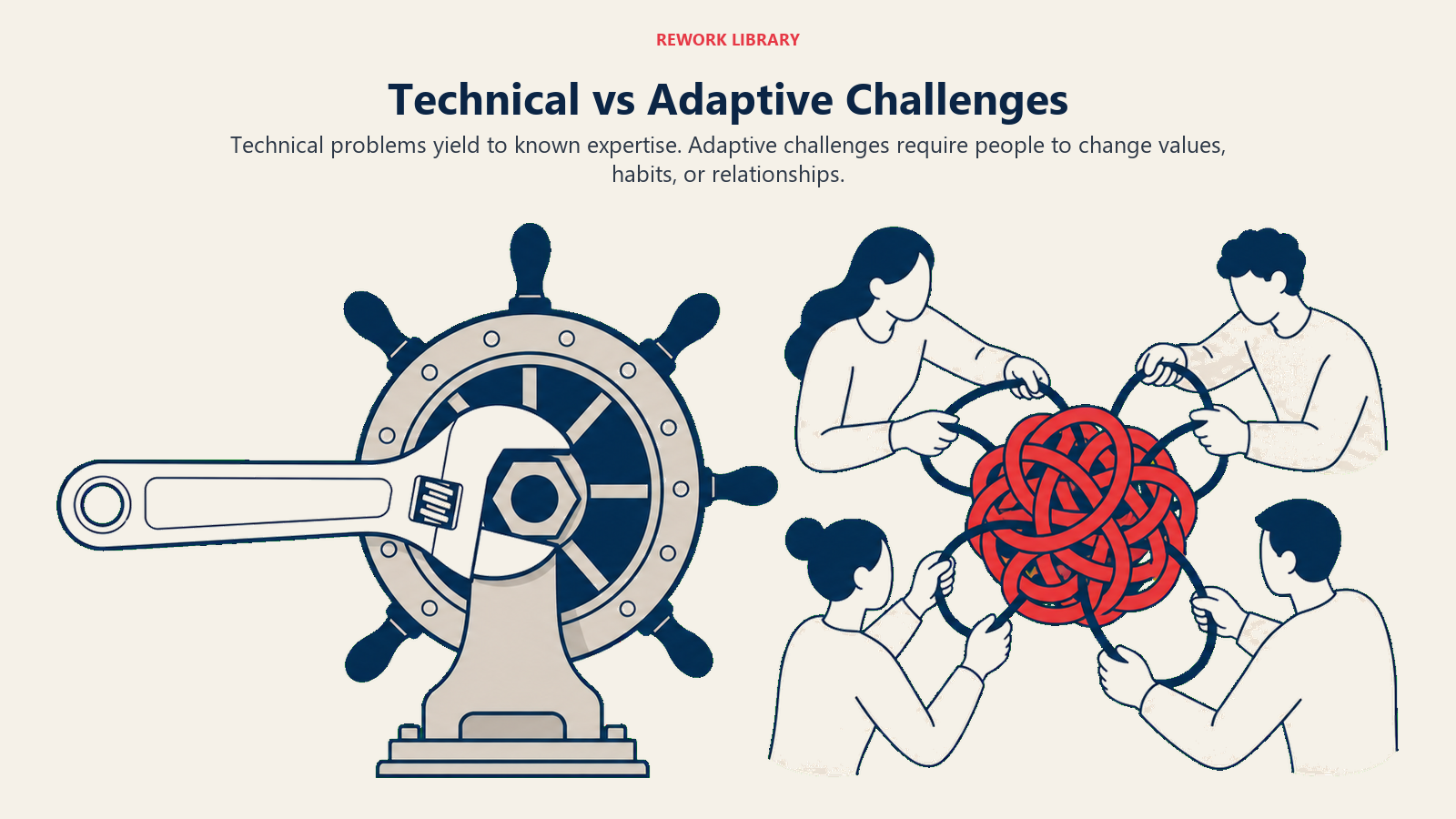
Un problema técnico tiene una solución conocida que puede ser implementada por un experto. El problema y la respuesta se ubican en el mismo dominio. Se contrata a la persona adecuada, se aplica el proceso correcto y el problema se resuelve. Un error de software es un problema técnico. Un sistema de climatización roto es un problema técnico. Incluso el lanzamiento de un producto con entregables claramente definidos es en gran medida técnico.
Un desafío adaptativo requiere que las personas que lo enfrentan cambien su forma de pensar, sentir o actuar. La solución no puede venir de un solo experto porque la experiencia necesaria aún no existe, o porque aplicarla requeriría que las personas renuncien a algo que valoran. Una fusión que fracasa porque dos culturas no logran integrarse es un desafío adaptativo. Un equipo de ventas que sigue volviendo a los hábitos antiguos de precios a pesar de la nueva capacitación enfrenta un desafío adaptativo. Una empresa que no puede ejecutar su estrategia declarada porque la gerencia media en realidad no cree en ella enfrenta un desafío adaptativo.
| Dimensión | Problema técnico | Desafío adaptativo |
|---|---|---|
| Quién lo resuelve | Un experto con el conocimiento adecuado | Las personas dueñas del problema |
| Tipo de solución | Aplicar soluciones o procedimientos existentes | Cambiar creencias, comportamientos o valores |
| Horizonte temporal | Corto a mediano plazo | Mediano a largo plazo |
| Rol de la autoridad | Dar la respuesta, delegar la ejecución | Sostener el espacio, regular la angustia |
| Ejemplo | Implementar un nuevo sistema CRM | Lograr que el equipo de ventas lo use de verdad |
| Señales de que ocurre | Diagnóstico claro, pasos conocidos | Fracasos repetidos, resistencia, recaída |
La mayoría de los desafíos organizacionales son mixtos: tienen componentes tanto técnicos como adaptativos. Implementar un nuevo sistema de gestión del desempeño es técnicamente sencillo. Lograr que los líderes den retroalimentación honesta sobre el desarrollo en lugar de calificaciones infladas es adaptativo. Los líderes que solo gestionan la mitad técnica suelen confundirse sobre por qué el cambio no se consolidó.
Los cuatro principios del liderazgo adaptativo
Heifetz y Linsky identificaron cuatro principios fundamentales que distinguen cómo operan los líderes adaptativos.
Justicia organizacional. El liderazgo adaptativo requiere visibilizar qué intereses se benefician del arreglo actual y quién carga con el costo del cambio. Los líderes que ignoran esto generan una resistencia que no comprenden. Una empresa que reestructura sus territorios de ventas puede presentar el cambio como puramente estratégico, pero los representantes que pierden cuentas de alto valor lo experimentan como injusto. Reconocerlo no es una concesión. Es la manera de mantener a las personas comprometidas a lo largo de un proceso difícil.
Inteligencia emocional. Los desafíos adaptativos generan ansiedad. Cuando se pide a las personas que cambien algo que valoran, con frecuencia responden no porque carezcan de información, sino porque el cambio les resulta amenazante. Los líderes adaptativos pueden leer este paisaje emocional sin dejarse abrumar por él. Distinguen entre el calor de la sala y lo que ese calor señala realmente sobre el problema de fondo.
Desarrollo de otros. En el liderazgo de servicio, el foco está en atender el crecimiento del equipo. El liderazgo adaptativo extiende esto específicamente a desarrollar la capacidad de las personas para resolver sus propios desafíos adaptativos con el tiempo. El objetivo no es resolver cada problema difícil por el equipo, sino ayudarles a desarrollar la resiliencia y el criterio para navegar el siguiente.
Carácter. El liderazgo adaptativo no es cómodo. Requiere disposición para plantear preguntas difíciles, decepcionar a quienes esperan respuestas que no se tienen y mantenerse en una tensión productiva sin apresurarse hacia una resolución falsa. Heifetz y Linsky llaman a esto "permanecer en el calor" y lo describen como uno de los comportamientos más sistemáticamente evitados en la vida organizacional.
Las prácticas del liderazgo adaptativo
Heifetz y Linsky articularon seis prácticas específicas para liderar el trabajo adaptativo. No son principios abstractos. Cada una corresponde a un comportamiento concreto que puede observarse, practicarse y mejorarse.
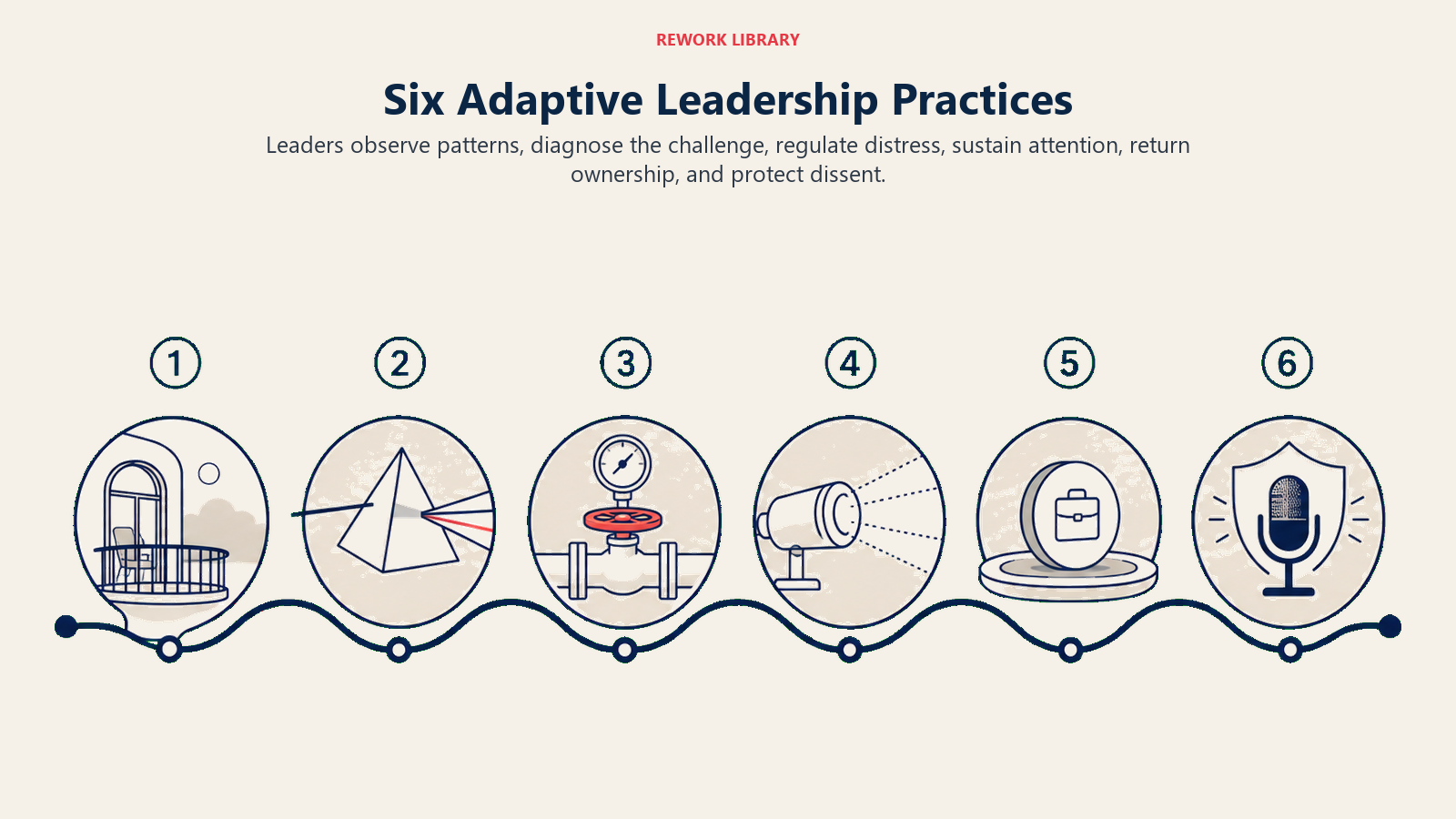
| Práctica | Qué significa | Cómo se ve en la práctica |
|---|---|---|
| Subir al balcón | Alejarse de la acción para ver patrones y dinámicas invisibles desde dentro de la situación | Un CEO que deja de asistir a cada reunión de producto para observar el comportamiento interfuncional desde la distancia |
| Identificar el desafío adaptativo | Diagnosticar correctamente si el problema es técnico o adaptativo antes de decidir cómo intervenir | Un VP que realiza un diagnóstico antes de asumir que un programa de capacitación resolverá un problema cultural |
| Regular la angustia | Mantener a la organización en la zona productiva entre demasiado cómoda (sin urgencia) y demasiado ansiosa (paralizada) | Un director que reconoce una amenaza real con claridad pero controla el ritmo al que el equipo la procesa |
| Mantener la atención disciplinada | Mantener a la organización enfocada en el trabajo difícil sin dejar que se escape hacia el trabajo técnico secundario o hacia temas laterales | Un líder que vuelve repetidamente a la pregunta adaptativa central cuando el equipo intenta resolver un problema diferente |
| Devolver el trabajo a las personas | Resistir el impulso de resolver los problemas adaptativos por los demás; devolver el problema a quienes lo poseen | Un líder que pregunta "¿qué cree usted que necesita cambiar?" en lugar de prescribir la respuesta |
| Proteger las voces de abajo | Asegurar que las perspectivas disidentes, especialmente de quienes tienen menos poder, permanezcan en la conversación | Un líder que crea activamente espacio para que el personal junior desafíe la estrategia en las revisiones directivas |
La más frecuentemente vulnerada de estas prácticas es la última. Las organizaciones son muy buenas silenciando a las personas que ven con mayor claridad el desafío adaptativo. Los trabajadores de primera línea que saben por qué el nuevo sistema no está funcionando suelen dejar de decirlo después de que sus primeras observaciones no generan ninguna respuesta.
Liderazgo adaptativo frente a otros estilos de liderazgo
El liderazgo adaptativo a veces se confunde con el liderazgo transformacional porque ambos abordan el cambio. Pero sus mecanismos son distintos. Los líderes transformacionales movilizan a las personas a través de una visión convincente y la inspiración personal. Los líderes adaptativos movilizan a las personas ayudándoles a enfrentar y trabajar a través de un problema que les exige cambiar. La transformación puede coexistir con el liderazgo adaptativo, pero también puede encubrir desafíos adaptativos con entusiasmo que no perdura.
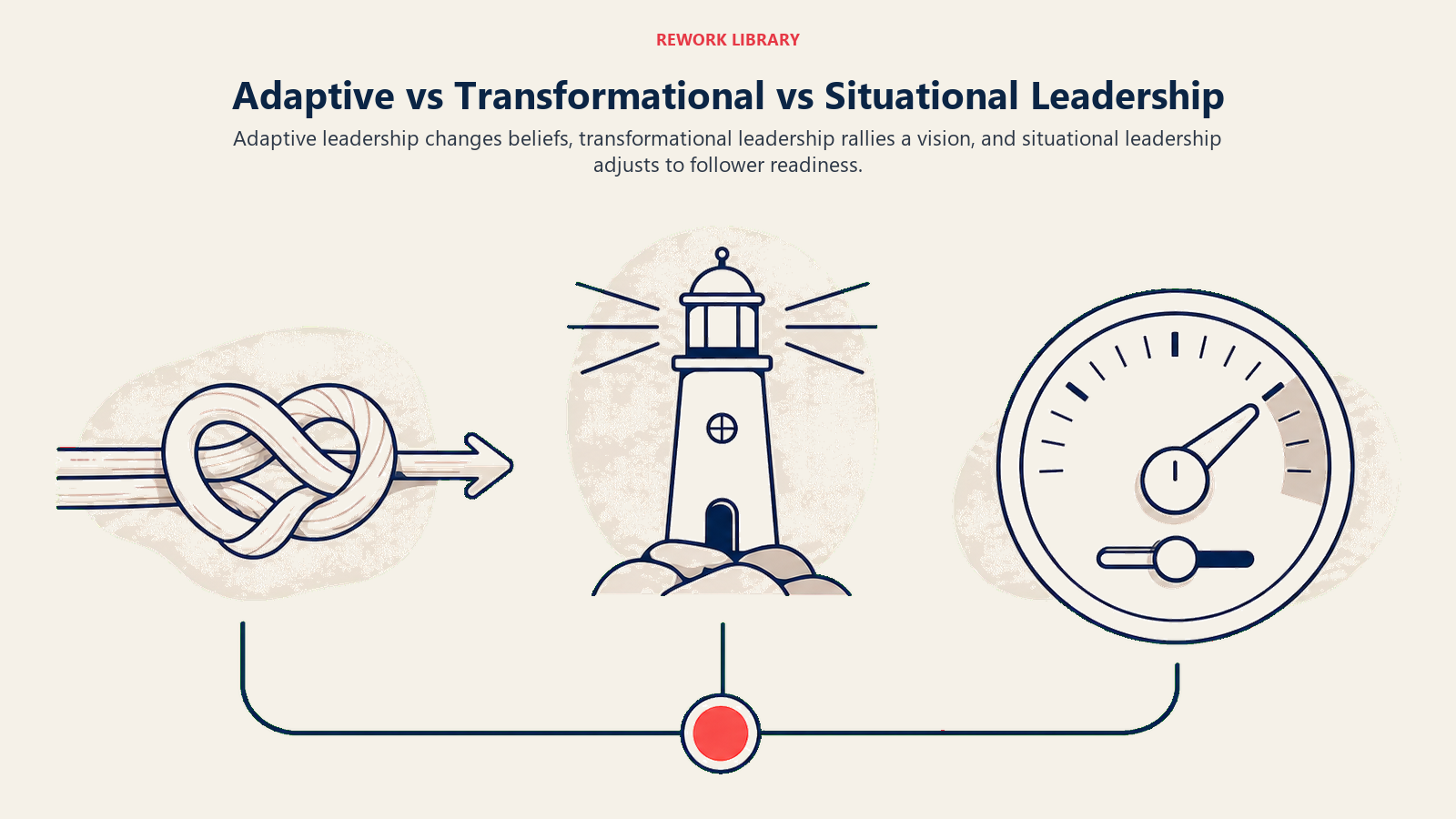
El liderazgo situacional es un complemento más adecuado. El liderazgo situacional sostiene que el estilo correcto depende del nivel de desarrollo del colaborador para una tarea específica. El liderazgo adaptativo sostiene que la intervención correcta depende de si el desafío es técnico o adaptativo. Ambos marcos hacen la misma pregunta diagnóstica antes de actuar: ¿qué requiere realmente esta situación?
| Dimensión | Liderazgo adaptativo | Transformacional | Situacional |
|---|---|---|---|
| Pregunta central | ¿Es esto técnico o adaptativo? | ¿Qué visión puedo inspirar? | ¿Qué necesita esta persona ahora mismo? |
| Mecanismo de cambio | Las personas realizan el trabajo de transformarse | El líder inspira la creencia en una nueva dirección | El líder ajusta su estilo a la disposición del colaborador |
| Fuente de autoridad | Hacer preguntas difíciles, sostener la tensión | Visión y carisma personal | Experiencia y flexibilidad |
| Mejor aplicación | Problemas culturales o conductuales arraigados | Puntos de inflexión estratégica | Brechas individuales de habilidades y motivación |
Véanse estilos clásicos de liderazgo y teorías del liderazgo para una comparación más amplia de cómo se desarrollaron estos marcos y dónde se superponen.
Beneficios y limitaciones
Beneficios:
- Resuelve problemas que la experiencia técnica no puede. Cuando un problema requiere que las personas cambien, solo un enfoque que aborde ese cambio directamente funcionará. El liderazgo adaptativo está diseñado específicamente para esto.
- Desarrolla la resiliencia organizacional. Las organizaciones que aprenden a navegar desafíos adaptativos desarrollan una capacidad de cambio que se acumula con el tiempo. La habilidad de confrontar problemas difíciles se transfiere entre contextos.
- Visibiliza la resistencia real de manera temprana. Al dar voz a la disidencia y reconocer los costos del cambio, los líderes adaptativos reducen el riesgo de un cumplimiento superficial que fracasa silenciosamente.
- Desarrolla a las personas mientras resuelven los problemas. Dado que el liderazgo adaptativo devuelve el trabajo a quienes lo poseen, desarrolla capacidades en todo el equipo en lugar de crear dependencia del líder.
- Se aplica en distintas culturas e industrias. La distinción técnico versus adaptativo aplica independientemente del sector. Organizaciones de salud, empresas tecnológicas, organizaciones sin fines de lucro y agencias gubernamentales enfrentan desafíos adaptativos.
Limitaciones:
- Lento ante emergencias reales. Sostener el espacio para el trabajo adaptativo y regular la angustia requiere tiempo. En una crisis genuina que necesita ejecución técnica inmediata, los enfoques adaptativos pueden retrasar la acción necesaria. La mayoría de las crisis tienen componentes tanto técnicos como adaptativos, pero los técnicos deben abordarse primero con frecuencia.
- Incómodo de practicar. La mayoría de las organizaciones recompensan a los líderes que dan respuestas. El liderazgo adaptativo requiere permanecer con problemas sin resolver y resistir el impulso de solucionarlos prematuramente. Muchos líderes encuentran esto profundamente incómodo, y la mayoría de las organizaciones lo dificulta.
- Difícil de medir en el corto plazo. El trabajo adaptativo suele verse como conflicto, ambigüedad y progreso lento antes de producir resultados. Los líderes bajo presión trimestral suelen abandonar las intervenciones adaptativas antes de que tengan tiempo de funcionar.
- Requiere habilidad política. Plantear preguntas difíciles y proteger voces disidentes genera fricción. Los líderes que lo hacen sin comprender el panorama político de su organización pueden encontrarse aislados antes de que el trabajo adaptativo esté terminado.
- No es el marco adecuado para todos los problemas. El liderazgo adaptativo es una herramienta específica para un tipo específico de desafío. Aplicado a problemas genuinamente técnicos, introduce complejidad innecesaria y retrasa buenas soluciones.
Cómo practicar el liderazgo adaptativo
La práctica adaptativa avanza a través del diagnóstico, la observación, la regulación de la presión, la propiedad compartida y la protección de la disidencia.
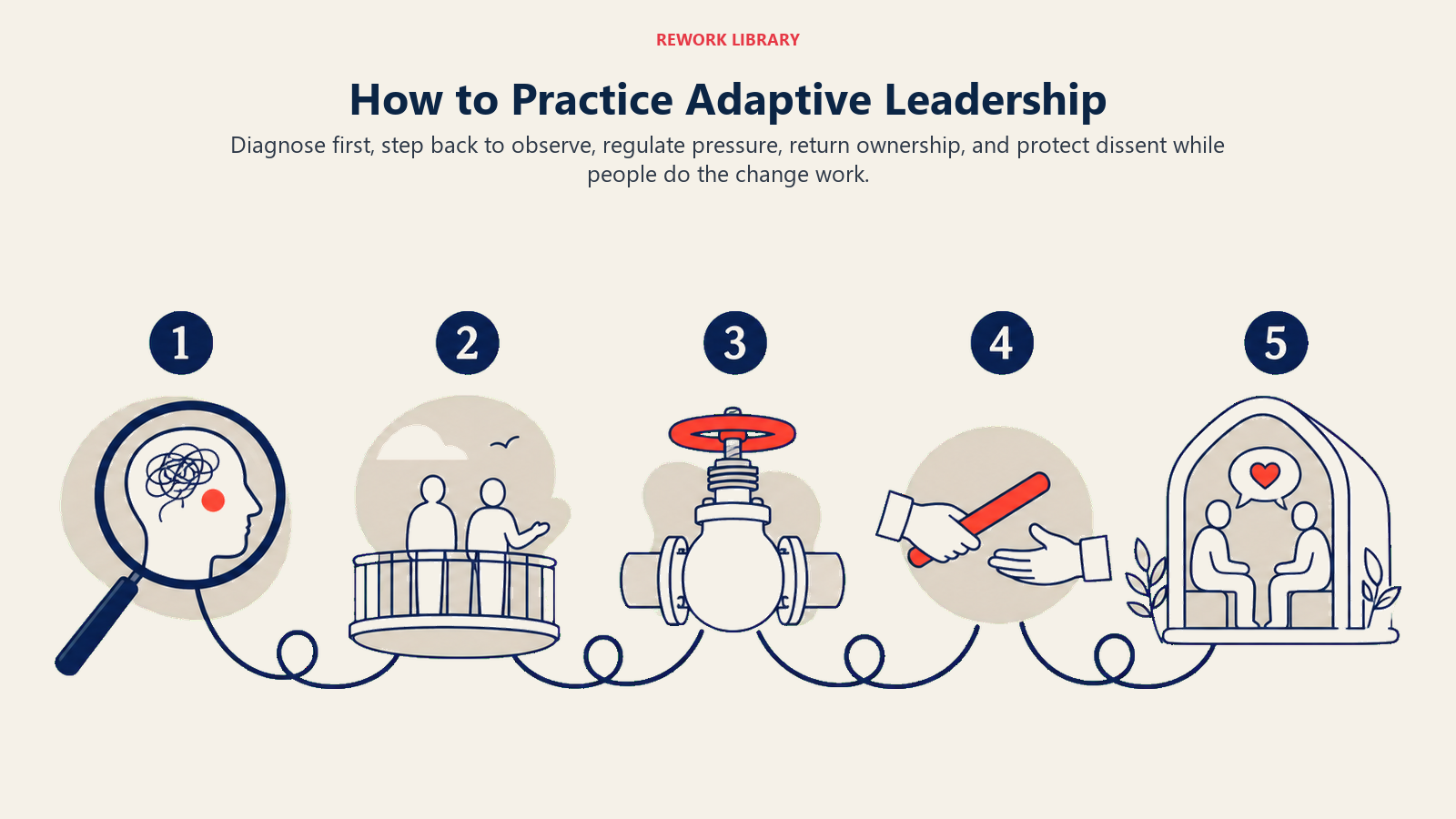
Paso 1: Diagnostique antes de prescribir
Antes de decidir cómo responder a un problema, pregúntese si es técnico o adaptativo. ¿Quién tiene la experiencia para resolverlo? Si la respuesta es "todos los involucrados necesitan cambiar algo", está frente a un desafío adaptativo. El diagnóstico en sí mismo es la mayor parte del trabajo. La mayoría de los líderes lo omiten.
Una pregunta diagnóstica útil: "¿Se ha resuelto antes este problema con un enfoque conocido?" Si la respuesta es sí, es técnico. Si las mismas soluciones se siguen intentando sin funcionar, eso es una señal clara de un desafío adaptativo subyacente.
Paso 2: Suba al balcón con regularidad
Reserve tiempo para salir de la participación operativa y observar su organización desde la distancia. Puede ser tan simple como reservar una hora a la semana para observar cómo se toman las decisiones, qué conversaciones no ocurren y dónde las personas evitan sistemáticamente el tema difícil. La vista desde el balcón revela patrones que son invisibles desde dentro de la acción.
Un director que asiste a todas las reuniones suele ser la persona menos informada sobre lo que realmente sucede en la organización, porque todos a su alrededor actúan para la reunión en lugar de revelar las dinámicas reales.
Paso 3: Regule la angustia, no el problema
Los desafíos adaptativos generan ansiedad organizacional. Su trabajo no es eliminar esa ansiedad (eso significaría eliminar el problema), sino mantenerla en un rango productivo. Con muy poca urgencia, las personas no se mueven. Con demasiada, entran en pánico o se paralizan.
En concreto: sea honesto sobre la gravedad del desafío, establezca un horizonte temporal claro para el trabajo y controle el ritmo al que llegan nuevas exigencias. Un equipo directivo que intenta abordar tres desafíos adaptativos simultáneamente no abordará ninguno de ellos correctamente.
Paso 4: Devuelva el trabajo a las personas que lo poseen
Cuando alguien le trae un problema adaptativo, resista el impulso de resolverlo. Pregúntese en cambio: "¿Qué cree usted que necesita cambiar aquí?" y "¿Qué está dispuesto a hacer de manera diferente?" Esto no es abdicación. Es la práctica central. Las únicas personas que pueden resolver un desafío adaptativo son aquellas cuyo comportamiento necesita cambiar.
Este es el paso que más líderes evitan porque parece irresponsivo. No lo es. Es el único enfoque que produce un cambio duradero ante problemas adaptativos.
Paso 5: Proteja las voces disidentes
Construya estructuras explícitas para que las personas con menos poder planteen sus preocupaciones. Esto puede ser pre-mortem antes de decisiones importantes, aportes escritos anónimos antes de reuniones clave o tiempo reservado en las revisiones directivas para perspectivas de primera línea. Las personas más capaces de ver claramente el desafío adaptativo suelen ser las menos escuchadas.
Y cuando alguien plantea una verdad difícil en una reunión, genere seguridad reconociéndola públicamente: "Esa es la pregunta difícil que aún no hemos respondido." No necesita tener la respuesta. Necesita señalar que la pregunta es bienvenida.
Ejemplos de liderazgo adaptativo
Un sistema hospitalario que enfrenta el agotamiento médico
La dirección del hospital identificó el agotamiento como un problema y respondió con soluciones técnicas: aplicaciones de bienestar, capacitación en resiliencia, herramientas de horarios flexibles. Ninguna de ellas movió las métricas. Cuando aplicaron un enfoque adaptativo, descubrieron que el verdadero desafío no era un problema de recursos. Los médicos sentían que habían perdido el control sobre cómo ejercían la medicina. Restaurar una autonomía significativa sobre las decisiones clínicas, incluso de manera limitada, requirió que administradores y médicos renegociaran supuestos largamente mantenidos sobre jerarquía y responsabilidad. Ese era un desafío adaptativo. Las herramientas técnicas habían sido reales pero insuficientes.
Una organización de ventas que no podía pasar de las ventas por volumen a las ventas por valor
Una empresa de software cambió su estrategia de go-to-market de ventas transaccionales de alto volumen a acuerdos empresariales más largos y consultivos. Invirtieron fuertemente en capacitación y nuevos playbooks (soluciones técnicas). Dieciocho meses después, el equipo de ventas seguía recayendo en comportamientos antiguos bajo la presión de cuotas. El desafío adaptativo era que la identidad de vender por volumen estaba profundamente ligada a cómo los representantes definían el éxito y medían su propia valía. Resolverlo requirió visibilizar esa pérdida explícitamente, rediseñar los incentivos y dar a los representantes tiempo para reconstruir confianza en un nuevo modelo. La capacitación había sido necesaria pero no suficiente.
Un equipo directivo que no podía exigirse responsabilidad mutua
Una empresa de logística regional tenía un equipo directivo funcional que evitaba sistemáticamente las conversaciones difíciles entre sí. El CEO contrató a un facilitador y realizó una serie de talleres sobre habilidades de comunicación (técnico). Las dinámicas no cambiaron. El desafío adaptativo era que el equipo tenía un acuerdo tácito: todos protegían la autonomía de los demás a cambio de no ser cuestionados. El trabajo real fue nombrar ese acuerdo y decidir juntos si cambiarlo. Esa conversación, celebrada en un retiro de dos días con el encuadre adecuado, fue más productiva que un año de capacitación.
Preguntas Frecuentes sobre el Liderazgo Adaptativo
¿Cuál es la diferencia entre el liderazgo adaptativo y la gestión del cambio?
La gestión del cambio generalmente se refiere al proceso estructurado de implementar un cambio planificado. El liderazgo adaptativo es un marco para liderar cuando la naturaleza del cambio en sí misma no está clara y las personas involucradas necesitan modificar su comportamiento o creencias para avanzar. La gestión del cambio es en gran medida técnica; el liderazgo adaptativo aborda lo que la gestión del cambio omite cuando las dimensiones humanas y culturales son el verdadero obstáculo.
¿Puede aplicarse el liderazgo adaptativo en organizaciones o equipos pequeños?
Sí. La distinción técnico versus adaptativo aplica a cualquier escala. Una startup de cinco personas donde el equipo fundador no puede ponerse de acuerdo sobre qué tipo de empresa construir enfrenta un desafío adaptativo. Una empresa de 50.000 personas donde los mandos medios no adoptarán una nueva estrategia también lo enfrenta. Las prácticas que describen Heifetz y Linsky funcionan a cualquier tamaño, aunque la complejidad política aumenta con la escala.
¿Cómo se identifica un desafío adaptativo versus un problema técnico?
La señal más confiable es el fracaso repetido de soluciones técnicas. Si un problema sigue volviendo a pesar de la implementación competente de soluciones obvias, casi con certeza hay un desafío adaptativo por debajo. Otra señal es que el problema involucra valores, identidad o creencias profundamente arraigadas sobre cómo deben funcionar las cosas. Los problemas técnicos no generan esas reacciones.
¿Es el liderazgo adaptativo lo mismo que ser flexible o ágil?
No exactamente. La flexibilidad y la agilidad describen la capacidad de respuesta ante condiciones cambiantes. El liderazgo adaptativo consiste específicamente en movilizar a las personas para abordar desafíos que les exigen transformarse a sí mismas. Un líder ágil adapta sus planes rápidamente. Un líder adaptativo ayuda al equipo a realizar el trabajo más difícil de cambiar su comportamiento o creencias. Ambas capacidades se complementan pero son distintas.
¿Cuánto tiempo toma el trabajo adaptativo?
Depende de la profundidad del desafío, pero la mayoría del trabajo adaptativo significativo tarda entre 12 y 36 meses antes de que un cambio duradero sea visible. Esto lo hace difícil de sostener en organizaciones con ciclos de planificación cortos o alta rotación de liderazgo. Una de las responsabilidades clave del líder adaptativo es generar suficiente paciencia organizacional para dejar que el trabajo se desarrolle al ritmo que realmente requiere.
Los líderes que realizan bien el trabajo adaptativo rara vez son los más visiblemente seguros de sí mismos. Son quienes pueden permanecer con un problema que no tiene una respuesta clara, hacer mejores preguntas que las respuestas que dan, y mantener a la organización avanzando a través de una dificultad genuina sin precipitarse hacia una resolución que solo parece progreso. Para los equipos que navegan una complejidad real, esa capacidad vale más que cualquier experiencia técnica que puedan contratar. Véanse 5 niveles de liderazgo y estilo de liderazgo de coaching para marcos relacionados sobre el desarrollo de líderes que construyen capacidades en otros. El liderazgo carismático y el liderazgo adaptativo aparecen juntos frecuentemente en organizaciones que enfrentan cambios significativos, aunque cumplen funciones distintas.

Senior Operations & Growth Strategist
On this page
- ¿Qué es el liderazgo adaptativo?
- Problemas técnicos versus desafíos adaptativos
- Los cuatro principios del liderazgo adaptativo
- Las prácticas del liderazgo adaptativo
- Liderazgo adaptativo frente a otros estilos de liderazgo
- Beneficios y limitaciones
- Cómo practicar el liderazgo adaptativo
- Paso 1: Diagnostique antes de prescribir
- Paso 2: Suba al balcón con regularidad
- Paso 3: Regule la angustia, no el problema
- Paso 4: Devuelva el trabajo a las personas que lo poseen
- Paso 5: Proteja las voces disidentes
- Ejemplos de liderazgo adaptativo