Porter's Five Forces: Framework und reale Beispiele
Turn this article into takeaways for your work.


Each assistant summarizes the article only for you and suggests best practices for your work.
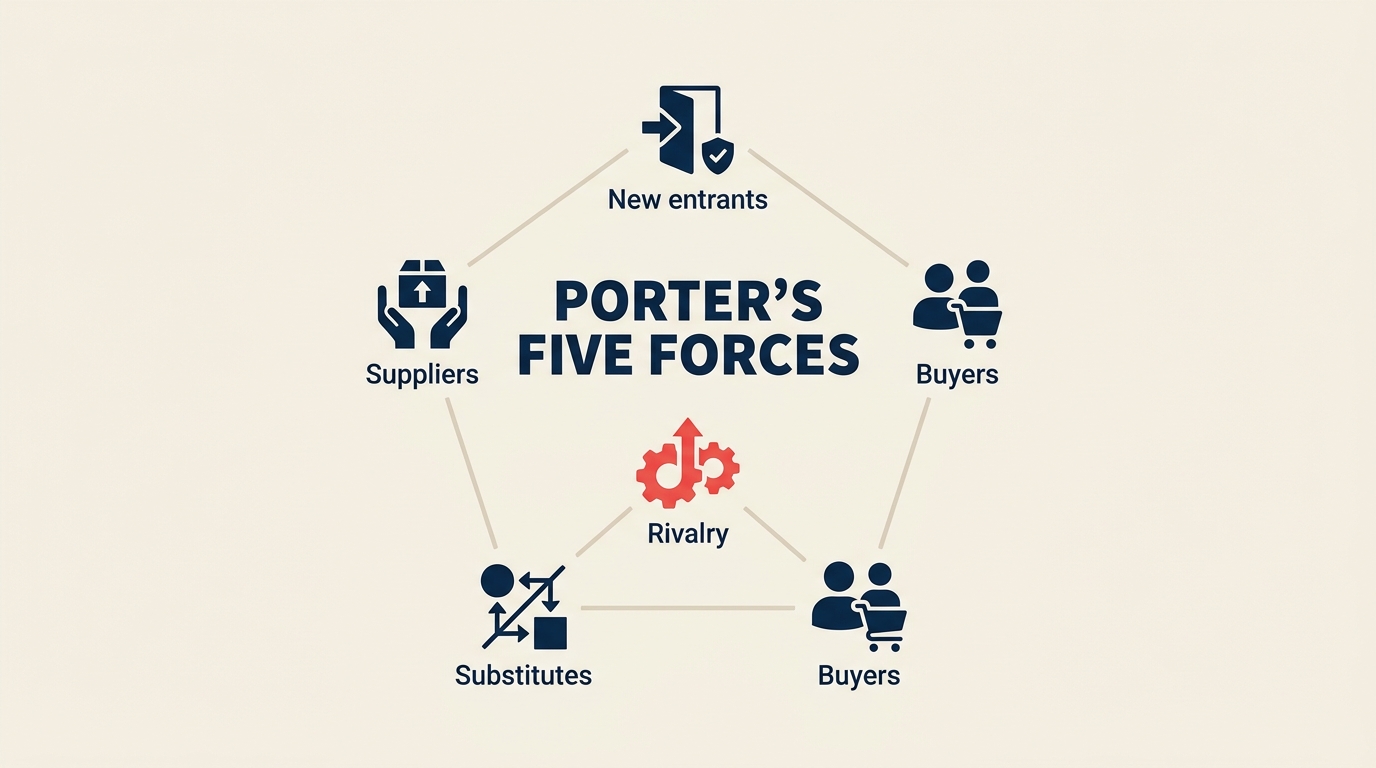
Porter's Five Forces ist eines der meistgelehrten Strategie-Frameworks in Wirtschaftshochschulen und Vorstandsetagen gleichermaßen. Wer verstehen möchte, warum manche Branchen Geld drucken, während andere um Krümel kämpfen, findet in diesem Modell die strukturellen Erklärungen.
Was ist Porter's Five Forces?
Porter's Five Forces ist ein Framework zur Analyse der Wettbewerbsintensität und des Gewinnpotenzials einer Branche, indem fünf strukturelle Kräfte untersucht werden, die sie prägen.
Michael Porter stellte das Modell in seinem 1979 erschienenen Harvard Business Review-Artikel „How Competitive Forces Shape Strategy" vor und vertiefte es in seinem 1980 erschienenen Buch Competitive Strategy: Techniques for Analyzing Industries and Competitors, veröffentlicht bei Free Press. Porter argumentierte, dass die Branchenstruktur, nicht allein die internen Stärken eines Unternehmens, die langfristige Rentabilität bestimmt. Das Framework gibt Führungskräften einen systematischen Weg, zu diagnostizieren, wo in ihrer Branche Macht konzentriert ist, bevor sie sich auf eine Strategie festlegen.
Wichtige Fakten
- Porters HBR-Artikel von 1979 „How Competitive Forces Shape Strategy" wurde in der akademischen Literatur über 60.000 Mal zitiert und gehört damit zu den meistzitierten Strategieartikeln, die je veröffentlicht wurden.
- Porters 2008er Update für den Harvard Business Review, „The Five Competitive Forces That Shape Strategy", ist einer der meistgeladenen Nachdrucke des Journals (HBR, 2008).
- Eine McKinsey Global Institute-Analyse aus dem Jahr 2023 ergab, dass strukturelle Branchenfaktoren für rund 40 % der Varianz der Unternehmensrentabilität branchenübergreifend verantwortlich sind, was unterstreicht, warum strukturelle Analyse vor der unternehmensinternen Strategiearbeit wichtig ist.
Die 5 Kräfte erklärt
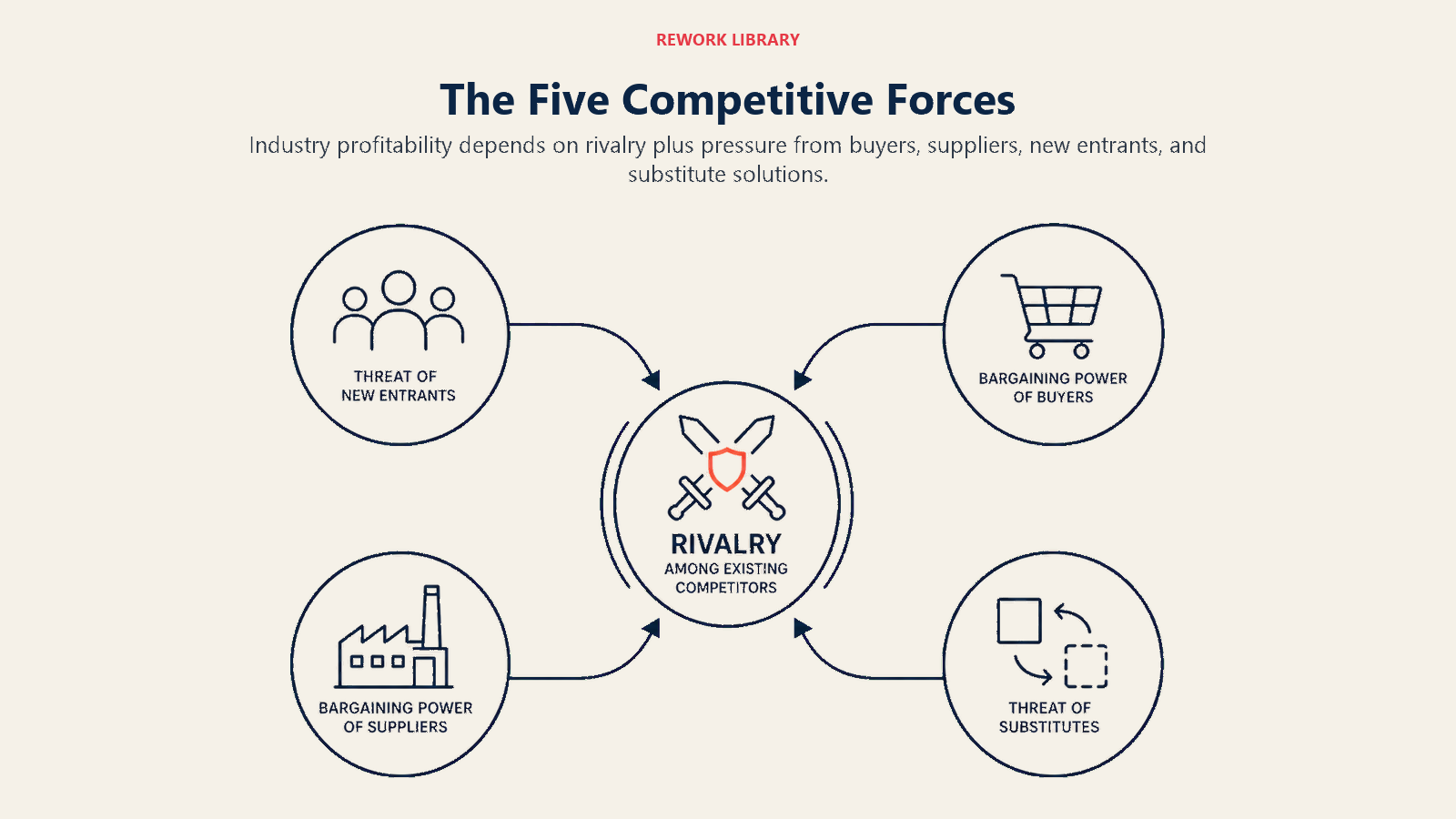
Bedrohung durch neue Wettbewerber
Neue in den Markt eintretende Wettbewerber verwässern den Marktanteil und können Preiskriege auslösen. Je stärker die Markteintrittsbarrieren, desto weniger wiegt diese Bedrohung für etablierte Unternehmen.
Was diese Kraft stark macht:
- Geringe Kapitalanforderungen für die Gründung in der Branche
- Minimale regulatorische oder lizenzrechtliche Hürden
- Kunden haben niedrige Wechselkosten beim Wechsel zu einem neuen Anbieter
- Etablierte Unternehmen haben keine starke Markentreue oder Netzwerkeffekte
- Technologie erleichtert die Replikation des Kernprodukts oder der Kerndienstleistung
Verhandlungsmacht der Lieferanten
Lieferanten gewinnen Macht, wenn sie einen knappen Input kontrollieren, den Unternehmen nicht leicht anderswo beziehen können. Hohe Lieferantenmacht drückt auf die Margen.
Was diese Kraft stark macht:
- Wenige Lieferanten dominieren den Inputmarkt
- Es gibt keine nah verwandten Ersatzinputs
- Der Wechsel von Lieferanten ist kostspielig oder zeitaufwendig
- Lieferanten könnten glaubhaft vorwärts in Ihre Branche integrieren
- Ihr Einkaufsvolumen ist für den Lieferanten zu gering, um relevant zu sein
Verhandlungsmacht der Abnehmer
Abnehmer gewinnen Macht, wenn sie glaubhaft abwandern können, Alternativen einfach vergleichen oder in Volumina kaufen, die groß genug sind, um Zugeständnisse zu fordern. Hohe Abnehmermacht drückt Preise nach unten.
Was diese Kraft stark macht:
- Wenige Abnehmer kaufen in großen Mengen
- Produkte sind undifferenziert oder commodityartig
- Wechselkosten für Abnehmer sind niedrig
- Abnehmer haben vollständige Preistransparenz
- Abnehmer könnten rückwärts integrieren und das Produkt selbst herstellen
Bedrohung durch Ersatzprodukte
Ersatzprodukte sind Produkte aus einer anderen Kategorie, die dasselbe Kundenbedürfnis erfüllen. Sie begrenzen den erzielbaren Preis, weil Kunden abwandern, sobald das Wertverhältnis sich angleicht.
Was diese Kraft stark macht:
- Das Ersatzprodukt bietet vergleichbare oder bessere Leistung zu einem niedrigeren Preis
- Die Wechselbereitschaft der Kunden ist hoch
- Die Ersatzproduktbranche wächst schneller als Ihre
- Abnehmer haben keine erheblichen Wechselkosten beim Einsatz des Ersatzprodukts
- Das Ersatzprodukt profitiert von Technologietrends, die es begünstigen
Wettbewerbsrivalität
Rivalität ist die Intensität des Wettbewerbs unter den bestehenden Akteuren. Hohe Rivalität ist meist das Ergebnis des Zusammenspiels der anderen vier Kräfte, kann aber auch aus branchenspezifischen Faktoren wie langsamem Wachstum oder hohen Fixkosten resultieren.
Was diese Kraft stark macht:
- Viele Wettbewerber annähernd gleicher Größe
- Langsames Branchenwachstum zwingt Unternehmen, um Marktanteile zu kämpfen, anstatt mit dem Markt zu wachsen
- Hohe Fixkosten drängen Unternehmen dazu, das Volumen unabhängig vom Preis zu maximieren
- Produkte sind schwer zu differenzieren
- Hohe Austrittsbarrieren halten Unternehmen in einem schrumpfenden Markt gefangen
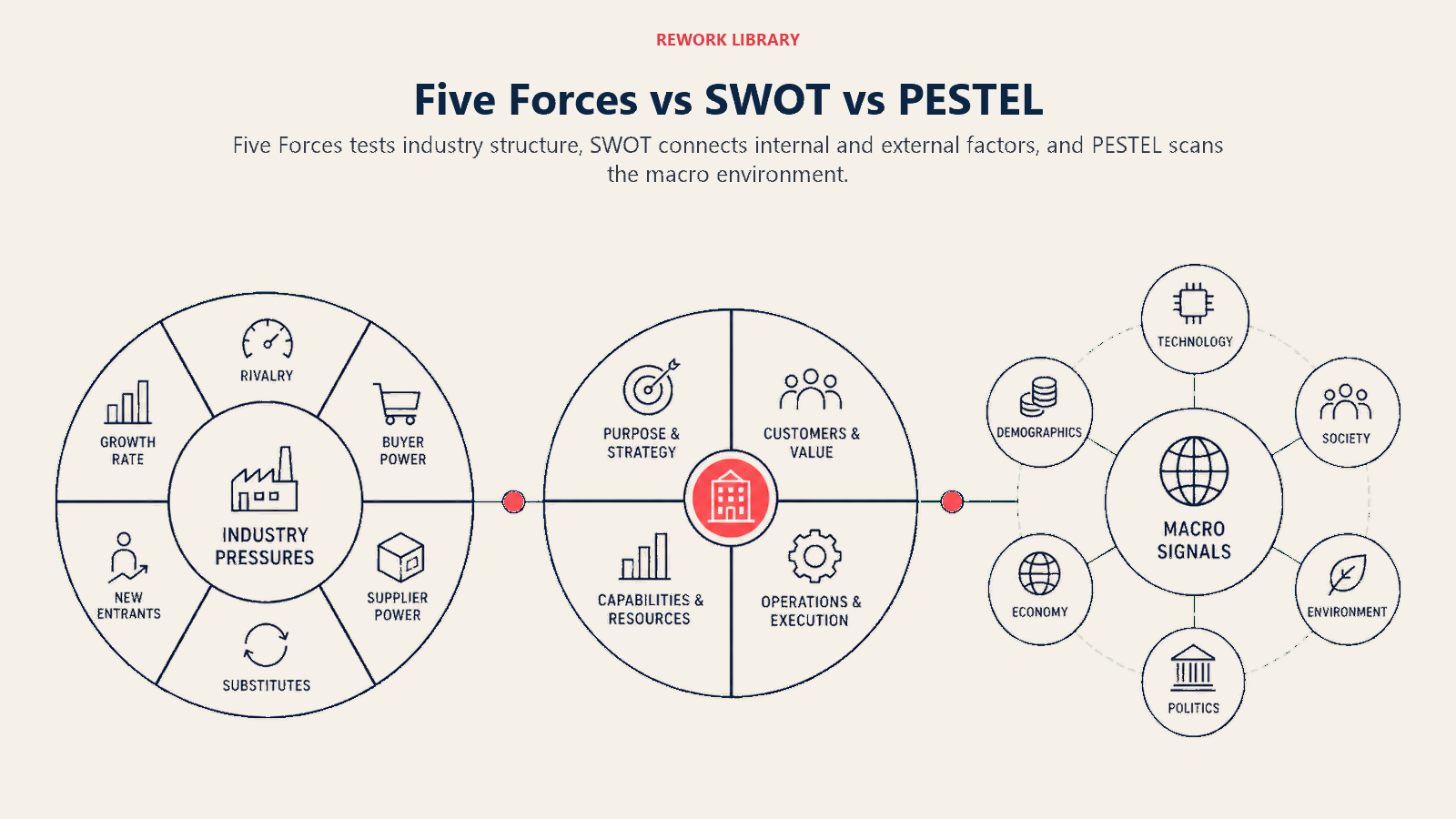
Porter's Five Forces vs. SWOT vs. PESTEL
| Framework | Fokus | Was es beantwortet | Am besten geeignet, wenn |
|---|---|---|---|
| Porter's Five Forces | Branchenstruktur | Ist diese Branche strukturell attraktiv? Wo sitzt die Macht? | Eintritt in einen neuen Markt, Bewertung von M&A-Zielen, Festlegung der Preisstrategie |
| SWOT-Analyse | Interne Stärken/Schwächen und externe Chancen/Bedrohungen | Wie steht unser Unternehmen im Verhältnis zu seinem Umfeld? | Jährlicher Strategie-Review, Wettbewerbspositionierung, Produkteinführung |
| PESTEL | Makroumfeld | Welche politischen, wirtschaftlichen, sozialen, technologischen, ökologischen und rechtlichen Kräfte könnten uns betreffen? | Langfristige Planung, Bewertung regulatorischer Risiken, Markteintritt |
Die drei Frameworks ergänzen sich, stehen nicht im Wettbewerb miteinander. Ein rigoroser Strategieprozess beginnt typischerweise mit PESTEL zur Analyse makroökonomischer Kräfte, führt dann eine Five Forces-Analyse durch, um die Branchenstruktur zu verstehen, und nutzt anschließend SWOT, um externe Erkenntnisse in unternehmensspezifische Implikationen zu übersetzen. Die BCG-Matrix und das Business Model Canvas helfen dann dabei, Ressourcen zuzuweisen und Geschäftsmodellhypothesen vor diesem strategischen Hintergrund zu prüfen.
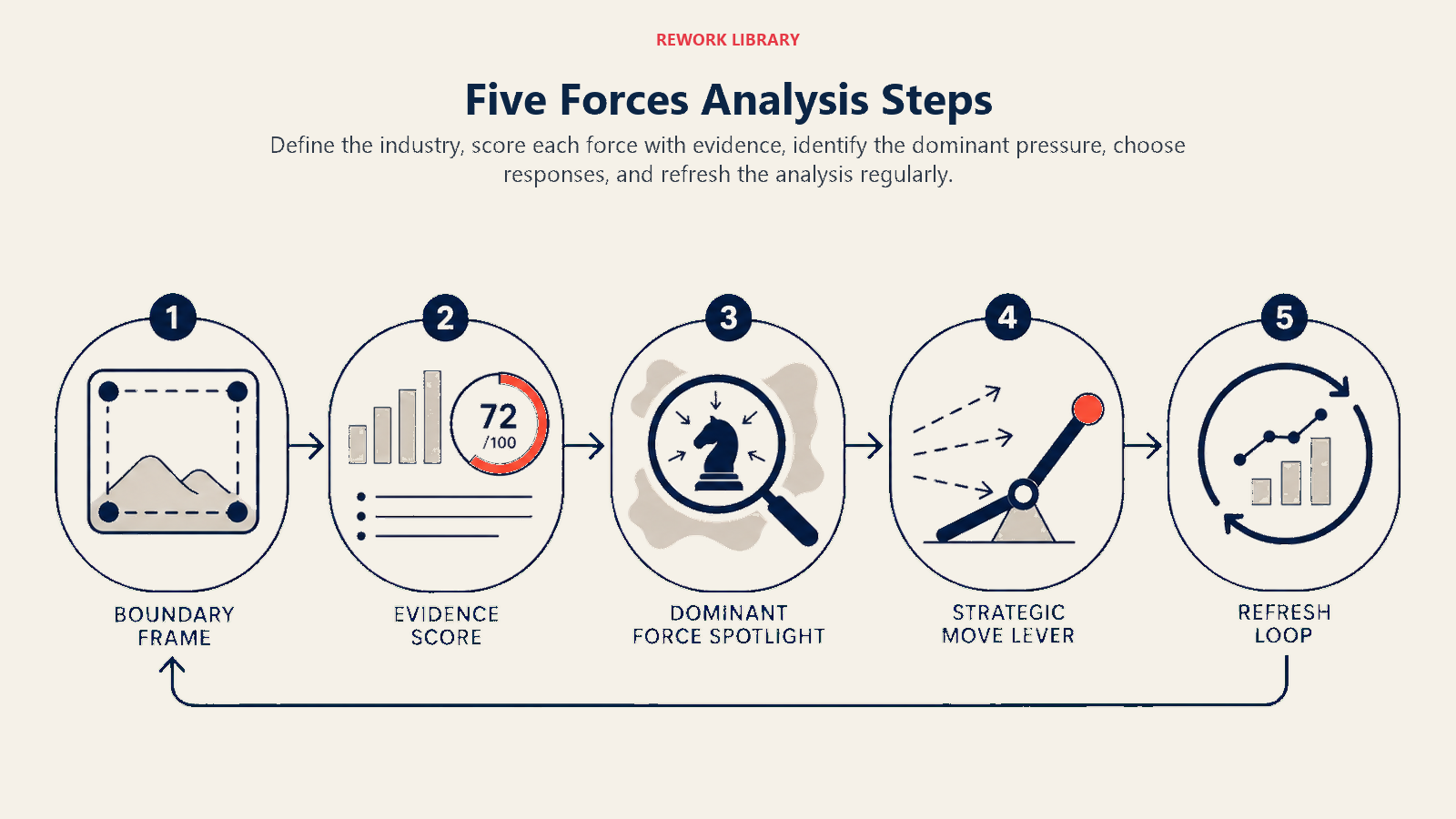
Porter's Five Forces-Analyse in 5 Schritten durchführen
Schritt 1: Branchenumfang definieren
Bevor Sie etwas bewerten, einigen Sie sich darauf, welche Branche Sie analysieren. Die Abgrenzung ist entscheidend. „Software" zu analysieren ist zu breit; „cloudbasierte Projektmanagementsoftware für mittelständische Unternehmen" ist konkret genug, um handlungsfähige Erkenntnisse zu liefern. Nutzen Sie SIC- oder NAICS-Codes als Ausgangspunkt, und grenzen Sie dann nach Geografie oder Kundensegment ein.
Schritt 2: Jede Kraft von niedrig bis hoch bewerten
Sammeln Sie für jede der fünf Kräfte Belege und bewerten Sie die Kraft: Niedrig, Mittel oder Hoch. Verlassen Sie sich nicht allein auf Intuition. Nutzen Sie Analystenberichte, Kundeninterviews, Lieferantenverträge und öffentlich zugängliche Finanzdaten. Ein Fünfspalten-Bewertungsraster hält die Analyse strukturiert und für die Unternehmensführung kommunizierbar. Die Festlegung von kritischen Erfolgsfaktoren je Kraft in dieser Phase hilft Teams, sich auf relevante Belege zu einigen.
Schritt 3: Die dominante Kraft identifizieren
In den meisten Branchen treiben eine oder zwei Kräfte die Rentabilität stärker als die anderen. In der kommerziellen Luftfahrt dominieren Rivalität und Abnehmermacht. In Unternehmenssoftware sind Bedrohung durch neue Wettbewerber und Lieferantenmacht (Talente, Cloud-Infrastruktur) entscheidend. Zu wissen, welche Kraft dominiert, sagt Ihnen, wo Sie strategische Energie konzentrieren sollten.
Schritt 4: Bewertung in strategische Maßnahmen übersetzen
Eine hohe Kraftbewertung ist eine Handlungsanweisung, nicht nur eine Diagnose. Hohe Abnehmermacht? In Differenzierung oder Wechselkosten investieren. Hohe Bedrohung durch neue Wettbewerber? Proprietäre Datenfestungen oder Patentportfolios aufbauen. Hier verbindet sich Five Forces mit SMART-Zielen und konkreten Initiativen. Nutzen Sie eine RACI-Matrix, um die Verantwortung für jede strategische Antwort zuzuweisen.
Schritt 5: Jährlich aktualisieren
Porter's Five Forces ist eine Momentaufnahme struktureller Bedingungen zu einem bestimmten Zeitpunkt. Märkte entwickeln sich. Eine heute als Niedrig eingestufte Kraft kann in 18 Monaten Hoch werden, wenn ein gut finanzierter neuer Wettbewerber eintritt oder ein wichtiger Lieferant konsolidiert. Planen Sie eine jährliche Wiederholung der Bewertung, oder nach jedem bedeutenden Branchenereignis, Zukauf oder regulatorischen Wechsel.
Reale Beispiele nach Branche
Luftfahrtbranche
| Kraft | Stärke | Warum | Strategische Implikation |
|---|---|---|---|
| Bedrohung durch neue Wettbewerber | Niedrig | Enormer Kapitalbedarf, Slots, Gates, Regulierungsgenehmigungen | Etablierte Unternehmen sicher vor Startups, aber nicht vor aggressiven Niedrigpreisanbietern |
| Abnehmermacht | Hoch | Preistransparenz über Vergleichsportale, geringe Differenzierung auf Kurzstrecken | Dauerhafter Margendruck; Treueprogramme als wichtigster Bindungshebel |
| Lieferantenmacht | Hoch | Duopol von Boeing und Airbus bei Großraumjets; Kerosinpreise | Airlines hedgen Kraftstoff aggressiv; Flottenentscheidungen auf Jahrzehnte gebunden |
| Bedrohung durch Ersatzprodukte | Mittel | Hochgeschwindigkeitsbahn auf Kurzstrecken; Videokonferenzen für Geschäftsreisen | Reale Bedrohung auf Strecken unter 3 Stunden; Mix der Geschäftsreisen verschiebt sich |
| Wettbewerbsrivalität | Sehr hoch | Überkapazitäten, Commodity-Produkt, hohe Fixkosten | Rentabilität äußerst gering; Konsolidierungswellen seit der Deregulierung |
SaaS und Cloud-Software
| Kraft | Stärke | Warum | Strategische Implikation |
|---|---|---|---|
| Bedrohung durch neue Wettbewerber | Hoch | Geringe Infrastrukturkosten, globaler Talentpool, schnelle Iterationszyklen | Kategoriemarktführerschaft wechselt schneller; etablierte Unternehmen müssen in verteidigbare Plattformschicht investieren |
| Abnehmermacht | Mittel | Abnehmer sind informiert, aber Mehrjahresverträge und Datenbindung reduzieren Abwanderung | Product-Led Growth senkt anfängliche Wechselbarriere; Enterprise-Verträge stellen sie wieder her |
| Lieferantenmacht | Niedrig-Mittel | AWS, Azure, GCP als wichtige Lieferanten, aber mehrere Optionen vorhanden | Cloud-Kostenmanagement ist echte Betriebspriorität; Multi-Cloud reduziert Abhängigkeit |
| Bedrohung durch Ersatzprodukte | Hoch | Open-Source-Alternativen, interne Entwicklungen, Kategoriekonsolidierung | ROI gegenüber Eigenlösungen klar nachweisen; Bündelung mit benachbarten Funktionen ist eine übliche Verteidigung |
| Wettbewerbsrivalität | Hoch | Überfüllte Kategorien, Freemium-Preisdruck, VC-finanzierte Verbrenstrategien | Differenzierung muss über Funktionen hinausgehen; Marke, Community und Integrationen zählen |
US-amerikanisches Fast Food
| Kraft | Stärke | Warum | Strategische Implikation |
|---|---|---|---|
| Bedrohung durch neue Wettbewerber | Mittel | Franchise-Modell senkt Barrieren, aber Immobilien und Markenbekanntheit sind hoch | Regionale Konzepte können skalieren, bedrohen Top-10-Ketten national aber selten schnell |
| Abnehmermacht | Hoch | Extreme Preissensitivität, einfacher Vergleich, keine Wechselkosten | Dollar-Menüs und Preis-Botschaften sind permanent, nicht aktionsbasiert |
| Lieferantenmacht | Niedrig-Mittel | Große Ketten kaufen in enormen Volumina von Rohstoffmärkten | Rohstoffpreissprünge (Rind, Weizen) schlagen trotz Größe auf die Margen durch |
| Bedrohung durch Ersatzprodukte | Hoch | Fast Casual, Lebensmittellieferungen, Kochboxen | Bequemlichkeit und wahrgenommener Wert werden ständig mit Alternativen verglichen |
| Wettbewerbsrivalität | Sehr hoch | Reifer Markt, nahezu identische Menüs, hohe Marketingausgaben | Innovationszyklen (neue Menüpunkte) beschleunigen sich; Treueprogramme werden zum zentralen Schlachtfeld |
Stärken und Grenzen von Porter's Five Forces
Die anhaltende Beliebtheit des Frameworks resultiert aus seiner Einfachheit und strukturellen Stringenz. Zu seinen Stärken zählen:
- Gibt Führungskräften ein gemeinsames Vokabular für die Diskussion von Wettbewerbsdynamiken
- Zwingt Teams, über das eigene Unternehmen hinauszusehen und die gesamte Wertschöpfungskette zu kartieren
- Funktioniert branchenübergreifend, in verschiedenen Regionen und bei unterschiedlichen Organisationsgrößen
- Liefert ein strukturiertes Ergebnis, das nach oben und bereichsübergreifend leicht kommunizierbar ist
- Harmoniert natürlich mit strategischem Denken und anderen Frameworks wie SWOT oder PESTEL
Das Framework hat aber auch reale Grenzen, die Anwenderinnen und Anwender anerkennen sollten:
- Es ist eine statische Momentaufnahme, kein dynamisches Modell. Es erfasst Wettbewerbskräfte zu einem bestimmten Zeitpunkt, zeigt aber nicht automatisch, wie sich Kräfte entwickeln werden.
- Es wurde für traditionelle Branchen konzipiert und gewichtet Netzwerkeffekte zu gering. In Plattformgeschäften ist der „Wettbewerber" oft auch der Komplementäranbieter, etwas, das das Five Forces-Modell nicht sauber abbildet.
- Es kann die Geschwindigkeit des technologischen Wandels unterschätzen. Eine heute als Niedrig eingestufte Kraft kann innerhalb von zwei bis drei Jahren existenziell Hoch werden, wenn eine Durchbrunchtechnologie die Wirtschaft verändert, wie es Cloud Computing bei On-Premise-Software tat.
- Es ignoriert weitgehend Komplementäre (eine „sechste Kraft", vorgeschlagen von Adam Brandenburger und Barry Nalebuff in ihrem 1996er Buch Co-opetition), deren Präsenz Wettbewerbsdynamiken ebenso stark verändern kann wie jede der fünf Standardkräfte.
- Oberflächlich angewendet liefert es qualitative Beobachtungen ohne die quantitative Strenge, die Kapitalallokationsentscheidungen erfordern. Die Bewertung muss auf Belegen basieren, nicht auf Intuition.
Häufig gestellte Fragen
Wer hat Porter's Five Forces entwickelt?
Michael E. Porter, Professor an der Harvard Business School, entwickelte das Framework. Er veröffentlichte es erstmals in seinem 1979 erschienenen Harvard Business Review-Artikel „How Competitive Forces Shape Strategy" und erweiterte es in seinem 1980 erschienenen Buch Competitive Strategy. Porter aktualisierte das Framework später in einem HBR-Artikel aus dem Jahr 2008.
Gibt es eine 6. Kraft?
Ja, mehrere Strateginnen und Strategen haben Ergänzungen vorgeschlagen. Die bekannteste ist die „Komplementäre"-Kraft, eingeführt von Adam Brandenburger und Barry Nalebuff in Co-opetition (1996). Komplementäre sind Unternehmen, deren Produkte den Wert des eigenen steigern. Microsoft und Intel in den 1990er Jahren sind das klassische Beispiel. Einige fügen auch Staat/Regulierung als sechste Kraft hinzu, obwohl Porter selbst Regulierungsbehörden als Teil der bestehenden fünf Kräfte betrachtet und nicht als eigene Kategorie.
Wie unterscheidet sich Porter's Five Forces von SWOT?
Porter's Five Forces analysiert die Struktur auf Branchenebene: die Kräfte außerhalb eines einzelnen Unternehmens, die bestimmen, wie Gewinn in der Wertschöpfungskette verteilt wird. Die SWOT-Analyse ist unternehmensspezifisch: Sie bewertet interne Stärken und Schwächen neben externen Chancen und Bedrohungen. Nutzen Sie Five Forces zunächst, um das Spielfeld zu verstehen, und dann SWOT, um zu beurteilen, wie Ihr Unternehmen darauf positioniert ist.
Funktioniert Porter's Five Forces für Technologie- und KI-Märkte?
Es funktioniert, erfordert aber Anpassungen. Das Framework wurde für Branchen mit klareren Produkt- und Lieferantengrenzen konzipiert. In KI- und Plattformmärkten verschwimmen traditionelle Kraftdefinitionen. Bedrohungen durch Ersatzprodukte können über Nacht entstehen. Lieferantenmacht (GPU-Hersteller, Anbieter von Basismodellen) kann unvorhersehbar ansteigen. Netzwerkeffekte schaffen „Winner-takes-most"-Dynamiken, die das Standardmodell nicht vollständig abbildet. Wenden Sie das Framework mit diesen Einschränkungen im Hinterkopf an und ergänzen Sie es durch Netzwerkeffekte-Analysen und plattformspezifische Strategietools.
Wie oft sollte ich eine Five Forces-Analyse aktualisieren?
Mindestens einmal jährlich im Rahmen der jährlichen Strategieplanung. In schnelllebigen Branchen wie SaaS, Fintech oder KI-Tools ist eine halbjährliche Überprüfung angemessener. Außerdem sollten Sie eine außerplanmäßige Aktualisierung nach bedeutenden Branchenereignissen vornehmen: einer bedeutenden Akquisition, einer neuen Regulierungsmaßnahme, einem wesentlichen Technologiewandel oder dem Eintritt eines gut finanzierten neuen Wettbewerbers in Ihre Kategorie.
Eine Porter's Five Forces-Analyse sagt Ihnen nicht, was Sie entwickeln oder wen Sie einstellen sollen. Aber sie sagt Ihnen etwas Grundlegenderes: ob die Branche, in der Sie konkurrieren, strukturell darauf ausgelegt ist, dass Sie gewinnen können. Führen Sie sie durch, bevor Sie Kapital einsetzen, bevor Sie in einen neuen Markt eintreten, und bevor Sie davon ausgehen, dass mehr Arbeit die Antwort auf ein strukturelles Problem ist, das zunächst die Strategie lösen muss.

Co-Founder & COO
On this page
- Was ist Porter's Five Forces?
- Wichtige Fakten
- Die 5 Kräfte erklärt
- Bedrohung durch neue Wettbewerber
- Verhandlungsmacht der Lieferanten
- Verhandlungsmacht der Abnehmer
- Bedrohung durch Ersatzprodukte
- Wettbewerbsrivalität
- Porter's Five Forces vs. SWOT vs. PESTEL
- Porter's Five Forces-Analyse in 5 Schritten durchführen
- Schritt 1: Branchenumfang definieren
- Schritt 2: Jede Kraft von niedrig bis hoch bewerten
- Schritt 3: Die dominante Kraft identifizieren
- Schritt 4: Bewertung in strategische Maßnahmen übersetzen
- Schritt 5: Jährlich aktualisieren
- Reale Beispiele nach Branche
- Luftfahrtbranche
- SaaS und Cloud-Software
- US-amerikanisches Fast Food
- Stärken und Grenzen von Porter's Five Forces