SWOT vs TOWS: Die entscheidenden Unterschiede
Turn this article into takeaways for your work.


Each assistant summarizes the article only for you and suggests best practices for your work.
Die meisten Strategiemeetings enden am Whiteboard. Vier Quadranten sind ausgefüllt, ein Gefühl der Zufriedenheit stellt sich ein, und dann kommt die entscheidende Frage: "Was machen wir jetzt konkret?" Genau in diese Lücke fallen diese beiden Frameworks, und zu wissen, welches Sie gerade verwenden, macht den gesamten Unterschied.
Was ist der Unterschied zwischen SWOT und TOWS?
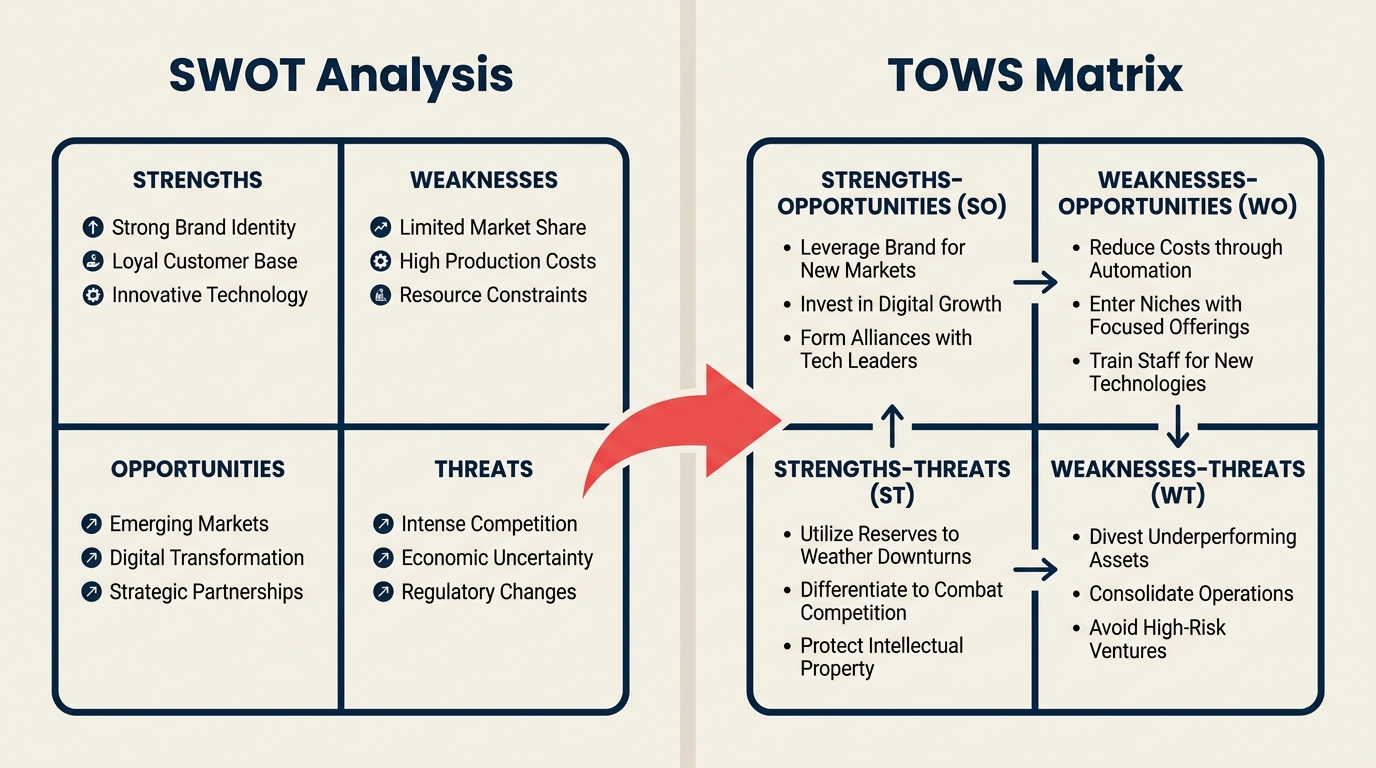
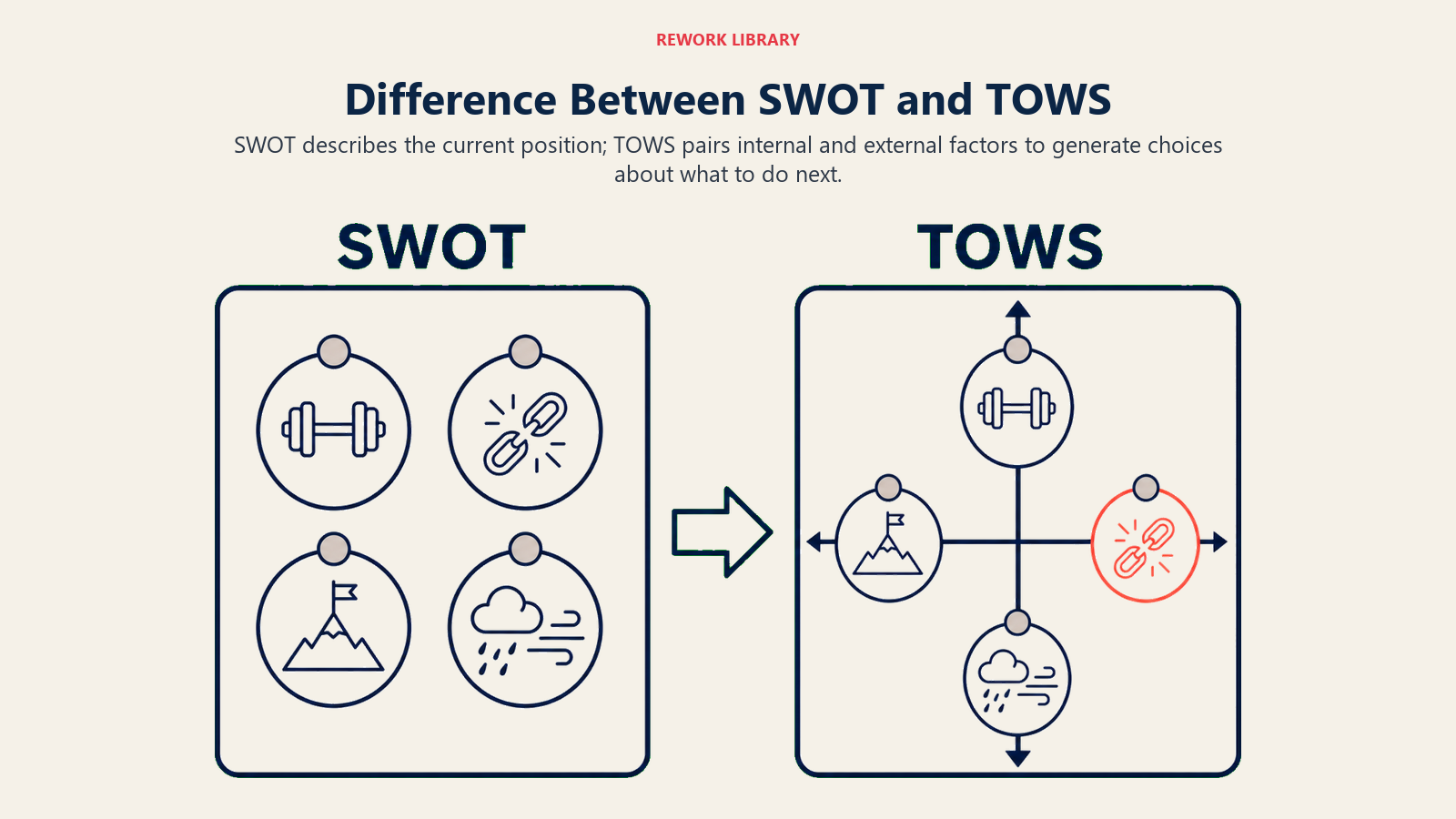
SWOT ist eine Bestandsaufnahme. Es listet die internen Stärken und Schwächen Ihrer Organisation neben externen Chancen und Risiken auf. TOWS ist der Handlungsschritt. Es nimmt dieselben vier Kategorien und kombiniert sie systematisch, um strategische Optionen zu erzeugen: SO (Strengths-Opportunities), ST (Strengths-Threats), WO (Weaknesses-Opportunities) und WT (Weaknesses-Threats). Kurz gesagt: SWOT sagt Ihnen, was über Ihre Position zutrifft; TOWS sagt Ihnen, was Sie dagegen unternehmen sollen.
Wichtige Fakten
- Das SWOT-Framework wurde am Stanford Research Institute (SRI) von Albert Humphrey und seinen Kollegen im Rahmen eines Forschungsprojekts der 1960er und 70er Jahre entwickelt, das die Planungsfehler von Fortune-500-Unternehmen untersuchte.
- Die TOWS Matrix wurde von Professor Heinz Weihrich in seinem 1982 erschienenen Aufsatz "The TOWS Matrix: A Tool for Situational Analysis" in Long Range Planning eingeführt.
- Laut einer Umfrage von Bridges Business Consultancy scheitern 67 % aller gut formulierten Strategien in der Umsetzungsphase, häufig weil die Analyse bei der Diagnose stehen bleibt und nie zu einem konkreten Handlungsrahmen führt.
Was ist eine SWOT-Analyse?
Eine SWOT-Analyse ist eine strukturierte Bestandsaufnahme der Faktoren, die Ihre Wettbewerbsposition beeinflussen. Sie untersuchen vier Kategorien:
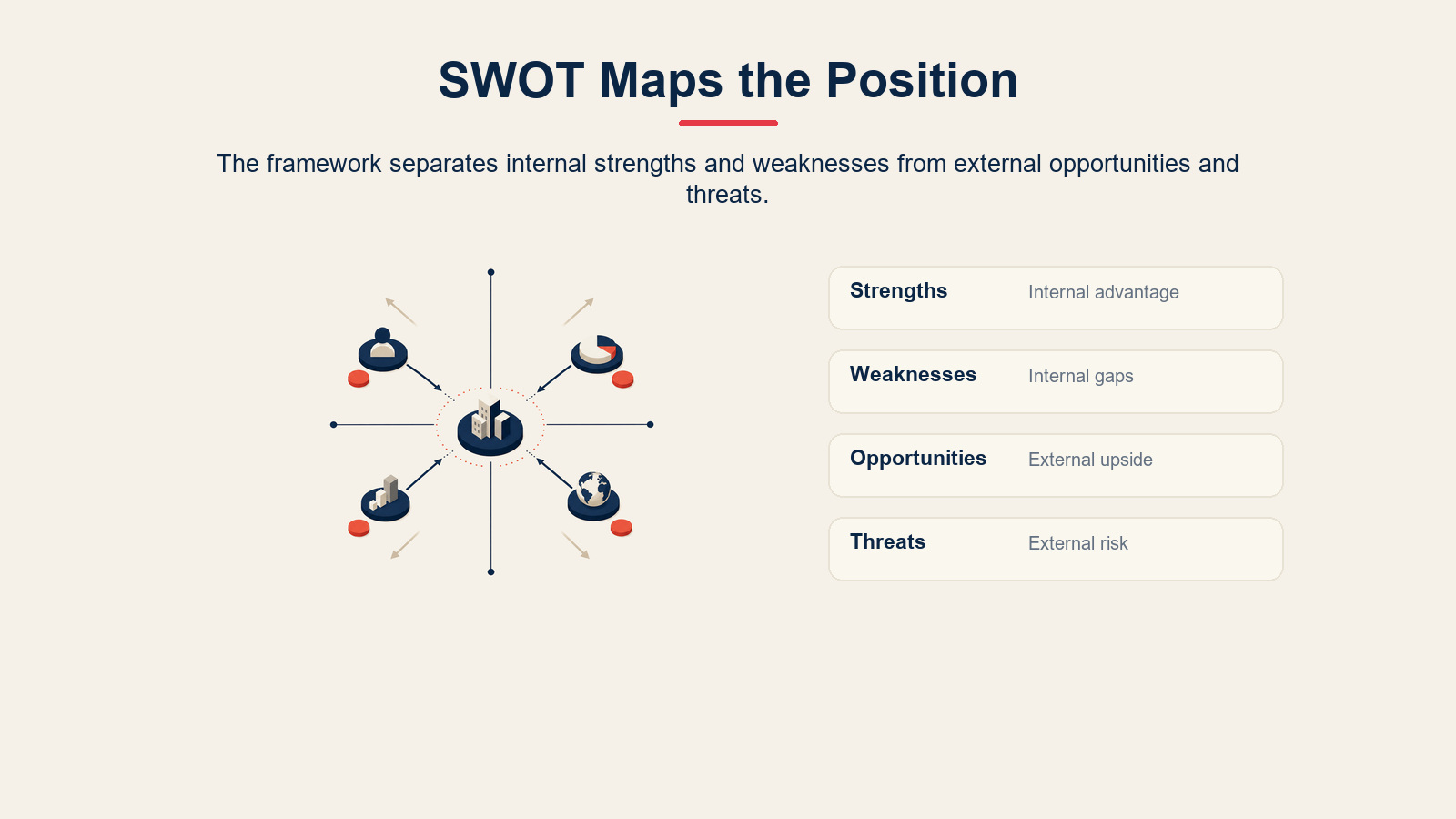
- Stärken (intern, positiv): Was Ihre Organisation im Vergleich zu Wettbewerbern gut macht. Starke Marke, proprietäre Technologie, treue Kundenbasis.
- Schwächen (intern, negativ): Interne Einschränkungen, die Sie in eine nachteilige Position bringen. Hohe Kostenstruktur, fehlende Kompetenzen, veraltete Systeme.
- Chancen (extern, positiv): Günstige Bedingungen in Ihrem Umfeld, die Sie nutzen könnten. Wachsende Märkte, ausscheidende Wettbewerber, regulatorischer Rückenwind.
- Risiken (extern, negativ): Kräfte außerhalb Ihrer Kontrolle, die die Leistung beeinträchtigen könnten. Neue Marktteilnehmer, sich verändernde Kundenpräferenzen, Unterbrechungen der Lieferkette.
SWOT eignet sich am besten als schnelle diagnostische Übersicht. Es ist inklusiv und lässt sich leicht in einem Workshop durchführen. Aber es ist rein beschreibend. Eine Liste von Faktoren ist noch keine Strategie.
Was ist eine TOWS Matrix?
Die TOWS Matrix verwendet dieselben vier Kategorien wie SWOT, kombiniert sie jedoch zu vier unterschiedlichen strategischen Perspektiven:
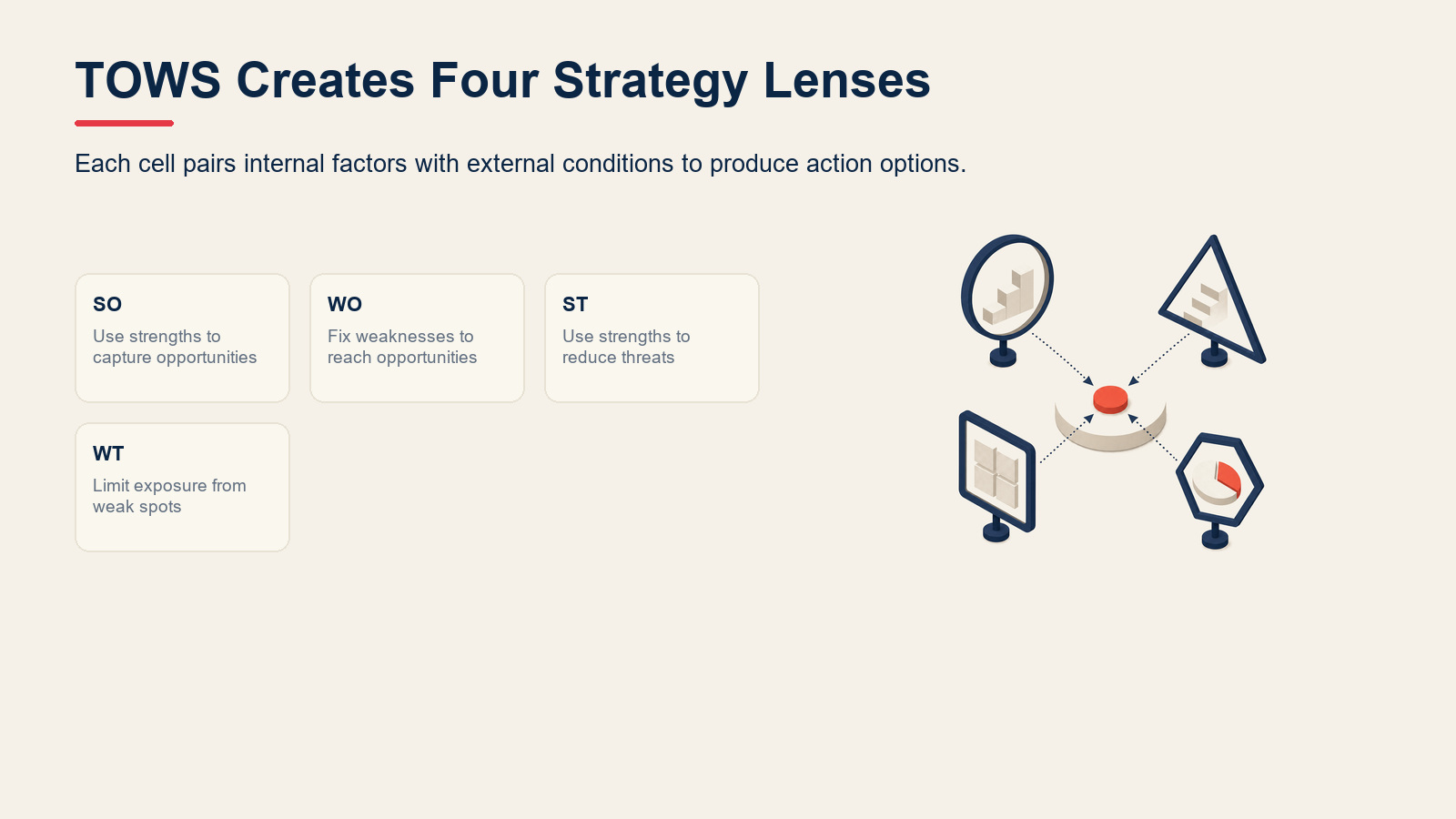
- SO (Strengths-Opportunities): maxi-maxi. Nutzen Sie Ihre Stärken, um verfügbare Chancen zu ergreifen. Dies ist Ihr offensiver, wachstumsorientierter Quadrant.
- WO (Weaknesses-Opportunities): mini-maxi. Beheben Sie Schwächen, damit Sie Chancen nutzen können, die Sie derzeit nicht erreichen können.
- ST (Strengths-Threats): maxi-mini. Setzen Sie vorhandene Stärken ein, um externe Risiken zu minimieren oder zu neutralisieren.
- WT (Weaknesses-Threats): mini-mini. Defensive Maßnahmen, die die Exposition begrenzen, wenn interne Schwächen und externe Risiken zusammentreffen.
Jede Kombination erzeugt konkrete strategische Optionen statt eines Statusberichts. Das ist der Kernwert.
SWOT vs TOWS: Direkter Vergleich
| Dimension | SWOT | TOWS |
|---|---|---|
| Hauptzweck | Diagnostische Bestandsaufnahme | Strategieentwicklung |
| Denkrichtung | Beschreibend: "Was ist" | Vorschreibend: "Was zu tun ist" |
| Ergebnis | Eine Liste von Faktoren | Strategische Optionen pro Quadrant |
| Einsatzzeitpunkt | Früh in der Planung, vor der Strategieformulierung | Nach SWOT, während der Strategieentwicklung |
| Analysetiefe | Oberflächliche Bestandsaufnahme | Quervergleich von Faktoren |
| Zentrale Einschränkung | Stoppt bei der Diagnose, kein Handlungspfad | Erfordert solide SWOT-Eingaben im Vorfeld |
| Erfinder | Humphrey / SRI, 1960er-70er | Weihrich, 1982 |
Wann SWOT, wann TOWS einsetzen?
Führen Sie SWOT immer zuerst durch. Es ist Ihr Faktenerhebungsschritt. Nutzen Sie ihn, wenn Sie:
- einen neuen Markt erschließen und eine schnelle Positionsbestimmung benötigen
- einen strategischen Planungszyklus mit verschiedenen Stakeholdern einleiten
- ein neues Führungsteam einarbeiten, das einen gemeinsamen Kontext benötigt
- eine Wettbewerbsanalyse vor einer Vorstandspräsentation durchführen
SWOT ist schnell und inklusiv. Jede Person kann ohne spezialisierte Schulung dazu beitragen.
Bringen Sie TOWS ins Spiel, sobald Sie ein solides, validiertes SWOT haben. Verwenden Sie die TOWS Matrix, wenn Sie:
- von der Diagnose zu einer Entscheidung über die strategische Ausrichtung übergehen müssen
- unter mehreren möglichen Wachstumsschritten priorisieren möchten
- eine bekannte Wettbewerbsbedrohung mit konkreten Gegenmaßnahmen abwehren wollen
- eine Strategie-Roadmap erstellen möchten, die interne Fähigkeiten mit Marktchancen verknüpft
Die beiden sind keine konkurrierenden Werkzeuge. SWOT speist TOWS. Teams, die nur SWOT durchführen, lassen den wertvollsten Teil unvollendet. Teams, die direkt zu TOWS springen, ohne ein solides SWOT zu haben, bauen Strategien auf Annahmen auf.
Für einen umfassenderen Blick darauf, wie externe Kräfte die Chancen und Risiken prägen, die Sie im SWOT aufdecken, ist die PESTEL-Analyse die natürliche Ergänzung. Sobald Sie strategische Optionen aus TOWS haben, hilft Ihnen Porter's Five Forces, diese anhand der Branchenstruktur zu überprüfen. Siehe auch PESTEL vs SWOT für einen Vergleich dieser beiden diagnostischen Werkzeuge.
Wie Sie von SWOT zu TOWS gelangen
Schritt 1: Ein solides SWOT aufbauen
Überstürzen Sie dies nicht. Ein oberflächliches SWOT liefert schwache TOWS-Optionen. Fordern Sie die Teilnehmenden zur Präzision auf: "Starkes Engineering-Team" ist weniger nützlich als "12-köpfiges Backend-Team mit zwei ML-Spezialisten und null Fluktuation in drei Jahren." Holen Sie Input aus verschiedenen Bereichen ein. Validieren Sie externe Faktoren mit Daten, nicht nur mit dem Bauchgefühl.
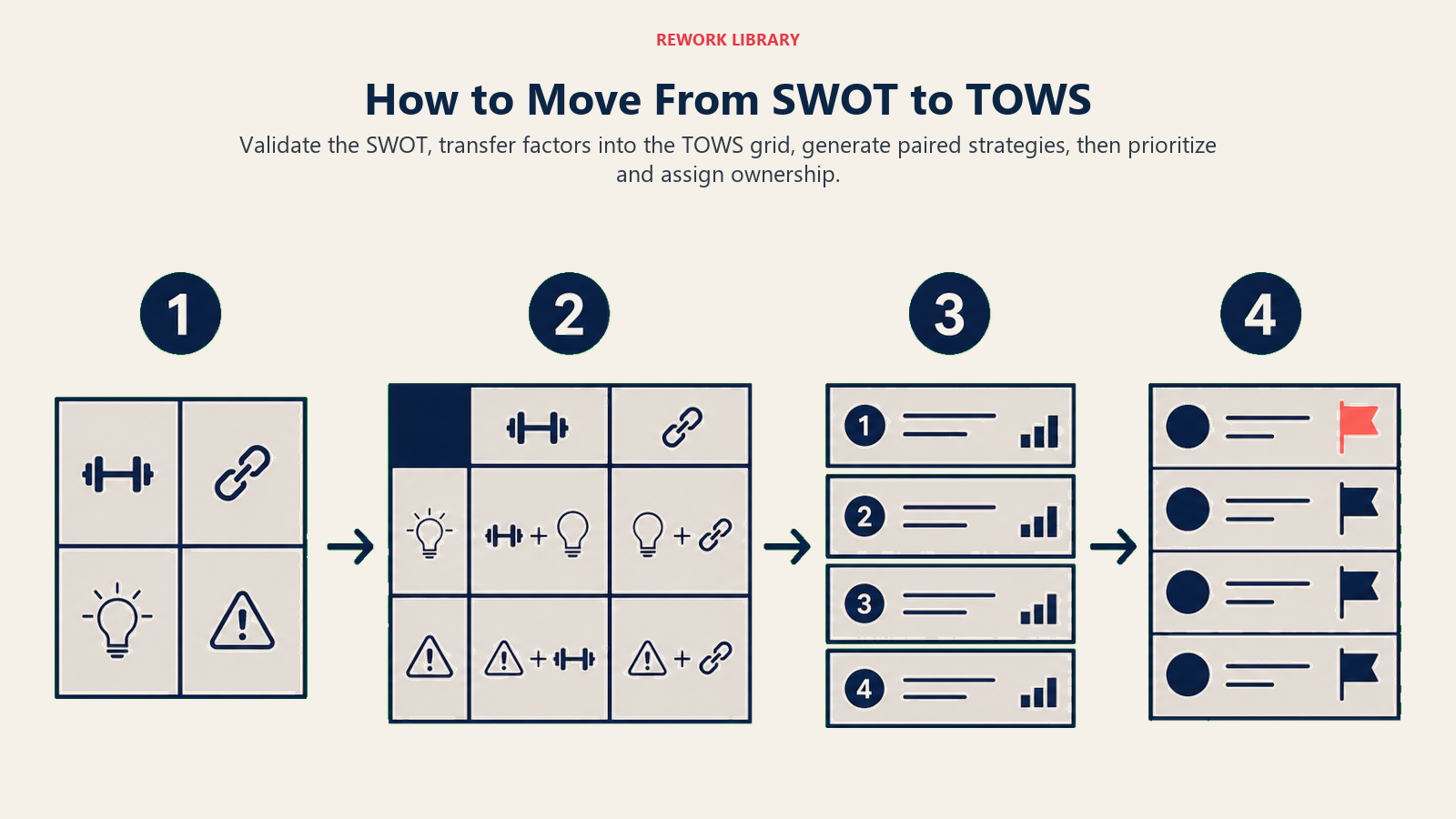
Schritt 2: Faktoren in das TOWS-Raster übertragen
Zeichnen Sie ein 2x2-Raster. Tragen Sie Ihre Stärkenliste entlang einer Achse und Ihre Chancen und Risiken entlang der anderen ein. Schwächen kommen gegenüber von Stärken. Sie sehen nun vier Felder, die jeweils eine Kombination darstellen.
Schritt 3: Gepaarte Strategien für jeden Quadranten entwickeln
Arbeiten Sie jedes Feld systematisch durch. Für SO: Welche Stärken können Sie nutzen, um welche Chancen zu ergreifen? Für WT: Welche Schwächen machen Sie am anfälligsten für welche Risiken, und was ist der minimale defensive Schritt? Streben Sie zwei bis vier konkrete Strategieideen pro Feld an. Formulieren Sie handlungsorientiert: "Expansion nach Südostasien durch unser bestehendes regionales Vertriebsnetz (S3), um die wachsende KMU-Nachfrage (O2) zu erschließen."
Schritt 4: Priorisieren und Verantwortlichkeiten zuweisen
Nicht alle Strategien sind gleichwertig. Bewerten Sie sie nach Wirkung und Machbarkeit. Wählen Sie die zwei bis drei besten pro Quadrant oder die fünf bis sieben besten insgesamt aus. Weisen Sie eine verantwortliche Person und ein Zieldatum zu. Ohne diesen Schritt wird TOWS zu einem weiteren Dokument, das in einem gemeinsamen Laufwerk abgelegt wird.
Für einen verwandten Blick darauf, wie zwei andere Portfolio-Werkzeuge die Priorisierung handhaben, siehe BCG vs GE-McKinsey Matrix.
TOWS Strategiebeispiele
Das folgende Beispiel verwendet eine mittelgroße regionale Supermarktkette, die einem wachsenden Wettbewerb durch nationale Discounter und lieferzentrierte Startups gegenübersteht.
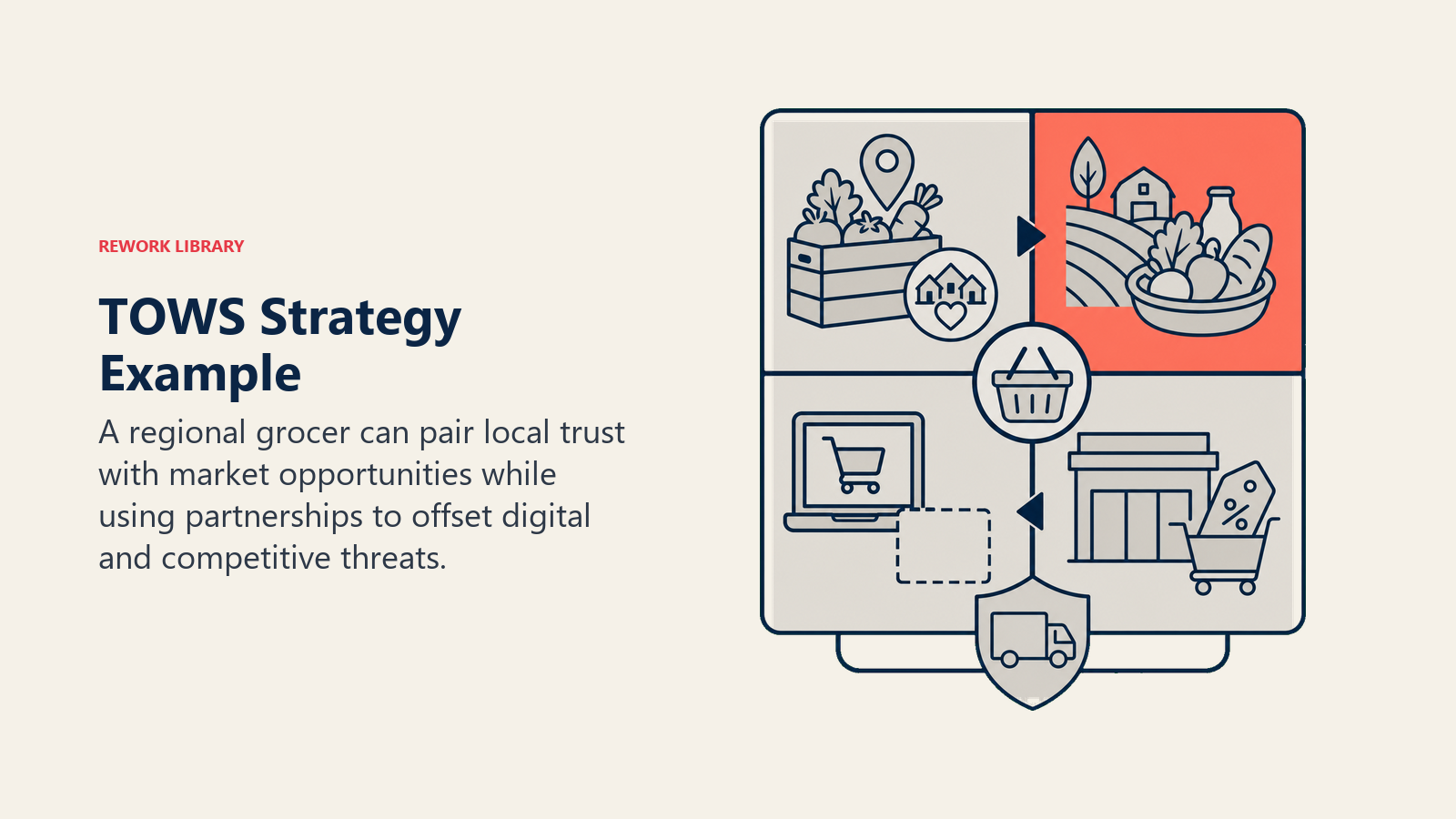
SWOT-Eingaben (vereinfacht)
- Stärken: enge Beziehungen zu lokalen Lieferanten, starke Markentreue in der Nachbarschaft, erfahrene Filialleiter
- Schwächen: keine E-Commerce-Fähigkeit, schwache IT-Infrastruktur, begrenztes Marketingbudget
- Chancen: wachsende Bewegung für lokale Lebensmittel, Fördermittel des Stadtrats für lokale Unternehmen, unterversorgte ältere Zielgruppen
- Risiken: zwei nationale Discounter eröffnen in der Nähe, Online-Lebensmittellieferung weitet sich in die Stadt aus, steigende Lohnkosten
| Quadrant | Strategie |
|---|---|
| SO (Strengths + Opportunities) | Lancierung einer "Kaufe Lokal"-Kampagne, die Lieferantenbeziehungen und bestehendes Markenvertrauen nutzt, um das lokale Lebensmittelsegment zu erschließen, bevor nationale Ketten es besetzen können |
| WO (Weaknesses + Opportunities) | Beantragung von Stadtrats-Fördermitteln für lokale Unternehmen, um einen einfachen Click-and-Collect-Service zu finanzieren und die E-Commerce-Lücke ohne großen Kapitalaufwand zu schließen |
| ST (Strengths + Threats) | Verstärkter Fokus auf Beziehungsaufbau durch Filialleiter und personalisierten Service, um Wechselkosten zu schaffen, die Discounter allein durch günstigere Preise nicht replizieren können |
| WT (Weaknesses + Threats) | Partnerschaft mit einem regionalen Lieferdienst verhandeln, um Lieferung ohne den Aufbau eigener Logistik anzubieten, und so die Exposition zu begrenzen, bis die IT-Infrastruktur ausgereift ist |
Das ist Strategieentwicklung in der Praxis. Jede Option verbindet einen spezifischen Faktor auf der einen Seite mit einem spezifischen Faktor auf der anderen Seite, sodass die Begründung nachvollziehbar bleibt.
Der Aufbau eines Wettbewerbsvorteils über einen dieser TOWS-Wege erfordert ein Verständnis dafür, welche Ressourcen und Fähigkeiten wirklich schwer zu replizieren sind. Hier zahlt sich zusätzliche Analyse aus.
Häufige Fehler von Teams
Die meisten SWOT- und TOWS-Probleme entstehen durch schwache Eingaben, zu viele Optionen oder einen fehlenden Entscheidungsschritt.
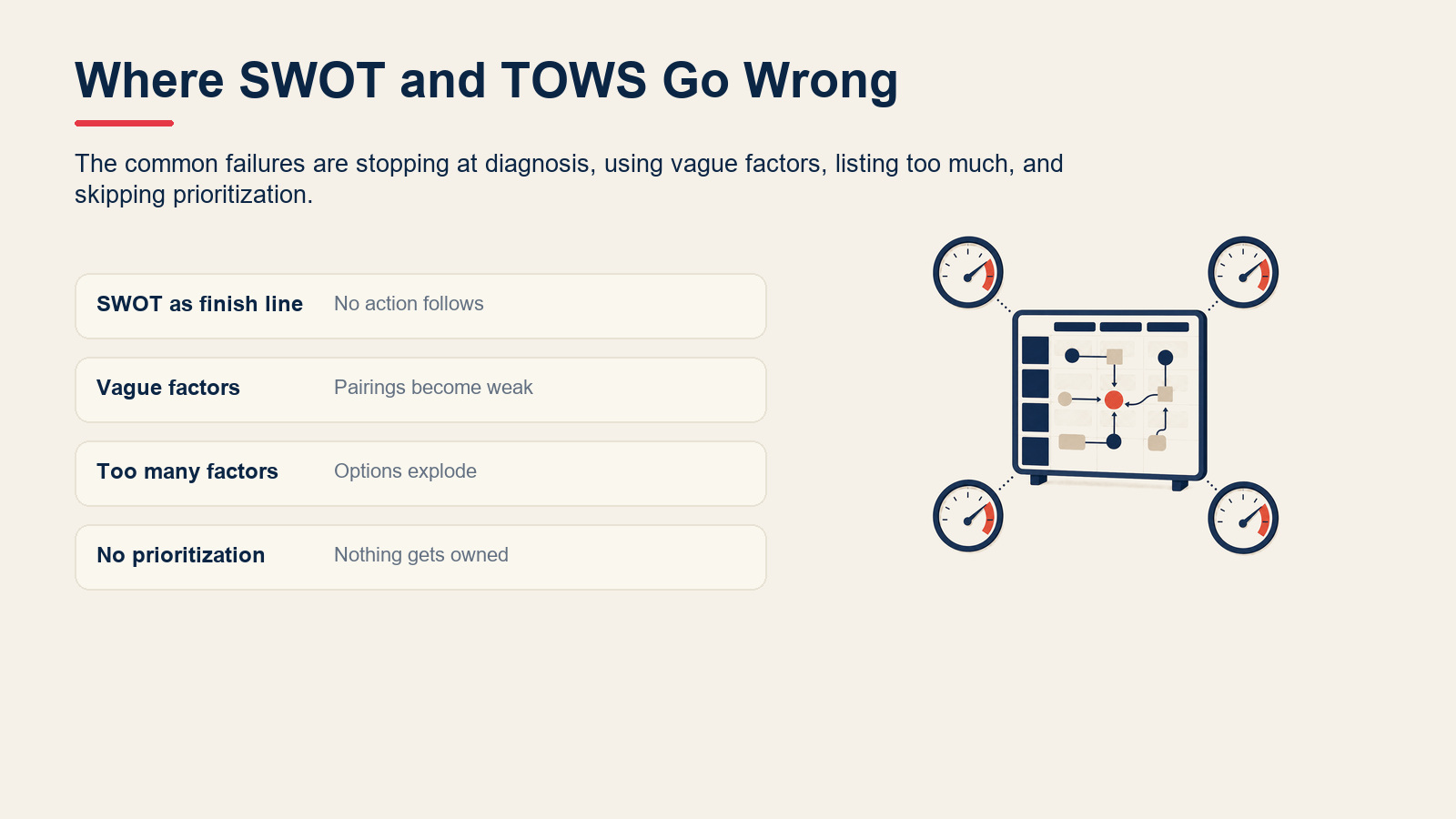
- SWOT als Ziel behandeln. Der häufigste Fehler. Das SWOT-Meeting endet, jemand erstellt eine Präsentation, und nichts ändert sich. SWOT ohne TOWS ist Diagnose ohne Rezept.
- Vage Faktoraussagen. "Gute Unternehmenskultur" oder "Marktunsicherheit" lassen sich kaum sinnvoll kombinieren. Fordern Sie Präzision bei jedem Faktor, bevor Sie den TOWS-Schritt beginnen.
- Zu viele Faktoren auflisten. Ein SWOT mit 20 Stärken und 15 Risiken erzeugt in TOWS Hunderte möglicher Kombinationen. Begrenzen Sie jede Kategorie auf die fünf bedeutendsten Faktoren.
- Priorisierung überspringen. TOWS kann ein Dutzend oder mehr Strategieoptionen erzeugen. Ohne eine klare Bewertungs- oder Priorisierungsmethode setzt kein Team eine davon entschlossen um.
- Analyserichtung verwechseln. SWOT geht von der Beobachtung zur Liste. TOWS geht von der Liste zur Strategie. Beide mid-Session zu vermischen führt zu Verwirrung darüber, was eigentlich entschieden wird.
- Kein Refresh einplanen. Beide Werkzeuge bilden eine Momentaufnahme. Marktbedingungen verändern sich. Ein SWOT von vor 18 Monaten kann veraltete Risiken enthalten oder neue Chancen übersehen. Planen Sie einen Aktualisierungszyklus ein.
Häufig gestellte Fragen
Ist TOWS besser als SWOT?
Sie dienen unterschiedlichen Zwecken, daher ist "besser" der falsche Rahmen. SWOT ist besser für die Diagnose; TOWS ist besser für die Strategieentwicklung. Die eigentliche Frage ist, ob Sie beides brauchen, und in den meisten Planungszyklen ist das der Fall. SWOT ohne TOWS hinterlässt Ihnen eine Liste. TOWS ohne ein solides SWOT hinterlässt Ihnen Strategien, die auf Vermutungen aufgebaut sind.
Kann ich SWOT und TOWS in derselben Sitzung verwenden?
Ja, und das ist der empfohlene Ansatz. Führen Sie SWOT in der ersten Hälfte Ihrer Sitzung durch, um ein gemeinsames Verständnis Ihrer Position aufzubauen. Wechseln Sie dann in der zweiten Hälfte zu TOWS, um dieses Verständnis in strategische Optionen umzuwandeln. Viele Teams tun dies in einem zweistündigen Workshop: 45 Minuten für SWOT, 60 Minuten für TOWS, 15 Minuten für die Priorisierung.
Wer hat die TOWS Matrix erfunden?
Professor Heinz Weihrich führte TOWS in seinem 1982 erschienenen Aufsatz "The TOWS Matrix: A Tool for Situational Analysis" in Long Range Planning ein. Er entwickelte ihn explizit als Werkzeug zur Strategieentwicklung, das die fehlende Handlungskomponente der SWOT-Analyse adressieren sollte.
Wie viele Strategieoptionen sollte TOWS generieren?
Jeder der vier Quadranten kann realistischerweise zwei bis vier Optionen erzeugen, was Ihnen acht bis sechzehn Rohstrategien gibt. Das sind zu viele, um sie gleichzeitig zu verfolgen. Der TOWS-Schritt sollte mit einer Priorisierung enden: Wählen Sie die fünf bis sieben Strategien aus, die die beste Kombination aus Wirkung und Machbarkeit bieten, und weisen Sie Verantwortlichkeiten zu.
Funktioniert TOWS auch für kleine Teams und Startups oder nur für große Organisationen?
Es funktioniert in jeder Größenordnung. Startups finden TOWS oft besonders nützlich, weil Ressourcen begrenzt sind: Die ST- und WT-Quadranten erzwingen diszipliniertes Denken darüber, welche Risiken angegangen und welche akzeptiert werden sollen. Das Framework skaliert gut nach unten, weil das Raster unabhängig von der Komplexität Ihrer SWOT-Eingaben gleich groß bleibt.
Wenn Ihr Team die SWOT-Quadranten routinemäßig ausfüllt und dann direkt zur Ausführungsplanung übergeht, ohne den TOWS-Schritt, machen Sie Strategie schwieriger als nötig. Die Kombinationsübung ist der Punkt, an dem abstrakte Analyse zu einer konkreten Entscheidung wird. Führen Sie SWOT durch, um klar zu sehen, dann führen Sie TOWS durch, um zu entscheiden.
Weiterführende Lektüre

Senior Operations & Growth Strategist
On this page
- Was ist der Unterschied zwischen SWOT und TOWS?
- Was ist eine SWOT-Analyse?
- Was ist eine TOWS Matrix?
- SWOT vs TOWS: Direkter Vergleich
- Wann SWOT, wann TOWS einsetzen?
- Wie Sie von SWOT zu TOWS gelangen
- Schritt 1: Ein solides SWOT aufbauen
- Schritt 2: Faktoren in das TOWS-Raster übertragen
- Schritt 3: Gepaarte Strategien für jeden Quadranten entwickeln
- Schritt 4: Priorisieren und Verantwortlichkeiten zuweisen
- TOWS Strategiebeispiele
- Häufige Fehler von Teams
- Weiterführende Lektüre