More in
Sales Tech News
AI Sales Teams Grow 2.6x Faster. Gartner Says Buyers Still Want a Rep
Jun 6, 2026
Aircall Bought Piper AI to Turn Every Sales Call Into Pipeline
Jun 6, 2026
Salesforce Just Handed Marketers AI Agents That Build Sales Pipeline
Jun 6, 2026
Revenue Intelligence Showed You the Risk. Revenue Execution Acts on It.
Jun 5, 2026
Meta Put an AI Agent in WhatsApp That Closes Sales for Any Business
Jun 4, 2026
VCs Poured Over $200M Into AI Sales Startups: The GTM Stack Signal
Jun 4, 2026
Are AI SDRs Worth It in 2026? The Data Says Build a Hybrid Team
Jun 3, 2026
GTM Engineering in 2026: The Sales Hire That Replaces Three Roles
Jun 3, 2026
ZoomInfo Feeds Verified Data to Your AI Sales Agents: The Single-Vendor Tradeoff
Jun 3, 2026
Salesforce Summer '26 Drops Multi-Agent Orchestration June 15. Here's the Sales Ops Audit Before Your Agents Start Handing Off
Jun 2, 2026
Layer or Replace? How to Evaluate the Two Competing Models of AI-Native CRM Before Your Next Renewal
Turn this article into takeaways for your work.


Each assistant summarizes the article only for you and suggests best practices for your work.
Two well-funded AI sales startups launched in early 2026 with opposite philosophies about what's wrong with your CRM, and what to do about it. TechCrunch reported in March 2026 that Rox AI hit a $1.2 billion valuation in a General Catalyst-led round, built entirely on a bet that the right approach is to deploy AI agents on top of Salesforce, Zendesk, and other incumbents rather than replace them.
The opposite bet belongs to Monaco. Also covered by TechCrunch in February 2026, Monaco, founded by Sam Blond (a former Founders Fund VC with deep sales leadership roots), came out of stealth with an AI-native CRM designed to replace the existing stack entirely. Monaco targets seed and Series A companies where the scar tissue of a legacy Salesforce implementation doesn't yet exist.
Both companies have credible investors, credible founders, and credible early customer signals. And the fact that they've landed on opposite conclusions about the same problem (AI in the sales stack) is itself useful information for Sales Ops teams evaluating their next infrastructure decision.
The Two Models, Stated Plainly
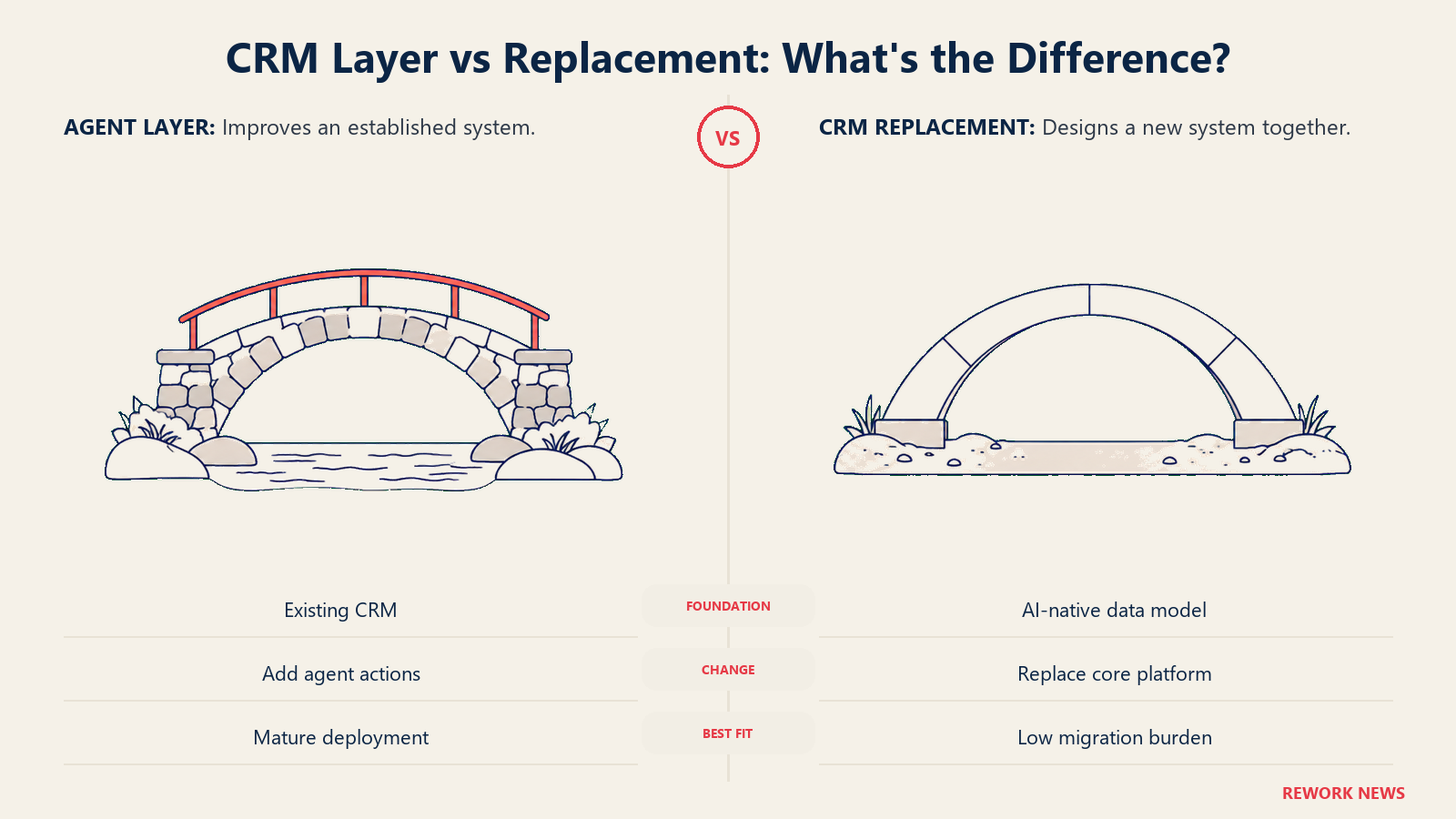
The "layer" model (Rox AI's bet): your CRM stores your most valuable sales data, including account history, contact relationships, deal progression, and communication records. The switching cost of migrating that data is enormous, and the risk of data loss or quality degradation during migration is real. The better answer is to plug AI agents into the existing system, where they can read and write CRM records, monitor accounts for signals, research new prospects, and automate work without requiring a platform change.
Rox AI's existing customers include Ramp, MongoDB, and New Relic, all companies with mature Salesforce deployments where a clean-slate replacement is essentially impossible. The agents are designed to surface risk signals in existing accounts, recommend next actions, and write the CRM records that reps currently fill in manually.
The "replace" model (Monaco's bet): if you're a company at an early enough stage, you don't have a CRM data problem yet. You have a CRM investment problem. You're about to spend years building a Salesforce configuration that requires a full-time admin, expensive consultants, and an integration layer that fights your reps rather than serving them. The better answer is an AI-native system where data model, workflows, and agent actions are designed together from scratch rather than bolted together over a decade.
Monaco's target buyer reflects this logic: early-stage companies where "migration cost" is low because there isn't much to migrate.
Why This Matters for Sales Ops Teams Right Now
The practical significance isn't necessarily "should we switch to Rox or Monaco." For most Sales Ops teams, the answer to that specific question is probably no. Contract timing, integration complexity, and budget cycles rarely align with a vendor's launch momentum.
The significance is strategic: the category is fracturing into clearly distinct models, and the evaluation criteria you use for one model don't transfer to the other. If you evaluate Rox AI the way you'd evaluate a new CRM (asking about data portability, admin complexity, and migration paths), you're asking the wrong questions for an agent-layer product. If you evaluate Monaco the way you'd evaluate an engagement add-on, you're also asking the wrong questions.
Getting the model right before the evaluation saves significant time and surfaces the real tradeoffs. A solid CRM buyer's checklist helps you structure those questions before a vendor demo dominates the agenda.
A 4-Point Evaluation Framework
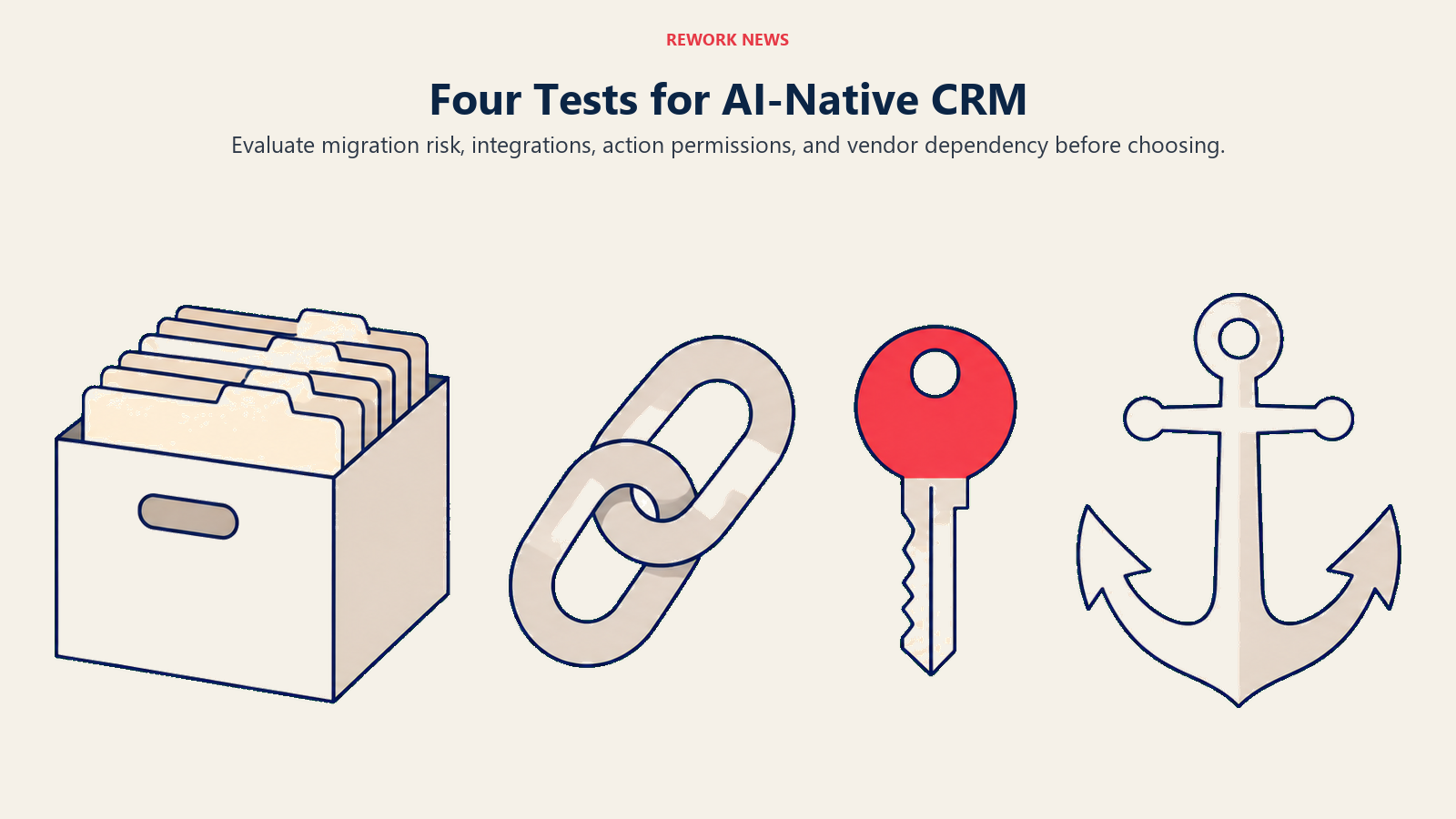
Four constraints determine whether an agent layer or a replacement CRM fits the current sales stack.
1. Data migration risk
The agent-layer model eliminates migration risk by design. Rox agents write to Salesforce records, so your existing data stays in place. The replace model requires migrating everything, and data migration quality is the leading cause of CRM project failure at every company size.
The honest question for a "replace" evaluation is: what's actually in your current CRM, is any of it worth migrating, and what does the migration process cost in time and money? Preparing data before a migration is often the step that reveals whether there's anything worth preserving. For companies that have spent years building bad Salesforce hygiene, the clean-slate argument makes real sense. There's nothing worth preserving. For companies with deep account history and relationship data, the migration risk is a real constraint.
2. Integration surface area
Agent-layer tools inherit every existing integration. Whatever connects to Salesforce today (your marketing automation, your CS platform, your billing system) continues to work after you add an agent layer. This is a meaningful advantage for companies with complex go-to-market stacks.
Replace-model tools start with zero integrations and build them out over time. Monaco is early-stage; its integration library is not at parity with Salesforce's. For Sales Ops teams whose CRM is the hub of a five- or six-tool stack, integration surface area is often the deciding constraint regardless of how good the native product is.
3. Agent action scope
Not all AI agents are created equal in terms of what they're allowed to do. The right governance question is: what decisions can the agent make autonomously, versus what requires human review before execution?
Rox AI agents write CRM records, meaning they're taking actions that change the source of truth for your sales data. That requires clear rules about which fields they write to, what triggers a write, and who can override. CRM workflow automation governance is directly relevant here: the same questions about trigger logic and field ownership apply whether the actor is a human rep or an AI agent. Monaco's agent model operates inside an AI-native data structure where the rules are built in from scratch, but those rules are also less battle-tested than a Salesforce deployment that's been running for years.
Either way, "AI agents touch CRM data" is a governance question that Sales Ops owns, not just a feature to evaluate.
4. Vendor dependency
The agent-layer model creates a new vendor dependency (Rox, or whichever agent platform you choose) without removing the existing one (Salesforce). You're now paying for two platforms, and the agent platform's value is entirely contingent on the underlying CRM staying in place.
The replace model reduces vendor count but concentrates dependency into a newer, less proven platform. A Monaco outage or acquisition event has broader impact than the same event at a tool that only writes meeting summaries.
Neither model avoids dependency. But the type of dependency matters, and it maps differently to your company's risk tolerance.
Two Scenarios: When to Choose Which
Company stage changes the balance between migration cost and the value of a fresh data model.
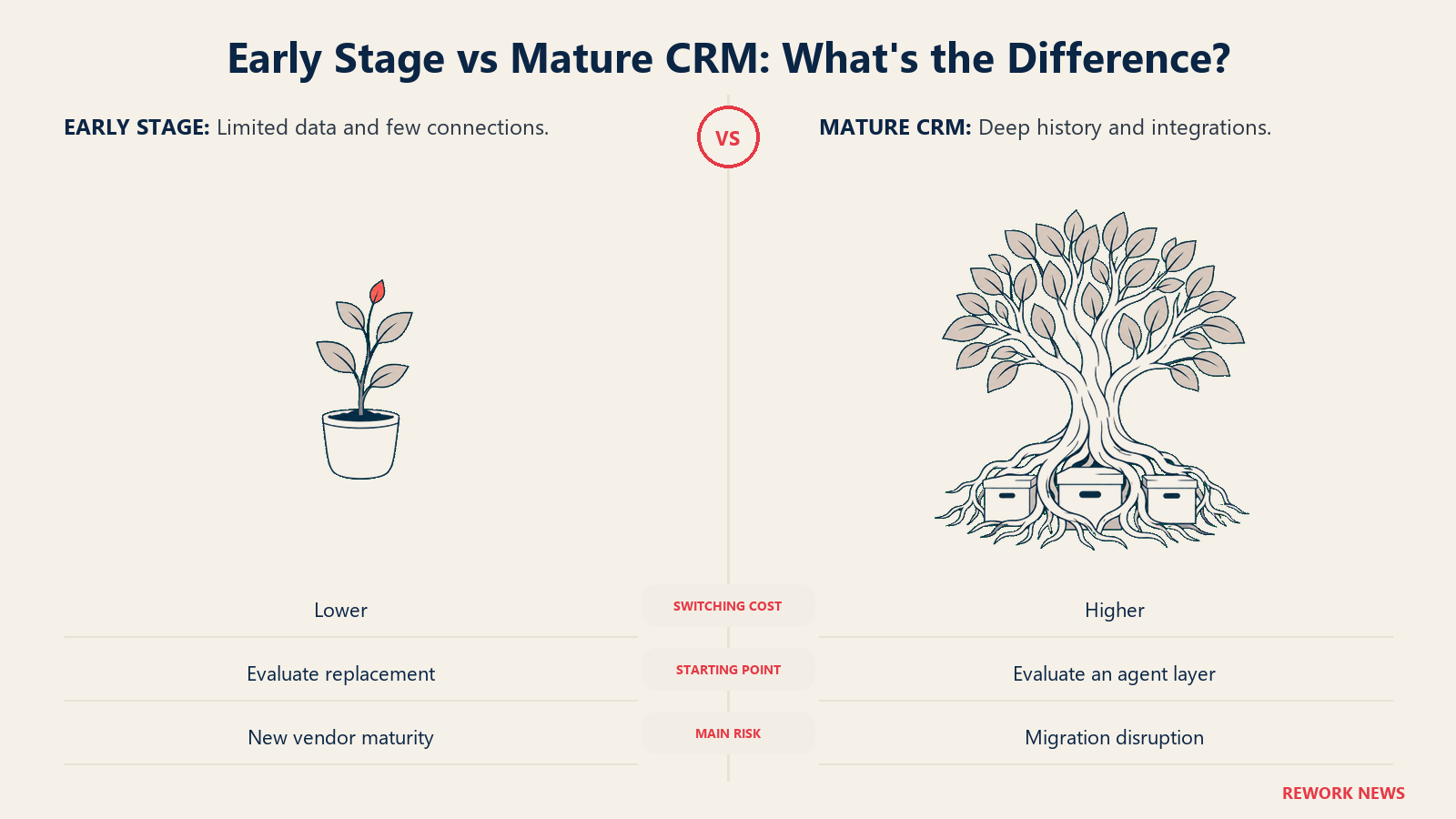
Scenario A: Series A-B company, 5-30 person sales team, currently in a Salesforce trial or HubSpot starter tier
The replace model deserves serious evaluation here. Migration cost is low, integration complexity is limited, and the opportunity to design your data model for AI from the start has compound value over the next three to five years. The tradeoff is betting on a newer vendor before the product is fully proven, which is manageable at this company stage where flexibility is higher.
Scenario B: Growth-stage or enterprise company, 30+ reps, Salesforce with 3+ years of data and multiple integrations
The layer model is almost certainly the right starting point. The migration cost of replacing a mature Salesforce implementation is a multi-quarter operational project that consumes RevOps bandwidth and creates data quality risk. An agent layer that improves what your reps do with existing CRM data, without touching the integration stack or requiring data migration, is a lower-risk path to AI impact.
The exception: if your Salesforce configuration is so broken that a migration would actually improve data quality rather than risk it, the cost-benefit changes. That's a question for a CRM audit, not a vendor demo. Where you sit on the RevOps maturity model is often the clearest signal for which path makes sense.
What to Add to Your Next Stack Review Agenda
Before your next sales stack review, run one analysis that doesn't require talking to a vendor: map the tools in your current stack that AI-native CRM vendors claim to replace or enhance, and score each on switching cost (high/medium/low) and data quality (clean/noisy/incomplete).
That map, not a demo or a G2 review, is what should anchor a real evaluation. And if you're re-thinking how your sales team is structured around the stack, sales org design as a growth lever is worth reading alongside this one. Rox AI at $1.2B valuation and Monaco out of stealth are both signals that the category is moving. But market momentum is not a purchasing decision. Your current stack, its switching costs, and your company's stage are.
Learn More
- A $1.2B CRM-Killer at $8M ARR: CEO Strategy: The CRO-level read on Rox AI's valuation and what it means for the incumbent CRM market
- Rework vs. Salesforce: Comparison guide for teams evaluating whether to layer or replace their current CRM
- CRM Buyers Checklist: The evaluation framework for making a disciplined layer-vs-replace decision
- Sales Org Design as a Growth Lever: How your stack decision connects to how you structure the sales team around it
Source: TechCrunch: Rox AI $1.2B Valuation | TechCrunch: Monaco Launch
