More in
Sales Tech News
AI Sales Teams Grow 2.6x Faster. Gartner Says Buyers Still Want a Rep
Jun 6, 2026
Aircall Bought Piper AI to Turn Every Sales Call Into Pipeline
Jun 6, 2026
Salesforce Just Handed Marketers AI Agents That Build Sales Pipeline
Jun 6, 2026
Revenue Intelligence Showed You the Risk. Revenue Execution Acts on It.
Jun 5, 2026
Meta Put an AI Agent in WhatsApp That Closes Sales for Any Business
Jun 4, 2026
VCs Poured Over $200M Into AI Sales Startups: The GTM Stack Signal
Jun 4, 2026
Are AI SDRs Worth It in 2026? The Data Says Build a Hybrid Team
Jun 3, 2026
GTM Engineering in 2026: The Sales Hire That Replaces Three Roles
Jun 3, 2026
ZoomInfo Feeds Verified Data to Your AI Sales Agents: The Single-Vendor Tradeoff
Jun 3, 2026
Salesforce Summer '26 Drops Multi-Agent Orchestration June 15. Here's the Sales Ops Audit Before Your Agents Start Handing Off
Jun 2, 2026
When Your Data Vendor Becomes Your Engagement Platform: Evaluating Apollo's Agentic Shift
Turn this article into takeaways for your work.


Each assistant summarizes the article only for you and suggests best practices for your work.
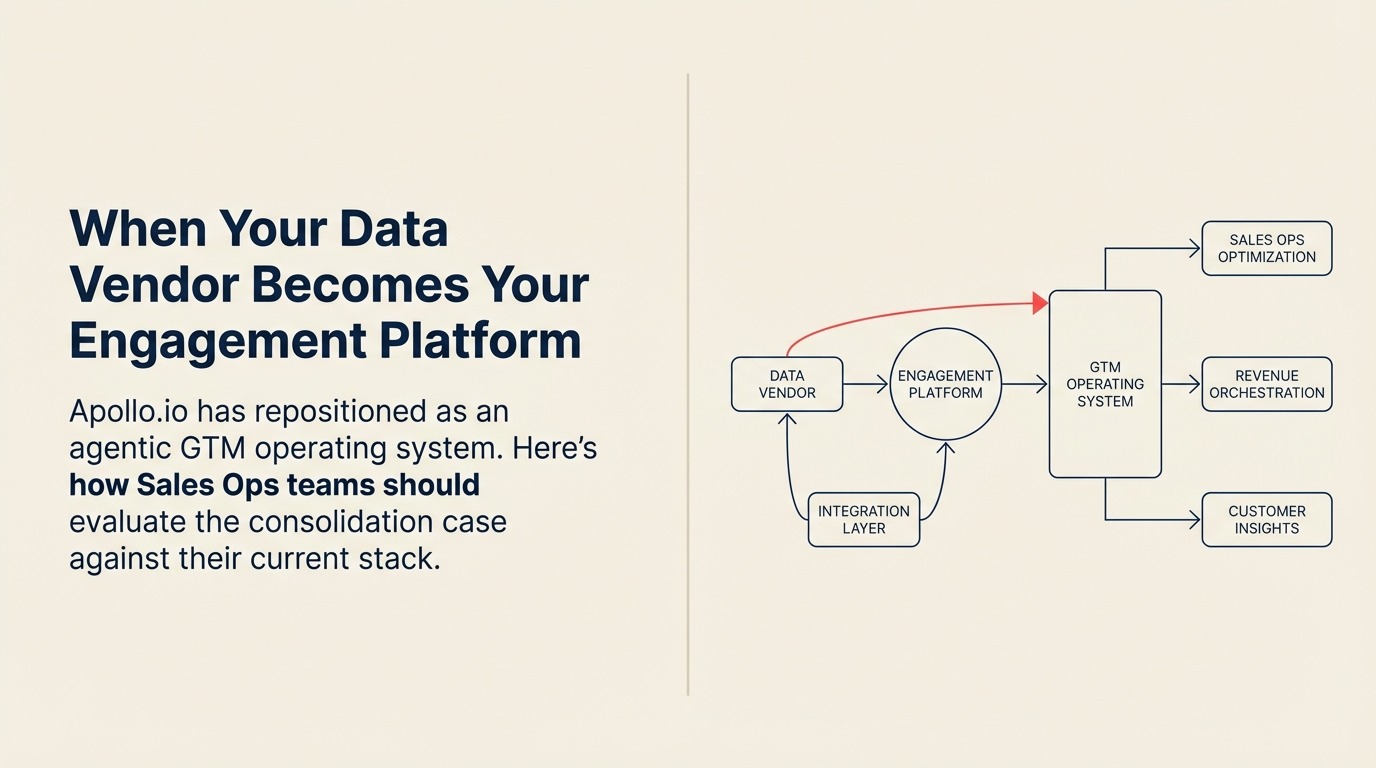
For most Sales Ops teams, Apollo.io meant one thing: contact data and prospecting lists. That's changing fast. According to Solutions Review, Apollo has relaunched its identity around what it calls a fully agentic GTM operating system, a platform that bundles data enrichment, outbound sequences, AI-generated messaging, and workflow automation into a single product. The pitch is consolidation. The question is whether the platform actually delivers it.
This evaluation matters beyond Apollo. It's the same calculus any team should run when a vendor expands its scope, which is exactly what the CRM comparisons landscape is forcing on buyers right now.
This shift isn't unique to Apollo. ZoomInfo has been moving in the same direction for the better part of two years, layering engagement features onto its data foundation. What's different about Apollo's move is the speed and the leadership signal behind it. Solutions Review reported that the company brought in Matt Curl as CEO in early February 2026, with founder Tim Zheng stepping into a chairman role. New outside CEOs at product-led growth companies typically signal one thing: a move upmarket, with enterprise-grade packaging and pricing to match.
The practical question for Sales Ops isn't whether Apollo's repositioning is credible. It's whether your current stack still makes sense, and whether this is the right moment to revisit that question seriously.
What the Category Consolidation Actually Looks Like
Sales technology has historically been purchased in layers. A company buys a data vendor for prospecting lists and enrichment. It buys a sales engagement platform for sequencing and outreach. It buys a revenue intelligence tool for call recording and deal forecasting. Each tool solves a distinct problem, and each generates its own data silo. Understanding which tool owns which job is foundational to good lead data management, and it's exactly what consolidation pitches tend to obscure.
What Apollo, ZoomInfo, and several of their peers are building toward is a collapse of those layers. Enrichment, sequencing, AI-generated email, and meeting booking are all now bundled inside Apollo's platform. Salesloft has partnered with AI-led growth platforms to extend its capabilities further. The category boundaries Sales Ops teams used to rely on when building a stack (data here, engagement there, intelligence somewhere else) are blurring, the same convergence Gartner formalized as Revenue Action Orchestration.
The implication isn't that every multi-vendor stack should be consolidated immediately. It's that the evaluation criteria you used three years ago may no longer reflect what the market offers now.
The Consolidation Case: What's Getting Easier to Make
Apollo reports roughly 20,000 users running end-to-end agentic workflows through its AI Assistant. The company claims users of the feature are 36% more likely to book meetings in their first 14 days of use. These figures come from Apollo's own marketing materials and need to be treated as such. More on that in a moment.
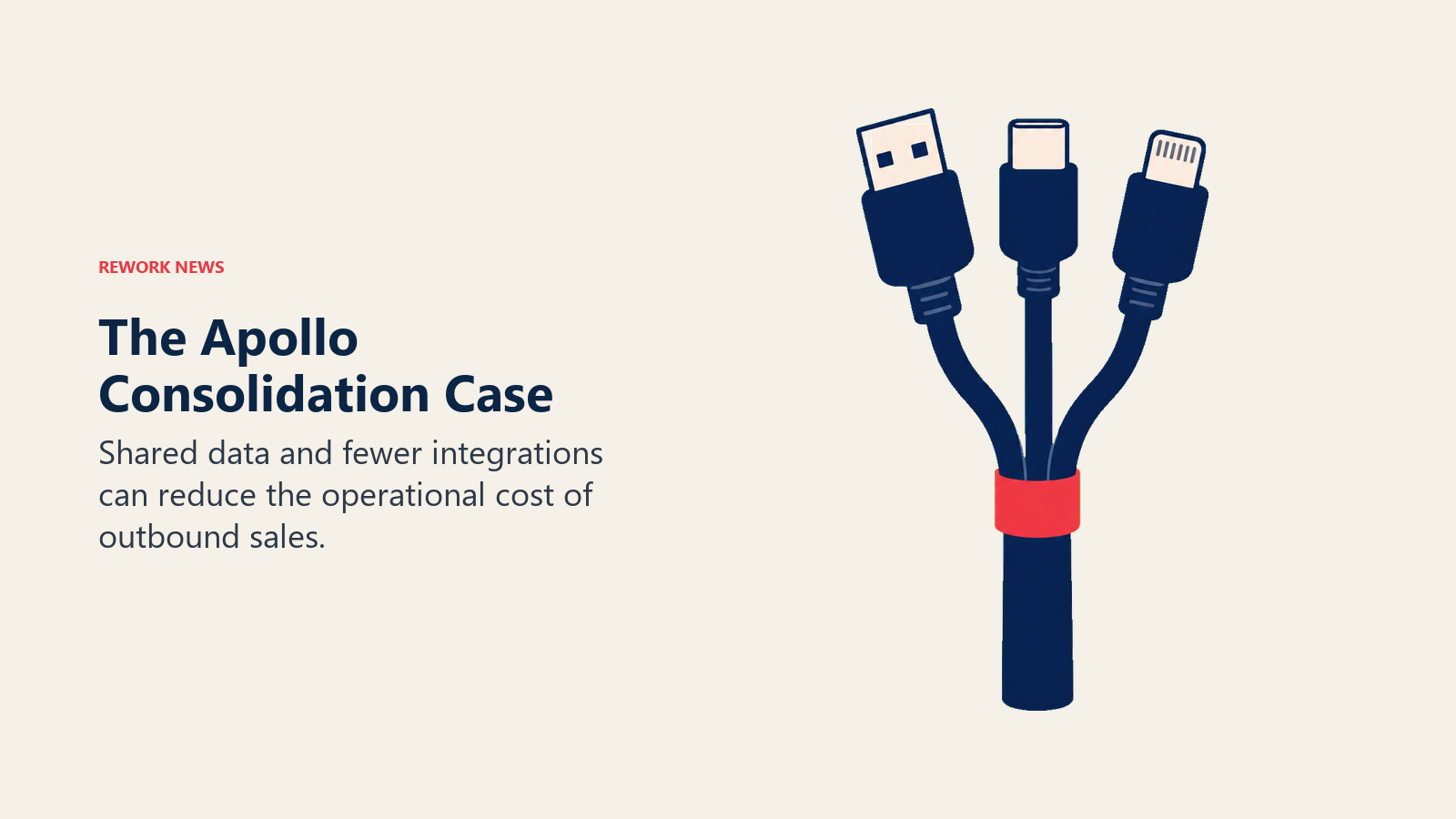
The genuine consolidation argument has a few real components. Fewer vendors means fewer contracts to manage, fewer integrations to maintain, and fewer CRM sync points to troubleshoot. If Apollo does data enrichment and outbound sequencing at comparable quality to your current separate tools, the operational savings are real.
A unified platform also means shared data context. When enrichment data and engagement data live in the same system, the AI has more signal to work with when generating outreach. The cross-tool data quality problems that plague multi-vendor stacks (contact enrichment from one source, activity data from another, attribution from a third) either shrink or disappear.
And the switching cost argument runs both ways. Yes, consolidating now means migration effort. But consolidating later, after Apollo has raised prices and locked in enterprise contracts, may cost more. If the category is moving toward fewer, larger platforms, early evaluation beats reactive migration.
The Consolidation Case: What Needs Honest Scrutiny
The 36% more meetings stat deserves careful handling. It's a marketing-reported metric from a self-reported population of early adopters, not a controlled trial against your current stack. First-14-days numbers also tend to reflect novelty effects as much as genuine workflow improvement.
If you run a pilot (and you should before making any consolidation decision) design it to test against your actual current tools under your actual conditions. A few principles for doing this honestly:
Match against actual current performance. Pull your current meeting booking rate per rep per month before running any Apollo comparison. Don't let Apollo's benchmark become your baseline.
Run it with average reps, not top performers. AI-assisted sequencing tends to raise the floor more than it raises the ceiling. The relevant question is whether mid-tier reps get meaningfully better, not whether your top closers do.
Measure data quality, not just output. If contact enrichment accuracy isn't benchmarked separately, you won't know whether you're getting better meetings or just more of them.
Negotiate contract flexibility before committing. Any vendor expanding its platform footprint aggressively is likely moving toward annual or multi-year contracts. Pilot agreements that lock you into longer terms defeat the purpose of evaluation.
A Framework for the Evaluation Decision
Before deciding whether Apollo's platform (or any consolidating data-plus-engagement vendor) warrants serious consideration, work through these questions:
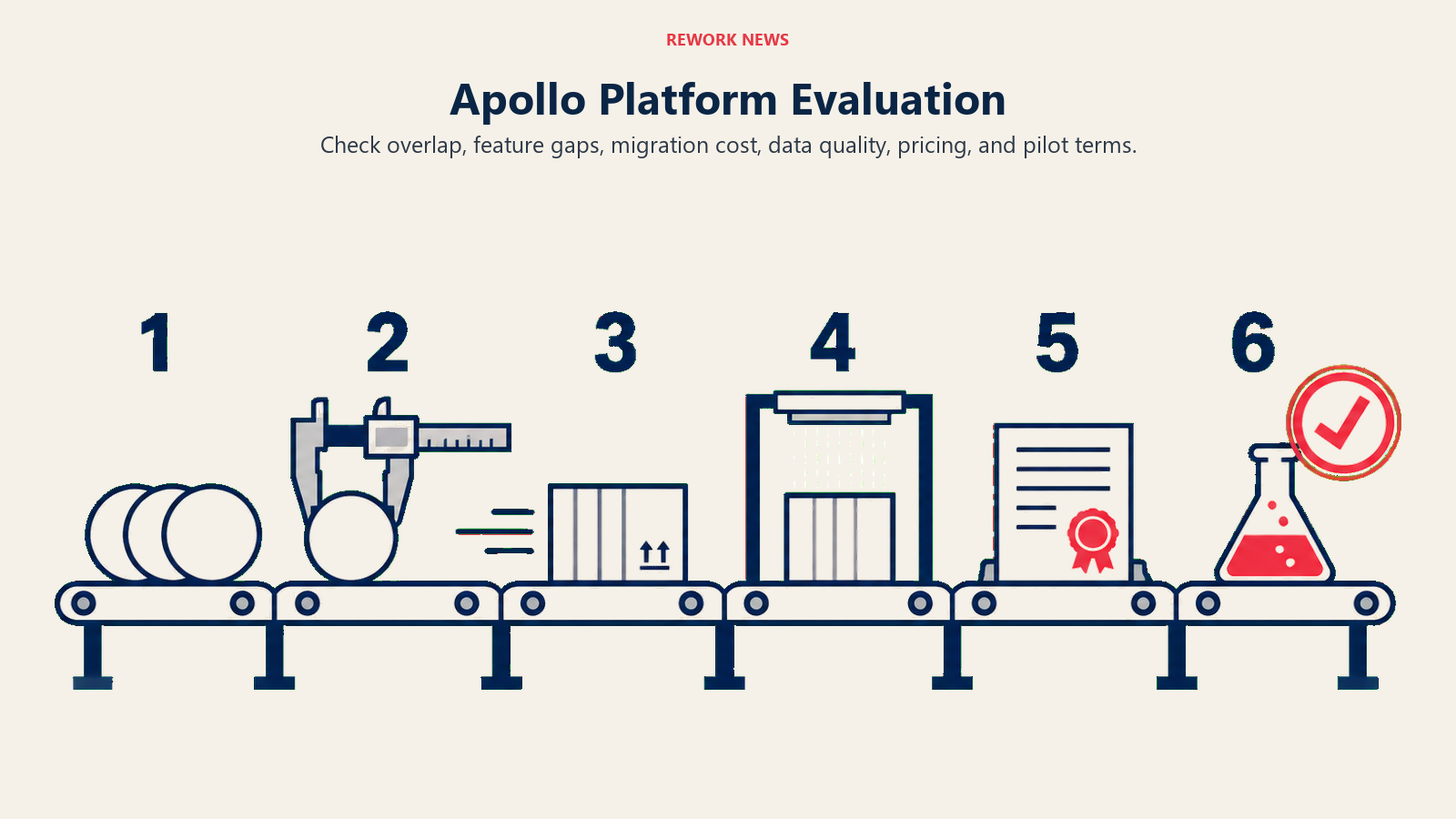
1. What does your current stack actually overlap? List every tool you're paying for that Apollo claims to replace. For most mid-market companies, this is at minimum a data enrichment vendor, a sales engagement platform, and possibly a basic AI writing tool for outreach personalization. Quantify the combined annual cost.
2. How far apart is Apollo on feature parity? Apollo's sequencing and AI outreach features are maturing, but they're not at feature parity with Outreach or Salesloft in every dimension. Identify the two or three capabilities your team relies on most heavily (automated branching sequences, call logging, CRM workflow triggers) and test those specifically.
3. What's the real migration cost? The sticker price of switching is usually the smallest component. Factor in rep retraining time (estimate conservatively: 10-15 hours per rep for a tool this central to their workflow), CRM data migration and field mapping, integration rebuild time, and the productivity dip during transition.
4. What's your data quality baseline? Apollo's AI outputs are only as good as the contact and account data feeding them. If your current CRM data is messy, consolidating onto a platform that automates against that data doesn't clean the data. It scales the errors. A structured lead data enrichment process is the prerequisite work that makes any AI-assisted platform actually function. It's the same dependency that surfaces with per-account revenue agents, where the agent is only as smart as the account data underneath it.
5. What does the new CEO signal for pricing? Bringing in an outside CEO with a mandate to drive enterprise growth typically precedes pricing model changes. If Apollo's current pricing is part of the consolidation math, check whether those rates are contractually locked before any significant commit.
6. Can you pilot without committing? A genuine pilot means no long-term contract, no deep CRM integration, and a clean comparison period. If the vendor won't offer that structure, the consolidation conversation isn't as far along as the marketing suggests.
What This Means for the Broader Stack Conversation
Apollo's positioning change is a symptom of a larger category dynamic, not a one-vendor story. Companies that built sales tech stacks in 2019 or 2020 (typically five to eight vendors, each solving a discrete problem) are now looking at markets where two or three platforms claim to cover the same ground. The parallel story in the CRM space is Salesforce moving the same direction. The Salesforce Momentum acquisition piece covers what that consolidation looks like in practice.
That's not necessarily bad news. If the platforms have actually matured, consolidation economics improve. If they haven't, the consolidation pitch is just a product roadmap dressed up as marketing.
Salesloft's partnership with 1mind, an AI-led growth platform, shows the same dynamic from a different angle. Engagement vendors are reaching for more of the stack too, not just data vendors. Every category is expanding toward the center, and the question for every Sales Ops team is the same: at what point does your current multi-vendor setup become harder to justify than a consolidated alternative?
The honest answer depends on team size, how deeply you've integrated existing tools, and how much switching cost you can absorb. But the answer is getting harder to defer.
What to Do This Week
The consolidation conversation is worth having now, before it becomes urgent. Here's a concrete starting point:
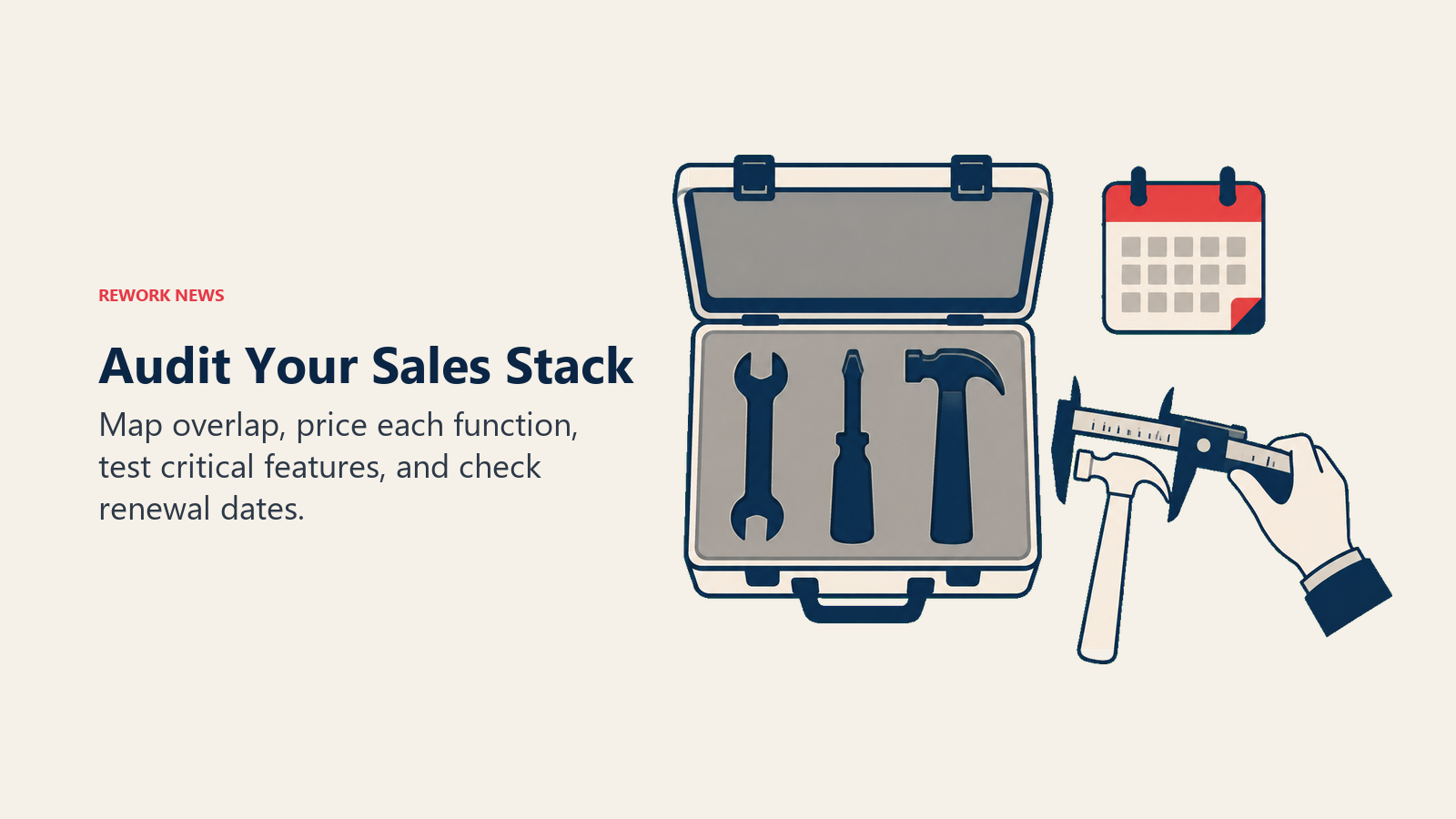
Audit the overlap first. Pull a list of every tool in your current stack and map what Apollo (or any bundled competitor) claims to replace. Don't start with pricing. Start with the feature overlap map.
Quantify current spend by function. What are you paying, per year, for data enrichment? For sales engagement? For AI writing assistance? For meeting booking tools? Get a real number before you run any vendor comparison.
Schedule a feature gap review. Pick the three capabilities your team would be most reluctant to lose and test those specifically in any evaluation. Not a general demo. A structured feature test against your actual use cases.
Check your current contracts. If you're six months out from renewal on a key stack vendor, this is the right window to run a parallel evaluation. Don't make a consolidation decision under contract pressure.
Talk to your reps. The tools reps actually use versus the tools in the official stack often diverge. Before evaluating a new platform, understand what adoption actually looks like in your current one.
Learn More
- ZoomInfo Is Now $GTM: What Your Sales Stack Evaluation Just Got More Complicated, The parallel data vendor consolidation story worth reading alongside Apollo's move
- Rework vs. HubSpot CRM, CRM comparison guide for teams evaluating platform consolidation
- CRM Buyers Checklist, How to structure your evaluation before any consolidating vendor locks you into a contract
- Sales Org Design as a Growth Lever, How stack consolidation decisions connect to org design choices
Source: Solutions Review, Top Martech News from the Week of March 6th
