More in
Sales Tech News
AI Sales Teams Grow 2.6x Faster. Gartner Says Buyers Still Want a Rep
Jun 6, 2026
Aircall Bought Piper AI to Turn Every Sales Call Into Pipeline
Jun 6, 2026
Salesforce Just Handed Marketers AI Agents That Build Sales Pipeline
Jun 6, 2026
Revenue Intelligence Showed You the Risk. Revenue Execution Acts on It.
Jun 5, 2026
Meta Put an AI Agent in WhatsApp That Closes Sales for Any Business
Jun 4, 2026
VCs Poured Over $200M Into AI Sales Startups: The GTM Stack Signal
Jun 4, 2026
Are AI SDRs Worth It in 2026? The Data Says Build a Hybrid Team
Jun 3, 2026
GTM Engineering in 2026: The Sales Hire That Replaces Three Roles
Jun 3, 2026
ZoomInfo Feeds Verified Data to Your AI Sales Agents: The Single-Vendor Tradeoff
Jun 3, 2026
Salesforce Summer '26 Drops Multi-Agent Orchestration June 15. Here's the Sales Ops Audit Before Your Agents Start Handing Off
Jun 2, 2026
Salesforce Can Now Pull Your Zoom Calls Into the CRM: What RevOps Needs to Audit First
Turn this article into takeaways for your work.


Each assistant summarizes the article only for you and suggests best practices for your work.
Salesforce completed its acquisition of Momentum on March 2, 2026, and the operational implications for RevOps are starting to come into focus. According to Salesforce Ben's reporting on the deal, Momentum is a call intelligence platform that captures voice and video data from Zoom, Google Meet, and other meeting tools, then converts that unstructured conversation data into structured CRM intelligence. The integration target is Agentforce 360 and Slack, meaning call summaries and insights are intended to flow directly into agentic workflows, not just into static record notes.
For RevOps teams running Salesforce, this is worth paying attention to, and not only because of what it enables. The manual data entry problem (the persistent gap between what happens on sales calls and what actually gets logged in CRM) is a known source of bad pipeline data. Momentum closes that gap at the ingestion layer. But solving an old problem at scale tends to surface new ones. The governance questions this raises are nearly identical to those the HubSpot Breeze governance framework lays out: different vendor, same structural challenge. When AI transcription and summarization start populating CRM records automatically, the governance questions shift rather than disappear.
Per Salesforce's official announcement, the acquisition is signed and complete. The full product integration timeline hasn't been published, which means planning now is preparation work, not an implementation sprint.
What Momentum Does and Why It Matters for the CRM Data Problem
The core value of call intelligence tools is simple: sales conversations contain operationally valuable information (objections raised, commitments made, competitive mentions, timeline signals) and most of it never makes it into CRM records in a usable form. Reps skip the post-call update, write notes too vague to act on, or forget the details before they get to it. That post-call gap is one of the main reasons lead response time degrades in practice: the intent is there but the logging never happens.
Momentum addresses this by capturing the call directly. Zoom and Google Meet sessions are recorded and processed; AI transcription converts audio to text; summarization layers extract key points and structure them for CRM consumption. The output is a structured record of what happened, not a rep's post-call recollection.
The Agentforce integration takes this further. Rather than just logging summaries as notes, call intelligence is intended to feed into Agentforce's agentic workflows, enabling agents to reason about deal context, coaching opportunities, and next-step recommendations using actual call data, not just manually entered pipeline fields.
Salesforce Ben notes the strategic context clearly: this is part of a broader acquisition pace that has seen Salesforce add a native content engine to Agentforce and complete ten deals in the past six months, with Momentum being the second in 2026 following Cimulate, an agentic commerce startup. Agentforce is growing fast. Its most recent quarterly figures showed ARR up 169% year-on-year, with deal volumes increasing 50% quarter-on-quarter in Q4. This isn't a side bet. It's the primary growth driver, and Momentum is infrastructure for it.
Forrester also published commentary on the acquisition's strategic implications, noting that the move fills a significant data gap in Salesforce's existing AI capabilities.
The New Risk Set That Call Data Introduces
Solving the CRM data entry problem via AI transcription is a real improvement. But unstructured voice data processed by AI introduces error modes that manually entered data doesn't. RevOps teams should go in clear-eyed about both the benefits and the new operational risks.
Transcription accuracy isn't uniform. AI transcription performs well on clear audio with standard vocabulary. It degrades on technical jargon, accented speech, crosstalk, and poor audio quality. If your sales team sells a technical product with proprietary terminology, the transcription error rate may run higher than vendor benchmarks suggest.
Summarization introduces interpretation. A human writing a post-call note can distinguish between what was said and what was implied. AI summarization condenses and interprets, and it doesn't always get that distinction right. A prospect saying "that's interesting, let me think about it" may be summarized very differently than one saying "let's move forward." That gap can narrow in ways that affect deal stage accuracy if a rep accepts the summary without reviewing it.
Misattribution in multi-party calls is a real risk. Discovery calls, demos, and technical evaluations often involve multiple speakers on both sides. AI transcription does its best to attribute comments to the right speaker, but speaker diarization is an imperfect technology. Objections can get attributed to the wrong contact; commitments logged under the wrong rep.
Call data introduces new retention considerations. Voice recordings sit in a different data category than CRM fields. Depending on your customers' jurisdictions and your own policies, storing recorded calls in a Salesforce-connected system may raise questions your legal or compliance teams haven't addressed yet.
None of these are reasons to avoid the integration. They're reasons to build a governance framework before enabling it in production.
A RevOps Preparation Checklist
Before the Salesforce-Momentum integration goes live in your environment, work through this checklist:
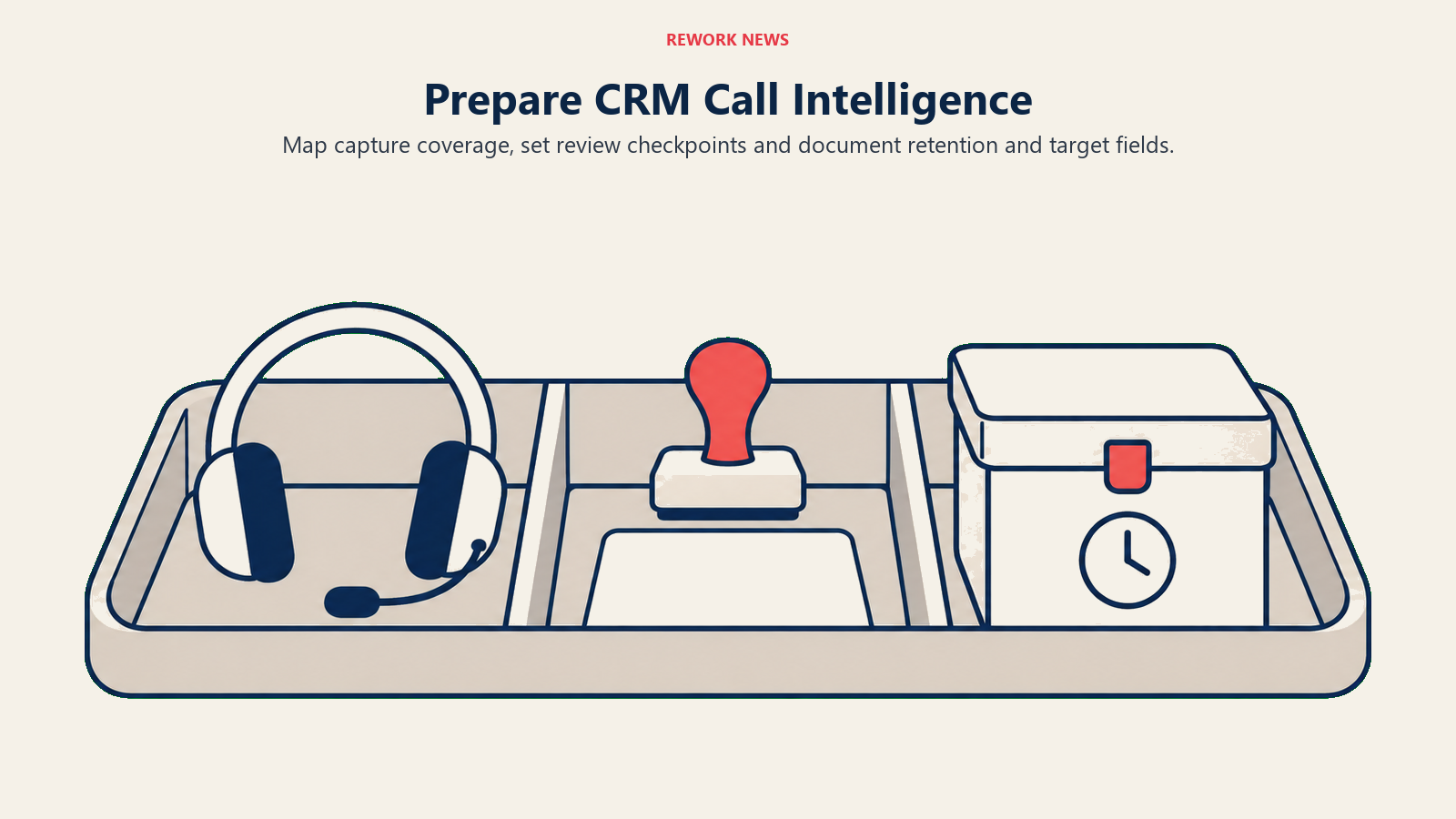
1. Document your current call data flow. How do sales calls currently get logged in your CRM? Which reps use Zoom versus Google Meet versus other tools? Is there a legacy dialer or proprietary call recording system in use? The integration won't capture calls from platforms it doesn't connect to, which means your call data completeness will depend on how uniform your team's tooling actually is.
2. Establish human review checkpoints for AI-generated summaries. Decide in advance whether AI-generated call summaries are treated as auto-approved for CRM logging or as first drafts that require rep confirmation. This isn't a binary choice. You can configure different review requirements for different field types or deal stages. But you should have a policy before the feature is live, not after.
3. Set expectations with reps before deployment. Reps need to know that call data is being captured, how it will appear in their CRM records, and what they're responsible for reviewing. Discovering after the fact that AI summaries have been logging to deals without their knowledge is a trust problem, and it's avoidable with a one-page communication before rollout.
4. Check vendor data retention policies for call recordings. What data does Momentum retain? For how long? In which regions? What happens to call recordings if your organization ends its Salesforce contract? These questions should go to your Salesforce account team before enabling the integration, not after a legal team finds a gap in your data handling documentation.
5. Identify which CRM fields the integration will populate. When call intelligence flows into CRM records via Agentforce, which fields does it write to? Activity notes? Custom fields? Deal stage? The answer matters for downstream reporting. If Agentforce-generated data populates fields that feed pipeline forecasting or commission calculation, the accuracy of those outputs now depends on the accuracy of AI transcription and summarization. Keeping a clean lead status management process is what makes those fields trustworthy in the first place.
6. Map your non-Zoom/Meet call volume. The Momentum integration is built around Zoom and Google Meet. If a portion of your team uses a legacy VoIP system, a proprietary enterprise dialer, or records calls in a different platform, those calls won't be captured. Before assuming call data completeness, understand what proportion of your team's call volume actually runs through the supported platforms.
The Agentforce Context Matters for Budget Decisions
The Momentum acquisition doesn't exist in isolation. It's one piece of a larger Agentforce buildout that Salesforce is executing quickly. The ARR trajectory ($800 million with 169% year-on-year growth) and the acquisition pace both signal that Agentforce isn't a feature layer on top of the existing CRM. It's becoming the primary product surface.
That matters for RevOps teams making platform investment decisions. If your organization is on Salesforce and hasn't made a deliberate decision about Agentforce adoption, the window for passive non-engagement is closing. Each acquisition Salesforce makes (call intelligence, commerce agents, and likely more) tightens the integration between platform layers in ways that make partial adoption increasingly awkward. Teams actively weighing whether Salesforce still fits their needs should look at the CRM comparison guides before the platform complexity deepens further.
The practical implication isn't necessarily to adopt Agentforce right now. It's to make an active decision rather than a default one. Does your team's roadmap include Agentforce deployment in 2026 or 2027? If yes, what data readiness work needs to happen first? If no, what's the plan when CRM features reps depend on start requiring Agentforce agents to function?
The Momentum acquisition accelerates the timeline on that conversation. Call intelligence flowing into CRM records is a concrete, rep-facing capability. When it ships, reps will notice, managers will ask questions, and CROs will want answers. RevOps teams that have already mapped the governance requirements will be in a much better position than those reacting on the fly.
What to Do This Week
The integration timeline isn't public yet, which means this is a planning window, not an implementation sprint. Use it:
Map your current call capture process. Where does call data currently live, and how does it get into CRM? Document the gaps: calls that aren't captured, reps who don't log, deal stages where activity logging drops off. The Momentum integration will fill some of those gaps and leave others. Understanding the current state tells you what to expect.
Inventory your call platform coverage. Pull a list of which tools your reps use for external calls. Zoom, Google Meet, and other supported platforms will be captured. Everything else won't be. Quantify the coverage gap before assuming the integration solves the full data entry problem.
Flag the data retention question for your legal or compliance contact. You don't need an answer this week, but you need the question on their radar. Call recording data in a CRM context has implications for data handling policies that are easier to address before deployment than after.
Open a conversation with your Salesforce account team about integration timelines. Salesforce hasn't published a product integration schedule for Momentum. Your account team may have roadmap details that aren't public. Knowing whether this is a Q3 2026 feature or a 2027 deliverable significantly affects when you need governance work completed.
Review your Agentforce configuration and enabled features. If Agentforce is already active in your environment, audit which features are enabled, which fields agents can write to, and whether your current approval controls reflect your governance policy. The Momentum integration will add new agent capabilities to an existing foundation. Knowing what that foundation looks like today is prerequisite work.
Learn More
- Salesforce Just Solved CRM's Oldest Data Problem, The broader RevOps implications of the Momentum acquisition
- Your Meetings Are Now a Programmable Data Source, How meeting intelligence APIs are becoming infrastructure for AI agents
- CRM Workflow Automation, How to structure workflows before call intelligence feeds into Agentforce
- Rework vs. Salesforce, CRM comparison for teams evaluating their platform options as Salesforce expands its AI footprint
Source: Salesforce Ben, Salesforce Acquires Momentum to Power Agentforce with Zoom and Google Meet | Salesforce Official Announcement | Forrester Analysis
