More in
Sales Leadership Insights
Why Sales Org Design Is the Most Under-Rated Growth Lever
Mar 16, 2026 · Currently reading
What Great Sales Leaders Actually Do in Their First 90 Days
Mar 10, 2026
Why Sales Retention Is the New Sales Hiring
Feb 4, 2026
Forecasting Discipline: What Separates 90% Callers from 50% Callers
Jan 19, 2026
Why Sales Org Design Is the Most Under-Rated Growth Lever
Turn this article into takeaways for your work.


Each assistant summarizes the article only for you and suggests best practices for your work.
Every serious growth conversation in B2B SaaS eventually cycles through the same short list: pipeline volume, product-market fit, pricing strategy, and go-to-market motion. These are real levers. They deserve serious attention.
But there's a structural decision that shapes all of them and almost never gets discussed until it's already broken. Who reports to whom. How territory is carved. Whether you've split inbound and outbound or kept them unified. How the SDR-to-AE handoff works, and who owns the consequences when it doesn't. Whether your CRM hierarchy reflects your actual selling motion or contradicts it in ways nobody has named.
Org design. It's the variable that compounds for years in either direction, and most sales leaders treat it as an administrative afterthought until attrition spikes, quota attainment drops, and everyone starts blaming each other across invisible structural fault lines.
The invisible tax of wrong structure
Structural misalignment has a cost, but it's diffuse enough that nobody owns it. It shows up as CRM data that nobody trusts because reps in different roles use the same fields differently. As forecast variance that seems like a rep problem until you notice it clusters in one segment or region. As cross-team friction where SDRs and AEs have adjacent incentives that quietly pull apart.
When your org design is wrong, accountability becomes genuinely murky. If an AE misses quota in a territory that was structurally disadvantaged from the start, is that a performance problem or a design problem? Most sales leaders call it a performance problem because that's a cleaner answer. The design question goes unasked.
This shows up in CRM hygiene too. Companies using Salesforce or HubSpot often discover their pipeline data is unreliable not because reps are lazy about updates but because the account hierarchy, territory mapping, and stage definitions were built for a structure that no longer matches how the team actually operates. The tool reflects the old org. The team works in the new one. Neither is wrong in isolation, the gap between them is the problem. Rebuilding that alignment starts with understanding how your CRM data model is designed and whether it still maps to your actual GTM motion.
Three org models and when each breaks
There's no universally correct sales org structure. But each model has a breaking point, and knowing where it breaks helps you catch it before it does.
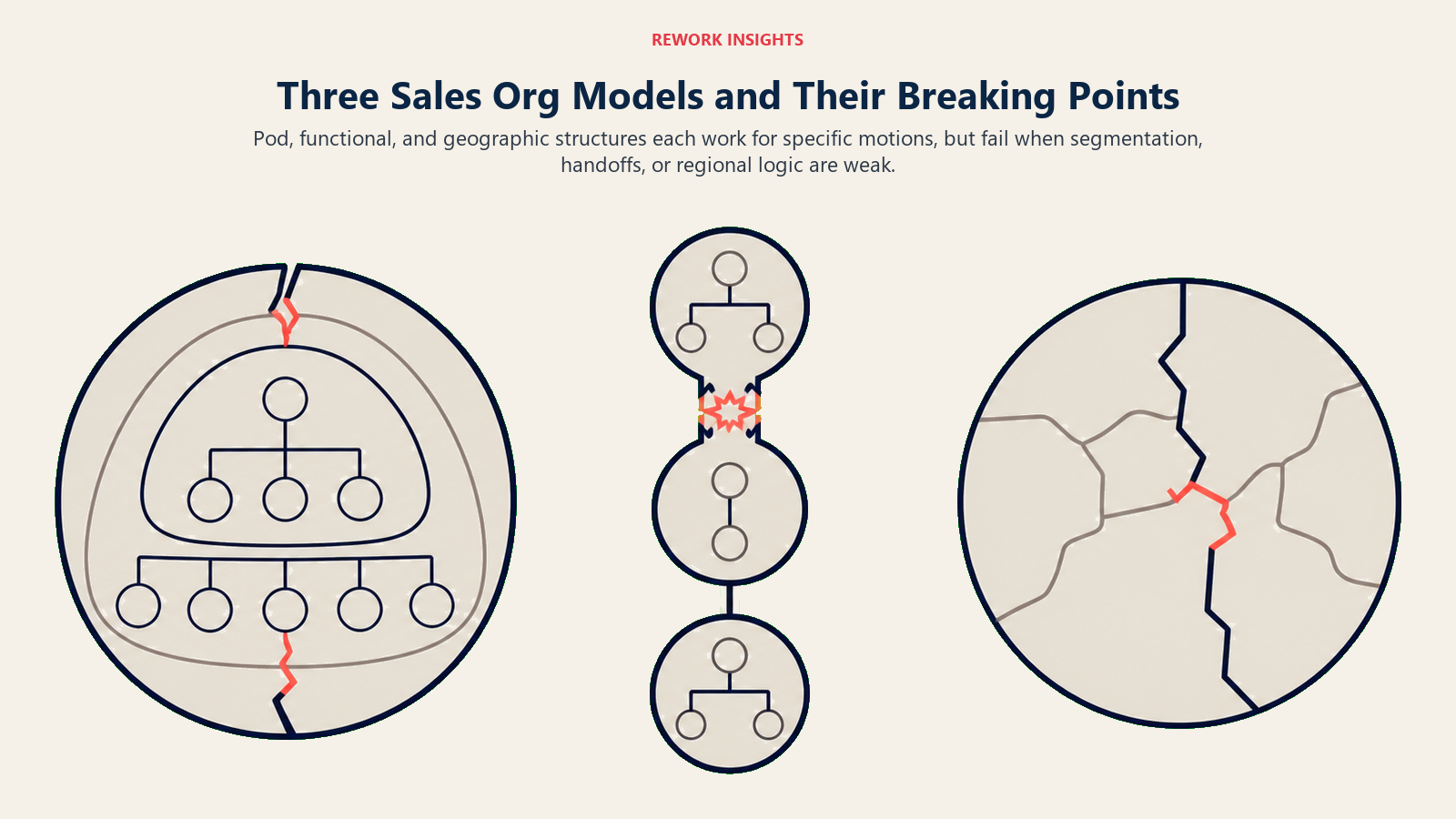
The pod model (segment-based teams) organizes reps around customer segments (usually SMB, mid-market, and enterprise) with their own SDR support, AEs, and sometimes dedicated CSMs. This works well when segments genuinely have different buying motions, different value props, and different success criteria. It breaks when the segments aren't actually distinct. McKinsey's research on B2B sales-force design found that pod-model implementations that don't map to genuine customer-segment differences consistently underperform single-structure teams within 18 months. If your SMB team and your mid-market team are selling the same product to companies that are 99 employees versus 101 employees, you've created artificial separation. Pod models also fail when they're built to mirror internal org charts rather than customer needs, which happens more than anyone admits.
The functional model (the classic SDR-AE-CSM split) is the most common structure in SaaS. It aligns specialization across prospecting, closing, and expanding with dedicated roles. It breaks when the handoffs become the bottleneck. The SDR-to-AE handoff in particular is a system stress test. When it works, you get clean qualification and fast progression. When it breaks (and it breaks in predictable ways) you're usually looking at misaligned incentives (SDRs paid on meetings, AEs paid on closed ARR, with nobody accountable for the gap between), unclear qualification criteria, or two teams that have never actually discussed what "ready for AE" means in practice.
The geographic model organizes teams by region and makes sense when territory coverage genuinely matters: field sales, regulated industries, or markets where in-person relationships drive deals. It breaks when geographic assignment becomes a proxy for other variables nobody wants to address directly. "We're going to build out EMEA" sometimes means "we're creating geographic distance from a problem we haven't solved in the US market."
The SDR-AE handoff as a canary
The SDR-to-AE handoff deserves specific attention because it's where org design problems become visible first.
When this handoff is working, the transition feels invisible to the buyer. The AE who picks up a qualified opportunity already knows the prospect's context, their stated pain, and what prompted the outreach. The deal progresses without a reset.
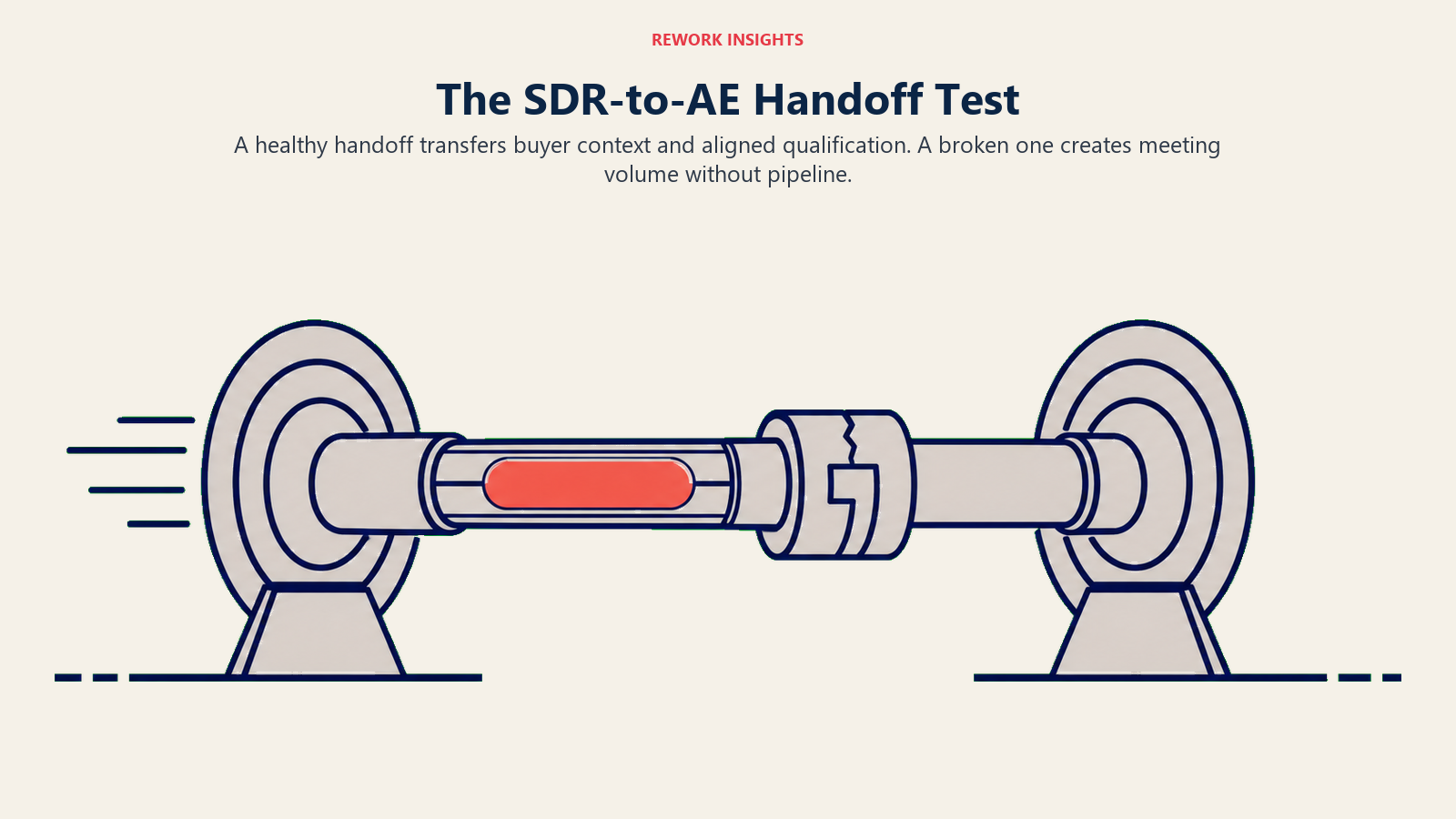
When it breaks, you see specific symptoms: AEs complaining about lead quality (often code for "the SDR meeting standard and my close standard aren't the same"), SDRs gaming bookings with meetings that technically qualify but won't convert, and a persistent gap between meeting volume and pipeline creation.
That gap isn't usually a training problem. It's usually a structural signal that the incentive systems for SDRs and AEs are pulling in different directions, with no mechanism to reconcile them. Before you retrain anyone, look at what each role is actually measured on and whether those measures are genuinely aligned or just superficially adjacent. And it's worth checking whether your pipeline stages actually reflect buyer behavior, because a handoff that looks clean on paper often falls apart when the stage definitions don't match how deals actually progress.
Segment ownership versus territory ownership
This is the design decision founders and early-stage CROs delay longest, and it costs them 12 to 18 months of growth when they finally have to make it.
Territory ownership is geographic: rep A owns the Southeast, rep B owns the Midwest. It's intuitive, easy to communicate, and avoids the awkward conversation about who owns which accounts.
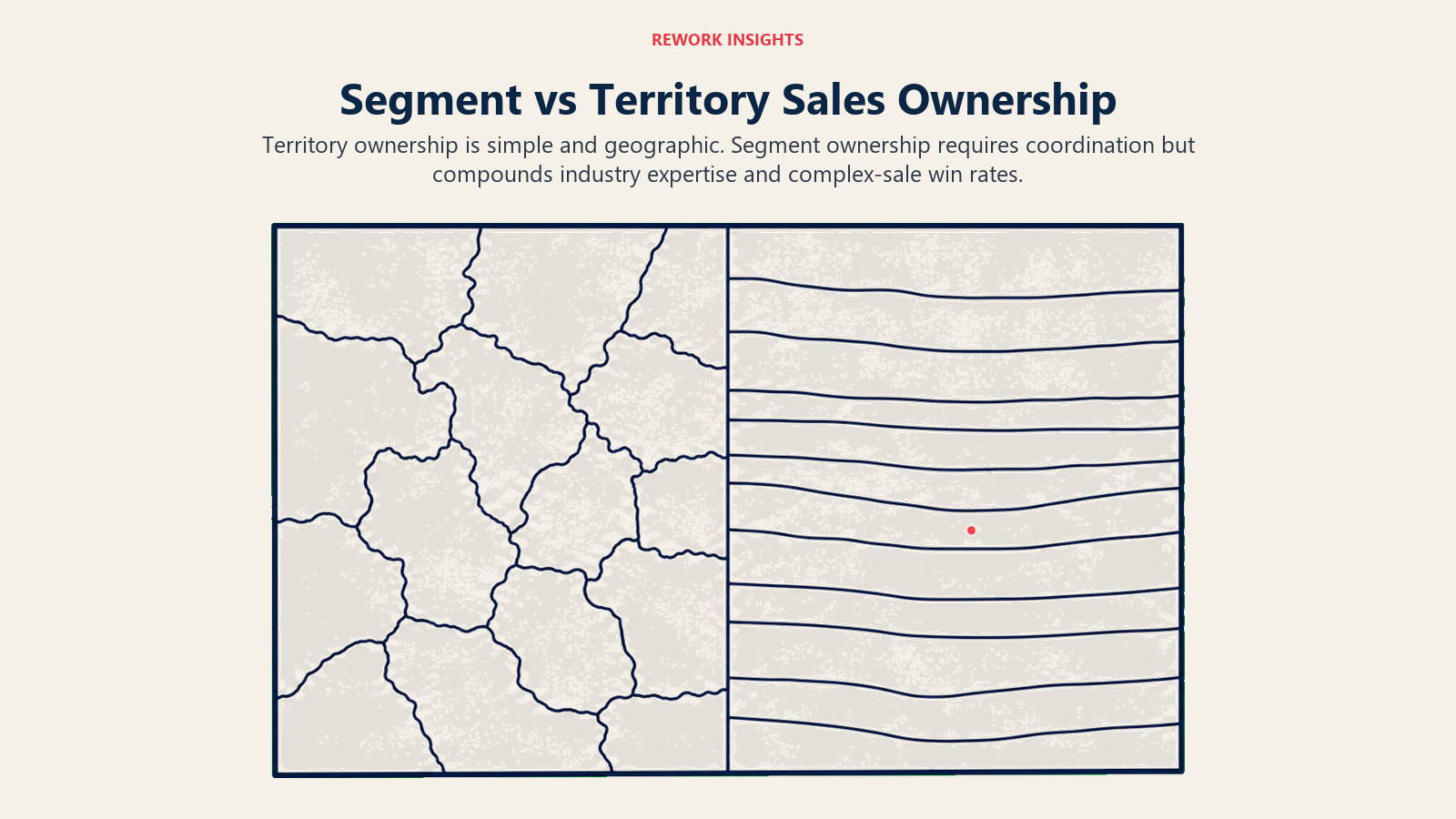
Segment ownership is industry or company-size based: rep A owns fintech companies between 200 and 1,000 employees regardless of geography. It requires more coordination but builds genuine domain expertise over time. Your fintech rep becomes the person who actually understands compliance complexity, security questionnaire patterns, and procurement timelines in that vertical.
The reason companies delay this decision is that it forces a conversation about who's winning and who isn't. When you shift from territory to segment, some reps end up with structurally better books than others. That's uncomfortable. So companies keep the territory model long past the point where it makes strategic sense, then wonder why no rep has ever developed real vertical expertise. The Harvard Business Review analysis of vertical specialization in B2B sales found that reps organized by industry segment outperform geographic territory reps on win rates in complex sales cycles by a meaningful margin. They've seen the buyer's objections, compliance patterns, and procurement process dozens of times over.
The segment ownership model shapes comp, hiring, and culture for years. Once you build a team of vertical specialists, you hire differently, train differently, and measure differently. That compounding effect is the upside. The downside is that making the switch mid-flight is expensive. The longer you wait, the harder the transition. Organizations that have handled this decision well typically have a strong RevOps maturity model underpinning it. The data infrastructure needed to make segment ownership work (clean account hierarchies, reliable territory attribution, accurate conversion rates by segment) has to be built before you can trust the decision you're making.
The Org Design Forcing Function
Before making any structural change (or before deciding not to make one), answer these four questions:
Where does the current structure create friction that customers experience? Not internal friction; customer-facing friction. If your prospects have to explain their situation to three different people before reaching the person with authority to advance the deal, your structure is costing you deals regardless of rep quality.
Where does the current structure misalign incentives at handoff points? Every handoff in a sales org is a potential incentive misalignment. List the handoffs (SDR to AE, AE to CSM, outbound to inbound). For each one, ask: what does each party optimize for, and does that create a gap or a seam?
Does our CRM hierarchy reflect how we actually sell, or does it reflect a structure we no longer operate in? This one reveals technical debt. Account ownership, territory mappings, and stage definitions that were set up three years ago often don't match current GTM motion, which corrupts the pipeline data everyone is trying to trust. If you're evaluating whether your current CRM can actually support a structural redesign, or whether the tool itself is adding friction, a direct CRM comparison can clarify what capabilities the leading platforms offer for territory management and account hierarchy.
If we grew 3x in headcount, would this structure scale or would it fracture? Some org designs work fine at 15 reps and break at 40. Knowing that in advance gives you the option to redesign before you're under duress.
These four questions won't produce a new org chart. They'll surface the real constraints, which is what you need before you move any boxes around.
The design decision founders delay longest
In early-stage SaaS, founders often hold the SDR and AE functions in a single "full-cycle" rep role. One person prospects, qualifies, demos, and closes. This makes sense at 10 customers. It doesn't make sense at 100.
The transition to a specialized model (separating prospecting from closing) is the structural decision most founders delay. The reason is usually that their best full-cycle reps are good at everything and resist specialization. Nobody wants to tell a high performer that half their job is being removed.
But the economics of the specialized model are clear past a certain scale threshold. Full-cycle reps at $250K OTE prospecting into cold accounts are expensive prospectors. SDRs at $70K base doing the same work free up closing bandwidth at a fraction of the cost. The math is obvious in retrospect and genuinely hard to act on in the moment. The Bridge Group's annual SaaS SDR research consistently shows that companies that make this specialization transition earlier, before they feel forced to, hit their growth targets faster in the two years following the transition than those who wait until the model is visibly broken.
The delay costs 12 to 18 months because once you make the transition, there's a ramp period while the new SDRs build pipeline and the AEs adjust to receiving rather than generating opportunities. You can't shortcut that ramp. Starting it earlier is the only mitigation.
Learn More