More in
Sales Tech News
AI Sales Teams Grow 2.6x Faster. Gartner Says Buyers Still Want a Rep
Jun 6, 2026
Aircall Bought Piper AI to Turn Every Sales Call Into Pipeline
Jun 6, 2026
Salesforce Just Handed Marketers AI Agents That Build Sales Pipeline
Jun 6, 2026
Revenue Intelligence Showed You the Risk. Revenue Execution Acts on It.
Jun 5, 2026
Meta Put an AI Agent in WhatsApp That Closes Sales for Any Business
Jun 4, 2026
VCs Poured Over $200M Into AI Sales Startups: The GTM Stack Signal
Jun 4, 2026
Are AI SDRs Worth It in 2026? The Data Says Build a Hybrid Team
Jun 3, 2026
GTM Engineering in 2026: The Sales Hire That Replaces Three Roles
Jun 3, 2026
ZoomInfo Feeds Verified Data to Your AI Sales Agents: The Single-Vendor Tradeoff
Jun 3, 2026
Salesforce Summer '26 Drops Multi-Agent Orchestration June 15. Here's the Sales Ops Audit Before Your Agents Start Handing Off
Jun 2, 2026
Agentforce Just Crossed $800M ARR: What CROs Should Budget for Agentic CRM in 2027

Turn this article into takeaways for your work.


Each assistant summarizes the article only for you and suggests best practices for your work.
Agentforce ARR reached $800 million on more than 29,000 customer deals in roughly 18 months, making Salesforce's agentic AI platform a near-billion-dollar business by early 2026. For CROs, the figure matters less as a revenue headline than as proof that agentic CRM has cleared the viability question, which forces a different 2027 budget conversation built on consumption, not seats.
Quick Take: Salesforce Agentforce crossed $800M ARR on 29,000 deals in 18 months. The category has cleared the viability question. The remaining challenge for CROs is that agentic CRM doesn't fit traditional seat-based budget models, because you're pricing outcomes, not headcount.
What the Data Says
- Salesforce Agentforce crossed $800M ARR and 29,000 customer deals since September 2024 (Salesforce / CX Today)
- Enterprise anchor customers include Amazon, Ford, GM, AT&T, Moderna, and Pfizer
- 89% of sales reps say AI improves their understanding of customers (Salesforce State of Sales 2026)
- Engine (corporate travel) deployed Agentforce to autonomously handle 50% of chat-based customer support volume
- Salesforce launched a $25 billion accelerated share repurchase alongside its 2026 product numbers, signaling sustained growth confidence
For the last two years, most CROs have been putting agentic AI in the "pilot" column of their budget models. A handful of agents in a proof-of-concept, a separate line item with a sunset date, and a standing agreement to revisit the question when the category matures. That moment is here, and the number that forces the conversation is $800 million.
Salesforce's Agentforce platform has crossed $800 million in annual recurring revenue and closed more than 29,000 customer deals since its September 2024 launch, according to CX Today's analysis of Salesforce's State of Sales 2026 report. In 18 months, what was a speculative product category became a near-billion-dollar business. The companies standardizing on it include Amazon, Ford, General Motors, AT&T, Moderna, and Pfizer. When that group moves in the same direction, it stops being a technology trend and starts being a procurement signal.
The question for CROs isn't whether agentic CRM is real. It's whether your 2027 budget model accounts for a category that no longer behaves like a pilot.
Why $800M ARR Is a Category Signal, Not Just a Revenue Number
Revenue milestones at software companies can be engineered. Bundle the right features, push the right deals, and you can hit a headline number without the market actually shifting. Agentforce's trajectory looks different for a few reasons.
First, the deal count matters more than the ARR figure. Twenty-nine thousand deals since September 2024 means adoption across company sizes, industries, and use cases, not concentration in a handful of strategic logos. When a platform crosses that kind of breadth in 18 months, it usually means the category has genuinely cleared the "it works" threshold across diverse environments. For a broader read on where AI agents fit in the modern sales pipeline, and what's genuinely working versus still overhyped, the picture is more nuanced than a single vendor's ARR figure.
Second, the named customer list carries specific weight. Amazon, Ford, GM, AT&T, Moderna, and Pfizer don't move on vendor-sponsored pilots. Their procurement processes are long, their IT governance requirements are substantial, and their willingness to go public with a vendor relationship signals post-evaluation confidence. For CROs at mid-market and enterprise companies, that list is doing the reference check work your team would have to do manually otherwise.
Third, Salesforce's simultaneous decision to launch a $25 billion accelerated share repurchase, as reported by financial analysts at Simply Wall St, is a confidence signal worth noting alongside the product numbers. Companies buying back stock at that scale are telegraphing that they believe their current growth trajectory is sustainable and undervalued by the market. That's relevant context when you're deciding whether to deepen a platform relationship or hedge.
None of this means Agentforce is the right choice for your stack. But it does mean the category has cleared the viability question that was legitimately holding some organizations back. The same capital signal is showing up in adjacent agent categories: Sierra crossed a $15.8B valuation selling AI customer agents into more than 40% of the Fortune 50.
The Pricing Model Problem Your Budget Spreadsheet Hasn't Solved
Here's the real budget problem Agentforce creates for CROs: the pricing model it's moving toward doesn't fit the spreadsheets most organizations use to forecast sales tech spend.
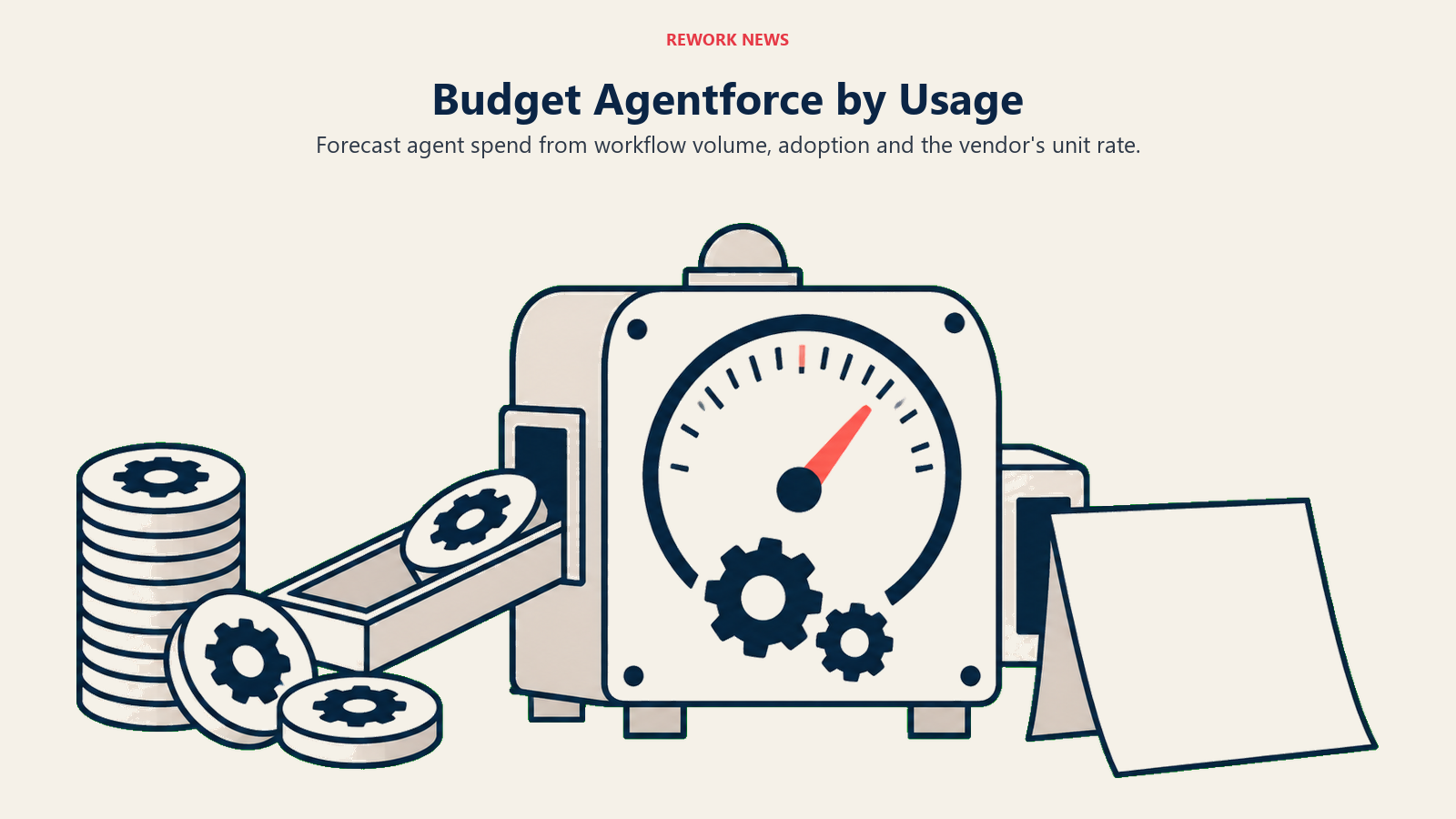
Traditional CRM and sales tool budgeting is seat-based. You count heads, multiply by the license cost, add a buffer for turnover and new hires, and you have your line item. It's predictable. Finance likes it. Procurement approves it. The broader shift away from per-seat models is a category-level change. Seat-based pricing is dying across the SaaS stack, and Agentforce's consumption model is one of the clearest examples of what's replacing it.
Agentforce is progressively shifting toward outcome-based and consumption pricing models. You're not buying seats for AI agents. You're paying for actions taken, resolutions completed, or outcomes achieved. Engine, a corporate travel company cited in the CX Today reporting, deployed Agentforce to autonomously handle 50% of its chat-based customer support volume. That's not a seat count. That's an outcome rate.
For a CRO, this creates a practical forecasting problem. How do you build a 2027 budget line for a tool whose cost scales with usage rather than headcount? Your answer has to be consumption-based. Identify your AI-addressable workflows, estimate the volume of interactions or tasks those workflows handle annually, and apply the vendor's per-action or per-outcome rate. Then model three scenarios: conservative adoption (30% of workflow volume AI-handled), expected adoption (60%), and aggressive adoption (85%). That range gives you and finance a number to anchor on that's more honest than a flat seat projection.
The good news is that outcome-based pricing generally aligns vendor incentives with yours. If the agent doesn't resolve the interaction, you don't pay at full rate. That's meaningfully different from a seat model where you're paying whether reps use the feature or not.
Slack as the AI Interface: A Governance Question for Your Revenue Stack
One of the less-discussed moves in Salesforce's 2026 positioning is the repositioning of Slack. It's no longer primarily a messaging platform. According to the CX Today analysis, Salesforce is building Slack as the primary interface through which AI agents route work and surface actions. The Slackbot layer becomes the front door for Agentforce activity inside the organization. CX leaders are tracking this shift closely. What it means to redesign governance before Slack becomes the default AI interface is a parallel conversation CROs need to have with their customer-facing teams.
For CROs who have Slack embedded in their sales teams' daily workflows, this creates a real question: where does your revenue stack actually live?
If sales reps are receiving AI-generated deal briefs, next-step recommendations, and customer alerts through Slack channels, the boundary between your collaboration tool and your CRM collapses. That's efficient. It's also a governance question that most organizations haven't fully answered, especially now that the Slackbot MCP client lets reps write back to the CRM straight from a Slack thread.
The practical implication is that your 2027 budget conversation needs to include a cleaner answer to "what are we actually buying?" If Slack, Salesforce, and Agentforce are increasingly a single surface for your reps, the license boundaries, data flows, and admin accountability need to be explicitly mapped before the procurement conversation. The CIO and RevOps should both be in that conversation early, not after the contract is signed.
What the 89% Number Actually Means
Salesforce's State of Sales 2026 report includes a figure that's been circulating in sales tech commentary: 89% of sales reps say AI improves their understanding of customers. It's a striking number, and it's worth treating carefully.
Self-reported improvement in AI tools tends to track adoption motivation more than it tracks verified outcome change. Reps who like a tool say it helps them. That's not useless data, but it's not the same as measuring whether deals close faster, win rates improve, or forecast accuracy increases at teams using AI features versus those that don't.
What the 89% figure does tell you is that rep resistance to AI tooling, which was a real adoption friction two or three years ago, has largely shifted. The mental model of "AI is here to watch me and judge my performance" has given way to "AI is here to help me prep for calls." That's a real change, and it matters for CROs thinking about change management on an Agentforce rollout. The battle to convince reps that AI is worth trying is mostly won. The remaining work is execution quality.
CNBC's April 2026 read on this is worth noting: Salesforce isn't being displaced in the AI era, but what customers want from the platform is changing. Organizations want Salesforce to do more of the work, not just record it. That's the shift your 2027 budget should reflect.
The Three-Scenario Consumption Model
Scenario modeling is the only sane way to budget outcome-based CRM pricing when usage can expand faster than seats.
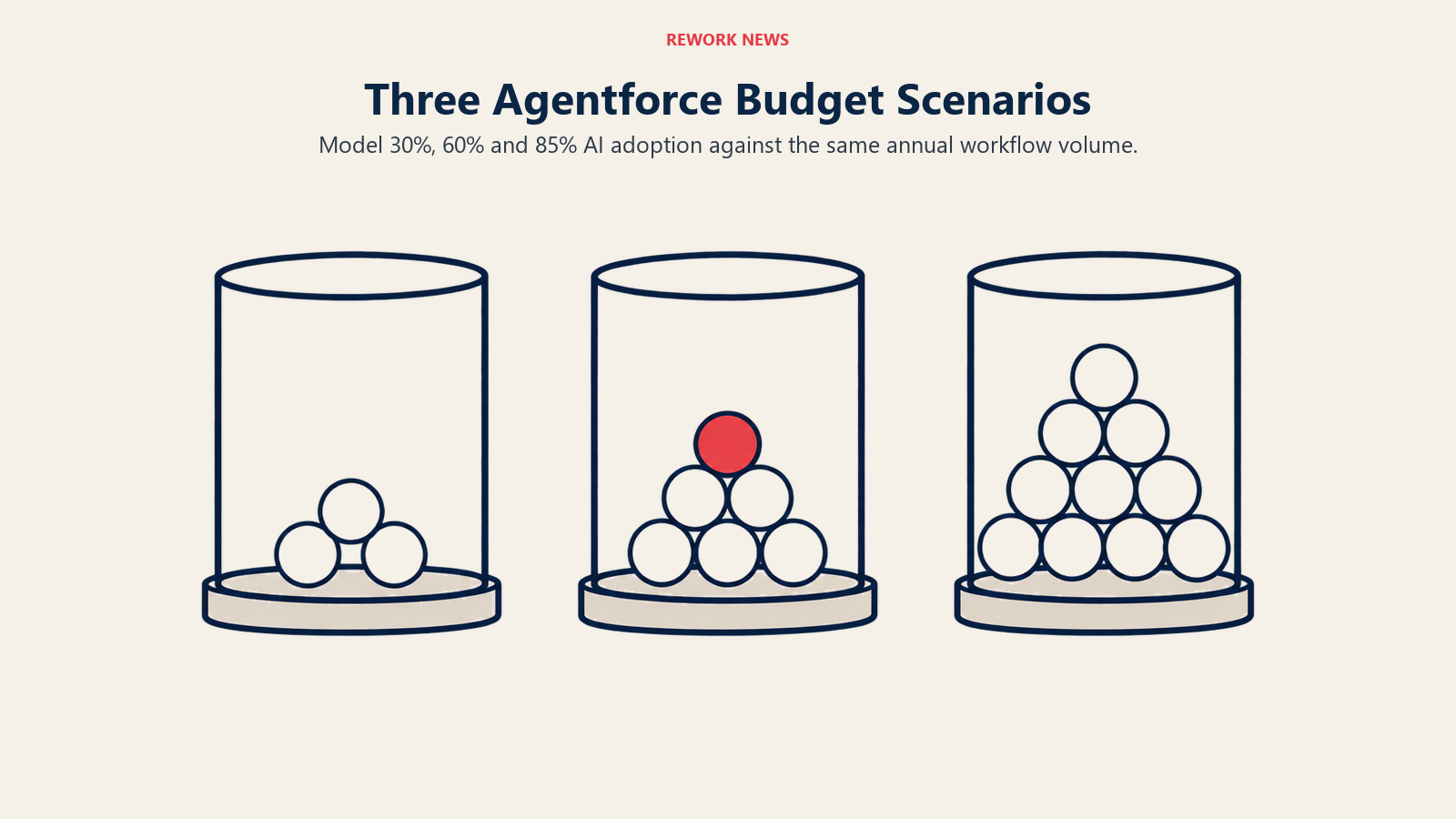
When budgeting for outcome-based CRM pricing, seat counts produce misleading forecasts. A more reliable approach models three adoption scenarios against actual workflow volumes. Conservative adoption assumes AI handles 30% of addressable interactions; expected adoption assumes 60%; aggressive assumes 85%. Applying vendor per-action or per-outcome rates to each scenario produces a spend range that finance can evaluate rather than a single number that will almost certainly be wrong.
The Consumption Budget Rule: Never budget agentic CRM spend as a flat seat count. Identify your highest-volume AI-addressable workflows, estimate annual interaction volume for each, and model three consumption scenarios (30% / 60% / 85% AI-handled). The range is a more honest forecast than a seat projection, and it aligns vendor incentives with yours, since outcome pricing means you pay when the agent performs.
A 5-Point Budget Framework for CROs Planning Agentic CRM Spend
Budget planning for agentic CRM requires a different framework than the one most sales leaders use for traditional software. Here's a working structure:
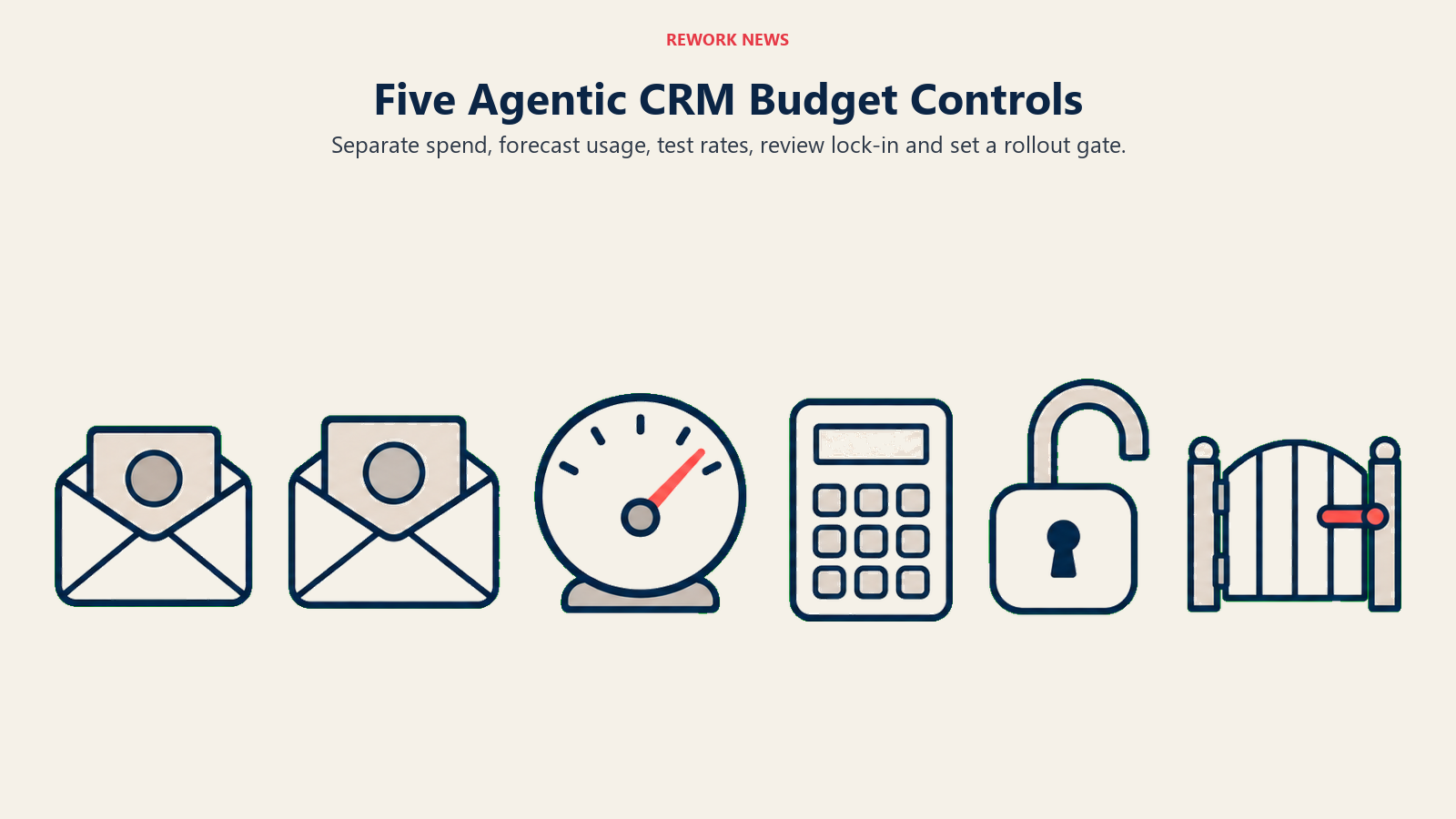
Line items: separate agent spend from seat spend. Don't bundle Agentforce costs into your existing Salesforce seat line. They have different cost structures, different scaling curves, and different ROI measurement approaches. Finance needs them separated to track spend accurately over time.
Forecasting approach: model by workflow volume, not headcount. Identify which workflows you'll hand to agents (inbound qualification, post-call documentation, customer health monitoring, churn risk flagging) and estimate their annual transaction volume. Salesforce has pushed agentic marketing agents into that same inbound qualification work, so factor that overlap into which team owns the spend. That's your consumption baseline. Apply pricing tiers to get a spend range.
Vendor evaluation: test the outcome-pricing math with actual deal data. Before committing to a contract structure, run your top three AI-addressable workflows through the vendor's pricing model using your historical volume data. The per-outcome rate that sounds reasonable in a sales presentation can look very different applied to 200,000 inbound inquiries per year.
Risk management: build a vendor concentration review cadence. Amazon, Ford, GM, AT&T, Moderna, and Pfizer all on the same agentic CRM platform is validation, but it's also a concentration signal. If Salesforce's pricing strategy or platform direction changes materially, the switching cost for organizations deeply embedded in Agentforce workflows will be significant. Schedule a vendor concentration review annually and document your exit criteria now, before you need them. The layer vs. replace evaluation framework for AI-native CRM is useful groundwork before any deep-platform commitment.
Pilot-to-production conversion: set a conversion gate, not a conversion date. Most agentic AI pilots stall because there's no defined threshold that triggers a production rollout. Set a measurable gate: if the pilot achieves X% of interactions resolved without human escalation at Y% accuracy, the workflow moves to production. Remove the calendar-based review that lets inconclusive pilots linger indefinitely.
What to Do This Week
The 2027 budget cycle for most organizations is six to nine months away, which is exactly the right time to start restructuring how you're framing agentic CRM internally. A few concrete steps for this week:
Pull your current Salesforce usage data and identify your highest-volume, lowest-complexity workflows. These are your Agentforce starting candidates. Volume tells you whether automation has scale; low complexity tells you the agent is likely to perform well without heavy customization. Inbound routing, initial outreach responses, and post-call documentation are typical first targets.
Have a direct conversation with your Salesforce account executive about the full pricing model for your use cases. Don't rely on case studies or benchmark rates. Bring your actual workflow volumes and get a consumption estimate based on your specific environment. The gap between a general pricing conversation and a usage-specific one is often significant.
Loop in your CFO contact before your next budget review. Consumption-based AI pricing is still unfamiliar to many finance teams. If your first budget conversation includes a line item with a variable range instead of a fixed seat count, you want that conversation prepared for rather than improvised. Brief finance on the consumption model, the scenarios you've modeled, and the guardrails you plan to put on usage.
Check whether your current Salesforce contracts include Agentforce access or require an add-on. Several enterprise agreements signed in 2024 and early 2025 include Agentforce access at certain tiers. Before you budget for a new purchase, confirm what you've already paid for.
Set a decision date for your 2027 agentic CRM position. Not a deadline for deploying agents, but a date by which your leadership team will have agreed on whether agentic CRM is a pilot, a production workload, or a strategic platform investment in your 2027 plan. The organizations that will move slowly in 2027 are the ones that don't make that call now.
Frequently Asked Questions
What is Salesforce Agentforce and why does $800M ARR matter?
Agentforce is Salesforce's agentic AI platform that enables autonomous agents to perform sales, service, and operational tasks within CRM workflows. Crossing $800M ARR on 29,000 deals in 18 months signals that the category has cleared the viability threshold, not just for large enterprises, but across company sizes and industries. When Amazon, Ford, and GM all standardize on the same platform, it stops being a pilot category.
How is agentic CRM priced differently from traditional CRM?
Traditional CRM licenses on a per-seat basis: you pay per user, per month. Agentforce and similar agentic platforms are moving toward consumption-based or outcome-based pricing, where you pay per action taken, interaction resolved, or outcome achieved. This means cost scales with usage rather than headcount, which is more aligned with value but requires a different budgeting approach.
What workflows should CROs prioritize for Agentforce pilots?
Start with your highest-volume, lowest-complexity workflows. Inbound lead routing and acknowledgment, post-call documentation, customer health monitoring, and churn risk flagging are typical first targets. These combine sufficient volume to show ROI at scale with enough predictability that agents perform well without heavy customization.
What is the rep adoption situation for AI sales tools in 2026?
Salesforce's State of Sales 2026 reports that 89% of sales reps say AI improves their understanding of customers. The earlier resistance to AI as a performance-monitoring tool has largely dissipated. The remaining change management challenge is execution quality: helping reps use AI tools effectively, not convincing them to try.
Should CROs separate Agentforce spend from their core Salesforce seat line?
Yes. Keep agent spend and seat spend as separate budget lines with different forecasting methods. Seat lines are fixed and headcount-tied; agent lines are consumption-based and workflow-volume-tied. Bundling them prevents accurate tracking over time and makes it harder to present a credible ROI case to finance as usage grows.
Learn More
- HubSpot Just Rewrote the AI Pricing Rulebook: How outcome-based pricing is changing budget conversations across the sales tech stack
- Layer or Replace? Evaluating AI-Native CRM Models Before Your Next Renewal: The two competing architecture models and how to evaluate which fits your org
- Salesforce Can Now Pull Your Zoom Calls Into the CRM: What RevOps needs to audit before call data flows into your CRM records
- AI Agents in the Sales Pipeline: The broader picture of where agentic AI sits in the modern revenue motion
Source: CX Today, Salesforce State of Sales 2026: AI Agents and Sales Teams

Co-Founder, Rework.com
On this page
- Why $800M ARR Is a Category Signal, Not Just a Revenue Number
- The Pricing Model Problem Your Budget Spreadsheet Hasn't Solved
- Slack as the AI Interface: A Governance Question for Your Revenue Stack
- What the 89% Number Actually Means
- The Three-Scenario Consumption Model
- A 5-Point Budget Framework for CROs Planning Agentic CRM Spend
- What to Do This Week
- Frequently Asked Questions
- What is Salesforce Agentforce and why does $800M ARR matter?
- How is agentic CRM priced differently from traditional CRM?
- What workflows should CROs prioritize for Agentforce pilots?
- What is the rep adoption situation for AI sales tools in 2026?
- Should CROs separate Agentforce spend from their core Salesforce seat line?