More in
Sales Tech News
AI Sales Teams Grow 2.6x Faster. Gartner Says Buyers Still Want a Rep
Jun 6, 2026
Aircall Bought Piper AI to Turn Every Sales Call Into Pipeline
Jun 6, 2026
Salesforce Just Handed Marketers AI Agents That Build Sales Pipeline
Jun 6, 2026
Revenue Intelligence Showed You the Risk. Revenue Execution Acts on It.
Jun 5, 2026
Meta Put an AI Agent in WhatsApp That Closes Sales for Any Business
Jun 4, 2026
VCs Poured Over $200M Into AI Sales Startups: The GTM Stack Signal
Jun 4, 2026
Are AI SDRs Worth It in 2026? The Data Says Build a Hybrid Team
Jun 3, 2026
GTM Engineering in 2026: The Sales Hire That Replaces Three Roles
Jun 3, 2026
ZoomInfo Feeds Verified Data to Your AI Sales Agents: The Single-Vendor Tradeoff
Jun 3, 2026
Salesforce Summer '26 Drops Multi-Agent Orchestration June 15. Here's the Sales Ops Audit Before Your Agents Start Handing Off
Jun 2, 2026
Outreach's MCP Server Move Changes How You Build AI Sales Workflows: Here's What Sales Ops Needs to Know
Turn this article into takeaways for your work.


Each assistant summarizes the article only for you and suggests best practices for your work.
Most product releases from sales engagement platforms are incremental: a new template type, a reporting tweak, a CRM sync improvement. Outreach's February 2026 release was different in one specific way, and Sales Ops teams who missed it may want to read this before their next automation planning session.
Buried under the more visible features in the release was an infrastructure move that quietly changes how Outreach fits into an AI-native sales stack.
What Outreach Released in February
According to the Outreach product blog published February 24, 2026, the company shipped seven meaningful updates. Here's the breakdown by what matters for Sales Ops specifically.
The MCP Server (the one to pay attention to)
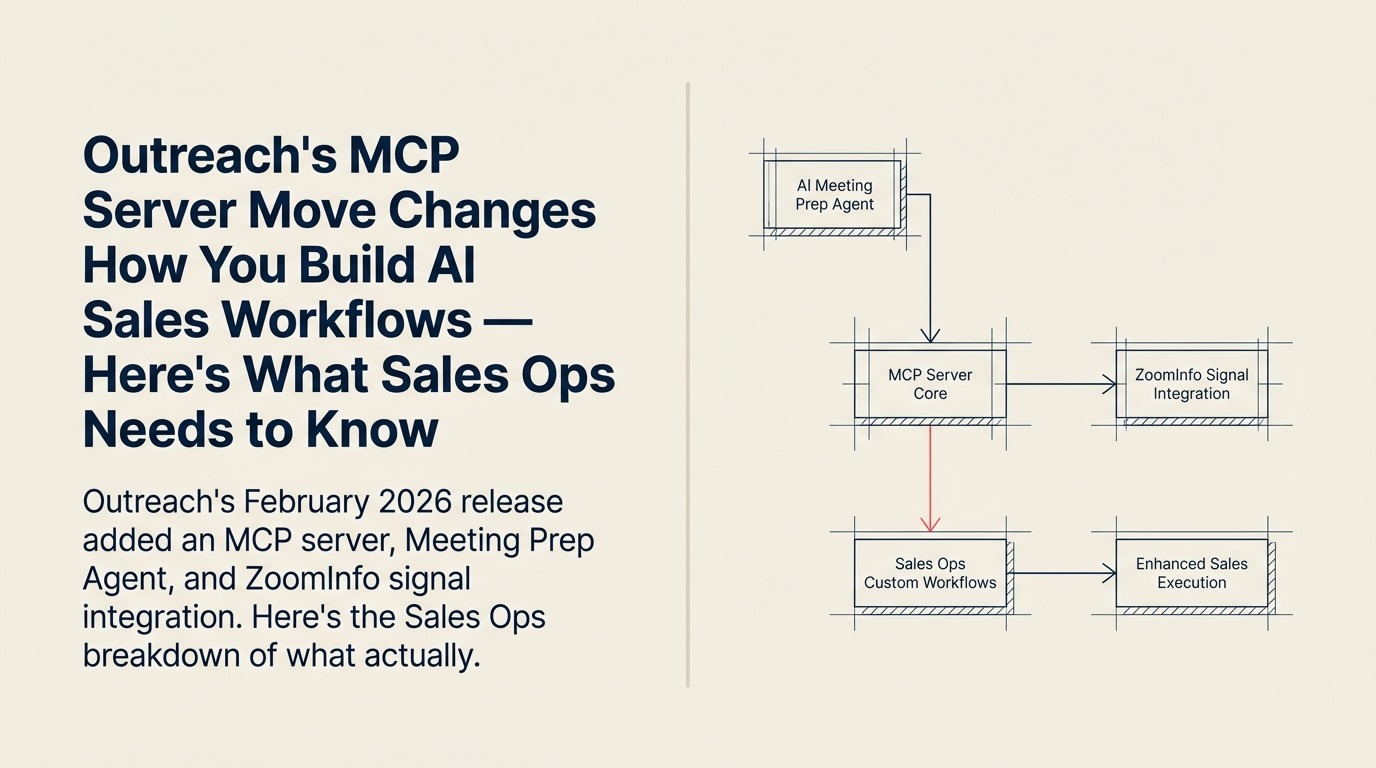
Outreach launched a public MCP (Model Context Protocol) server, joining Anthropic's open ecosystem for AI-to-AI communication. In plain terms: Outreach's data (sequence activity, deal signals, engagement patterns, call notes) can now be queried directly by external AI agents without custom API development.
The list of systems that can now pull Outreach data through MCP includes Salesforce Agentforce, Microsoft Copilot, Claude, Google Drive, SharePoint, and Glean. If your RevOps team has been manually building Zapier or n8n workflows to shuttle Outreach data into AI tools, this changes the calculus. Native MCP support is architecturally cleaner and more maintainable than custom webhook chains.
This matters beyond just convenience. When Outreach data is accessible to AI orchestrators natively, it means your AI sales coaching tools, your pipeline review agents, and your CRM automation flows can all query engagement history without requiring a dedicated integration build per system. For Sales Ops teams managing a growing set of point-tool integrations, that's a meaningful reduction in technical debt.
Meeting Prep Agent (Beta)
The Meeting Prep Agent generates a pre-meeting brief for every scheduled call. It pulls in recommended talking points, a summary of the account's activity history, and an overview of the meeting attendees, all delivered before the call starts. Reps don't have to assemble this manually.
The practical impact depends heavily on your current pre-call process. If your SDRs and AEs are already spending 10–15 minutes per call doing research, the Meeting Prep Agent can reclaim that time. If pre-call prep isn't standardized in your team, this feature won't fix the underlying process gap, but it does give you a tool to create a consistent baseline.
Sequential Dialing
Sequential Dialing reduces the number of clicks reps need to move through a calling queue. Reps advance through tasks without manually navigating back to the sequence view between each call. On its own, a minor improvement. At scale, if your team runs high-volume outbound, the friction reduction is real.
Outreach Knowledge (Beta)
This feature makes internal documents (product specs, pricing sheets, objection handling guides, technical resources) searchable inside Outreach. Reps can pull relevant content during an active conversation rather than switching tabs or Slacking the SE team.
For Sales Ops, this is an onboarding and knowledge management play. If you've been fighting the battle of reps giving inconsistent answers because they can't find the right doc, Outreach Knowledge gives you a place to surface that content at the moment it's needed.
ZoomInfo Integration Enhancement
Outreach expanded its ZoomInfo integration to surface website visit signals inside Outreach sequences. When a contact or account shows a spike in website activity, that signal now appears within the rep's workflow, flagging accounts with heightened buyer interest.
This closes a workflow gap that previously required a separate trigger in your automation layer, typically either a ZoomInfo-to-CRM webhook or a ZoomInfo-native alert that reps had to check in a different tool. Pulling the signal into Outreach means reps see it in context, at the point they're already working the account.
Deal Agent and Research Agent Upgrades
Deal Agent now supports updates to custom methodology fields and auto-generates deal summaries. The Research Agent adds scheduled automatic refresh of account research at user-defined intervals. For teams with custom qualification frameworks in their CRM, the custom field support is the more meaningful update.
The Stack Implications
Sales Ops teams evaluating Outreach against alternatives like Salesloft or Apollo should think about this release in three layers.
First, the MCP move is a bet on interoperability over consolidation. Where some vendors are trying to expand into adjacent categories and absorb the whole stack, Outreach is positioning itself as the connective tissue, the system that other AI agents can query rather than the platform that replaces them. That's a different architectural philosophy. For Sales Ops teams building modular AI-native stacks, this approach may fit better than a monolithic platform. For teams that want to minimize vendor count, it's less compelling.
Second, the Meeting Prep Agent and Outreach Knowledge are both adoption plays, not capability plays. They don't add revenue functionality that didn't exist before. They add enough friction reduction that reps are more likely to use the process you've already designed. If your sales process relies on pre-call research and consistent messaging, these features reduce the gap between process design and actual rep behavior.
Third, the ZoomInfo signal integration is the most tactical feature for immediate workflow impact. If you're a ZoomInfo customer, adding this integration to your Outreach sequences today is a low-lift, high-signal improvement to your rep workflow. Outreach later deepened this in its May 2026 release, wiring 20 new ZoomInfo buying signals directly into sequences and sunsetting the legacy 360 homepage.
For broader context on how sales engagement platforms are evolving alongside AI-native CRM architectures, the RevOps insights library covers the category shift in more depth.
Who Should Act First
Sales Ops teams on Outreach who are also ZoomInfo customers. The website signal integration is available now and straightforward to activate. If you're not already surfacing ZoomInfo intent signals in your rep workflows, this is the easiest quick win in the February release.
RevOps leaders planning 2026 AI automation roadmaps. The MCP server is worth a technical conversation with your engineering or systems team now, before you've committed to a specific integration architecture. Understanding how Outreach data will flow into your AI orchestration layer affects every automation decision you make this year.
Sales Ops leaders evaluating whether to stay on Outreach or migrate. If your primary objection to Outreach has been integration complexity, the MCP move addresses that concern. If it's been UI/UX, sequence flexibility, or pricing, this release doesn't change those variables.
You can find the Salesloft vs. Outreach evaluation criteria in the comparisons library if you're mid-evaluation and want a structured framework alongside this news.
What to Do This Week
Use one meeting type to test preparation quality while checking access to buyer signals and relevant knowledge.

- If you're on ZoomInfo + Outreach: Check whether your ZoomInfo integration is configured to surface website visit signals in Outreach. If not, it's likely a settings change, not a new implementation.
- Ask your Outreach CSM about MCP server access. Beta access and configuration details will determine whether this fits into your near-term automation plans.
- Evaluate Meeting Prep Agent in beta against your highest-volume meeting type first. Pick one segment (enterprise discovery calls, SMB demos, or renewal calls) and run a two-week pilot before rolling broadly.
- Audit your Outreach Knowledge content library. If you're going to use the knowledge feature, the value is only as good as the documents you put in it. Identify the top five content gaps your reps hit in conversations and start there.
Outreach's February release won't rewrite your sales strategy. But the MCP server move, specifically, is the kind of infrastructure shift that quietly becomes very significant once you're 12 months into an AI-native sales stack. Sales Ops leaders who understand it now will be better positioned to design automation workflows that don't need to be rebuilt when the next AI agent shows up in your ecosystem.
Learn More
- Your Meetings Are Now a Programmable Data Source, MCP context from a CTO architecture perspective and why the standard matters
- AI Agents Are Taking Over Revenue Workflows, Governance checklist before MCP-connected agents touch your pipeline data
- Qualification Frameworks, Calibrating meeting prep AI outputs to your actual qualification logic
- Weekly Pipeline Review, How AI-enriched call data changes what you look at in pipeline reviews
Source: Outreach February 2026 Product Release: AI That Executes | Outreach Blog, February 24, 2026
