More in
Sales Tech News
AI Sales Teams Grow 2.6x Faster. Gartner Says Buyers Still Want a Rep
Jun 6, 2026
Aircall Bought Piper AI to Turn Every Sales Call Into Pipeline
Jun 6, 2026
Salesforce Just Handed Marketers AI Agents That Build Sales Pipeline
Jun 6, 2026
Revenue Intelligence Showed You the Risk. Revenue Execution Acts on It.
Jun 5, 2026
Meta Put an AI Agent in WhatsApp That Closes Sales for Any Business
Jun 4, 2026
VCs Poured Over $200M Into AI Sales Startups: The GTM Stack Signal
Jun 4, 2026
Are AI SDRs Worth It in 2026? The Data Says Build a Hybrid Team
Jun 3, 2026
GTM Engineering in 2026: The Sales Hire That Replaces Three Roles
Jun 3, 2026
ZoomInfo Feeds Verified Data to Your AI Sales Agents: The Single-Vendor Tradeoff
Jun 3, 2026
Salesforce Summer '26 Drops Multi-Agent Orchestration June 15. Here's the Sales Ops Audit Before Your Agents Start Handing Off
Jun 2, 2026
The Clari-Salesloft Platform Is Fully Live and Drift Is Dying. Here's What CROs Need to Evaluate Right Now
Turn this article into takeaways for your work.


Each assistant summarizes the article only for you and suggests best practices for your work.
The merger everyone watched in 2025 is now operational. As reported by the Salesloft newsroom, Clari and Salesloft formally completed their combination on December 3, 2025, installing Steve Cox as CEO of the combined entity. The company's stated goal is a "Predictive Revenue System": a single platform that folds sales engagement, revenue forecasting, and intelligence into one roof.
Then came the surprise. In March 2026, the combined platform announced a partnership with 1mind (an AI digital teammates vendor) and quietly placed Drift, the conversational marketing product that thousands of revenue teams have built workflows around, on a gradual sunset path. According to Demand Gen Report's coverage of the announcement, the 1mind integration is meant to handle the pipeline-generation surface that Drift occupied. Whether it does that equally well for teams who've built Drift deeply into their inbound and account-based motion is an open question.
For CROs, two things are now true at the same time: this is the most significant revenue tech consolidation of the past several years (the same shift Gartner formalized when it named Revenue Action Orchestration a category), and one of the platform's embedded data points is quietly devastating. Internal research from Clari Labs, cited on the Salesloft newsroom, found that 87% of enterprises missed their 2025 revenue targets even as they increased AI investment. Forty-eight percent said their revenue data isn't AI-ready. Forty-two percent have no formal governance framework for their AI tools.
What the "Predictive Revenue System" Actually Claims
The marketing framing is ambitious: engagement data from Salesloft, forecasting data from Clari, and now AI-driven pipeline generation from 1mind, combined into a unified system that can predict revenue outcomes rather than just report them. The combined entity doubled its R&D headcount post-merger to build toward this positioning.
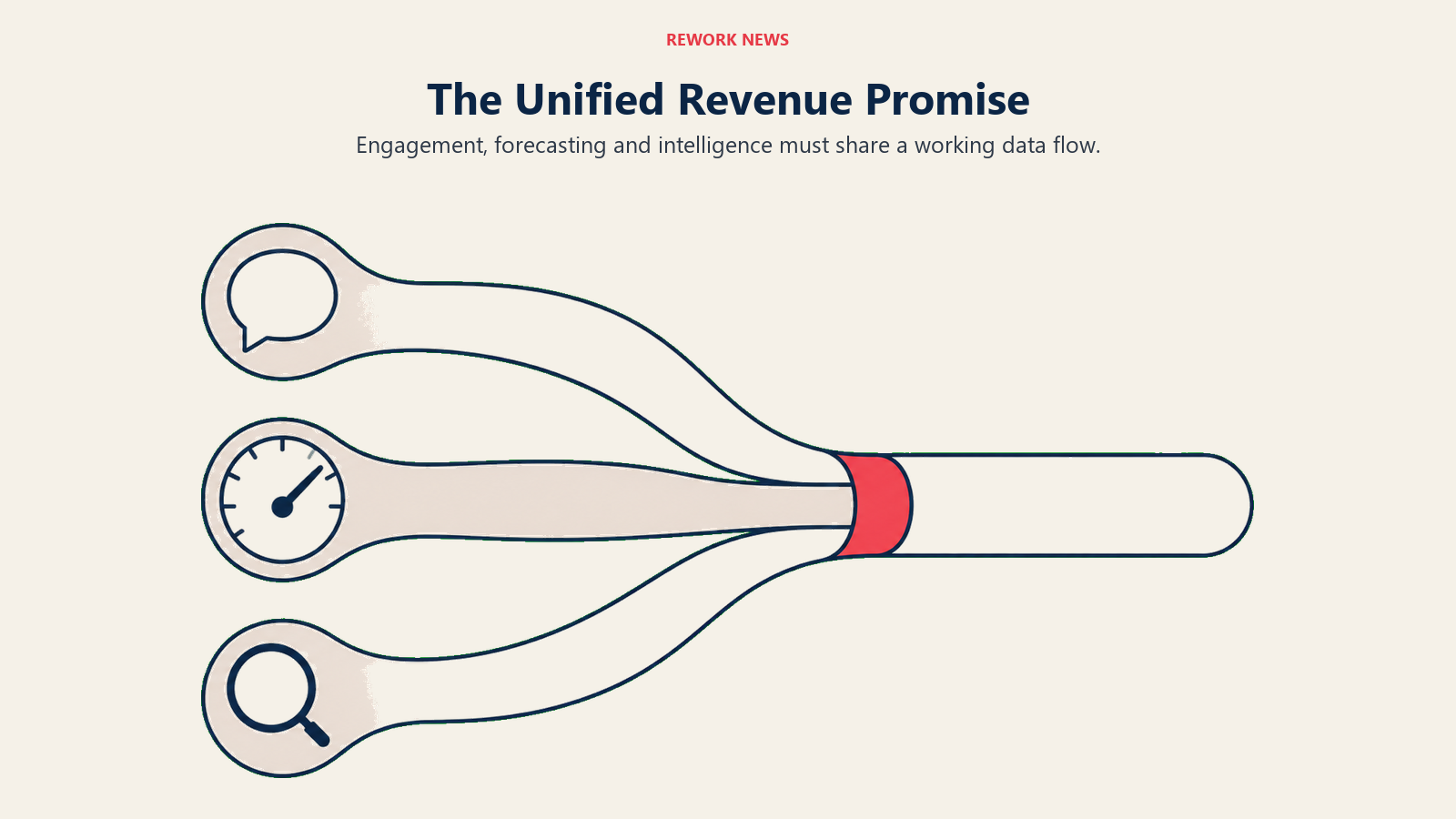
That's a real differentiator on paper. Sales engagement and revenue intelligence have historically lived in separate platforms with separate data models, separate rep workflows, and separate forecast inputs. The same convergence is now reaching the conversation layer, where Aircall folded Piper AI's revenue intelligence into its phone platform. A genuinely unified system would eliminate the translation layer that RevOps teams currently manage by hand: pulling Salesloft sequence data into Clari models, reconciling engagement signals with pipeline risk scores, building manual processes to connect what reps are doing with what the forecast says. It's the same fragmentation problem that makes pipeline hygiene a cultural issue rather than a tooling one.
But "unified" is an implementation promise, not a launch-day feature. The combined entity has been operational for four months. What's live in production and what's on the roadmap are questions worth asking directly before making a commitment decision.
The 87% Stat Deserves More Than a Footnote
Here's where it gets uncomfortable. The same company making a platform claim about predicting revenue outcomes is also publishing research showing that 87% of enterprises couldn't hit their targets last year despite spending more on AI. The research frames this as an industry diagnosis, not a Clari+Salesloft self-indictment. To be fair, the point is that fragmented data and poor governance are the culprits, problems the combined platform is designed to solve.
But CROs should read the stat critically, not just accept the framing. The question worth sitting with is: what evidence does the combined platform have that unified revenue data actually improves forecast accuracy for the companies using it? Reference customers, close-rate data, and forecast variance before-and-after comparisons are the right things to ask for. Forecasting discipline at the CRO level starts with knowing what your current data actually measures before adding another prediction layer on top of it. The platform's position is "we solve the fragmentation problem." The honest follow-up question is: by how much, for which types of companies, and over what time horizon?
This isn't a reason to dismiss the platform. It's the reason to run a structured evaluation rather than a purchasing reflex.
The Drift Sunset Is a Separate Urgency
If your team is running Drift (whether that's chatflows on your website, conversational ABM campaigns, or live chat routing into sales sequences), the 1mind partnership announcement is your signal to start a migration audit now. The 5-step Drift migration playbook for Sales Ops teams covers exactly what that audit should include. The "gradual sunset" language doesn't come with a published end-of-life date, but product rationalizations at scale rarely get faster timelines once they're announced.
The 1mind integration promises AI digital teammates that handle pipeline from first touch through close. That's a different capability model than Drift's buyer-initiated conversation approach. Whether it fits your GTM motion depends heavily on your inbound mix, your SDR-to-AE handoff model, and how much of your pipeline actually originates from website-based conversations versus outbound.
For now, treat the announcement as a trigger to document your Drift-dependent workflows before a forced migration compresses your options.
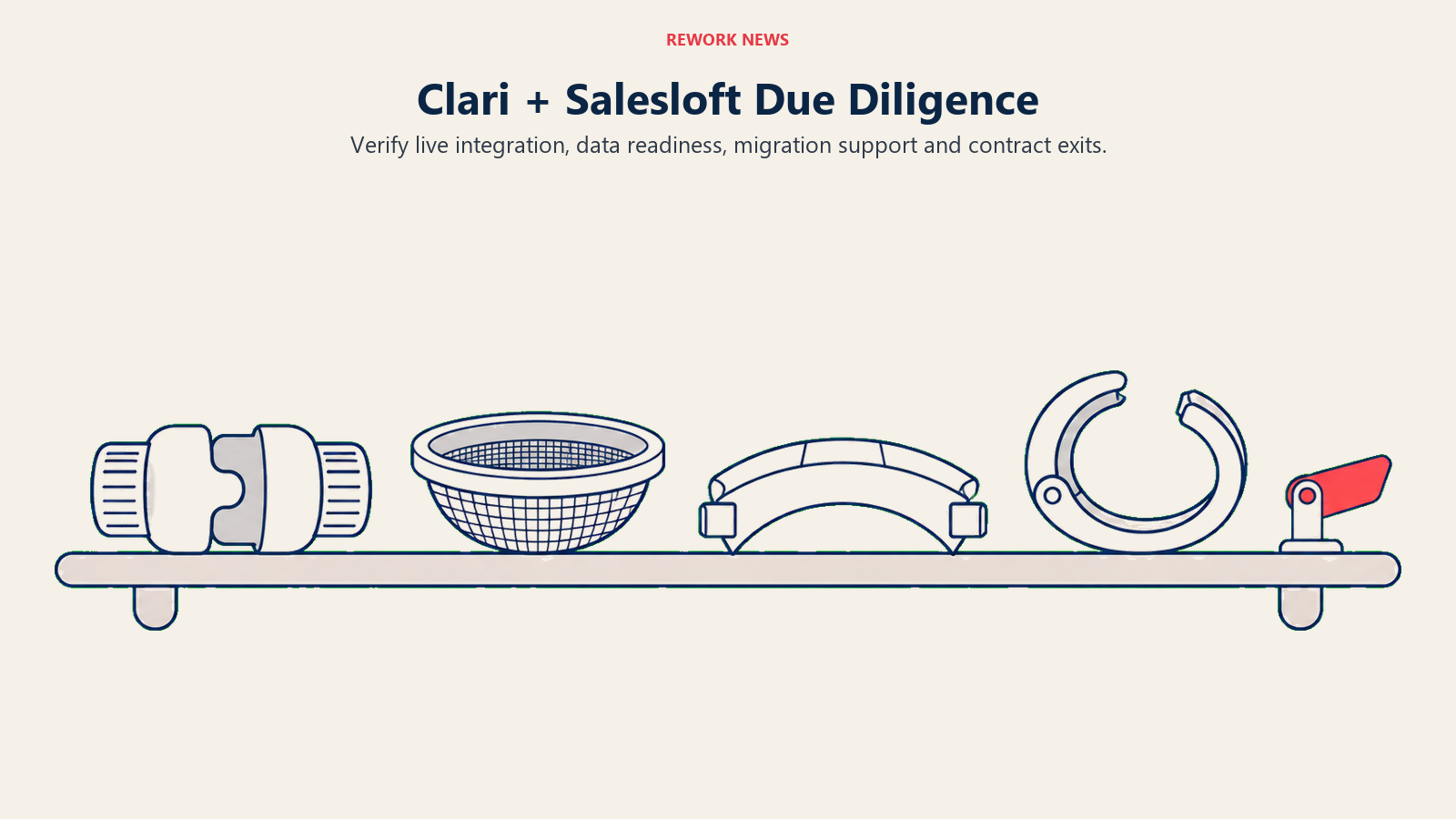
A 4-Question Due Diligence Checklist Before Committing to the Combined Platform
CROs evaluating whether to consolidate onto the Clari+Salesloft platform, or deepen their existing contract, should work through at least these four questions before the next renewal conversation:
1. What's actually unified today versus what's on the roadmap? Ask the account team to show you the data model. Where does engagement data from Salesloft flow into Clari's forecasting engine, and does that flow happen automatically or require a manual sync step? The answer tells you whether the unified promise is a current feature or a future one.
2. How does the platform handle AI-generated forecast inputs? The Clari Labs research finding (48% of enterprises say their revenue data isn't AI-ready) is worth stress-testing against your own data. If your CRM fields are inconsistently populated, your sequence completion rates are noisy, or your opportunity stages aren't disciplined, the AI forecasting layer will amplify those problems, not solve them.
3. What's the Drift migration path, specifically? Get a written answer on the 1mind integration timeline and what workflows are supported at launch. If the migration is 12 months away, you have runway. If support degradation starts in Q3, you need a parallel workstream running now.
4. What does a contract commitment lock you into? Revenue tech consolidation deals often come with multi-year commitments and usage-based terms that become expensive if headcount changes. Understand the exit provisions before signing. A structured CRM buyer's checklist helps you audit what you're actually committing to before the contract conversation starts. The "all in one place" pitch sounds great until your business model changes and you're paying for seats you're not using.
What to Put on Your Next QBR Agenda
The CRO's job in the next quarterly review isn't to decide whether to buy or not buy a platform. It's to ensure the right people are asking the right questions before a purchasing decision is driven by a contract deadline or a vendor relationship.
Add one item to your next QBR agenda: map your current revenue data stack against the Clari+Salesloft platform's unified claims. Understanding where your team sits on the RevOps maturity model is a useful anchor for that conversation. Where are your engagement data, forecast data, and intelligence data living today? Which of those are manual processes versus automated ones? And if you're a Drift user, how much pipeline volume flows through it?
That inventory, not a vendor demo, is what should anchor a CRO's decision about whether a platform consolidation makes sense at your company's current stage.
The combined platform is real, the ambition is legitimate, and the Drift sunset is a genuine forcing function for some teams. But "the biggest revenue tech merger is operational" is not itself a reason to act. A clear picture of your current state, matched against what the platform actually delivers today, is.
Learn More
- Drift Is Being Sunset: 5-Step Migration Playbook for Sales Ops, Detailed steps for managing the Drift transition within the Clari+Salesloft context
- Forecasting Discipline for CROs, What changes when forecast data and engagement data share a unified platform
- Pipeline Stages That Match Your Selling, Aligning your pipeline structure before consolidating data sources
- The B2B Chat Tool Market Is Consolidating, The same consolidation story from the CMO's perspective
Source: Salesloft Newsroom, Clari-Salesloft Merger | Demand Gen Report, 1mind Partnership | Salesloft Revenue AI Research
