More in
Sales Leadership Insights
Why Sales Org Design Is the Most Under-Rated Growth Lever
Mar 16, 2026
What Great Sales Leaders Actually Do in Their First 90 Days
Mar 10, 2026
Why Sales Retention Is the New Sales Hiring
Feb 4, 2026
Forecasting Discipline: What Separates 90% Callers from 50% Callers
Jan 19, 2026 · Currently reading
Forecasting Discipline: What Separates 90% Callers from 50% Callers
Turn this article into takeaways for your work.


Each assistant summarizes the article only for you and suggests best practices for your work.
Forecast accuracy is the clearest measure of a CRO's credibility with a board. Not quota attainment, not pipeline coverage. Accuracy. A leader who calls $4M and closes $4.1M is trusted. A leader who calls $5M and closes $3.2M has a credibility problem regardless of what the number is, and the board knows it compounds. Gartner research on sales forecasting has found that only about 45% of sales leaders express high confidence in their own forecast accuracy, which means the majority are presenting numbers they privately don't trust.
Most companies respond to poor forecast accuracy by adding process. More CRM fields, tighter stage gates, more pipeline review meetings, better hygiene enforcement. This almost never works, because the problem isn't the data, it's the behavior that generates the data.
The teams that call within 5-10% consistently have made a structural and cultural decision: they've changed what happens when someone is wrong. Not punished for being wrong, but held accountable for the logic behind their call. That's a different thing, and it runs upstream of any CRM configuration.
Why CRM data isn't the bottleneck
Salesforce doesn't corrupt forecasts. HubSpot doesn't corrupt forecasts. Pipedrive doesn't corrupt forecasts. Reps do.
Here's how it happens. A rep has a deal that's been in "late stage" for six weeks. It hasn't moved because the champion went quiet after the internal approval process stalled. The rep knows this. But changing the stage to "stalled" or "at risk" triggers a coaching conversation they'd rather avoid, and it makes their pipeline look worse in the weekly review. So the deal stays where it is. The stage gate says "negotiation." The actual situation is "radio silence since October 14th."
Multiply that by ten reps and thirty deals, and you have a forecast built on optimism plus social pressure, not real signal. The leader who runs that forecast call then has to adjust by gut: "I'm going to take 20% off the top because my team always holds." But gut adjustments are just layering a second bad model on top of the first one.
The bottleneck isn't that reps lack the information to update pipeline accurately. They have the information. The bottleneck is the organizational environment that makes updating accurately feel costly. This is a pipeline hygiene culture problem before it's a process problem, and fixing it requires changing what happens when reps tell the truth, not adding more fields to your CRM.
Three forecast failure modes
Sandbagging is the most discussed and the least dangerous. A rep knows a deal is likely to close but under-commits to protect their bonus, make Q4 look better, or manage expectations after a bad Q3. Sandbagging is a cultural problem but a manageable one. If a leader pays attention to the pattern over time, it's detectable and correctable.
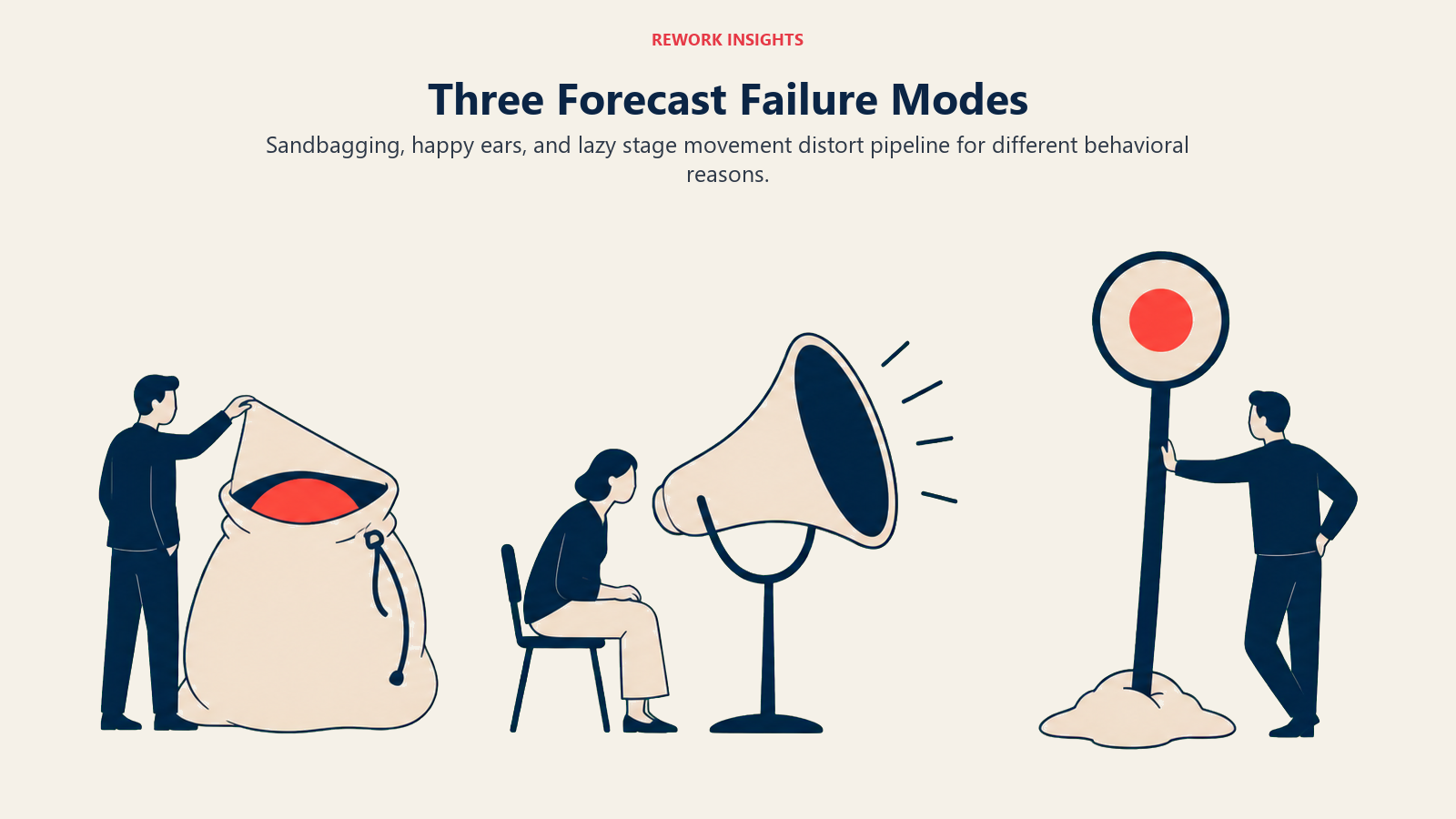
Happy ears is more expensive. A rep believes a deal will close because they want it to, because the prospect said encouraging things, because the champion is enthusiastic even though no one with budget authority has been in a conversation. Happy ears is almost always enabled by a manager who doesn't ask hard enough questions in deal review. When "I've built a strong relationship" satisfies a deal review, happy ears propagates. This dynamic is well documented in CEB/Gartner's Challenger Sale research, which found that deals with single-threaded champions (one contact, no mobilizer) fail to close at dramatically higher rates than multi-threaded opportunities, regardless of how strong the champion relationship feels.
Lazy stage movement is the most damaging at scale. It's not intentional distortion, just inertia. Deals stay in stages they've grown out of because updating them is more effort than leaving them, and nothing in the environment rewards accurate stage movement. A deal that closes from "proposal sent" when it should have been in "verbal commit" doesn't feel like a forecasting failure. It feels like a win. But it trains the rep that stage accuracy doesn't matter, and it corrupts your conversion rate data for every forecast you'll build in the next year. The fix starts with pipeline stage definitions that actually match how buyers move, not how sellers want to think they move.
Each failure mode has a different management enabler. Sandbagging gets worse when leaders publicly celebrate or shame forecast misses. Happy ears gets worse when managers accept vague deal language without probing. Lazy stage movement gets worse when nobody ever checks whether stage criteria actually match deal reality.
Deal inspection as a skill, not a meeting
The best CROs I've watched in deal review have one thing in common: they ask questions that reveal the deal's reality rather than questions that confirm what the rep wants to say.
Average deal review: "Where are you on the Acme deal?" Rep answers: "We're in legal review, should close by end of month." Manager moves on. Nobody learned anything.
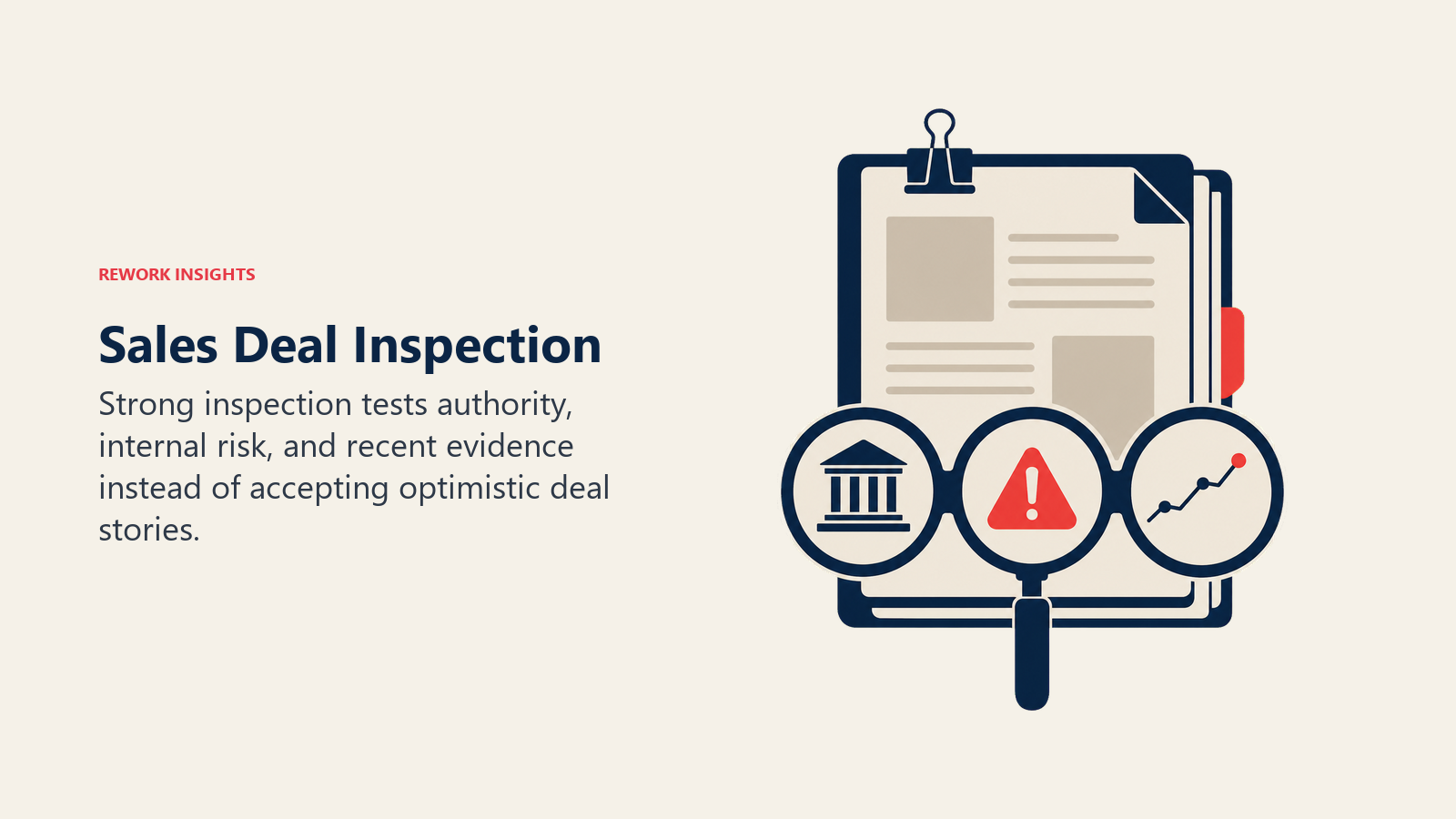
Skilled deal inspection: "Who on their side owns the legal review? Have you spoken to that person directly, or is it going through your champion? What specifically is in review, the MSA or the SOW? What's their typical legal timeline for a deal this size?" Those questions don't feel aggressive. But they immediately reveal whether the rep actually knows the deal or whether they're pattern-matching to a story.
A good deal inspection process formalizes this kind of questioning into a repeatable structure, not so it becomes bureaucratic, but so the manager isn't the only one asking the hard questions every week. The three questions I've seen consistently separate real deals from fiction:
Who in their org has said, explicitly, that they want to move forward with you, and what authority do they have over this decision? Champions are not decision-makers. A champion who can't release budget is a helpful contact, not a committed buyer.
What would have to happen internally for this deal not to close this quarter? This is a useful inversion. If the rep can't answer it, they haven't thought about the deal's actual risks. If they answer with "nothing, we're locked in," that's almost never true.
When did you last speak to someone with budget authority, and what specifically did they say? Recency and specificity. Old conversations don't anchor current forecasts. Vague encouragement from six weeks ago isn't a commit.
These questions feel like deal coaching, not interrogation, because they're genuinely curious rather than accusatory. But they surface the real deal status faster than any CRM stage gate.
The commit culture question
There's a real tension in forecast accountability: you need reps to be honest about risk, but punishing them for surfacing risk teaches them to hide it. This is the commit culture problem, and most sales organizations resolve it badly.
The bad version looks like this: reps learn that putting a deal in forecast means that deal gets maximum scrutiny, so they either sandbag (keep it off the list until it's certain) or hedge (put it in forecast with so many caveats that they can't technically be wrong). Neither behavior produces accurate forecasts.
The good version requires separating two distinct conversations. The first is: "what do you believe will happen?" The second is: "why do you believe that, and what's your evidence?" Leaders who conflate these conversations create an environment where reps are being evaluated on both their outcome and their optimism simultaneously, which pressures toward happy ears.
When a rep says "this deal is in, I'm confident" and it doesn't close, the right coaching question isn't "what happened?" It's "what did you believe, and what did that belief rest on?" That separates the outcome (unpredictable) from the quality of the reasoning (improvable).
The Forecast Confidence Stack
A defensible forecast number is built in layers, not in a single estimate. Here's how teams with high accuracy structure theirs:
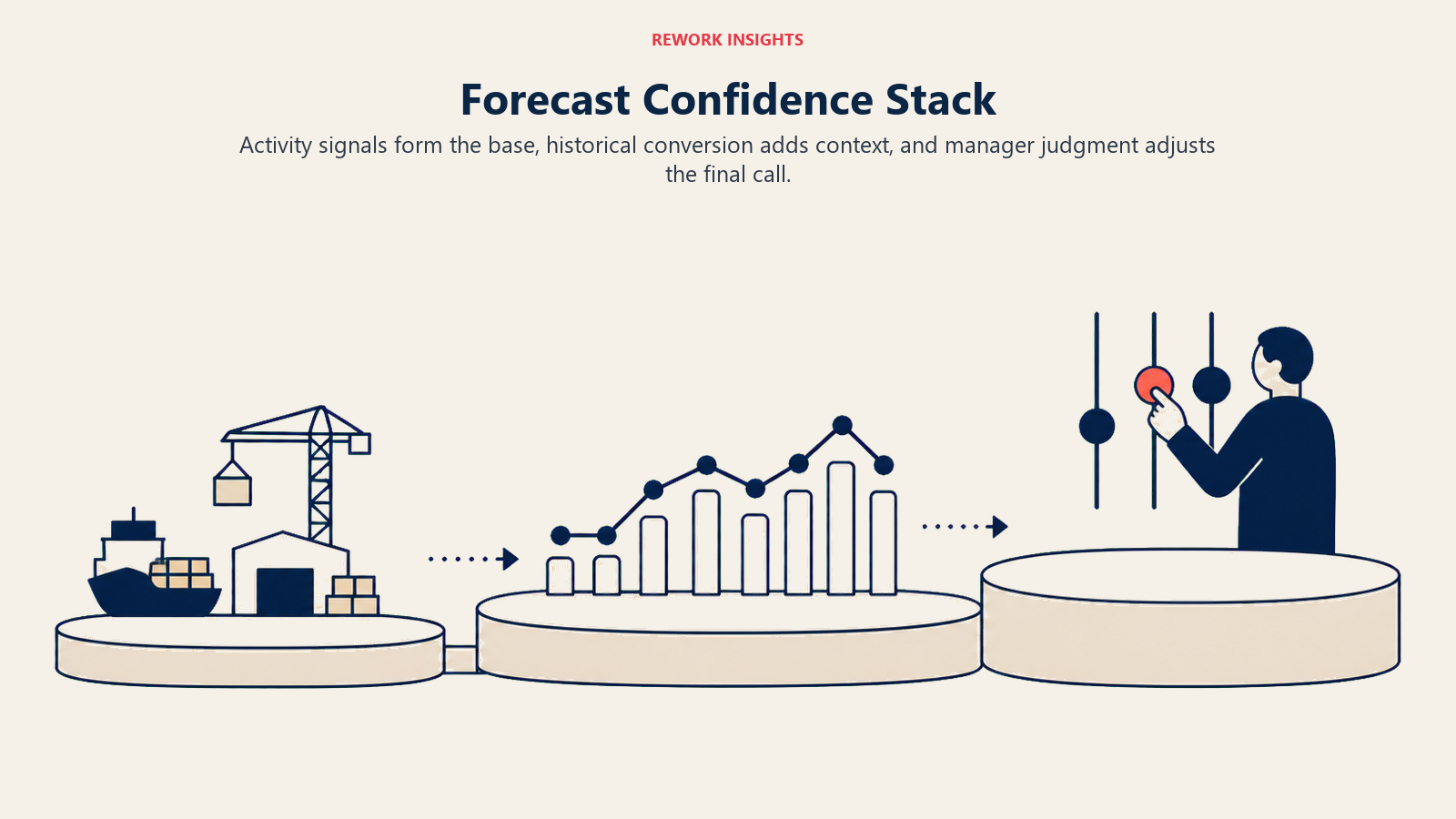
Layer 1: Activity signals. What has actually happened in the last two weeks? Not what the rep expects to happen. What occurred. Meetings held. Contracts requested. References called. Legal review initiated. Activity signals are facts. They're the foundation.
Layer 2: Historical conversion rates. Of deals that have reached this stage in the past, with this company profile, in this quarter, how many closed? Not anecdotally, but from the CRM data. If you don't have this data, that's a separate problem to solve, but approximate data is better than no baseline. McKinsey's research on data-driven sales organizations found that teams using historical conversion rates as a forecast input (rather than relying solely on rep judgment) improved their forecast accuracy by an average of 15 percentage points over two years. Regular lost deal reviews are how high-accuracy teams build the pattern knowledge that makes historical conversion rates meaningful rather than just averaged noise.
Layer 3: Manager gut-check. After seeing the activity signals and the historical context, the manager's read on the rep's relationship with the deal and with the account. This is intuition, but it's informed intuition. It goes on top of facts, not in place of them.
A CRO who can show a board this structure ("here are the committed deals, here's the activity evidence for each, here's the historical conversion rate for deals at this stage, and here's where I've adjusted the number based on manager input") is presenting a credible forecast. Not a perfect one, but a defensible one. That's what board credibility actually requires.
Two approaches to the forecast call
One VP ran weekly all-hands forecast calls: full team on a video call every Monday, each rep gives a verbal update on their top deals, manager asks clarifying questions live. The call ran 90 minutes. It produced a forecast. It also produced theater.
Reps who knew their deals were weak either talked fast, hedged heavily, or waited for the VP to move on. Nobody surfaced real risk voluntarily because doing so in front of peers felt costly. The forecast from that call was consistently optimistic by 15-20%.
Another VP ran 30-minute async reviews: each rep recorded a five-minute Loom on their top three deals (their commit number, the evidence behind it, and the specific risk) before Monday morning. The VP watched the Looms on Sunday evening, added written questions to each one, and had reps respond in writing before the Monday stand-up.
The written commit reason changed behavior. When a rep has to type out "I believe this deal will close because X, Y, and Z happened in the last week," they self-audit. Vague optimism doesn't survive the writing process. And when the VP followed up with "your evidence for Z is that the champion told you, so have you confirmed with the CFO?" that question lived in writing, which the rep would see again the following week.
The async VP's forecast accuracy ran around 88% over three quarters. The all-hands VP ran around 61%.
Tactical takeaway
Three questions to ask in any deal review that reveal whether the deal is real:
- Who has explicitly said yes with budget authority, and when did you last confirm it?
- What would have to go wrong internally for this deal not to close in the committed window?
- What specifically happened in the last two weeks that moved this deal forward?
If the answers are vague, old, or hypothetical, the deal isn't in forecast yet. It's in pipeline. Those are different categories, and conflating them is where most forecast misses begin.
Learn More