More in
Revenue Operations Insights
The True Cost of Software Sprawl (It's Not the Licenses)
Jun 12, 2026
Pipeline Hygiene as a Cultural Practice, Not a Data Problem
Apr 7, 2026 · Currently reading
The RevOps Maturity Model: From Reactive to Strategic
Apr 6, 2026
Attribution Is Broken. Here's What to Measure Instead
Mar 9, 2026
CAC Payback: The Metric That Actually Predicts SaaS Survival
Feb 6, 2026
Pipeline Hygiene as a Cultural Practice, Not a Data Problem
Turn this article into takeaways for your work.


Each assistant summarizes the article only for you and suggests best practices for your work.
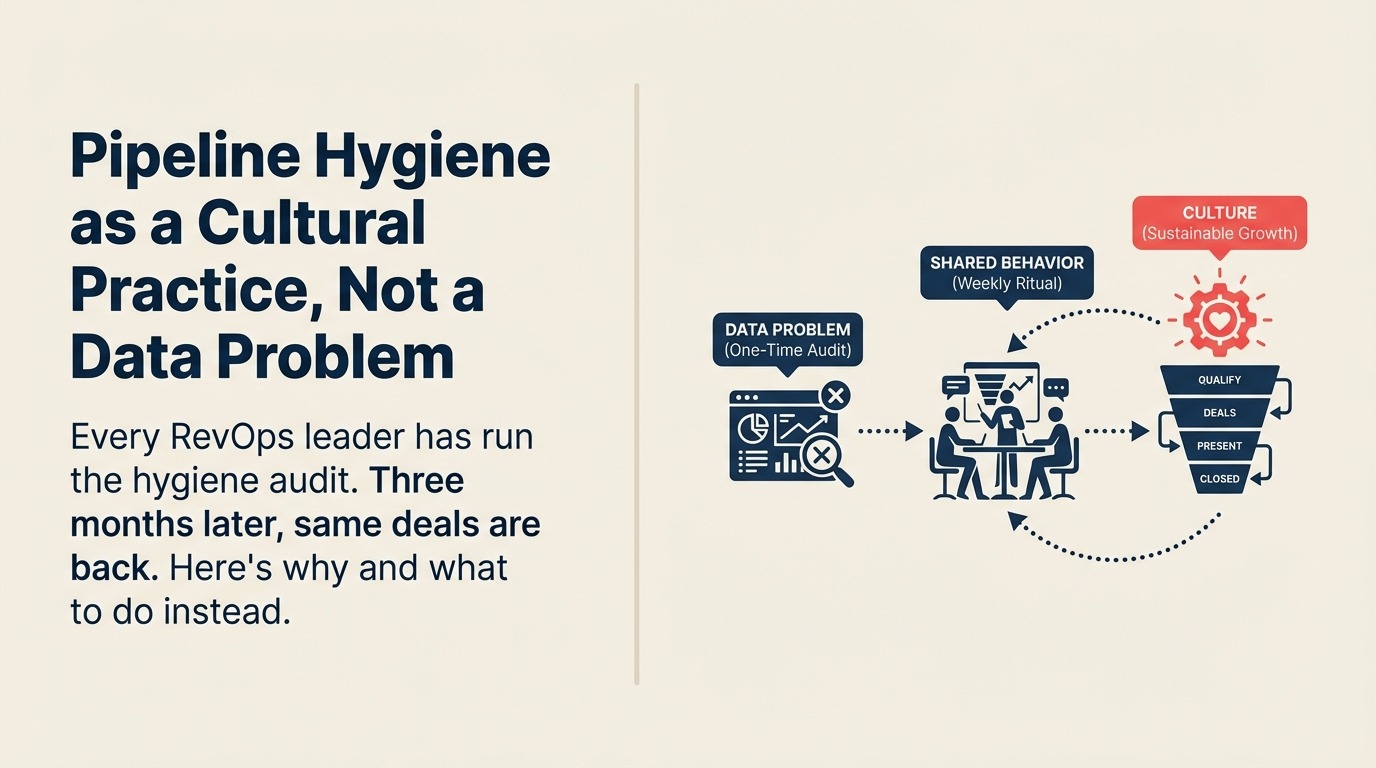
Every RevOps leader has run the pipeline hygiene audit. You pull the stale opportunities report, flag deals that haven't moved in 45 days, build a cleanup checklist, and schedule the coaching sessions. Reps update their fields. Managers nod along. The next quarter's pipeline looks clean for about six weeks.
Then it reverts.
The audit-fix-decay cycle repeats because we keep treating pipeline hygiene as a data quality problem when it's actually a behavioral contract problem. It does not help that the true cost of software sprawl fragments the same pipeline data across a dozen disconnected tools, but the root behavior still has to be fixed first. The CRM fields aren't wrong because reps don't know how to fill them in. They're wrong because there's no shared agreement about what accurate data is worth, and no consequence structure that makes accuracy the path of least resistance.
Why Hygiene Sprints Always Fail
The sprint model has a fatal design flaw: it exerts pressure at the wrong point in time.
When RevOps runs a hygiene sprint, they're cleaning up decisions that were already made wrong weeks ago. A rep who moved a deal to "Proposal Sent" before a proposal existed did so in the moment: their manager was asking for pipeline coverage, the deal felt warm, and "Proposal Sent" unlocked a better forecast category. No retrospective audit changes the incentive that produced that choice. Research from Harvard Business Review on sales manager incentive design shows that pipeline inflation is almost always a downstream consequence of how managers frame pipeline coverage conversations, not a data quality problem at all.
The management behavior that perpetuates this is more subtle than most RevOps leaders are willing to say directly. Managers who push reps for pipeline coverage at quarter start create a structural incentive for optimistic deal staging. When a manager asks "what's in your Q3?" and the honest answer is "not enough," reps move deals up to avoid the uncomfortable conversation. The CRM absorbs the fiction. RevOps inherits the cleanup.
Fixing hygiene without addressing that manager incentive is like bailing water from a boat with a hole in the hull.
The Three Reps Who Corrupt Your Pipeline
Not all bad pipeline data looks the same. Knowing which rep pattern you're dealing with determines which intervention works.
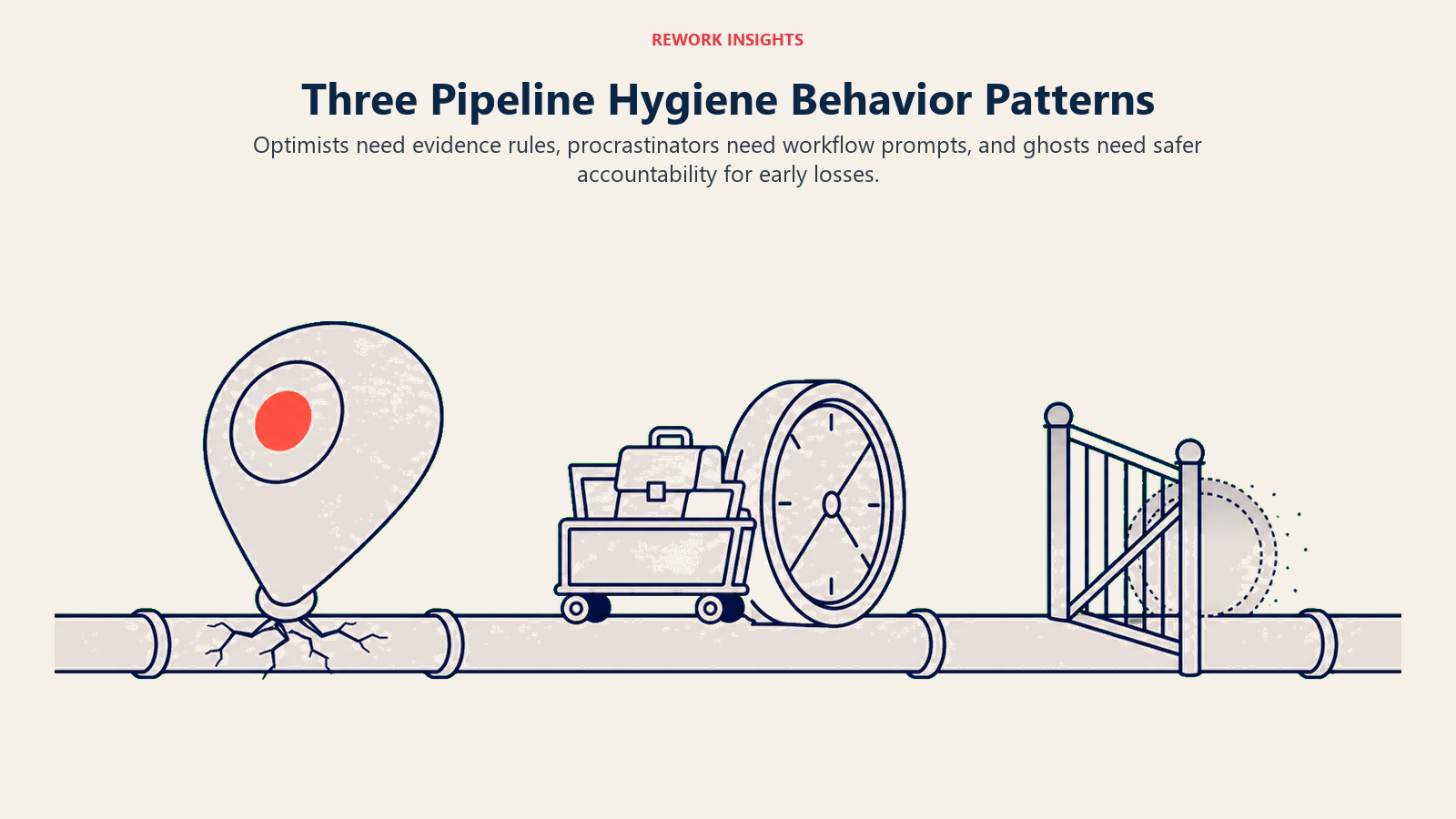
The Optimist. This rep genuinely believes every deal is closer than it is. They advance stage when a prospect "seemed interested" on the call. They don't close out deals because they're planning to "try one more time." Their pipeline is twice the size it should be, and their win rate is consistently below team average. The intervention here isn't discipline, it's shared stage definition with observable exit criteria. "Proposal Sent" means a specific document exists and was opened, full stop. Without those objective criteria, the optimist will always find a reason to advance. Building pipeline stages around buyer behavior evidence, not rep activity, removes the ambiguity that the Optimist exploits.
The Procrastinator. This rep updates their CRM the night before one-on-ones and doesn't update it between those times. Their data isn't systematically wrong, it's just always two weeks stale. Pipeline meetings based on their data are working with last fortnight's reality. The intervention is workflow automation. If deal updates require a manual CRM session, the procrastinator will always postpone. If updating close date is required to book a next step, or if the CRM sends an activity alert after 7 days of silence, the behavior changes at the point of friction.
The Ghost. This rep stops updating deals the moment they sense a deal is going cold. The deal sits in stage 3 for 90 days because updating it to "lost" means acknowledging a miss. Ghosts inflate pipeline accuracy metrics because the deal count looks stable while value quietly decays. The intervention is a manager conversation, not a system change. Ghosting is almost always about fear of accountability. If the culture around losing deals is punitive rather than analytical, ghosts multiply. Creating explicit "no blame for early close" language in one-on-ones unlocks more honest data than any hygiene audit.
Most pipelines have all three archetypes. The mix tells you a lot about what kind of hygiene intervention will actually stick.
Stage Definition as a Cultural Artifact
When "Proposal Sent" means five different things to five different reps, your CRM is fiction dressed up with timestamps.
Stage definitions fail when they describe activity that happened ("we sent a proposal") rather than buyer behavior that occurred ("the champion confirmed they're presenting this internally"). Activity-based stages are fully within the rep's control to game. Buyer-behavior-based stages require evidence from outside the rep's own interpretation.
The rewrite is simple but requires RevOps and sales management to agree on observable evidence at each stage:
- Stage 2 → 3 should require confirmation that there is a named internal champion who owns the evaluation
- Stage 3 → 4 should require that a proposal has been sent AND that the prospect has scheduled a follow-up specifically to discuss it
- Stage 4 → 5 should require verbal or written confirmation that the deal is approved to move to contract
These aren't just CRM hygiene rules. They're shared beliefs about what "progress" means in a sales cycle. Getting managers to sign off on these definitions in writing, and to use them in coaching rather than just in audits, is what makes them cultural rather than procedural.
Building the Hygiene Contract
Pipeline hygiene that holds requires three parties to agree to different things in writing. Without all three, the behavioral contract collapses.
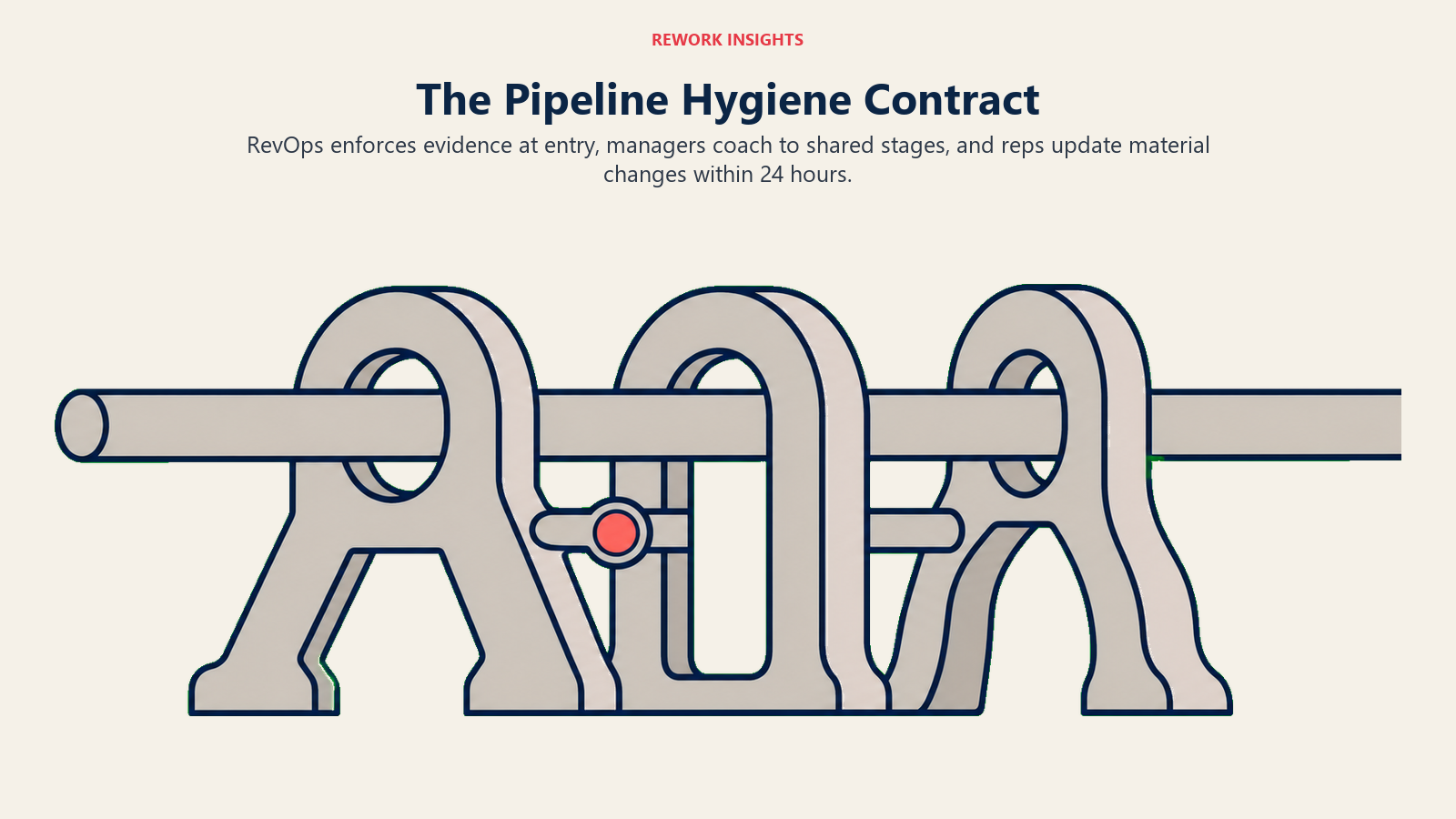
What RevOps agrees to: Maintain CRM workflows that enforce stage definition at entry, not at audit. If a stage requires a specific field to be populated before the deal can advance, that check happens at the click, not three weeks later in a report. CRM workflow automation that gates stage progression is the technical implementation of this commitment. RevOps also agrees to make hygiene visible in management dashboards before the sprint, not just during it. A weekly "pipeline integrity" summary for each manager creates ambient awareness that doesn't require an audit to generate.
What sales management agrees to: Use stage definitions consistently in one-on-ones. Not "where's this deal going?" but "what buyer behavior happened that moved this to stage 3?" If managers use the same vocabulary as the CRM stage definitions in coaching, reps align to that standard rather than their own interpretation. Managers also agree not to pressure reps for pipeline coverage in ways that incentivize optimistic staging.
What reps agree to: Update deal records within 24 hours of any substantive conversation with a prospect. Not a week later, not the night before the one-on-one. The standard is: if something happened that changes what you know about this deal, the CRM should reflect it before you end your workday.
This contract sounds obvious. It rarely exists in writing anywhere. When you formalize it (even a shared Google Doc that RevOps, sales leadership, and reps have reviewed), it creates an accountability surface that a verbal norm never provides. Gartner's research on CRM adoption consistently shows that reps who understand the downstream use of their data, forecasting, headcount decisions, quota-setting, update records more accurately than those who see CRM data entry as administrative overhead with no consequence.
The Pipeline Integrity Score
Rather than a quarterly hygiene audit, build a weekly signal that surfaces risk before it becomes a crisis.
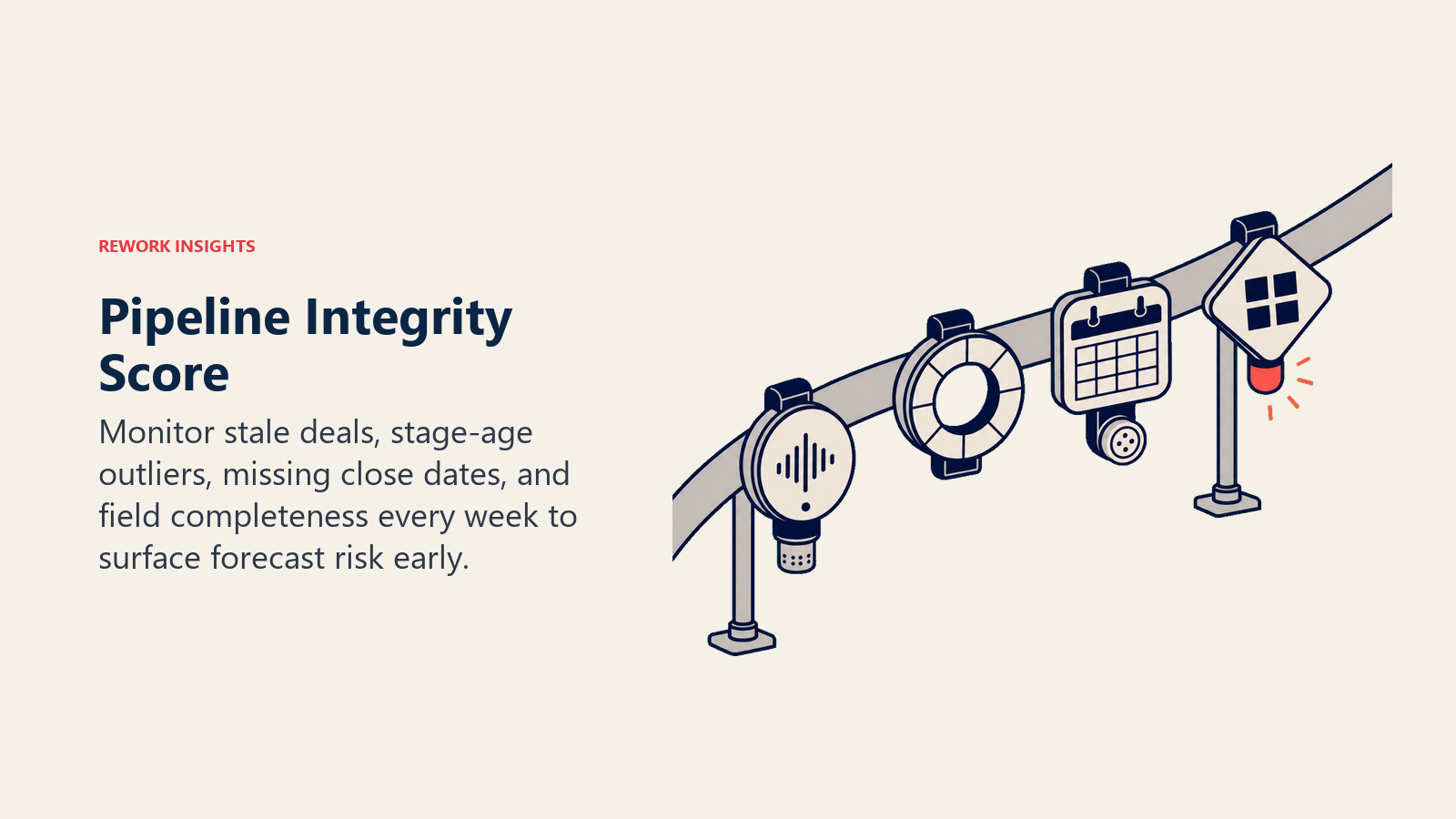
The Pipeline Integrity Score uses four CRM fields to generate a simple weekly number for each manager:
- Stale deal ratio: Percentage of open deals with no activity logged in the past 14 days
- Stage age outliers: Deals that have spent more than 1.5× the average time in their current stage
- Missing close date: Open deals with no close date or a close date in a past quarter
- Field completeness: Percentage of deals missing required fields (contact role, next step, decision date)
Score each field 0–25 and sum to 100. A manager with a Pipeline Integrity Score of 80+ has fundamentally clean data. Below 60 triggers a direct conversation. Below 40 triggers a joint RevOps and sales management review before the next forecast call.
The value is that the score creates a standing weekly expectation rather than a surprise quarterly audit. Managers see it every Monday. Reps know their manager sees it. The ongoing visibility changes behavior more than any sprint because it removes the "it's not audit week so nothing matters" dynamic. Forrester's research on sales pipeline management found that organizations running continuous pipeline integrity signals rather than periodic audits reduced forecast variance by a material margin, the mechanism is exactly this: consistent ambient visibility rather than concentrated cleanup pressure.
Most HubSpot and Salesforce deployments can surface these four fields in a custom report in about an hour of configuration. Pipedrive and Zoho CRM have equivalent reporting modules. The logic isn't complex. The discipline is in looking at the number every week and acting on it. A weekly pipeline review structure gives managers the consistent cadence that turns this score into action rather than a number nobody checks.
The 15-Minute Weekly Hygiene Check-In
Here's a format that managers can run without RevOps in the room.
Opening (2 minutes): Pull the Pipeline Integrity Score for the team. Name the two or three reps with the lowest scores. This isn't shaming, it's visible accountability.
Review (8 minutes): For each deal that's been in the same stage for more than two weeks, the manager asks: "What's the last thing that happened with this deal from the buyer's side?" Not "what did you do?" but "what did the buyer do?" If the rep can't answer, that deal is either stuck or fictional.
Decisions (5 minutes): For any deal the rep can't give a buyer-behavior answer about, make one of three decisions on the spot: advance it if evidence exists, push close date forward to reflect reality, or close it as lost or inactive. No deal stays in ambiguity after this conversation. This same discipline applies when you're reviewing lead lifecycle stages and qualification hand-off criteria, ambiguity at the top of the funnel compounds into dirty pipeline downstream.
This format works because it doesn't require preparation, doesn't create shame, and produces a concrete output every week. The rep leaves knowing exactly which deals need action. The manager leaves with an accurate snapshot. RevOps gets data they can actually forecast from.
Learn More
- CAC Payback: The Metric That Actually Predicts SaaS Survival, Why clean pipeline data directly affects your CAC calculation accuracy
- The RevOps Maturity Model: From Reactive to Strategic, How mature RevOps teams move from hygiene enforcement to proactive pipeline intelligence
- Attribution Is Broken. Here's What to Measure Instead, When pipeline data is unreliable, attribution analysis becomes even less trustworthy
