More in
AI Jobs & Skills News
Finance Keeps Shedding Jobs as the Economy Hires: The White-Collar Warning
Jun 6, 2026
AI Skills Just Became the Hardest Hire in the World. You Won't Recruit Your Way Out
Jun 6, 2026
Is AI Actually Killing Jobs? May's Hiring Numbers Say Not So Fast
Jun 5, 2026
You Put Your AI Agents on the Org Chart. Accountability Quietly Dropped
Jun 5, 2026
Everyone Blames AI for the Gen Z Job Crisis. The Fed Points at Remote Work
Jun 5, 2026
AI's Net Job Drag Fell to 11,000 a Month. Construction Is Hiding the Truth
Jun 4, 2026
AI Blamed for a Record 40% of May's US Layoffs, the Third Month Running
Jun 4, 2026
Four Futures for Jobs by 2030: The Mid-2026 Checkpoint for CEOs
Jun 3, 2026
Can Federal AI Apprenticeships Fix Your Skills Gap Cheaper Than Hiring?
Jun 3, 2026
AI Engineer Pay Split Into Two Markets. Only the Top Is a Bubble
Jun 3, 2026
48% of Q1 2026 Tech Layoffs Were Blamed on AI: The Communication Playbook CHROs Need Before the Next Board Meeting

Turn this article into takeaways for your work.


Each assistant summarizes the article only for you and suggests best practices for your work.
Quick Take: 78,557 tech workers were laid off in Q1 2026, with 47.9% of cuts attributed to AI. The credibility risk for CHROs isn't the layoffs themselves. It's AI washing: using AI as broad cover for cuts that would have happened anyway. A clear attribution framework, built before the board meeting, is the difference between controlling the narrative and chasing it.
What the Data Says
- 78,557 tech sector employees were laid off between January 1 and early April 2026 (Tom's Hardware / Layoffs.fyi)
- 47.9% of Q1 2026 tech layoffs were explicitly attributed to AI and workflow automation
- Oracle announced plans to eliminate 20,000–30,000 roles, moving $8–$10 billion from OpEx to CapEx on AI infrastructure
- Block eliminated approximately 4,000 roles (roughly 40% of its global workforce) citing AI capability expansion
- Roughly half of AI-attributed layoffs may be reversed within 18 months if AI productivity gains don't materialize (HR Executive)
The Q1 2026 layoff numbers are specific enough now that "AI is changing workforce needs" no longer works as a general statement. It's a data point, and your board, your employees, and your regulators are going to test it.
According to reporting from Tom's Hardware, 78,557 tech sector employees were laid off between January 1 and early April 2026. Nearly half (47.9%) of those cuts were explicitly attributed to reduced demand for human workers because of AI and workflow automation. More than three-quarters of the affected positions were in the U.S.
These aren't sector-wide background numbers. They're the data your board will walk into the next meeting with. And if your workforce communication strategy still treats AI as a vague future force, you're going to get caught flat-footed.
The Two Archetypes Your Board Is Already Asking About
Two Q1 cases are setting the frame for how boards, investors, and employees are reading AI-related workforce decisions.
Oracle announced plans to eliminate between 20,000 and 30,000 positions as part of a deliberate reallocation, moving $8 to $10 billion out of operating expenditure on people and into capital expenditure on AI infrastructure. This is a structural bet: trading recurring labor cost for AI capacity. It's a clear OpEx-to-CapEx thesis, and it's the archetype that CFOs and boards find easiest to model and approve. For a broader read on which roles AI is actually eliminating versus creating at companies in the 50–500 employee range, the picture is more nuanced than the headlines suggest.
Block, led by Jack Dorsey, went further in percentage terms. The company eliminated roughly 4,000 roles (approximately 40% of its global workforce), citing the expanding capability of AI tools to perform tasks that previously required human headcount. That's a much more aggressive claim, and it carries a much larger credibility burden.
Both decisions are now public reference points. When your board asks "what's our AI workforce position," these are the comparisons they're making implicitly. The question isn't whether you'll be asked to address them. It's whether you're ready with a framework that holds up to scrutiny.
The AI Washing Problem CHROs Can't Ignore
Here's where it gets complicated. OpenAI CEO Sam Altman has publicly called out "AI washing," the practice of attributing layoffs to AI that would have been made anyway for financial, strategic, or performance reasons. It's not a fringe concern. It's a credibility risk that's now been named by one of the most visible figures in the AI industry. It's also worth setting this in the context of PwC's concurrent finding that just 20% of companies capture 74% of AI's economic value, meaning many of the companies cutting costs in AI's name haven't restructured to actually capture AI's upside.
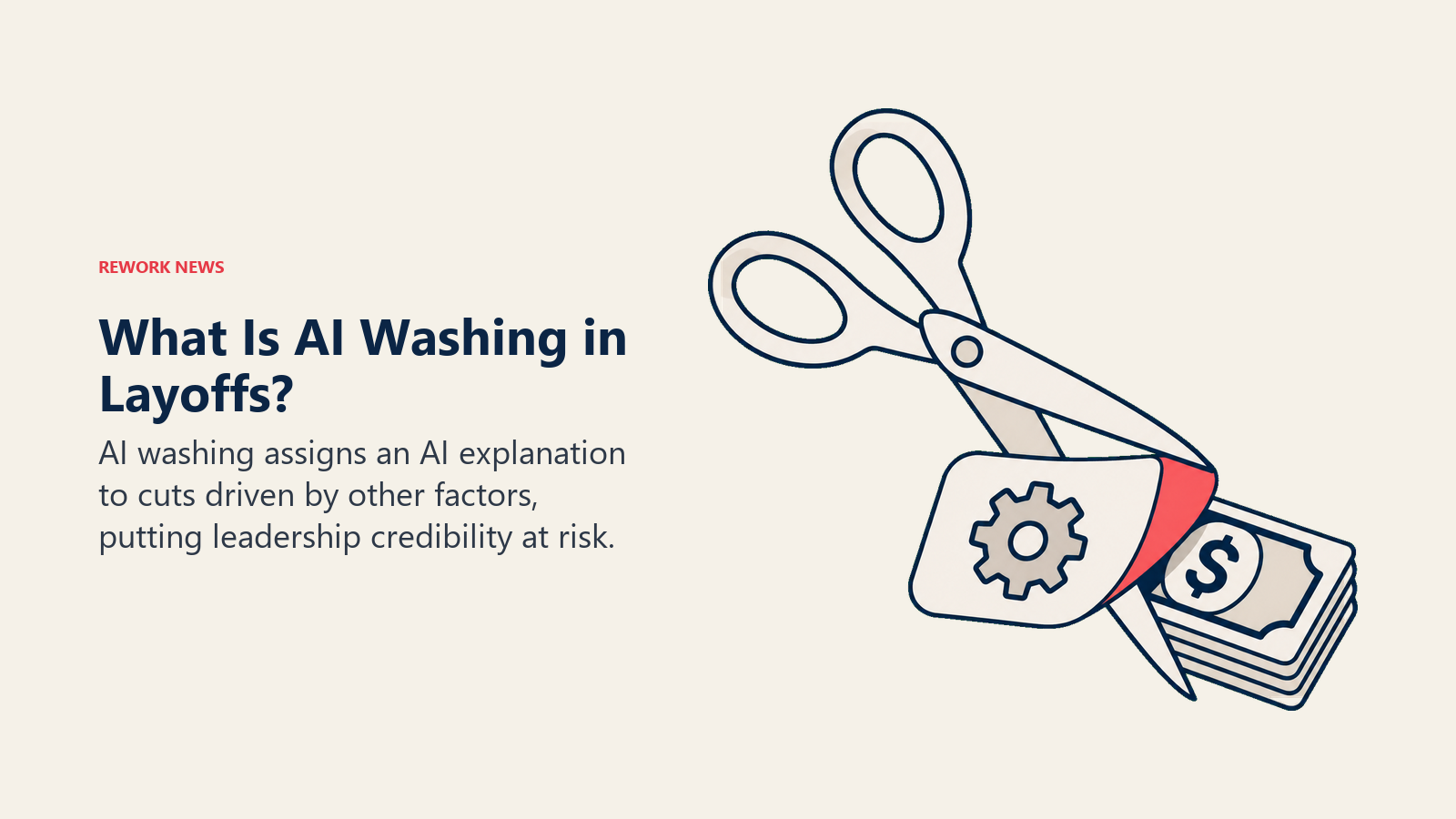
The business press has picked up the term. HR Executive has reported that roughly half of the layoffs currently attributed to AI may be quietly reversed within 18 months, as companies discover either that the AI productivity gains didn't materialize, or that the cuts outpaced what current capability could actually support. CBS News has similarly documented cases where AI was cited as justification for reductions that were primarily cost-driven.
And Harvard Business Review has made the point plainly: many companies are cutting based on AI's potential, not its current performance. That's a meaningful distinction. Telling employees and the board that AI has replaced a function when you actually mean "we expect AI to replace this function in 18 months" is not just spin. It's a liability.
For CHROs, this creates a specific risk. If you use AI attribution as a broad justification for cuts that are partly or mostly driven by other factors, and the rehire data surfaces later (or the AI capability gap becomes visible), you've lost credibility with employees, and possibly with regulators who are increasingly watching AI-based workforce decisions.
The communication framework you bring to the board needs to survive that scrutiny. Here's how to build it.
The CHRO Credibility Test
Before communicating any AI-driven workforce change, a CHRO should be able to answer three questions on paper: Which specific AI capability is replacing this work? At what stage of maturity is that capability deployed, piloted, or projected? And what is the reallocation, where does the investment freed up actually go? A communication that can't answer all three is not an AI attribution story. It's a restructuring story told with AI language.
The Attribution Burden Rule: For any workforce change attributed to AI, document the specific capability, the evidence of maturity, and the reallocation destination before communicating externally. If any of the three is missing, separate that change from your AI narrative. Credibility survives a restructuring story; it rarely survives an AI washing revelation.
A 5-Point Communication Framework for AI-Related Workforce Changes
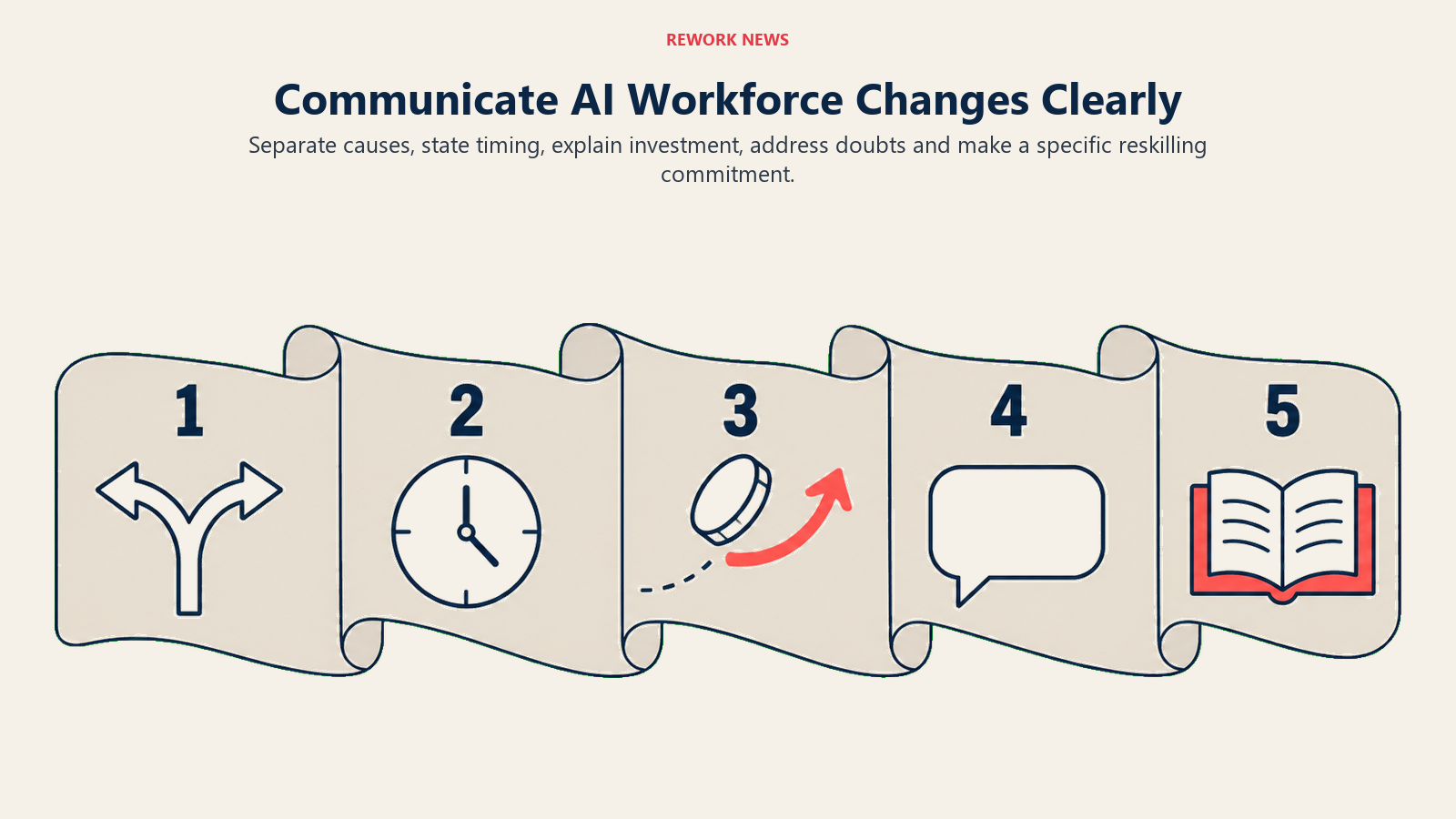
1. Separate AI-driven changes from general restructuring. Do this on paper before you communicate anything.
Not every cut in a restructuring cycle is AI-driven. Some are cyclical. Some are organizational. Some are performance-related. Before you frame anything as AI-related to the board or to employees, run an internal attribution exercise: for each affected role or function, document specifically which AI capability or workflow automation is actually replacing the work, with evidence. If you can't name the capability and the evidence, you don't have an AI attribution story. You have a restructuring story, and you should tell it as such.
This step protects you legally, operationally, and reputationally. It also gives you a factual basis for board communication that can withstand follow-up questions.
2. Be explicit about the timeline: current performance vs. projected capability.
If cuts are based on what AI can do today, say so and be specific. If cuts are based on what you expect AI to do in 12 to 24 months, say that too, but own it as a strategic bet with real uncertainty. Employees and boards can evaluate a strategic bet. What they can't forgive is discovering later that the framing was imprecise.
3. Quantify the reallocation, if there is one.
Oracle's communication worked in part because the reallocation narrative was concrete: $8 to $10 billion moving from OpEx to CapEx. That's a business model argument, not just a headcount argument. If your AI-related workforce changes are funding infrastructure, capability, or new role categories, make that transfer explicit. "We're reducing X roles to fund Y investment" is a strategic statement. "AI is making some roles unnecessary" without the offset narrative leaves employees and the board filling in blanks you don't want filled in.
4. Acknowledge the counter-narrative directly.
Your employees have read the same headlines you have. Many of them know about AI washing. The CHROs who come out of this period with intact credibility will be the ones who said, directly, "we know some companies are using AI as cover for cuts that aren't really AI-driven, and here's why our situation is different." That's a harder message to deliver, but it's the one that builds trust rather than eroding it.
5. Commit to a rehire or reskilling position. And mean it.
Entry-level coding roles, customer service functions, and data-entry positions are showing up most frequently in the affected categories. But new roles are growing in parallel: prompt engineering, AI safety, MLOps, and AI-human collaboration functions are expanding, particularly at AI-native organizations. If your AI-related changes are accompanied by a genuine reskilling or redeployment commitment, that commitment needs to be specific about scope, timeline, and investment. Vague promises about "retraining" that don't materialize will be remembered. A 90-day AI fluency plan for teams is one concrete format for making the reskilling commitment operational rather than rhetorical.
What the Board Wants From You Specifically
The board's questions about AI and workforce will typically run in this order. Have answers ready for all five. Boards that have also read how to present AI workforce investment without the hype will come in with sharper questions than in prior cycles.
- What's our current AI-to-headcount exposure? Which functions could be materially affected by AI capability in the next 12 to 24 months, and what's your assessment of timing?
- What's our attribution framework? How are we distinguishing AI-driven workforce changes from restructuring driven by other factors?
- What's the reallocation story? If we're reducing headcount, where is that investment going? What AI capability or infrastructure does it fund?
- What's the risk if we're wrong about the timeline? If the AI productivity gains don't materialize as projected, what's the operational and reputational exposure?
- What's our employee communication plan? What are we saying, when, and how are we handling the AI washing concern?
Boards that have seen the Oracle and Block coverage are already asking versions of these questions. The CHROs who walk in with a prepared framework rather than reactive answers will control the narrative. The ones who don't will spend the rest of the year catching up.
What to Do This Week
Before the next board meeting, run through this internal prep sequence.
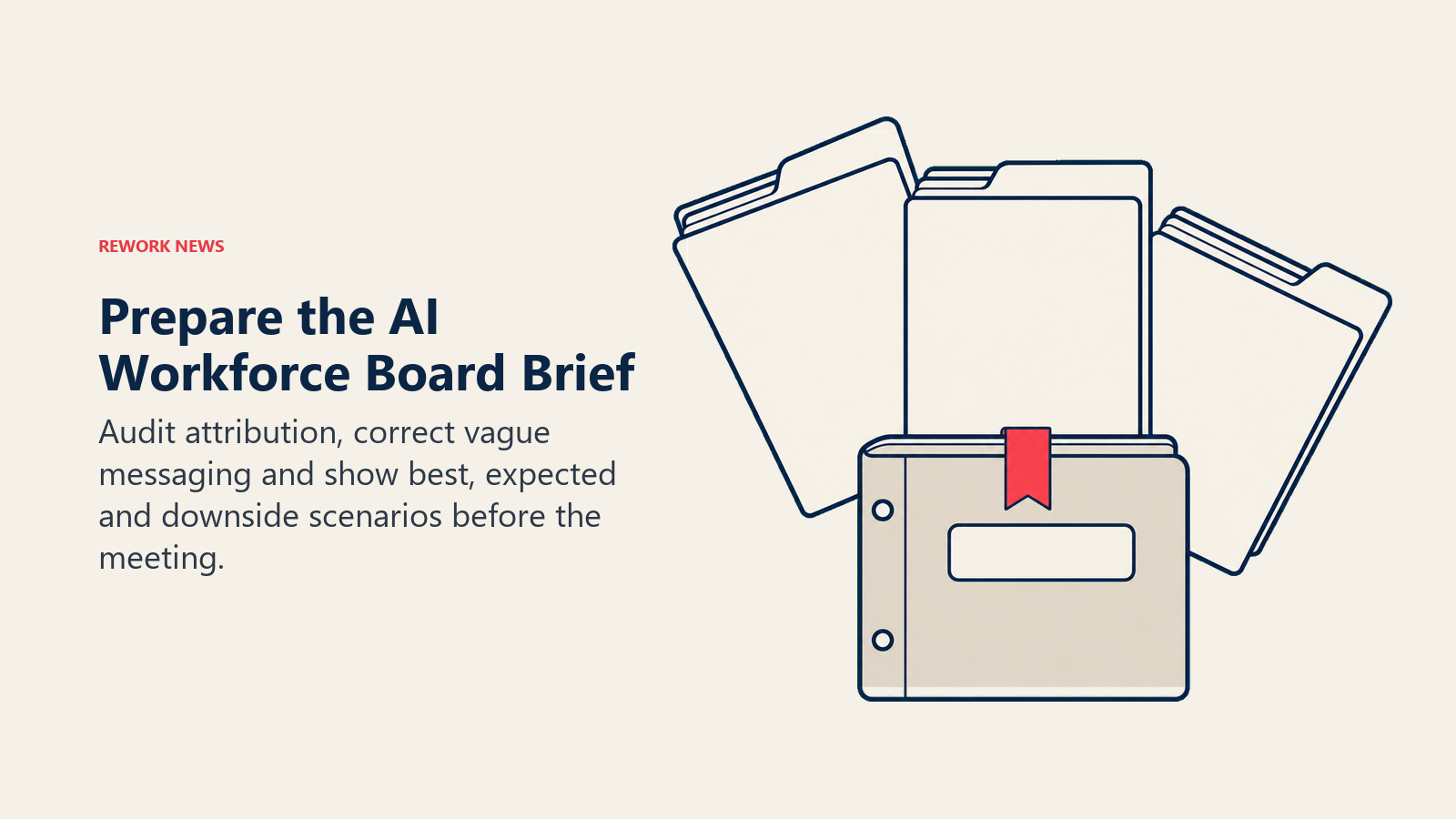
First, audit your AI attribution. For any current or planned workforce changes, document which specific AI capabilities are driving the change and at what stage of maturity (deployed, piloted, or projected). Any change without a clear capability reference should be separated from your AI narrative.
Second, review any existing communications that used AI language broadly. If you've used phrases like "AI is changing our workforce needs" without specifics in recent all-hands or manager communications, make a plan to add specifics in your next round. Employees remember vague language when they're looking for reasons to distrust.
Third, build a simple scenario table for the board: best case, expected case, and downside case for your AI workforce thesis over the next 18 months. What does the headcount picture look like if AI productivity gains arrive on schedule, late, or partially? A CHRO who can present the full range, not just the optimistic case, will earn more board confidence than one presenting a single-scenario view.
The Q1 data is out. The AI washing concern is named and public. The CHROs who come out of this well won't be the ones who avoid the conversation. They'll be the ones who had it first, on their own terms, with a framework they built before the pressure arrived. Separately, as Gallup's data shows 50% of the U.S. workforce now using AI at work, the conversation can't wait for the next board cycle. The workforce is already making decisions with or without a formal framework.
Frequently Asked Questions
What is AI washing in the context of layoffs?
AI washing refers to the practice of attributing layoffs to AI automation when the cuts are primarily driven by financial, strategic, or performance reasons. OpenAI CEO Sam Altman publicly named the concern in early 2026. CHROs risk credibility damage (with employees, boards, and regulators) when workforce changes attributed to AI don't hold up under scrutiny.
How should CHROs distinguish AI-driven layoffs from general restructuring?
For each affected role or function, document which specific AI capability is replacing the work, at what stage of maturity that capability sits (deployed, piloted, or projected), and what the freed-up investment funds. If all three can't be answered with evidence, the change should be framed as restructuring rather than AI-driven workforce adjustment.
What were the largest AI-attributed layoffs in Q1 2026?
Oracle announced plans to eliminate 20,000–30,000 positions, reallocating $8–$10 billion from labor OpEx to AI infrastructure CapEx. Block eliminated roughly 4,000 roles (approximately 40% of its global workforce), citing AI's expanded capability to perform tasks previously requiring human headcount. Both are now public reference points boards use when evaluating other organizations' AI workforce positions.
Is there a risk that AI-attributed layoffs get reversed?
HR Executive reported that roughly half of AI-attributed layoffs in the current cycle may be reversed within 18 months if AI productivity gains don't arrive as projected. CHROs who frame cuts as AI-driven based on projected capability rather than current performance carry the reputational and operational risk of that reversal.
What should CHROs prepare before the next board meeting on AI workforce?
Prepare answers to five specific questions: What is the organization's current AI-to-headcount exposure? What attribution framework distinguishes AI-driven changes from other restructuring? Where is freed-up investment going? What is the downside scenario if AI gains arrive late? And what is the employee communication plan that directly addresses the AI washing concern?
Related Reading

On this page
- The Two Archetypes Your Board Is Already Asking About
- The AI Washing Problem CHROs Can't Ignore
- The CHRO Credibility Test
- A 5-Point Communication Framework for AI-Related Workforce Changes
- What the Board Wants From You Specifically
- What to Do This Week
- Frequently Asked Questions
- What is AI washing in the context of layoffs?
- How should CHROs distinguish AI-driven layoffs from general restructuring?
- What were the largest AI-attributed layoffs in Q1 2026?
- Is there a risk that AI-attributed layoffs get reversed?
- What should CHROs prepare before the next board meeting on AI workforce?