More in
AI Workforce Transformation
Does AI Make Distributed Teams Easier or Harder to Lead?
Oct 11, 2026
Where AI Productivity Monitoring Turns Into Surveillance
Oct 11, 2026
Why Your Most Experienced People Resist AI Hardest (and Why You Need Them Most)
Oct 11, 2026
Is AI Making Teams Less Collaborative?
Oct 11, 2026
Should CEOs Use AI Themselves? Why Executive Fluency Sets the Adoption Ceiling
Oct 11, 2026
Does AI Favor Generalists or Specialists? What It Means for Who You Hire
Oct 10, 2026
Is Experience Still Worth Paying For When AI Narrows the Skill Gap?
Oct 10, 2026
When Every Candidate Uses AI, What Is a Resume Still Worth?
Oct 10, 2026
Should AI Screen Your Job Candidates? Where Automated Hiring Helps and Where It Backfires
Oct 10, 2026
Should Candidates Be Allowed to Use AI in Interviews?
Oct 10, 2026
How to Talk to Your Board About AI Workforce Investment Without the Hype
Turn this article into takeaways for your work.


Each assistant summarizes the article only for you and suggests best practices for your work.
Most AI workforce proposals die in the boardroom. Not because the investment is wrong. But because the pitch is.
CEOs and CHROs walk in with decks full of transformation potential, productivity multipliers, and competitive urgency. Board members sit across the table, arms crossed, thinking about the last three technology initiatives that didn't deliver. Then someone mentions "generative AI" and the room splits: half skeptical, half worried about being left behind, none of them sure what they're actually being asked to approve.
The result: the proposal gets tabled. Or worse, you get a symbolic budget to "run a pilot" that will never scale.
If you're preparing a board presentation on AI workforce investment, the problem isn't your strategy. It's probably your framing. Here's how to fix it.
The Credibility Gap
Board members are not AI skeptics by nature. They're skeptics of investment proposals that lack three things: a defensible ROI model, a realistic risk analysis, and evidence that the executive team actually understands what they're buying.
Most AI workforce pitches fail on all three counts. They lead with technology capability ("our teams can use AI to generate content 10x faster"), skip straight to transformation vision, and bury the cost-benefit math in an appendix no one reads. That pattern looks like hype, because it is.
The credibility gap is real. A 2024 Gartner survey found that 63% of board members say they're not confident their management teams can evaluate AI investment risks accurately. That number should worry you more than any competitor moving faster than you. You can close a competitor gap with the right investment. But you can't get board alignment if you've lost credibility before the vote. The executive decision framework for AI workforce strategy gives you the analytical structure that turns a credibility problem into a strategic advantage.
Three questions every board member is asking silently when you present:
"What happens if this doesn't work?" Boards think in scenarios. The downside scenario needs to be named and bounded, not ignored.
"What does this actually cost, all-in?" Not the software licenses. The full cost: retraining time, productivity dip during transition, change management, ongoing support. Boards have seen vendors quote SaaS fees while hiding the real implementation burden.
"How will we know if it's working?" Vague success metrics ("improved AI fluency") destroy confidence. Boards want measurable outcomes with timelines attached.
Answer all three before they're asked. That's the table stakes for a credible pitch.
Framing It as Infrastructure, Not Experimentation
The single biggest framing shift that changes how boards respond: stop positioning AI workforce investment as innovation spend, and start positioning it as productivity infrastructure.
Experimentation spend is discretionary. Boards cut it when they need to hit a quarter. Infrastructure is different. It's the foundation your revenue model runs on.
When Salesforce reported that AI-augmented sales reps close 27% more pipeline than non-augmented reps, that's an infrastructure argument. When McKinsey estimated that companies with AI-ready workforces operate with 15-20% lower labor cost per revenue dollar, that's an infrastructure argument. It's not "we're investing in the future." It's "we're maintaining our ability to compete on unit economics."
The framing matters because boards allocate capital differently against infrastructure vs. innovation. Infrastructure gets multi-year commitment. Innovation gets a pilot budget and a 90-day review. You don't want the 90-day review.
Building the Business Case
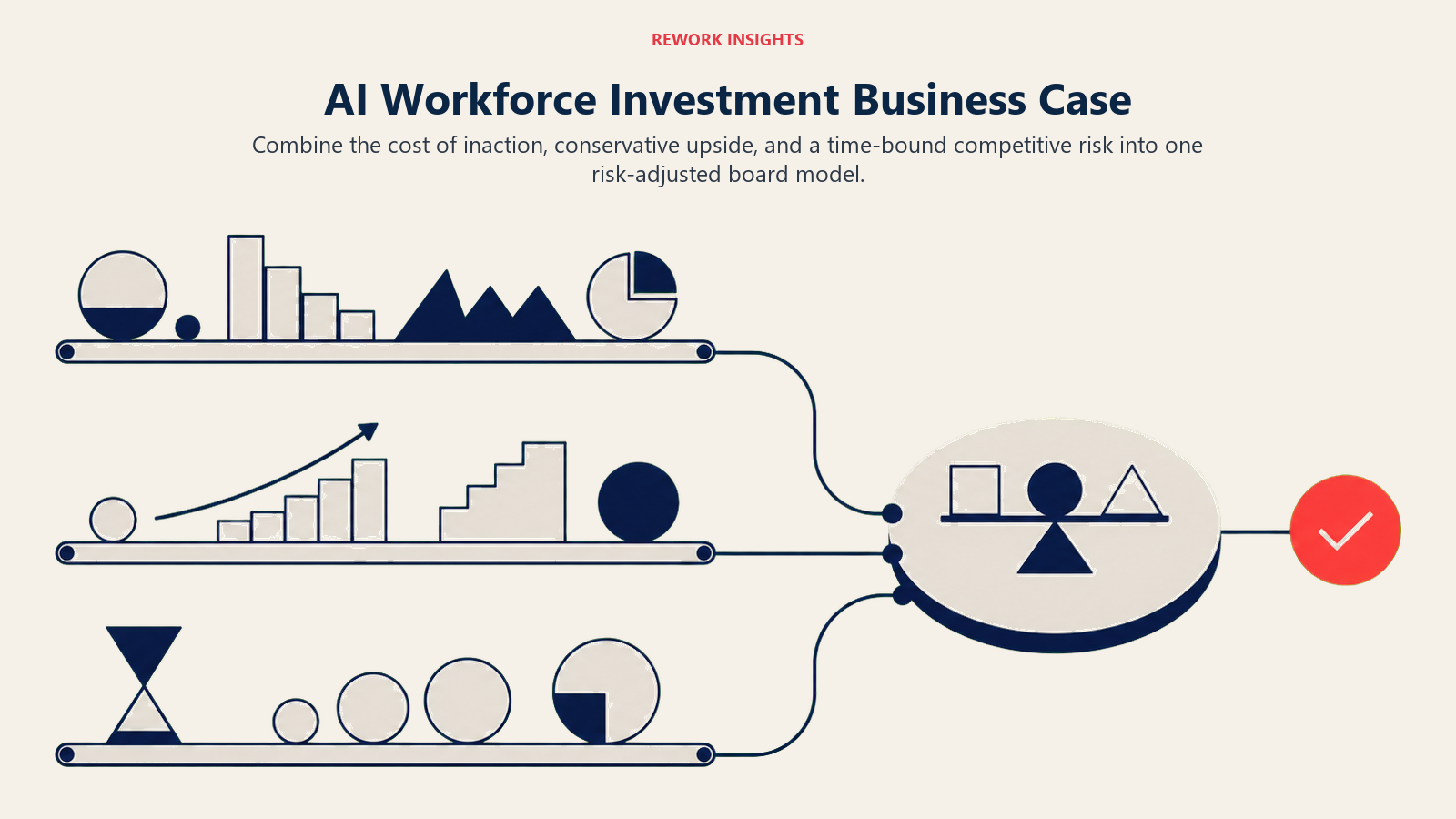
A board-ready business case for AI workforce investment has three components: baseline cost of inaction, upside from action, and competitive risk timeline.
Baseline: What an AI-Unready Workforce Already Costs You
This is the part most CEOs skip, and it's the most persuasive part of the deck.
Your workforce's current AI skill gap has a measurable cost today. Start with three line items:
Productivity drag. Employees without AI fluency spend an estimated 3-5 hours per week on tasks that AI tools could handle in 20 minutes. Across a 200-person professional team, that's roughly 600-1,000 hours per week of recoverable productivity. At a blended fully-loaded cost of $75/hour, that's $45,000-$75,000 per week sitting idle. Boards can check that math.
AI-related attrition premium. LinkedIn's 2025 Workforce Confidence Index found that 41% of professionals say they'll leave their current employer within 12 months if the company doesn't invest in AI training. If your annual attrition runs 15% today and that number moves to 20% because of AI dissatisfaction, you're paying replacement costs on 10 additional employees per year. At a typical 50-75% of annual salary to replace a mid-level professional, that's a concrete number your CFO can model. The AI fluency salary premium data for 2026 shows this cost is only growing.
Slower hiring cycles. AI-fluent candidates command a significant premium and take longer to close. Or they're already taken. Bain & Company research from late 2025 showed that mid-market companies in the bottom AI-readiness quartile take 40% longer to fill technical and commercial roles than top-quartile peers. Slower hiring = slower revenue growth. The causation is direct.
Add those three numbers up. That's your cost-of-inaction baseline. Present it before you mention a single dollar of investment.
Upside: Revenue Per Employee Lift
The most credible number to put in front of a board is revenue per employee before and after AI augmentation.
Industry benchmarks are now available. Across professional services, SaaS, and financial services (sectors comparable to most mid-market businesses), companies that completed structured AI workforce programs in 2024-2025 reported revenue per employee gains of 12-18% within 18 months. For a $50M ARR company with 150 employees, that's roughly $300K-$450K in incremental revenue capacity per employee at the margin, or the equivalent of 8-12 additional FTEs without the headcount cost.
Benchmark sources your CFO will trust: McKinsey Global Institute, Bain & Company, IDC's Future of Work research. Use those. Not vendor case studies.
For a simple 12-month payback model, structure it like this:
| Item | Amount |
|---|---|
| Total investment (training, tooling, change management) | $X |
| Recovered productivity at 50% capture rate (Year 1) | $Y |
| Attrition cost reduction | $Z |
| Revenue per employee lift (conservative 10%) | $W |
| 12-month net return | $Y + $Z + $W - $X |
Present the conservative scenario. Boards discount optimistic projections. A conservative model that still shows positive ROI is far more persuasive than an aggressive model that looks like a sales pitch.
Risk: The Competitor Talent Advantage Timeline
This is the urgency lever, but it needs to be grounded in data, not anxiety.
The argument isn't "AI is moving fast, we need to move now." Boards have heard that since 2012. The argument is: "Competitors who started structured AI workforce programs 18 months ago are now operating at a cost and speed advantage that will compound. Here's when that advantage becomes a durable gap."
The compounding effect is real. Teams that have been working with AI tools for 12 months are an estimated 35-40% faster on core workflows than teams just starting. That gap doesn't close just by buying the same tools. It requires time and deliberate practice. Every month you delay is a month your competitors extend their head start.
You can reference the hidden cost of delaying AI upskilling analysis for the CFO-ready version of this argument. The key point for the board: this is a time-sensitive investment. The window for catching up without paying a significant premium is narrowing.
Handling the Three Most Common Objections
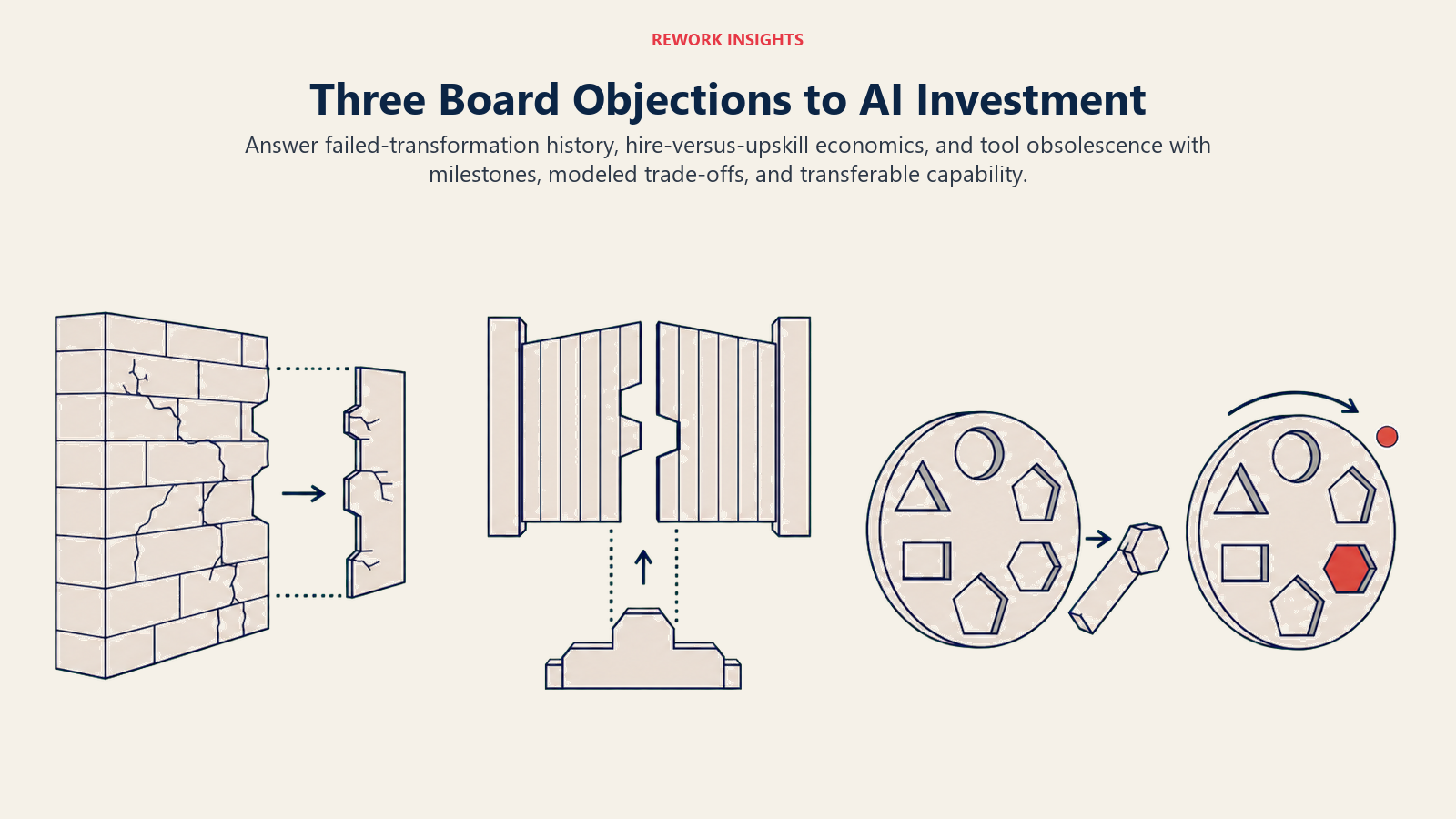
No matter how strong your case, three objections will come up. Prepare for them specifically.
Objection 1: "We tried this with digital transformation. It didn't stick."
Response: "You're right to be skeptical. The reason digital transformation programs underdelivered is that they treated technology as the product and assumed behavior change would follow automatically. We're not doing that. This program is structured around role-specific workflows with measurable behavior change milestones at 30, 60, and 90 days. The technology is a means to an end. The end is measurable productivity lift, and we're tying a portion of the investment disbursement to hitting those milestones."
Objection 2: "Can't we just hire AI-native people instead of retraining our existing team?"
Response: "We modeled that. Replacing the bottom 30% of AI-unready roles with AI-native hires costs roughly 2.5x what a structured upskilling program costs, takes 9-12 months per cohort, and still requires the remaining 70% to operate with new team members. It also creates real attrition risk in the existing team: people who hear 'hire AI-native' as 'you're getting replaced.' The better model is a combination: upskill the core, hire AI-native for net-new roles where institutional knowledge doesn't matter."
Objection 3: "How do we know the AI tools will still be relevant in two years? This space is moving fast."
Response: "The investment isn't primarily in specific tools. It's in the capability of the workforce to work with AI systems in general. Prompt engineering, workflow design, human-AI collaboration patterns: those transfer across platforms. If we train on Copilot today and the market shifts to a different platform in 18 months, the core skills still apply. We're building organizational muscle, not tool-specific knowledge."
What to Put in the Board Packet
Board members read your deck differently than your leadership team does. They're reading for risk, credibility, and decision clarity. Not for inspiration.
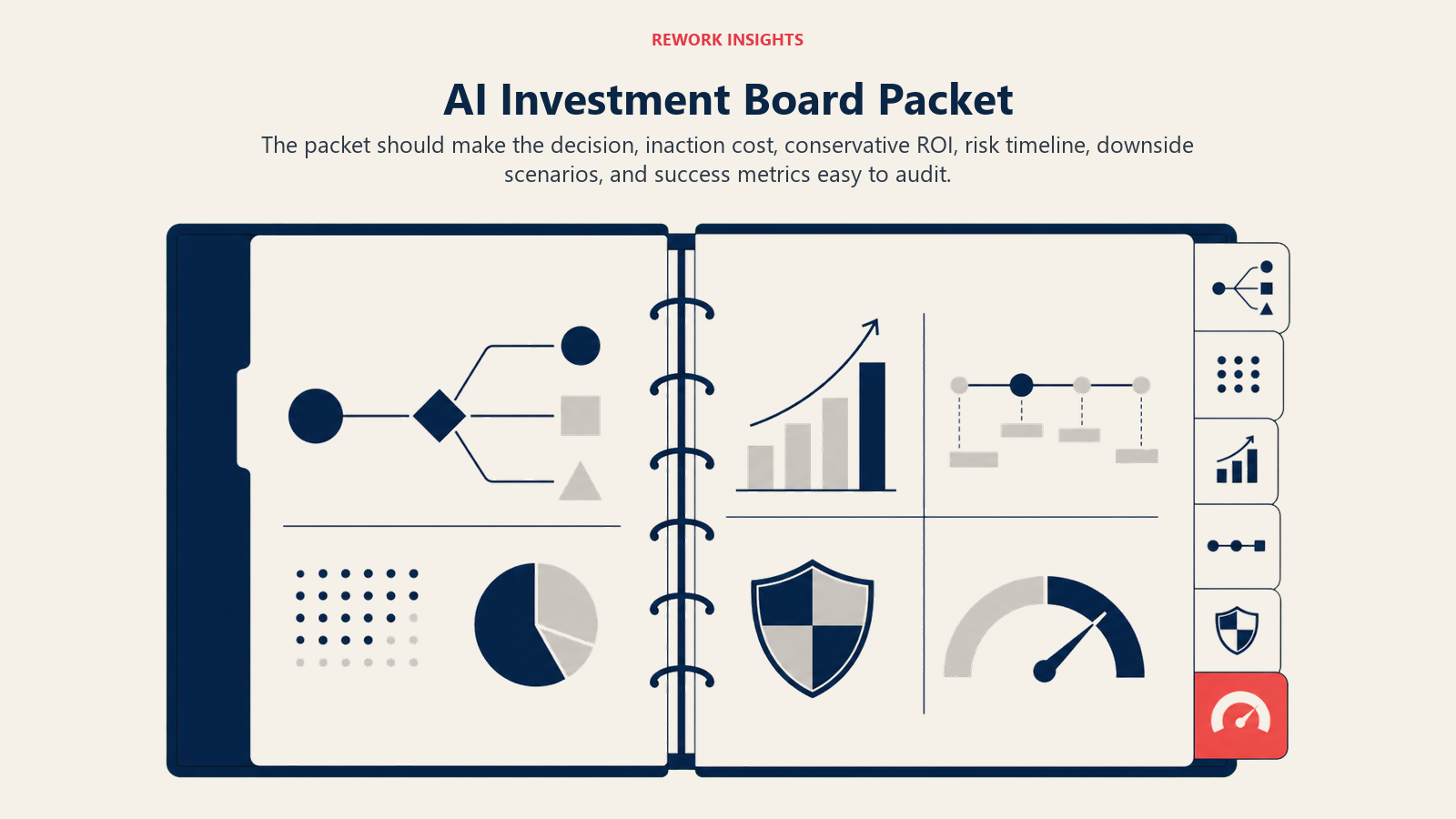
A one-page executive summary for the board packet should contain exactly six elements. You can also use an AI readiness assessment template to attach a structured baseline audit that shows the board exactly where the workforce stands today:
The decision you're asking for. Specific dollar amount, specific timeline, specific governance structure. Not "approval to explore AI workforce strategy." "Approval of $X investment over 18 months, with quarterly ROI reviews against these specific metrics."
The baseline cost of inaction. Three numbers: productivity drag cost, attrition premium, hiring cycle impact. Total them.
The projected ROI model. Conservative scenario only. 12-month and 24-month projections. Show your assumptions.
The competitive risk timeline. One paragraph. When does inaction become a durable disadvantage?
The three downside scenarios and mitigations. What if AI tool adoption is slower than expected? What if attrition doesn't improve? What if a key vendor changes pricing? Name the scenarios, bound the downside, explain the mitigation.
The success metrics. Specific, measurable, time-bound. "AI fluency assessments passed by 80% of commercial team by Q3" is a metric. "Improved AI capability" is not.
Attach the full analysis as an appendix. Most board members won't read it. But the ones who ask questions will want to know it exists.
Getting a Mandate vs. Getting Budget
This is the distinction that separates executives who drive real transformation from those who run perpetual pilots.
A budget line is the board saying: "We'll fund this. Show us it works." A mandate is the board saying: "We need this to work. Make it happen."
The difference in practice: a mandate changes how the rest of the company responds. When the CHRO has to push AI training adoption through 15 skeptical department heads, a mandate from the board is the authority that makes that possible. A budget line gets you resistance. A mandate gets you compliance, and eventually, adoption.
To get a mandate instead of budget, you need to connect the investment to something the board already cares about. Usually that's one of three things: margin expansion, competitive positioning, or talent retention in a tight market. Pick the one your board is most focused on right now. Build your opening narrative around it. The rest of the business case supports the framing, but the framing is what determines whether you walk out with budget or mandate.
For further context on how the role of AI leadership is evolving at the executive level, the CAIO article covers why mid-market companies are creating new AI executive roles and what governance structures are working. And if you haven't built out your full AI workforce strategy yet, the executive decision framework provides a structured approach from assessment to implementation.
Understanding what a successful implementation looks like also helps boards see a realistic path forward. The 12-month AI workforce roadmap shows exactly how a 200-person company can execute from audit to measurable ROI, the kind of concrete plan boards respond to. And for a business case for AI training budget, the guides collection has a template-ready framework you can adapt.
The board conversation about AI workforce investment isn't about AI. It's about whether your organization will be able to compete on cost and speed 18 months from now. Frame it that way, back it with numbers, and you'll stop getting pilots and start getting mandates.
Learn More

Co-Founder, Rework.com
On this page
- The Credibility Gap
- Framing It as Infrastructure, Not Experimentation
- Building the Business Case
- Baseline: What an AI-Unready Workforce Already Costs You
- Upside: Revenue Per Employee Lift
- Risk: The Competitor Talent Advantage Timeline
- Handling the Three Most Common Objections
- What to Put in the Board Packet
- Getting a Mandate vs. Getting Budget
- Learn More