More in
AI Jobs & Skills News
Finance Keeps Shedding Jobs as the Economy Hires: The White-Collar Warning
Jun 6, 2026
AI Skills Just Became the Hardest Hire in the World. You Won't Recruit Your Way Out
Jun 6, 2026
Is AI Actually Killing Jobs? May's Hiring Numbers Say Not So Fast
Jun 5, 2026
You Put Your AI Agents on the Org Chart. Accountability Quietly Dropped
Jun 5, 2026
Everyone Blames AI for the Gen Z Job Crisis. The Fed Points at Remote Work
Jun 5, 2026
AI's Net Job Drag Fell to 11,000 a Month. Construction Is Hiding the Truth
Jun 4, 2026
AI Blamed for a Record 40% of May's US Layoffs, the Third Month Running
Jun 4, 2026
Four Futures for Jobs by 2030: The Mid-2026 Checkpoint for CEOs
Jun 3, 2026
Can Federal AI Apprenticeships Fix Your Skills Gap Cheaper Than Hiring?
Jun 3, 2026
AI Engineer Pay Split Into Two Markets. Only the Top Is a Bubble
Jun 3, 2026
The US National AI Talent Pipeline Initiative: What $2B in Federal Funding Means for Employers
Turn this article into takeaways for your work.


Each assistant summarizes the article only for you and suggests best practices for your work.
In February 2026, the White House signed the National AI Workforce Investment Act, authorizing $2.1 billion over four years to accelerate AI-ready talent production across the US economy. The stated target: 500,000 newly trained AI-capable workers entering the labor market by the end of 2029.
For Heads of Operations, there are two things worth tracking about this initiative. One is grant eligibility: portions of the funding flow directly to private employers who meet co-investment requirements. The other is supply-side impact: even organizations that never touch a federal grant application will operate in a labor market shaped by this program within the next 24 months.
The money is moving regardless. The question is whether your organization engages early or reacts late.
What Happened: Structure of the Initiative
The $2.1 billion is administered jointly by three agencies: the Department of Labor (DOL), the National Science Foundation (NSF), and the Department of Commerce's National Institute of Standards and Technology (NIST). Each agency manages a distinct funding stream with different eligibility requirements and timelines.
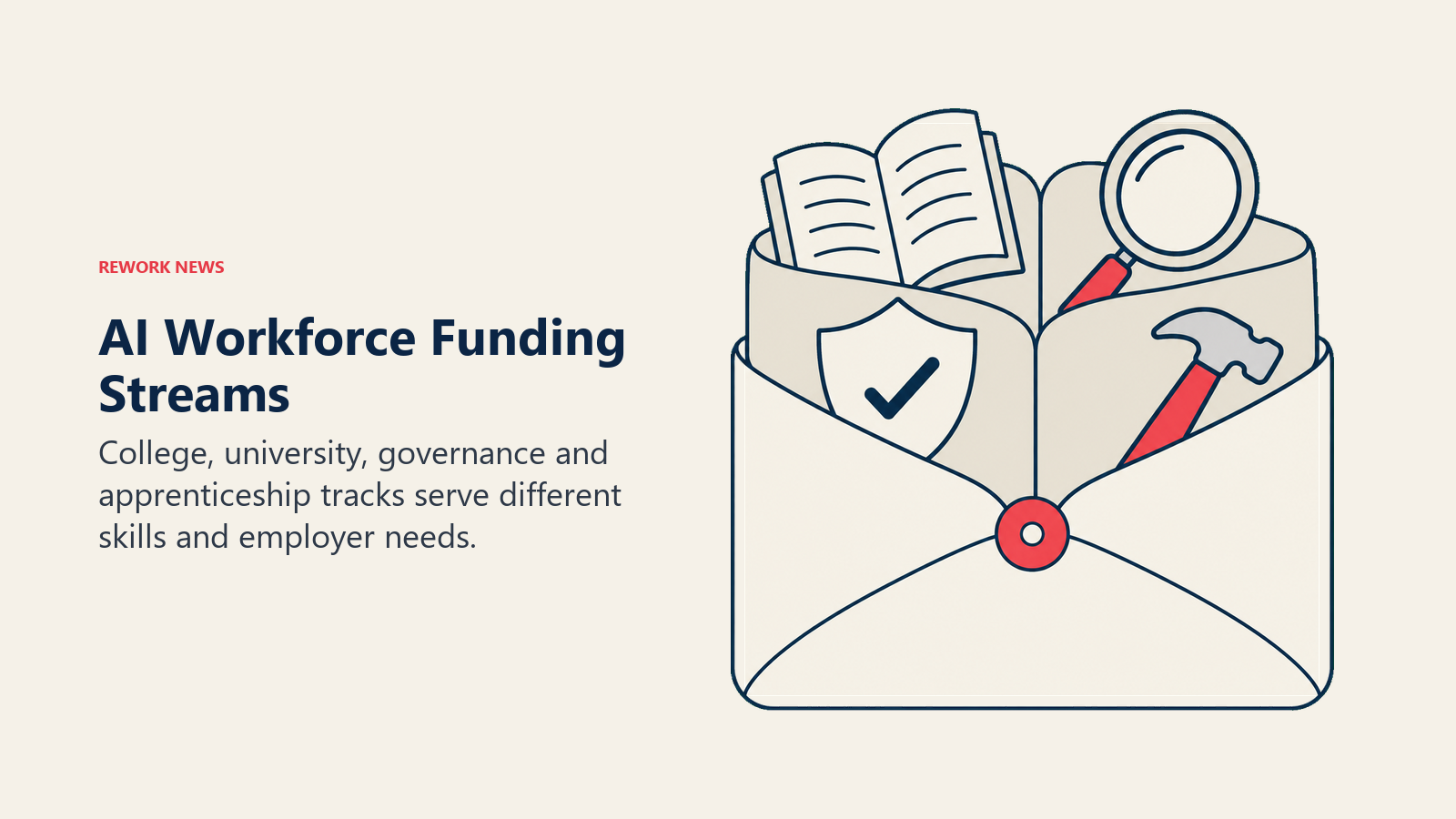
DOL: Workforce Innovation Grants ($800 million) Community college partnerships and regional workforce development boards. Funds curriculum development, equipment, and instructor training. Employers can co-design curricula in exchange for priority hiring access to graduates.
NSF: AI Education and Research Pipeline ($650 million) University and research institution grants for AI-specific degree tracks, graduate fellowships, and applied research programs. Includes a $120 million employer partnership program for companies that contribute matching funds or in-kind mentorship.
NIST: AI Standards and Workforce Readiness ($350 million) Focused on governance, safety, and AI assurance roles, not core ML engineering. Targets a different talent profile: workers who can assess, audit, and document AI system behavior for compliance purposes.
DOL: Registered AI Apprenticeship Program ($300 million) Co-funded apprenticeships for AI roles, modeled on the existing registered apprenticeship framework. Employers pay apprentice wages; DOL subsidizes training and certification costs at up to 50% for qualified programs.
The remaining $80 million covers administration, program evaluation, and a new National AI Workforce Data Dashboard that will track credential attainment and employment outcomes in near-real-time.
Why It Matters for Heads of Operations
Angle 1: Grant Eligibility
If your organization runs formal training programs (internal academies, rotational programs, technical development tracks) you may qualify for DOL apprenticeship co-funding or NSF partnership grants. The requirements aren't trivial, but they're not prohibitive for mid-to-large employers either.
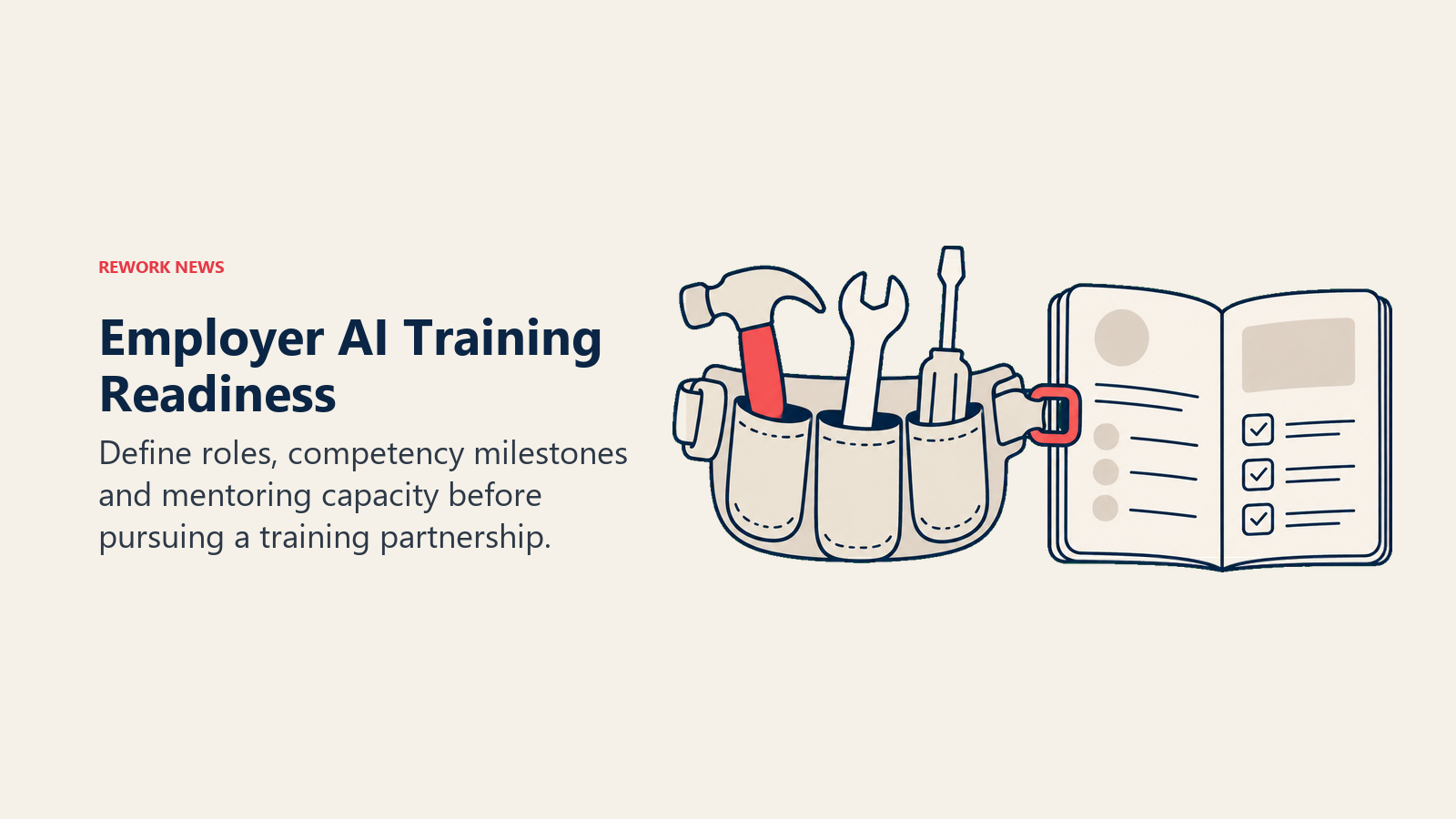
For the DOL Registered Apprenticeship track, employers need: a defined job role classification, a structured curriculum with measurable competency milestones, a designated mentor or supervisor ratio of no more than 1:5, and a minimum 12-month program duration. Companies that already run structured onboarding for technical roles often meet most of these criteria with minor modifications.
For the NSF employer partnership program, the co-investment requirement is a 1:1 match: for every federal dollar allocated to a university program your company co-designs, you contribute an equivalent amount in cash, faculty time support, or internship capacity. Return: priority access to graduates, co-authorship rights on curriculum, and input on research agenda.
Angle 2: Labor Market Impact
Even if you never file a grant application, this program reshapes the talent pool your recruiters will draw from by 2027–2028. Specifically:
The community college track is designed to produce AI-capable workers who don't have four-year computer science degrees. That means a broader, more geographically distributed pipeline entering roles like AI operations specialist, data analyst with AI tooling, and AI-assisted customer experience manager, positions that operations teams hire for regularly.
If your current job postings still require a bachelor's degree in CS for roles that are really about AI tool proficiency and process management, you'll be screening out the majority of the federally trained candidates. An AI skills matrix that separates engineering depth from operational proficiency gives your hiring team a clearer screen that doesn't accidentally exclude the candidates this pipeline is designed to produce.
The Numbers
| Funding Stream | Amount | Target Beneficiaries | First Cohorts |
|---|---|---|---|
| DOL Workforce Innovation Grants | $800M | Community colleges, regional WDBs | Q3 2026 |
| NSF Education Pipeline | $650M | Universities, research institutions | Q1 2027 |
| NIST AI Standards Workforce | $350M | Governance and audit roles | Q2 2027 |
| DOL Apprenticeship Program | $300M | Employers + apprentices | Q4 2026 |
| Administration & Data | $80M | Federal agencies | Ongoing |
| Total | $2.18B | 500,000 workers by 2029 |
Geographic allocation favors states with high manufacturing and logistics employment that are already experiencing AI-driven job displacement: Michigan, Ohio, Texas, and Pennsylvania receive the largest community college grants in the first funding cycle. California and New York receive the largest NSF university allocations.
Employer co-investment requirement for apprenticeship grants: 50% of training costs, with a minimum 12-month commitment and a commitment to hire at least 70% of completing apprentices into full-time roles.
Timeline for first cohorts to enter the labor market: DOL community college graduates will begin entering the workforce in meaningful numbers by Q1 2027. NSF university graduates from new AI-specific programs start in Q3 2027. Apprenticeship completions begin Q4 2027.
What Smart Leaders Are Doing
Two early-mover examples are already public.
Amazon announced in January 2026 a co-design partnership with six community colleges in the Gulf Coast region under the DOL Workforce Innovation Grant program. Amazon contributes curriculum requirements and guaranteed interview slots for graduates; the colleges receive $4.2 million in DOL matching funds. Amazon's stated goal: fill 1,200 AI operations coordinator roles per year from this pipeline by 2028, at a hiring cost significantly below open-market recruiting.
Caterpillar is piloting the DOL Registered Apprenticeship model for AI-integrated manufacturing roles at three facilities in Illinois. Apprentices rotate through AI monitoring, process optimization, and quality assurance functions. Caterpillar covers 50% of training costs; DOL covers the rest. The program targets 240 completions per year starting in Q4 2026.
Neither company is doing this purely out of civic interest. The economic logic is straightforward: co-designed pipelines produce candidates who already know your systems, your safety requirements, and your operational context. Open-market hiring doesn't.
What to Watch Next
Three risks are worth monitoring.
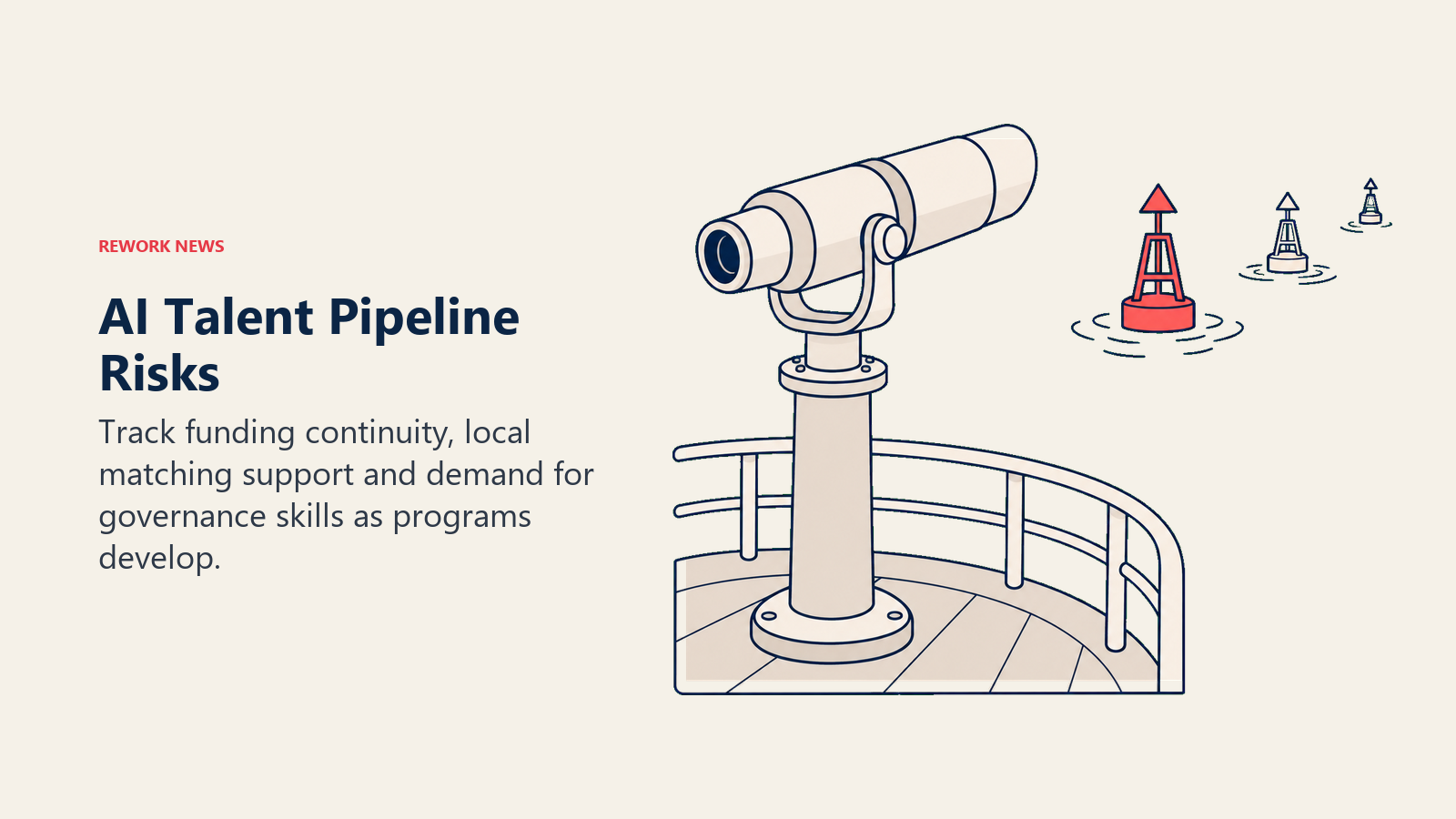
Congressional reauthorization. The Act authorized four years of funding. Reauthorization in 2030 is not guaranteed, particularly if political conditions shift. Employers building long-term dependency on federally subsidized training pipelines face exposure if funding lapses.
State-level matching programs. At least 14 states have announced plans to match federal allocations with state workforce funds, effectively doubling the program's reach in those geographies. Ohio, Texas, and Michigan are furthest along. Employers operating in those states will see accelerated pipeline development ahead of national averages.
Scope expansion to AI governance roles. NIST's $350M governance workforce stream is currently the smallest allocation. But with EU AI Act compliance requirements hitting US-listed companies in 2026 and 2027, demand for AI audit, risk, and governance roles is growing faster than supply. Expect lobbying to expand this stream in the 2028 budget cycle.
The federal government rarely moves faster than the private sector on talent development. This program is unusual in its scale and employer-facing design. Operations leaders who engage now shape the curriculum, secure early hiring access, and reduce recruiting costs. Those who engage in 2028 are competing for the same graduates as everyone else. Understanding the AI roles being eliminated and created in mid-market companies helps clarify which role categories to target when co-designing curricula with community colleges.
Learn More
