More in
AI Jobs & Skills News
Finance Keeps Shedding Jobs as the Economy Hires: The White-Collar Warning
Jun 6, 2026
AI Skills Just Became the Hardest Hire in the World. You Won't Recruit Your Way Out
Jun 6, 2026
Is AI Actually Killing Jobs? May's Hiring Numbers Say Not So Fast
Jun 5, 2026
You Put Your AI Agents on the Org Chart. Accountability Quietly Dropped
Jun 5, 2026
Everyone Blames AI for the Gen Z Job Crisis. The Fed Points at Remote Work
Jun 5, 2026
AI's Net Job Drag Fell to 11,000 a Month. Construction Is Hiding the Truth
Jun 4, 2026
AI Blamed for a Record 40% of May's US Layoffs, the Third Month Running
Jun 4, 2026
Four Futures for Jobs by 2030: The Mid-2026 Checkpoint for CEOs
Jun 3, 2026
Can Federal AI Apprenticeships Fix Your Skills Gap Cheaper Than Hiring?
Jun 3, 2026
AI Engineer Pay Split Into Two Markets. Only the Top Is a Bubble
Jun 3, 2026
Bootcamps Are Producing More AI Graduates Than Universities, and Employers Are Taking Notice
Turn this article into takeaways for your work.


Each assistant summarizes the article only for you and suggests best practices for your work.
In 2023, universities still produced roughly twice as many AI-capable graduates as bootcamps and accelerated programs combined. By Q3 2025, that ratio had inverted. Bootcamps, online credential programs, and intensive technical institutes now account for an estimated 58% of new AI-ready entrants to the US labor market, according to NCES graduate output data cross-referenced with enrollment figures from major program providers.
The crossover happened faster than most hiring teams adjusted for. And the downstream consequence is showing up in a specific, measurable way: companies that still screen AI role candidates exclusively through traditional degree filters are rejecting the majority of qualified applicants before the first interview.
What Happened: The Pipeline Inversion
The driver isn't that universities stopped producing AI graduates. It's that bootcamps scaled faster.
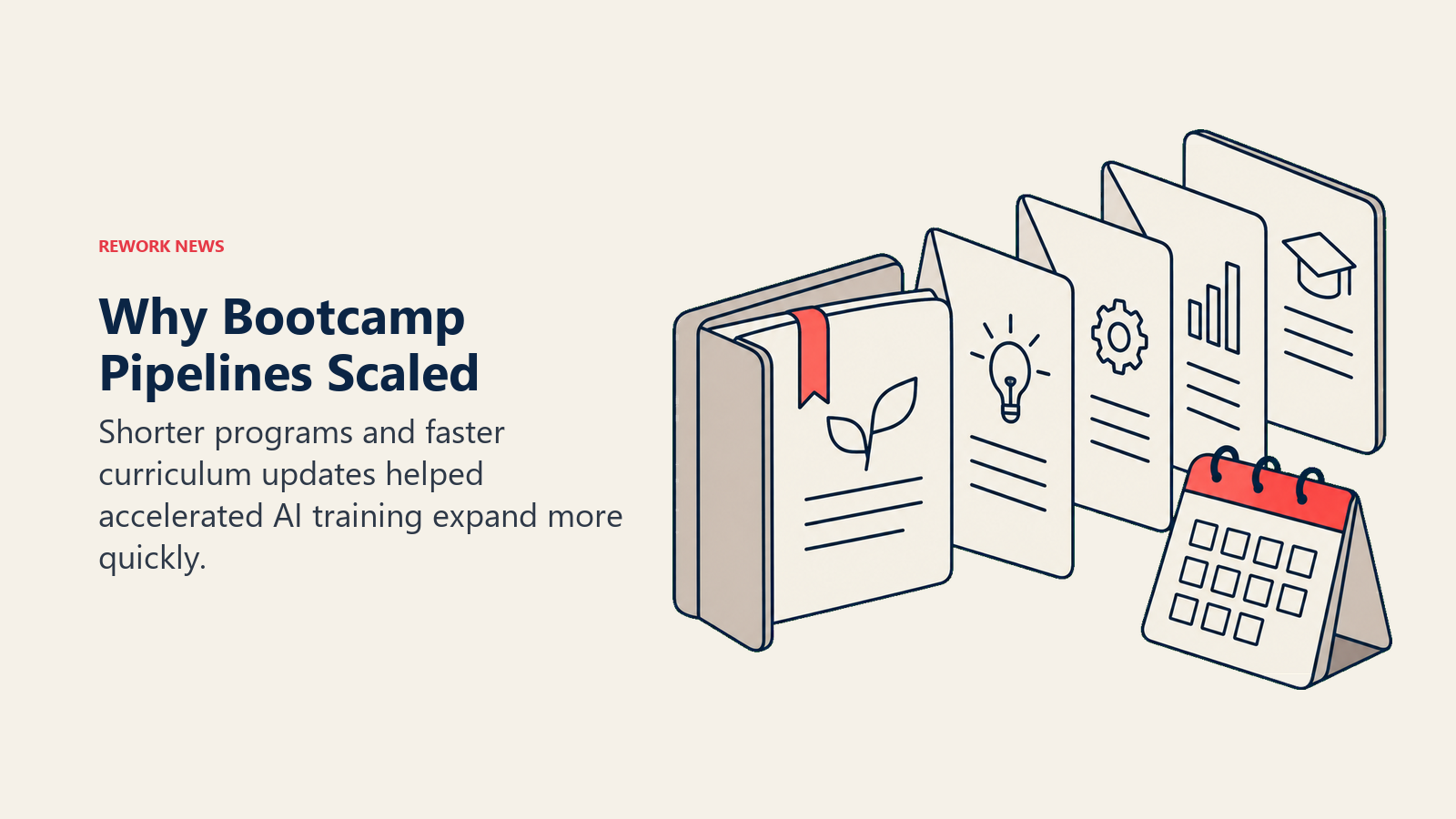
Between 2023 and 2026, enrollment in AI-focused bootcamp programs grew 340% across the major providers: Springboard, Flatiron School, Lambda (now BloomTech), General Assembly, and a cluster of newer entrants including Corise and Maven. Average program length dropped from 9 months to 6–7 months as curricula became more focused. Completion rates improved from a sector average of 61% in 2022 to 74% in 2025 as programs invested in student support infrastructure.
University CS and ML program enrollment, meanwhile, grew at roughly 12% annually, constrained by faculty pipelines, accreditation cycles, and physical campus capacity. The programs are rigorous. But they're not nimble.
The curriculum gap is narrowing faster than most academics want to admit. Bootcamp programs in 2026 are teaching LLM fine-tuning, RAG architecture, agentic workflow design, and AI product management, topics that most university ML programs added to elective tracks only in 2024 or 2025. Time-to-curriculum-update at a bootcamp is measured in weeks. At a university, it's measured in catalog years.
Why It Matters for Team Leads
If you're hiring for AI roles (AI workflow specialist, ML operations engineer, AI-assisted analyst, prompt engineer, data pipeline developer) and your ATS is filtering for "Bachelor's degree in Computer Science or related field," you're cutting out most of your addressable market.
That's not a values argument. It's a pipeline math argument.
The total number of four-year CS and ML graduates entering the US job market annually is approximately 130,000, according to NCES 2025 data. Not all of them go into AI-specific roles. The number pursuing AI roles specifically is estimated at 45,000–55,000 annually.
Bootcamp and accelerated program graduates entering AI roles: approximately 85,000–95,000 annually in 2025, projected to reach 110,000–120,000 by end of 2026.
If your job postings filter exclusively for four-year degrees, you're working with a candidate pool that's roughly 35% of the available market. Your competitors who've dropped the degree requirement are fishing in the full pool.
The Numbers: Bootcamp vs. University Side-by-Side
The comparison below separates training focus, program model and hiring signals across the two candidate pathways.
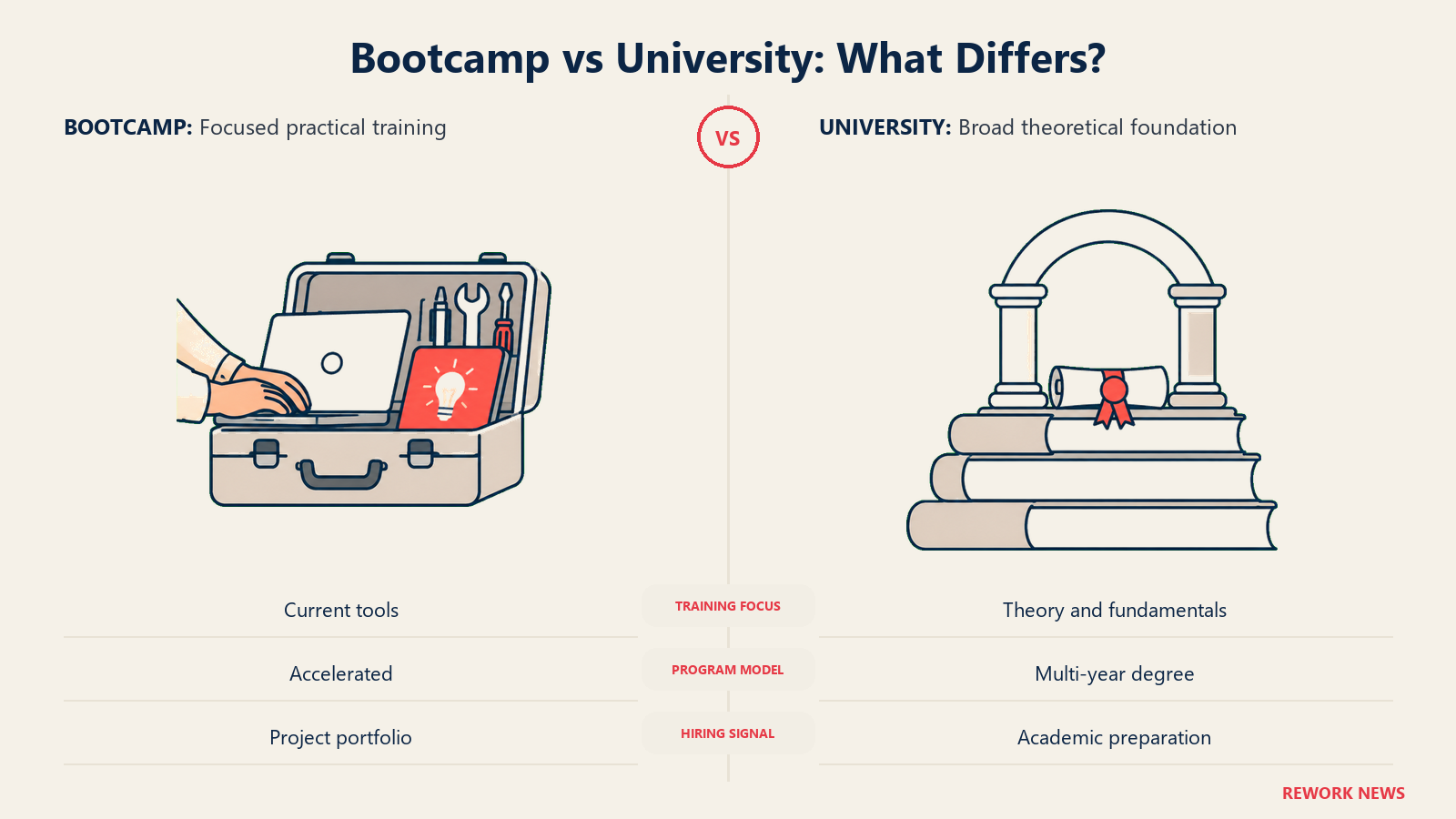
| Metric | Bootcamp Graduates | University Graduates |
|---|---|---|
| Annual AI-role entrants (2025) | ~90,000 | ~50,000 |
| Average program duration | 6–7 months | 48 months |
| Average time-to-hire (days post-graduation) | 62 days | 89 days |
| Average ramp time to full productivity | 4.2 months | 3.8 months |
| Starting salary, AI-adjacent roles | $78,000 | $92,000 |
| Starting salary, core ML/engineering roles | $94,000 | $118,000 |
| Employer satisfaction at 6 months (survey) | 81% | 84% |
| 12-month retention rate | 71% | 76% |
Sources: NCES Graduate Employment Survey 2025, Springboard Outcomes Report 2025, LinkedIn Talent Insights Q4 2025, Mercer AI Workforce Benchmarking Study 2025.
A few things worth unpacking in that table.
The ramp time difference is smaller than most managers expect: 4.2 months vs. 3.8 months. Bootcamp graduates have more direct hands-on experience with the current tooling stack. University graduates have stronger theoretical foundations that pay off over longer tenure horizons. For roles that need someone productive in 90 days, the bootcamp candidate isn't a meaningful disadvantage.
Employer satisfaction at 6 months is 81% vs. 84%, a 3-point gap that's statistically meaningful but practically small. Many hiring managers assume the gap is larger than it is. The data doesn't support filtering on credential type as a reliable quality signal at the rates most companies apply it.
The salary gap is real and persistent for core engineering roles. But for the growing category of AI-adjacent operational roles (AI workflow management, prompt operations, AI quality assurance) the salary gap is under $8,000 at the median, and bootcamp graduates are meeting performance expectations at close to the same rate as university graduates.
The 12-month retention gap (71% vs. 76%) is worth monitoring. Bootcamp graduates change jobs more frequently in their first two years, partly because they're in higher demand and partly because they entered the workforce quickly and are still optimizing their career trajectory. Companies that invest in clear growth paths for bootcamp hires close most of this gap.
Real Companies That Dropped Degree Requirements
Google removed degree requirements from a significant portion of its AI and data roles in 2023 and has since expanded that policy. In a 2025 blog post, Google's VP of People Operations noted that skills assessments now predict job performance better than educational credentials for technical roles below the senior engineering level.
IBM has been the most vocal large employer on this shift. The company publicly committed in 2021 to filling 50% of its US job openings with candidates who don't have four-year degrees. By 2025, IBM reports that non-degree hires in technical roles perform comparably on performance reviews and have retention rates within 4 percentage points of degree-holding peers.
Accenture restructured its AI and automation hiring in 2024 to evaluate candidates through a standardized skills assessment rather than resume screening. The change increased bootcamp candidate pass-through rates by 38% and reduced average time-to-fill for AI roles by 21 days.
None of these companies are doing this as a diversity initiative, though it has diversity benefits. They're doing it because the data showed they were leaving talent on the table.
What Smart Team Leads Are Doing
Three practices are separating hiring managers who are consistently finding strong AI talent from those who aren't.
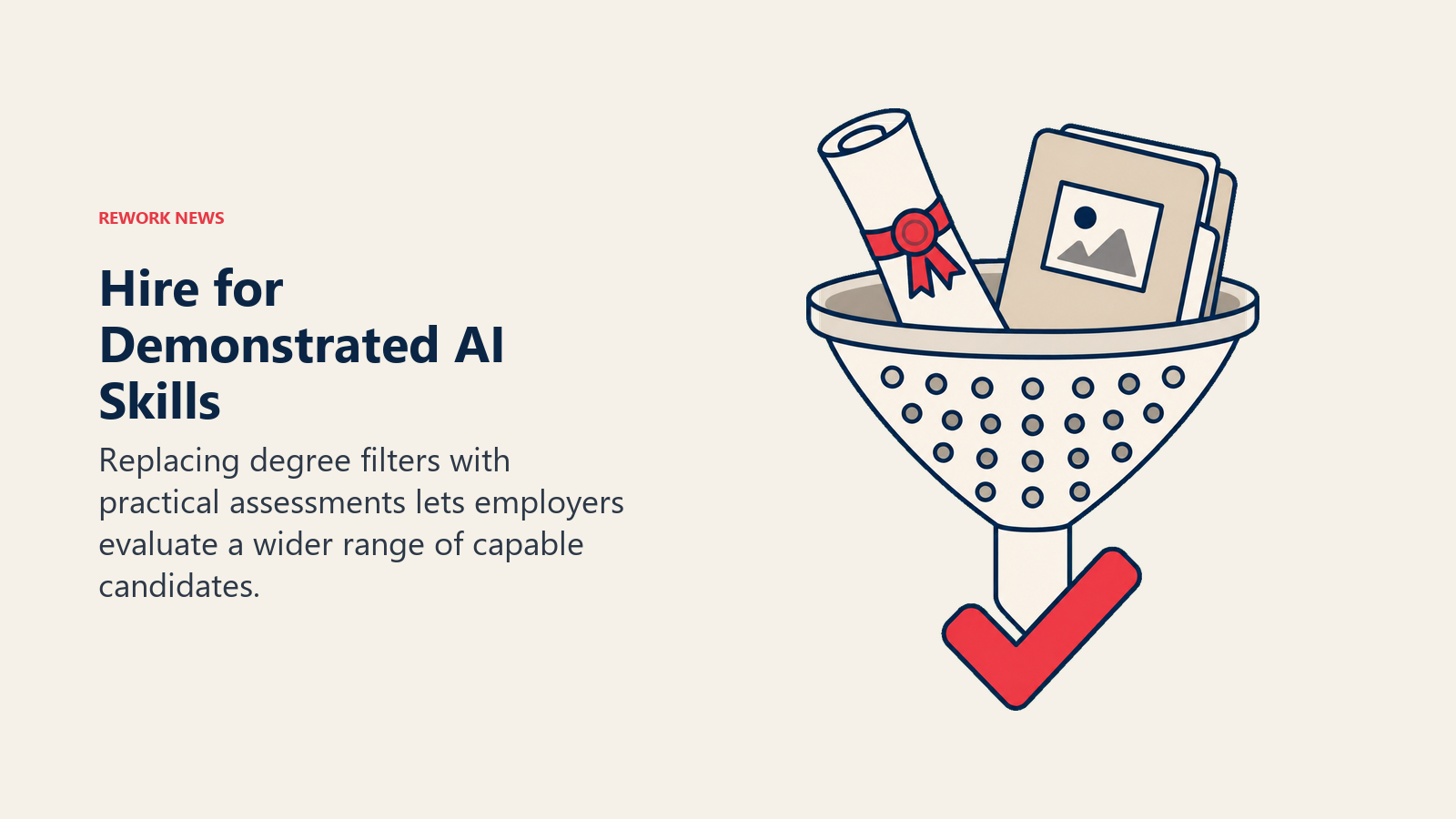
Replacing degree filters with skills assessments. A 45-minute technical screen focused on actual tooling proficiency (prompt construction, data interpretation, workflow documentation) identifies capable candidates regardless of how they got there. The tools are cheap and the signal is better.
Building direct bootcamp partnerships. Several major programs now offer employer partnerships that give hiring teams early access to graduates in exchange for feedback on curriculum relevance and guaranteed interview slots for top performers. Springboard's employer partner program, for example, gives partners access to candidate profiles 60 days before graduation. This is the same logic behind running AI pilot programs, starting with a defined cohort and measuring outcomes before scaling.
Adjusting job posting language. "Bachelor's degree in CS or equivalent experience" seems equivalent but still signals a preference that discourages bootcamp graduates from applying. "Demonstrated ability to build and deploy AI workflows, assessed via technical screen" gets a different candidate pool.
The third one takes about 20 minutes to implement and meaningfully changes who applies.
What to Watch Next
Universities aren't standing still. MIT, Georgia Tech, Carnegie Mellon, and roughly 40 mid-tier programs have fast-tracked AI-specific degree tracks that compress traditional four-year programs or offer 18-month AI-focused master's options. If bootcamp curriculum moves faster than universities, but universities are now moving faster than before, the quality gap between credential types may narrow by 2028.
The more interesting question is whether bootcamp programs maintain their curriculum advantage as the AI tooling landscape stabilizes. In 2023–2025, the pace of model releases and tool launches gave bootcamps an edge: they could update curricula in weeks. If the landscape consolidates around a smaller set of dominant platforms, the curriculum agility advantage shrinks.
But that's a 2028 problem. For 2026 hiring cycles, the data is clear: the bootcamp-vs-university debate is settled by volume alone. And hiring teams that haven't updated their screening criteria are working with an artificially narrowed candidate pool. The hiring vs. upskilling framework helps you decide when to hire externally at all versus building AI capability from within your existing team.
Learn More
