More in
AI Jobs & Skills News
Finance Keeps Shedding Jobs as the Economy Hires: The White-Collar Warning
Jun 6, 2026
AI Skills Just Became the Hardest Hire in the World. You Won't Recruit Your Way Out
Jun 6, 2026
Is AI Actually Killing Jobs? May's Hiring Numbers Say Not So Fast
Jun 5, 2026
You Put Your AI Agents on the Org Chart. Accountability Quietly Dropped
Jun 5, 2026
Everyone Blames AI for the Gen Z Job Crisis. The Fed Points at Remote Work
Jun 5, 2026
AI's Net Job Drag Fell to 11,000 a Month. Construction Is Hiding the Truth
Jun 4, 2026
AI Blamed for a Record 40% of May's US Layoffs, the Third Month Running
Jun 4, 2026
Four Futures for Jobs by 2030: The Mid-2026 Checkpoint for CEOs
Jun 3, 2026
Can Federal AI Apprenticeships Fix Your Skills Gap Cheaper Than Hiring?
Jun 3, 2026
AI Engineer Pay Split Into Two Markets. Only the Top Is a Bubble
Jun 3, 2026
Remote AI Roles Are Exploding and Rewriting Where Companies Can Source Top Talent
Turn this article into takeaways for your work.


Each assistant summarizes the article only for you and suggests best practices for your work.
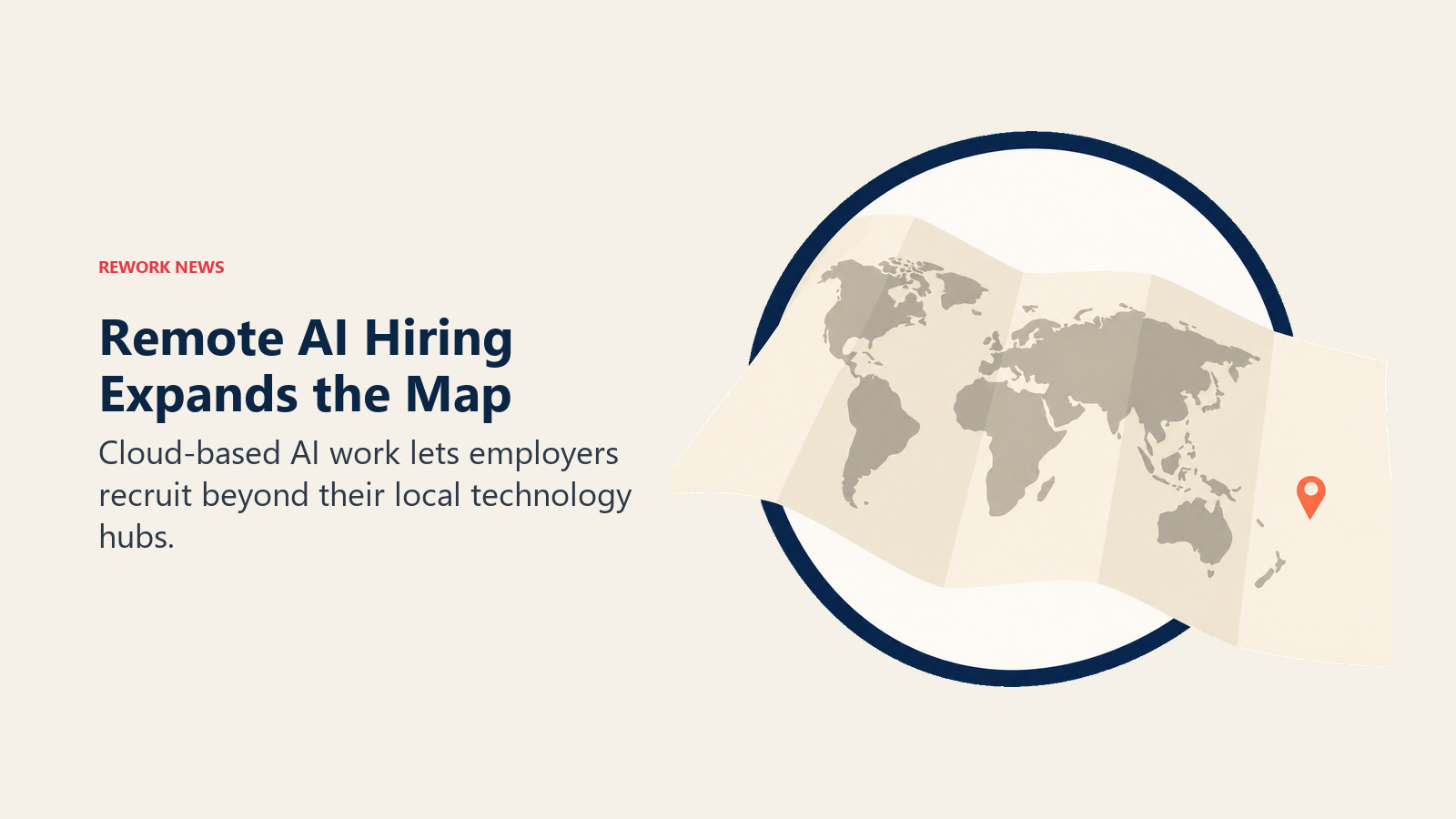
AI skills jobs are going remote faster than the rest of tech: 65% of AI postings in Q1 2026 listed fully remote or remote-first work, up from 38% in 2024. That nearly doubled share means CEOs can now source AI talent globally, while companies relying on a tech-hub zip code are watching their hiring advantage dissolve.
Sixty-five percent of AI job postings in Q1 2026 listed fully remote or remote-first work arrangements. Two years ago, that number was 38%.
That's not a gradual drift. That's a structural shift in how AI work gets done, and where the people who do it choose to live.
For CEOs, the implications cut two ways. Companies that have always struggled to hire AI talent because of their geography now have access to a global pool. And companies that assumed their San Francisco or New York zip code gave them a talent advantage are discovering that advantage is dissolving faster than their return-to-office policies can compensate for.
The geography of AI talent is being rewritten. Whether your company benefits or gets caught flat-footed depends largely on whether leadership has updated its assumptions about where great AI work can happen.
What Happened: Two Years of Remote Acceleration in AI Roles
The remote AI trend predates 2024, but it accelerated sharply. Analysis of job posting data from LinkedIn, Indeed, and Glassdoor shows that AI-specific roles (machine learning engineers, AI product managers, prompt engineers, AI data scientists) went remote at roughly twice the rate of general software engineering roles during 2024-2025.
Several forces drove this. First, the tools themselves. AI development work is almost entirely cloud-based. Model training, fine-tuning, and deployment happen on AWS, GCP, and Azure, not in an office lab. The workflow is inherently location-agnostic in a way that, say, semiconductor engineering or robotics is not.
Second, the talent scarcity dynamic. When demand for a skill exceeds supply by the margins we've seen in AI, employers get flexible. Companies that would never have offered remote for a backend engineer role were offering it for ML engineers just to get candidates to respond.
Third, a cohort effect. A large share of today's AI practitioners built their careers during or after the pandemic. Remote-first is their baseline expectation, not a perk. Companies that don't offer it simply get filtered out before the first screen.
The Numbers Behind the Shift
Remote prevalence: 65% of AI-specific postings listed as fully remote or remote-first in Q1 2026, up from 38% in Q1 2024. For comparison, general software engineering remote postings grew from 42% to 51% over the same period, a meaningful increase but less dramatic.
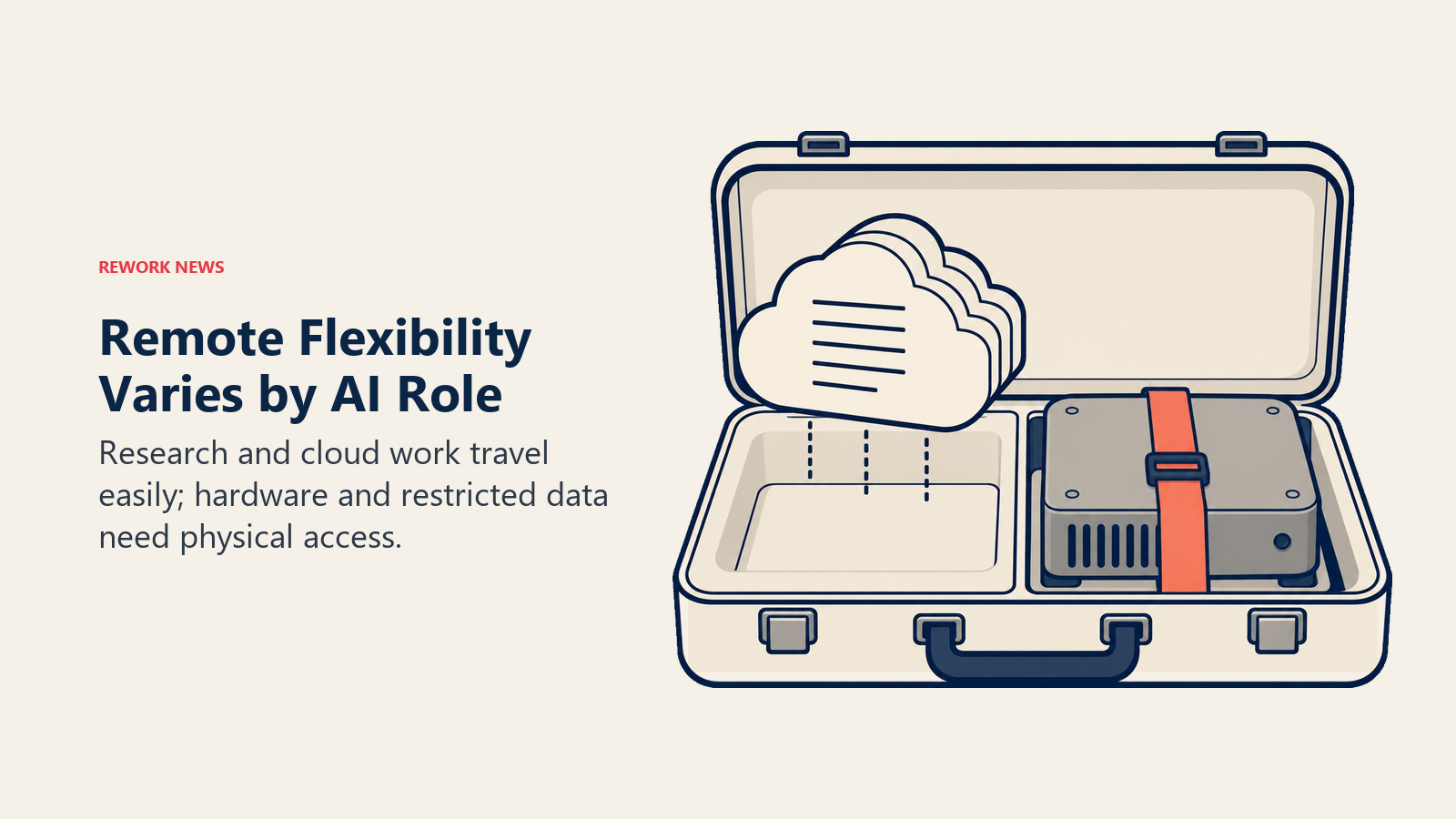
Role-by-role split: Not all AI roles are equally remote-friendly. The pattern breaks down roughly as follows:
- Most remote-friendly: AI/ML research, prompt engineering, AI product management, NLP engineering, AI content strategy, remote rates above 70%
- Mixed: AI application development, data science, MLOps, remote rates 50-65%
- On-site skewed: AI infrastructure and hardware, embedded AI systems, regulated industry AI (financial services compliance models, healthcare AI requiring on-site data access), remote rates below 30%
Geographic talent redistribution: Cities outside traditional tech hubs are capturing a growing share of AI employment. Austin, Raleigh-Durham, Salt Lake City, and Nashville have all seen 40%+ increases in resident AI workers since 2023, largely driven by remote workers relocating from higher cost-of-living markets. Internationally, Warsaw, Krakow, Bangalore, Ho Chi Minh City, and Medellín are seeing significant concentrations of AI professionals working for US and European employers.
Salary adjustments by geography: Remote AI roles are showing less dramatic geographic pay compression than remote software engineering roles overall. Employers competing for scarce AI talent are often paying at or near market rate regardless of candidate location. The median salary differential between a remote AI engineer in Austin versus San Francisco has narrowed to approximately 12-15%, down from 22-28% in 2022-2023.
Return-to-office impact: Among AI-specific job postings that shifted from remote-first to hybrid or on-site requirements in 2025 (typically following corporate RTO mandates), applications dropped by an average of 47% compared to equivalent postings that maintained remote options. Offer acceptance rates on hybrid AI roles fell 31%.
Why This Matters for CEOs
The geographic moat is gone. If you're running a company in a secondary market and have historically struggled to recruit AI talent because candidates didn't want to relocate, that constraint is largely lifted. You can now hire an ML engineer in Warsaw, a prompt engineer in Ho Chi Minh City, or an AI product manager in Raleigh, at competitive wages, without relocation.
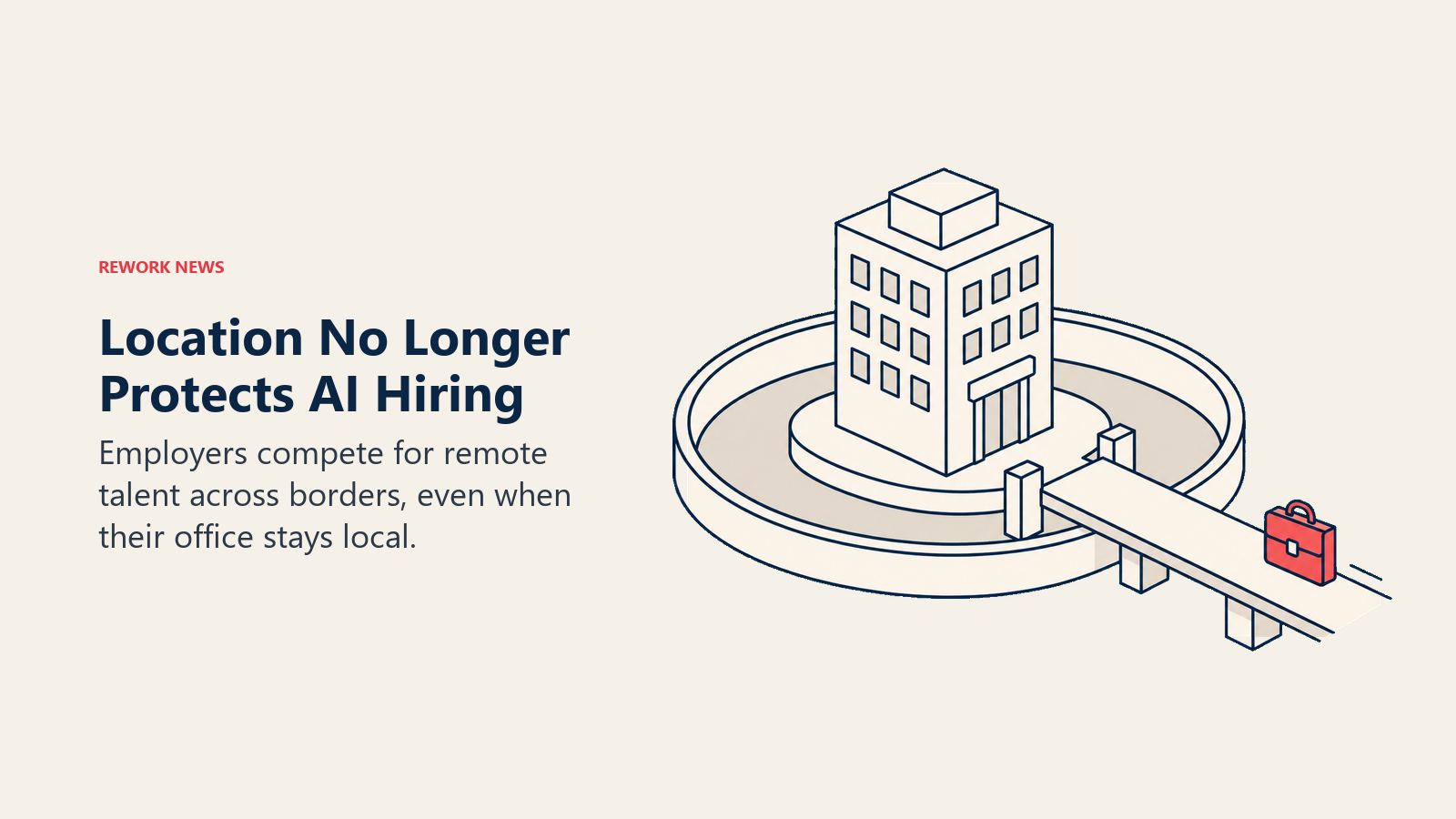
But the inverse is equally true and more urgent for companies in major tech hubs: your location advantage is eroding. The AI specialist who previously would have considered San Francisco or New York because that's where the roles were now has dozens of remote options from companies that will pay comparable salaries without the cost-of-living premium. You're competing globally whether you intended to or not.
Return-to-office mandates are creating a measurable, data-backed competitive disadvantage in AI hiring specifically. This isn't a general remote work debate. The AI talent cohort is more remote-preferring, more globally distributed, and more likely to filter on work arrangement before evaluating compensation than the average tech worker. Companies issuing broad RTO mandates without carve-outs or nuance for AI roles are handing a recruiting weapon to competitors who haven't. The AI workforce transformation in professional services shows how distributed AI teams are already being structured effectively in knowledge-work environments.
For CEOs thinking about M&A, geographic distribution of AI talent also affects deal logic. Acquiring a company partly for its AI team is less straightforward when that team is distributed across 12 countries under varied remote agreements. Integration complexity has a new dimension.
What Smart Leaders Are Doing
The companies moving fastest on distributed AI hiring aren't just posting roles as remote. They're actively building talent pipelines in specific international markets.
Shopify has publicly discussed hiring AI and ML talent in Eastern Europe and LatAm as a deliberate strategy, not just opportunistic sourcing. Their AI team spans 15+ countries with no single geographic center of gravity.
Smaller AI-native companies are going further. Several YC-backed AI startups have built fully distributed AI research teams, explicitly targeting candidates in Poland, Romania, India, and Southeast Asia, offering competitive USD-denominated salaries where the purchasing power differential means dramatically lower effective cost per hire.
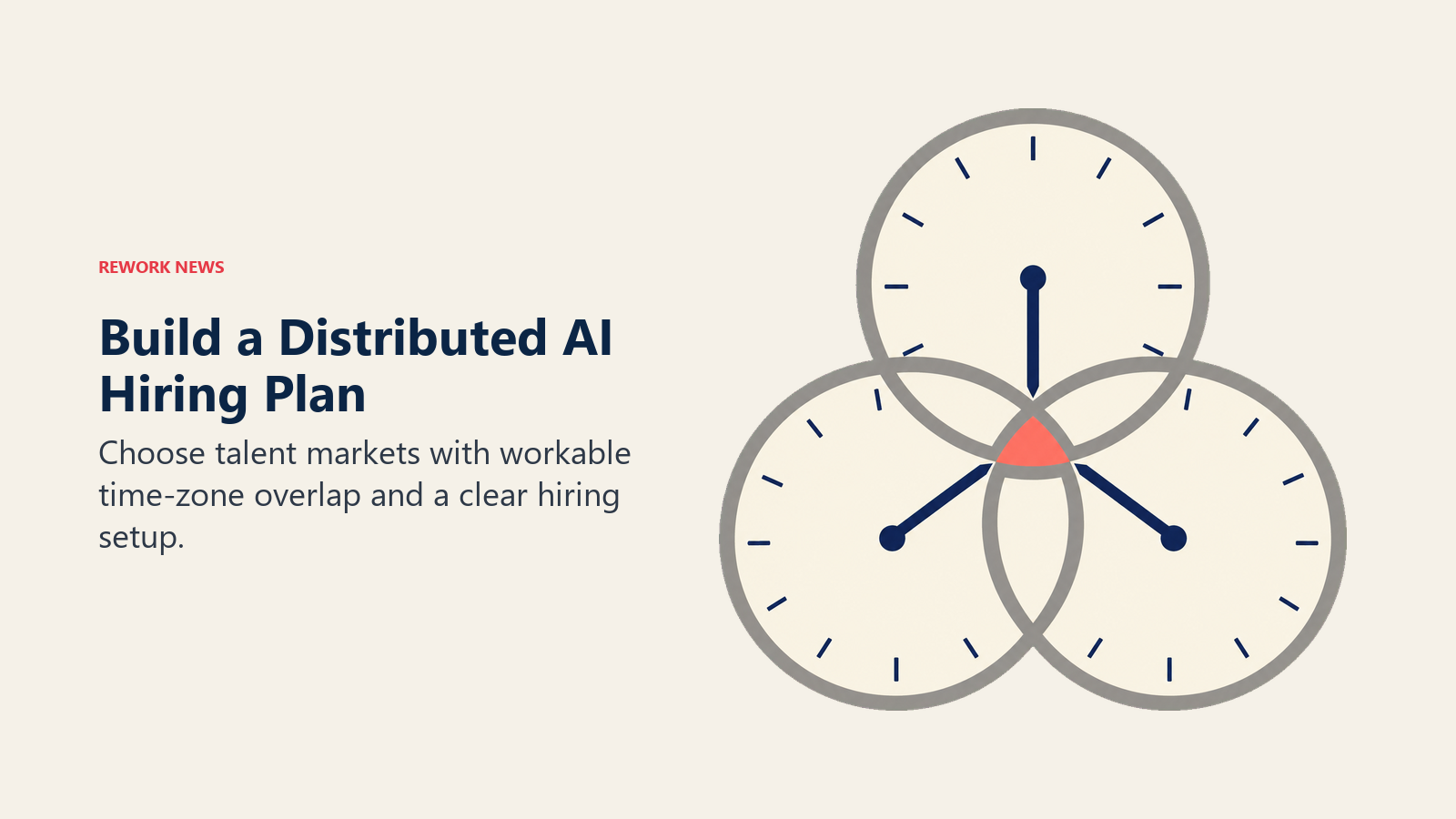
The emerging playbook for mid-market CEOs looks like this: identify 2-3 international markets with strong AI talent concentrations and manageable timezone overlap, establish legal entities or use employer-of-record services to hire there, and offer remote-first policies as a structural advantage in those markets rather than a reluctant accommodation. A cross-functional AI collaboration framework becomes especially important when your AI talent is distributed across multiple time zones and can't rely on hallway conversations to stay aligned.
None of this requires giving up a domestic presence. But it does require acknowledging that AI talent strategy is no longer a local market problem.
What to Watch Next
The most consequential question for 2026-2027 is whether return-to-office mandates at large employers create enough of a market disruption to fully open the door for remote-first competitors to capture top AI talent at scale.
Early evidence suggests that's already happening in pockets. Several AI researchers who left major tech companies after RTO mandates have ended up at smaller firms or startups that explicitly recruited them on remote-first terms. If that pattern scales, it could accelerate talent redistribution away from the largest incumbents in ways that compound over time.
There's also a regulatory dimension emerging. Several EU countries are advancing AI worker portability frameworks that would make cross-border AI employment easier to navigate from a legal standpoint. If those pass, the friction cost of hiring EU-based AI talent drops significantly for US companies.
The companies that treat remote AI hiring as a strategic tool rather than a staffing convenience will have a structural talent advantage within two years. The window to build that capability before it becomes table stakes is closing.
Frequently Asked Questions
What share of AI jobs are now remote?
About 65% of AI-specific job postings in Q1 2026 listed fully remote or remote-first work, up from 38% in Q1 2024. By comparison, general software engineering remote postings rose from 42% to 51% over the same period, a smaller jump.
Which AI roles are most remote-friendly?
AI and ML research, prompt engineering, AI product management, and NLP engineering lead, with remote rates above 70%. Data science and MLOps sit in the middle at 50 to 65%. AI infrastructure, embedded systems, and regulated-industry AI stay mostly on-site, below 30%.
Why are AI skills jobs going remote faster than other tech roles?
AI development is almost entirely cloud-based, so the work is location-agnostic. Talent scarcity also pushes employers to offer flexibility, and most current AI practitioners treat remote-first as a baseline expectation rather than a perk.
How does remote AI hiring change talent strategy for CEOs?
Geography stops being a moat. Companies in secondary markets gain access to a global pool, while tech-hub employers lose their location advantage. Return-to-office mandates measurably hurt AI recruiting, with applications on hybrid AI roles dropping about 47%.
Where is AI talent concentrating outside traditional hubs?
Austin, Raleigh-Durham, Salt Lake City, and Nashville have each seen 40%+ growth in resident AI workers since 2023. Internationally, Warsaw, Krakow, Bangalore, Ho Chi Minh City, and Medellín are drawing AI professionals working for US and European employers. See which industries are hiring AI talent fastest.
Learn More
