More in
Productivity Tech News
Half of U.S. Workers Now Use AI on the Job: The Operating Model COOs Need for the Post-Pilot Era
Apr 17, 2026 · Currently reading
Notion Now Searches Your Salesforce Data: What Cross-Tool AI Means for How Operations Teams Work
Mar 20, 2026
You Can Now Give Notion a 20-Minute Task and Walk Away: What That Means for How You Lead
Mar 17, 2026
Notion Custom Agents Are Free Until May 3: How COOs Should Run a 3-Week Evaluation
Mar 13, 2026
Atlassian Cut 900 R&D Roles: What Operations Leaders Need to Assess Before Renewal
Mar 10, 2026
You Can Now Hire AI Agents for Your Monday.com Workspace: What That Means for How COOs Evaluate Work Management Platforms
Feb 6, 2026
ClickUp Wants to Replace Your PM Tool, Your Slack, and Your Zoom: Is the Everything App Bet Worth It?
Jan 30, 2026
Monday.com Lost 19% in One Day Over AI Agents: What That Signals About SaaS Pricing and Your Next Renewal
Jan 29, 2026
Monday.com vs. Asana in 2026: The AI Architecture Decision That Should Drive Your Platform Choice
Jan 16, 2026
AI Meeting Context vs. Your Notion Workspace: Do Teams Actually Need Both in 2026?
Jan 13, 2026
Half of U.S. Workers Now Use AI on the Job: The Operating Model COOs Need for the Post-Pilot Era

Turn this article into takeaways for your work.


Each assistant summarizes the article only for you and suggests best practices for your work.
Quick Take: Gallup reports 50% of U.S. employed adults now use AI at work, with 13% using it daily. When a majority of your workforce uses AI regardless of policy, you're no longer running a pilot: you're running an undocumented operating model. The COO's job now is to make that model explicit.
What the Data Says
- 50% of employed American adults report using AI in their role at least a few times a year, up from 46% the prior quarter (Gallup 2026)
- 13% of U.S. workers use AI daily; 28% use it a few times a week or more (Gallup 2026)
- 65% of employees at AI-implementing organizations report productivity and efficiency gains (Gallup 2026)
- Industries with higher AI exposure experienced approximately 10% greater productivity growth and 4.8% higher wage growth per standard deviation of AI exposure (phys.org analysis of 2017–2024 industry data)
- The Federal Reserve began formally tracking AI adoption in U.S. economic indicators in early 2026, signaling structural embedding at macroeconomic scale
For most of the past three years, AI at work has been framed as a transition: a set of tools to pilot, a behavior to encourage, an investment to justify. That framing made sense when adoption was single-digit and concentrated in technically minded employees. It doesn't fit anymore.
Gallup's latest workforce survey found that 50% of employed American adults now report using AI in their role at least a few times a year, up from 46% the prior quarter. Thirteen percent use it daily. Twenty-eight percent use it a few times a week or more. Gallup frames this as the workforce crossing a structural threshold, not a hype spike but a genuine majority shift. And according to Gallup's research, the daily-user segment has grown fast enough that the 13% figure is likely conservative given underreporting in self-assessed surveys. PwC's concurrent research adds context: just 20% of companies are capturing 74% of AI's economic value, suggesting that majority adoption alone doesn't determine who wins.
The Federal Reserve recognized the same inflection point in early 2026, announcing it would begin formally tracking AI adoption in U.S. economic indicators. When the Fed builds a new data series around a technology, it's acknowledging that the technology is structurally embedded enough to matter to macroeconomic measurement. That's not a signal about potential. It's a signal about present reality.
The question for COOs isn't whether AI has reached operational scale. It has. The question is whether your operating model has caught up.
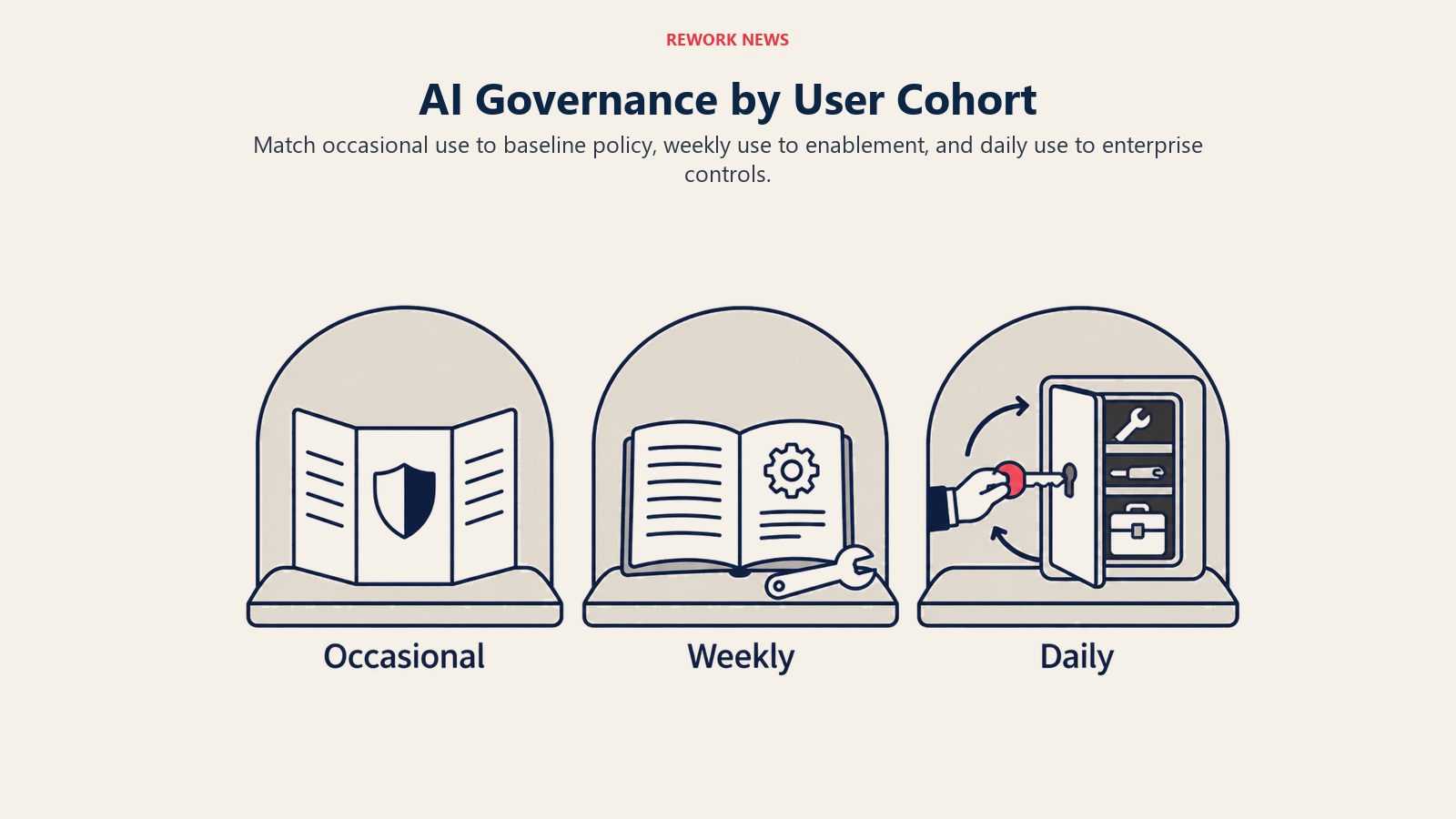
Most AI governance policies were written for a world where daily users were rare. Gallup's data shows that world is gone. Managing AI adoption at majority scale requires treating three distinct cohorts differently: occasional users who need baseline guardrails, weekly users who need structured enablement, and daily users who need enterprise-grade tooling and a feedback channel. A single policy for all three over-constrains the people generating the most value and under-constrains the people taking the most risk.
The Majority Adoption Rule: Once more than 50% of your workforce uses AI at work, individual behavior becomes organizational policy by default. The question is no longer whether your employees use AI. It's whether you've built the governance infrastructure to make that use consistent, auditable, and strategically aligned. Shadow AI is now the organizational default; official policy is the exception that needs to catch up.
Five Operating Model Shifts You Need to Make Now
The operating model shifts translate AI usage data into changes in policy, tooling, measurement, and manager behavior.
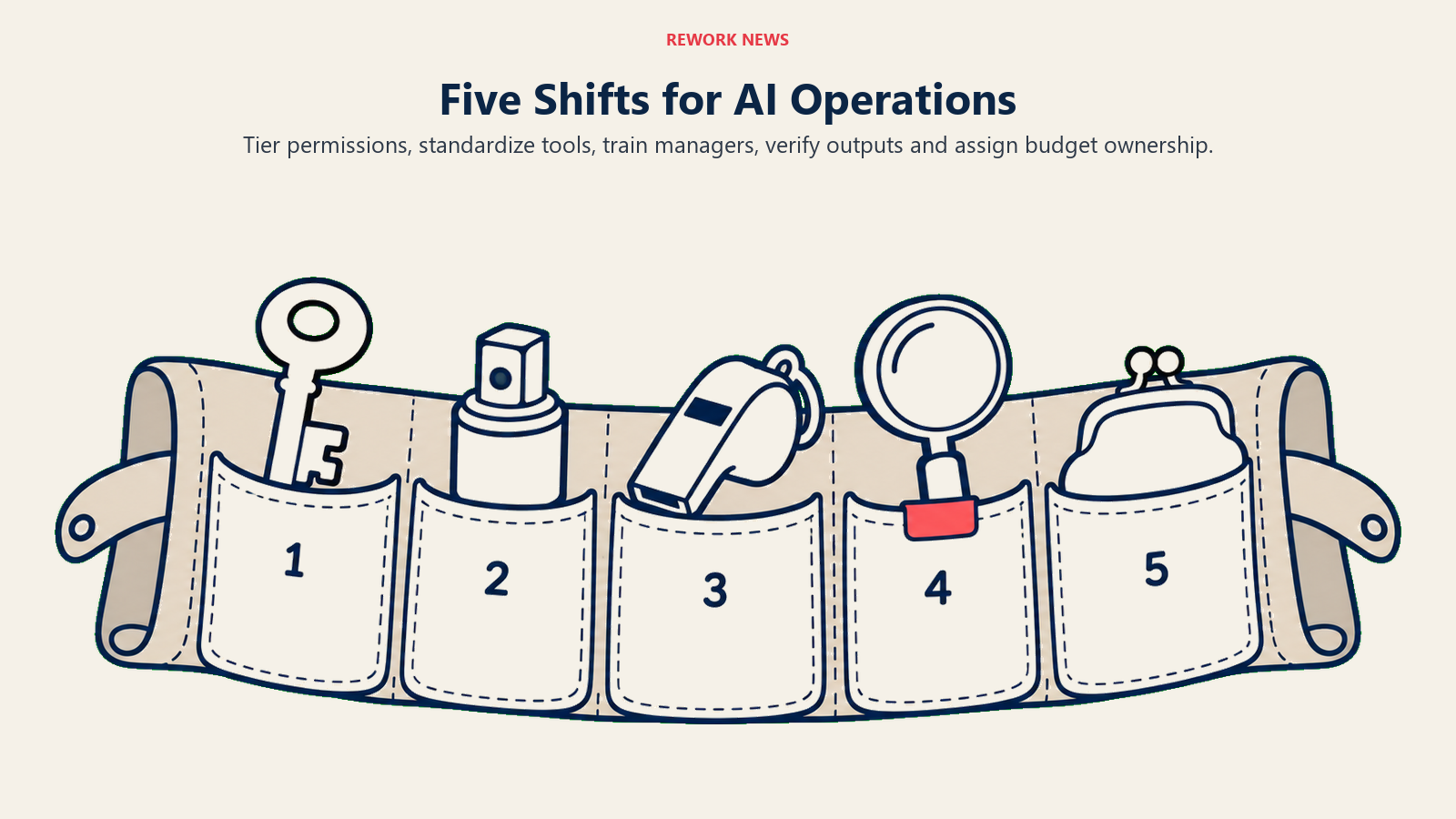
The structural change Gallup is documenting demands changes across five dimensions of how operations runs.
1. Governance policy: from blanket rules to tiered permissions. A single AI use policy written for occasional users creates compliance theater for daily users who've already built workflows your policy didn't anticipate. Redesign your governance framework around the three cohorts. Set clear data classification rules (what can go into which tools), define approved tool tiers by use case, and build a fast-track review path for daily users who want to formalize workflows they've already built informally.
2. Tooling standardization: consolidate the stack before it fragments further. When AI adoption reaches majority levels, the informal tool proliferation that accumulates over a pilot period becomes an operational liability. Employees on different AI tools can't share prompts, workflows, or outputs cleanly. Your IT and security teams are managing an expanding attack surface. And your data governance framework is only as strong as your weakest unsanctioned tool. Run an audit of what your employees are actually using versus what's officially provisioned. The gap will almost certainly be larger than you expect.
3. Manager enablement: your managers are the AI governance layer you're not training. Daily and weekly AI users don't interact with your policy documents in the moment they're deciding whether to trust an AI output. They interact with their manager's judgment. If your managers haven't been explicitly trained on what good AI-assisted work looks like, how to review AI outputs in their domain, and what the common failure modes are, they can't perform that governance role. This isn't a one-time training event. It's an ongoing competency your management development function needs to own. The change management playbook for AI rollouts addresses specifically how to sequence manager training within a broader adoption program.
4. Performance metrics: add AI fluency to your measurement framework. Most performance management systems were built before AI was a daily work tool. That means they can't distinguish between an employee who's performing well because they're skilled and one who's performing well because they've become exceptionally effective at using AI. And they can't identify employees who are underperforming partly because they haven't had adequate AI enablement. Update your operational KPIs to include AI adoption and output quality indicators. Not as a surveillance mechanism but as a diagnostic tool for where your enablement investments are landing. A practical framework for measuring AI adoption ROI gives operations leaders a three-layer model that holds up to board review.
5. AI budget line items: stop funding AI through discretionary spend. When AI tools live in the miscellaneous software budget, there's no ownership over utilization, no accountability for outcomes, and no structured path for requesting additional tooling. As the majority of your workforce becomes AI-dependent, AI tooling is a core operational expense, not an experiment. Build a dedicated line item, assign ownership, and tie it to the output metrics you're tracking.
What to Do This Week
The shift from pilot governance to operational governance doesn't require a transformation program. It requires a few concrete moves.
First, pull your current AI tool usage data from IT and your software procurement records. Map who's using what against your approved tool list. The delta is your shadow AI exposure. Don't treat it as a compliance problem yet; treat it as a signal about where your approved stack has gaps.
Second, review your current AI acceptable use policy and identify whether it was written for occasional users. If it doesn't address daily-user workflows, automation building, or output verification standards, it needs a second version. You don't have to retire the first one. Add a tiered annex that covers the higher-frequency use cases.
Third, identify your five highest-volume daily AI users in operations and ask them one question: what approved tool limitation are you working around right now? The answers will tell you more about your tooling gaps than any vendor survey.
The Gallup milestone matters not because 50% is a psychologically satisfying number but because majority adoption is the threshold at which individual behavior becomes organizational policy, whether you've written that policy or not. Shadow AI is now the default, not the exception. The COOs who act on that shift now are building the operating infrastructure that will compound over the next two years. The ones who wait are letting their employees write the policy for them. On the sales side specifically, Salesforce's Agentforce reaching $800M ARR signals that agentic CRM tools are no longer in pilot territory, a consideration for COOs evaluating how deeply to embed platform-level AI into operations workflows.
Frequently Asked Questions
What does it mean that 50% of U.S. workers now use AI at work?
Gallup's 2026 survey found that 50% of employed American adults report using AI tools in their work role at least occasionally, up from 46% the prior quarter. The Federal Reserve's decision to build a formal tracking series around AI adoption in 2026 signals that this threshold represents structural embedding, not a temporary adoption spike. For COOs, majority adoption means AI governance is now a baseline operational requirement, not an initiative.
How should COOs think about the three different AI user cohorts in their workforce?
Gallup's data breaks down into three practical segments: occasional users (a few times a year) who need baseline policy coverage, weekly users who've integrated AI into regular workflows and need structured enablement, and daily users (13% of the workforce) who need enterprise-grade tooling, automation guardrails, and feedback channels. Governance policies written for occasional users systematically over-constrain daily users and under-address the integration risks of weekly users.
Is the 65% productivity improvement figure from Gallup reliable?
The 65% figure reflects self-reported productivity improvement at organizations actively implementing AI (a perception metric, not a throughput measurement). Cross-industry analysis of 2017–2024 data found approximately 10% greater productivity growth in sectors with higher AI exposure, which is directionally consistent but measured differently. COOs should use the Gallup figure as a sentiment indicator and build separate output-based metrics for operational performance claims.
What is shadow AI and why is it a COO concern at majority adoption?
Shadow AI refers to AI tools employees use without formal IT provisioning or policy coverage. At majority adoption levels, shadow AI is no longer an edge case. It's the default mode for employees whose needs exceed the approved stack. The operational risks include inconsistent outputs entering customer-facing workflows, data governance gaps when sensitive information is pasted into consumer AI tools, and an expanding security attack surface. Auditing actual tool usage against the approved list is the first diagnostic step.
How should COOs update performance metrics to account for AI adoption?
Performance management systems built before AI was a daily work tool can't distinguish between employees performing well from skill versus those leveraging AI effectively, or underperforming because they lack AI enablement. Update operational KPIs to include AI adoption indicators and output quality checks. The goal isn't surveillance; it's identifying where enablement investments are landing and where gaps persist.
Related Reading
- Monday.com vs. Asana in 2026: The AI Architecture Decision That Should Drive Your Platform Choice: Evaluating work management platforms when AI governance is a selection criterion
- You Can Now Hire AI Agents for Your Monday.com Workspace: What the agent marketplace shift means for daily-user tooling decisions
- Atlassian Cut 900 R&D Roles: What Operations Leaders Need to Assess Before Renewal: Vendor stability as a factor in AI tooling decisions

Co-Founder, Rework.com
On this page
- Five Operating Model Shifts You Need to Make Now
- What to Do This Week
- Frequently Asked Questions
- What does it mean that 50% of U.S. workers now use AI at work?
- How should COOs think about the three different AI user cohorts in their workforce?
- Is the 65% productivity improvement figure from Gallup reliable?
- What is shadow AI and why is it a COO concern at majority adoption?
- How should COOs update performance metrics to account for AI adoption?