More in
AI Jobs & Skills News
Finance Keeps Shedding Jobs as the Economy Hires: The White-Collar Warning
Jun 6, 2026
AI Skills Just Became the Hardest Hire in the World. You Won't Recruit Your Way Out
Jun 6, 2026
Is AI Actually Killing Jobs? May's Hiring Numbers Say Not So Fast
Jun 5, 2026
You Put Your AI Agents on the Org Chart. Accountability Quietly Dropped
Jun 5, 2026
Everyone Blames AI for the Gen Z Job Crisis. The Fed Points at Remote Work
Jun 5, 2026
AI's Net Job Drag Fell to 11,000 a Month. Construction Is Hiding the Truth
Jun 4, 2026
AI Blamed for a Record 40% of May's US Layoffs, the Third Month Running
Jun 4, 2026
Four Futures for Jobs by 2030: The Mid-2026 Checkpoint for CEOs
Jun 3, 2026
Can Federal AI Apprenticeships Fix Your Skills Gap Cheaper Than Hiring?
Jun 3, 2026
AI Engineer Pay Split Into Two Markets. Only the Top Is a Bubble
Jun 3, 2026
Fortune 500 Companies Are Appointing Chief AI Officers at Record Pace: What the Role Actually Does
Turn this article into takeaways for your work.


Each assistant summarizes the article only for you and suggests best practices for your work.
The Chief AI Officer (CAIO) is the fastest-growing senior AI job in the Fortune 500, with adoption jumping from 19% to 43% of companies in twelve months. The role owns AI strategy, governance, or operations depending on the company, pays $420,000 to $680,000 in total cash compensation, and exists to give one accountable owner to AI investment that would otherwise fragment across the CTO, CDO, and business units.
Twelve months ago, roughly 19% of Fortune 500 companies had a Chief AI Officer or an equivalent titled executive with dedicated AI strategy ownership. Today, that number sits at 43%.
The 210% growth rate in CAIO appointments isn't a coincidence of hiring cycles. It's a structural response to a specific problem: as AI tooling proliferates across every business function, organizations that lack a dedicated owner for AI strategy end up with patchwork deployments, inconsistent governance, and no one accountable for measuring whether the investment is actually working.
The CAIO role is becoming standard infrastructure. Not a vanity hire. Not a defensive PR move. But the question of whether your organization needs one, and how to structure it if you do, deserves more precision than most coverage of this trend provides.
The Wave of Appointments
The acceleration began in earnest in Q3 2025, following a cluster of high-profile announcements. UnitedHealth Group, American Express, and Lowe's all named CAIOs within a 60-day window, and the pace hasn't slowed since. LinkedIn tracked 94 CAIO appointments among Fortune 500 companies in 2025 alone, compared to 30 in 2024 and fewer than 10 in 2023.
The sectors leading the adoption wave are financial services, healthcare, and retail, all three characterized by high data volume, regulatory complexity, and competitive markets where AI-driven efficiency translates directly to margin. Financial services has the highest CAIO density: roughly 62% of Fortune 500 financial firms now have the role. Healthcare is at 51%. Retail sits at 47%.
The lagging sectors are energy, utilities, and industrial manufacturing, industries where AI adoption is happening but moves more slowly due to legacy infrastructure, longer capital cycles, and less acute competitive pressure from AI-native competitors.
Why CEOs Are Creating the Role Now
The honest answer is that the alternative (distributing AI strategy ownership across CTO, CDO, and business unit heads) has produced visible failures at scale. AI projects launched without unified governance have created data privacy incidents, inconsistent vendor relationships, redundant tooling investments, and executive teams that can't answer basic questions about their AI ROI. The executive decision framework for AI workforce strategy provides a structured way to map those accountability gaps before they become costly.
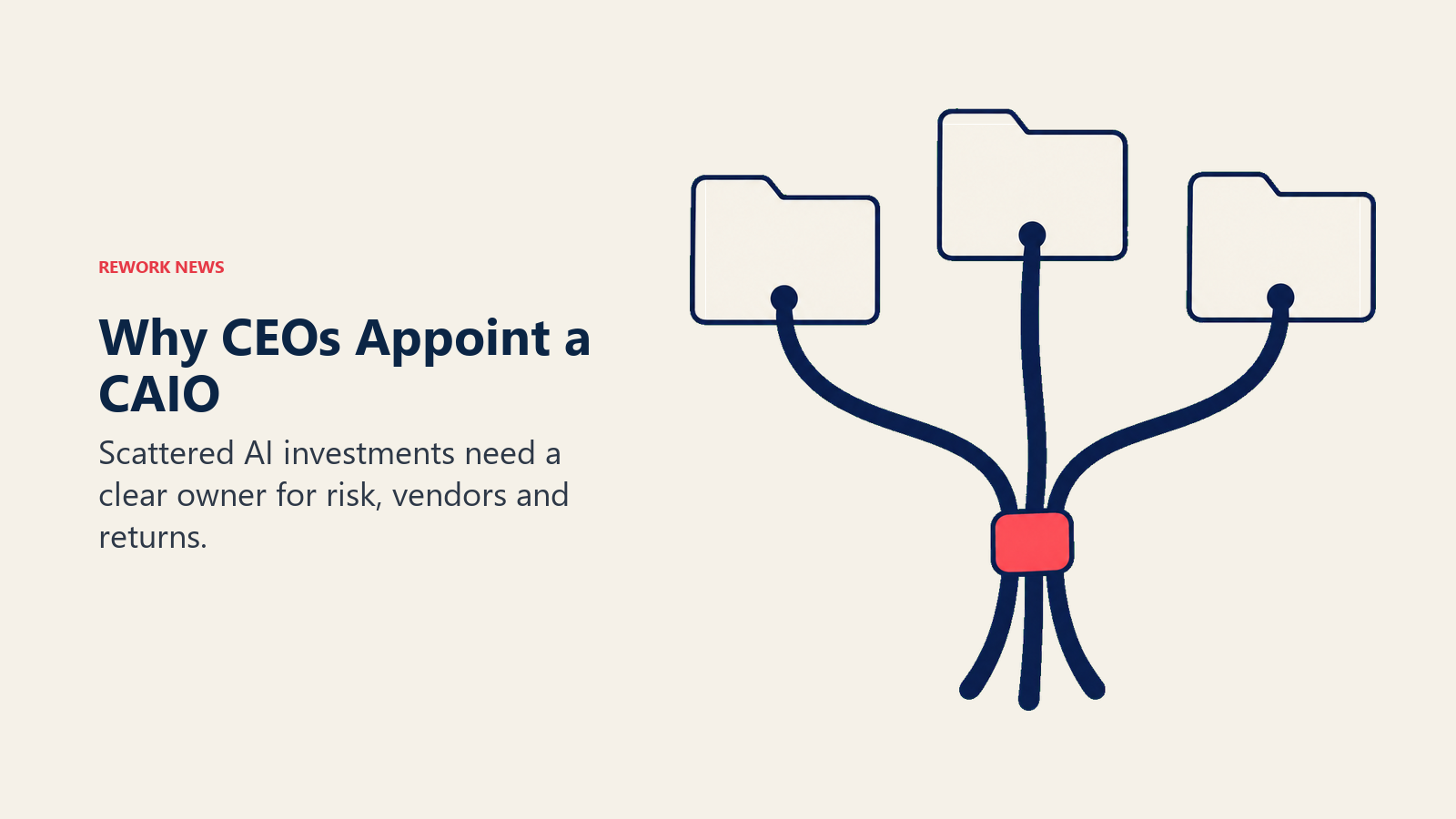
The CAIO appointment typically follows one of three triggering events. The first is a board-level mandate: boards with technology committees have begun requiring AI governance reporting, and CEOs need someone who owns that deliverable. The second is a competitive signal: a direct competitor naming a CAIO creates organizational pressure to respond. The third, and arguably most legitimate, is an AI initiative failure: a costly deployment that didn't deliver expected outcomes, traced back to absence of strategic ownership.
Regulatory pressure is accelerating the timeline as well. The EU AI Act's risk classification requirements, effective for large organizations from August 2026, create compliance obligations that benefit from dedicated ownership. Companies operating in the EU are moving faster on CAIO appointments than peers in less regulated markets.
What the Role Actually Owns
This is where coverage of the CAIO trend tends to get imprecise. There's no standard job description for the role, and what a CAIO owns varies significantly by organization. But three models have emerged as the dominant structures:
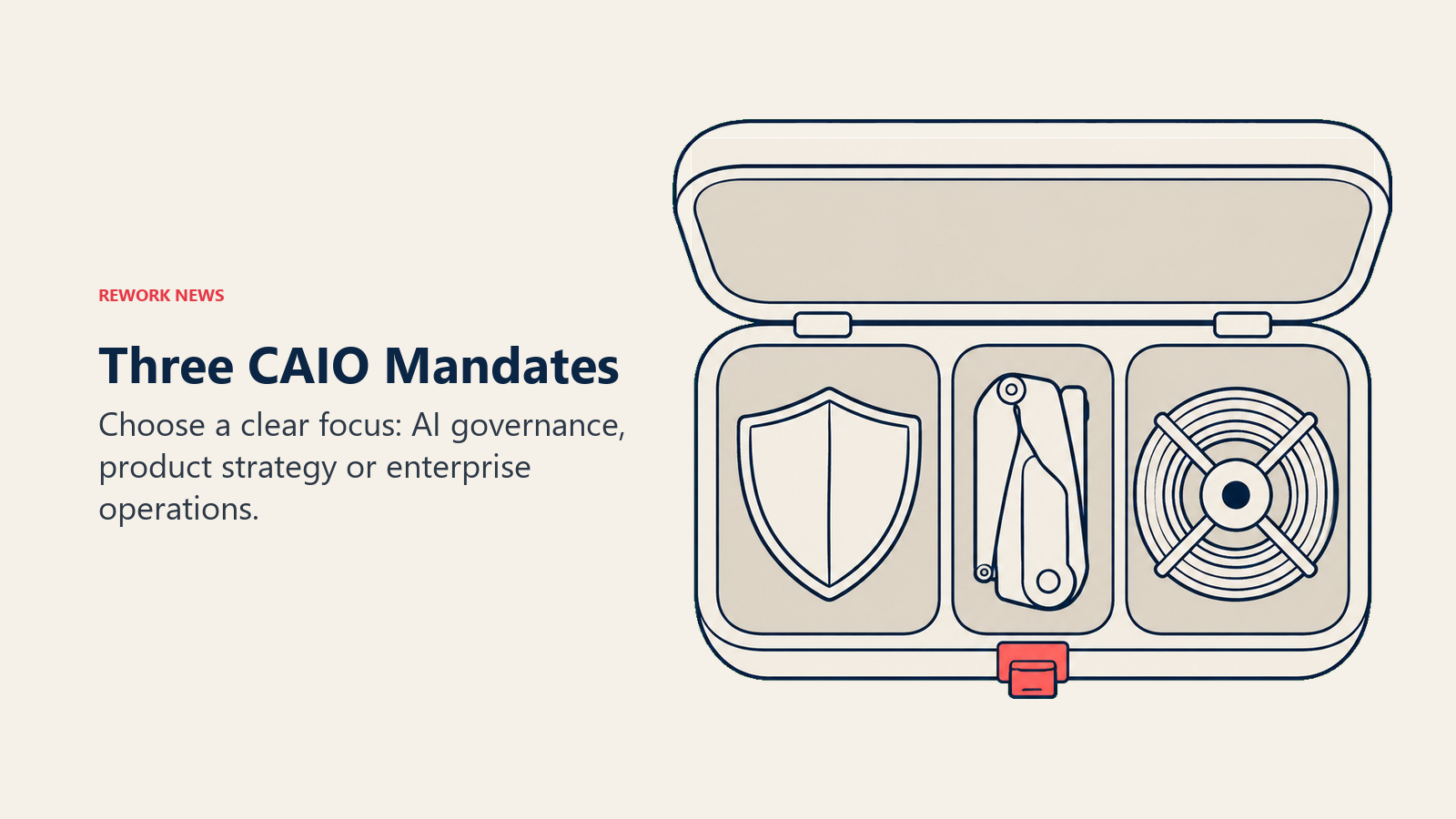
The Governance Model. The CAIO owns AI policy, risk management, and compliance. They don't run AI product teams or control the AI engineering org. Their mandate is ensuring that AI is being deployed responsibly, consistently, and in line with legal requirements. This model is most common in financial services and healthcare, where regulatory risk is high. The CAIO in this model typically reports to the CEO or Chief Risk Officer.
The Product Model. The CAIO owns AI product strategy, defining which AI capabilities the company builds or buys, setting the product roadmap for AI features, and coordinating between engineering and business units. They're less focused on governance and more on competitive differentiation. This model is common in retail and technology companies. The CAIO in this model often reports to the CEO or CTO.
The Operations Model. The CAIO owns the AI tooling stack across the enterprise, managing vendors, monitoring model performance, running internal AI training programs, and measuring productivity impacts. This is the broadest operational mandate and typically requires the largest team. It's emerging in professional services firms and large retailers. Reporting line is usually to the COO or CEO.
Some organizations blend models, particularly in early-stage CAIO deployments where the role is still being defined in practice. The risk of blending is scope dilution: a CAIO who owns governance, product, and operations ends up owning nothing well.
How It Differs From CTO and CDO
The confusion between CAIO and existing C-suite roles is real and worth addressing directly.
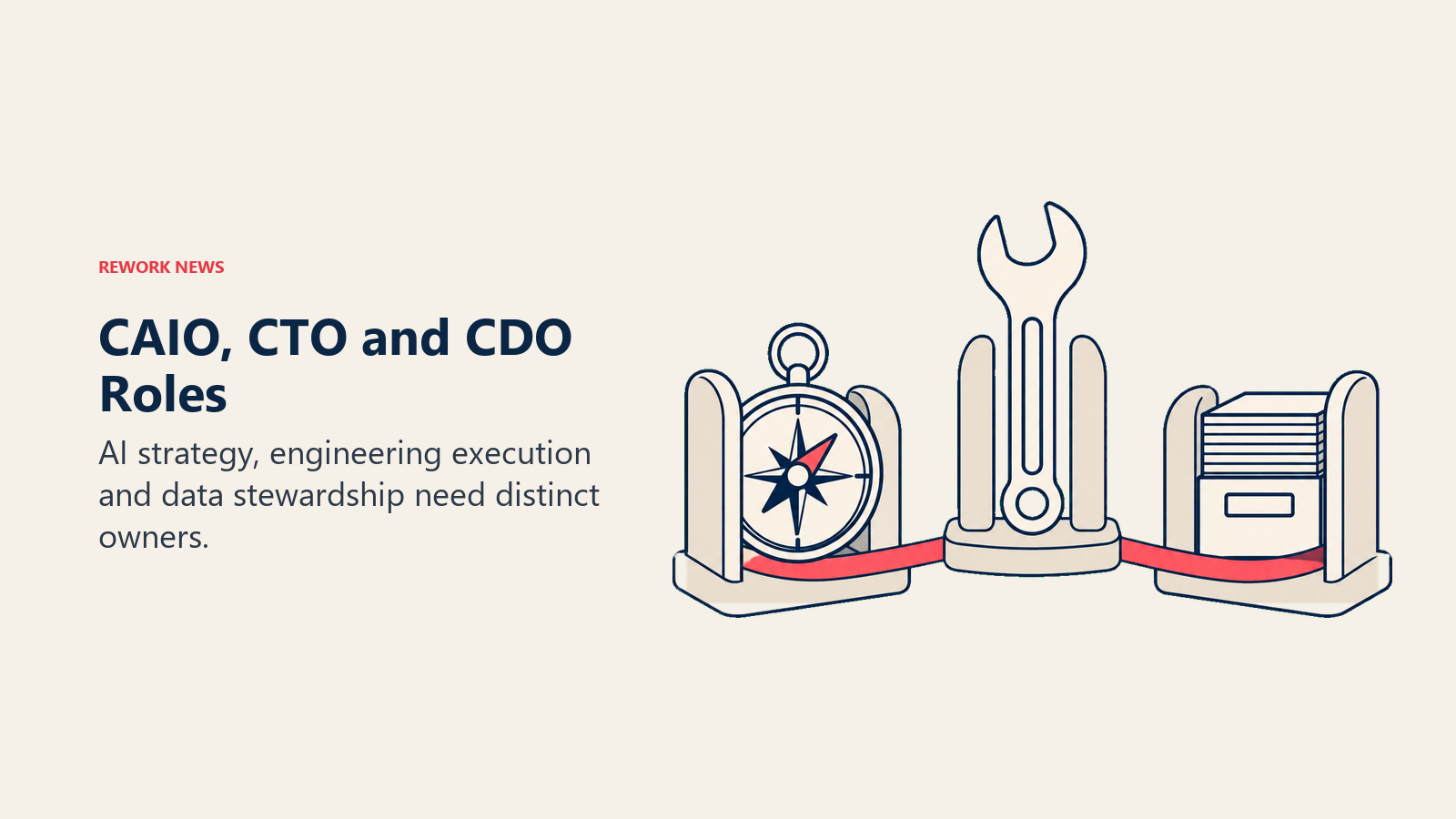
The CTO owns the engineering organization and technology infrastructure. AI engineering may sit under the CTO, but the CTO's mandate is broader and often more focused on reliability, scalability, and technical talent than on AI strategy as a business differentiator. A CAIO and CTO can coexist cleanly when the CAIO owns AI strategy and vendor governance and the CTO owns AI engineering execution.
The CDO owns data strategy and data infrastructure: governance, quality, pipelines. AI depends on data, so the CDO-CAIO relationship requires clear coordination. But the CDO's mandate isn't AI strategy. It's data as a company asset. Many organizations run both roles with a formal interface between them.
Where conflicts arise is in organizations that try to give the CDO or CTO an "expanded mandate" to cover AI strategy as an add-on. Both roles are already full jobs. Adding AI strategy as a secondary responsibility produces the same outcome as not having a dedicated owner at all. The work gets deprioritized when execution pressures rise.
Compensation and Reporting Lines
Compensation for CAIO roles at Fortune 500 companies is settling into a range of $420,000 to $680,000 total compensation (base plus annual bonus, excluding equity). The range is wide because the role's scope varies significantly across the three models described above.
Reporting lines break down as follows, based on LinkedIn's analysis of publicly disclosed organizational structures: 54% report directly to the CEO, 31% report to the CTO, and 15% report to the COO or CDO. The CEO reporting line is more common in organizations where the CAIO owns strategic AI governance. The CTO reporting line is more common where the CAIO is focused on AI product.
Average CAIO tenure at Fortune 500 companies is currently 2.1 years, lower than other C-suite roles (CTO averages 4.2 years, CFO averages 5.1 years). The short tenure reflects the role's newness, the pace of AI change, and in some cases a mismatch between what organizations expected the role to deliver and what the CAIO was actually empowered to do.
Named Examples Worth Tracking
Three recent appointments illustrate how the role is being structured differently by sector:
Cigna Group named a CAIO in November 2025 with a governance-first mandate, reporting to the CEO. The stated scope: AI risk management, model transparency standards, and regulatory compliance across all AI deployments. A textbook Governance Model appointment driven by healthcare regulatory exposure.
Target Corporation appointed a CAIO in January 2026 with a product mandate, owning the AI features roadmap across its app, supply chain, and personalization stack. Reports to the CTO. Classic Product Model in a retail competitive context.
Deloitte created a Global CAIO role in Q4 2025 with an operations mandate: standardizing AI tooling across its 450,000-person workforce, managing LLM vendor relationships, and running the firm's internal AI upskilling program. Operations Model at professional services scale.
What to Watch Next
Two dynamics will shape how the CAIO role evolves through the rest of 2026. The first is whether it standardizes into a stable job family with consistent scope expectations, or continues to fragment into different configurations depending on sector and org structure. Standardization would accelerate adoption by reducing the friction of defining the role from scratch each time.
The second is regulatory pressure. As the EU AI Act enforcement machinery ramps up and equivalent legislation advances in other jurisdictions, organizations that haven't created an AI governance ownership structure will face compliance pressure that makes the CAIO appointment less optional. LinkedIn's data on AI skills demand already shows AI governance as a fast-growing skill category within senior leadership hiring.
The question for CEOs isn't whether to eventually appoint a CAIO. It's whether to do it before a competitor does, before a regulatory deadline forces it, or before an AI failure makes it obvious in hindsight that someone should have owned this earlier.
Comparing hiring velocity by sector shows that industries leading on CAIO adoption are also leading on overall AI talent density, which suggests the appointment is a leading indicator of organizational AI maturity, not just an org chart adjustment.
The replace-vs-augment debate that often frames AI workforce discussion is also relevant to how CAIOs define their mandate. What the workforce data actually shows is that organizations with dedicated AI strategic ownership are making more deliberate augmentation decisions, because there's actually someone accountable for making them. The CAIO isn't a fad for mid-market companies: the same structural need exists well below the Fortune 500 scale.
Frequently Asked Questions
What does a Chief AI Officer do? A CAIO owns the company's AI strategy. In practice the mandate follows one of three models: governance (AI policy, risk, and compliance), product (deciding which AI capabilities to build or buy and owning the roadmap), or operations (managing the enterprise AI tooling stack, vendors, and training). The model depends on the sector and the problem that triggered the hire.
How much does a Chief AI Officer make? Total cash compensation at Fortune 500 companies runs $420,000 to $680,000, covering base plus annual bonus and excluding equity. The wide range reflects how much the role's scope varies across the governance, product, and operations models.
How is a CAIO different from a CTO or CDO? The CTO owns engineering and infrastructure; the CDO owns data strategy and quality. The CAIO owns AI strategy and vendor governance as a business differentiator. A CAIO and CTO can coexist when the CAIO sets AI strategy and the CTO executes AI engineering. Bolting AI strategy onto an already-full CTO or CDO role tends to fail.
Does my company need a Chief AI Officer? The need is structural, not size-specific. When AI tooling spreads across functions with no single owner, you get patchwork deployments, inconsistent governance, and no accountability for ROI. The same gap exists well below the Fortune 500, which is why mid-market companies are creating the role too.
Learn More
