More in
AI Jobs & Skills News
Finance Keeps Shedding Jobs as the Economy Hires: The White-Collar Warning
Jun 6, 2026
AI Skills Just Became the Hardest Hire in the World. You Won't Recruit Your Way Out
Jun 6, 2026
Is AI Actually Killing Jobs? May's Hiring Numbers Say Not So Fast
Jun 5, 2026
You Put Your AI Agents on the Org Chart. Accountability Quietly Dropped
Jun 5, 2026
Everyone Blames AI for the Gen Z Job Crisis. The Fed Points at Remote Work
Jun 5, 2026
AI's Net Job Drag Fell to 11,000 a Month. Construction Is Hiding the Truth
Jun 4, 2026
AI Blamed for a Record 40% of May's US Layoffs, the Third Month Running
Jun 4, 2026
Four Futures for Jobs by 2030: The Mid-2026 Checkpoint for CEOs
Jun 3, 2026
Can Federal AI Apprenticeships Fix Your Skills Gap Cheaper Than Hiring?
Jun 3, 2026
AI Engineer Pay Split Into Two Markets. Only the Top Is a Bubble
Jun 3, 2026
The AI Certification Market Hit $4B, But Only a Handful of Credentials Signal Job Readiness
Turn this article into takeaways for your work.


Each assistant summarizes the article only for you and suggests best practices for your work.
For AI skills to move a job application, the credential has to be one hiring managers actually recognize. Employer surveys point to a short list: Google Professional Machine Learning Engineer, AWS Certified Machine Learning, Microsoft Azure AI Engineer, and DeepLearning.AI specializations. Most of the 400+ other AI credentials carry recognition rates under 20%, and a real project portfolio often outweighs any certificate.
The AI certification market crossed $4 billion in 2026. There are now over 400 distinct AI credentials available, from 10-hour Coursera courses to 6-month bootcamp programs to vendor-specific certificates from Google, AWS, and Microsoft. New offerings launch almost weekly.
For Heads of Operations and L&D leaders, that explosion creates a real problem: when everything is a credential, nothing signals competence.
The hard question isn't whether to invest in AI training. It's which credentials actually move the needle when vetting training vendors, evaluating employee programs, or interpreting what's on a candidate's resume.
Employer data is starting to provide some answers, and they're more selective than the certification vendors would like you to know.
What Happened: 18 Months of Credentialing Chaos
The AI certification surge tracks almost perfectly with the ChatGPT inflection point. From late 2023 through 2025, every major platform rushed to launch AI learning tracks. Coursera, edX, and LinkedIn Learning each added hundreds of AI-adjacent courses. Google launched its AI Essentials certificate. AWS expanded its ML credential stack. Microsoft tied Copilot training into its existing Azure learning paths. DeepLearning.AI became a standalone institution in all but name.
The market grew 38% year-over-year from 2024 to 2025, then accelerated another 29% in the first half of 2026 as enterprise L&D budgets started flowing toward AI reskilling in earnest.
But employer acceptance hasn't kept pace with supply. A 2025 survey of 1,200 hiring managers across enterprise and mid-market companies found that only 23% said they actively screened for AI certifications during resume review. Most said project portfolio or demonstrated output quality mattered far more than credentials.
That gap (between the volume of certifications and the actual weight employers give them) is where L&D budget evaporates.
The Numbers That Actually Matter
Market size and trajectory: The global AI certification market reached approximately $4.1B in 2025, up from $2.2B in 2023. Analyst projections put it at $6.5-7B by 2028, driven primarily by enterprise training spend, not individual learners.
Employer recognition rates: When hiring managers were asked which specific credentials they would weight positively in a hiring decision, the list was short:
- Google Professional Machine Learning Engineer: recognized by 61% of surveyed hiring managers in tech and operations roles
- AWS Certified Machine Learning, Specialty: recognized by 58%
- Microsoft Certified: Azure AI Engineer Associate: recognized by 54%
- DeepLearning.AI specializations (Coursera): recognized by 47%, particularly in data-adjacent roles
- IBM AI Engineering Professional Certificate: recognized by 31%, with stronger weight in enterprise IT contexts
Everything below that list showed recognition rates under 20%. Dozens of credentials from newer platforms landed in the 5-10% range.
Portfolio vs. credentials: Among the same hiring manager cohort, 71% said they weighted a portfolio of real AI work projects at least as heavily as certifications. 43% said a strong project portfolio could compensate entirely for a lack of formal credentials.
Completion rates: This is where many training vendors look bad. Coursera's internal data (disclosed in investor materials) shows course completion rates for AI certificates average around 17%. Bootcamp-style programs with cohort accountability structures see much higher completion, typically 68-74% for programs with active instructor involvement.
Time-to-credential: Self-paced programs advertise 10-40 hours but average completion time stretches to 3-6 months due to attrition and re-enrollment. Structured bootcamp tracks run 12-20 weeks with clearer completion gates.
Why This Matters for Operations Leaders
If you're allocating training budget, the credential your employees earn matters for two reasons beyond learning outcomes: it affects their external market value, and it affects how hiring managers read their resumes if they move.
Subsidizing credentials with low employer recognition rates doesn't just waste the training budget. It also misses the retention angle. Employees who complete Google MLE or AWS ML certifications have measurable increases in external offers within 6-12 months. That's a retention risk, but it's also a signal that the credential actually moves labor market outcomes. If the certification isn't moving outcomes, the L&D investment isn't working. Building a business case for AI training budget that's anchored to recognized credentials gives the ROI analysis real teeth.
The reverse is also true: if a vendor is selling you their proprietary AI certification as a hiring differentiator, check the employer recognition data first. A credential that 80% of hiring managers have never heard of doesn't improve your team's competitive readiness. It just checks a training completion box.
There's also a vendor selection dimension here. Companies that run internal learning platforms or partner with bootcamps need to evaluate which credential outcomes their programs actually deliver. Completion rate and credential quality should both be in the vendor scorecard.
What Smart Leaders Are Doing
A handful of large employers have started explicitly citing certifications in job postings, not as requirements but as signals. Amazon, JPMorgan Chase, and Deloitte have all posted roles in the past 12 months where AWS or Google AI certifications appeared under "preferred qualifications." That's a shift from 2023, when AI credentials rarely appeared in non-technical postings.
Some companies are taking the opposite approach: moving away from credentials entirely and toward skill assessments. Unilever and several financial services firms have piloted role-specific AI task evaluations as part of their hiring screens, essentially testing what candidates can do with AI tools in context, not what certificate they hold.
A third model is emerging in larger enterprises: internal credentialing tied to job progression. Rather than relying on external certifications, companies like Accenture and Wipro are building internal AI learning pathways where milestone completion unlocks pay band eligibility. This decouples the training ROI calculation from external credential market dynamics entirely.
What to Watch Next
The most important open question in AI credentialing is whether a single dominant standard emerges, the way CompTIA's Security+ became the de facto floor credential in cybersecurity, or the way the CFA became the screen for asset management roles.
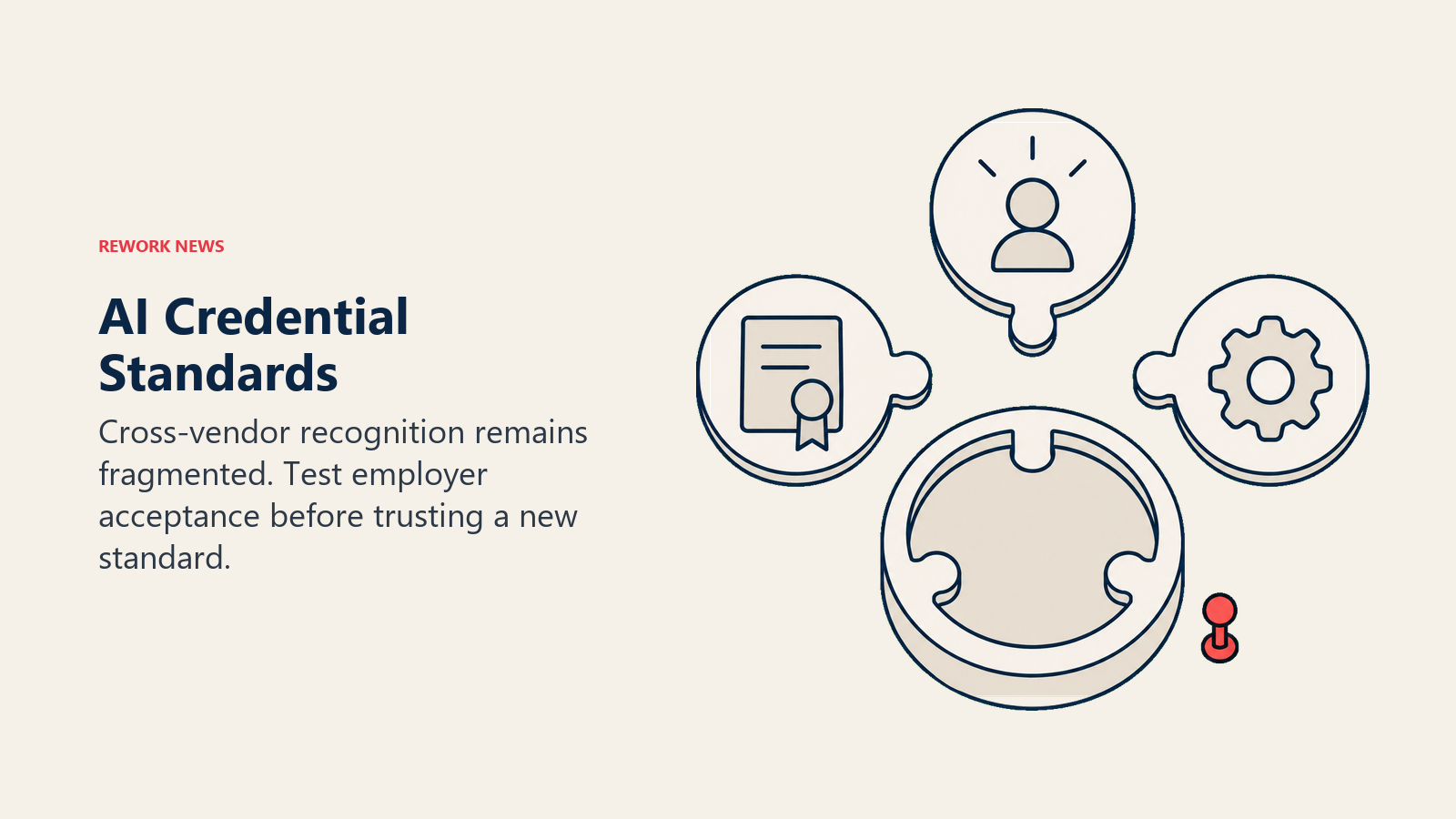
Right now, that convergence isn't happening. The market is fragmented across vendor-specific (Google, AWS, Microsoft), platform-specific (Coursera, edX), and domain-specific (DeepLearning.AI) credentials with no clear interoperability or equivalency framework.
If a credentialing body does emerge with cross-vendor employer acceptance (something like a CAIA or CFA for AI practitioners) it would dramatically simplify L&D vendor selection and allow cleaner ROI tracking. Several professional associations are positioning for that role. None have achieved critical mass yet.
Until then, the practical guidance for operations leaders is to anchor training investment to credentials with documented employer recognition above 40%, weight project portfolios equally to credentials in internal promotion and external hiring, and treat vendor-proprietary certifications with skepticism unless you can see independent hiring manager adoption data. How AI is changing retention is part of the same equation, because credentials that build real market value create attrition risk, but that risk is manageable with the right comp strategy.
The $4B market isn't going to get less crowded. The signal problem is getting worse before it gets better.
AI Skills and Certifications for Jobs
Which AI certifications do hiring managers actually recognize?
Survey data points to a short list: Google Professional Machine Learning Engineer (61% recognition), AWS Certified Machine Learning Specialty (58%), Microsoft Azure AI Engineer Associate (54%), and DeepLearning.AI specializations (47%). Most other credentials land below 20% recognition.
Do AI certifications help you get a job?
They help most when the credential is widely recognized and paired with demonstrable work. In the same survey, 71% of hiring managers weighted a portfolio of real AI projects at least as heavily as certifications, and 43% said a strong portfolio could offset a missing credential entirely.
Are AI skills more valuable than AI certifications?
For hiring, demonstrated skill usually wins. Employers increasingly run role-specific AI task evaluations that test what candidates can do with AI tools, rather than relying on which certificate they hold. Certifications still matter as a screen, but they are a starting signal, not proof of competence.
Which AI credential should a company fund for its team?
Anchor training spend to credentials with documented employer recognition above 40%, which today means the Google, AWS, Microsoft, and DeepLearning.AI tracks. Treat vendor-proprietary certifications with skepticism unless you can see independent hiring-manager adoption data.
Learn More
- Workers with AI Fluency Are Commanding a 27% Salary Premium
- Bootcamps Are Producing More AI Graduates Than Universities
- Companies Are Spending an Average of $1,800 Per Employee on AI Reskilling
- Build the AI Skills Gap Analysis Your Executives Are Getting Wrong
- Build an AI Champions Program Inside Your Organization
