More in
AI Jobs & Skills News
Finance Keeps Shedding Jobs as the Economy Hires: The White-Collar Warning
Jun 6, 2026
AI Skills Just Became the Hardest Hire in the World. You Won't Recruit Your Way Out
Jun 6, 2026
Is AI Actually Killing Jobs? May's Hiring Numbers Say Not So Fast
Jun 5, 2026
You Put Your AI Agents on the Org Chart. Accountability Quietly Dropped
Jun 5, 2026
Everyone Blames AI for the Gen Z Job Crisis. The Fed Points at Remote Work
Jun 5, 2026
AI's Net Job Drag Fell to 11,000 a Month. Construction Is Hiding the Truth
Jun 4, 2026
AI Blamed for a Record 40% of May's US Layoffs, the Third Month Running
Jun 4, 2026
Four Futures for Jobs by 2030: The Mid-2026 Checkpoint for CEOs
Jun 3, 2026
Can Federal AI Apprenticeships Fix Your Skills Gap Cheaper Than Hiring?
Jun 3, 2026
AI Engineer Pay Split Into Two Markets. Only the Top Is a Bubble
Jun 3, 2026
Which Industries Are Hiring AI Talent Fastest in 2026, and Which Are Falling Behind
Turn this article into takeaways for your work.


Each assistant summarizes the article only for you and suggests best practices for your work.
The latest AI talent hiring news shows financial services, healthcare, and retail leading on AI hiring velocity in 2026, while utilities, energy, and manufacturing fall behind. Job posting data ranks each industry by year-over-year growth in AI-specific roles, a leading signal of which sectors are building revenue capability fastest and where the talent gap is turning structural.
In Q1 2026, financial services companies posted 3.4x more AI-specific roles than a year prior. Healthcare was at 2.9x. Retail hit 2.7x. Meanwhile, utilities posted 1.1x growth. Energy sat at 1.3x.
That spread matters to CROs because AI talent density is a leading indicator of future revenue capability. The organizations hiring AI talent now are building compounding advantages in forecasting accuracy, pipeline efficiency, customer personalization, and competitive pricing, none of which show up in a competitor's income statement until 18 to 24 months after the hiring decisions were made. By the time lagging industries see the revenue impact in competitors' results, the talent gap is already structural.
This isn't an HR report. It's a market intelligence snapshot.
How the Data Was Measured
The analysis draws from three labor market data sources: LinkedIn's job posting index, Indeed's hiring velocity tracker, and Burning Glass Technologies' skills taxonomy. The combined dataset covers approximately 2.4 million AI-related job postings from Q1 2025 to Q1 2026.
AI role categories were defined using Burning Glass's taxonomy, which classifies roles by skill cluster rather than job title alone. This matters because titles like "Data Scientist" or "Business Analyst" increasingly require AI-specific skills but don't show up in title-based searches. The broader skill-based classification captures the full scope of organizations' AI hiring activity, not just the roles explicitly labeled "AI."
Year-over-year growth rates are calculated on posting volume, not hires. Posting volume is the leading signal: it reflects current intent, not lagging hiring outcomes.
The Top 5 Industries by AI Hiring Velocity
| Industry | YoY AI Posting Growth | Avg Time-to-Fill AI Roles |
|---|---|---|
| Financial Services | +240% | 61 days |
| Healthcare & Life Sciences | +188% | 74 days |
| Retail & E-Commerce | +171% | 58 days |
| Logistics & Supply Chain | +154% | 65 days |
| Professional Services | +142% | 70 days |
Financial Services leads by a significant margin. The driver isn't one trend, it's three converging pressures. Fraud detection at scale requires ML infrastructure. Personalized financial advice requires AI-driven recommendations. And regulatory compliance in an increasingly complex environment is being partially offloaded to AI-assisted monitoring tools. JPMorgan Chase, which has publicly discussed its AI hiring program, added over 400 AI-specific roles in Q1 2026 alone. The sector's 61-day average fill time reflects a relatively mature recruiting infrastructure for AI talent, built over several years of earlier investment.
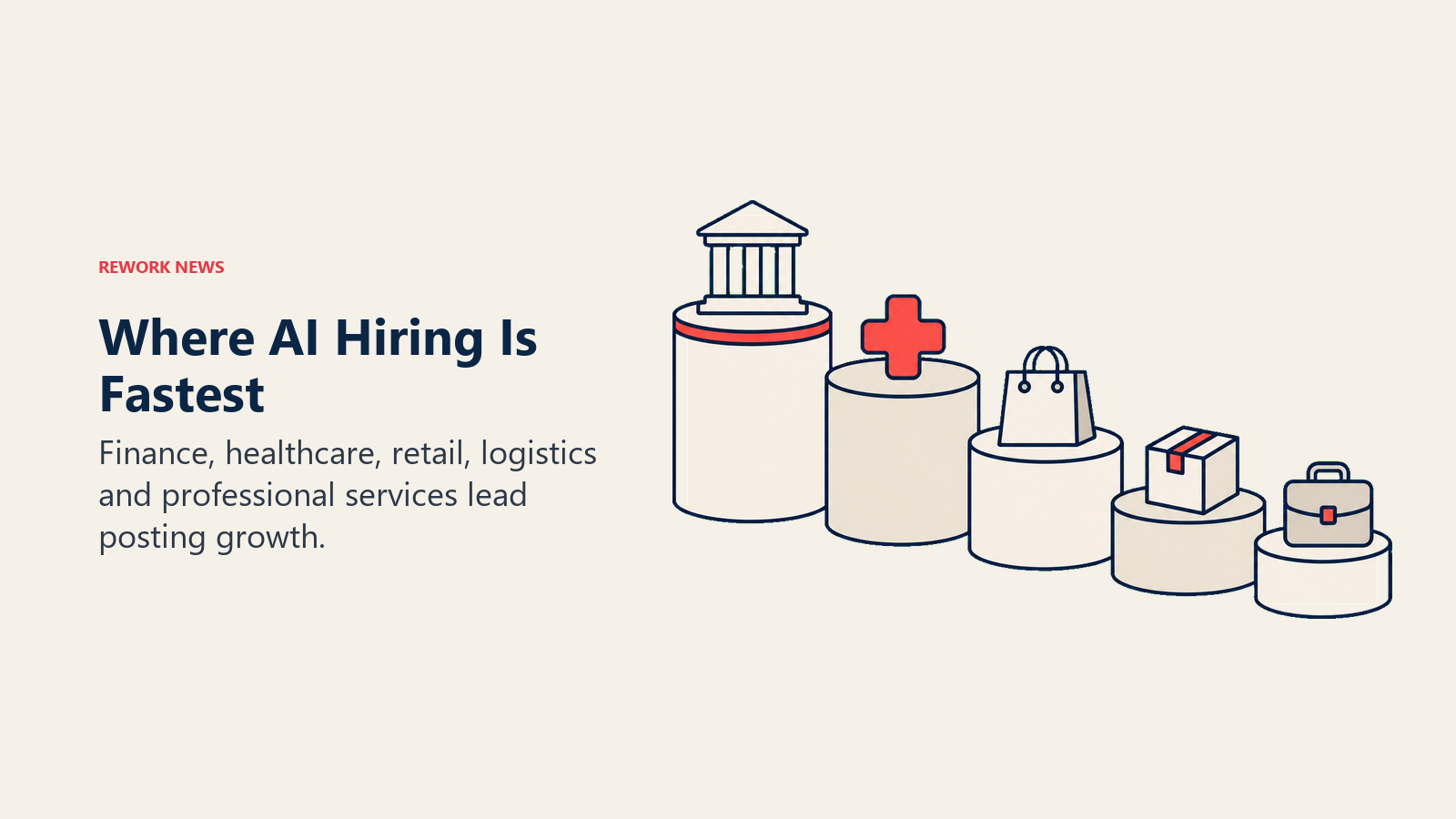
Healthcare and Life Sciences is the fastest-accelerating sector. It ranked third 12 months ago and has moved to second. The shift reflects two dynamics: diagnostic AI tools moving from pilot to production, and pharmaceutical companies deploying AI in drug discovery pipelines. Hospitals and health systems are the newer entrants to the AI hiring market, which explains the longer 74-day fill time. They're building recruiting capability for AI roles that their HR teams hadn't previously sourced.
Retail and E-Commerce is hiring fastest for AI roles in two specific clusters: personalization engineering (AI models that drive product recommendation and dynamic pricing) and supply chain optimization. Amazon and Walmart remain the dominant hirers by volume, but mid-market retailers are now entering the AI talent market in meaningful numbers. The 58-day fill time is the best in the top 5, driven partly by competitive compensation and partly by a clear AI use case that's easy to articulate to candidates.
Logistics and Supply Chain hiring is concentrated in route optimization, demand forecasting, and warehouse automation. The sector includes companies like FedEx and DHL, which have run multi-year AI programs, as well as a large middle tier of 3PLs and regional carriers that are accelerating. The 65-day fill time reflects mid-market recruiting constraints: these companies are competing with tech and financial services for the same ML engineers.
Professional Services (consulting, legal, accounting) rounds out the top 5. The hiring here is split between building internal AI capability (automating research, due diligence, document review) and developing AI-powered service offerings for clients. Deloitte, McKinsey, and KPMG are among the largest AI hirers in this category by volume. For CROs in professional services, the competitive implication is that competitors who build AI capability into their delivery model faster can do the same work at lower cost or higher margin.
The Bottom 5 Industries Falling Behind
| Industry | YoY AI Posting Growth | Gap vs. Financial Services |
|---|---|---|
| Utilities | +8% | -232 percentage points |
| Energy & Oil/Gas | +31% | -209 percentage points |
| Industrial Manufacturing | +44% | -196 percentage points |
| Agriculture | +52% | -188 percentage points |
| Government & Public Sector | +67% | -173 percentage points |
The laggard sectors share structural characteristics. Capital-intensive infrastructure creates longer planning cycles. Legacy operational technology (OT) systems are harder to integrate with AI tooling. And the competitive urgency (a direct competitor deploying AI that threatens revenue) is less immediately visible than in financial services or retail.
But the lag isn't permanent or insurmountable. Industrial manufacturing is the most likely sector to accelerate rapidly in H2 2026 and 2027, driven by predictive maintenance applications reaching commercial maturity and supply chain AI proving ROI in adjacent sectors. When industrial manufacturers begin hiring AI talent aggressively, they'll face a more constrained talent pool than financial services encountered two years earlier, because the supply side hasn't grown fast enough to meet a delayed demand surge.
Government and public sector faces a different constraint: compensation structures that make it difficult to compete with private sector AI salaries. The solution in this sector tends to be AI augmentation of existing staff rather than aggressive net-new AI hiring, which explains the lower posting volume but doesn't mean AI capability development is absent.
What the Leaders Are Doing Differently
The industries at the top of the velocity table aren't just outspending laggards on AI salaries. The hiring strategies that differentiate leaders from followers break into three patterns.
Combined external and internal tracks. JPMorgan Chase and Cigna both run parallel programs: competitive external hiring for core AI engineering roles, combined with internal reskilling programs that convert high-potential analysts and operations staff into AI Analyst and AI Operations roles. The internal track fills faster and builds institutional knowledge that external hires take months to acquire. A structured hiring vs. upskilling decision framework makes it easier to decide which track to run for each role category.
University partnerships with long lead times. Several financial services firms, including Goldman Sachs and Visa, have established research partnerships with AI labs at Carnegie Mellon, Stanford, and MIT that create recruiting pipelines 18 to 24 months ahead of hiring need. This approach isn't available to every organization, but it reflects a deliberate investment in supply, not just demand.
Revised comp bands that move fast. Retail leaders in particular have been aggressive about updating AI role compensation mid-year rather than waiting for annual comp cycles. When the market for ML Engineers moves by $20,000 in six months (which it did between Q2 and Q4 2025), companies that update comp bands mid-year fill roles. Those that don't see offers declined and pipelines dry up.
The CRO Lens: AI Talent as Revenue Infrastructure
For CROs, the competitive read on this data is straightforward. Companies hiring AI talent at 2x to 3x your industry's average velocity are building forecasting, personalization, and pipeline optimization capabilities that will produce measurable revenue advantages in 12 to 24 months. The standard revenue ops playbook assumes relatively similar organizational capability across competitors. That assumption is increasingly wrong in industries where AI talent velocity has diverged.
LinkedIn's data on the broader AI skills demand surge shows that the 142% overall increase is being driven disproportionately by the same sectors leading the industry velocity rankings. The concentration of demand in financial services, healthcare, and retail isn't just a hiring story, it's a signal about where AI-driven revenue capability is concentrating.
Workers with AI fluency are commanding a 27% salary premium across job categories, which means the competitive gap isn't limited to dedicated AI roles. Sales teams, account management teams, and revenue ops functions where AI-fluent workers are concentrated will outperform equivalently staffed teams where AI fluency is absent. That's a direct input to sales force planning.
AI-augmented sales teams are closing 31% more deals, a data point that reframes AI talent hiring from a cost center to a revenue multiplier. For CROs benchmarking industry AI hiring velocity, the right frame isn't "are we keeping up?" It's "are we building AI capability fast enough to protect our revenue in markets where competitors are building it faster?"
What to Watch in H2 2026
Two scenarios are worth tracking. The first: industrial manufacturing, energy, and logistics reach their own inflection points and begin hiring aggressively. If that happens in H2 2026, the supply-demand gap for AI talent in those sectors will be severe. They'll be entering a market that's already tighter than when financial services started hiring at scale. Companies in lagging sectors that start building AI talent pipelines now, even modestly, will be significantly better positioned than those waiting for the pressure to become obvious.
The second: whether the leading sectors' hiring velocity normalizes as initial AI deployments complete and organizations shift from build to operate. Some cooling is plausible. But the evidence from financial services, where AI hiring velocity has accelerated for three consecutive years, suggests that early adopters don't slow down as AI matures. They find new applications and hire to build them.
The competitive intelligence conclusion: the industries moving fastest on AI talent now are not moving to check a box. They're building capabilities that compound. Organizations in lagging sectors have a narrowing window to catch up before the gap becomes structural.
Frequently Asked Questions
Which industry is hiring AI talent fastest in 2026?
Financial services leads, posting roughly 3.4x more AI-specific roles year over year (+240%), followed by healthcare and life sciences (+188%) and retail and e-commerce (+171%). These three sectors are building AI capability fastest because they have clear, revenue-linked use cases for it.
Which industries are falling behind on AI hiring?
Utilities (+8%), energy and oil and gas (+31%), and industrial manufacturing (+44%) post the slowest AI hiring growth. Capital-intensive infrastructure, legacy operational technology, and less visible competitive urgency all slow these sectors down.
Why does AI talent hiring velocity matter for CROs?
AI talent density is a leading indicator of future revenue capability. Companies hiring AI talent at 2x to 3x their industry average are building forecasting, personalization, and pipeline advantages that typically show up in revenue 12 to 24 months later, well before competitors can react.
How is AI hiring velocity measured?
It's calculated on job posting volume, not actual hires, using LinkedIn's posting index, Indeed's hiring velocity tracker, and Burning Glass skill taxonomy across about 2.4 million AI-related postings. Posting volume reflects current intent, making it a faster signal than lagging hire data.
Learn More
