Greiner's Growth Model: The Five Crises of a Growing Company
Turn this article into takeaways for your work.


Each assistant summarizes the article only for you and suggests best practices for your work.
Greiner's growth model says a company doesn't grow in a straight line. It grows through calm periods of "evolution," then hits a management crisis, a "revolution," that forces it to change how it is run. Larry Greiner described five phases of growth, each ending in a specific crisis: leadership, autonomy, control, red tape, and an open question after collaboration.
The useful part is the pattern. The way you managed the company at 10 people is the thing that breaks it at 100, and the fix for one crisis plants the seeds of the next. If you know which phase you're in, you can see the next crisis coming before it arrives.
Where the model comes from
Larry E. Greiner was a professor of management and organization at the University of Southern California's Marshall School of Business, as Harvard Business Review's page for the article notes. The article, "Evolution and Revolution as Organizations Grow," first appeared in HBR in 1972. HBR carried a version of it again in its May-June 1998 issue.
The two dates matter because the model exists in two versions. Toolshero's overview of the Greiner model explains that Greiner originally described five phases and later added a sixth. A peer-reviewed review of organizational life cycle models in the Journal of Organization Design cites the 1972 piece as Harvard Business Review volume 50, pages 37 to 46. The five-phase version is the core of this article. The sixth phase gets its own section below.
One caution: HBR's page is behind a paywall, so the details here come from academic and educator summaries of the article, not from a full read of Greiner's text. Where those summaries disagree, this article says so.
The two ideas underneath: evolution and revolution
Greiner used two words with specific meanings. An organizational design review in the Journal of Organization Design summarizes them this way: a stage of evolution is a period of growth where no major upheaval occurs in organizational practices, and a revolution is a period of substantial turmoil. How management resolves each revolution decides whether the company moves on to the next stage.
That framing is the whole engine. A company doesn't fail because it grew. It gets stuck because the management style that produced the last phase of growth has become the obstacle. Leaders who built the company by deciding everything themselves are the ones who struggle to let go when the company needs delegation.
The two axes: age and size
Greiner's chart plots the age of the organization against its size. Toolshero describes the model as a descriptive framework in which age is marked out against size, with time as its only variable.
Age sits on the horizontal axis, and size (headcount, revenue, or complexity) sits on the vertical. The curve shows each phase as a rising run of growth that ends in a dip.
The review in the Journal of Organization Design adds one more detail. It reports that Greiner described each phase using five parameters: management focus, organizational structure, top management style, control system, and management reward emphasis. It also says the evolutionary periods range from 4 to 8 years depending on the industry. In fast-growing industries the periods may be shorter, and in mature industries they may be longer. Treat those years as a rough pattern, not a schedule.
The five phases and their crises
Phase 1: Growth through creativity
This is the founder phase, when the founders' energy goes into building a product and finding a market for it. Toolshero adds that the company is young and small, the structure is flat, and the organization is informal.
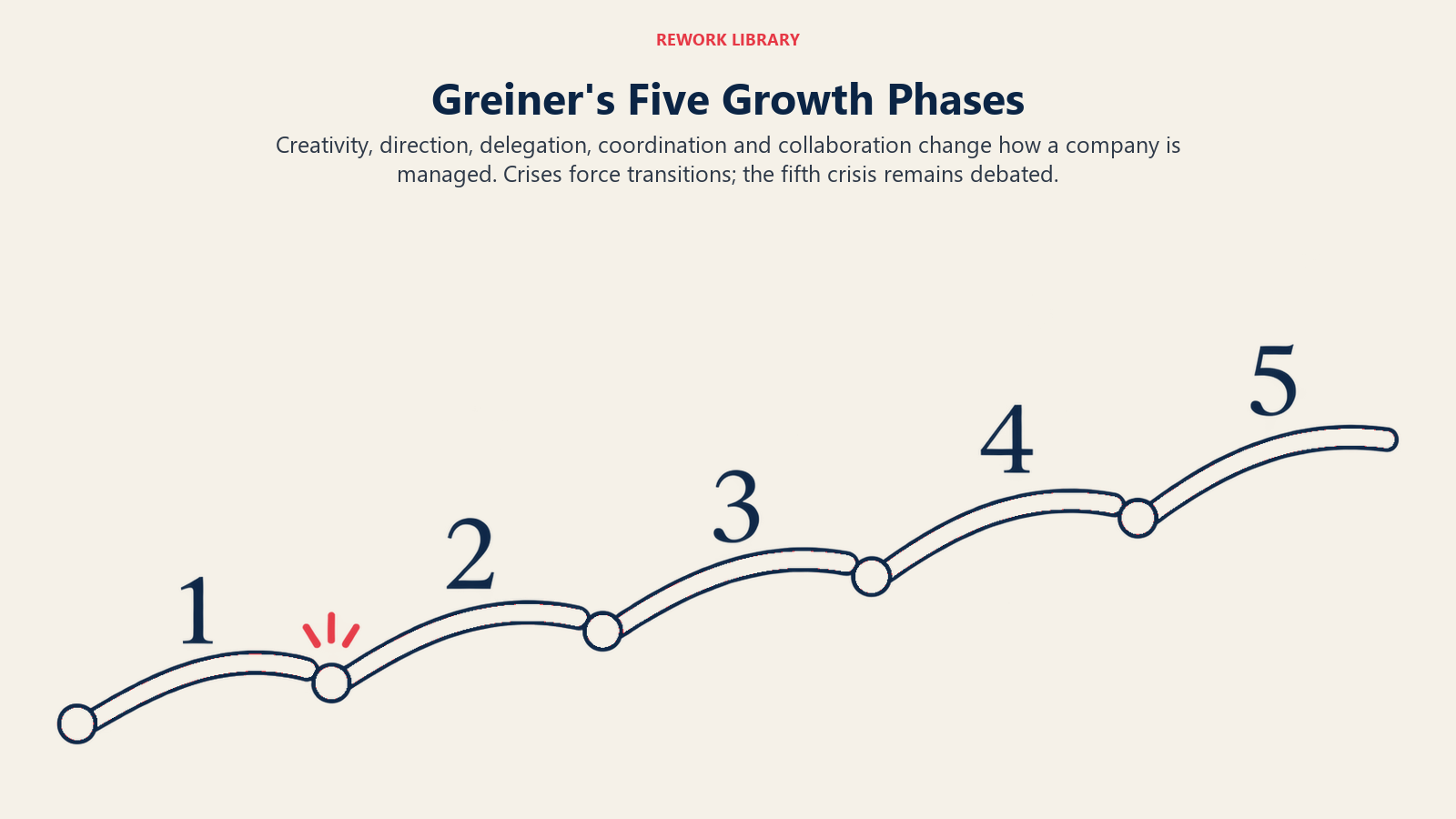
The crisis: informal communication stops working as the team grows. Problems pile up that the founders may not be suited to solve, or may not want to. This is the crisis of leadership. The question becomes who can pull the organization together, and the founder often isn't the answer. If this is your situation, the founder-to-CEO transition covers it in depth.
Phase 2: Growth through direction
The usual fix for the leadership crisis is a professional manager and a more formal structure. Direction now comes from the top, and lower-level managers act more as functional specialists than as independent decision makers. Toolshero notes that rules and procedures are formalized and standardized in this phase.
The crisis: the people closest to customers and operations know the most and want to decide for themselves. They push back against decisions made at the top. This is the crisis of autonomy.
Phase 3: Growth through delegation
The company answers the autonomy crisis by pushing authority down. Top managers give up some authority, and Toolshero describes a division structure with separate product groups and individual managers who answer for results.
The crisis: top executives feel they're losing their grip on a sprawling operation. Field managers run their own show without coordinating plans, money, or people with the rest of the company. This is the crisis of control.
Phase 4: Growth through coordination
Leadership responds with formal systems that pull the units back together: product groups, formal planning reviews, and corporate staff who oversee coordination. Toolshero calls it the standardization phase.
The crisis: the systems outlive their usefulness. Line managers and corporate staff start to resent each other, paperwork piles up, and procedure takes precedence over problem solving. This is the crisis of red tape.
Phase 5: Growth through collaboration
The answer to bureaucracy is a looser, more behavioral way of working. This phase leans on teams and on handling interpersonal differences well, with social control and self-discipline replacing much of the formal control. Common features include problem-solving teams, cross-functional task forces, a matrix structure, and team incentives.
The crisis here is where sources diverge, and it's worth being honest about that. The Journal of Organization Design review says collaboration-led growth is broken off by a lack of internal solutions for growth. Some textbook summaries describe the likely problem as psychological saturation: employees growing exhausted from the intensity of teamwork and the pressure to innovate. Toolshero describes a "consultation crisis" and says the way out is external alliances. Those aren't identical claims, so if you cite this phase, cite the version you've actually read.
Summary table
| Phase | Growth through | Typical features | Crisis that ends it |
|---|---|---|---|
| 1 | Creativity | Founder-led, informal, flat | Leadership |
| 2 | Direction | Professional management, functional structure, formal rules | Autonomy |
| 3 | Delegation | Decentralized units, results-based management | Control |
| 4 | Coordination | Formal planning, central staff oversight | Red tape |
| 5 | Collaboration | Teams, matrix structure, social control | Open: lack of internal growth solutions, or team exhaustion, depending on the source |
| 6 (added later) | Extra-organizational solutions | Mergers, alliances, networks | Not specified by Greiner, per some summaries |
The sixth phase added in the later version
Toolshero says Greiner later added a sixth phase, which it labels growth through alliances. Growth comes from external contacts: mergers, alliances, and extensive networks, not only from the organization's own structure. Other summaries call it the extra-organizational solutions stage, and they do not agree on whether a crisis follows it.
Toolshero does propose a risk for this phase: an identity crisis, where a company focused on alliances loses sight of its own core business. That's Toolshero's reading, not a documented Greiner crisis, so treat it as a useful caution and not a fact about the model.
For a startup, the sixth phase is usually far away. It describes a company that has outgrown what any internal structure can deliver and looks to partners, acquisitions, or outsourcing to keep growing.
How to use the model
The model works as a diagnostic, not a forecast. Four practical ways to apply it:
- Name the phase. Ask which management style is running the company right now: founder improvisation, central direction, delegation, formal coordination, or team-based collaboration. Most leadership teams can answer this in a few minutes, and disagreement about the answer is itself informative.
- Match symptoms to crises. Decisions bottlenecking on one person points to a leadership or autonomy crisis. Divisions drifting apart points to control. Teams complaining that nothing can happen without a form points to red tape.
- Don't solve a crisis by doubling down. The model's central warning is that each phase's solution creates the next crisis. A founder who responds to a control problem by centralizing harder is repeating the phase-2 answer in a phase-4 company.
- Plan the transition early. Toolshero points out that the model can't tell you exactly when growing pains will hit, because phase length can't be determined in advance. That's an argument for watching for symptoms, not for waiting on a calendar.
It pairs well with other organizational tools. The McKinsey 7S framework helps you check whether structure, systems, and skills are aligned for the phase you're in, and Lewin's change management model gives you a way to run the transition itself. If your growth problem is on the sales side, sales organization scaling shows how the same pattern plays out in a revenue team.
Greiner and startup stages
The model isn't a funding-stage framework, and it doesn't map neatly onto seed, Series A, and so on. Phases are defined by how the organization is managed, not by how much money it has raised. Still, there's a rough overlap. Early phases resemble the idea, pre-seed, and seed stages where a founder holds most decisions, and the later phases resemble the shift from early stage to growth stage, when the company has to build management layers and systems it never needed before.
Phase length depends on growth rate, so a fast-growing company can move through the early phases quickly and a slow-growing one can stay in phase 1 for a long time. For a product-level view of the same kind of curve, see the product life cycle, and for a broader view of growth levers, the scaling growth framework.
Criticisms and limits
The model is more than 50 years old, and it shows in places.
It's deterministic. The Journal of Organization Design review argues that life cycle models, including Greiner's, describe a single deterministic trajectory in which growth in size forces companies to adopt one particular organizational configuration. The authors say this has limited explanatory power in the actual business environment, and propose thinking of organizational change as a response to environmental variety and uncertainty instead, with many possible solutions.
It assumes every company passes through every stage. The same review notes that Churchill and Lewis, writing in 1983, identified weaknesses in earlier models, including the assumption that a company must grow and pass through all the stages or die trying. A company that stays small on purpose never needs the later phases.
It measures size narrowly. According to that review, Churchill and Lewis also criticized earlier models for defining size mostly by annual sales while ignoring other factors such as value added, number of locations, and complexity.
It was built for a different business environment. The review says that when life cycle models were developed, business volatility and uncertainty were lower than they are now. A company in a fast-changing market may not have 4 to 8 calm years to spend in any one phase.
The fair way to use Greiner is as a vocabulary for management problems, not as a map your company must follow. If your company skips a phase, hits two crises at once, or never reaches the later stages, the model hasn't failed. It's just not a law.
Key Facts
- Larry E. Greiner was a professor of management and organization at USC's Marshall School of Business, according to HBR's article page.
- HBR's page says a version of "Evolution and Revolution as Organizations Grow" appeared in the May-June 1998 issue (HBR).
- The original article is cited as Harvard Business Review volume 50, pages 37 to 46 (1972), per a Journal of Organization Design review, which also puts each evolutionary period at 4 to 8 years depending on the industry.
- The five phases are creativity, direction, delegation, coordination, and collaboration, ended by crises of leadership, autonomy, control, red tape, and (for phase 5) an open problem, per the Journal of Organization Design.
- Each phase is described using five parameters: management focus, organizational structure, top management style, control system, and management reward emphasis (Journal of Organization Design).
- Evolutionary periods are reported to range from 4 to 8 years depending on the industry (Journal of Organization Design).
- Greiner originally described five phases and later added a sixth (Toolshero).

On this page
- Where the model comes from
- The two ideas underneath: evolution and revolution
- The two axes: age and size
- The five phases and their crises
- Phase 1: Growth through creativity
- Phase 2: Growth through direction
- Phase 3: Growth through delegation
- Phase 4: Growth through coordination
- Phase 5: Growth through collaboration
- Summary table
- The sixth phase added in the later version
- How to use the model
- Greiner and startup stages
- Criticisms and limits
- Key Facts