What Is a Marketplace Business Model?
Turn this article into takeaways for your work.


Each assistant summarizes the article only for you and suggests best practices for your work.
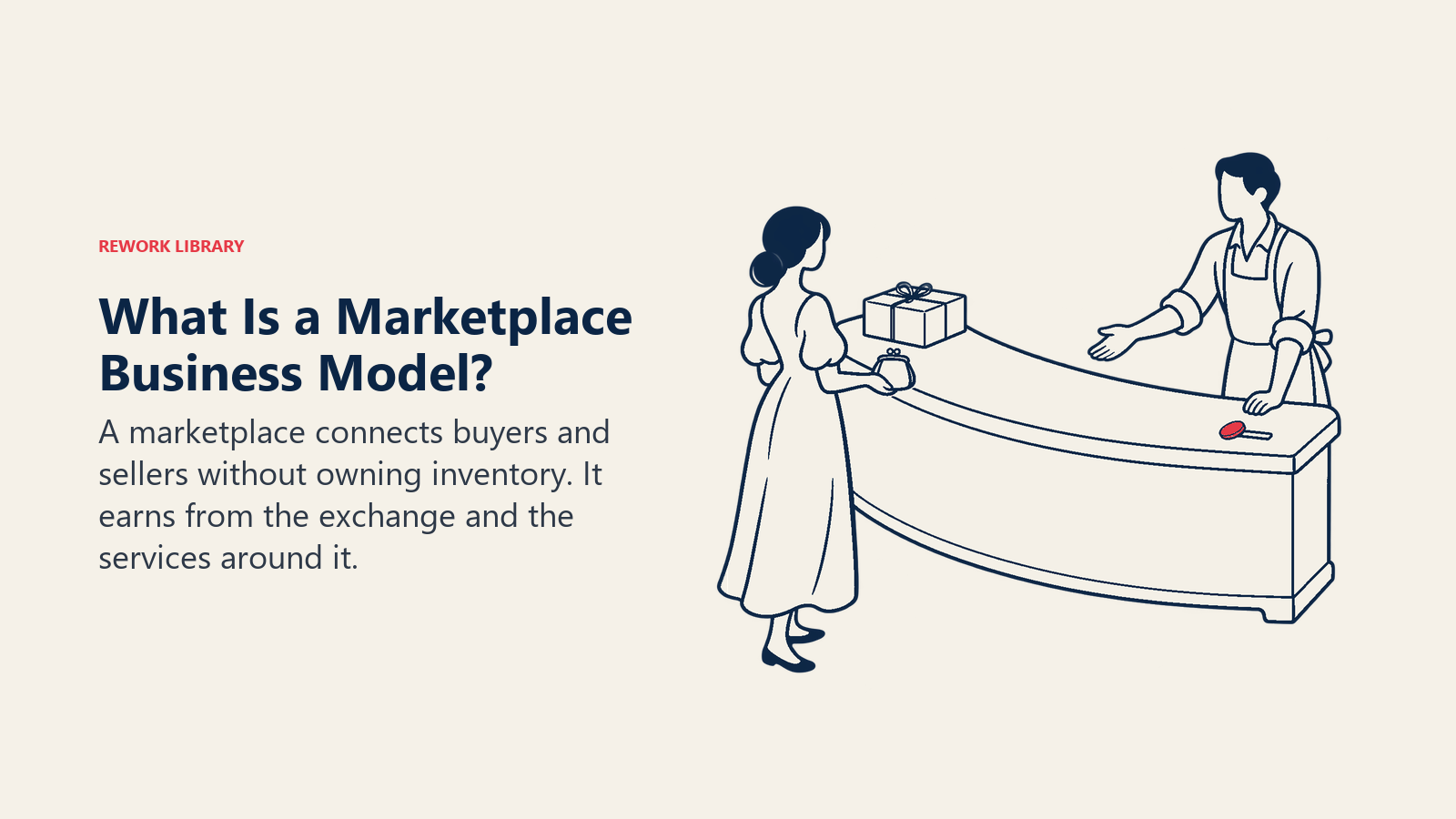
A marketplace business model is a way of making money by connecting two groups, buyers and sellers, and letting them transact with each other. The marketplace itself usually doesn't make the product, doesn't buy it in advance and doesn't hold it in a warehouse. It builds the place where the match happens, sets the rules, and takes a cut of the value that changes hands.
That one sentence hides most of what makes marketplaces interesting. They can grow without owning inventory. But they can't exist until both sides show up, and they leak value whenever buyers and sellers decide to deal directly. This article walks through the definition, the main types, the ways marketplaces earn revenue, the cold-start problem, and the metrics that matter, using public company filings for the numbers. It's one of several business-model articles in this series, so for how a company's model changes with its maturity, see the stages of a startup.
What a marketplace is, and what it isn't
Three features define a marketplace.
- Two distinct groups. Buyers (demand) and sellers or providers (supply) are different customers with different needs.
- The parties transact with each other. The contract for the sale is, in the simplest case, between buyer and seller. The marketplace is the intermediary.
- The operator doesn't own the goods or the work. It owns the match, the trust layer and often the payment flow.
Economists call this structure a two-sided market, and the idea has been around far longer than the internet. In a well-known Harvard Business Review article, Eisenmann, Parker and Van Alstyne describe how companies in industries such as banking, software and media make money by linking different sides of their customer networks, with audiences and advertisers as one example. The credit card, which links consumers and merchants, is the article's own example. Online marketplaces are a newer instance of the same shape.
What a marketplace is not matters just as much. A store that buys stock and resells it is a reseller. A company that builds a foundation other businesses build on is closer to a platform, a distinction covered in the platform business model article. The comparison table later in this piece puts the three side by side.
The main types of marketplaces
Marketplaces differ along two axes: what is being exchanged, and how much the operator controls the experience.
By what's being exchanged
| Type | What changes hands | Typical features |
|---|---|---|
| Product marketplace | Physical or digital goods | Search, listings, reviews, shipping, returns |
| Services marketplace | Time, skills or labor (freelancers, tradespeople, drivers) | Profiles, scheduling, ratings, dispute handling |
| Rental or sharing marketplace | Temporary access to assets (homes, cars, equipment) | Availability calendars, deposits, insurance, identity checks |
| B2B marketplace | Goods or services between businesses | Larger orders, negotiated pricing, procurement workflows, credit terms |
Consumer-to-consumer, business-to-consumer and business-to-business are separate labels you'll also see, but they cut across the table above rather than replacing it. A B2B marketplace can sell products, services or rentals.
By how hands-on the operator is
- Unmanaged (open) marketplaces. Sellers list, buyers browse, and the operator mostly provides tools and policy. Quality varies, and the marketplace relies on ratings and rules to keep it acceptable.
- Managed marketplaces. The operator curates or vets supply, may set standards, handle matching, and guarantee outcomes. That raises quality and cost at the same time. It also gives the operator more control over the transaction, which helps when buyers might otherwise take the relationship offline.
Most real marketplaces sit somewhere on a spectrum between the two, and many move toward more management as they mature.
How marketplaces make money
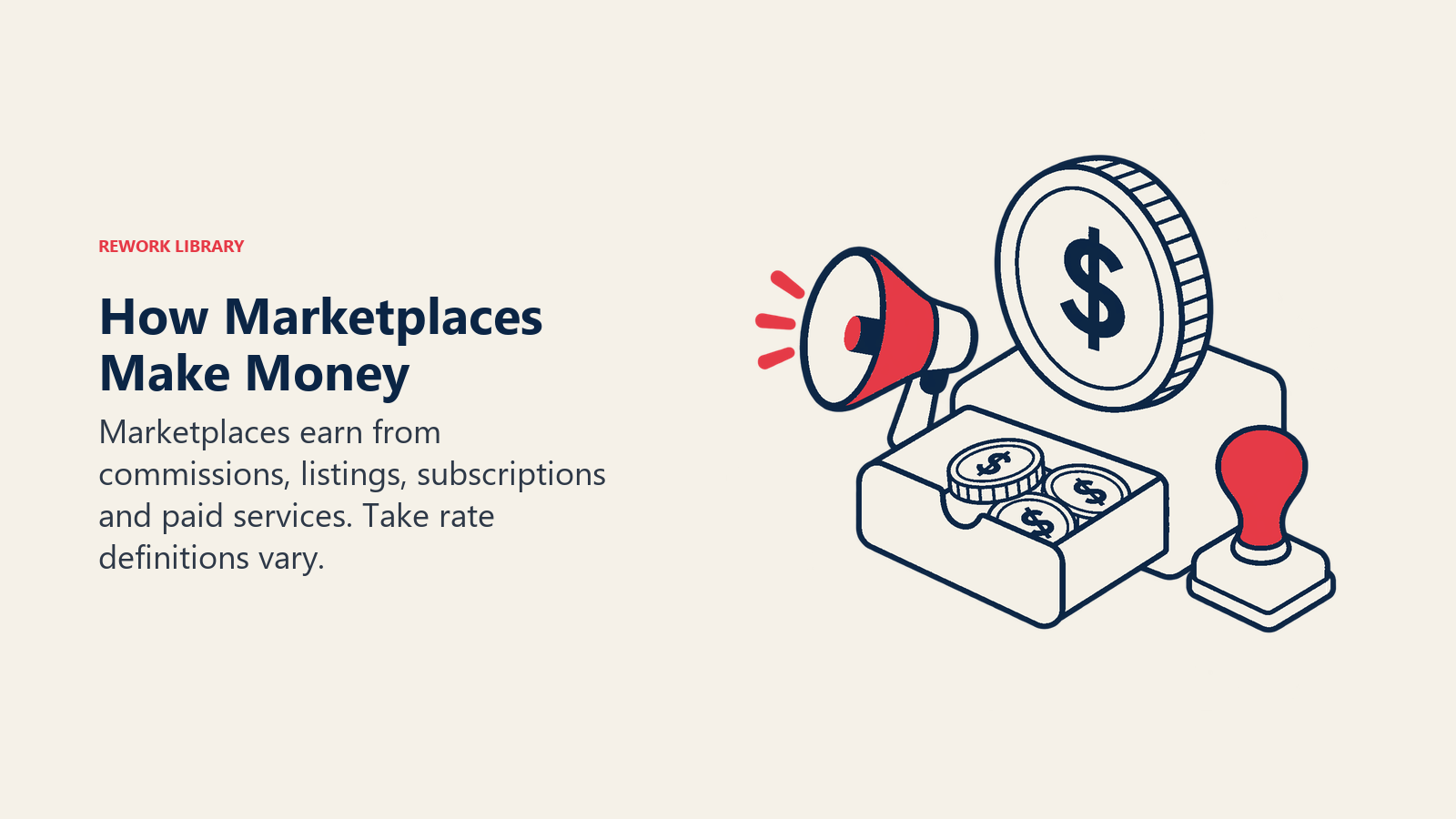
Marketplaces tend to combine several revenue lines. The common ones:
| Revenue stream | How it works | Where it shows up |
|---|---|---|
| Commission (take rate) | A percentage of each transaction's value | The foundation of most marketplaces |
| Listing or insertion fees | A fixed fee for each listing, charged whether or not it sells | Common in goods marketplaces |
| Seller subscriptions | A recurring fee for tools, storefronts or reduced commissions | Tiers for professional sellers |
| Advertising and promoted placement | Sellers pay for more visibility in search results | Rises as supply gets crowded |
| Payment and fulfilment services | Fees for processing payments, shipping labels, delivery or financing | Adds revenue and keeps the transaction on-platform |
| Buyer-side fees | Service or membership fees paid by buyers | Common in services and rentals |
The mix usually shifts over time. Early on, a marketplace may charge little or nothing to attract supply. Later, as sellers compete for attention, advertising and services can carry a growing share of revenue. Etsy's 2025 results hint at it: its release attributes revenue growth mainly to on-site advertising, and its services revenue grew 11.3% while marketplace revenue slipped 0.7%. We'll look at those numbers below.
What "take rate" means
Take rate is the share of transaction value that the marketplace keeps as revenue. The definition varies by company, which makes comparisons tricky. Etsy, for example, defines its take rate in its earnings release as consolidated revenue divided by consolidated GMS, where GMS is the value of what's sold. That means its take rate includes revenue from sources such as advertising and seller services, not only a commission on each sale. Another company might count only the commission. Before comparing two take rates, check what's in the numerator.
GMV vs net revenue: why reported revenue is so much smaller
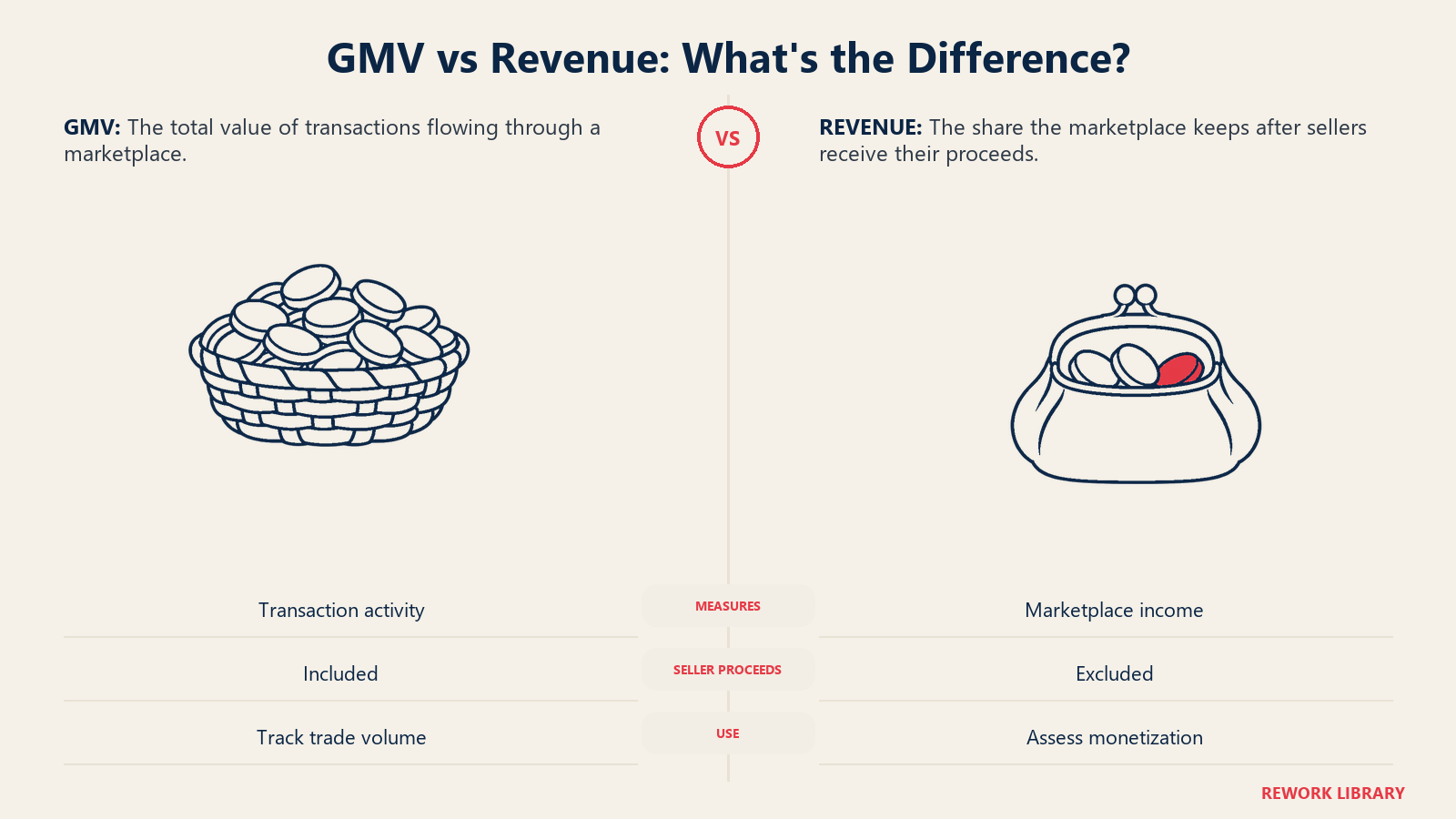
This is where first-time readers get confused. Gross merchandise volume (GMV) is the total value of the transactions that flow through the marketplace. Revenue is the part of that value the marketplace keeps. The gap between them is what sellers receive.
Two company filings make the gap concrete.
- Etsy, full year 2025. In its fourth-quarter and full-year 2025 earnings release, Etsy reported consolidated GMS of $11,916.9 million and revenue of $2,883.5 million, a revenue take rate of 24.2%. The same release splits revenue into marketplace revenue of $2,007.2 million and services revenue of $876.3 million.
- eBay, full year 2025. In its fourth-quarter and full-year 2025 results, eBay reported GMV of $79.6 billion and revenue of $11.1 billion. Dividing one by the other gives roughly 14%, our own arithmetic rather than a figure eBay states.
Two lessons follow. First, a marketplace with $80 billion of GMV isn't an $80 billion-revenue business, and a headline GMV number tells you about activity, not income. Second, two successful marketplaces can have very different yields on the same GMV. The difference comes from what they sell, what extra services they provide and how much of their revenue comes from advertising and seller tools. These are two companies in different circumstances, not a benchmark for what any marketplace should earn.
A caution for founders: GMV is a vanity number if you stop there. It can be pumped by discounts, by low-margin categories or by transactions you subsidize. What matters is the revenue and gross profit that come out of it, which you can track with unit economics and gross margin.
The chicken-and-egg problem
Every marketplace starts at zero, and zero is a terrible place to be. Buyers won't come without sellers, and sellers won't list without buyers. This is the cold-start problem, and it's the main reason marketplaces are harder to launch than they look.
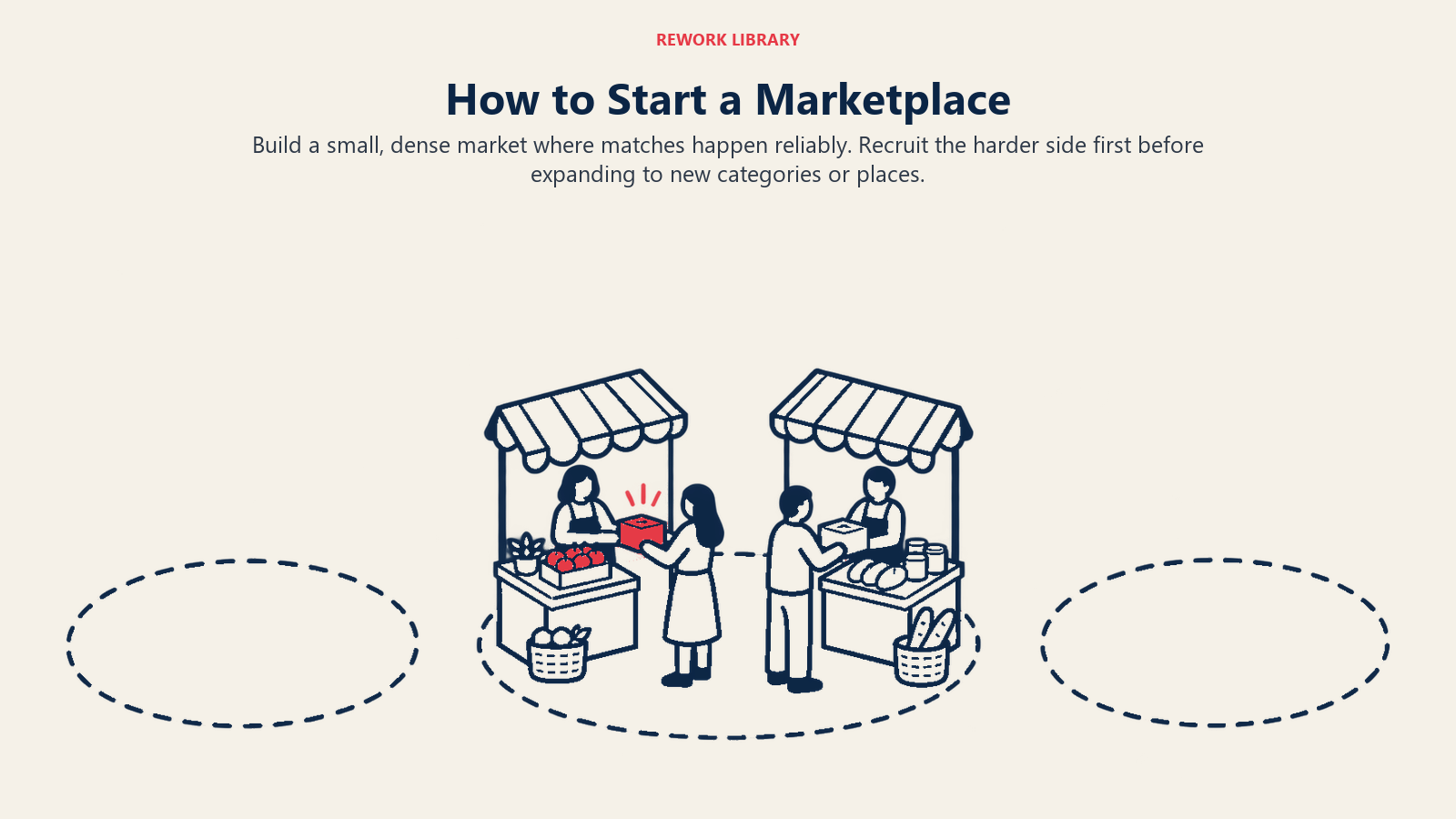
Eisenmann, Parker and Van Alstyne treat this as a defining challenge of two-sided markets in the same HBR article cited above. Andrew Chen, who worked on growth at Uber before becoming an investor, frames it with the idea of an atomic network: the smallest network that can stand on its own, with enough density and stability to grow by itself. If you can build one, he argues, you can often build a second next to it and then repeat.
In his writing on the "hard side" of a network, Chen adds that for marketplaces the hard side is usually the sellers and providers, who do more of the work and are harder to acquire and keep. Many founders start there.
Common ways to get past the cold start:
- Start small and local. Concentrate on one city, one category or one customer segment until matches happen reliably, then expand. This is the atomic-network idea in practice.
- Win the hard side first. Give sellers or providers something useful even before buyers arrive, such as software that helps them run their business, so they have a reason to be there.
- Seed supply by hand. Founders recruit sellers personally, import listings with permission, or list inventory themselves at the start.
- Subsidize one side. Offer free listings, guarantees, or incentives to the side that's harder to get, then stop once the other side is present.
- Use an existing audience. Launch inside a community or newsletter where one side already gathers.
- Run the service yourself first. Fulfil early demand manually, then add independent suppliers as volume grows.
Subsidies deserve a warning. They can buy growth that disappears the day they stop, which is why the next section matters.
Liquidity: the core metric
Marketplace liquidity is, in the words of the marketplace-software company Sharetribe, the likelihood that a transaction will happen on your marketplace. A buyer who searches should be likely to find something worth buying, and a seller who lists should be likely to sell. Sharetribe separates the two: seller liquidity is the chance a listing leads to a transaction in a given period, and buyer liquidity is the chance a visit leads to a transaction.
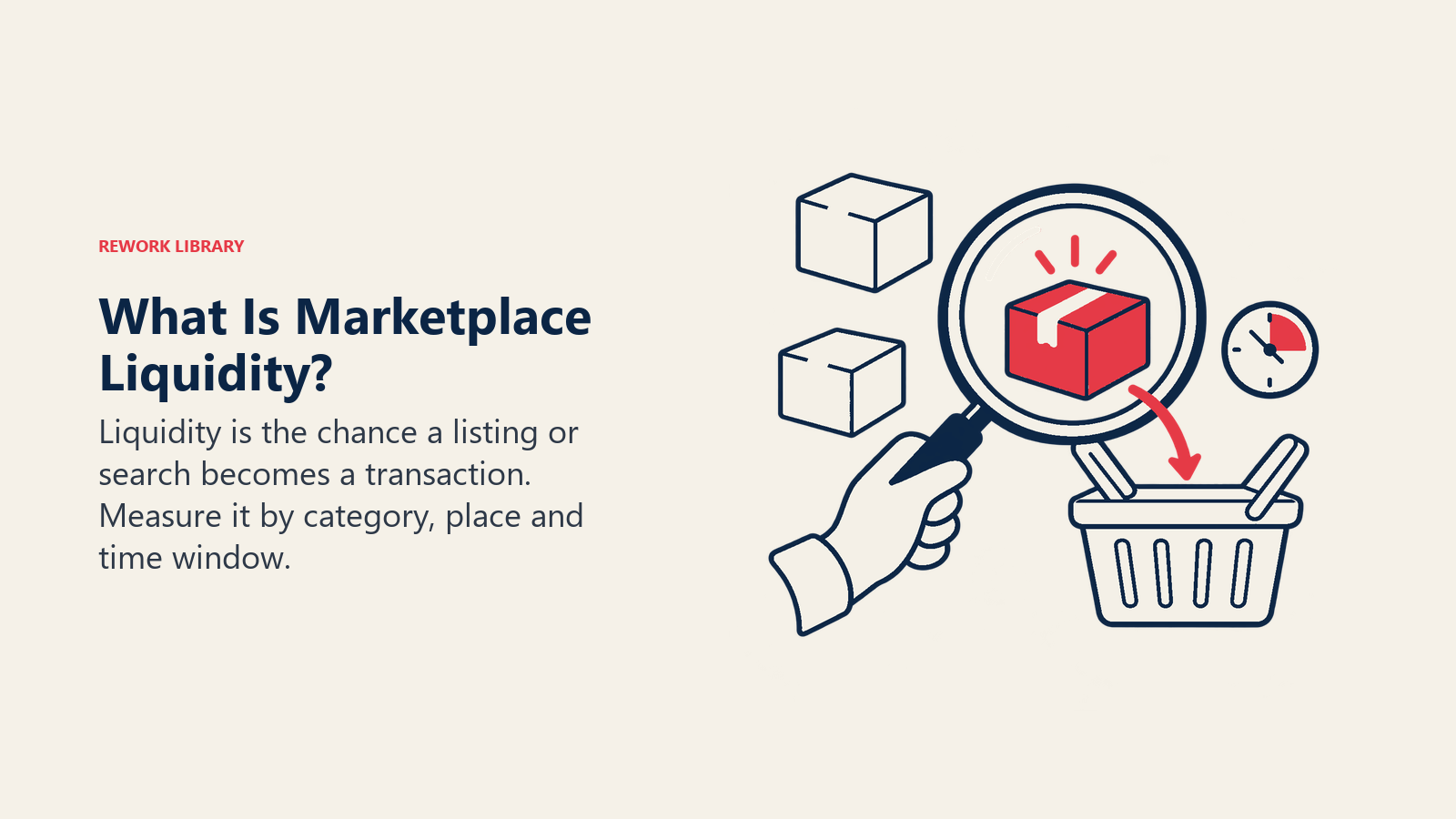
Liquidity is local. A marketplace isn't liquid in the abstract, but for a particular category, place and price range. A ride-hailing app can be highly liquid downtown and useless in a village. That's why expansion into a new city or category often means starting the cold-start work again.
Practical ways teams measure it include:
- The share of listings that sell within a set time window.
- The share of searches that lead to a purchase or request.
- Time to first response and time to match.
- The proportion of buyers who return and buy again.
Liquidity also sets up the economics. A marketplace that matches reliably can afford to charge a take rate, because users get value they can't easily find elsewhere. It's also a prerequisite for network effects, where each new buyer makes the marketplace more useful to sellers and the reverse. Once that loop is turning, it resembles the flywheel effect. Even then, the advantage isn't automatic. Competing marketplaces can often co-exist in the same category if users join several at once.
Disintermediation and leakage
The marketplace's biggest structural risk is that its users stop needing it. Disintermediation, also called leakage, happens when a buyer and seller meet on the marketplace and then complete future transactions off it to avoid the fee.
Leakage is most likely when:
- The relationship is repeated (a home cleaner who serves the same client every week).
- Transactions are large enough that the fee hurts.
- The marketplace adds little after the first introduction.
- Buyers can easily identify or contact the seller.
Marketplaces respond in a few ways. They can make the platform genuinely more useful after the match through payments protection, insurance, scheduling, invoicing and dispute resolution. They can restrict contact details until payment. They can lower fees for repeat relationships. Or they can move toward a managed model where the operator guarantees the outcome. None of these is free, and each can annoy the users it's meant to protect. The best defense is usually value that continues after the first deal.
Marketplace vs platform vs reseller
These three get mixed up constantly, partly because large companies often combine them.
| Marketplace | Platform | Reseller | |
|---|---|---|---|
| Core activity | Matches buyers and sellers who transact | Provides a foundation others build on or sell through | Buys goods or services and sells them on |
| Owns inventory? | No | No (it owns the infrastructure) | Yes |
| Who contracts with the buyer? | Usually the seller | Varies; often the third party | The reseller |
| Main revenue | Commission, fees, advertising | Access fees, usage, revenue share, subscriptions | Margin between buy and sell price |
| Main risk | Cold start and leakage | Getting developers or partners to build | Inventory, working capital |
| Key metric | Liquidity, take rate | Ecosystem activity | Gross margin, inventory turns |
Real businesses blur the lines. A marketplace that adds payments and logistics is acting more like a platform, and one that begins holding stock for popular items is taking on some reseller risk. The labels describe the dominant mechanism, not a rigid category. For related models that sit near the marketplace, see b2b2c business model, which describes reaching consumers through business partners, and productized service, a different way to sell expertise.
Strengths and weaknesses of the model
Strengths
- Asset-light. No inventory or production means less capital tied up per dollar of sales.
- Network effects. Once liquid, more participants make the marketplace more useful, and that can become a durable economic moat.
- Data. Transaction history shows what sells, at what price and to whom.
- Scalable supply. Adding sellers doesn't require the operator to hire or buy.
Weaknesses
- Slow, expensive start. You need both sides at once, and acquiring them costs money before revenue appears.
- Limited control over quality. The experience depends on sellers you don't employ.
- Leakage and price pressure. Fees invite workarounds, and sellers push back on increases.
- Dependence on matching quality. If search, trust or support fall behind, users leave and don't return.
Key Facts
- A marketplace connects buyers and sellers who transact with each other, and typically doesn't own the inventory or the work being sold.
- Economists call this a two-sided market; the HBR article by Eisenmann, Parker and Van Alstyne describes businesses that link different sides of a customer network.
- Etsy's full-year 2025 consolidated GMS was $11,916.9 million, revenue $2,883.5 million and revenue take rate 24.2%.
- eBay's full-year 2025 GMV was $79.6 billion against revenue of $11.1 billion, roughly 14% by our arithmetic.
- Etsy defines take rate as consolidated revenue divided by consolidated GMS, so definitions differ across companies.
- Liquidity is the likelihood that a transaction will happen on the marketplace, and it is local to a category and place.
- Andrew Chen's atomic network is the smallest self-sustaining network, the usual way out of the cold start.
- The main structural risk is leakage, where buyers and sellers move repeat deals off the marketplace.
Related Reading

On this page
- What a marketplace is, and what it isn't
- The main types of marketplaces
- By what's being exchanged
- By how hands-on the operator is
- How marketplaces make money
- What "take rate" means
- GMV vs net revenue: why reported revenue is so much smaller
- The chicken-and-egg problem
- Liquidity: the core metric
- Disintermediation and leakage
- Marketplace vs platform vs reseller
- Strengths and weaknesses of the model
- Key Facts
- Related Reading