What Is a Productized Service?
Turn this article into takeaways for your work.


Each assistant summarizes the article only for you and suggests best practices for your work.
A productized service is a service that is sold the way a product is sold. The buyer picks an offer from a defined menu, sees a fixed price, knows what they will receive and roughly when, and doesn't need a custom proposal first. Behind the scenes, the provider delivers it through a standard process instead of reinventing the work for each client.
Think of the difference between "we'll scope a branding project after a discovery call" and "a brand identity package, a set number of logo concepts, two revision rounds, delivered in ten business days, one price." Same expertise. Very different business. The second version is easier to buy, easier to explain, easier to deliver repeatedly and easier to improve over time.
This article explains what a productized service is, how it differs from custom consulting and from software, the common forms it takes, how its economics work, and the risks founders tend to hit. It also covers the idea that productization can be a stepping stone toward software, and a practical way to judge whether a service is ready to be productized. It's a concept guide, not a startup recipe, and practices vary by industry and market.
What makes a service "productized"
"Productized" isn't a legal category. It's a spectrum, and the word is usually applied when several of the following are true.
- Defined scope. The offer states what is included and, just as important, what isn't. The buyer doesn't negotiate the contents each time.
- Fixed price. Pricing is published or quoted from a short list, not built up from estimated hours. This is the opposite of the billable hour, which the billable hour vs value pricing article covers in detail.
- Standard process. The steps, tools, templates and checklists are largely the same from client to client, so a new team member can follow them.
- Defined deliverable. The client receives a specific output, such as an audit report, a configured system or a set of finished assets, not a vague promise of "support."
- Defined timeline. A delivery window or cadence is part of the offer.
- Simple buying path. A page, a checkout or a short intake form replaces a long sales cycle.
Almost no service meets all six perfectly. A firm that standardizes the process and the deliverable but still quotes price per project is partly productized. What matters is the direction: fewer decisions per client, more reuse per delivery.
The long-standing idea behind it
The thinking is much older than the label. In a 1972 Harvard Business Review article, Theodore Levitt argued that service businesses are not as different from manufacturing as people assume, and that there are only industries whose service components are greater or less than those of others. His case was that service delivery could be systematized and run with the discipline of a production line instead of being left to individual improvisation.
More recently, Mohanbir Sawhney of Kellogg wrote in HBR that products are the key to increasing margins for a services business, but only when they are managed the right way. And in a 2024 MIT Sloan Management Review piece, he defined productization as automating, standardizing and packaging aspects of a service into a tangible, repeatable and scalable offering. Notice the wording: it's about parts of a service. Productization isn't all-or-nothing.
Productized service vs custom services vs SaaS
A productized service sits between two familiar models. It borrows the packaging and repeatability of software and keeps the human delivery of a services firm.
| Custom agency or consulting | Productized service | SaaS product | |
|---|---|---|---|
| What the buyer gets | A tailored engagement | A defined package or recurring service | Access to software |
| Scope | Negotiated per client | Fixed, with stated limits | Fixed by the product's features |
| Pricing | Hourly, project or retainer, often quoted | Fixed price or fixed subscription | Per seat, per usage or tiered (see SaaS pricing models) |
| Delivered by | Senior people, tailored each time | People following a standard process | The software itself |
| Sales cycle | Often long, proposal-driven | Short, often self-serve or near it | Short to long depending on the buyer |
| Main cost driver | Staff time | Staff time, but more predictable | Engineering, hosting, support |
| Main constraint | Headcount and senior attention | Delivery capacity and scope discipline | Product and distribution |
| Typical risk | Revenue tied to hours worked | Scope creep and commoditization | Competition and churn |
The key difference between the middle and right columns is where the work happens. In a productized service, people still do the work. In SaaS, the software does most of it. That is why the economics, covered below, look different.
Common forms of productized services
Founders package services in several recurring ways.
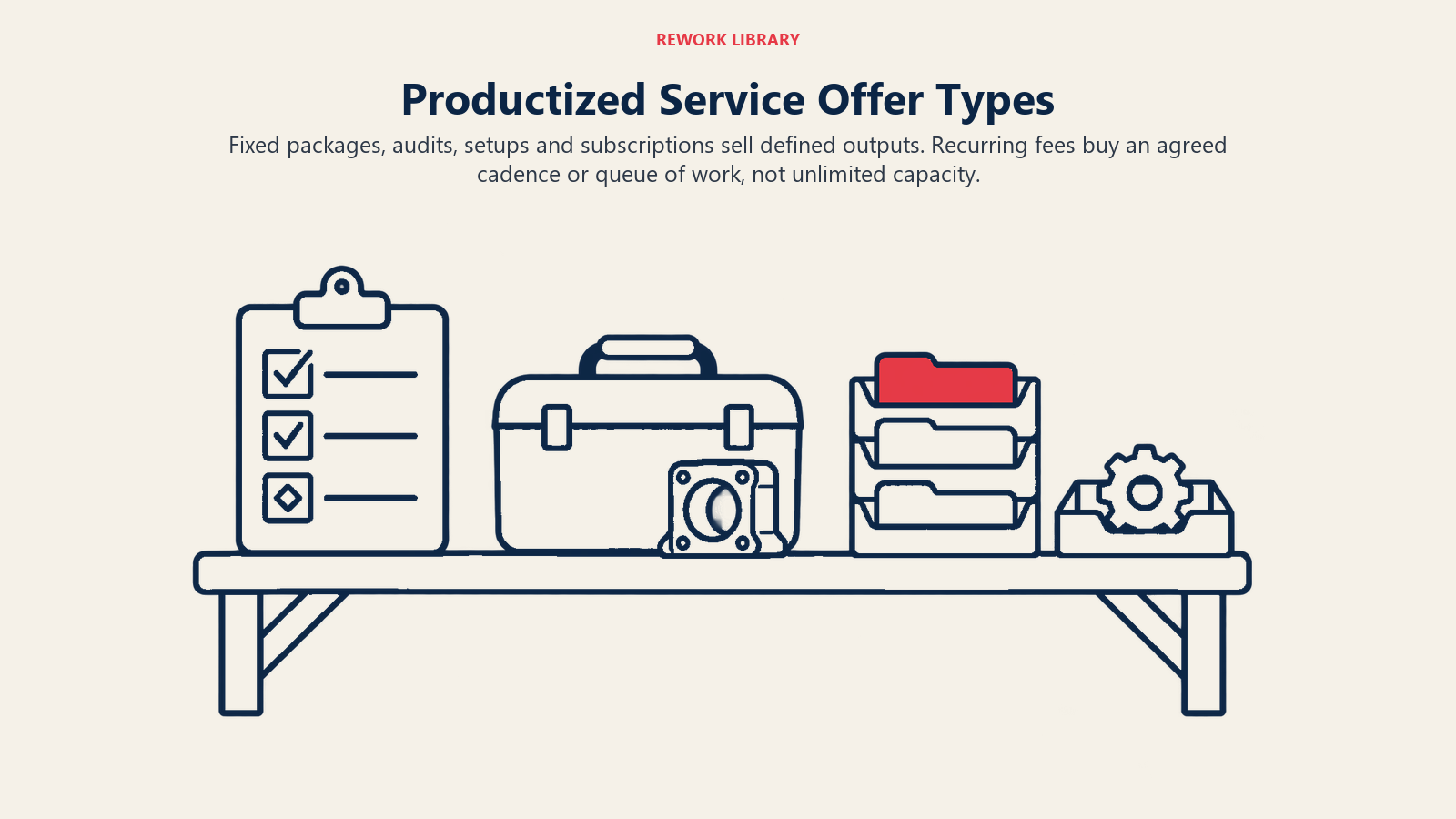
Fixed-scope packages
A one-time offer with a clear start and end: a website build, a brand kit, a tax filing, a legal formation package. The buyer pays a set price for a set output.
Subscription or "unlimited request" services
The client pays a recurring fee and submits requests into a queue, which the provider works through one at a time. Common in design, development, copywriting and video editing. The fee buys a throughput of work, not hours.
Audits and assessments
A defined review of something the client already has, such as a security review, an SEO audit or a financial health check, producing a standard report. Audits are a popular first productized offer because the process is repeatable and the deliverable is easy to describe.
Done-for-you setups
The provider configures something on the client's behalf: an analytics setup, a CRM implementation, an email automation system. The scope is defined by a checklist, so the job can be priced and scheduled in advance.
Retainer-like subscriptions
A recurring fee for a bundle of defined activities each month, such as a content calendar, monthly reporting and a set number of deliverables. It looks like a traditional retainer, but what's included is fixed and written down. The difference from an old-style retainer is that the output is specified, not just the time.
Many businesses combine these. A common pattern is a low-priced audit that leads into a done-for-you setup and then into a monthly subscription.
The economics of a productized service
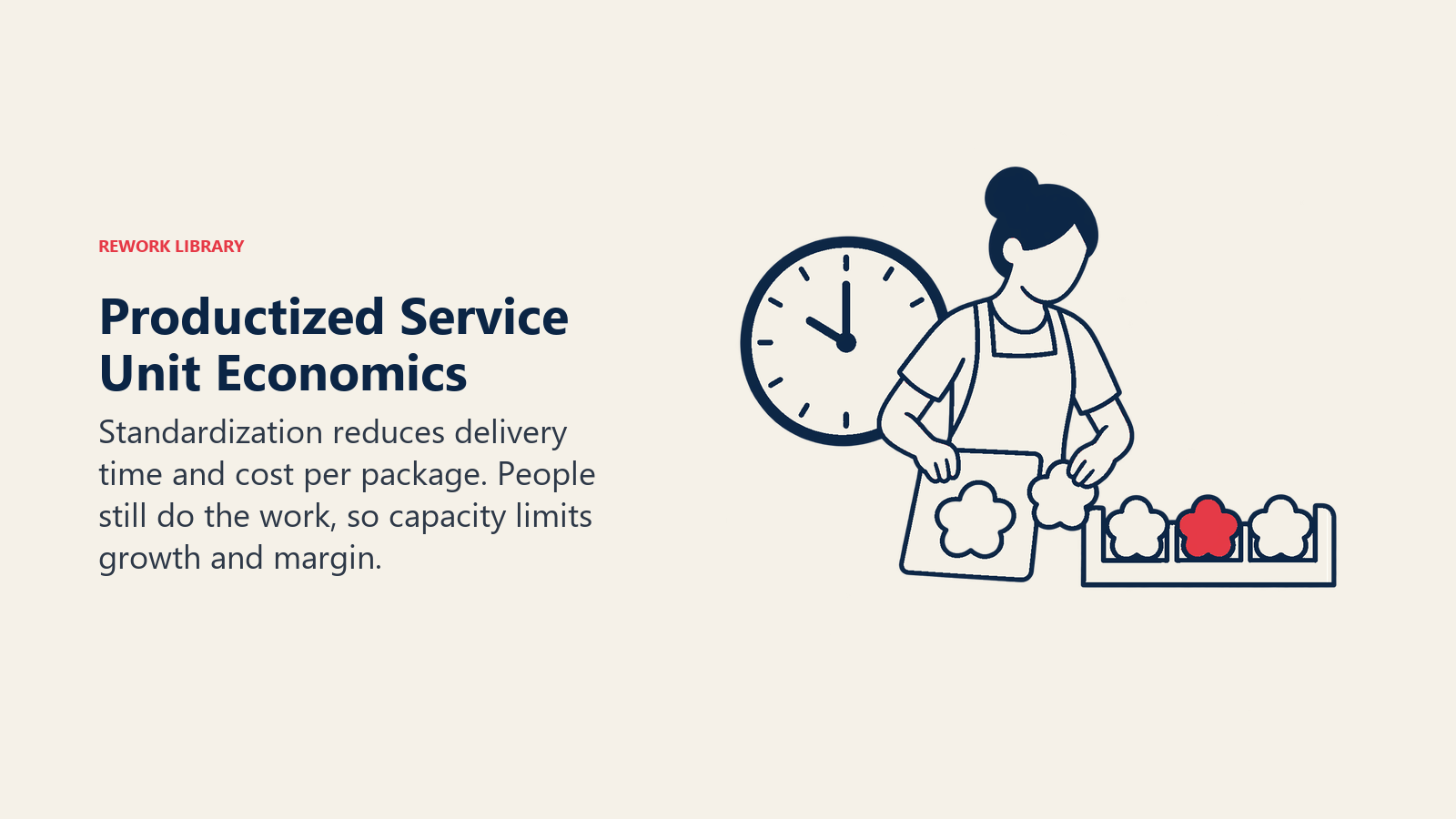
Productizing doesn't turn a services business into a software business. People still deliver the work, so costs still rise with volume. What changes is how predictable and efficient that work becomes.
Margins depend on standardization
Delivery cost is mostly labor. The more the process is standardized, with templates, checklists, reusable components and clear handoffs, the less time each unit takes and the less senior attention it needs. That's where margin comes from. If every client still requires custom judgment, the price is fixed but the cost isn't, and margin gets squeezed on the difficult accounts. For the underlying measure, see gross margin.
For context, Sawhney describes the problem productization addresses: professional services firms struggle to get gross margins above roughly 40%, while product companies such as Google and Adobe enjoy gross margins of 60% to 90%. Those are his reference points for professional services firms and product companies in general, not a forecast for any individual productized service, which can land well below or above them depending on how much of the delivery is truly standardized.
Delivery capacity is the constraint
A software product can serve a thousand customers without a thousand employees. A productized service can't. Revenue is limited by how many units the team can deliver per week, which makes capacity planning the central operating question. Sawhney's 2016 article makes the same point about services in general: to double revenue, a consulting firm or law practice has to double its staff.
Utilization and predictability
Because scope and timelines are fixed, the provider can estimate how many hours a package takes and schedule work against capacity. That predictability helps utilization, the share of paid time that produces billable output, because there's less idle time between custom proposals and fewer surprises mid-project. It also makes cash flow easier to forecast, particularly with subscription models.
Unit economics still apply
A productized service has customers, acquisition costs and lifetime value like any other business. The unit economics framework applies directly: what does it cost to deliver one package, what does it cost to win a client, and how long does the client stay? Subscription versions make that lifetime calculation easier, which is one reason founders favor them.
Advantages
- Easier to buy. A clear offer and price remove the proposal step and reduce buyer anxiety.
- Easier to sell and market. One specific offer is simpler to explain than "we do everything."
- More predictable delivery. A standard process shortens learning curves for new staff and makes quality more consistent.
- Better economics from repetition. Each delivery improves the templates and the next one is faster.
- Lower founder dependence over time. If the process is written down, someone other than the founder can run it.
- A natural source of product insight. Doing the same job repeatedly shows which parts are tedious and automatable.
Risks and limitations
- Scope creep. Clients ask for "just one more thing." If the provider says yes, the fixed price turns into a loss. Clear boundaries and a willingness to say no are part of the product.
- Commoditization. A standard offer is easier to compare, and easier for competitors to copy. Price becomes the main differentiator unless the provider has a distinct specialty, brand or outcome.
- Capacity ceilings. Growth requires more delivery staff. Hiring and training become the bottleneck, and quality can slip as volume increases.
- Difficulty scaling beyond the founder. Early on, the founder's expertise holds the service together. If the process lives only in their head, the business can't grow past what they can personally deliver.
- Poor fit for varied needs. Some clients genuinely need custom work. Forcing them into a package can lose the sale or deliver weak results.
- Churn in subscription models. Recurring services depend on clients seeing continued value. If requests dry up or quality dips, clients cancel.
- Under-pricing. Fixed prices set before the real delivery cost is known often turn out too low. Time tracking at the start, even for a fixed-price offer, helps avoid this.
From productized service to software
Many founders treat a productized service as a first stage, not a destination. The pattern is sometimes called services-to-software or tech-enabled services. It works roughly like this.
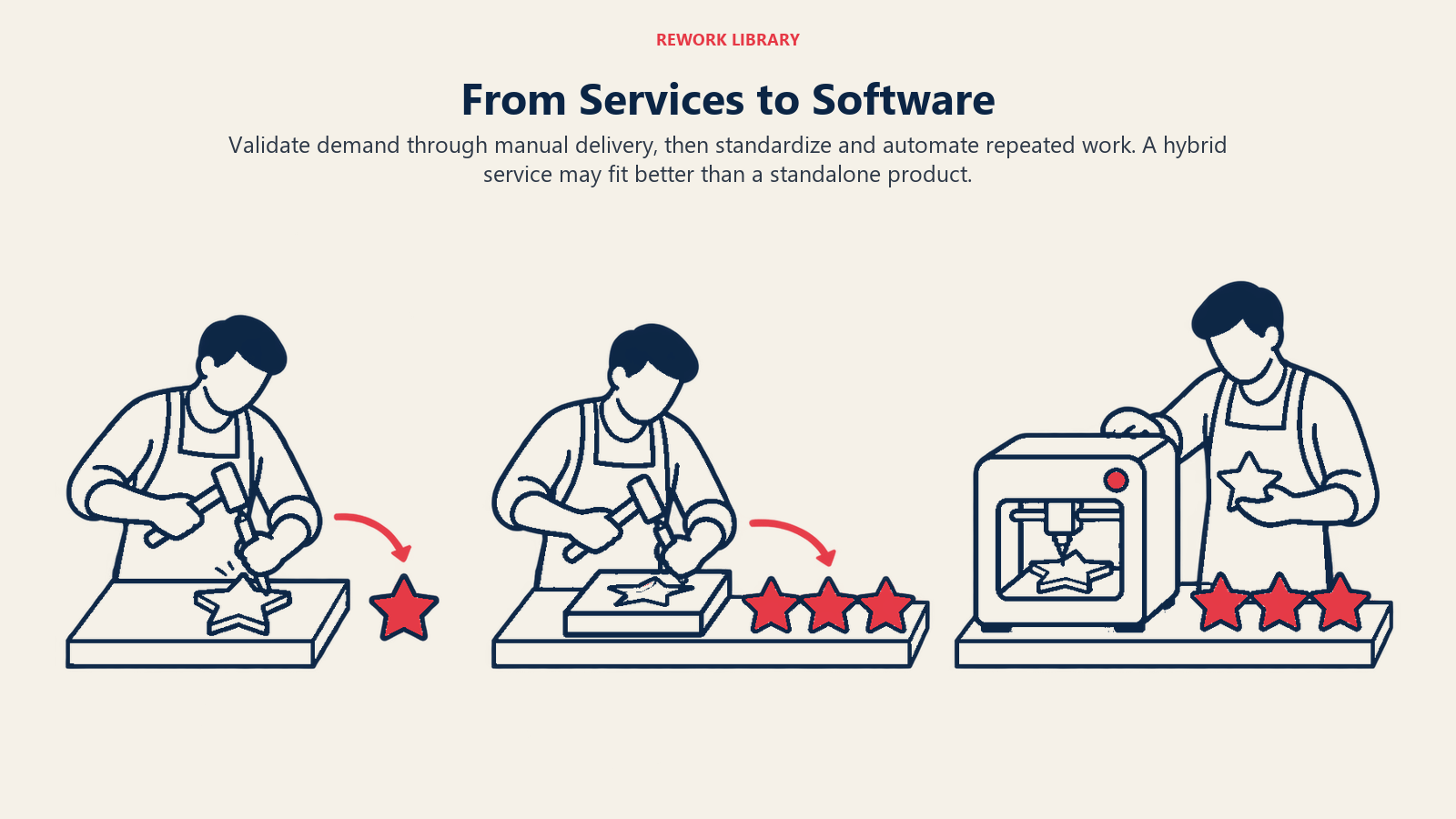
- Sell the service by hand. Validate that people will pay for the outcome.
- Standardize the process. Write the steps, templates and checklists.
- Automate the repetitive parts. Internal tools, scripts and workflows reduce delivery time per unit.
- Expose some of it to the client. A dashboard, intake system or self-serve option lets clients do part of the work or see progress.
- Decide what the company is. It might stay a services business with better tooling, become a hybrid, or spin out a product that other firms can use.
The upside is real. Sawhney notes that SaaS startups command 6 to 8 times annual revenue valuations, while project-based service startups typically sell for 1 to 2 times revenue. Those multiples describe market valuations in his article, not outcomes any particular company can expect, and they depend on the product genuinely scaling. His example of a firm doing this is Littler Mendelson, whose CaseSmart platform combines technology with specialized attorneys to deliver labor law services with more predictable costs.
The downside is that it's a different business. Building software requires engineering skill, a different cost structure and different go-to-market work. Some productized services are better off staying services with strong internal tooling. Productization is a way to find out which path fits, not a guarantee that software follows.
For readers who want to see how this relates to other models, a marketplace business model connects buyers to independent providers instead of employing the delivery team, and a B2B2C business model delivers a service through another business to its customers. Each answers the capacity problem differently.
How to decide whether a service is ready to productize
Not every service should be packaged. These questions help you check.
| Question | A good sign | A warning sign |
|---|---|---|
| Have you delivered it several times? | Yes, with similar steps each time | Each engagement was very different |
| Can you describe the process in writing? | Clear steps and checklists exist | It depends on instinct and judgment |
| Is the outcome the same across clients? | A recognizable deliverable | The result depends on each client's unique situation |
| Do clients ask for the same things? | Requests repeat | Requests are all custom |
| Can someone else deliver it? | A teammate can follow the process | Only the founder can do it well |
| Do you know your delivery cost? | You've tracked time per delivery | You're guessing |
| Is there demand for a fixed offer? | Buyers ask for "a price for X" | Buyers insist on tailored scoping |
A reasonable starting approach is to pick the most repeated engagement, write down what it includes and excludes, price it from tracked delivery cost, and sell it to a small number of clients before committing. Treat the first version as a test. If the process needs constant exceptions, the service may not be ready, or the offer may be scoped too broadly.
For startups, this also fits the stage logic described in stages of a startup: early companies often sell services by hand to learn what customers value, then standardize what repeats.
Key Facts
- A productized service is sold like a product: defined scope, fixed price, standard process, defined deliverable and timeline.
- Sawhney defines productization as automating, standardizing and packaging aspects of a service into a repeatable, scalable offering.
- Theodore Levitt argued in 1972 that service delivery can be systematized like a production line.
- In professional services, doubling revenue means doubling staff, which is the linear scaling problem productization tries to ease.
- Sawhney cites gross margins of roughly 40% or below for professional services versus 60% to 90% for product companies.
- Productized services still depend on human delivery capacity, so margins come from standardization, not from the label.
- Main risks: scope creep, commoditization, capacity ceilings and dependence on the founder.
- Productization can lead to software, but it can also stay a better-run services business.
Frequently Asked Questions about Productized Services
What is a productized service in simple terms?
It's a service packaged and sold like a product. The scope, price, process and deliverable are defined in advance, so the buyer knows what they get without a custom proposal.
How is a productized service different from a consulting engagement?
A consulting engagement is usually tailored and priced by time or project estimate. A productized service is standardized, priced as a fixed offer and delivered through a repeatable process. The compromise is less flexibility for the client in exchange for speed and clarity.
Is a productized service the same as SaaS?
No. In SaaS, software delivers most of the value and can serve many customers without a matching increase in staff. In a productized service, people still do the work, so capacity grows with headcount. Productization can be a step toward software, but it isn't the same thing.
What are examples of productized services?
Common forms include fixed-scope packages, unlimited-request subscriptions, audits, done-for-you setups and retainer-like monthly bundles with a fixed list of deliverables.
Are productized services more profitable than custom work?
They can be, because standardization lowers delivery time and cost per unit and makes pricing more predictable. But margins depend on how consistently the process is followed. A fixed price with unpredictable work can be less profitable than hourly billing.
How do you prevent scope creep in a productized service?
State what's included and excluded in writing, limit revision rounds, route extras to a separate priced add-on, and be consistent about saying no. The boundaries are part of what the client is buying.
When should a productized service become a software product?
When the repetitive parts of delivery can be automated, clients would use a self-serve version, and the company is ready to take on engineering and a different cost structure. Many businesses decide it's better to keep the service and use software internally.
Related Reading

On this page
- What makes a service "productized"
- The long-standing idea behind it
- Productized service vs custom services vs SaaS
- Common forms of productized services
- Fixed-scope packages
- Subscription or "unlimited request" services
- Audits and assessments
- Done-for-you setups
- Retainer-like subscriptions
- The economics of a productized service
- Margins depend on standardization
- Delivery capacity is the constraint
- Utilization and predictability
- Unit economics still apply
- Advantages
- Risks and limitations
- From productized service to software
- How to decide whether a service is ready to productize
- Key Facts
- Related Reading