What Is a Platform Business Model?
Turn this article into takeaways for your work.


Each assistant summarizes the article only for you and suggests best practices for your work.
A platform business model is a way of making money by connecting two or more groups of people or companies and enabling them to interact, instead of by making a product and selling it directly. The company builds the infrastructure, the rules and the matching mechanism. Other people supply the goods, services, content or software, and other people consume them. The platform earns from the interaction.
That sounds abstract, so start with the contrast that defines the idea: the pipeline. A traditional (or "pipeline") business makes something, pushes it down a chain of steps and sells it to a customer. A platform business sits in the middle of a market and lets other parties do the making and the buying. This article explains the vocabulary, the main types, how platforms make money, why they tend to concentrate, and what can go wrong. It is a reference for founders and operators, not a growth playbook.
Platform vs pipeline
The most cited framing of this contrast comes from Marshall Van Alstyne, Geoffrey Parker and Sangeet Paul Choudary in their Harvard Business Review article, Pipelines, Platforms, and the New Rules of Strategy (April 2016). Its subtitle is "Scale now trumps differentiation." The authors open with a mobile phone example: in 2007 the five major handset makers collectively controlled 90% of the industry's global profits, the year Apple's iPhone arrived and began taking market share. The point is that a platform competitor changed the basis of competition, and the incumbents' pipeline advantages stopped counting for as much.
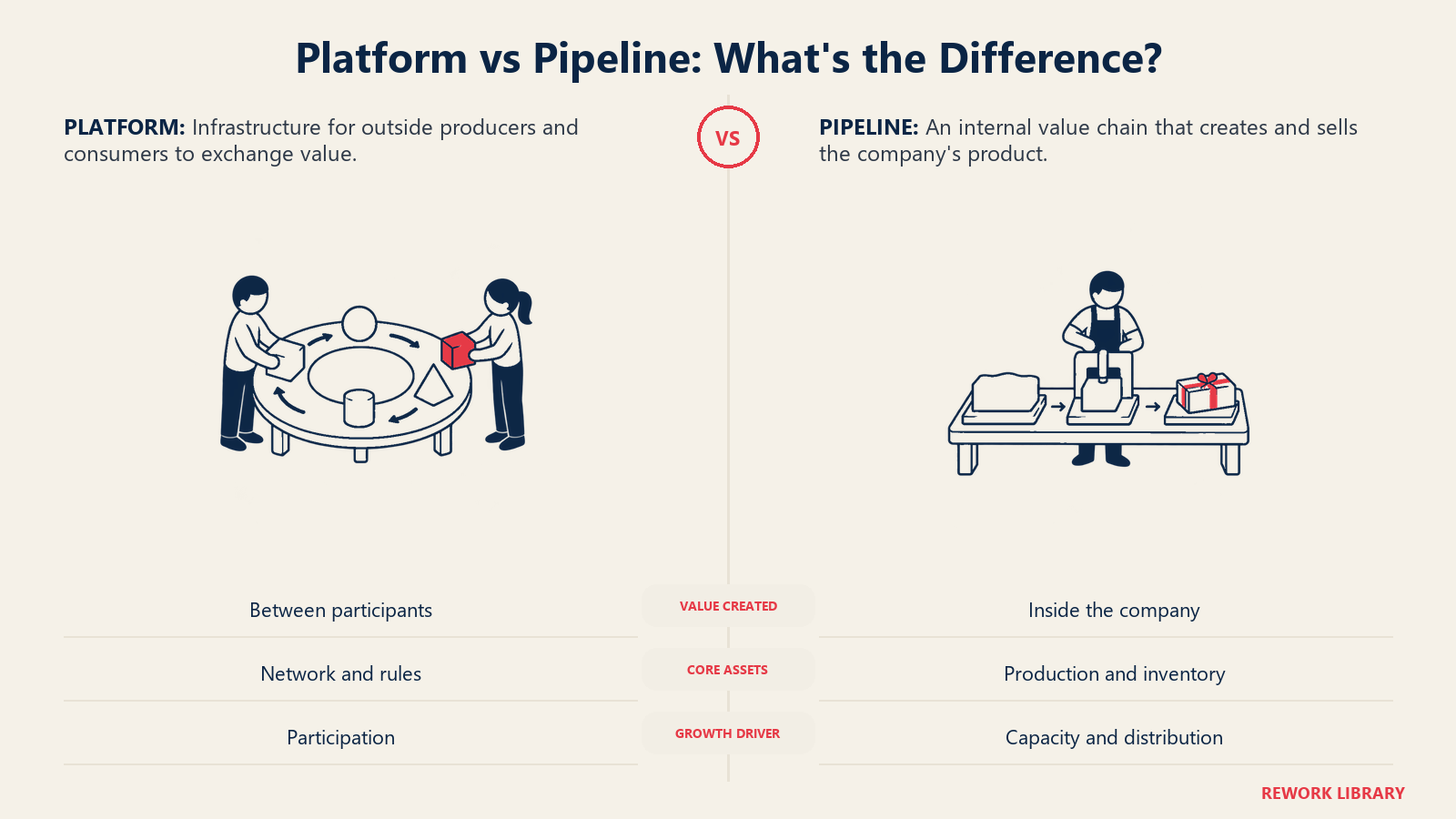
Here is the structural difference in a table.
| Pipeline (linear) business | Platform business | |
|---|---|---|
| Core activity | Creates and sells its own products or services | Enables interactions between outside producers and consumers |
| Main assets | Factories, inventory, employees, brand | Network, data, rules, matching technology |
| Where value comes from | Inside the firm, along a value chain | Between participants, in the exchange |
| Growth driver | Production capacity, distribution, marketing spend | Participation: more users attract more users |
| Typical cost pressure | Cost of goods sold rises with volume | Marginal cost of adding a participant is often low |
| Main risk | Competitors out-producing you | Participants leaving, or never arriving |
The table simplifies. Many real companies mix both. Amazon sells its own goods (pipeline) and also hosts third-party sellers (platform). The question is which activity drives the economics of the company.
The core interaction and the three roles
Every platform is built around one core interaction: the repeated exchange that the platform exists to make easier. For a ride-hailing app, it is a ride. For an app store, it is a download. For a freelance site, it is a hired project. If the core interaction is unclear, the platform is probably not one yet.
Three roles show up in almost every platform.
- Producers supply something: drivers, sellers, content creators, app developers, hosts, lenders.
- Consumers use or buy what producers supply: riders, shoppers, viewers, app users, guests, borrowers.
- The platform owner runs the infrastructure and sets the rules: who can join, how they are matched, how trust is built, how money moves, what is allowed.
One person can be both producer and consumer. A social network user reads posts (consumes) and writes them (produces). That blurring is why the older "supplier and customer" vocabulary fits platforms badly.
Economists describe the structure as a two-sided or multi-sided market. In their influential 2003 paper, Jean-Charles Rochet and Jean Tirole write that platforms in industries such as software, media and payment systems must "get both sides of the market on board" and that they devote much attention to how they court each side while making money overall. That sentence contains the central difficulty of the model, which later sections return to.
Types of platforms
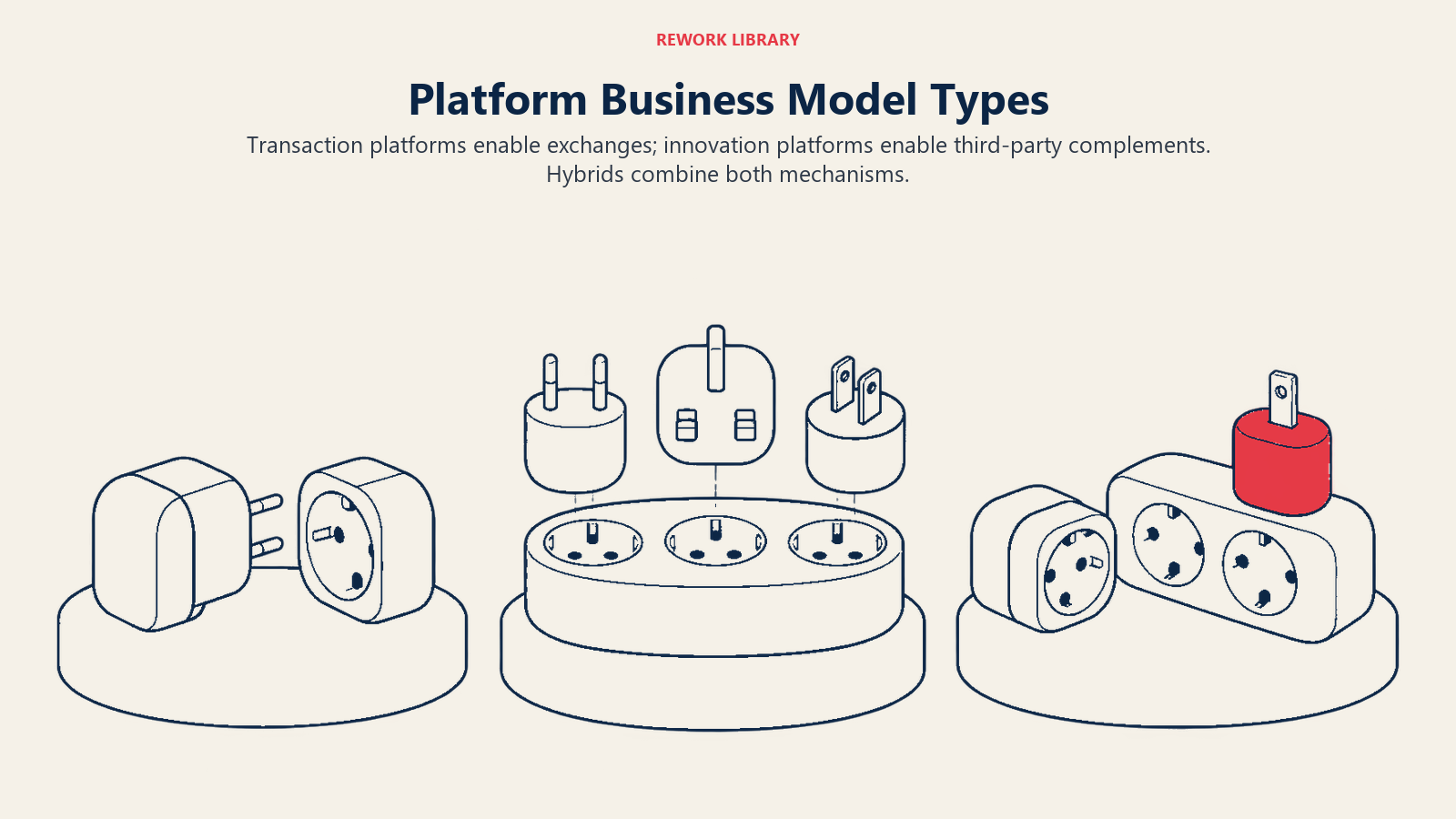
Michael Cusumano, Annabelle Gawer and David Yoffie, in their book The Business of Platforms, separate platforms into types. According to MIT Sloan's description of the book, transaction platforms bring together two sides of a market such as buyers and sellers, while innovation platforms rely on third parties to create complementary products and services that make the platform more valuable, such as smartphone apps. The same source notes that Amazon, Apple, Google and Tencent (WeChat) combine the two types.
| Type | What the platform does | Who adds value | Illustrations |
|---|---|---|---|
| Transaction (exchange) platform | Matches two sides and enables the exchange | Buyers and sellers, riders and drivers | Marketplaces, ride-hailing, payment networks |
| Innovation (developer) platform | Provides a base technology others build on | Third-party developers who add complements | Operating systems, app ecosystems, cloud and API platforms |
| Hybrid | Does both | Both groups | Large consumer technology ecosystems |
If your model is mainly a matching service for goods and services, read marketplace business model, which covers that special case in detail. A marketplace is one kind of transaction platform. Platforms is the broader family.
Innovation platforms have their own logic. They are valuable because a base technology (an operating system, a payment API, a no-code builder) is cheaper to extend with outside help than to extend alone. The open-source world takes a related approach, though without the same ownership of the base layer. See open-source business model for how that differs.
Network effects: why the model can compound
A network effect exists when a product becomes more valuable as more people use it. Two kinds matter for platforms. For a longer treatment, read the network effects article.
- Same-side (direct) effects. More users of the same type make the platform better for each of them. A messaging app is more useful when more of your contacts are on it.
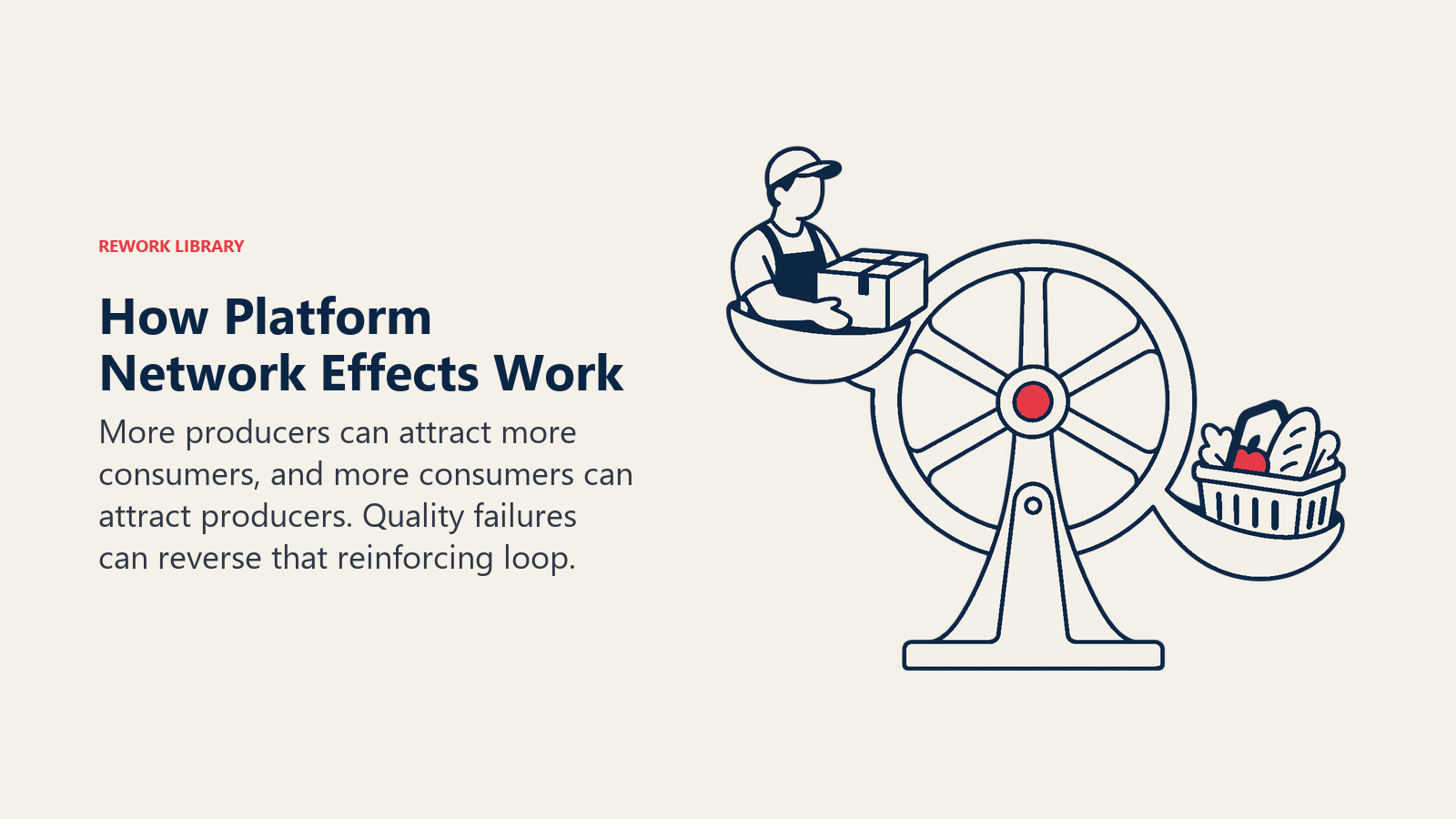
- Cross-side (indirect) effects. More participants on one side make the platform more attractive to the other side. More riders attract more drivers, and more drivers shorten the wait for riders. More app users attract more developers, and more apps attract more users.
Effects can also be negative. Too many sellers can drown buyers in noise. Too many low-quality users can reduce trust. A platform that ignores this will see growth turn into churn.
Cross-side effects create a loop that resembles a flywheel: participation on one side feeds participation on the other, which feeds the first side again. When the loop works, it becomes a form of economic moat, because a newcomer must replicate both the product and the crowd. For the consumer-growth side of the same phenomenon, see viral network effects.
The cold start problem
The same logic makes the beginning hard. A platform with no sellers attracts no buyers, and a platform with no buyers attracts no sellers. Rochet and Tirole's "both sides on board" idea is the cold start problem stated in four words.
Founders commonly try a few approaches, all of which are tactics rather than guarantees:
- Start with one side and make the product useful alone. Offering a tool that works for a single user (a "single-player mode") means the platform can attract producers before the network exists.
- Narrow the market. Build density in one city, one niche or one category before expanding.
- Subsidize one side. Pay or discount the side that is harder to attract, and charge the other.
- Seed the supply. Create or curate initial listings by hand so the first buyers find something.
Which side to subsidize depends on which side is more sensitive to price and which side the other side most wants. That is the pricing question at the heart of two-sided markets.
How platforms make money
Platforms rarely charge both sides the same way. The usual monetization patterns are:
- Transaction fees. A cut of each exchange, usually a percentage or a fixed amount.
- Access fees. A charge to join or to maintain a seat, such as a subscription for sellers or members.
- Enhanced access or curation. Fees for better visibility, promoted placement, premium tools or verified status. These work only if the unpaid experience stays good enough to keep participants.
- Advertising. Participants on one side pay to reach the other.
- Developer and distribution fees. On innovation platforms, third parties pay for tooling, hosting, certification or distribution through the platform's store.
Exact rates vary by platform and change over time, so this article gives no current figures. Check each company's own filings and terms. Before copying a fee structure, test it against the basic economics: the platform's unit economics still have to work, with the cost of acquiring each participant weighed against what each one brings in over time.
Governance and curation
A platform is a rule-making organization. Governance is how the owner decides who participates and how. It covers:
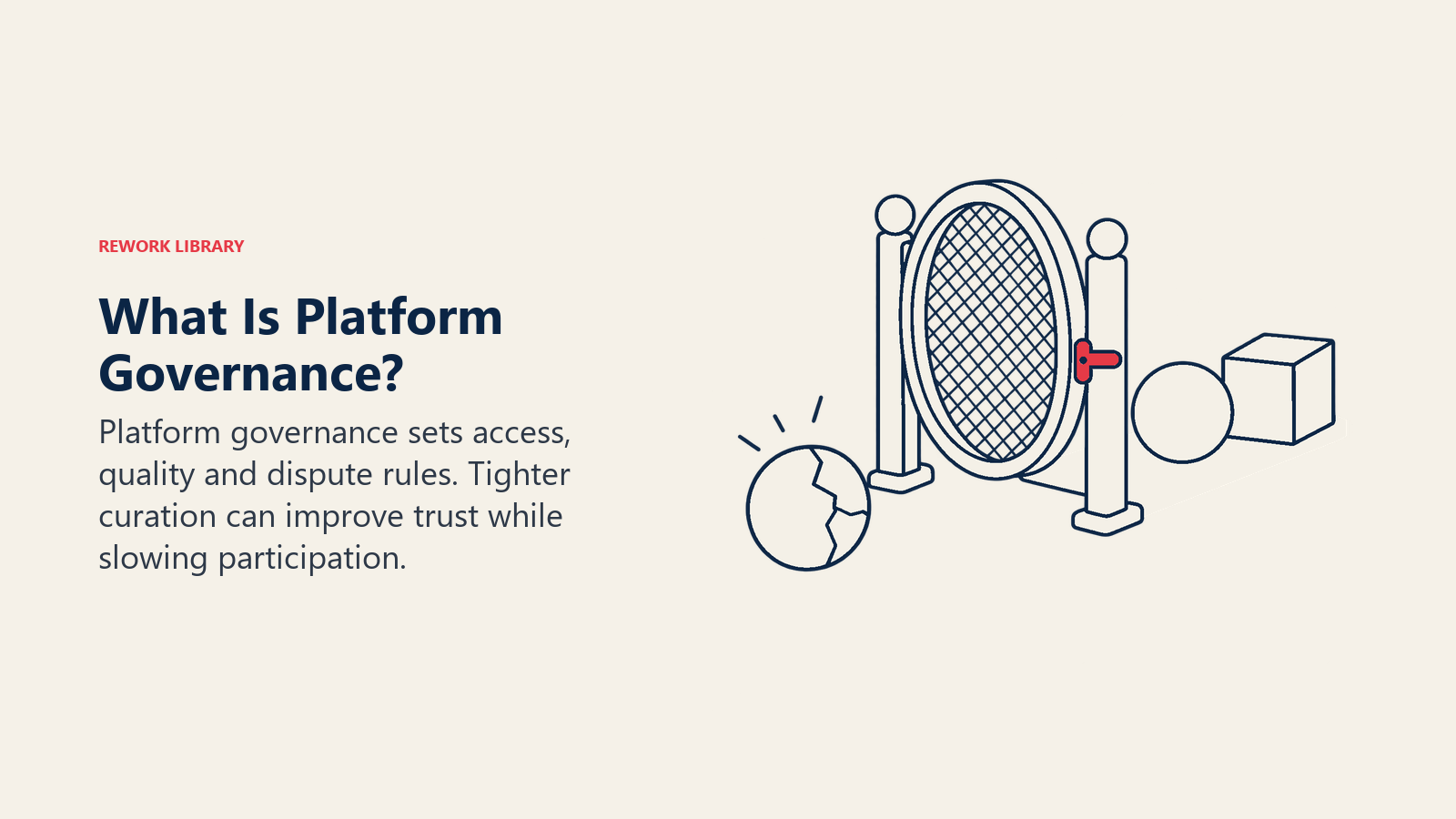
- Access: open to anyone, vetted, or invitation only.
- Quality control: ratings, reviews, verification, listing standards, removal of bad actors.
- Dispute handling: refunds, arbitration, safety rules.
- Data and interoperability: what participants can take with them, and who owns the data the interaction generates.
- Pricing power: whether the owner or the producers set prices.
There is a trade-off. Tight curation raises quality and trust but slows growth. Loose access grows quickly but invites low-quality or harmful behavior. The right level depends on how costly a bad interaction is. A ride is low-stakes compared with a childcare booking or a payment, so safety and verification expectations differ.
Multi-homing, switching costs and winner-take-all
Do platforms always end up with one winner? Not always. Two factors decide it.
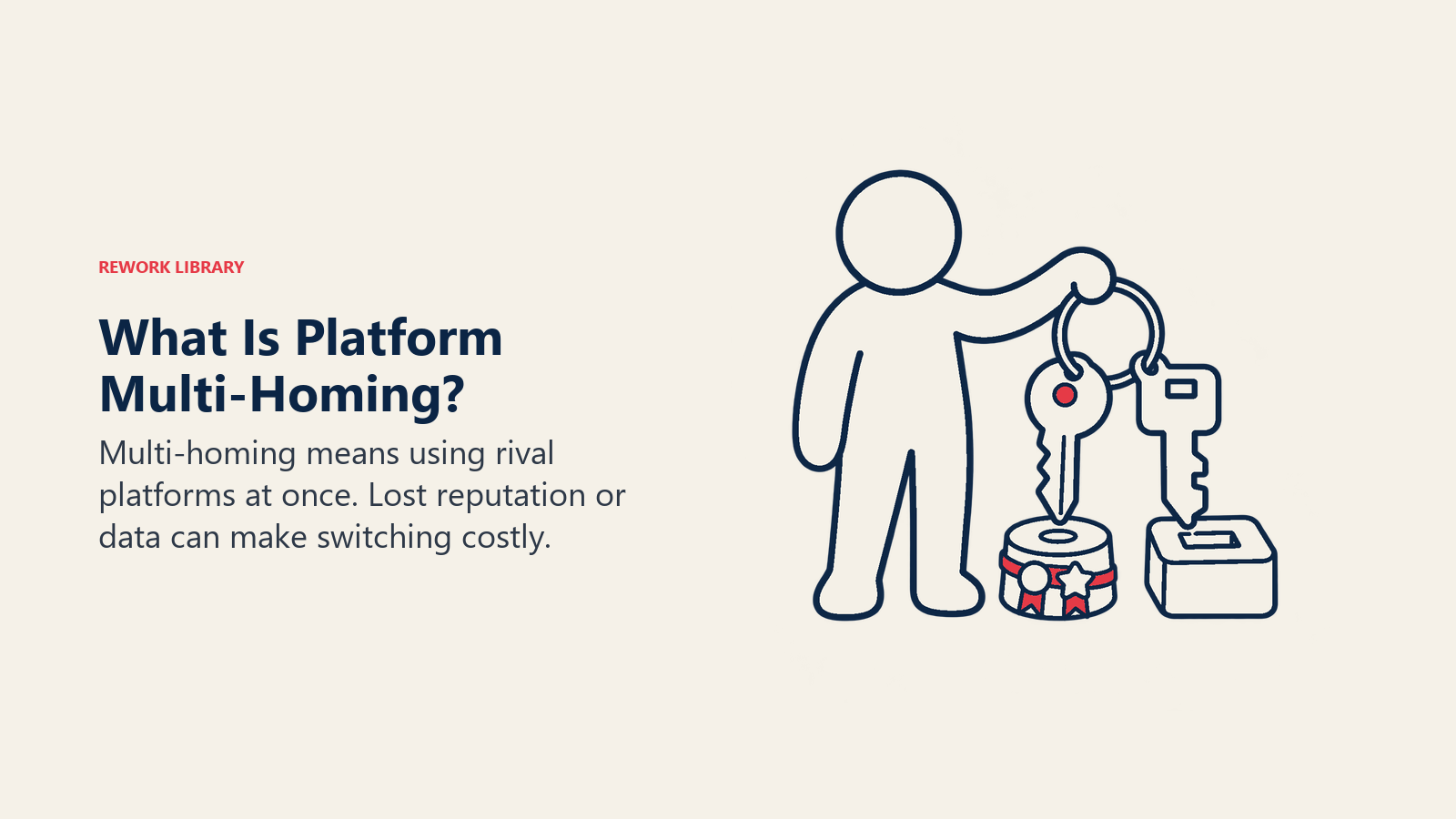
Multi-homing means a participant uses several competing platforms at once. Many drivers work for more than one ride app, and many sellers list on more than one marketplace. When multi-homing is cheap, no single platform can lock in its users, and competition stays open.
Switching costs work against that. If leaving means losing your reputation, your data, your integrations or your audience, participants stay. A seller with thousands of reviews on one site thinks twice before moving.
Markets tend toward concentration when four conditions hold together: strong network effects, high switching costs, little multi-homing, and limited room for differentiation. If instead the market has distinct segments, local effects or easy multi-homing, several platforms can coexist. This is a pattern in the literature and in experience, not a law. Treat any claim that "platforms always winner-take-all" with caution.
Risks and limits of the model
Platforms attract attention because the successes are large. The failures are common and less visible. The MIT Sloan description of The Business of Platforms makes this point directly: although some platform businesses can grow extraordinarily fast, most lose extraordinary amounts of money, and platform-izing a bad, low-profit business does not make it a good business. A platform wrapper does not fix weak economics.
The main risks:
- Cold start failure. The network never reaches the density needed to be useful.
- Leakage. Participants meet on the platform, then transact elsewhere to avoid fees. Trust, payment protection and repeat-use tools are the usual defenses.
- Quality and trust failures. A few bad experiences can drive away the good participants who make the platform valuable.
- Dependence on the platform owner. Producers who build on a platform depend on its rules, which the owner can change. That is a business risk for them and a reputational risk for the owner.
- Platform power and regulation. Large platforms can favor their own offers or squeeze participants, which has drawn regulators' attention.
- Weak unit economics. Subsidies that buy growth can hide the fact that no participant is profitable at scale.
Regulation
Regulation now shapes the model at scale. The EU's Digital Markets Act is, in the European Commission's words, the EU's law to make the markets in the digital sector fairer and more contestable. It targets large "gatekeeper" platforms providing core platform services such as app stores, search engines and messaging. According to the Commission, gatekeepers must not rank their own services more favorably than similar third-party offerings, and they must let business users promote offers and transact outside the platform. The Commission lists fines of up to 10% of a company's total worldwide annual turnover, or up to 20% for repeated infringements. The Commission's gatekeeper page shows which companies it has designated so far.
For an early-stage founder, this is not an immediate concern, since the rules target very large platforms. The lesson is broader: the more control a platform has over its participants, the more scrutiny it attracts, so governance choices made early have long consequences. Rules differ by country and by sector, and practices vary by market.
Is a platform the right model for a startup?
A platform model fits when the answer to most of these questions is yes.
- Is there a fragmented set of producers and a fragmented set of consumers who struggle to find each other?
- Does each side get more value as the other grows?
- Can you make the first interaction valuable without a large network?
- Will participants return, instead of using you once?
- Do the unit economics work at the transaction level?
If the answers are mostly no, a conventional product, a service or a software subscription may be a better path. See stages of a startup for where this decision usually gets tested.
Key Facts
- A platform business model earns by enabling interactions between producers and consumers, while a pipeline business creates and sells its own product.
- Van Alstyne, Parker and Choudary's 2016 HBR article notes that five major handset makers held 90% of industry profits in 2007, the year the iPhone launched.
- Rochet and Tirole's 2003 paper says platforms must get both sides of the market on board.
- Cusumano, Gawer and Yoffie distinguish transaction platforms, innovation platforms and hybrids that combine both.
- Platforms can have same-side and cross-side network effects, and negative ones too.
- Common revenue sources are transaction fees, access fees, enhanced curation, advertising and developer fees.
- Winner-take-all outcomes depend on network effects, switching costs and multi-homing, so they are a tendency, not a rule.
- The EU Digital Markets Act lists fines of up to 10% of worldwide annual turnover for gatekeeper breaches.
Related Reading

On this page
- Platform vs pipeline
- The core interaction and the three roles
- Types of platforms
- Network effects: why the model can compound
- The cold start problem
- How platforms make money
- Governance and curation
- Multi-homing, switching costs and winner-take-all
- Risks and limits of the model
- Regulation
- Is a platform the right model for a startup?
- Key Facts
- Related Reading