What Is a B2B2C Business Model?
Turn this article into takeaways for your work.


Each assistant summarizes the article only for you and suggests best practices for your work.
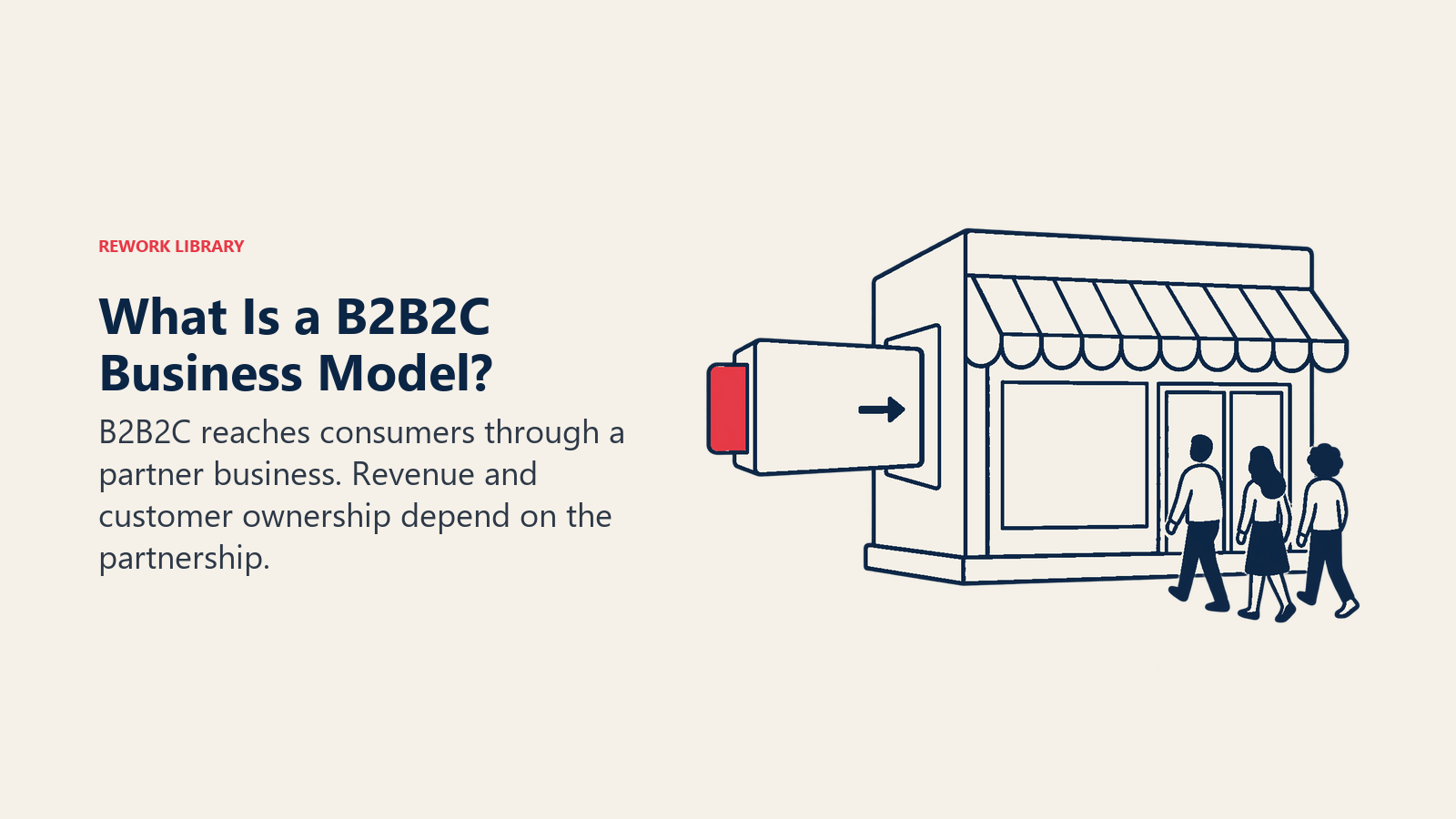
A B2B2C (business-to-business-to-consumer) business model is one where a company sells to, or through, another business in order to reach that business's own customers. The partner sits in the middle. The startup sells a product, a service or a piece of technology to the partner, and the partner's customers end up using it.
That sounds like ordinary distribution, and it partly is. But the model raises a question that ordinary B2B and B2C don't: who owns the relationship with the end consumer? Everything interesting about B2B2C, from how money is split to what can go wrong, comes back to that question.
This article covers the definition, how B2B2C compares to the models around it, the common variants, how revenue is typically shared, the advantages and risks, the metrics worth watching, and when a startup should consider it. It's reference material, so there are no prices or vendor recommendations here. For the broader range of startup models, see the sibling articles on the marketplace business model and the platform business model.
What B2B2C means
Shopify defines B2B2C as a model in which one company sells a product or service to another company, and that product or service helps the second company sell to its own end consumers. Three parties are involved:
- The startup (the first B). It builds the product or service.
- The partner business (the second B). It already has customers, a brand and a channel.
- The end consumer (the C). This person or household ends up using the product, and may or may not pay for it directly.
The key design choice is how visible the startup is to the consumer. In Shopify's framing, both brands are visible to the consumer and both partners have direct access to the end consumer, which is what separates B2B2C from white or private labeling, where the supplier stays invisible. That's a useful distinction, but definitions vary. Many practitioners use B2B2C more loosely to include white-label arrangements too, so it helps to say which one you mean when you write a partnership plan.
Two questions help place any arrangement:
- Who pays? The partner, the consumer, or both?
- Whose customer is it? Does the consumer sign up with the startup, with the partner, or with neither (because the product is simply "included")?
B2B2C vs B2B, B2C and B2B2B
| Model | Who the startup sells to | Who uses it | Customer relationship |
|---|---|---|---|
| B2B | A business | Employees of that business | The startup owns it |
| B2C | Individual consumers | The same consumers | The startup owns it |
| B2B2C | A business partner | The partner's consumers | Shared, or owned by the partner |
| B2B2B | A business partner | Other businesses served by the partner | Shared, or owned by the partner |
Shopify describes the contrast with plain B2B this way: in traditional B2B only the second company interacts directly with customers, whereas B2B2C lets both companies have a relationship with the consumer. B2B2B is the same structure one layer over: the partner resells to other businesses rather than to individuals. A payroll platform sold through accounting firms to small businesses is a typical shape.
Two related terms are easy to confuse with B2B2C.
- Reseller or retail channel. A company sells units to a retailer, and the retailer sells them to consumers. The retailer owns the shelf and often the customer. The channel sales model covers this in depth.
- Marketplace. A startup connects buyers and sellers and earns on the transactions. Marketplaces share some structure with B2B2C, since sellers are businesses and buyers are consumers, but the startup runs the meeting place rather than serving the partner's own customer base. See the marketplace business model.
Common B2B2C variants
B2B2C is a family of arrangements, not one template. These are the forms startups run into most often.
Embedded and white-label services
The startup builds a capability that the partner presents as part of its own product. Stripe's documentation describes Connect as a way to white-label and monetize Stripe financial products so businesses can accept payments, hold funds, move money, spend with cards, and access financing within their software. The software company is the customer of the provider, and the software company's users experience payments or financing as a feature of the product they already use. This is often called embedded finance when the capability is financial, but the same pattern applies to embedded insurance, identity, logistics or communications.
Co-branded offers
Both brands appear in front of the consumer. A reservation tool sold to restaurants, for example, shows up to diners as part of the restaurant's booking experience while the tool's brand stays visible. Shopify lists OpenTable and Instacart among its examples of the model. Co-branding builds trust through association, but it also means two brands share responsibility for the experience.
Employer-sponsored benefits
The employer is the paying customer, and employees are the end users. Health coverage is the largest example. KFF's 2025 survey found that 61% of firms with 10 or more workers offer health benefits, and 97% of firms with 200 or more workers do, and that 55% of workers are covered by a plan their employer offers. A startup selling a wellness, mental health, learning or financial-wellness benefit to employers is using the same logic: win one buyer and reach many individuals at once. The employer chooses the product, so selling to employers is closer to B2B selling, while the product experience is consumer-like.
Financial products through banks and retailers
Insurance sold through banks, often called bancassurance, is a long-running version of B2B2C. The insurer supplies the product, and the bank offers it to customers it already serves. The same structure shows up when a lender, a payments company or an insurer plugs into a retailer's checkout. Rules differ a lot by country and product, so a startup working in regulated financial services needs local legal advice before designing the partnership.
Retail and distribution partnerships
A consumer brand gets onto a retailer's shelves or into a retailer's app, and the retailer provides the shopper relationship. When the brand also gets some access to the shopper (through data, loyalty or a co-branded page), this starts to look like B2B2C. When it doesn't, it's plain wholesale.
API-delivered services
A startup exposes its capability through an API, and partners build it into their own apps. The partner's customers may never see the startup's name. This is common in maps, messaging, identity checks, translation and fraud detection. It's the most scalable form, because one integration can reach a partner's entire base, and also the one where the startup is most easily replaced.
How revenue is shared
The money structure depends on who the customer is. These are the concepts, without prices, because the numbers vary widely by industry and negotiating power.
| Structure | How it works | Who carries the risk |
|---|---|---|
| Wholesale or license | The partner pays the startup a fee, then sells to consumers at its own price | The partner carries demand risk |
| Revenue share | The consumer pays, and the proceeds are split between startup and partner | Shared, tied to sales |
| Per-member or per-seat fee | The partner pays per enrolled user, employee or account | The startup carries adoption risk, since enrollment drives revenue |
| Platform fee on payments | The partner earns a cut of each transaction the startup processes | Shared, tied to volume |
| Referral or commission | The partner is paid for each customer it sends | The startup carries acquisition cost, the partner carries little |
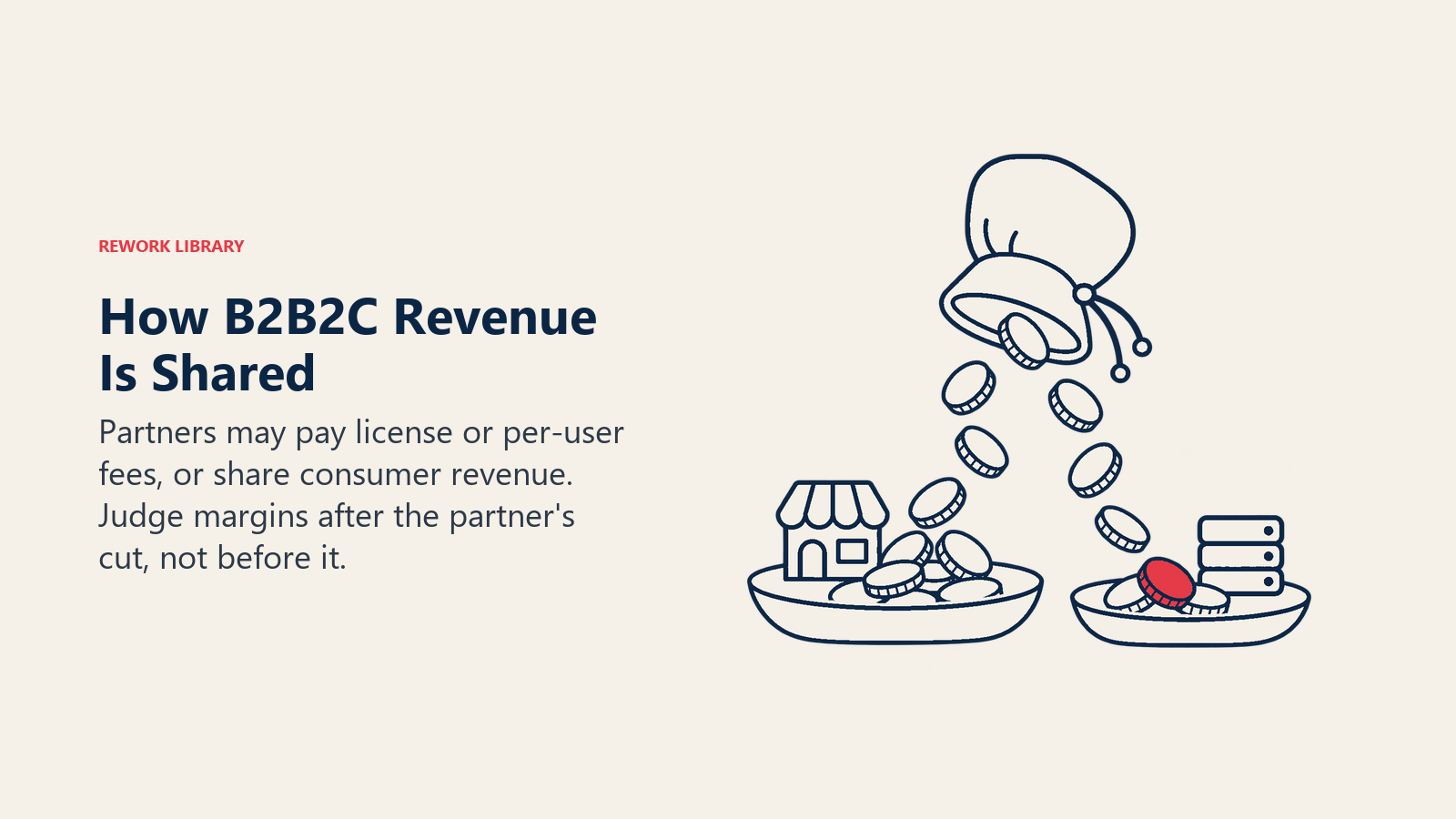
Shopify's article notes that B2B2C comes with lower profit margins because of fees and revenue sharing. That's the price of distribution. If a partner gives you access to its customers, it will want a meaningful share of what those customers generate. Before signing, model the deal's gross margin after the partner's cut, not before it.
Advantages of a B2B2C model
- Distribution you couldn't build alone. One partner agreement can bring thousands of users. Shopify lists reaching more customers through the partner's existing audience as the first benefit, and the partner's channel is often the one thing a young startup can't replicate quickly.
- Borrowed trust. Consumers are more willing to try something their bank, employer or favorite retailer recommends. Shopify also names credibility and trust by association with established brands as a benefit.
- Lower acquisition cost per user. Winning one partner can replace thousands of individual ad-driven sign-ups, which often improves the LTV to CAC ratio, as long as the revenue share doesn't eat the gain.
- Faster learning at scale. A partner's large, engaged base can give a startup real usage data quickly, if the contract lets the startup see it.
- Natural fit with partner-led growth. The partner-led growth approach is built on this idea: other companies' customers become your growth channel.
Risks and trade-offs
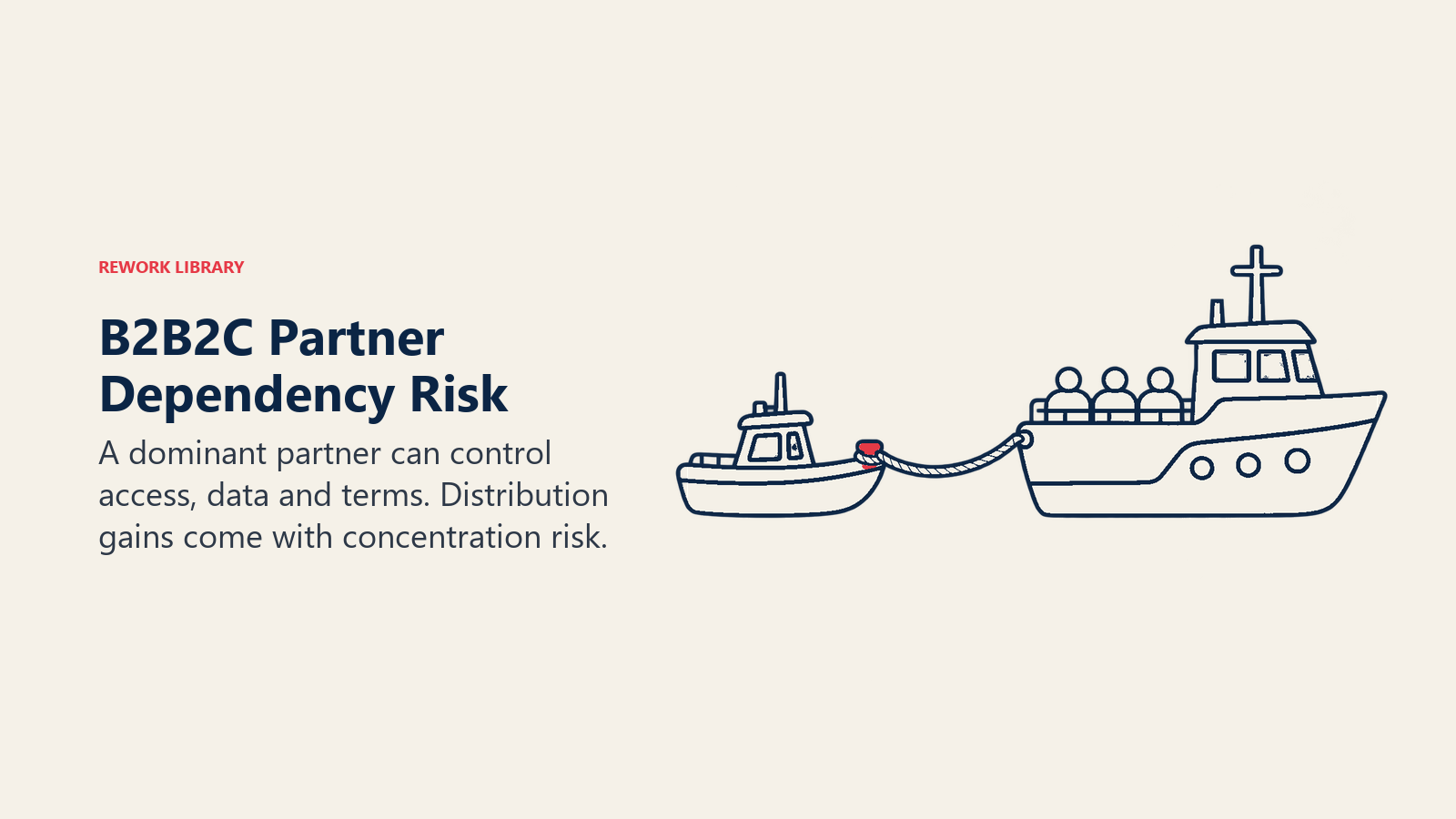
- Partner dependency. If one partner supplies most of your users, that partner can renegotiate, switch vendors or build the capability in-house. Concentration is the largest structural risk.
- Data ownership. If the partner owns the consumer relationship, it may also own the data. Without that data, the startup has limited ability to improve the product, personalize it or sell anything else to those users. Settle data rights in the contract before launch.
- Brand dilution. In white-label setups the consumer never learns your name, so you build no brand equity. In co-branded setups, a partner's bad service can reflect on you.
- Two customers to satisfy. The partner wants low risk, easy integration, reporting and revenue. The consumer wants a product that works. A feature that delights consumers but creates support work for the partner can still lose the account.
- Channel conflict. Selling directly to consumers while also partnering with businesses that serve those same consumers puts you in competition with your own partners. Many startups pick a lane for each segment to avoid it.
- Lower margins and limited control. Shopify's list of challenges includes lower margins and limited control over the customer experience with the partner. Slow partner sales cycles also push revenue later than founders expect.
- Regulation and liability. In finance, insurance and health, the partner and the startup may each carry compliance duties. Responsibilities should be written down, not assumed.
Metrics to watch
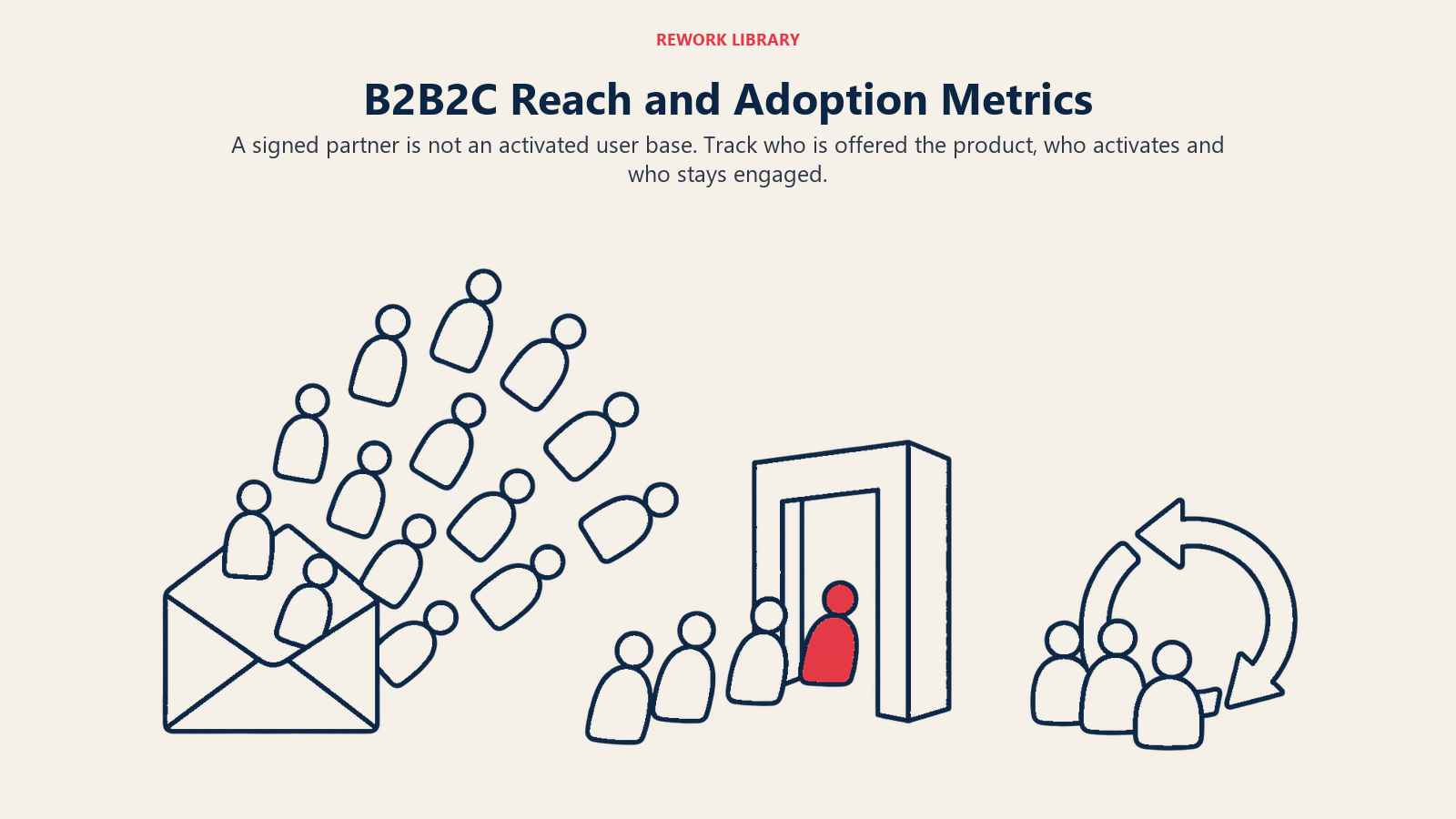
A B2B2C business has two funnels, one with the partner and one with the end user. Track both.
| Area | Metric | What it tells you |
|---|---|---|
| Partner | Time to sign and integrate a partner | How scalable the partner motion is |
| Partner | Revenue concentration (share from the top partner) | Dependency risk |
| Partner | Partner retention and renewal | Whether partners are happy |
| Reach | Share of the partner's base that is offered the product | Whether the partner is really promoting it |
| Adoption | Activation and enrollment rate among reached consumers | Whether consumers want it |
| Engagement | Retention of end users over time | Value to the consumer, not just the partner |
| Economics | Revenue per end user after partner share | Whether the deal pays |
| Economics | Cost to win and support a partner versus lifetime value | The B2B2C version of unit economics |
The gap between "offered" and "adopted" is where B2B2C deals often disappoint. A partner can sign a contract and then give the product little visibility, so reach and adoption need to be measured from the start, not assumed from the signature.
When a startup should choose B2B2C
B2B2C tends to fit when several of these are true:
- The consumer already trusts someone else. Banks, employers, telecoms, retailers and platforms hold trust you can't quickly build.
- Consumer acquisition is expensive or slow. If paid acquisition makes the numbers fail, a partner's installed base can change the math.
- The product works as an add-on. It fits inside a partner's existing experience without requiring a separate relationship.
- You can survive on a partner's share. Your costs to serve must leave room after the revenue split.
- You can protect your position. That might mean keeping some direct relationship, owning key data, holding exclusivity limits, or building a feature the partner can't easily copy.
It tends to fit poorly when the product needs a deep direct relationship with the user, when a single partner would represent nearly all revenue, or when the startup hasn't yet shown the product works at all. At the earliest stages, a handful of direct users often teach more than a distribution deal does, which is why many founders add the partner channel after the first signs of demand, as covered in stages of a startup. If you plan to build a network of partners rather than depend on one, the channel partner program article shows how that is structured.
Practices differ by country, industry and regulator, and we haven't found a reliable comparative source for specific regions such as Southeast Asia, so check local norms with partners and lawyers before copying a model from another market.
Key Facts
- B2B2C means selling a product or service to a business partner that uses it to serve its own consumers. Shopify defines it as a model where one company sells to another company so the second can better sell to end consumers.
- Strict definitions say both brands are visible to the consumer, which separates B2B2C from white-labeling. Many practitioners use the term more loosely.
- Stripe Connect is a way to white-label and monetize financial products inside another company's software, a typical embedded-finance case.
- Employer-sponsored benefits are a B2B2C pattern: KFF's 2025 survey found 61% of firms with 10+ workers offer health benefits.
- The same survey found 55% of workers are covered by a plan offered by their employer.
- Typical revenue structures are wholesale or license, revenue share, per-member fees, platform fees and referral commissions.
- Main benefits are distribution, borrowed trust and lower acquisition cost. Main risks are partner dependency, data ownership, brand dilution and channel conflict.
- Practices vary by market and regulator.
Related Reading

On this page
- What B2B2C means
- B2B2C vs B2B, B2C and B2B2B
- Common B2B2C variants
- Embedded and white-label services
- Co-branded offers
- Employer-sponsored benefits
- Financial products through banks and retailers
- Retail and distribution partnerships
- API-delivered services
- How revenue is shared
- Advantages of a B2B2C model
- Risks and trade-offs
- Metrics to watch
- When a startup should choose B2B2C
- Key Facts
- Related Reading