Hardware Startups: Business Models and Why They Are Hard
Turn this article into takeaways for your work.


Each assistant summarizes the article only for you and suggests best practices for your work.
A hardware startup is a young company whose product is a physical device: a sensor, a wearable, a robot, a medical gadget, a piece of industrial equipment. Most of what founders learn about startups comes from software, where a product can be copied at near-zero cost and fixed overnight. Hardware breaks several of those assumptions. Every unit costs real money to make, mistakes can be locked into tooling and inventory, and the product often needs regulatory approval before it can be sold.
This article explains what makes hardware different, the main business models hardware companies use, how a product moves from prototype to production, and why investors tend to treat the category with caution. It's reference material, not a recommendation to pick hardware or avoid it. Plenty of strong companies are built on devices, and the point is to understand the economics before committing to them.
What makes hardware different from software
The differences come down to a handful of structural facts.
- Marginal cost is real. Software has a cost to build and a very low cost to serve one more customer. A device has a cost to design and a meaningful cost to build each unit. That per-unit cost is the bill of materials (BOM) plus assembly, packaging, shipping and warranty.
- Iteration is slower. Y Combinator's Alexis Ohanian described hardware companies as facing iteration time measured in days rather than seconds, the burden of marginal costs, and unexpected hurdles such as Chinese New Year. A software team can ship a fix in an afternoon. A hardware team may wait weeks for a new sample.
- Inventory ties up cash. Components are usually ordered before a single customer pays. Money is spent months ahead of revenue, which is a working capital problem that software companies mostly avoid.
- Approvals gate the launch. Devices that emit radio signals, connect to mains power or touch the body usually need certification before they can be sold. More on that below.
- Returns and warranty are built in. Physical products break, get returned and need replacement parts. That cost belongs in the model from the start.
- Gross margins are usually lower. Because each unit costs money, gross margin is typically thinner than for software. Apple's fiscal 2025 annual report is a useful reference point: its products gross margin was 36.8 percent, while services reached 75.4 percent. Apple is far from a startup, and the exact figures don't transfer to a young company, but the gap between selling a device and selling a service attached to it is the pattern founders try to exploit.
Paul Graham made the historical point in his essay The Hardware Renaissance (October 2012): hardware had been a worse base for fast-growing companies than software, and investors held a bias against it. He argued that crowdfunding, easier manufacturing and cheaper prototyping tools were changing this. That essay is a snapshot from 2012, so read it as context for how the conversation started, not as current market data.
Hardware business models compared
"Hardware startup" describes the product, not the way the company makes money. The same device can be sold in several ways, and the choice changes cash flow, margins and how customers relate to the company.
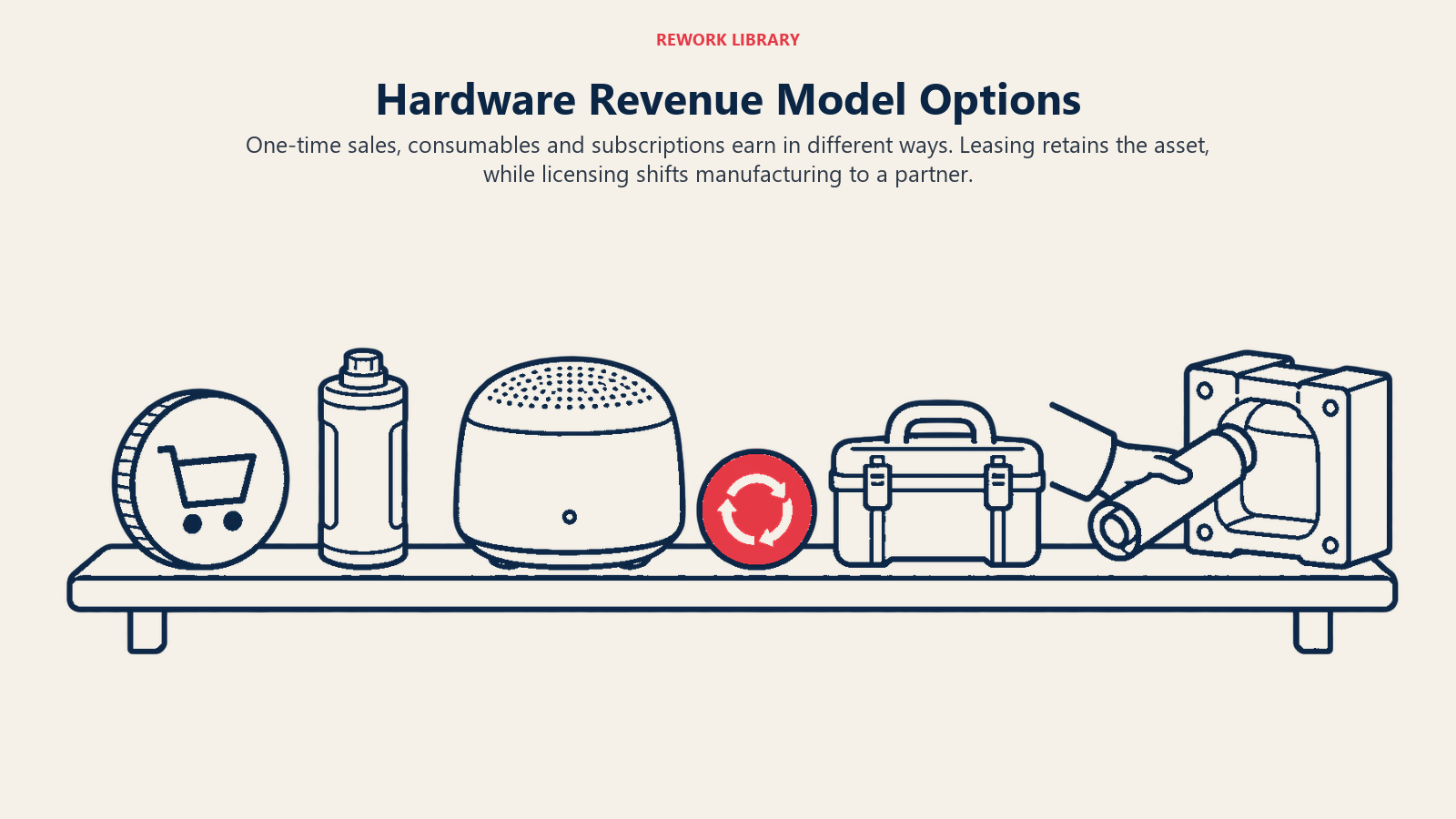
| Model | How revenue works | What it does to the economics | Main risk |
|---|---|---|---|
| One-time sale | Customer pays once for the device | Simple, revenue arrives at purchase, margin depends entirely on BOM and price | Revenue stops after the sale, so growth requires constant new customers |
| Razor-and-blades (consumables) | Device sold cheaply or at modest margin, refills or parts sold repeatedly | Recurring revenue from consumables, can carry higher margin than the device | Customers may buy compatible third-party refills or stop using the device |
| Hardware plus subscription | Device plus a paid software or service layer | Adds high-margin recurring revenue on top of low-margin hardware | Customers must see ongoing value or they cancel, and the service has its own costs |
| Hardware-as-a-service (leasing) | Customer pays monthly or per use and the company keeps the asset | Lowers the customer's upfront cost, turns sales into recurring revenue | The company funds the device up front, so cash and financing become the constraint |
| B2B and industrial sales | Devices sold to businesses, often with installation, service contracts or integration | Higher price per unit, longer sales cycles, stickier customers | Slow sales and pilots can drain cash before volume arrives |
| Licensing and IP | The company designs the technology and others manufacture and sell it | Little inventory and capital needed, margin per unit can be high | Dependence on partners, and royalty rates can be small |
One-time sale
This is the default and the easiest to explain. The company spends on design, tooling and inventory, sells units, and keeps the difference between price and landed cost. The model works when the product is clearly worth the price and volume is high enough to spread fixed costs. Its weakness is that each sale is a one-off. The customer who bought a device last year isn't paying anything this year.
Razor-and-blades
The name comes from the idea that the handle is sold cheaply and the blades are sold again and again. In hardware, the same logic covers coffee machines and capsules, printers and ink, or water filters. The device is the way in, and the consumable is where the lifetime value builds up. The model depends on lock-in. If customers can easily buy compatible refills elsewhere, the economics weaken.
Hardware plus subscription
Here the device is paired with a paid service: cloud storage for cameras, coaching or analytics for a fitness device, monitoring for a sensor network. The goal is to turn a one-time sale into a recurring stream. This only works if the service is something customers value on its own and if the company can cover the real costs of running it, such as cloud hosting and support. If you're modeling it, treat the service as a separate unit economics calculation from the device.
Hardware-as-a-service
Instead of buying, the customer rents the device or pays for outcomes, such as per hour of machine use. It cuts the customer's upfront cost and can open up buyers who couldn't afford a purchase. But the company now owns the asset. It has to pay for the device up front and wait months or years to earn that money back, so it needs financing and careful tracking of cash flow. Pricing and pay-per-use designs borrow from usage-based pricing.
B2B and industrial
Selling equipment to companies changes the pace. Unit prices are higher, buyers want pilots and proofs, and deals involve installation, training and service contracts. Customers tend to stay long once the device is embedded in their operations, but the sales cycle can run long enough to strain a young company's runway. Distributors and resellers often help; see the channel sales model.
Licensing and IP
A company with strong technology can license its designs or components to larger manufacturers, who handle production and distribution. This avoids inventory risk but gives up control and usually takes a smaller slice of each sale. It tends to suit deep-technology companies whose value lies in the design itself rather than in running a supply chain. A related idea on the software side is covered in the open source business model article.
In practice, many hardware companies blend these models: a device sold once, plus consumables, plus an optional subscription. When you evaluate one, ask which layer actually produces the profit.
The development path: from prototype to production
Hardware companies move through stages that software teams don't have. The names vary by company and industry, but a common sequence looks like this.
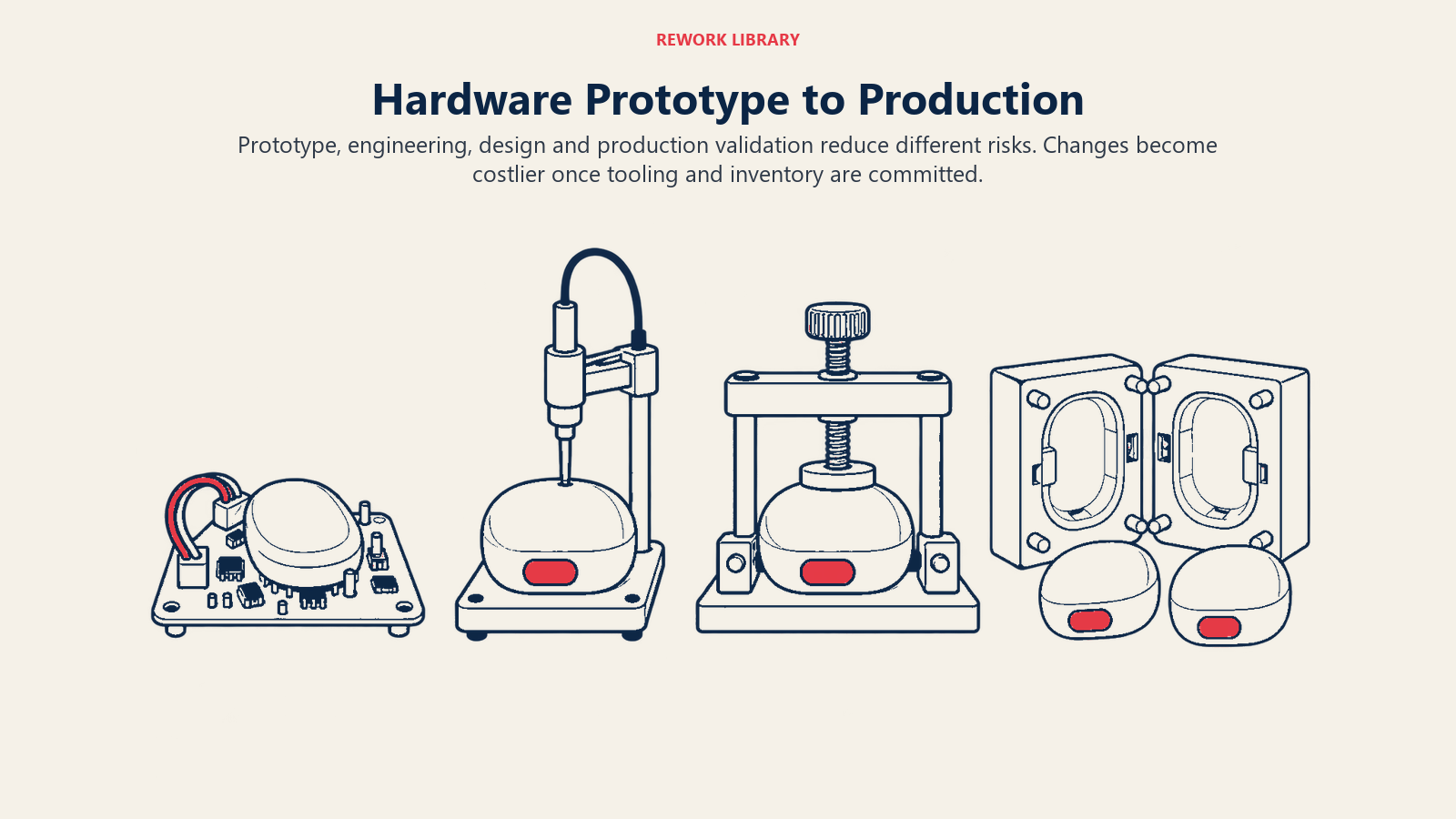
- Prototype. Works-like and looks-like models that prove the concept. Cheap tools such as 3D printers and development boards have made this stage far more accessible, a point Graham highlights in his 2012 essay.
- EVT (engineering validation test). The first builds with real production-intent electronics, used to check that the design works.
- DVT (design validation test). Builds closer to the final design, tested for reliability, durability and compliance with standards.
- PVT (production validation test). A trial run on the actual production line to check that the factory can build the product consistently at the planned rate and cost.
- Pilot and mass production. A small initial batch to real customers, followed by volume manufacturing and shipping.
These labels are an industry convention rather than a formal standard, and companies compress, repeat or rename the stages. The reason the sequence exists is that changes get more expensive at each step. Fixing a design mistake in a prototype can cost a few hours. Fixing it after tooling is cut and thousands of units are built can cost the whole production run.
For a startup, this path stretches the time before the first revenue. A pre-seed hardware company may spend its entire early budget just reaching a working prototype, which affects where it sits among the stages of a startup.
Certification and compliance
Many devices can't legally be sold until they pass regulatory checks, and the process takes time and money.
In the United States, the FCC states that radio frequency devices must be properly authorized under 47 CFR part 2 before being marketed or imported. The agency describes two routes: Certification and Supplier's Declaration of Conformity. For Certification, testing must be done by an FCC-recognized accredited laboratory. The rules on marketing are strict: under 47 CFR 2.803, marketing includes advertising for sale, and conditional sales contracts are allowed only with a prominent disclosure that delivery depends on the authorization being completed.
In the European Economic Area, the equivalent for many products is CE marking. The European Commission explains that it indicates the product was assessed to meet safety, health and environmental protection requirements, and that manufacturers must carry out the conformity assessment, set up the technical file and issue the EU declaration of conformity. It also notes that not every product requires the mark.
Other requirements apply depending on the product: safety standards for batteries and power supplies, medical device approvals, food-contact rules, and country-specific radio approvals. Founders should check what applies to their product and target markets early, because failing a test after production has begun is expensive. Requirements and timelines differ by country, so confirm them with a qualified test lab or advisor rather than assuming one market's rules apply elsewhere.
Cash flow and inventory risk
The most common way hardware startups get into trouble isn't a bad product. It's the gap between when cash goes out and when it comes back.
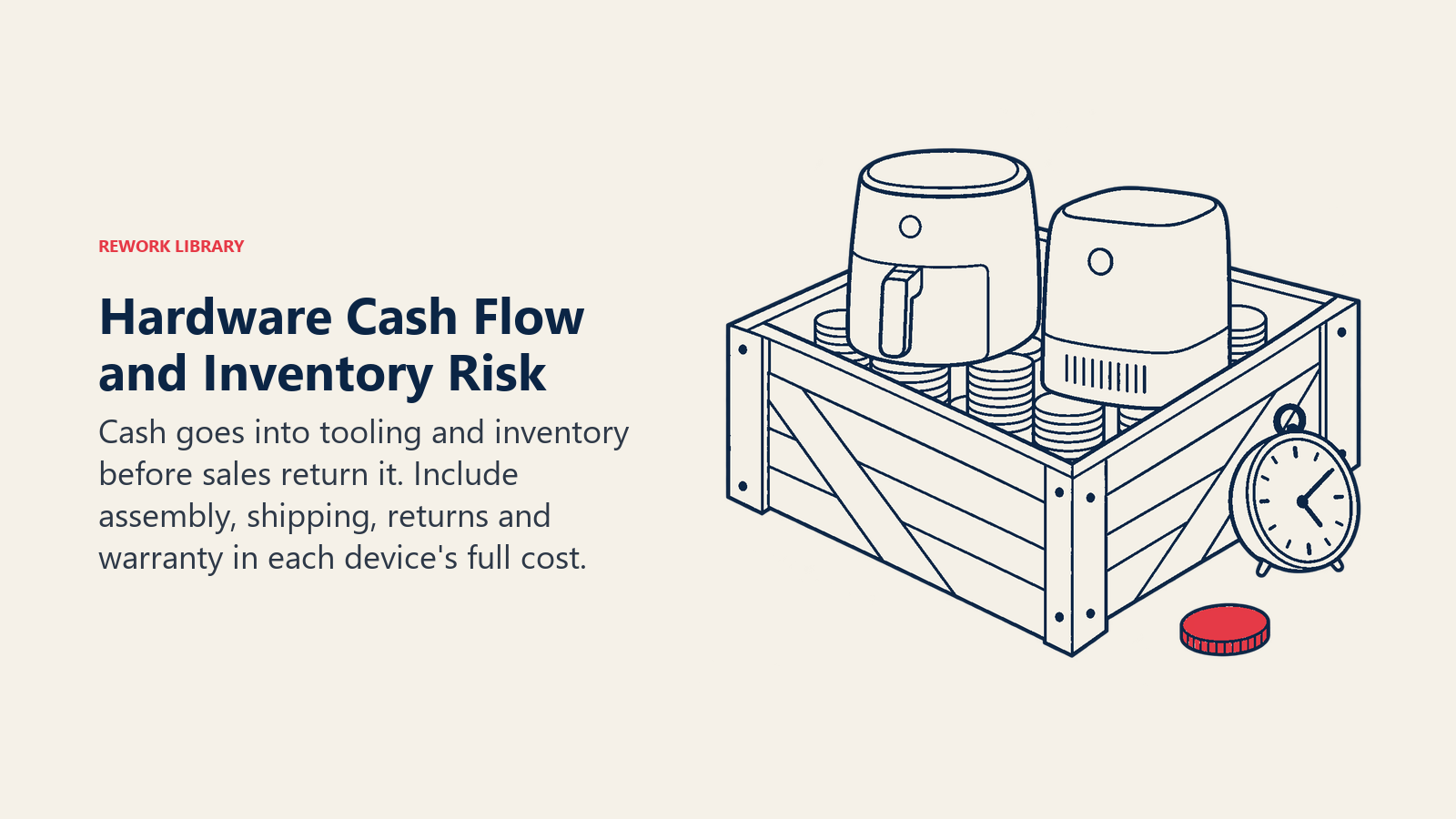
- A manufacturer typically wants deposits or purchase orders before building.
- Components may need to be ordered months ahead, locking in quantities.
- Tooling is a fixed cost paid before volume.
- Finished units sit in inventory, in transit or at retailers before they become revenue.
- If a design flaw appears, the money in unsold stock can be lost.
Contrast that with a software product, where a customer's payment typically arrives before or near when the cost of serving them is incurred. Hardware reverses the order. The company funds the product first and gets paid later, so growth consumes cash. A founder who doubles sales may need to double inventory financing at the same time. That's why runway planning in hardware has to include purchase commitments, not just salaries.
Unit-level math matters more too. A company that sells a device for less than its fully loaded cost, which includes the BOM, assembly, shipping, returns and warranty, loses money on each sale and gets worse as it scales. The LTV to CAC ratio is still useful, but the lifetime value has to be net of device costs and service costs. Scale can help, because larger orders lower component prices, which is the logic of economies of scale. It only helps once the company has the volume and cash to reach it.
Crowdfunding pre-orders as validation
Crowdfunding became a popular way for hardware founders to test demand before building inventory. Graham pointed out in 2012 that hardware does well on crowdfunding sites. Backers pay in advance, so the company learns whether people will actually pay and gets cash toward tooling.
There are real advantages: demand evidence, early customers, and money that doesn't dilute ownership. But there are risks too.
- Pledges aren't profit. The money raised has to cover manufacturing, certification, shipping and fees, and backers expect delivery on time.
- Timelines slip. Hardware schedules often run longer than a campaign promises, and backers notice.
- Rules apply. Kickstarter states that hardware and product design creators are required to show working prototypes, that photorealistic renderings aren't allowed, and that creators must explain how they'll produce the product and whether they've made anything similar before.
- Regulation still applies. In the US, the FCC marketing rules cited above affect how and when a device that uses radio can be advertised for sale.
- Supporters aren't the market. Early backers are enthusiasts. Strong campaign results don't guarantee that mainstream buyers or retailers will follow.
Crowdfunding is evidence of interest, not proof of a profitable business. Treat the campaign as the start of the manufacturing problem, not the end of the funding problem.
Why investors view hardware as harder
Investors aren't against devices as such. They weigh the risks that hardware adds on top of normal startup risk.
- More capital before proof. The company often needs tooling, inventory and certification before it learns whether the market wants the product.
- Slower learning loops. Fewer experiments per year means fewer chances to find product-market fit before the money runs out.
- Lower margins and less operating leverage. As covered above, each sale carries a cost that software doesn't, and a business with thinner margins takes longer to become scalable.
- Supply chain exposure. Component shortages, factory delays and shipping problems can stall revenue regardless of demand.
- Harder to fix after launch. A software bug is a patch. A hardware defect can mean a recall.
Graham described this bias as long-standing and argued it was starting to look less justified in 2012. How investors see hardware today varies by fund and sector, and we haven't relied on a single statistic to describe it. What's consistent is that hardware founders have to show a clearer path to capital efficiency, a credible manufacturing plan and a model that doesn't depend on selling one device per customer forever.
How practices vary by market
Hardware economics differ by country and product. Manufacturing cost, access to factories and test labs, certification rules, import duties and financing options all vary. We haven't found a comparable source covering Southeast Asia or other specific regions, so founders there should check local manufacturers, test labs and investors rather than assuming the practices described here apply directly.
Key Facts
- A hardware company pays a per-unit cost for every device, so gross margin is usually lower than for software.
- Apple's fiscal 2025 10-K reports 36.8 percent gross margin on products and 75.4 percent on services, illustrating why companies attach services to devices.
- Y Combinator describes hardware as having iteration time measured in days rather than seconds, with marginal costs to bear.
- Paul Graham's The Hardware Renaissance (2012) says investors had a bias against hardware, and that crowdfunding, manufacturing and prototyping were getting easier.
- The FCC says RF devices must be authorized before being marketed or imported.
- CE marking is a declaration by the manufacturer that a product meets EU requirements, and not every product needs it.
- Kickstarter requires working prototypes for hardware projects and bans photorealistic renderings.
- Common business models are one-time sale, consumables, device plus subscription, hardware-as-a-service, B2B and industrial sales, and licensing.
- Cash goes out for inventory and tooling before revenue comes in, which is the main source of hardware cash risk.
Related Reading

On this page
- What makes hardware different from software
- Hardware business models compared
- One-time sale
- Razor-and-blades
- Hardware plus subscription
- Hardware-as-a-service
- B2B and industrial
- Licensing and IP
- The development path: from prototype to production
- Certification and compliance
- Cash flow and inventory risk
- Crowdfunding pre-orders as validation
- Why investors view hardware as harder
- How practices vary by market
- Key Facts
- Related Reading