Measuring Individual Contribution in AI-Augmented Work
Turn this article into takeaways for your work.


Each assistant summarizes the article only for you and suggests best practices for your work.
Measuring individual contribution in AI-augmented work means isolating what one person's judgment and decisions added to an output a model and a workflow also helped produce. It matters for pay, promotion, and accountability, but naive activity metrics (tickets closed, words drafted, tool usage) get inflated by AI and stop reflecting anyone's actual contribution. No org has fully solved this. The most defensible approach mixes leading indicators, team-level accountability, and honest human judgment instead of a single number.
Key Facts
- Goodhart's Law, stated by economist Charles Goodhart in 1975 and popularized as "when a measure becomes a target, it ceases to be a good measure" by anthropologist Marilyn Strathern in 1997, describes what happens once a contribution metric gets tied to pay (Wikipedia, "Goodhart's law").
- DORA's 2024 State of DevOps report separates individual outcomes (satisfaction, flow, self-reported productivity) from team- and system-level delivery metrics, and found AI adoption raised individual productivity and flow while measurably hurting delivery stability and throughput at the team level (DORA, Accelerate State of DevOps Report 2024).
- The SPACE framework warns against reducing developer productivity to single activity counts like lines of code or commits, since these conflate visible activity with real output and get gamed once tied to individual evaluation (Forsgren et al., "The SPACE of Developer Productivity," ACM Queue, 2021).
- A meta-analysis of 94 independent samples and 23,461 workers found no evidence that electronic performance monitoring improves individual performance, and found it reliably raises worker stress regardless of implementation (Ravid et al., "A meta-analysis of the effects of electronic performance monitoring on work outcomes," Personnel Psychology, 2023).
- MIT NANDA's review of 300+ enterprise AI deployments found 95 percent of generative AI pilots showed no measurable P&L impact, a gap researchers trace to unmeasured workflow factors, not individual effort (MIT NANDA, "The GenAI Divide: State of AI in Business 2025", via Fortune).
Why Attribution Suddenly Matters Again
Attribution was never fully solved before AI. A salesperson closing a deal a teammate sourced, an engineer shipping a feature a designer specified: work has always been collaborative, and credit has always been partly a judgment call. AI didn't create the problem. It made an old problem load-bearing in more places at once, because nearly every output now has a third contributor that can't be interviewed, promoted, or held accountable.
Pay and promotion still assume individual output
Compensation and promotion decisions assume you can trace a result back to a person's judgment with reasonable confidence. That assumption gets shakier every quarter. If a rep writes fifteen outbound emails with an AI assistant and closes three deals, and a peer without the assistant writes five by hand and closes two, whose quarter reflects better judgment? The systems compensation relies on weren't built for this ambiguity, and most companies run them anyway because there's no obvious replacement yet. Compensation and fairness in the AI era goes further into what pay logic actually breaks when one person's output looks like five people's, thanks entirely to the tool rather than the judgment behind it.
Accountability doesn't disappear because a model helped
When an AI-assisted decision goes wrong (a missed contract clause, an overpromising customer email, a bad assumption baked into a model) someone still has to own it. You can't put a language model on a performance improvement plan. This is related but distinct from measuring contribution for reward: it's about who answers when something breaks, not who gets the bonus when it works, and both get harder because the line between "the person decided this" and "the tool produced this" has gone blurry.
Credit shapes morale in ways leaders underestimate
People notice, fast, when credit gets misallocated. A team member who framed the problem and caught the model's confident-sounding wrong answer, watching a teammate get equal credit for accepting an AI draft wholesale, is a quick way to erode trust in the workplace. Get attribution visibly wrong a few times and your best people quietly do less of the hard-to-measure work, because the system just told them it doesn't count.
Why Naive Activity Metrics Fail Worse Than Before
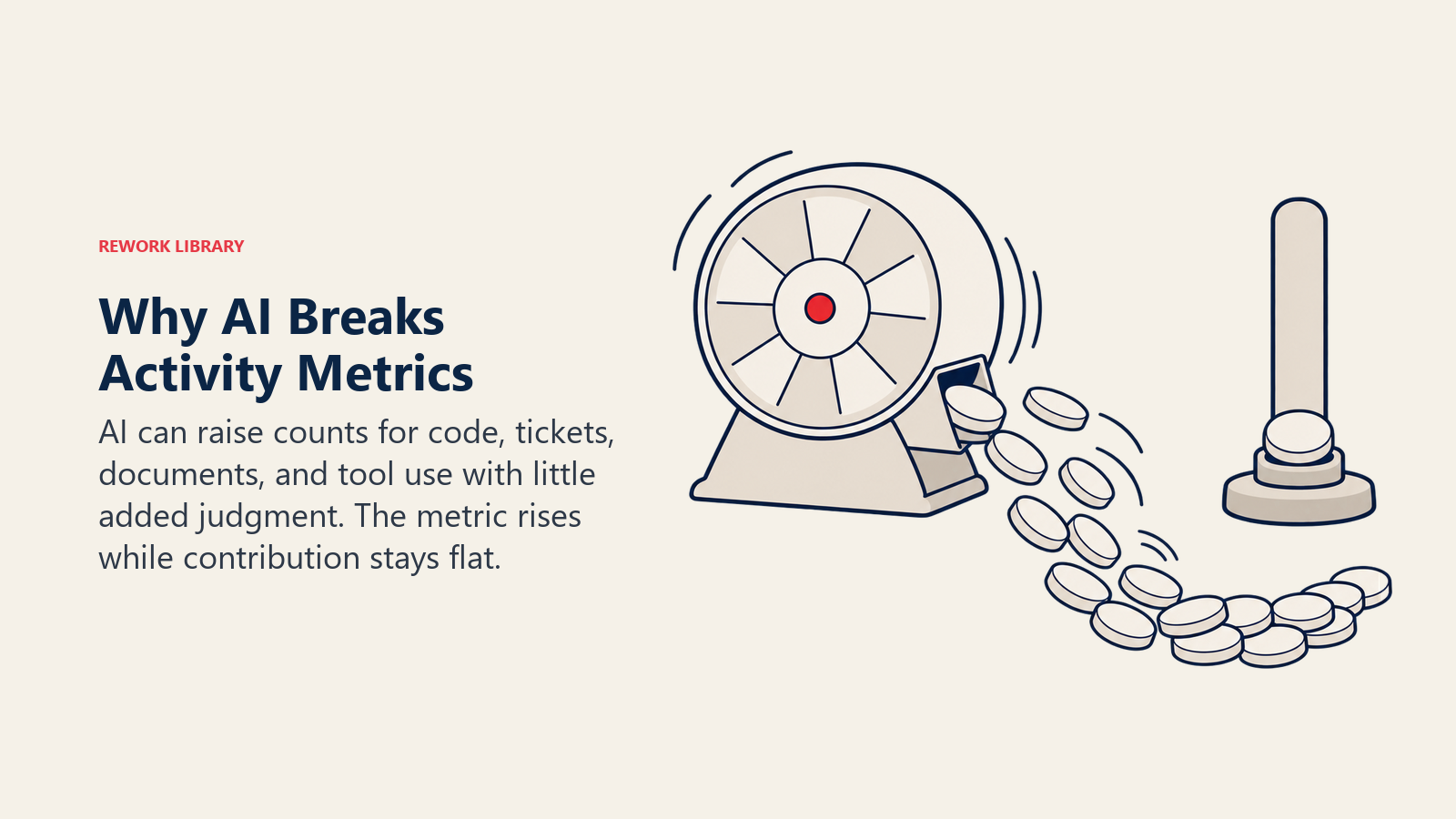
Every organization already has some version of an activity metric: tickets closed, lines of code, words drafted, calls made. These were always an imperfect proxy for value. AI breaks the proxy in a specific way: it makes the activity trivially easy to produce in volume, while the actual judgment (was this the right answer, did it hold up) stays exactly as hard as it always was, or harder, because now someone has to verify the output instead of just producing it.
Goodhart's Law was already waiting for this
Goodhart's Law says a measure that becomes a target stops being a good measure, because people reorganize their effort around whatever the metric rewards rather than the underlying goal. This isn't new to AI: it's the same mechanism behind teachers narrowing instruction to a standardized test, or call center agents keeping calls short to hit a handle-time target instead of solving the problem. What AI changes is the speed of the gaming. A metric that took real effort to inflate before (writing more code, drafting more emails) can now be inflated with a few prompts and almost no judgment, so the gap between "the number went up" and "the value went up" widens faster than most performance systems can adjust.
What a metric used to measure vs. what it rewards now
| Metric | What it looked like it measured | What it actually rewards now |
|---|---|---|
| Lines of code / commits | Engineering output and effort | Verbose AI-generated code and commit-padding, unrelated to working software |
| Tickets closed per week | Support throughput | Splitting easy, AI-assisted tickets into more tickets rather than solving hard ones |
| Words or documents drafted | Writing output | Volume of AI-drafted text, not the thinking, editing, or judgment behind it |
| Response time / turnaround speed | Responsiveness and diligence | Shipping an unverified AI draft fast, not catching the case where it was wrong |
| AI tool usage frequency ("seat adoption") | AI proficiency and enthusiasm | Clicking accept repeatedly, not verifying, correcting, or improving the output |
| Meetings or messages sent | Collaboration and engagement | AI-assisted message volume, which can rise sharply with no change in decisions made |
The lesson software engineering already learned the hard way
Software teams hit this problem first, because code output was one of the earliest things AI made trivially easy to inflate. The industry's answer, formalized in the SPACE framework, was to reject single activity metrics for individuals and measure productivity across five dimensions (satisfaction, performance, activity, communication, efficiency), most of which only make sense at the team or system level. DORA's 2024 research backs this with an uncomfortable finding: AI adoption raised how productive individual developers felt, while measurably hurting the team-level metrics that predict whether software ships reliably. Read only the individual numbers and AI looks like an unambiguous win. Read the team-level numbers next to them and a more honest picture appears, the same pattern this collection documents in the AI productivity paradox: individual signals and organizational outcomes can move in opposite directions at once.
The Team-Level vs. Individual-Level Tradeoff
This is the tradeoff every leader ends up negotiating, whether they name it or not.
Team-level measurement is more honest, but it doesn't answer the pay question
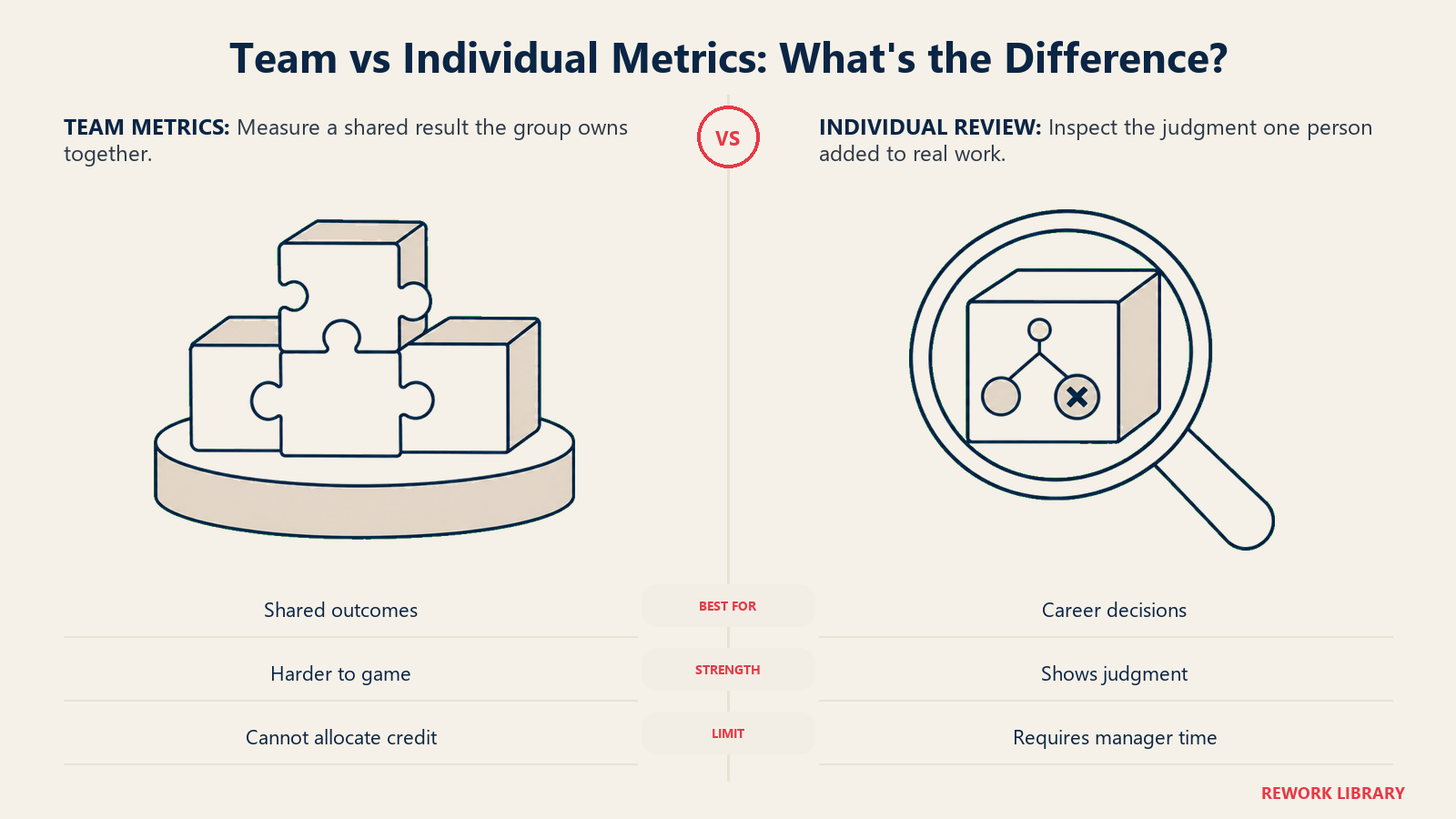
Measuring outcomes at the team or workflow level (did this pod ship the feature, did its customers churn less) resists gaming better, because it's harder for one person to inflate a shared number without the rest of the team noticing. It also fits how orchestrator-style roles work now: a job might be almost entirely judgment and coordination, invisible to any activity count, while still being the reason the team's output is good. The cost is that team-level measurement doesn't, by itself, tell you who to promote or pay more.
Individual-level measurement is what leaders want, and the harder problem
Every comp and promotion system eventually needs an individual signal, because pay decisions are made about people, not pods. But the more precisely you try to isolate one person's marginal contribution, the more you hit a problem nobody has cracked: a person who prompts well, catches the model's mistake, and ships a great result in twenty minutes can look, on any activity metric, identical to someone who accepted the first draft, got lucky, and shipped something mediocre. The two performances aren't the same, and most systems can't tell them apart without a human reviewing the actual work.
There is no clean resolution, and pretending otherwise is worse
The honest position needs both lenses: team-level metrics for decisions affecting the whole group, and individual, judgment-based review for decisions inescapably about one person, like who gets promoted. Trying to automate that individual layer with a dashboard is where most of the damage happens.
Leading Indicators That Still Carry Signal
None of the following is gameable in the same fast, cheap way that activity counts are, because each one requires the observer to actually look at the work rather than count it.
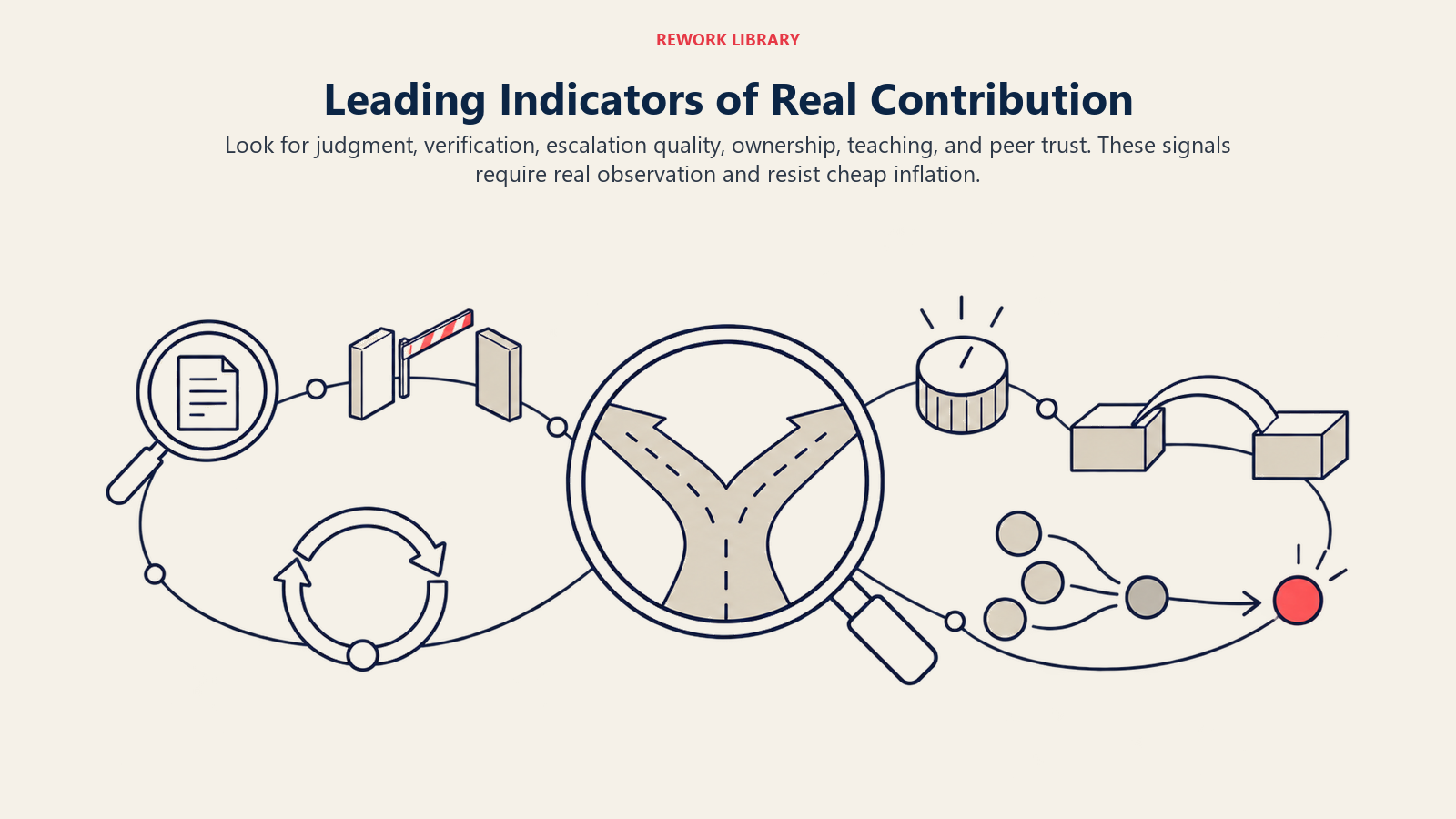
- Judgment under ambiguity. Did this person make a defensible call in a situation the AI tool, the playbook, and the policy didn't clearly cover? The single hardest thing to fake, and the clearest signal of real contribution.
- Verification behavior. Does this person check an AI output against the source or the customer's real situation before it goes out, or wave it through? A manager who spends thirty minutes reviewing real work samples sees this immediately; no automated metric catches it well. That checking time is also the load pace and burnout in the AI era calls the verification tax, work AI's speed created rather than removed.
- Escalation quality. Do they know the difference between a decision to make and one to raise, and raise the right ones at the right time? Escalating everything is as much a failure of judgment as escalating nothing.
- Full-cycle ownership. Did the outcome hold up weeks later, once a customer or downstream team actually used what this person produced? Slower to observe than a weekly dashboard, and far harder to fake.
- Teaching and calibration signal. Does working with this person make others better at spotting AI's mistakes, not just faster at producing output? One of the complementary skills that gets more valuable as AI absorbs routine work.
- Peer-routed trust. When something ambiguous and high-stakes comes up, who do colleagues route it to, unprompted? A real signal most performance systems never bother to capture, even though everyone already knows the answer.
These require an actual human to look at actual work, which is why they resist the fast gaming that activity metrics invite. They're inputs to a judgment call, not a replacement for one.
The Surveillance Trap: Why Monitoring Backfires
The instinct, once activity metrics stop working, is often to monitor harder: screen recording, keystroke logging, AI-usage tracking. The research is unusually consistent, and bad news for that instinct.
What the evidence actually shows
The 2023 meta-analysis covering 94 samples and over 23,000 workers found no evidence that electronic performance monitoring improves performance. It did find a reliable increase in worker stress associated with being monitored, regardless of how it was implemented. That's the opposite of the usual pitch for monitoring tools: more visibility, more accountability, better output. The data says it mostly buys stress with no measurable performance gain.
Trust is the actual mechanism, and it's expensive to rebuild
The same research finds transparency moderates the damage: monitoring that's disclosed and clearly tied to a legitimate goal does less harm than covert or punitive monitoring. But "less harm" isn't "helps." Once people believe they're watched to catch them rather than support them, they route around the system, the same behavior MIT NANDA documented in AI pilots abandoned the moment they created friction. Surveillance-style measurement produces the same failure mode as the metrics it was meant to fix: people optimize for looking productive under the thing being watched, at the expense of the judgment that was the actual point. It also works against the psychological safety a team needs to admit "I'm not sure this AI output is right," which is exactly the behavior worth encouraging.
A Defensible Practical Approach
No formula solves this cleanly. A defensible approach accepts that and builds in the checks the formula can't provide.
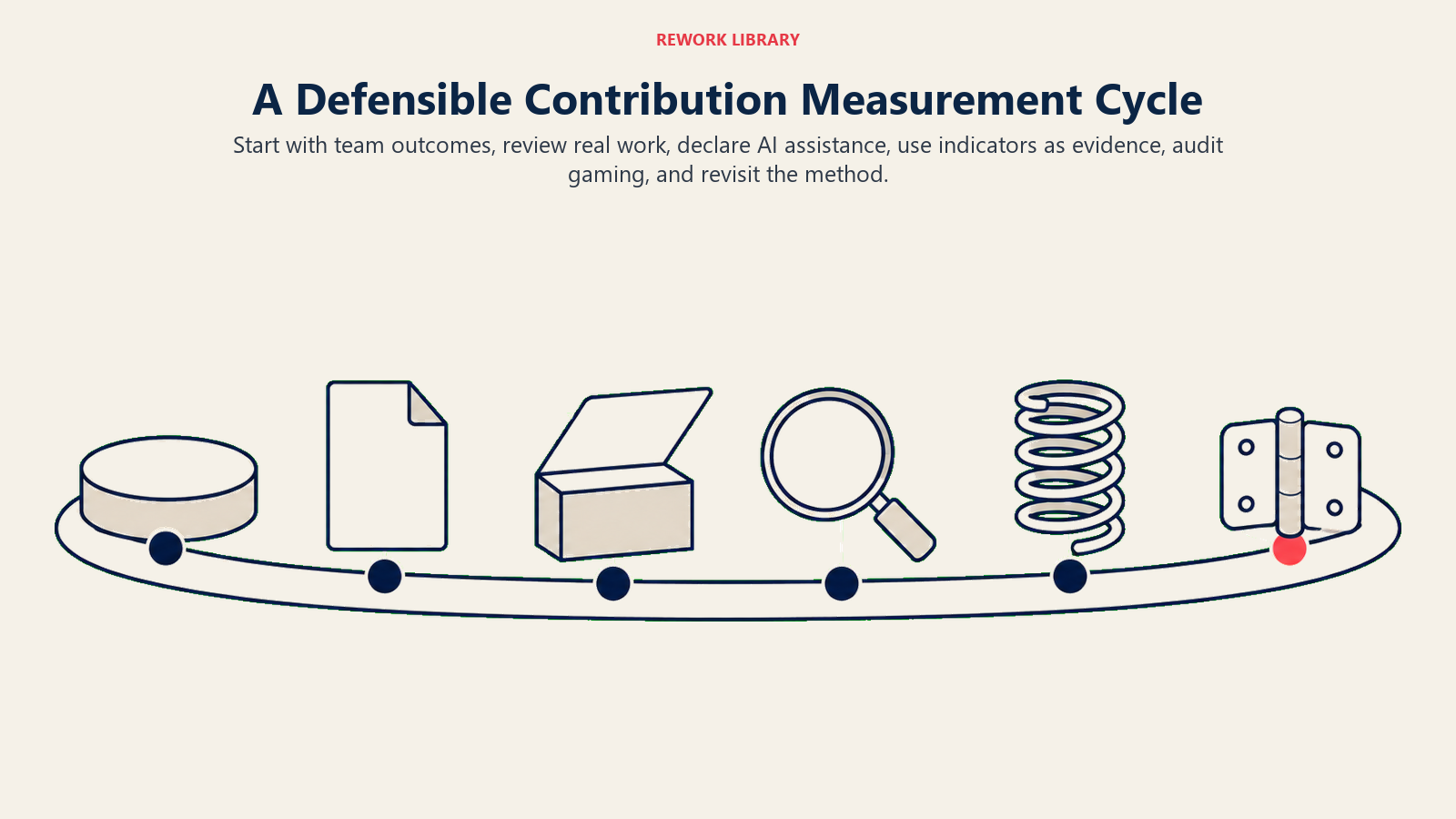
- Default to team- or outcome-level metrics for anything that funds a broad decision. Bonus pools and roadmap credit should track outcomes a group is jointly accountable for, not activity counts AI can inflate unevenly.
- Reserve individual assessment for actual human review of actual work, on a cadence, not a dashboard. A manager reading a sample of real output, including where someone caught or missed a mistake, gets a far more accurate picture than any usage metric.
- Make AI assistance something people declare, not something they hide. If "I used AI to draft this, then revised these three sections" is normal and safe to say, contribution conversations get honest fast. If people hide it to look capable, the whole system runs on bad information.
- Treat leading indicators as inputs to a conversation, not an automated score. The moment one gets formalized into a number that sets pay, it starts to suffer the same Goodhart's Law dynamics as the metrics it replaced.
- Audit for gaming on a fixed cadence and expect any metric to decay. Whatever you measure today gets optimized around within a couple of quarters. Build review of the review into the system.
- Separate "did the work get done" from "was this person's judgment the differentiator." Conflating them is the single most common reason contribution measurement quietly breaks trust.
An AI audit trail that records what a model produced and what a person changed or overrode gives this process something concrete to work from, instead of memory or self-report months later. It works best paired with human-in-the-loop review points built into the workflow itself, and with managers who actively keep their own judgment sharp enough to spot the difference between a good call and a lucky one.
What This Doesn't Solve
Intellectual honesty matters more here than a tidy conclusion. This is genuinely, partly unsolved, and a few things are worth saying plainly rather than glossing over.
There's no reliable, automated way today to separate "prompted well and knew what good looked like" from "got a lucky first draft and shipped it," at the scale most organizations need. The leading indicators above require a human's time, and most organizations haven't budgeted for it, so many will keep defaulting to activity metrics that are cheap to collect and known to mislead. AI ROI measurement at the company level is hard enough; pushing that same rigor down to individual attribution multiplies the difficulty. And the field hasn't converged: what counts as fair attribution in a software team, where SPACE and DORA give a decade of prior art, doesn't automatically transfer to sales, legal, or support, where the failure modes differ enough that borrowing the framework wholesale gets the wrong answer with high confidence.
None of that is a reason to give up on measuring contribution. It's a reason to hold any method loosely, keep a human in the loop on decisions that matter most to a career, and treat this the way the rest of this collection treats every AI-and-work claim: an open, evolving problem with real evidence behind the settled parts and real uncertainty in the rest. Building good culture metrics alongside this work helps, since a team that already measures how it works together has a head start, but it doesn't finish the job alone.
One test cuts through most of this before adopting any contribution metric: would you be comfortable explaining, out loud, to the person being measured, why this number reflects their judgment rather than the model's? If the honest answer is no, the metric isn't ready to touch anyone's pay, no matter how clean the dashboard looks.
Frequently Asked Questions about Measuring Contribution in AI-Augmented Work
Why is measuring individual contribution harder now that AI is involved?
Activity metrics that used to require real, visible effort to inflate (more code, more documents, more tickets closed) can now be produced in volume with minimal judgment. The metric can rise sharply while the value the person actually added stays flat, which breaks the assumption most pay and promotion systems rest on.
What is Goodhart's Law and why does it apply here?
Goodhart's Law, popularized as "when a measure becomes a target, it ceases to be a good measure," describes how any metric tied to a reward gets optimized around rather than genuinely improved. AI speeds this up because the specific behaviors that used to make a metric meaningful (real effort, real output) can now be substituted with AI-generated volume much faster than performance systems can adjust.
Should companies measure contribution at the team level or the individual level?
Both, for different decisions. Team- or outcome-level metrics are harder to game and work well for group-level decisions like bonus pools or roadmap credit. Individual-level assessment is still necessary for pay and promotion decisions about one person, but it requires actual human review of actual work, not an activity dashboard, because dashboards can't reliably separate good judgment from a lucky AI-assisted outcome.
Does monitoring or surveillance software solve the attribution problem?
The evidence says no. A meta-analysis of 94 samples and over 23,000 workers found no evidence that electronic performance monitoring improves individual performance, and found it reliably increases worker stress. Monitoring can also push people to hide their AI use or route around the system entirely, which makes contribution harder to assess honestly, not easier.
What are leading indicators of real contribution in AI-augmented work?
Judgment under ambiguity, verification behavior (checking an AI output before it ships), escalation quality, full-cycle ownership of an outcome after handoff, and whether colleagues route ambiguous or high-stakes work to this person unprompted. These require a human observer and resist fast gaming better than activity counts do.
Is this measurement problem the same as performance management?
They're related but distinct. This is about how to measure what one person actually added to an AI-assisted result. Performance management is the broader process of reviewing, coaching, and rating people over time, which draws on measurement but also involves goal-setting, feedback, and development conversations that go beyond any single metric.
Is there an industry-standard solution to this problem yet?
No. Software engineering has the most mature thinking here, through frameworks like SPACE and DORA's research, but even that field hasn't fully solved individual attribution in AI-assisted work. Treat any current method as a reasonable starting point, not a settled answer.

Co-Founder, Rework.com
On this page
- Key Facts
- Why Attribution Suddenly Matters Again
- Pay and promotion still assume individual output
- Accountability doesn't disappear because a model helped
- Credit shapes morale in ways leaders underestimate
- Why Naive Activity Metrics Fail Worse Than Before
- Goodhart's Law was already waiting for this
- What a metric used to measure vs. what it rewards now
- The lesson software engineering already learned the hard way
- The Team-Level vs. Individual-Level Tradeoff
- Team-level measurement is more honest, but it doesn't answer the pay question
- Individual-level measurement is what leaders want, and the harder problem
- There is no clean resolution, and pretending otherwise is worse
- Leading Indicators That Still Carry Signal
- The Surveillance Trap: Why Monitoring Backfires
- What the evidence actually shows
- Trust is the actual mechanism, and it's expensive to rebuild
- A Defensible Practical Approach
- What This Doesn't Solve