Compensation and Fairness in the AI Era: What Do You Pay the Person Whose Agents Do the Work of Five?
Turn this article into takeaways for your work.


Each assistant summarizes the article only for you and suggests best practices for your work.
Compensation and fairness in the AI era is the unresolved question of what to pay someone whose AI agents let them produce what used to take four or five people. There is no settled answer yet. Output-based pay logic breaks once a tool supplies most of the leverage, and the historical record on who keeps productivity gains isn't encouraging for the worker.
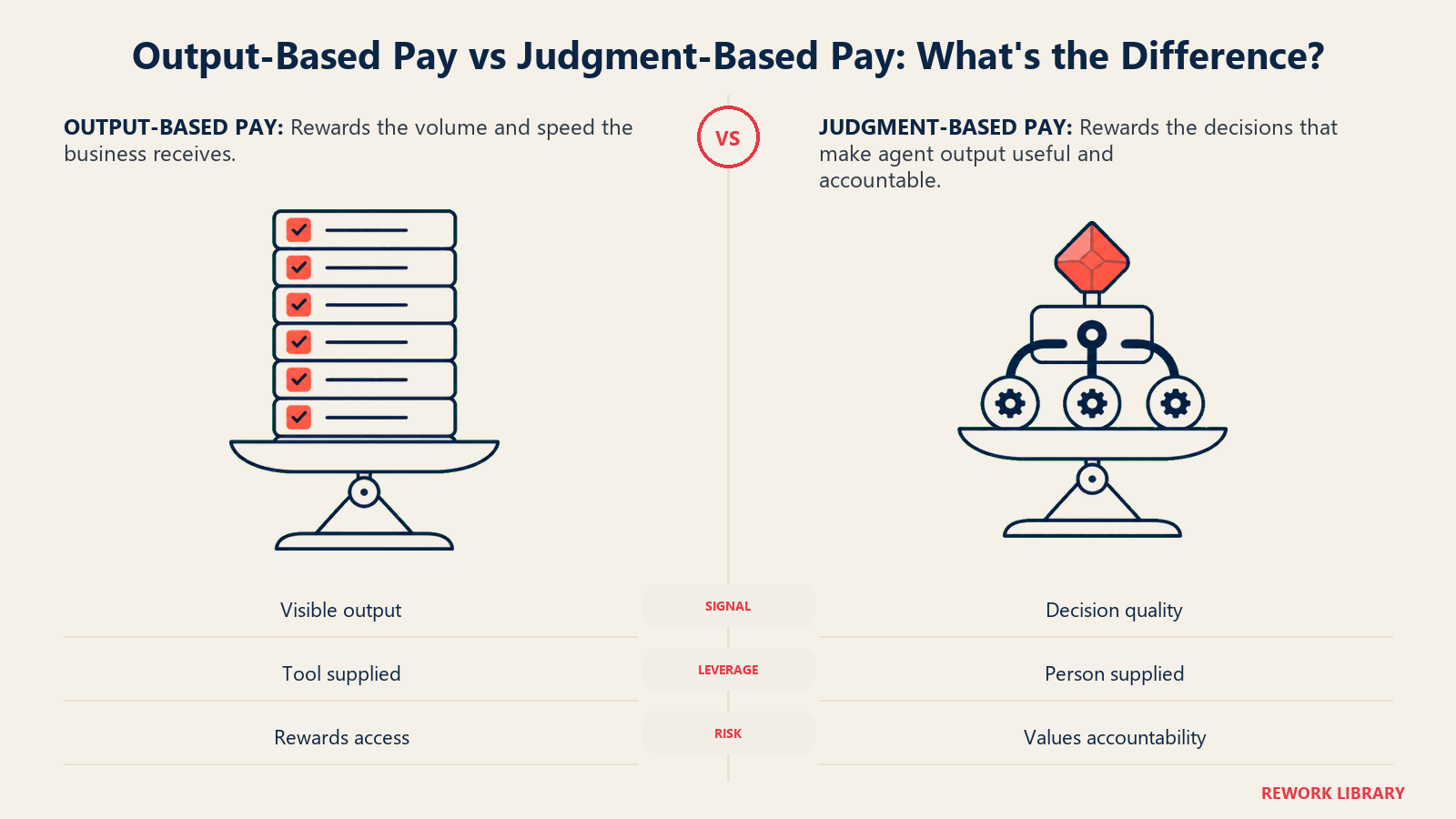
This isn't a policy gap a smarter comp framework quietly resolves. It's a live argument, playing out in comp committees right now, between two positions that can't both be fully true: pay for output, because that's what the business gets, or pay for the judgment underneath the output, because the agents are rented and the judgment isn't. Most companies are answering it by accident, through whatever their existing pay bands happen to do.
Why Output-Based Pay Logic Breaks When the Tool Supplies the Leverage
Pay-for-output logic rests on an assumption nobody had to state out loud: output was mostly a function of the person. A rep closing triple the deals of an average colleague was assumed to be triple as skilled. An analyst producing five models a week instead of one was, by the same logic, worth roughly five times as much. Output was a decent proxy for individual contribution because, for most of the last century, that was approximately true.
The Old Formula: Pay Followed Marginal Output
Compensation theory calls this paying for marginal product: the extra value a worker's next hour adds to the business. It worked reasonably well when the tools available to two people in the same role were interchangeable. Give both a laptop and a CRM, and the output gap between them really did trace back to something about them: judgment, effort, technique.
What Changes When the Leverage Is Rented, Not Earned
AI agents break that proxy quietly. A support rep working alongside an agent that drafts replies and escalates only the hard cases can close five times the tickets of an unassisted colleague, not because they're five times better, but because they're renting five times the tool. Pay-for-output logic, applied naively, now rewards whoever got the better agent stack first, which is closer to a hardware allocation decision than a performance signal. That's the same measurement gap explored in measuring individual contribution in AI-augmented work: once a tool inflates raw output, output stops being a clean stand-in for the person behind it.
None of this means output stops mattering. It means the honest question moved from "how much did this person produce" to "how much of that came from judgment versus the leverage the company handed them," and most performance systems were never built to separate the two.
The Historical Answer: Capital-Driven Gains Rarely Went to the Worker
Every time a company has faced a version of this question, whether the tool was a machine or a piece of software, there's a documented pattern for what happens to the money. It doesn't, by default, flow to the worker in proportion to the productivity gained.
The Productivity-Pay Gap
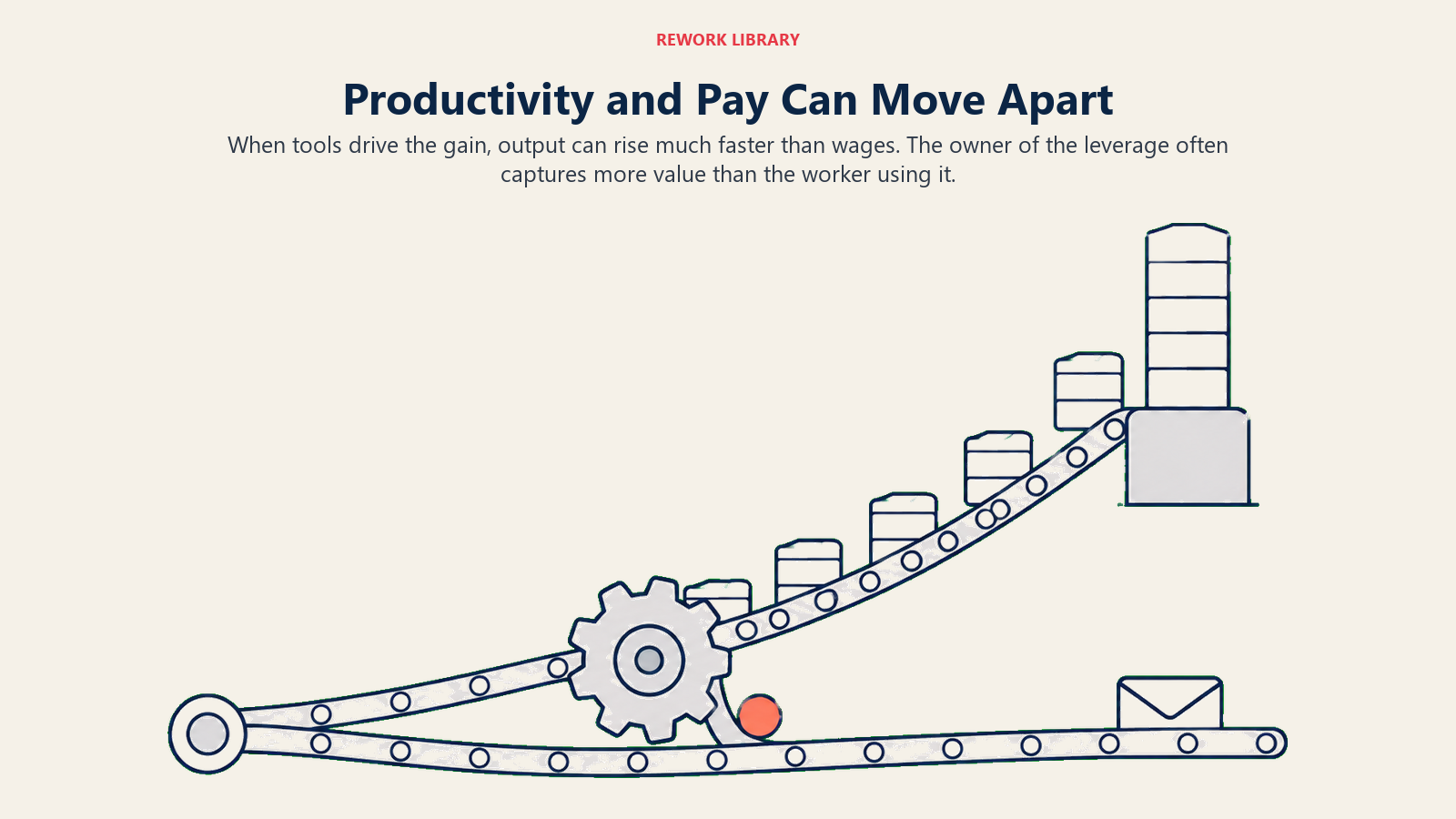
Economists at the Federal Reserve Bank of St. Louis tracked U.S. labor productivity against real wages since the early 1970s and found an accumulated gap of about 70% by the end of 2022, using consumer prices to adjust wages. The gap narrows considerably under a different price measure, and that's worth saying plainly: its size depends on methodology, and economists disagree about which measure answers which question. What doesn't change under any measure is the direction: pay hasn't kept pace with output per hour for roughly half a century. A separate, nonpartisan Congressional Research Service analysis lands in the same place: productivity and pay moved together until the 1970s and diverged afterward, with a shrinking labor share of national income doing much of the explanatory work.
What the Expertise Framework Predicts for AI
A more specific lens comes from MIT economists David Autor and Neil Thompson, whose 2025 research on expertise offers a mechanism rather than a single number. Automation has two opposite wage effects depending on what it removes. Strip out the routine part of a job and leave the expert judgment behind, and the remaining role gets harder to fill: between 1980 and 2018, bookkeeper employment fell by roughly a third while real hourly wages for those who remained rose nearly 40%, because what was left required more judgment. Strip out the expert, hard-to-learn part instead, and the opposite happens: once automation absorbed inventory clerks' most specialized tasks, the job got easy enough that employment more than doubled while real wages fell about 13%.
Which of these two an AI rollout resembles is a design choice most companies make without meaning to, and it predicts the pay outcome better than any stated intention about "rewarding AI-driven output." An agent that absorbs the tedious 80% of a job and leaves the hard 20% argues for higher pay per remaining person. An agent that absorbs the differentiated part and leaves oversight argues for the opposite. Few companies have asked which one their own rollout is.
Pay Question, Old Logic, and What Changes With AI Leverage
| Pay question | The old logic | What changes with AI leverage |
|---|---|---|
| Should output determine pay? | Yes, output reliably proxied skill and effort | Output can reflect tool access more than the person, so it stops being a clean signal |
| Is a "10x" producer worth 10x pay? | Roughly, if the multiple came from their own capability | Weaker case, if the multiple came from an agent stack the company provided |
| Do productivity gains from new tools flow to workers? | Historically, only partially and unevenly | No evidence AI-era gains flow differently; early wage-premium data (below) is volatile |
| Does removing routine tasks help or hurt pay? | Not previously a distinct question | Helps when it leaves judgment behind; hurts when it removes the expert part instead |
| Should "AI skill" carry a premium? | Not applicable | Yes, sharply, for now, though premiums this fast-moving tend to compress |
| Is perceived fairness a soft concern? | Treated as a retention nicety | Measurably tied to trust and job-search behavior, sharper now that AI adds a new comparison point |
Perceived Fairness, Trust, and Why It Isn't a Soft Metric
Every mechanical question above eventually collides with a psychological one: does the person doing the work believe they're paid fairly, regardless of what the spreadsheet says. That isn't a minor variable. It's one of the more reliably measured drivers of trust and attrition in the compensation research, and AI sharpens it.
What Happens When Employees Believe They Are Underpaid
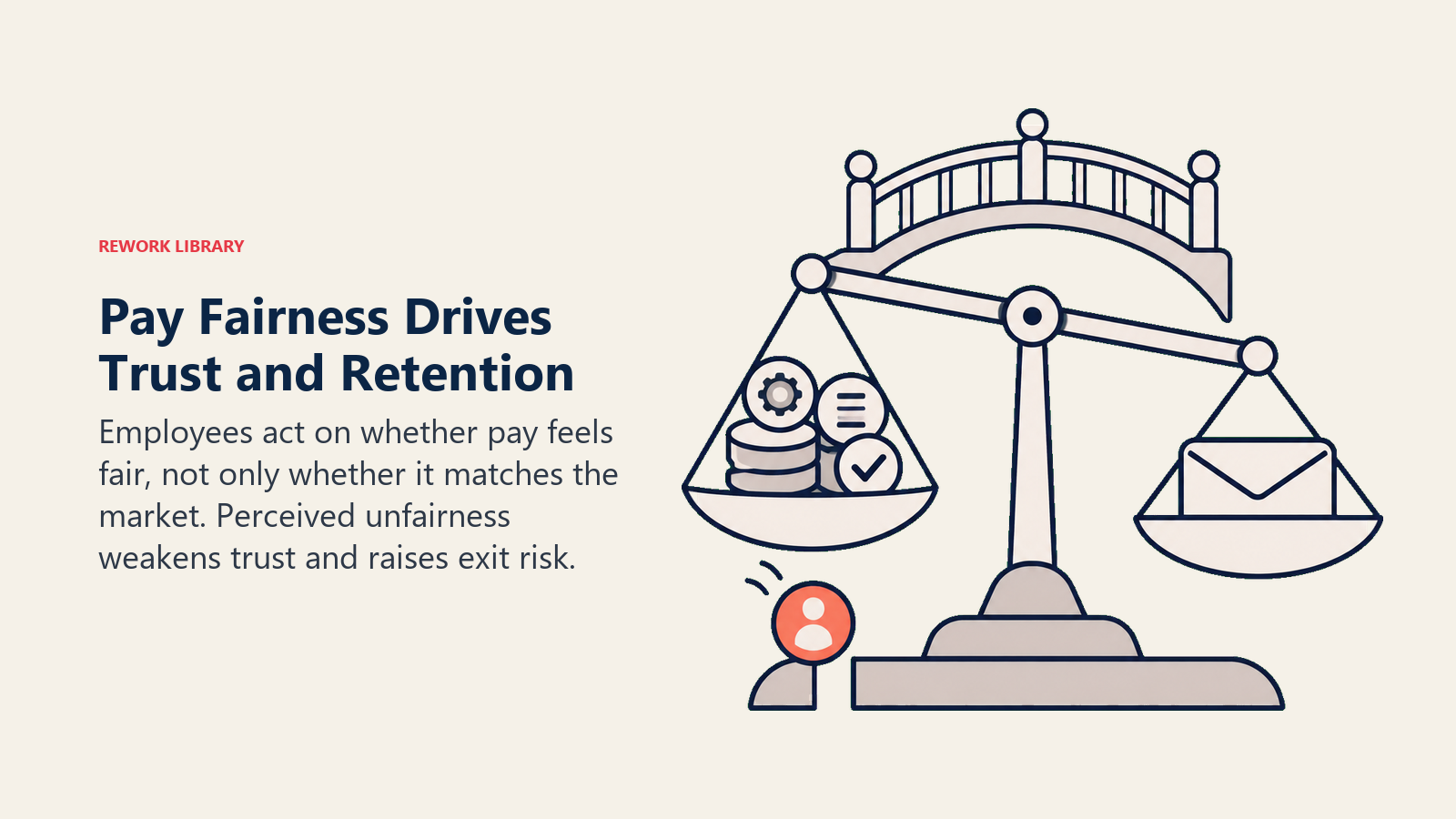
Equity theory, the framework J. Stacey Adams proposed in the early 1960s, holds that people judge fairness by comparing their ratio of inputs (effort, skill, time) to outcomes (pay, recognition, growth) against a reference person's ratio. When the comparison feels lopsided, people reduce effort, push for a raise, discount the comparison, or leave.
Current data backs this up. Payscale's 2025 Fair Pay Impact Report found most workers believe they're underpaid even when actually paid at or above market, and that employees who believe they're underpaid are 45% more likely to be job-hunting within six months than those who feel fairly paid, regardless of actual earnings. A separate 2026 Salary.com survey found workers who rate their pay as unfair are more than five times as likely to report declining trust in their employer (36.4%) as those who feel fairly paid (6.6%). Trust tracks perceived fairness far more tightly than it tracks actual compensation, which is exactly why culture and employee retention treats pay perception as a retention lever in its own right, not just a line item.
The AI Wrinkle: Comparing Yourself to a Machine
Equity theory assumed the reference point was another person. AI leverage complicates that: an employee whose output tripled via an agent stack has to judge whether pay should reflect the tripled output, the unchanged skill underneath it, or an unstated blend. Left unaddressed, that ambiguity resolves into resentment (the company is capturing all the gain) on one side or a sense of being overpaid on the other, and both erode the kind of workplace trust that building trust in the workplace treats as a prerequisite for nearly everything else a team does well.
Should AI Skills Carry a Wage Premium, and How Fast Does It Decay?
Separate from fairness sits a narrower, more measurable question: does working with AI command a real wage premium today, and how durable is it.
The Premium Is Real, and Moving Fast
PwC's 2025 Global AI Jobs Barometer, drawing on close to a billion job postings across 24 countries, found roles requiring AI skills command a 56% wage premium over comparable roles, more than double the 25% premium the same analysis found a year earlier. Lightcast, using a more conservative method across 1.3 billion postings, put it closer to 28%, or roughly $18,000 a year, rising to 43% for postings requiring two or more AI skills. The two measure different things (PwC looks at what AI-skilled roles pay; Lightcast at what employers advertise), which explains some of the gap, but both point the same direction: real, and growing.
Why Premiums Like This Rarely Last
A premium that more than doubled in twelve months is unusual, and that speed cuts both ways. Premiums this large typically show up early in an adoption curve, when a skill is genuinely scarce, and tend to compress as it becomes table stakes, the pattern seen with more than one wave of hot technical skills over the past two decades. Nobody has published solid decay data yet, since the premium itself is barely a year into being measured at scale. Treat the 56% or 28% figures as a snapshot of a market still in its scarcity phase, not a durable feature, and build policy that can adjust downward without a painful renegotiation when it does.
Pay Compression Between AI-Leveraged Juniors and Experienced Seniors
A messier problem shows up inside a single team: what happens to the pay gap between a junior whose agent stack approximates senior-level output, and the senior colleague who built the same judgment the slower way, over years.
The Compression Scenario
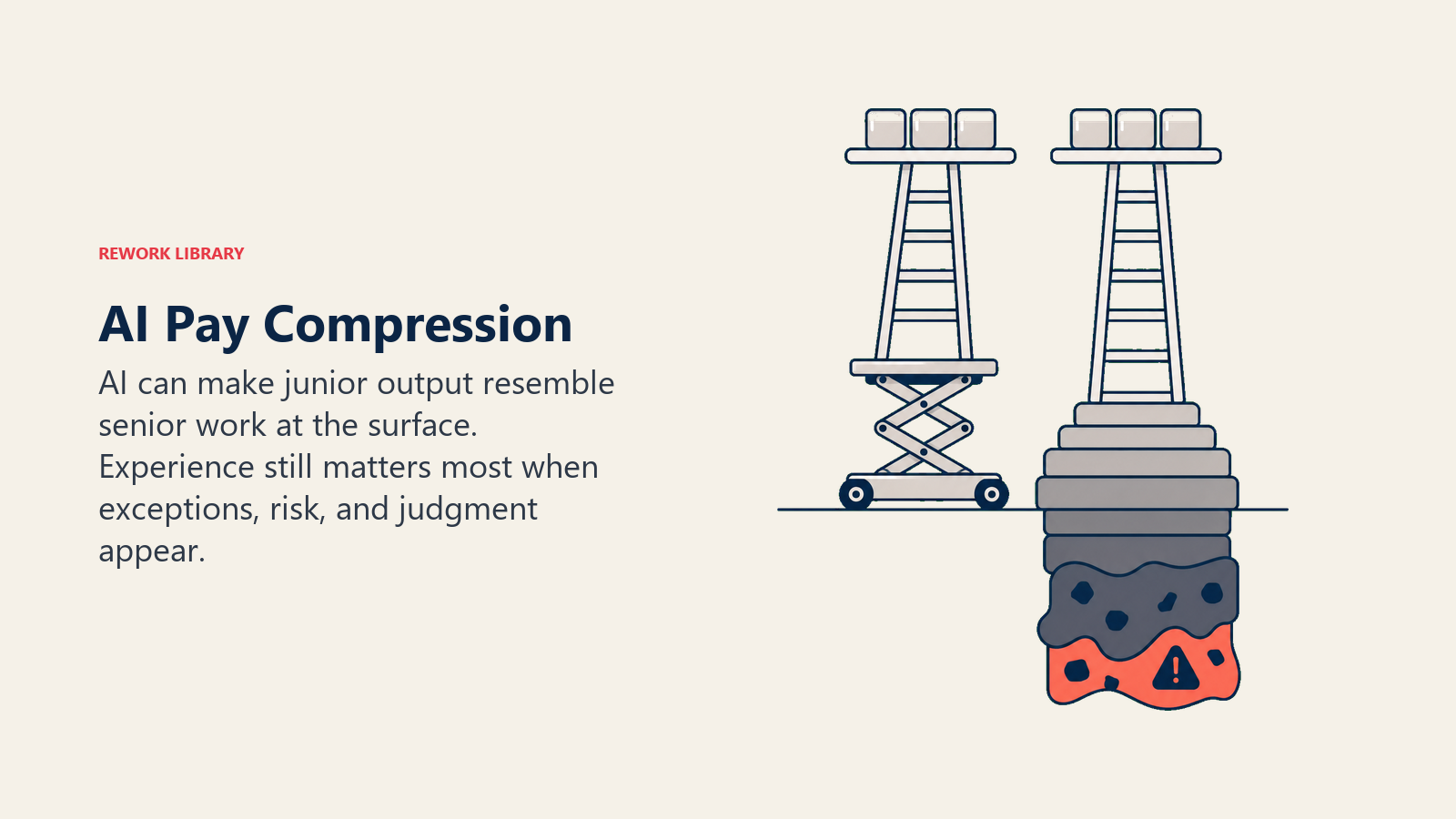
If a two-year associate fluent in orchestrating AI agents produces work comparable in volume and polish to a ten-year veteran's, the experience-based pay ladder starts to look arbitrary to both, for opposite reasons. The junior sees matching output and wonders why the pay doesn't match. The senior sees AI-assisted output measured against the same yardstick as their harder-won judgment and wonders what the years were for. This is the same tension explored from a career-ladder angle in career paths in the age of AI: what "senior" means gets harder to define once it becomes easier to fake at the surface.
Why This Might Be Temporary, or Might Not Be
One argument treats this as a transitional artifact: AI-assisted output looks similar to expert output on the surface, but the judgment gap (knowing when the AI is wrong, when the polished draft hides a bad assumption) hasn't disappeared, just gotten less visible. On that view, compression is a measurement failure evaluation eventually corrects. The counterargument: if AI keeps closing the visible-output gap faster than evaluation can catch up, the market pays for what it can observe, and years of tacit judgment stop commanding a premium, the way the broken bottom rung describes happening to the entry-level jobs that used to build that judgment. Nobody has enough longitudinal data yet to say which future is closer to correct.
What Honest Policy Looks Like
The practical task isn't finding one correct formula. It's building a policy that states its assumptions out loud, so employees can see the reasoning even where they disagree, and revising it without that feeling like a broken promise when the evidence shifts.
Questions to Answer Before You Set a Policy
Name, in writing, whether your pay bands reward output, judgment, or an explicit mix, because most companies have never actually decided. Audit whether a given AI rollout resembles the bookkeeper pattern (routine work removed, judgment intensified) or the inventory-clerk pattern (expert work removed, role commoditized), since the two argue for opposite adjustments. Decide, before someone asks in a one-on-one, whether an AI-skills premium is a genuine part of your philosophy or a temporary market-matching adjustment, and say which. This belongs in the same conversation as performance management when AI does the work, since evaluating requires defining first, and it should draw on the AI-complementary skills your company has actually decided to reward, not whichever are loudest in the job market.
What Not to Promise Employees
Don't promise pay will track individual output one-to-one, because that link is exactly what's breaking. Don't promise an AI-skills premium is permanent, because premiums this size tend to compress once the skill stops being scarce. Don't treat fairness as secondary to the "real" numbers: the data above shows perceived fairness predicting trust and attrition more reliably than most output metrics. And don't treat this as a DEI checkbox separate from core comp strategy: pay compression and AI-driven output inflation land unevenly across roles and tenure, and a policy that ignores it will surface as a fairness complaint either way.
None of this produces a formula to hand a comp committee and call finished. It produces a defensible position: attentive to the evidence, honest about what isn't known yet, and built to revise when better data arrives. Compensation is only one piece of the larger question what is the future of work is trying to answer, and on this piece specifically, unsettled may be the most honest place to land this year.
Key Facts
- The accumulated gap between U.S. labor productivity and real wages (consumer-price deflator) reached roughly 70% by the end of 2022, though the size depends heavily on which price index adjusts wages. Source: Federal Reserve Bank of St. Louis, FRED Blog, 2023
- Automation removing routine tasks tends to raise wages and shrink headcount (bookkeepers: employment down about a third, real wages up nearly 40%, 1980-2018); automation removing expert tasks tends to do the opposite (inventory clerks: employment more than doubled, real wages down about 13%). Source: Autor and Thompson, "Expertise," NBER, 2025
- Roles requiring AI skills commanded a 56% wage premium, more than double the 25% premium recorded a year earlier, across close to a billion job ads in 24 countries. Source: PwC 2025 Global AI Jobs Barometer, reported by Open Data Science
- A separate analysis of 1.3 billion job postings found a more conservative 28% AI-skills wage premium (about $18,000 a year), rising to 43% for two or more AI skills. Source: Lightcast, "Beyond the Buzz," via PR Newswire, 2025
- Employees who believe they're underpaid, even at or above market, are 45% more likely to be job-hunting within six months than those who feel fairly paid. Source: Payscale, 2025 Fair Pay Impact Report
- Employees who rate their pay unfair are more than five times as likely to report declining trust (36.4%) as those who feel fairly paid (6.6%). Source: Salary.com research, August 2026, via GlobeNewswire
Frequently Asked Questions about Pay and Fairness in the AI Era
If AI agents let one person do the work of five, should that person be paid five times as much?
Not automatically. Much of that output multiple comes from the tool rather than the individual, and whether higher pay is justified depends on how much of the gain came from judgment versus company-provided leverage, a distinction most pay systems don't yet make.
Does history suggest AI productivity gains will go to workers or companies?
Not encouragingly for workers by default. U.S. wage growth has lagged productivity growth by a wide, methodology-dependent margin since the 1970s, and nothing in current evidence suggests AI will automatically behave differently.
Should companies pay a premium for AI skills?
The market already does: premiums range from roughly 28% to 56% depending on methodology, and doubled in a year by one measure. Premiums that move this fast have historically compressed once the skill becomes common, so treat it as temporary rather than a permanent tier.
Why does perceived fairness matter if the pay math is defensible?
Because trust and attrition track perceived fairness more reliably than actual pay levels. Employees who feel underpaid job-search and lose trust at much higher rates, even when objectively paid at or above market.
What is pay compression, and why is AI making it worse?
It's when pay gaps between junior and senior employees shrink despite unchanged experience differences. AI can make junior output look similar to senior output on the surface, raising the question of whether the underlying judgment gap still justifies the pay difference.
Is there a proven, correct way to set AI-era compensation policy?
No, and any framework claiming to have solved it deserves skepticism. State your assumptions, audit whether your AI rollout adds or removes judgment from a role, and build in room to revise as better data arrives.
Should junior employees be paid less because their output is AI-assisted?
Not as a blanket rule. What matters is whether the AI removed routine work, which historically raises the value of remaining judgment, or removed expert work, which historically commoditizes the role.
What's the biggest mistake leaders make setting AI-era pay policy?
Treating it as a purely financial calculation and skipping the fairness conversation. A policy defensible on a spreadsheet but never explained will still generate the attrition and trust problems tied to perceived unfairness.

Co-Founder, Rework.com
On this page
- Why Output-Based Pay Logic Breaks When the Tool Supplies the Leverage
- The Old Formula: Pay Followed Marginal Output
- What Changes When the Leverage Is Rented, Not Earned
- The Historical Answer: Capital-Driven Gains Rarely Went to the Worker
- The Productivity-Pay Gap
- What the Expertise Framework Predicts for AI
- Pay Question, Old Logic, and What Changes With AI Leverage
- Perceived Fairness, Trust, and Why It Isn't a Soft Metric
- What Happens When Employees Believe They Are Underpaid
- The AI Wrinkle: Comparing Yourself to a Machine
- Should AI Skills Carry a Wage Premium, and How Fast Does It Decay?
- The Premium Is Real, and Moving Fast
- Why Premiums Like This Rarely Last
- Pay Compression Between AI-Leveraged Juniors and Experienced Seniors
- The Compression Scenario
- Why This Might Be Temporary, or Might Not Be
- What Honest Policy Looks Like
- Questions to Answer Before You Set a Policy
- What Not to Promise Employees
- Key Facts