How to Build Trust in the Workplace
Turn this article into takeaways for your work.


Each assistant summarizes the article only for you and suggests best practices for your work.
Building trust in the workplace means demonstrating, consistently and over time, that you are both competent (you can do the job) and have good character (you will do right by the people around you). Trust is not a feeling that either exists or doesn't. It is the accumulated result of specific, observable behaviors, which is also why it can be built on purpose and rebuilt after it breaks.
That definition matters because most workplace advice treats trust as something you either have with someone or don't, like a light switch. Researchers who study it treat it as a dial with moving parts: ability, integrity, and benevolence in the academic literature, or competence and character in the popular leadership writing built on top of it. This article covers those models, why trust functions as the load-bearing wall under culture and performance, how it gets built and broken in practice, the difference between trust among peers and trust in leadership, a cross-cultural wrinkle most trust advice ignores, and what changes now that a growing share of "teammates" are AI systems instead of people.
What Workplace Trust Actually Is
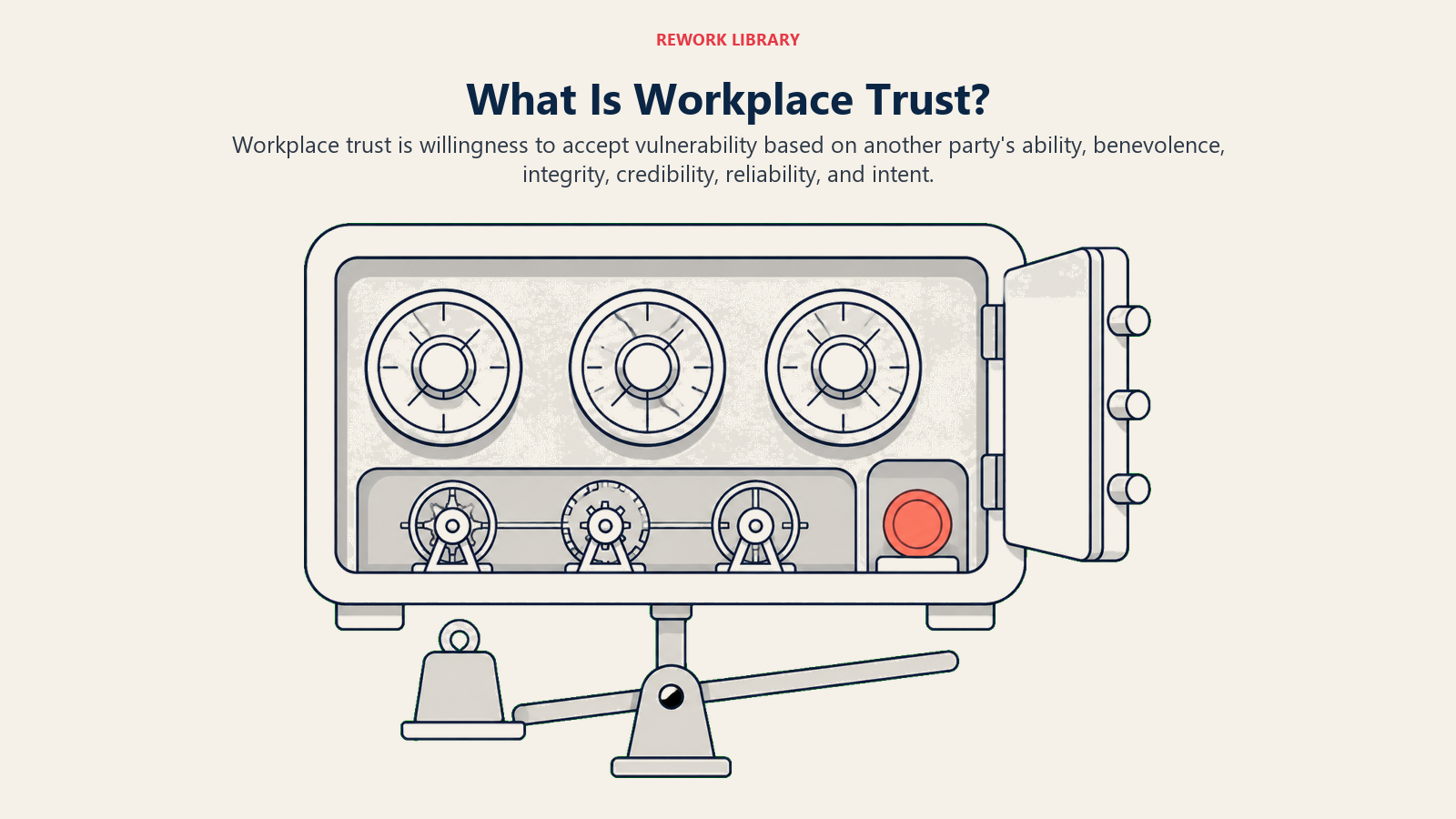
Organizational researchers Roger Mayer, James Davis, and F. David Schoorman published the model that most later trust frameworks build on in a 1995 paper for the Academy of Management Review. They defined trust as a willingness to be vulnerable to another party's actions, based on the expectation that the other party will perform a particular action important to you, regardless of your ability to monitor or control them. Their model breaks the basis for that willingness into three factors: ability (does this person have the skill to do what they say), benevolence (do they care about my interests, not just their own), and integrity (do they operate by principles I find acceptable and stick to them consistently).
Notice what is missing from that list: liking someone. You can trust a colleague you would never invite to dinner, because trust is a judgment about reliability and intent, not a judgment about warmth. This is also where trust differs from psychological safety, a related but distinct concept. Psychological safety is a team-level belief that speaking up will not get you punished. Trust is more often a one-to-one judgment about a specific person or system. A team can be psychologically safe in general while individual members still trust each other unevenly, and building trust between two specific people is usually the fastest way to raise the safety of the whole room.
The Trust Equation
Consultant Charles H. Green's Trust Equation, introduced in his book The Trusted Advisor, breaks trust into a simple formula that has held up well in practice: Trust = (Credibility + Reliability + Intimacy) divided by Self-Orientation.
Credibility is what someone says: do their words hold up, do they know what they are talking about. Reliability is what someone does: do they follow through on commitments, show up on time, deliver what they promised. Intimacy is how safe someone feels to be candid with: can you tell them something sensitive without regretting it later. Self-orientation is the denominator that shrinks all three: how much someone appears focused on their own interests versus yours. A brilliant, reliable colleague who is visibly building their own case for promotion in every interaction still scores low on trust, because the equation punishes self-interest even when the other three numbers are high.
Covey's Speed of Trust: Character and Competence
Stephen M.R. Covey's book The Speed of Trust collapses the same idea into two words: character and competence. Character covers integrity (do you match your words with your actions) and intent (are your motives genuinely good for the other person, not just yourself). Competence covers capabilities (do you have the skills the role requires) and results (do you actually deliver a track record of them). Covey's core argument, and the reason the book's title uses the word "speed," is that trust functions as a tax or a dividend on every interaction. Low trust adds friction and cost to everything: more approvals, more documentation, more meetings to confirm what a trusted colleague would have just been allowed to do. High trust removes that friction, which is why trust shows up in how fast decisions move as much as in how people feel.
Key Facts
- "My employer" was the most trusted institution measured in the 2026 Edelman Trust Barometer, with 78% of respondents saying they trust their employer to do the right thing, ahead of business, government, media, and NGOs. Source: Edelman
- Compared with people at low-trust companies, people at high-trust companies report 74% less stress, 50% higher productivity, 40% less burnout, and 76% more engagement at work. Source: Harvard Business Review, "The Neuroscience of Trust"
- In PwC's Trust in US Business Survey, 86% of executives say they highly trust their employees, but only 60% of employees feel highly trusted back, and only 67% say they highly trust their employer in return. Source: PwC
- Only 27% of workers say they fully trust their employer to use AI responsibly, and 59% believe AI is making workplace bias worse rather than better. Source: HR Dive
- In the same survey, 77% of workers say they review a coworker's output more carefully once they know AI was involved, and 45% have had to redo work a colleague leaned on AI for too heavily. Source: HR Dive
Why Trust Is the Foundation of Culture and Performance
Trust is not one input into culture among many. It is closer to the foundation the rest of culture gets built on, because almost everything else people call "culture" only works if trust is already present. Feedback only lands if the recipient trusts the feedback is meant to help them, not to make a case for their exit. Speaking up in a meeting only feels worth the risk if you trust it will not be held against you later, which is the specific mechanism behind psychological safety at work. Delegation only works if a manager trusts the work will come back done right, and an employee trusts they will not be punished for a reasonable mistake made along the way.
That is also why the link between culture and performance runs so consistently through trust specifically, rather than through more visible things like perks or mission statements. High-trust organizations move faster because fewer decisions require a paper trail to protect against bad faith. They retain people longer because employees who trust their leadership are not constantly hedging against being blindsided by a reorg or a broken promise. And they catch problems earlier, because someone who trusts that raising a concern will be treated as useful information, not a threat, tends to raise it while it is still small and cheap to fix.
How Trust Is Built
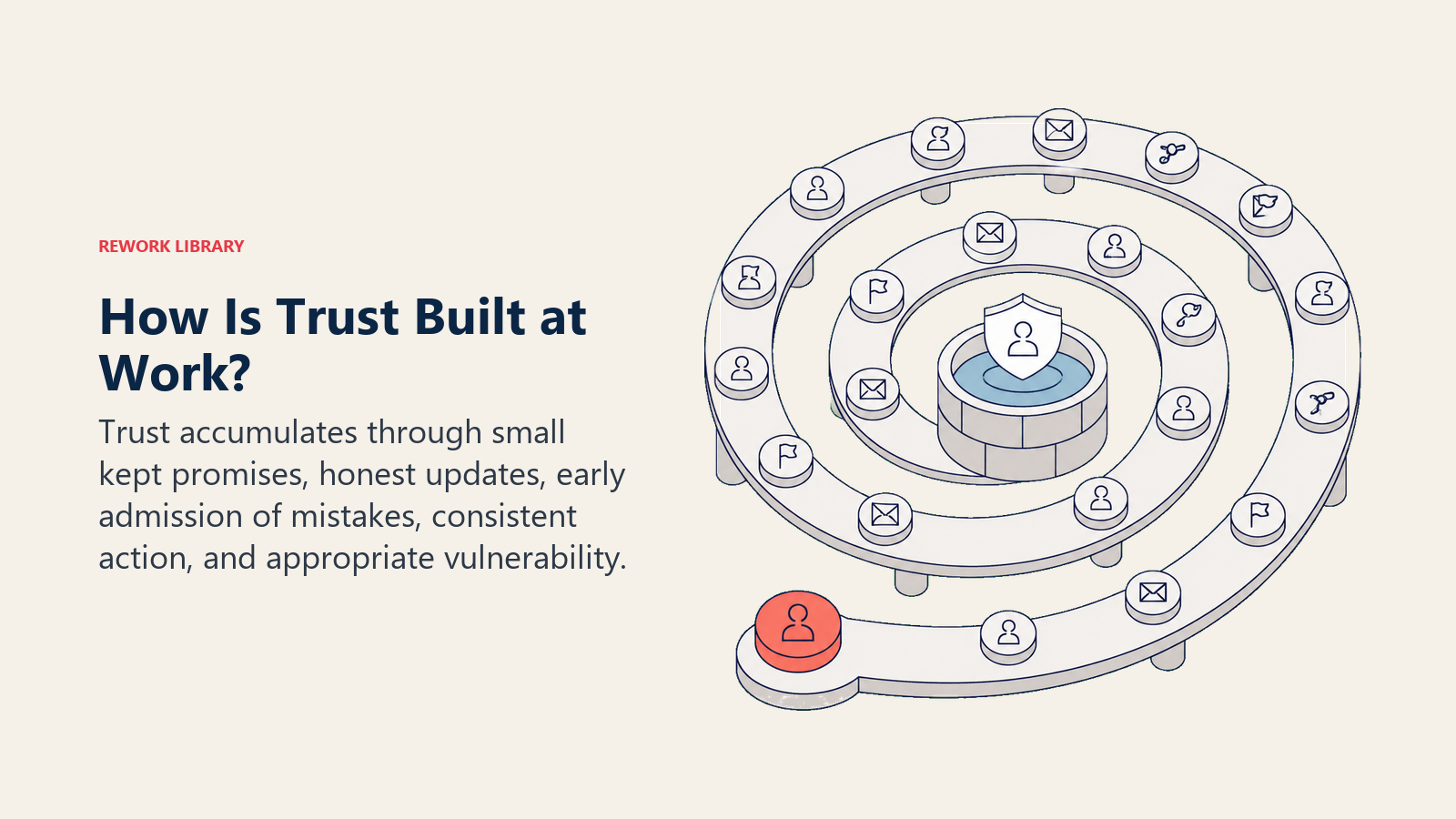
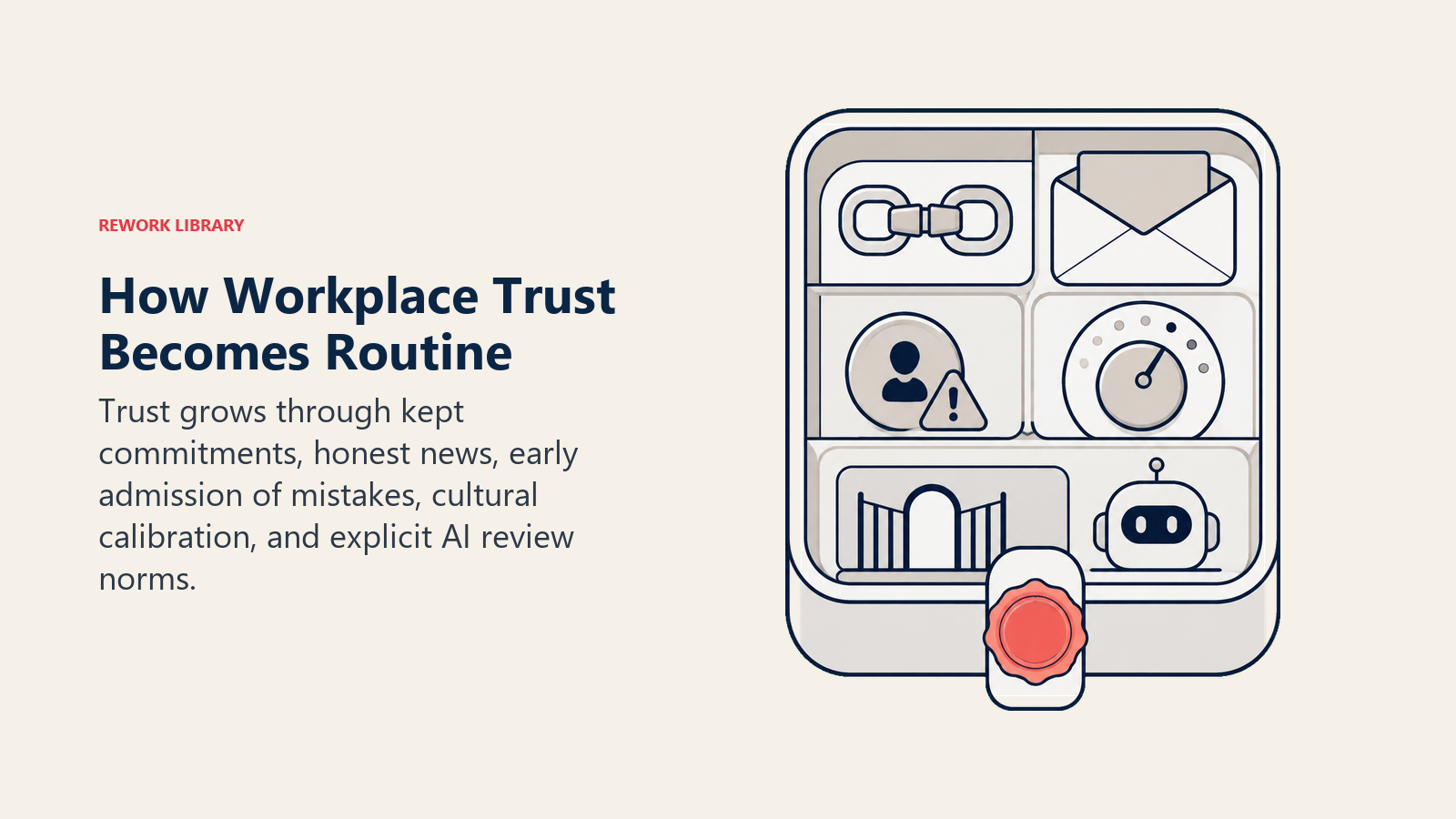
Trust is built the slow way: through a long series of small, kept commitments, not through a single grand gesture. Someone says they will follow up by Friday, and they do. Someone admits a mistake before being caught, rather than after. Someone gives you the real version of bad news instead of the softened one. None of these single moments feels significant on its own. The pattern across dozens of them is what a colleague eventually starts calling "someone I trust."
Consistency between what someone says and what they do matters more than any individual promise, because it is the pattern, not the promise, that people are actually tracking. A leader who talks about transparency but only shares good news is training the team to discount everything they say about transparency going forward. A leader who shares a genuinely hard number, on time, even when it reflects poorly on the team, builds more trust in that one act than a year of values-deck language.
Trust Between Team Members (Peer Trust)
Peer trust tends to build fastest around visible follow-through on small, mundane commitments: did the notes actually get sent, did the handoff include the context the next person needed, did someone flag a risk before it became someone else's emergency. It also builds through appropriate vulnerability: admitting "I don't know" or "I got this wrong" in front of peers, rather than only in private, signals that this team is a safe place to be imperfect out loud, which is the same territory building a feedback culture depends on.
Trust in Leadership (Vertical Trust)
Trust in leadership carries extra weight because of the power asymmetry involved: an employee who is wrong about trusting a peer usually absorbs a smaller cost than an employee who is wrong about trusting a manager who controls their pay, their assignments, and their career path. That asymmetry is exactly what shows up in the PwC gap above. Executives consistently overestimate how much they are trusted, because from their seat, they mostly see the version of events that reaches them, not the version employees are quietly protecting themselves against. Closing that gap takes leaders actively seeking out the version of the story they are not automatically shown, and then visibly acting on what they hear.
How Trust Breaks Down
Trust is asymmetric: it is built in small increments and can be destroyed in one. A single broken promise, one instance of taking credit for someone else's work, or one moment of publicly humiliating someone for an honest mistake can undo months of consistent, trust-building behavior. That asymmetry is not unfair, it is functional: it exists because a single serious violation is genuinely more informative about someone's real character than a long run of ordinary good behavior, which is easier to fake for a while.
The most common ways trust erodes in practice are rarely dramatic. Inconsistency between words and actions, over time, teaches people to stop believing the words. Withholding information "to protect people" usually reads as condescension once discovered, and it almost always gets discovered. Favoritism, even unintentional, teaches everyone outside the favored circle that the stated rules are optional for some people. And blame that lands on the person who raised a problem, rather than on the problem itself, is one of the fastest ways to teach an entire team to stop raising problems, a dynamic covered in depth in how to measure company culture and the silence patterns it is designed to catch early.
Rebuilding Broken Trust
Trust can be rebuilt, but not on the timeline most people want, and not through apology alone. Stephen R. Covey described relationships as running an "emotional bank account": every trust-building action is a deposit, every trust-breaking action is a withdrawal, and a single large withdrawal can wipe out a long history of deposits. Rebuilding means making deposits again, deliberately and visibly, for long enough that the other party's risk calculation actually changes, not just their stated forgiveness.
Three things speed up a genuine rebuild. First, a specific, non-defensive acknowledgment of what happened, without immediately pivoting to context or excuses; people can hear context later, but a rushed defense right after a violation reads as minimizing it. Second, a visible change in the underlying behavior, not just a promise to do better, because promises are exactly the currency that already got spent. Third, patience with the timeline: the person who was let down gets to set the pace of re-earning trust, and pushing them to "move on" faster than they are ready to almost always backfires into a second, smaller breach layered on top of the first.
The Cross-Cultural Nuance: Trust Isn't Built the Same Way Everywhere
Most trust advice, including the frameworks above, quietly assumes one cultural default: that trust is earned by delivering on commitments. That default is accurate for a lot of the world, and it is not universal. Researcher Erin Meyer's Culture Map names this a specific axis, "Trusting," and splits it into two distinct routes to the same destination.
Task-based cultures, common in the US, the UK, and much of Northern Europe, build trust primarily through work: you do what you said you would do, reliably, and trust follows the track record. Relationship-based cultures, common across much of Southeast Asia, Latin America, China, and the Middle East, build trust primarily through personal connection first, and treat a rush straight to business as a mild warning sign rather than a sign of efficiency. Neither route is more "real" than the other. They are two different, internally consistent mechanisms for answering the same underlying question: can I take a risk on this person. The full model, and how it interacts with communication style, hierarchy, and decision-making, is covered in The Culture Map, explained and applied to day-to-day team leadership in managing a multicultural team.
The practical failure mode is predictable once you see it named. A task-based leader who skips small talk to "respect everyone's time" with a relationship-based team reads as cold and untrustworthy, no matter how reliable their delivery track record is, because reliability was never the thing being evaluated first. A relationship-based leader who invests heavily in personal rapport with a task-based team can read as evasive or unserious if the actual deliverables slip while the relationship-building happens. Leading a genuinely global or distributed team means recognizing which route a given colleague is running on, and meeting them there, rather than assuming your own default is simply how trust works. How business culture differs across the world covers the broader map this specific axis sits inside.
Trust When Your Teammate Is AI
Every model above assumes trust is a judgment about another person. That assumption is getting tested constantly now that a growing share of daily work involves handing a task to an AI system and deciding how much to rely on what comes back, which is exactly the territory what is AI-native culture and the new manager role Microsoft has called the agent boss are both about. Trust in AI output turns out to fail in both directions, not just one.
Over-trust. A mid-2025 study by AI safety research group METR had experienced open-source developers complete real coding tasks with and without AI tools available. They finished 19% slower with AI available, yet afterward estimated it had made them 20% faster. That gap between measured and perceived performance is automation bias in a controlled setting: people systematically overestimate how much an AI assistant is actually helping, and that overconfidence is precisely what stops anyone from double-checking the output closely enough. Research on human-AI collaboration describes this as a structural risk of automated systems generally, not a personal failing: the more polished and confident an output looks, the less scrutiny it tends to get, regardless of whether the confidence is warranted.
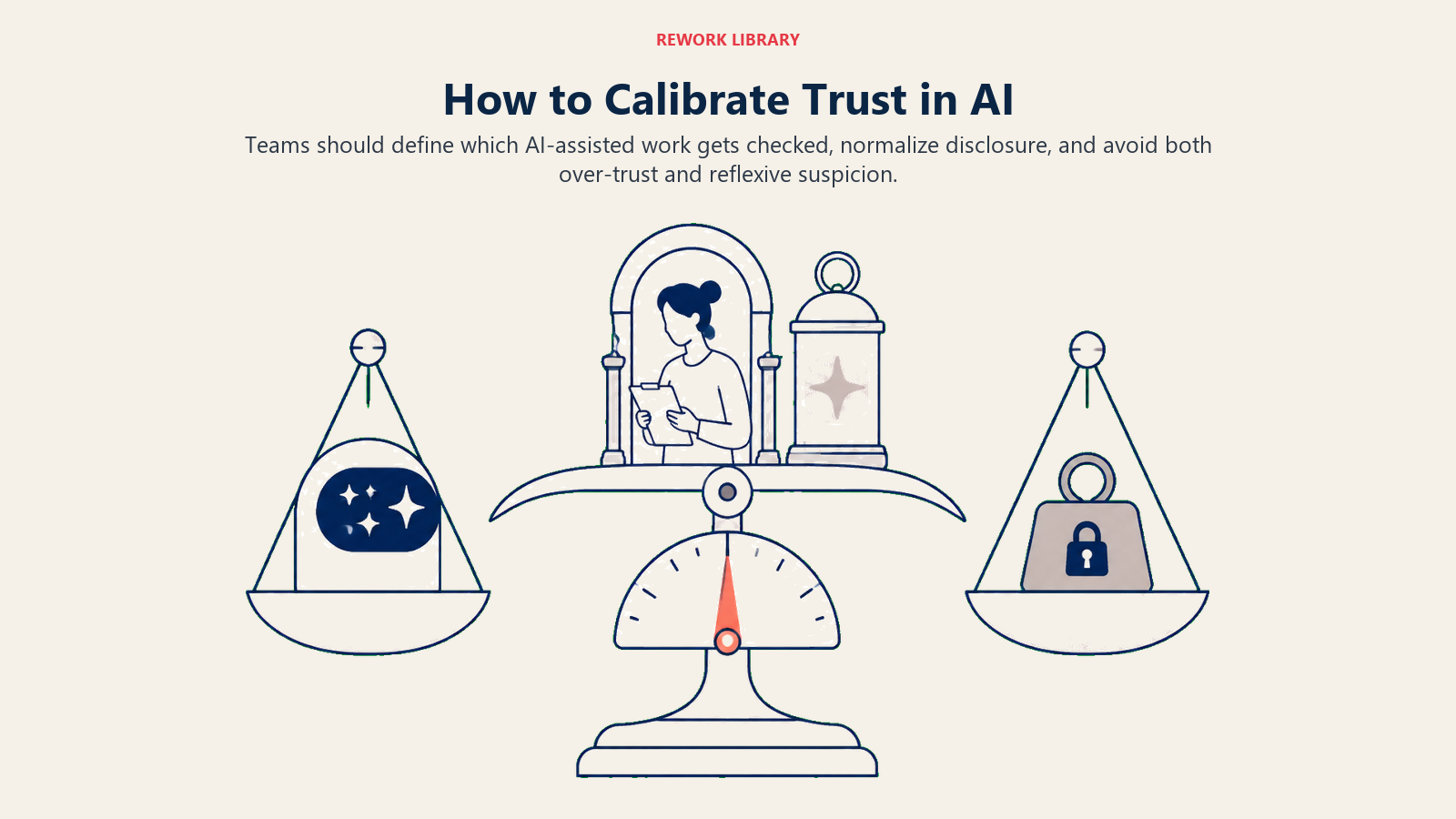
Under-trust, and the opposite problem. Researchers Logg, Minson, and Moore documented the reverse effect in their work on "algorithm appreciation": in several tasks, people actually weighted algorithmic advice more heavily than equivalent advice from another person, particularly for judgments that felt objective or quantifiable. Combined with the over-trust findings above, the honest conclusion is that people are inconsistent, not uniformly skeptical or uniformly credulous, about trusting AI output. That inconsistency is exactly why blanket rules ("always verify AI work" or "trust the tool, it's been tested") both fail. What actually works is naming, out loud, which categories of AI-assisted work get spot-checked and which do not, so trust in the output is a team decision rather than each person's private guess.
Disclosure. Only 27% of workers fully trust their employer to use AI responsibly, and 77% say they review a colleague's work more carefully once they know AI was involved, which creates a quiet incentive to hide AI use rather than disclose it, the exact dynamic AI cultural debt describes accumulating unmanaged. A team that treats "I used AI for the first draft" as neutral, disclosed information builds more real trust over time than a team where using AI feels like something to admit under pressure. The fix is not a policy banning AI. It is making disclosure boring and normal, so nobody has to choose between using a useful tool and being seen as trustworthy about how they used it.
Where This Leaves You
None of this requires a personality transplant. Trust is a specific set of behaviors, not a trait some leaders have and others don't: keep the small commitments, tell people the real version of the news, admit the mistake before you're caught, and adjust how you build it depending on whether the person across from you runs on task-based or relationship-based defaults. The same discipline extends, awkwardly but genuinely, to the AI systems now doing a share of the work: name what gets checked, disclose how the work got made, and resist both the over-trust and the reflexive suspicion that make that disclosure harder than it needs to be.
The unglamorous, operational side of trust, consistent onboarding, clear ownership of who is accountable for what, and feedback and recognition that actually reach the people who earned them, is easier to sustain when it is not scattered across five disconnected tools and a dozen manual handoffs. That is the kind of quiet consistency Rework's Work Ops and People app are built to support underneath the harder leadership work described above, not a replacement for it.
Frequently Asked Questions about Building Trust in the Workplace
What is the fastest way to build trust in the workplace?
There is no shortcut, but the highest-leverage single behavior is consistently keeping small commitments: following up when you said you would, delivering what you promised, and telling people the real version of bad news instead of a softened one. Trust accumulates from a pattern of small, kept promises far more than from any single grand gesture.
What are the main components of trust at work?
Most research-backed models agree on the same two categories under different names. Mayer, Davis, and Schoorman's academic model uses ability, benevolence, and integrity. Stephen M.R. Covey's Speed of Trust collapses this into character (integrity and intent) and competence (capabilities and results). Both describe the same underlying idea: people trust you when they believe you can do the job and believe you will do right by them.
What is the Trust Equation?
The Trust Equation, from Charles H. Green's book The Trusted Advisor, defines trust as Credibility plus Reliability plus Intimacy, divided by Self-Orientation. The first three build trust; the fourth, how self-interested someone appears, shrinks it, even when the other three scores are high.
How is trust different from psychological safety?
Trust is usually a one-to-one judgment about whether a specific person or system will act in your interest. Psychological safety is a team-level belief that speaking up will not get you punished. The two reinforce each other closely, since building trust between individual team members is usually the fastest practical way to raise a team's overall psychological safety.
Can broken trust actually be rebuilt?
Yes, but not quickly and not through apology alone. Rebuilding requires a specific, non-defensive acknowledgment of what happened, a visible and sustained change in behavior rather than just a promise, and patience with a timeline set by the person who was let down, not the person who broke the trust.
Is trust built the same way in every culture?
No. Erin Meyer's Culture Map identifies a specific "Trusting" axis: task-based cultures (common in the US, UK, and much of Northern Europe) build trust mainly through reliable delivery on work, while relationship-based cultures (common across much of Southeast Asia, Latin America, China, and the Middle East) build trust mainly through personal connection first. Leading across cultures means recognizing which route a colleague runs on rather than assuming your own default is universal.
Should you trust AI-generated work the same way you trust a colleague's work?
Not automatically in either direction. Research shows people both over-trust AI output, assuming it helped more than it measurably did, and in some cases over-weight algorithmic advice compared to equivalent human advice. The more reliable approach is naming, as a team, which categories of AI-assisted work get checked and which don't, rather than leaving it to individual guesswork.
Why do employees hide their use of AI at work?
Surveys consistently find that a majority of workers scrutinize a colleague's output more closely once they learn AI was involved, which creates pressure to conceal AI use rather than disclose it. Treating AI use as routine, disclosed information, instead of something to admit under pressure, builds more trust over time than either banning the tools or staying quiet about using them.

Co-Founder, Rework.com
On this page
- What Workplace Trust Actually Is
- The Trust Equation
- Covey's Speed of Trust: Character and Competence
- Key Facts
- Why Trust Is the Foundation of Culture and Performance
- How Trust Is Built
- Trust Between Team Members (Peer Trust)
- Trust in Leadership (Vertical Trust)
- How Trust Breaks Down
- Rebuilding Broken Trust
- The Cross-Cultural Nuance: Trust Isn't Built the Same Way Everywhere
- Trust When Your Teammate Is AI
- Where This Leaves You