Workslop: How AI-Generated Busywork Erodes Effort and Ownership
Turn this article into takeaways for your work.


Each assistant summarizes the article only for you and suggests best practices for your work.
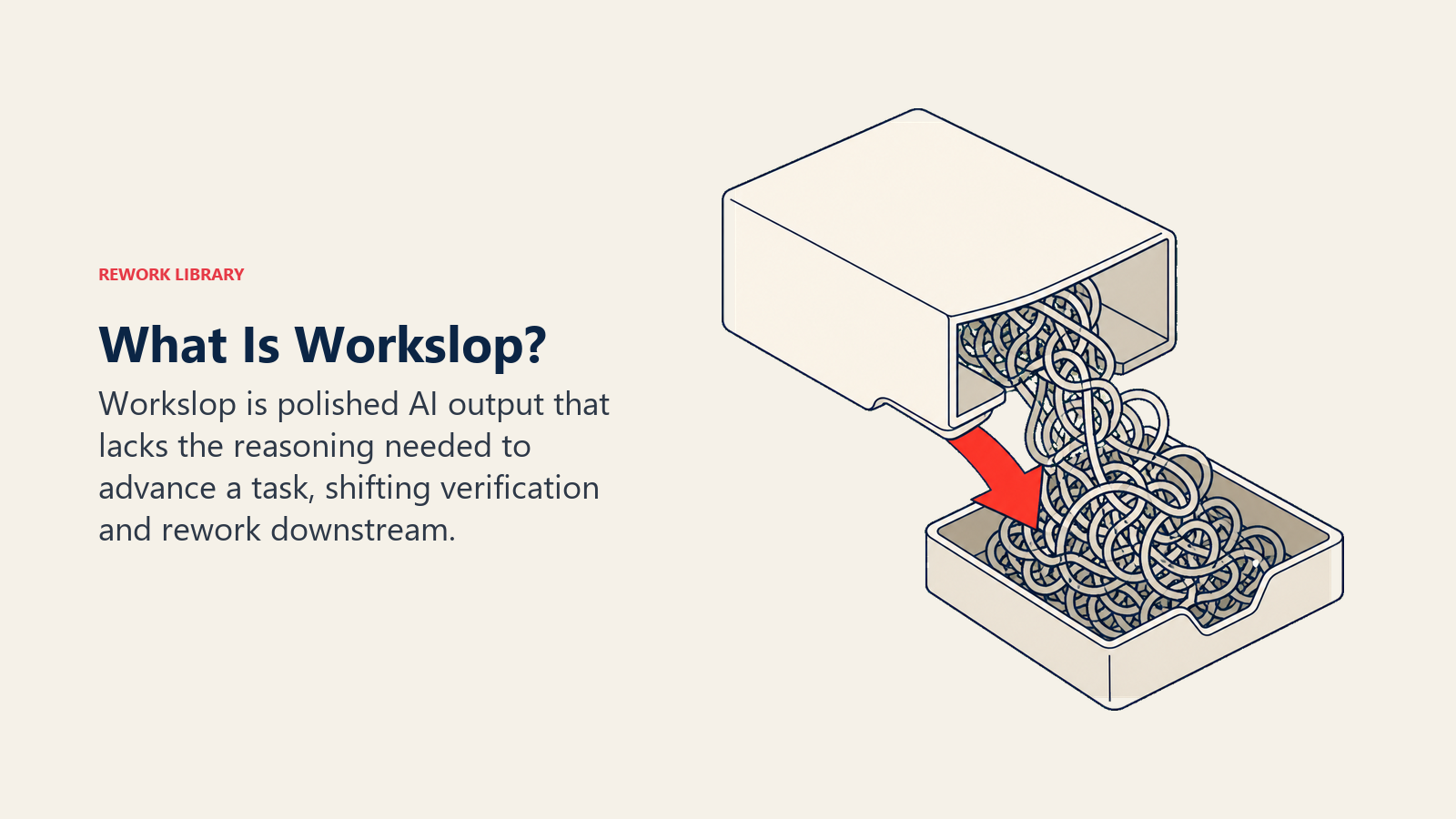
Workslop is AI-generated work that looks finished but isn't: a report, brief, or piece of code polished enough to pass a glance but missing the reasoning needed to actually use it. Researchers at BetterUp Labs and Stanford's Social Media Lab coined the term in 2025 to name something simple and costly: the effort a task used to require doesn't disappear when AI drafts it fast. It just moves downstream, to whoever has to figure out what the output actually means.
That shift, from "effort happens before delivery" to "effort happens after delivery, and lands on someone else," is the real subject of this article. Workslop is the catchiest name for it right now. The underlying problem, work that looks done without anyone having actually done the thinking, will outlast the word.
What Workslop Actually Is
The formal definition, from the BetterUp Labs and Stanford Social Media Lab study published in Harvard Business Review in September 2025, is content that "masquerades as good work, but lacks the substance to meaningfully advance a given task." The researchers surveyed 1,150 U.S. full-time desk workers and found the problem was not rare or theoretical. Roughly 15% of everything employees receive at work is now AI-generated, and a meaningful share of it fails this basic test: does it actually move the task forward, or does it just look like it did.
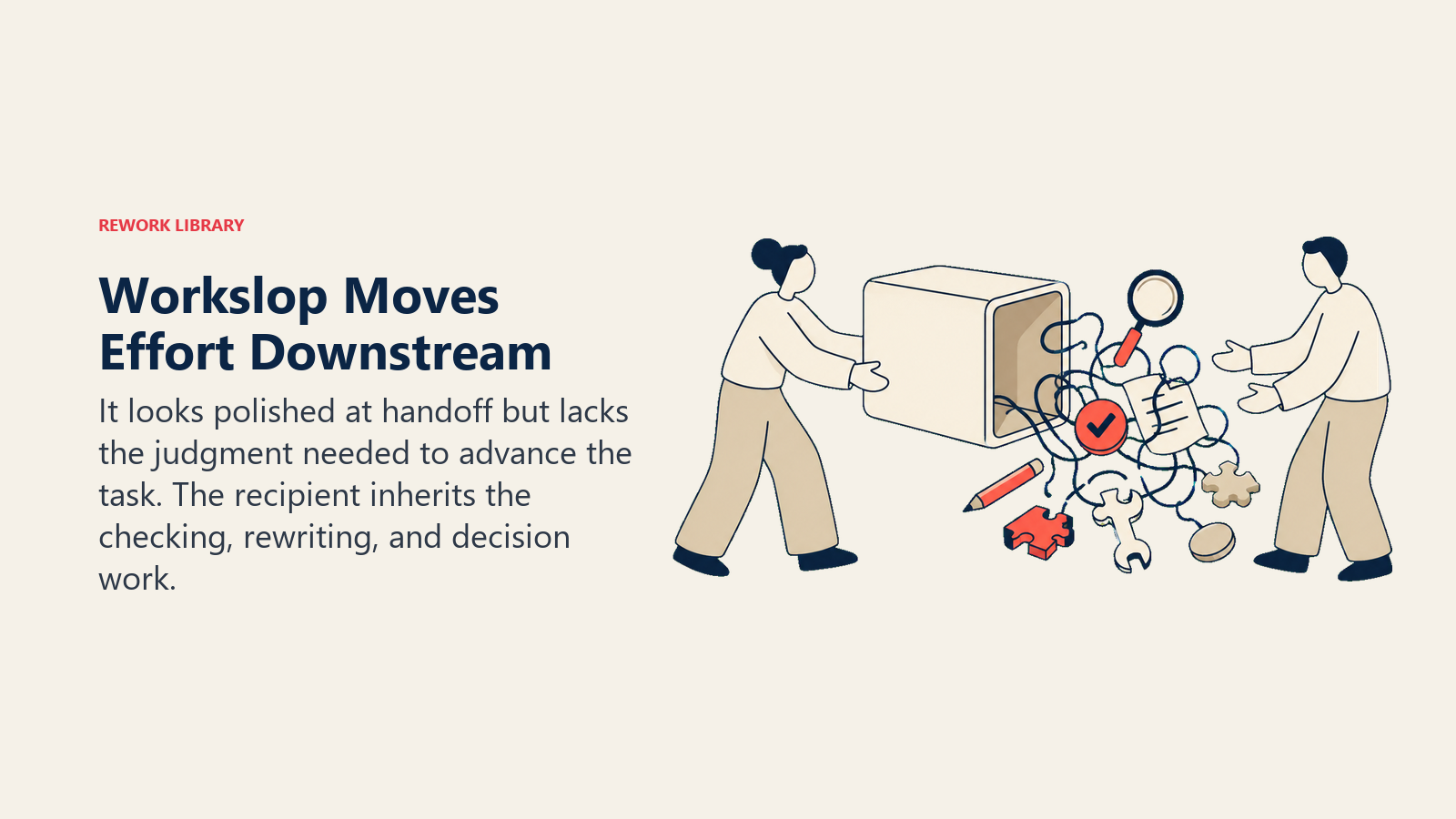
The mechanism is what makes workslop different from ordinary bad work. A sloppy first draft written by a tired person usually still contains real thinking, even if the execution is rough. Workslop inverts that. It arrives well-formatted, confidently worded, and structurally complete, all the surface signals people used to rely on as proxies for "someone thought this through." Strip away the polish and there's often no underlying reasoning to find. The output didn't skip steps because someone was rushed. It skipped steps because generating fluent text doesn't require doing the steps at all.
Not the Same as "AI Helped With This"
It's worth being precise here, because the term gets used loosely. AI-assisted work that is genuinely reviewed, checked against a real requirement, and backed by a person who can defend every claim in it is not workslop, regardless of how much of the first draft a model produced. Workslop specifically describes the case where the polish substitutes for the substance instead of accelerating it: AI did the fast part, and nobody did the slow part that used to come with it. The tool isn't the problem. The absence of anyone taking ownership of the output is.
Where the Term Comes From, and Why It's Worth Keeping
"Workslop" is a vendor-adjacent coinage, born out of one research collaboration rather than decades of organizational theory. Treat it as one framing among several, not a settled category. What makes it worth using anyway is that it names a pattern precisely: not "AI is bad," not "people are lazy," but a specific transaction where effort is quietly reassigned from the sender to the recipient, and nobody agreed to that trade.
The Effort Asymmetry at the Core of the Problem
Every workslop incident has the same lopsided shape. Producing the output took a prompt and a few minutes. Figuring out whether the output is trustworthy, and redoing the parts that aren't, takes far longer. The BetterUp and Stanford researchers measured this directly: recipients spent an average of one hour and fifty-six minutes untangling each instance of workslop they received, checking claims, rewriting sections, or tracking down the person who sent it to ask what they actually meant.
That gap compounds at scale in a way that individual incidents hide. The researchers estimated workslop costs roughly $186 per affected employee per month in lost productivity, which scales to more than $9 million a year in a 10,000-person company. None of that shows up as a discrete line item anywhere. It shows up as slower cycles, more meetings that should have been unnecessary, and a general sense that reviewing other people's work has gotten harder even though nobody can point to why.
The deeper issue is that this asymmetry breaks a bargain teams have relied on for a long time without ever writing it down: if something looks done, treating it as done is a reasonable bet. AI-generated work breaks that bet quietly, because polish and substance used to travel together and now they don't have to. A reviewer who still extends the old trust gets burned. A reviewer who stops extending it has to re-verify everything, which is its own tax on every single interaction, not just the ones that turn out to be workslop.
How Workslop Dilutes Ownership
Ownership used to be legible almost by accident. The person whose name was on the document had, by necessity, done the thinking that produced it. Reading their work told you something reliable about their judgment, because there was no way to separate the document from the reasoning that built it.
Workslop severs that link. A document can now read as confident and well-organized without the named author having verified a single claim in it, and a colleague reading it has no reliable way to tell the difference from the outside. That uncertainty doesn't just create friction, it erodes something more specific: the ability to hold anyone accountable for a decision, because "I don't fully know what's in here" becomes a plausible answer even from the person who sent it. We cover the accountability side of this directly in building a culture of accountability, and the trust mechanics of working alongside AI-shaped output in trust when your teammate is AI.
Ownership dilution has a second-order effect that's easy to miss: it punishes the people who did the work honestly. A manager who can't distinguish a verified analysis from a fast AI pass has no way to reward the extra hour someone spent checking their numbers. Over time, that flattens the incentive to check anything, because checking stops being visible and stops being rewarded. This is one of the clearest ways workslop connects to the broader pattern covered in AI cultural debt: unmanaged AI adoption doesn't just create bad outputs, it quietly rewrites what "doing your job well" gets recognized as.
The Trust Cost Compounds Fast
Workslop's most expensive effect isn't the redo time. It's what happens to how colleagues read each other afterward. The BetterUp and Stanford data on this is specific and uncomfortable: 42% of recipients said they viewed the sender as less trustworthy after receiving workslop, and 32% said they would be less willing to work with that person again. Roughly half rated the sender as less creative, capable, or reliable than they had before, and 53% said the experience left them simply annoyed.
None of that damage is limited to the one document. Once a colleague has been burned by workslop, they start reading everything from that person with more suspicion, including work that was genuinely careful. That skepticism tax is expensive precisely because it's indiscriminate: it slows down good work along with the bad, because the recipient no longer has a fast way to sort one from the other. Teams that get here stop being able to move quickly on trust alone, which is the thing that made them fast in the first place. This is the same erosion covered from the human-agent-team angle in human-agent teams culture, where unclear division of labor between people and AI creates the same credibility gap at a structural level.
Key Facts
- 40% of U.S. full-time desk workers received AI-generated "workslop" from a colleague in the past month, and roughly 15% of everything employees receive at work is now AI-generated. Source: Harvard Business Review, September 2025
- Each workslop incident took recipients an average of 1 hour 56 minutes to resolve, an estimated $186 per affected employee per month, or more than $9 million a year in lost productivity at a 10,000-person company. Source: Harvard Business Review, September 2025
- 42% of recipients rated the sender as less trustworthy after receiving workslop, 32% said they'd be less willing to work with that person again, and 53% reported feeling annoyed. Source: Harvard Business Review, September 2025
- Workslop is largely a management problem, not an individual one: research traces it to unclear AI mandates and overwhelmed teams told to "use AI more" without any standard for what good output looks like. Source: Harvard Business Review, January 2026
- A KPMG and University of Melbourne study of more than 48,000 respondents found 57% of employees admit to hiding their AI use at work; in a separate HBR survey of 604 daily AI users, nearly one in three said they had intentionally withheld AI-related methods from colleagues. Source: Harvard Business Review, June 2026
- Employees in the lowest quartile of organizational trust were nearly four times more likely to hide their AI use than those in the highest quartile (47% versus 14%), meaning disclosure follows trust, not policy. Source: Harvard Business Review, June 2026
Why Workslop Keeps Happening
Vague Mandates, Overwhelmed Teams
Follow-up research from Stanford's Jeffrey Hancock, published in HBR in January 2026, traced workslop back to something ordinary and fixable: leaders issuing broad directives to "use AI more" without ever defining what an acceptable AI-assisted output actually looks like. Combine that with teams already stretched thin, and the incentive tilts hard toward shipping something fast rather than something verified. Nobody set out to produce workslop. The conditions that produce it, unclear standards plus real time pressure, are just really good at generating it anyway.
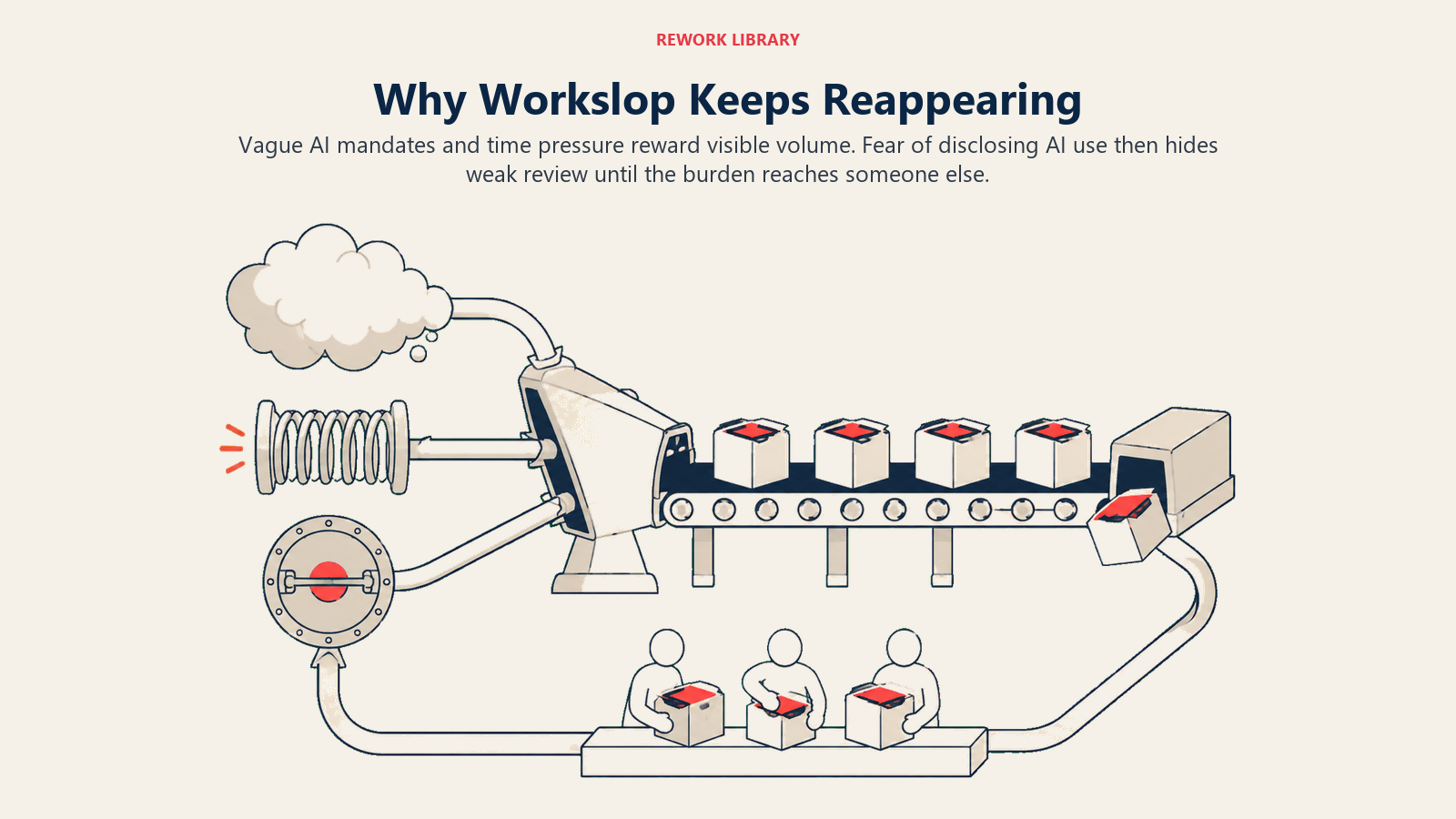
This is why blaming individual employees for workslop usually misses the point. A person under deadline pressure, with no clear signal for what "good enough" means, will reasonably default to whatever gets something out the door. The fix has to happen upstream of that decision, not after it.
The Disclosure Trap
A second HBR study, published in June 2026, found that employees frequently hide how much AI shaped their work, and not out of dishonesty. A KPMG and University of Melbourne survey of more than 48,000 respondents found 57% admit to concealing their AI use at work. HBR's own survey of 604 daily AI users found close to one in three had intentionally withheld AI-related methods from colleagues, and the pattern tracked organizational trust almost exactly: workers in the lowest-trust quartile hid their AI use at more than three times the rate of workers in the highest-trust quartile.
That matters directly for workslop, because disclosure is the fastest way to calibrate how much scrutiny a piece of work needs. When people hide AI involvement out of fear of looking less capable or being handed more work, reviewers lose the one signal that would have told them to check more carefully. Silence about AI use doesn't prevent workslop. It just guarantees it gets discovered the expensive way, after it's already cost someone two hours. We go deeper on what healthy disclosure looks like in practice in AI etiquette and workplace norms.
The Cultural Norms That Actually Prevent Workslop
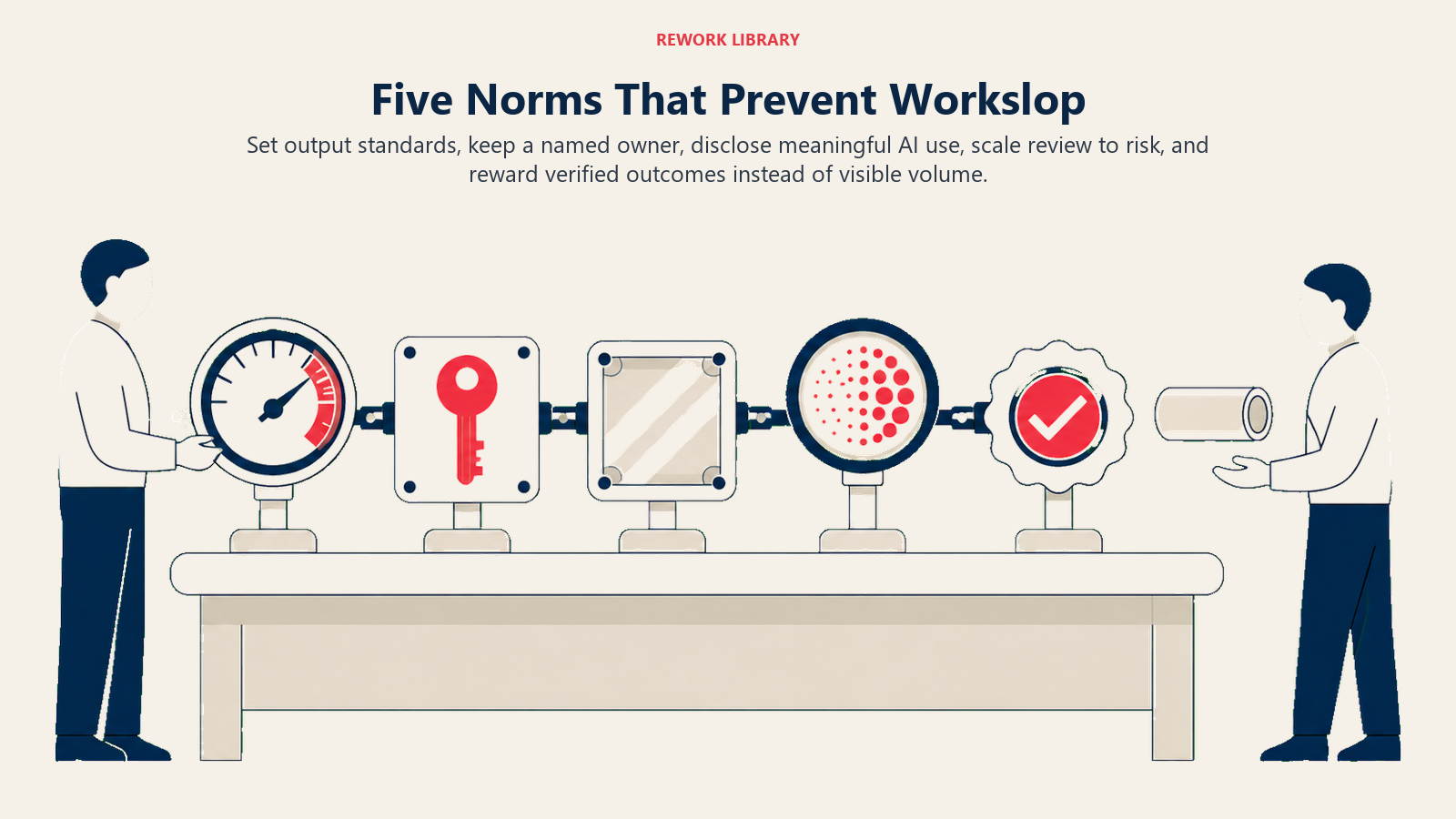
Workslop isn't solved by banning AI tools or by trusting every AI-assisted document by default. It's solved the way most effort-and-ownership problems are solved: by making the standard explicit instead of assumed.
| Norm | What it looks like in practice | What it fixes |
|---|---|---|
| Output standards, not tool rules | A written definition of what "done" means for a given task, independent of whether AI touched it | Removes the vague "use AI more" mandate that HBR's research ties directly to workslop |
| Accountability for the claim, not the tool | Whoever's name is on the work owns every fact and recommendation in it, AI-assisted or not | Restores the link between authorship and verified thinking that workslop severs |
| Low-cost disclosure | A quick, non-punitive note on what was AI-drafted versus human-verified | Gives reviewers the calibration signal that silence currently denies them |
| Scaled review | More scrutiny for high-stakes outputs, lighter review for low-stakes ones, decided in advance | Stops "check everything" or "check nothing" from becoming the only two settings |
| Recognition for verification | Crediting the person who caught an error or confirmed a claim, not just the person who produced the draft | Keeps the incentive to actually check work from quietly disappearing |
None of this requires slowing AI adoption down. It requires treating "what does good look like here" as a question worth answering before the tool ships, not after the first bad experience. A short written standard for a recurring task type, reviewed and updated as the work changes, does more to prevent workslop than any policy banning specific tools. Building this kind of explicit standard-setting into a team's operating rhythm is the substance of building an AI-ready culture: it's less about the AI and more about finally writing down expectations that used to be safe to leave implicit.
Software has a narrow, useful role here. A workflow step that asks "what was AI-assisted here" before a document moves to review, or an approval stage that makes ownership of the final claim explicit, is the kind of unglamorous consistency that Rework's Work Ops tools are built to support. It doesn't decide what the standard should be. It just makes sure the standard, once a team agrees on one, actually gets applied every time instead of only when someone remembers.
A Credible Case for Skepticism
It's worth pushing back on the framing a little before treating it as settled. "Workslop" is a catchy term from a single research collaboration, not a peer-reviewed category with decades of replication behind it, and there's a real risk of using it to pathologize AI use in general rather than the specific failure mode it describes. Plenty of AI-assisted work is fast, verified, and genuinely good, and treating every AI-drafted document with automatic suspicion just reintroduces the skepticism tax in a different form, this time aimed indiscriminately rather than at the actual problem.
The more useful reading of the research, including Hancock's January 2026 follow-up, is that workslop is a management failure with a management fix: unclear standards plus time pressure, not something inherent to the technology. Organizations that respond by writing down expectations and calibrating review tend to see the problem shrink. Organizations that respond by banning tools or shaming individual employees tend to just push the same behavior underground, which the disclosure research suggests is already happening at a meaningful scale. The durable lesson isn't "AI produces bad work." It's that any tool cheap enough to produce a convincing draft in seconds needs an equally deliberate standard for what happens after the draft, or the effort it saved on one end just reappears, larger, on the other.
Where This Fits
Workslop is one visible symptom of a broader shift already reshaping how organizations think about effort, credit, and trust once AI sits inside daily work. It connects directly to AI cultural debt, the compounding cost of rolling out AI without managing its human side effects, and to the larger restructuring Microsoft has described as the Frontier Firm and the rise of the agent boss, where hybrid human-AI teams make ownership questions even more central. The related failure mode of low-effort AI content circulating more broadly is covered in what AI slop is and why it spreads.
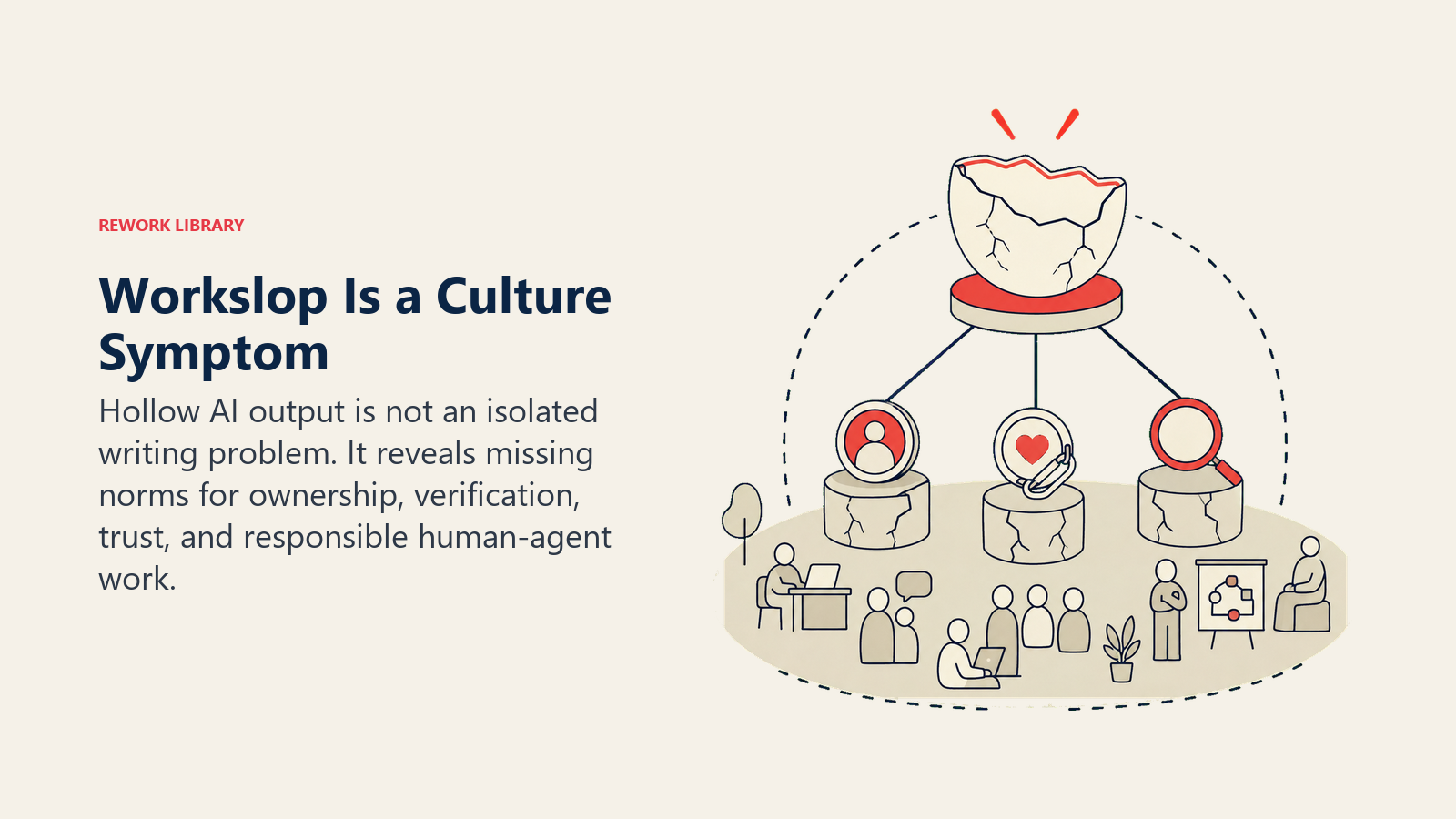
None of this gets fixed with a single policy memo. It gets fixed the way what is business culture describes culture getting built in general: through the norms a team actually enforces day to day, not the ones written on a slide. Naming workslop precisely, and building the small habits, disclosure, scaled review, credit for verification, that keep it from taking root, is a concrete first step toward what an AI-native culture looks like in practice rather than in theory.
Frequently Asked Questions about Workslop
What is workslop, exactly?
Workslop is AI-generated content that looks finished and well-produced but lacks the substance to actually advance the task it was meant to help with. The term was coined by researchers at BetterUp Labs and Stanford's Social Media Lab in a September 2025 study published in Harvard Business Review, and it describes cases where the person receiving the work has to do real thinking the sender's output only appeared to contain.
How is workslop different from just bad or lazy work?
Ordinary bad work usually still contains real, if rough, thinking, because producing it took genuine effort. Workslop inverts that: it arrives polished, confident, and well-formatted, all the surface signals people used to rely on as proxies for careful work, without necessarily containing the underlying reasoning. The polish substitutes for the substance instead of reflecting it.
Is all AI-assisted work considered workslop?
No. Work that is AI-drafted but then genuinely reviewed, verified, and owned by the person who sends it is not workslop, no matter how much of the first draft a model produced. Workslop specifically describes the case where verification never happens and the polish is left to do the convincing on its own.
How much does workslop actually cost a company?
BetterUp Labs and Stanford's Social Media Lab estimated that each workslop incident costs the recipient close to two hours in rework, translating to roughly $186 per affected employee per month, or more than $9 million a year in a 10,000-person company. That figure only counts direct rework time and doesn't include the slower, harder-to-measure cost of colleagues trusting each other's output less.
Why do employees create workslop if they know it's a problem?
Research from Stanford's Jeffrey Hancock, published in HBR in January 2026, traces most workslop back to leaders issuing vague directives to use AI more without defining what an acceptable output actually looks like, combined with teams already under real time pressure. Very few people set out to produce workslop deliberately; unclear standards plus deadline pressure reliably produce it anyway.
Why don't more employees just disclose when they used AI?
A June 2026 HBR study found that disclosure tracks organizational trust closely: employees in the lowest-trust quartile hid their AI use at more than three times the rate of those in the highest-trust quartile, and many said they stayed quiet for rational reasons, fear of looking less capable, being given more work, or seeming easier to replace. Disclosure improves when trust improves, not when a policy demands it.
What actually prevents workslop on a team?
Explicit, written standards for what "done" looks like on a given task type, accountability that follows the claim rather than the tool used to produce it, low-friction disclosure norms, and review effort that scales with how high-stakes the output is. None of this requires slowing AI adoption; it requires deciding in advance what good looks like instead of discovering it after a bad experience.
Should companies just restrict AI tools to stop workslop?
Most research points the other way. Workslop tends to be a management and standards problem, not a technology problem, and banning tools or treating every AI-assisted document with automatic suspicion tends to push the same shortcuts underground rather than eliminate them. The more effective response is calibrating expectations and review, not restricting the tool itself.
Workslop is easy to dismiss as a clever label for something that's always existed: someone hands in weak work, and someone else has to clean it up. What's different now is the speed and the disguise. A weak human draft used to take time to produce, which limited how much of it any one person could generate. AI removes that limit, so the same shortcut that used to cost one person an afternoon can now cost a whole team hours a week, dressed up well enough that nobody notices until the pattern repeats. Getting ahead of it has little to do with using AI less. It comes down to a team agreeing, on purpose, what "actually done" still means, and then holding each other to it.

Co-Founder, Rework.com
On this page
- What Workslop Actually Is
- Not the Same as "AI Helped With This"
- Where the Term Comes From, and Why It's Worth Keeping
- The Effort Asymmetry at the Core of the Problem
- How Workslop Dilutes Ownership
- The Trust Cost Compounds Fast
- Key Facts
- Why Workslop Keeps Happening
- Vague Mandates, Overwhelmed Teams
- The Disclosure Trap
- The Cultural Norms That Actually Prevent Workslop
- A Credible Case for Skepticism
- Where This Fits